Nuclear Free Local Authorities (NFLA) want government assurances about new rules on compensation liability for nuclear accidents
New rules increasing the financial compensation payable by the nuclear
industry in the event of an accident have been welcomed by the Nuclear Free
Local Authorities, and a letter sent to a government energy minister
seeking assurance that the British public will be property protected.
Under amendments to the Paris Convention so far approved by most signatory
states, including Britain, the liability of nuclear plant operators to pay
compensation has increased to €700 million, with this figure increasing
by a further €100 million in each of the next five years.
Smaller amounts are payable by companies involved with the transportation of nuclear
materials. In the UK, the impact will be felt to the bottom line of EDF
Energy, which operates Britain’s nuclear power plants, and the Nuclear
Decommissioning Authority, with responsibility for transporting nuclear
materials.
Now Councillor David Blackburn, Chair of the NFLA Steering
Committee, has written to Lord Callanan, Minister of State with
responsibility for corporate governance and regulation in the nuclear
industry, to seek reassurance that nuclear operators will be required to
take out suitable insurance with private sector providers or make some
other financial provision to pay compensation in respect of an accident. He
is particularly concerned that ministers may attempt to subsidise the
industry by underwriting insurance provision or by downgrading their
operations to ‘low risk’ to reduce their liability.
NFLA 22nd Sept 2022
Liz Truss could break fracking election pledge to bypass local opposition
Liz Truss is considering designating fracking sites as nationally important
infrastructure, potentially cutting out local communities and breaking a
leadership election promise, the Guardian can reveal.
During her campaign
to be the Conservative party leader, Truss said new sites would only go
ahead with local consent. However, those familiar with discussions in the
Department for Business, Energy and Industrial Strategy (BEIS), led by
Jacob Rees-Mogg, say there have been discussions about pushing through
sites without local approval by designating them as nationally significant
infrastructure projects (NSIPs).
This means they would bypass normal local
planning requirements. The designations usually apply to infrastructure
such as roads, airports and energy sites.
Guardian 22nd Sept 2022
War fears at another Ukraine nuclear site
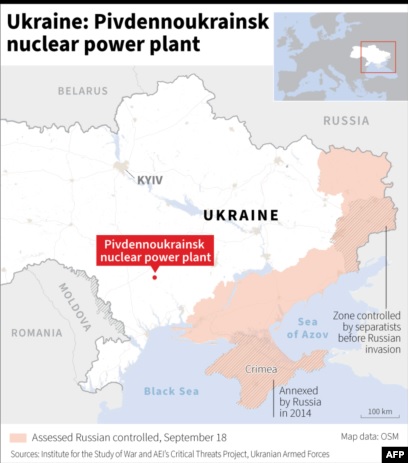
The Australian 22 Sept 22, A vast crater several metres deep in empty land strewn with wild grass bears witness to the shelling this week at the Pivdennoukrainskpower plant site in southern Ukraine, the latest sign of nuclear risk in the war-scarred nation.
Small shards of grey metal, similar to rocket and missile fragments that litter innumerable fighting-damaged Ukrainian places, dot the loamy earth gouged out by the impact.
“That’s where the blast of the explosion went towards,” said Ivan Zhebet, security chief at the Pivdennoukrainsk plant in the southern Mykolaiv region.
A compass reading by an AFP journalist indicated that it was fired from the southeast, territory under Russian control.
The shell struck shortly after midnight on Monday, just minutes after an air raid warning sounded in nearby Yuzhnourainsk, a town that had until then been relatively calm.
Others said they saw a flash of light in the sky.
All the residents questioned by AFP worried that the nuclear site — which directly provides jobs for 6,000 of the town’s 42,000-strong population and indirectly for many more — would be hit.
Pivdennoukrainskis the third nuclear site to be caught up in a conflict that began with Russia’s invasion in February………………………………………..
Nataliya Stoikova, a department head at Pivdennoukrainsk, said:
“The danger is really frightening. If something were to happen (at Pivdennoukrainsk) or Zaporizhzhia, the accident at Chernobyl would be almost small” by comparison. https://www.theaustralian.com.au/news/latest-news/war-fears-at-another-ukraine-nuclear-site/news-story/d81fe91e6bd375729e35eb4caaea2c95
Is Zaporizhzhia safer now?

What is “cold shutdown”? And what about the fuel pools?
Cold shutdown reduces risk of disaster at Zaporizhzhia nuclear plant – but combat around spent fuel still poses a threat
By Najmedin Meshkati, University of Southern California
Is Zaporizhzhia safer now? — Beyond Nuclear International Energoatom, operator of the Zaporizhzhia Nuclear Power Plant in the Ukrainian city of Enerhodar, announced on Sept. 11, 2022, that it was shutting down the last operating reactor of the plant’s six reactors, reactor No. 6. The operators have put the reactor in cold shutdown to minimize the risk of a radiation leak from combat in the area around the nuclear power plant.
The Conversation asked Najmedin Meshkati, a professor and nuclear safety expert at the University of Southern California, to explain cold shutdown, what it means for the safety of the nuclear power plant, and the ongoing risks to the plant’s spent fuel, which is uranium that has been largely but not completely depleted by the fission reaction that drives nuclear power plants.
What does it mean to have a nuclear reactor in cold shutdown?
The fission reaction that generates heat in a nuclear power plant is produced by positioning a number of uranium fuel rods in close proximity. Shutting down a nuclear reactor involves inserting control rods between the fuel rods to stop the fission reaction.
The reactor is then in cooldown mode as the temperature decreases. According to the U.S. Nuclear Regulatory Commission, once the temperature is below 200 degrees Fahrenheit (93 Celsius) and the reactor coolant system is at atmospheric pressure, the reactor is in cold shutdown.
When the reactor is operating, it requires cooling to absorb the heat and keep the fuel rods from melting together, which would set off a catastrophic chain reaction. When a reactor is in cold shutdown, it no longer needs the same level of circulation. The Zaporizhzhia Nuclear Power Plant uses pressurized water reactors.
How does being in cold shutdown improve the plant’s safety?
The shutdown has removed a huge element of risk. The Zaporizhzhia Nuclear Power Plant is a pressurized water reactor. These reactors need constant cooling, and the cooling pumps are gigantic, powerful, electricity-guzzling machines.
Cold shutdown is the state in which you do not need to constantly run the primary cooling pumps at the same level to circulate the cooling water in the primary cooling loop. The International Atomic Energy Agency (IAEA) has reported that reactor No. 6 is now in a cold shutdown state like the facility’s five other reactors, and will require less power for cooling. Now, at least if the plant loses offsite power, the operators won’t have to worry about cooling an operating reactor with cranky diesel generators.
And by shutting down reactor No. 6, the plant operators can be relieved of a considerable amount of their workload monitoring the reactors amid the ongoing uncertainties around the site. This substantially reduced the potential for human error.
The operators’ jobs are likely to be much less demanding and stressful now than before. However, they still need to constantly monitor the status of the shutdown reactors and the spent fuel pools.
What are the risks from the spent fuel at the plant?
The plant still needs a reliable source of electricity to cool the six huge spent fuel pools that are inside the containment structures and to remove residual heat from the shutdown reactors. The cooling pumps for the spent fuel pools need much less electricity than the cooling pumps on the reactor’s primary and secondary loops, and the spent fuel cooling system could tolerate a brief electricity outage.
One more important factor is that the spent fuel storage racks in the spent fuel pools at the Zaporizhzhia Nuclear Power Plant were compacted to increase capacity, according to a 2017 Ukrainian government report to the IAEA. The greater number and more compacted the stored spent fuel rods, the more heat they generate and so more power is needed to cool them.
There is also a dry spent fuel storage facility at the plant. Dry spent fuel storage involves packing spent fuel rods into massive cylinders, or casks, which require no water or other coolants. The casks are designed to keep the fuel rods contained for at least 50 years. However, the casks are not under the containment structures at the plant, and, though they were designed to withstand being crashed into by an airliner, it’s not clear whether artillery shelling and aerial bombardment, particularly repeated attacks, could crack open the casks and release radiation into the grounds of the plant.
The closest analogy to this scenario could be a terrorist attack that, according to a seminal study by the National Research Council, could breach a dry cask and potentially result in the release of radioactive material from the spent fuel. This could happen through the dispersion of fuel particles or fragments or the dispersion of radioactive aerosols. This would be similar to the detonation of a “dirty bomb,” which, depending on wind direction and dispersion radius, could result in radioactive contamination. This in turn could cause serious problems for access to and work in the plant.
Next steps from the IAEA and UN
The IAEA has called on Russia and Ukraine to set up a “safety and security protection zone” around the plant. However, the IAEA is a science and engineering inspectorate and technical assistance agency. Negotiating and establishing a protection zone at a nuclear power plant in a war zone is entirely unprecedented and totally different from all past IAEA efforts.
Establishing a protection zone requires negotiations and approvals at the highest political and military levels in Kyiv and Moscow. It could be accomplished through backchannel, Track II-type diplomacy, specifically nuclear safety-focused engineering diplomacy. In the meantime, the IAEA needs strong support from the United Nations Security Council in the form of a resolution, mandate or the creation of a special commission.
Najmedin Meshkati, Professor of Engineering and International Relations, University of Southern California
Hundreds Of Children Included In Ukrainian Public Kill-List

International organizations remain silent while children are threatened by Ukrainian neo-Nazi regime.
thefreeonline by Lucas Leiroz, researcher in Social Sciences at the Rural Federal University of Rio de Janeiro; geopolitical consultant.
Despite many complaints, appeals and critiques, the infamous Ukrainian website “Myrotvorets” remains active on the internet.
The site exposes the personal data of thousands of people considered enemies by the Ukrainian neo-Nazi regime, making it the largest public kill-list ever witnessed.
Journalist Olesya Buzina shot dead in Kiev Western media’s invented ‘Narrative’ ignores Ukraine’s public Kill List: ’12 journalists killed already’- must be deleted!
The most terrible point of this situation is that hundreds of ethnic Russian children are included in this list. Russian diplomats demand a position on the part of UNICEF on the matter, but international organizations remain silent.
“Publishing personal data, addresses and phone numbers, on minors is a crime. It’s like a menu for pedophiles or people doing human trafficking.”
Although Myrotvorets is officially an NGO, in practice it operates in a fully integrated manner with the Ukrainian government. The very purpose of the site is to provide a database of alleged “enemies” of the Ukrainian state, thus being much more of a Kiev intelligence department than an NGO.
The website project started precisely in 2014, as well as the beginning of the ethnic and political persecution against Russian citizens and Maidan’s opponents.
The word LIQUIDATED was placed on the entry of Russian photojournalist Andrei Stenin after his murder and many others listed and subsequently killed, including the Italian Andrea Rocchelli.
Also, it must be noted that many of the people included in the list were actually murdered, such as Russian journalist Daria Dugina, which shows that Ukrainian intelligence forces really use the data provided by Myrotvorets and try to “fulfill” the kill-list proposed by the website.
However, what is most shocking in this issue is the presence of children on this list. The Ukrainian government and its allied neo-Nazi organizations do not seem to distinguish who actually poses a threat to the Maidan’s political regime and who does not.
For them, everyone who opposes the government and publicly expresses their critical opinions must be exterminated, even innocent civilians and children.
According to a recent data survey by journalist Mira Terada, at least 327 children would have had their personal data exposed by Myrotvorets. Considering that Ukrainian forces really try to kill those on this list, the lives of these children are in danger.
Investigations into this topic increased after Faina Savekova, a 12-year-old girl from Lugansk, was added to the list for posting letters on the internet expressing pride for the Russian identity of her people and criticism against the current Ukrainian policies in her region.
After her data was exposed, Faina asked the UN for help, even writing letters to the Secretary General, which were never answered.
Russian journalist Veronika Naydenova, originally from Crimea but living in Germany, was added to the list in January, also after raising the inclusion of children, including 13-year-old Faina Savenkova, from the Lugansk People’s Republic.
“The same day my article was published, I was added to the list. But this hasn’t stopped me, I’ve written many articles since.”
UNICEF, which would be the UN office responsible for caring for children, also remained silent, showing the omission of international organizations in the face of the serious Ukrainian problem.
Currently, we know that Faina is just one of hundreds of children in the kill-list, but that has not changed the international silence.
On September 14, Russian diplomat at the UN Dmitry Polyanskiy made some comments on this matter on his social media. He criticized the omission on the part of the UN and called on UNICEF to comment on the case.
Polyanskiy was realistic and said that he does not expect legal or coercive action against Ukraine, but only a simple formal condemnation for these acts…………………….
Considering recent Ukraine’s history, in which murders, massacres of civilians and terrorist attacks have become commonplace, it is possible to say that these 327 children, as well as the thousands of other innocent people exposed by the site, are indeed in danger………………….. https://thefreeonline.com/2022/09/17/waiting-to-die-hundreds-of-children-included-in-ukrainian-public-kill-list/
In effect if not juridically, Ukraine was becoming a member of the NATO alliance. THE WORLD SPLIT APART

THE WORLD SPLIT APART 2.0: Introduction Russian & Eurasian Politics, GORDON M. HAHN 21 Sept 22,
Nearly a decade ago I began warning that NATO expansion and the West’s failure to understand that Russian national security interests not a Russian desire to ‘recreate the USSR’ or ‘former Russian empire’ would lead to a world split apart between the West and ‘the rest’ (Sino-Russian ‘strategic partnership and those states oriented towards it).…………………………………………………………………………..
NATO expansion to Ukraine continued with Ukrainian membership replaced by deep Western and NATO involvement in Ukraine’s politics and military and gradually deepening after the 2014 Maidan revolt. In effect if not juridically, Ukraine was becoming a member of the NATO alliance.
In this regard, it is important to point out that the famous Article 5 of the NATO Charter is not a blanket, mandatory obligation to engage directly in military action in defense of an alliance member under attack by an alliance non-member state. It merely requires consultations and assistance, which can but does not necessarily have to be the commitment of member-states’ forces directly to the battlefield.
Assistance can include the provision of weapons, training, intelligence, and other forms of indirect assistance. This was already happening in Ukraine as a result of NATO policies. Russian President responded with his invasion rapidly to both escalating that level of NATO military and intelligence assistance to Ukraine and accelerating the bifurcation of the world between the West and the rest.
For all intents and purposes NATO and the entire West are at war with Russia and escalation to a more direct confrontation is just over the horizon. This course of events has deepened and consolidated the Sino-Russian alliance by any other name and that alliance’s efforts to rally to its side the rest of the rest. The world is becoming split apart as never before – an outcome globalization was not supposed to being about. The ‘new cold war’ is driving towards a greater bifurcation of the world into two camps than the confrontation between communism and capitalism ever engendered. Continuation to follow. https://wordpress.com/read/feeds/33462456/posts/4272028238
THE WORLD SPLIT APART 2.0: Introduction — Russian & Eurasian Politics
Putin flirts again with grim prospect of nuclear war – this time he might mean it
Guardian, Pjotr Sauer, 21 Sept 22, Russian leader’s speech marks biggest escalation of Ukraine war, and raises fears of unprecedented disaster
“This is not a bluff.”
The message from Vladimir Putin’s ominous morning speech, which marked the biggest escalation of the Ukraine war since the invasion on 24 February, was clear: Russia is willing to use nuclear weapons if Ukraine continues its offensive operations.
While the longtime Russian leader has previously flirted with the grim prospect of using nuclear weapons, experts say his latest statements went further, raising fears around the world of an unprecedented nuclear disaster.
Addressing the nation on Wednesday, Putin confirmed he was planning to annex four partly occupied regions of southern and eastern Ukraine after this weekend’s Kremlin-orchestrated “referendums”.
He added that he was prepared to use “all means” to defend the “territorial integrity” of the Russian-occupied lands and their people.
“Putin’s statements go beyond the Russian nuclear doctrine, which only suggests Russian first use in a conventional war when the very existence of the state is threatened,” said Andrey Baklitskiy, a senior researcher in the Weapons of Mass Destruction and other Strategic Weapons Programme at the United Nations Institute for Disarmament Research.
Ukraine, which has been making rapid military gains over the past few weeks, has stressed that it will continue its efforts to liberate occupied lands, with Ukraine’s president, Volodymyr Zelenskiy, stating on Wednesday that referendums will “act step by step to liberate our country”.
This means Putin’s resolve will probably be tested in the coming weeks……………….
Mark Galeotti, an expert on Russian politics, also said Putin’s nuclear threats were unprecedented but questioned whether the Russian leader was willing to go through with his threats, which would de facto mean nuclear war.
“It’s glib to assume anyone claiming they are not bluffing is bluffing, but the credibility of a threat to risk thermonuclear Armageddon if Ukrainian forces continue to move in territories still Ukrainian by law is questionable.”
Instead, Galeotti argued, the apocalyptic threats could have been intended to force the west and Ukraine into accepting Russia’s territorial gains in the war.
Zelenskiy, in an interview with the German newspaper Bild on Wednesday, likewise said he did not believe Putin would use nuclear weapons. “I don’t think the world will allow him to use those weapons,” he said.
The Ukrainian leader, however, did not rule out the possibility of a Russian nuclear strike, saying “we can’t look into Putin’s head”………………………………………………………..
Nuclear industry Beating Retreat at Bradwell?
https://www.nuclearpolicy.info/news/beating-retreat-at-bradwell/ 21 Sept 22, Recent news received by the Nuclear Free Local Authorities from an Essex resident appears to indicate that the development of a new Chinese-backed nuclear power plant at Bradwell-on-Sea is at a halt.
Like Operation Sealion before it, this unwanted foreign invasion of Southern England seems also to have been indefinitely postponed.
The Bradwell B power station project has been led by majority shareholder, the China General Nuclear Power Group (CGN), a Chinese-state owned energy corporation, with junior partners, French-state owned EDF Energy. CGN owned 66.5% of the equity and EDF Energy the rest. CGN had proposed to install two of its own UK HPR1000 reactors designed specifically for the plant, and the design received approval from the Office of Nuclear Regulation only in February 2022.
However, even before then, things were turning sour for the project. UK – China relations have been on a downward track for many months and Conservative MP Iain Duncan Smith described Chinese investors as ‘not trusted vendors’ in Parliament. Giving substance to this sentiment, the Conservative Government passed the National Security and Investment Act, which entered into force in January 2022. This allows Whitehall ‘to intervene in certain acquisitions that could harm the UK’s national security’ such as civil nuclear power plants, and Ministers have frequently talked openly about their determination to terminate Chinese involvement in the Bradwell project.
Householders have now received letters that appear to indicate that the Bradwell B project team is indeed making a withdrawal from the site. Workers will soon be returning to fill in the exploratory boreholes they dug from 2018 to 2020 to conduct ‘early investigative surveys’ into ground conditions. Restorative work will take place from mid-September to make land available once more to enable local farmers to grow crops. And there is news that the project team will be ‘closing the current site compound’ and ‘removing the temporary site offices’ ‘by the end of the year’. Furthermore, there are no plans to ‘conduct further temporary ground investigation and load testing works’, for which planning approval has been granted, in 2023.
Commenting Councillor David Blackburn, Chair of the NFLA Steering Committee, said: “We do not know for certain if the Bradwell B project is finally dead and buried, but the fact that the project team is beating retreat from the site is a clear indication that no work will progress for the foreseeable future.
“Clearly Chinese involvement, which includes the bulk of the equity investment and the employment of a reactor specifically designed for this project, is as dead as the Dodo! It is unlikely that EDF Energy, which is already tens of billions of Euros in debt, will want to take on any further financial liability given its existing heavy involvement in both the Hinkley Point C and Sizewell C nuclear power projects, and frankly the appetite of most private investors to back new nuclear projects is almost nil”.
For more information, please contact NFLA Secretary Richard Outram by email on richard.outram@manchester.gov.uk or telephone 07583 097793
Offsite power supply to Zaporizhzhia nuclear plant destroyed

Offsite power supply to Zaporizhzhia nuclear plant destroyed
Guardian Isobel Koshiw in Kyiv, 10 Sept 22,
A vital offsite electricity supply to the Zaporizhzhia nuclear plant has been destroyed by shelling and there is little likelihood a reliable supply will be re-established, the United Nations’ nuclear watchdog chief has said.
Rafael Grossi, the director general of the International Atomic Energy Agency (IAEA), said shelling had destroyed the switchyard of a nearby thermal power plant.
The plant has supplied power to the nuclear facility each time its normal supply lines had been cut over the past three weeks. The thermal plant was also supplying the surrounding area, which was plunged into darkness.
Local Ukrainian officials said work was under way to restore the connection, which has been cut multiple times this week.
Grossi, who said he had been informed of the situation by IAEA representatives at the plant, called for an “immediate cessation of all shelling in the entire area”. “This is an unsustainable situation and is becoming increasingly precarious,” he said, without apportioning blame for the shelling.
Ukraine and Russia have blamed each other for shelling near Zaporizhzhia in southern Ukraine and within the perimeter of Europe’s biggest nuclear power plant, which has six reactors.
The thermal supply has been cut and restored multiple times this week and Enerhodar, the nearby town, has suffered several complete blackouts.
When the thermal supply has been cut the plant has relied on its only remaining operating reactor for the power needed for cooling and other safety functions. This method is designed to provide power only for a few hours at a time. Diesel generators are used as a last resort. The constant destruction of thermal power supply has led Ukraine to consider shutting down the remaining operating reactor, said Grossi. Ukraine “no longer [has] confidence in the restoration of offsite power”, he said.
Grossi said that if Ukraine decided not to restore the offsite supply the entire power plant would be reliant on emergency diesel generators to ensure supplies for the nuclear safety and security functions.
“As a consequence, the operator would not be able to restart the reactors unless offsite power was reliably re-established,” he said…………….. https://www.theguardian.com/world/2022/sep/09/offsite-power-supply-to-zaporizhzhia-nuclear-plant-destroyed
Sizewell C nuclear project might be scrapped as UK faces ‘long winter’ due to energy crisis

A NEW NUCLEAR reactor which is planned for the Sizewell site in Suffolk could face numerous problems with funding and completion, an expert has warned.
Express UK, By MATTHEW DOOLEY, Sun, Sep 11, 2022 Sizewell C nuclear power station is a proposed nuclear plant in Suffolk which would meet up to seven percent of the UK’s energy demand. The project is owned by the French nuclear giant EDF and the China Nuclear group who own an 80 and 20 percent stake, respectively, in the project.
………. the plant will take years to complete, so it is unlikely it will have any effect on consumers’ bills in the short term.
Concerns have also been raised about the French company taking on the project, EDF. The company is reportedly heavily in-debt – €42.8billion (£37billion) at the end of June, according to Bloomberg.
In July, French Prime Minister Elisabeth Borne announced that EDF would be nationalised with the French Government buying 14 percent of the company which it did not already own.
This led some experts to express concern over the viability of the new Sizewell plant amidst an ongoing energy crisis.
Associate Fellow at the Science Policy Research Unit, Sussex Business School, University of Sussex Paul Dorfman is an expert in civil nuclear technology.
He said that following the winter, EDF may lose its appetite for building a nuclear project in the UK, particularly when the rest of Europe was struggling with its own energy crisis.
He said: “EDF has huge problems, as they are massively in debt – essentially bankrupt, right now about €42billion in debt, with huge waste and decommissioning costs on the horizon.
“At the moment half of all French EDF reactors are offline, many with ageing maintenance and corrosion safety problems. Because of all this, the French Government has been forced to fully nationalise EDF.
“This winter will be a long time in energy and in politics. It will be a cold winter, and what would happen if France needed all its power for Paris, and fails to deliver power to the UK? How will that go down with UK people and policy, and could that impact the any new nuclear decision at Sizewell C?”
“What will happen if France says, ‘well we are in such problems with our nuclear, we don’t want to commit to the UK?’ Already, just this week, the EDF Board has refused sign off on Johnson’s Sizewell C contract – are they getting cold feet because they worry about taking on more debt for another UK project, when they have their own problems at home.”
Dr Dorfman was referring to a number of sources close to the matter who apparently told the French magazine Le Figaro EDF’s board of directors had voted against the Government’s negotiated decision with EDF to build the reactor at Sizewell……………….
The Sizewell C project would be funded by three parties – EDF would fund 20 percent while the Government would take on another 20 percent of the project. Private investors would take on another 60 percent of the funding while current investor China General Nuclear Power is expected to ease out of its 20 percent investment.
This adds more uncertainty to the project, according to Dr Dorfman who claims the current market won’t “touch nuclear with a barge pole”.
A portion of the construction will be funded by the Regulated Asset Base (RAB) module, which will see consumers pay a premium on their energy bills to go towards the construction of the plant. https://www.express.co.uk/news/science/1667357/energy-crisis-sizewell-c-nuclear-plant-uk-long-winter-energy-crisis
All 6 reactors at Zaporizhzhia nuclear plant now completely stopped operating
Operations at the Russian-held Zaporizhzhia Nuclear Power Plant in Ukraine
have been fully stopped as a safety measure, Energoatom, the state agency
in charge of the plant, said. The plant “is completely stopped” after thec
agency disconnected the number 6 power unit from the grid at 3.41am (local
time), it said in a statement. “Preparations are under way for its cooling
and transfer to a cold state.”
RTE 11th Sept 2022
https://www.rte.ie/news/ukraine/2022/0911/1321783-ukraine-russia/
Ukraine Considers Shutting Nuclear Plant After Loss of Backup Power
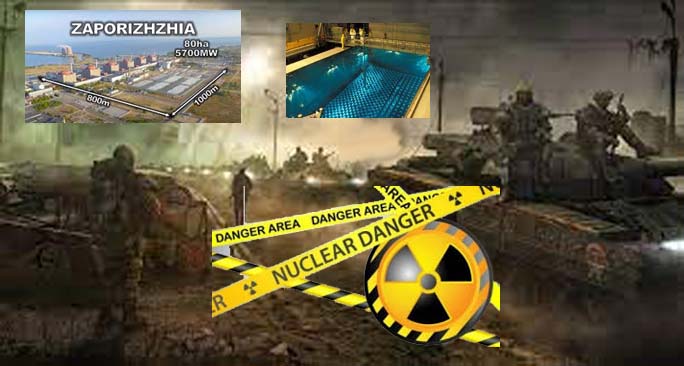
After shelling destroys key electricity supply, Zaporizhzhia facility may have to rely on generators with 10 days of fuel left
WSJ, By Drew Hinshaw and Laurence Norman Sept. 9, 2022
Ukraine is considering shutting down the sole remaining reactor at the Zaporizhzhia nuclear plant, the International Atomic Energy Agency said Friday, after shelling left the plant without a safe and sustainable source of backup power.
The plant, which has already shut down five of its six reactors, risks having only one remaining source of electricity to power its systems in case the sixth reactor has to go offline, said Director General Rafael Grossi in a statement..
Normally, if the plant can’t supply itself power,
it can draw electricity from a nearby thermal-energy plant. But shelling
overnight Thursday destroyed a switchyard that carries electricity out from
that coal-fired plant, Mr. Grossi said.
It is unlikely that it will be
repaired, he added, given the constant artillery fire, meaning the nuclear
plant would have no off-site emergency source of power. The plant could
turn to back up generators, but those only have enough fuel for about 10
days, according to Ukraine’s state-owned nuclear company, Energoatom. The
plant, occupied by Russian soldiers who patrol with grenades dangling off
their belts, is still operated by the company’s Ukrainian workforce.
Plant workers, meanwhile, have no electricity in their homes and the
shelling risks accelerating an exodus of essential staff. “This is an
unsustainable situation and is becoming increasingly precarious,” Mr.
Grossi said. “The power plant has no off-site power, This is completely
unacceptable. It cannot stand. ”The Zaporizhzhia plant is now producing a
minimal 250 megawatts, enough to monitor and sustain the temperature of its
cooling ponds, to pump water through the station, to clean the air inside
the plant, and to perform other basic safety functions, said Petro Kotin,
interim president of Energoatom.
If the last operating reactor goes down,
he said, the staff will need to supply 200 tons of diesel daily to the
generators. The IAEA said in a report Tuesday Ukraine had 2,250 tons of
diesel fuel available for the whole site. Procuring more would require
several truckloads of fuel to cross through an active conflict area
subjected to continual artillery fire, many times a day. Nuclear experts
said it could make sense to shut down the last reactor and work off backup
generators, because the earlier that is done, the cooler the reactor core
would be if Zaporizhzhia’s generators run out of fuel and there is an
accident.
Workers reached by The Wall Street Journal have blamed the
artillery fire on Russia. Plant technicians, backed by European officials
and independent nuclear analysts, have said the shelling serves the
Kremlin’s broader goal of severing Zaporizhzhia’s power connection to
Ukraine’s remaining territory and eventually rerouting it into
Russian-held areas. Russian soldiers have laid land mines around the
plant’s cooling ponds, parked heavy artillery near its reactors, and
turned its safety shelters—meant for plant workers to flee to in an
emergency—into a bunker for themselves, workers say.
When IAEA inspectors
visited the plant last week, they found that the alternative emergency
center that Russian soldiers offered the staff didn’t have its own
ventilation system to filter out radiation from the air, or its own source
of power—or even an internet connection.
Shutting down the plant, in the
midst of an active conflict, would pose enormous and unprecedented
challenges for the nuclear industry. Defunct or dormant nuclear plants
still require electricity and careful maintenance by trained staff to
monitor and safeguard spent nuclear fuel, among other safety operations.
The plant currently suffers obstacles sourcing the spare parts and fuel
that would be required. Compounding difficulties, the Zaporizhzhia plant
has seen a considerable amount of its workforce flee, slipping out through
Russian checkpoints to Ukrainian-held ground.
Wall Street Journal 10th Sept 2022 https://www.wsj.com/articles/ukraine-considers-shutting-nuclear-plant-after-loss-of-backup-power-11662747396
Here’s why the risk of a nuclear accident in Ukraine has ‘significantly increased’
https://www.wboi.org/npr-news/npr-news/2022-09-09/heres-why-the-risk-of-a-nuclear-accident-in-ukraine-has-significantly-increased By Geoff Brumfiel, September 9, 2022, The head of the International Atomic Energy Agency is warning that the risk of a nuclear accident at the Zaporizhzhia nuclear power plant has “significantly increased,” following ongoing fighting around the site.
“Let me be clear, the shelling around Zaporizhzhia nuclear plant must stop,” IAEA Director General Rafael Mariano Grossi said in a brief recorded statement released on Friday.
Grossi also warned that the continued fighting might require the plant to shut down its last operating reactor. That would set into motion a chain of events that could intensify the current nuclear crisis. Here’s how.
Nuclear plants need electricity
The Zaporizhzhia nuclear plant is the largest in Europe, capable of producing thousands of megawatts of electricity. But the plant also needs power from the same electricity grid it feeds.
The power is used to run the various parts of the plant, including its safety and cooling systems. Specifically, nuclear power plants require water to be pumped constantly through their cores in order to function safely, and the pumps need electricity.
At Zaporizhzhia, the power is normally supplied by four high-voltage lines, which connect the nuclear complex to Ukraine’s electricity grid, but the conflict has seen those lines systematically cut. The last 750kV line was severed on September 3, according to the IAEA.
A backup line was disconnected two days later due to a fire on the site. In a press conference shortly after returning from Zaporizhzhia, Grossi told reporters that he believed the power lines were being deliberately targeted:
Zaporizhzhia has been making its own power, but that’s a limited solution
Since losing its last connection to the grid on Sept. 5, the nuclear plant has been powering itself in so-called “islanding operation mode.” Under this setup, the Unit 6 reactor has been producing low levels of electricity that are running the rest of the facility.
The reactors at Zaporizhzhia are designed to operate in this mode during startup, according to a nuclear engineer who worked directly with the reactors when the plant began operations in the 1980s, but who was not authorized to speak publicly by his current employer.
“It’s not good, it cannot be done for a long time,” he says. The problem is less to do with the reactor itself than the turbine, generators and other systems–all of which are designed to run at significantly higher power levels than islanding operation mode provides.
Adding to the problem, Grossi said in his statement, is the increasing strain on the plant’s Ukrainian operators. Many of the plant’s current staff of just under 1,000 live in the nearby town of Enerhodar. Its water, sewage and electrical supplies have all been disrupted in recent days by the same fighting that’s damaged the lines around the plant.
“The shelling is putting in danger operators and their families, making it difficult to adequately staff the plant,” Grossi says.
Shutting down the last reactor will trigger emergency generators
With conditions deteriorating, it seems more likely that Ukrainian authorities will decide to power down the last reactor. But in the short term, that could exacerbate the crisis.
That’s because nuclear reactors are more like charcoal grills than gas stoves. Even after they’re shut off, they remain hot for a long period of time. Water must still circulate in the cores to prevent a meltdown.
With its reactors shut down, Zaporizhzhia will switch to backup emergency diesel generators to keep the reactors cool. The emergency generators themselves are a tried-and-true method for cooling a nuclear reactor. In fact, the Nuclear Regulatory Commission requires U.S. plants to switch to emergency diesel generators immediately, bypassing the “islanding operation mode” used in Zaporizhzhia.
“We don’t want to go on the diesel generators, but it’s a situation you can abide by for awhile,” says Steven Nesbit, a nuclear engineer and member of the American Nuclear Society’s rapid response taskforce, which is tracking the current crisis. For example, after losing power during Hurricane Andrew in 1992, the Turkey Point Nuclear Plant in Florida operated for days on emergency diesel power.
If the generators run out of fuel, a meltdown could occur
Continue readingUK and Europe cannot depend on nuclear power, with reactors shutting down, just as winter hits.
The first real winter test of how strained the UK’s energy supplies are will come next month when nuclear reactors start closing for maintenance, just as the heating season kicks off.
Nuclear output makes up roughly 15% of Britain’s energy mix, and the planned shutdowns may challenge
electricity production when the country can least afford it. Two units at n the Heysham plant in northern England are set to halt for periods between October and November, and more nuclear closures are scheduled through winter.
European power prices have surged amid an energy crisis linked to soaring gas costs caused by Russia’s war in Ukraine. While early winter weather is expected to be mild, the UK grid risks becoming particularly
tight as it gets colder, with the country exporting power to France because of major outages at reactors there.
Bloomberg 7th Sept 2022
Zelensky and NATO plan to transform post-war Ukraine into ‘a big Israel’.

https://thegrayzone.com/2022/09/17/zelensky-nato-ukraine-big-israel/— ALEXANDER RUBINSTEIN·SEPTEMBER 17, 2022
The NATO-backed Atlantic Council has proposed apartheid Israel as a blueprint for a hyper-militarized Ukraine. The paper was authored by Obama’s former ambassador to Tel Aviv, now an Israeli spy-tech consultant.
Just forty days after Russia’s military campaign began inside Ukraine, Ukrainian President Vlodymyr Zelensky told reporters that in the future, his country would be like “a big Israel.” The following day, one of Israel’s top promoters in the Democratic Party published an op-ed in NATO’s official think tank exploring how that could be executed.
Zelensky made his prediction while speaking to reporters on April 5, rejecting the idea that Kiev would remain neutral in future conflicts between NATO, the European Union, and Russia. According to Zelensky, his country would never be like Switzerland (which coincidentally abandoned its Napoleon-era tradition of nonalignment by sanctioning Russia in response to its February invasion).
“We cannot talk about ‘Switzerland of the future,’” the president informed reporters. “But we will definitely become a ‘big Israel’ with its own face.”
For those wondering what a “big Israel” would actually look like, Zelensky quickly elaborated on his disturbing prophecy.
“We will not be surprised that we will have representatives of the Armed Forces or the National Guard in all institutions, supermarkets, cinemas — there will be people with weapons,” Ukraine’s president said, predicting a bleak existence for his citizens. “I am sure that our security issue will be number one in the next ten years.”
Though the web post was based on comments Zelensky made to reporters, the president’s office mysteriously excised a section of his remarks in which he declared a future Ukraine would not be “absolutely liberal, European.” Instead, along with his vision for a heavily militarized Ukraine, the post emphasized Zelensky’s readiness to join NATO “already tomorrow.”
For NATO’s power brokers, however, Zelensky’s intimated willingness to join the military alliance was perhaps the least remarkable aspect of his statement. Instead, within 48 hours of his comments, the Atlantic Council – NATO’s semi-official think tank in Washington – published a “road map” exploring how to transform Ukraine into “a big Israel.”
Authored by Daniel B. Shapiro, the former US Ambassador to Israel under President Barack Obama, the document posited that “the two embattled countries share more than you might think.”
Just as former US Secretary of State Alexander Haig presented Israel as “the largest American air craft carrier in the world that cannot be sunk,” Shapiro put forward a vision of Ukraine as a hyper-militarized NATO bastion whose national identity would be defined by its ability to project US power against Russia.
Despite Israel’s reluctance to join the Western sanctions campaign against Russia, it has aided Ukraine’s militarily, sending two large shipments of defensive equipment since February of this year. In the past, however, Israel’s support for Ukraine in its fight against Russia has been more than defensive.
Back in 2018, over 40 human rights activists petitioned the Israeli High Court of Justice to stop arming Ukraine after members of the neo-nazi Azov Battalion were caught brandishing Israeli-made weapons. As Israel’s Ha’aretz noted at the time, “The militia’s [Azov] emblems are well-known national socialist ones. Its members use the Nazi salute and carry swastikas and SS insignias… One militia member said in an interview that he was fighting Russia since Putin was a Jew.”
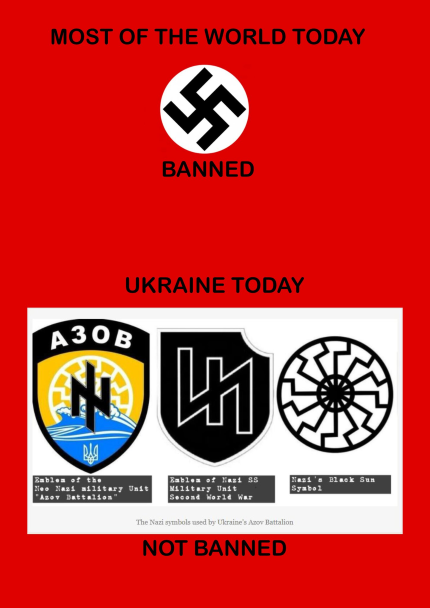
Zelensky, a Ukrainian Jew, was apparently unperturbed by Israel’s alleged arming of Nazi elements in his country. One year after his 2019 election, he made a pilgrimage to Jerusalem to launch what he called a “prayer for peace,” and to attend an event entitled “Remember the Holocaust to fight anti-Semitism.” Ahead of the junket, Zelensky heaped praise on Israeli society, remarking in an interview that “Jews managed to build a country, to elevate it, without anything except people and brains,” and that Israelis are a “united, strong, powerful people. And despite being under the threat of war, they enjoy every day. I’ve seen it.”
1 This Month





PLEASE OPPOSE HR 8255 AND S.3639 – bills would accelerate satellite deployment, with no environmental review or safeguards – https://ncstd5li.quorum.us/campaign/169331/
To see nuclear-related stories in greater depth and intensity – go to https://nuclearinformation.wordpress.com
-
Archives
- October 2026 (74)
- September 2026 (339)
- August 2026 (330)
- July 2026 (355)
- June 2026 (287)
- May 2026 (306)
- April 2026 (356)
- March 2026 (251)
- February 2026 (267)
- January 2026 (308)
- December 2025 (358)
- November 2025 (359)
-
Categories
- 1
- 1 NUCLEAR ISSUES
- business and costs
- climate change
- culture and arts
- ENERGY
- environment
- health
- history
- indigenous issues
- Legal
- marketing of nuclear
- media
- opposition to nuclear
- PERSONAL STORIES
- politics
- politics international
- Religion and ethics
- safety
- secrets,lies and civil liberties
- spinbuster
- technology
- Uranium
- wastes
- weapons and war
- Women
- 2 WORLD
- ACTION
- AFRICA
- Atrocities
- AUSTRALIA
- Christina's notes
- Christina's themes
- culture and arts
- Events
- Fuk 2022
- Fuk 2023
- Fukushima 2017
- Fukushima 2018
- fukushima 2019
- Fukushima 2020
- Fukushima 2021
- general
- global warming
- Humour (God we need it)
- Nuclear
- RARE EARTHS
- Reference
- resources – print
- Resources -audiovicual
- Weekly Newsletter
- World
- World Nuclear
- YouTube
-
RSS
Entries RSS
Comments RSS

