UK government to change the rules – so that billions of pounds of pension funds can go to dodgy new nuclear projects

Pension fund reforms will help to unleash wave of investment in nuclear energy, according to senior industry sources. The Chancellor, Kwasi Kwarteng, announced a plan on Friday to unlock billions of pounds of cash that could be poured into major infrastructure programmes and innovative businesses. The Government is scrambling to get energy projects off the ground following the Russian invasion of Ukraine.
French state energy giant DF is developing Sizewell C and has received UK Government backing. But
the project still needs to drum up billions of pounds in private investment. Kwarteng’s plan will relax rules in order to allow fund managers to invest in assets that will potentially take a long time to make a return.

Details of the changes are likely to be closely monitored by regulators and pension campaigners. Tom Greatrex, chief executive of the Nuclear Industry Association, said pension money ‘will be a boost to the
prospect of getting new nuclear plants built to fix our energy security crisis’, adding: ‘The first big infrastructure project where this will have an effect could well be Sizewell C.’ He said it was a ‘very important step’ alongside two other major changes that are shaking up the industry.

The first is a new financing model, called the ‘regulated asset base’, which allows investors to receive returns during the construction phase of big projects.

The second is a planned rebranding – expected later this year – of nuclear as green energy, which it is hoped will attract backers that are currently barred from putting money into the sector. Kwarteng’s plan
could also help spur funding for a fleet of mini nuclear reactors being developed by engine maker Rolls-Royce. A spokesman for Rolls-Royce said: ‘This broadens the pool for vital UK infrastructure funding. SMRs are perfectly sized for pension investment owing to the lower project costs of around £2billion.
Mail on Sunday 24th Sept 2022
Vladislav Ugolny: Ukraine is targeting civilians for retribution in the east while its Western backers turn a blind eye
Tens of thousands of residents of Kharkov region may become victims of Kiev’s “justice”
https://www.rt.com/russia/563216-future-victims-of-ukrainian-justice/ By Vladislav Ugolny, a Russian journalist based in Donetsk, 23 Sept 22
The Ukrainian offensive in Kharkov Region, launched earlier this month, led to Russia’s armed forces losing control of a number of settlements.
These include the towns of Balakleya, Izium, Kupiansk, Volchansk and a number of villages and small locales. Nevertheless, the Russian army, by concentrating on rearguard battles, was able to avoid significant losses and managed to retreat to the left bank of the Oskol River to regroup.
However, the primary victims of this turn of events were the inhabitants of the aforementioned areas who are now in the hands of Ukraine.
Left behind
There is no exact information about the population of this region. The last census was conducted by Kiev more than 20 years ago, and the country’s statistics are known to be wildly inaccurate.
At the outset, we can estimate the pre-war population at 200,000 people. After the outbreak of hostilities, some were forced to flee. The number of refugees depended on the intensity of the fighting. For example, in the Russia-border town of Volchansk, people continued to live normally – they had not heard firing in the city since March – and there has always been humanitarian aid. However, the frontline villages south of Izium were virtually wiped off the face of the earth.
In any case, we are talking about tens of thousands of people. Most likely, at least 100,000 people lived in the Russian-controlled territories. Some of them remain under the protection of the Russian army, which controls the left bank of the Oskol, and villages such as Kupiansk-Uzlovoi and Borovaya, which have now become the sites of intense hostilities.
After the beginning of the Ukrainian offensive, some Kharkov Region residents were forced to leave their homes. An evacuation was carried out in Volchansk, Veliky Burluk, Kupiansk and Izium. Various estimates suggest that between 5,000 and 25,000 people have fled to Russia in September alone.
According to Readovka journalists, Voronezh Region accommodated about a thousand refugees. Another small number left Kharkov and headed to the Donetsk and Lugansk People’s Republics, in particular to the nearest district center of Svatovo.
In any case, most local residents have remained in situ. Based on the communication with residents of small Donbass front-line towns that have been shelled for eight years, it is safe to say that such a decision is not politically motivated. Residents of such areas, many of whom are older people, those with disabilities, families with household plots or low-mobility relatives who require care, usually cling to their land, homes and traditional way of life to the end. They are the ones who have not evacuated their homes in recent months, and it is they who are now under threat.
Ukraine is preparing ‘mop-ups’
A number of channels have appeared in the Telegram messenger app, one of the leading social media platforms for both sides of the conflict, which publish the personal data of so-called “collaborators.” The basis for accusations could be anything, including communicating with the Russian military or receiving humanitarian aid. Some of these channels are currently blocked, after a wave of complaints to Telegram’s technical support.
Despite this, some remain operational and many dehumanize Russia’s supporters as “zhduny(rus) – waiters.” According to the public consensus in Ukraine, such people who sympathize with Moscow are the cause of the conflict. In the eyes of Ukrainian radicals, anyone who expresses a positive attitude towards Russia is a threat to national security.
Thus, personal data in the early days of the offensive was published for one purpose: to point out enemies so that they would be killed during the “sweep” – a set of actions aimed at establishing control over occupied territory undertaken by the army, mercenaries and nationalist battalions. ‘Mopping-up’ is outside the criminal procedure code and is not regulated by any laws. Law may come to the territory later but, in the very first days, “revolutionary justice” is carried out, without lawyers and with the functions of judge, prosecutor and executioner performed by Ukrainian combatants.
To help their murderous cause, similar channels are being created that publish personal data with calls for lynching.
After the ‘cleansing’ is completed, elements of the Ukrainian legal system will come to the captured cities. They will focus on the concealment of war crimes committed during the ‘clean-up‘, and instead point the finger at Russia. The last two tasks will be carried out simultaneously, such as in Bucha, and those killed by Ukrainians will be cynically presented as victims of the Russian army.
Demonstrative detentions
According to the Security Service of Ukraine (SBU), as of last week 16 people suspected of collaborating with Russian authorities had already been detained. The security agents are first and foremost interested in tax officials responsible for the functioning of local businesses during Moscow’s control of the territory. However, local teachers who switched to teaching the Russian curriculum are also at risk.
Despite international humanitarian law, which obliges the party in control of a territory to preserve the educational process and emphasizes that no harm be done to educators, Kiev seems determined to punish teachers, to use them as an example to others.
Deputy Prime Minister of Ukraine Irina Vereshchuk says that these teachers committed crimes and should be punished for high treason. Such measures by the Ukrainian government are aimed primarily at intimidating educators in Russian-controlled territory. By showing a willingness to prosecute civilian workers, Kiev is raising the stakes.
Ukrainian law enforcement is also known to detain forestry workers, for having helped the Russian army to collect firewood. The details are unknown: whether they supplied the Russians with firewood on a commercial basis, felled the forests entrusted to them, or simply told the soldiers where to chop, remains unknown.
Traditions of Ukrainian ‘justice’
Any civilian living in Russian-controlled territory could be charged with collaboration. Ukraine has a special ministry for the reintegration of “temporarily occupied territories,” which since 2016 has been developing a policy of “filtering” the civilian population. Initially, its activity was concentrated around Donbass and Crimea but its scope has now expanded.
The most striking example is the law ‘On the State Policy of the Transitional Period’, which has been criticized by, among others, the Venice Commission [on constitutional law] for the fact that Ukrainian state policy in the territories it occupies is aimed at investigating only the alleged war crimes of the opposite side, ignoring the goal of establishing the truth about all crimes. This law also introduced differentiated treatment of citizens, depending on their level of interaction with Russia and/or the Donbass republics.
The topic of differentiating guilt – and, according to Ukraine, the entire civilian population is guilty to a greater or lesser degree – was then promoted by all sorts of non-profit organizations. So the Crimean Tatar Resource Center engaged with the Soros Foundation’s ‘Vozrozhdeniye’ and the extremist organization ‘Mejlis of the Crimean Tatar people,’ who claim to be the exiled Ukrainian government of Crimea, developed a whole methodology for evaluating the degree of collaboration.
For a demonstration of this scale, Ukrainians cited three respective examples: a doctor at a Crimean city hospital, an acting city council deputy and the ex-chief prosecutor of Crimea, Natalya Poklonskaya.
According to the methodology, the doctor scores 17 points, the deputy 30, and Poklonskaya 86. Thus, any Crimean doctor is already guilty of collaborationism, having 17 points. Since 2014, Ukrainian society, represented by non-profit organizations, has debated the doctor’s degree of guilt and the punishment which ought be meted out. We see the results of such discussions in Kharkov Region.
Preparing the ‘next Bucha’
In addition to fighting teachers and foresters, Ukrainian law enforcement and the media are also busy falsifying war crimes. They open the so-called “cellars” – illegal prisons and torture chambers, in which alleged prisoners of war and civilians were kept. The process of falsification relies on vivid shots – frames with a prayer scratched on the wall of one of the basements.
Another fabrication involved seven Sri Lankan students attending the Kupiansky Medical College, which was allegedly held by Russian military personnel since March, who testified about torture by the Russians.
The official position is simple: angry Russians simply detained and tortured foreigners. That the Russian army in fact evacuated them from Mariupol and Kherson is ignored. For the time being, Sri Lanka’s Ministry of Foreign Affairs is asking Kiev to provide more information about its citizens. A fair investigation, however, should not be expected until those Sri Lankans find themselves outside the hands of the Ukrainian state.
Speaking of Kiev’s hand, another media symbol of the “genocide of the Ukrainian people” was presented as the hand of a deceased man with rubber bracelets in the colors of the Ukrainian flag. This was apparent evidence of a hate crime: a man killed for wearing Ukrainian symbols. As it turned out, the body was that of Sergey Sova, a member of the 93rd Mechanized Brigade, who was killed during fighting near Izium.
In general, the only mass graves that Ukrainian propaganda now clings to are the cemeteries organized by Russians, where the victims of the military conflict were buried, including Ukrainian soldiers. There is an inscription on one of the crosses, in particular, “APU [Ukrainian Armed Forces] 17 people, Izium, from the morgue.” Ukrainians claim that there are 440 bodies there. Some of the crosses have memorial plaques, some only an inventory number.
The bodies were buried by the Russian army in accordance with the traditions of the region. Perhaps, of course, among those buried under the cross are Muslims, Jews, or adherents to pagan beliefs popular among Ukrainian neo-Nazi battalions, but the Russians did everything possible on their part to ensure the remains of the enemy were not desecrated.
In normal circumstances, these bodies would have been given to the Ukrainian side in return for the bodies of dead Russian soldiers, but Ukraine boycotted these exchanges due to an unwillingness to admit significant losses. In particular, the son of the aforementioned Sergey Sova learned a few months later about the fate of his father and through the media requested the body be transferred back home for a proper burial. Prior to that, Sova had most likely been listed as missing, a ploy that suppresses official numbers of dead Ukrainian soldiers and avoids compensation payments to their families.
Now, however, the Ukrainian soldiers killed in battle and buried in accordance with the dominant religious traditions in Ukraine will be counted as victims of an “alleged genocide.” After a while, when it is impossible to distinguish whether people were killed in early September or mid-September, they will be presented as victims of the retreating Russian army.
All of this is a sinister and cynical story, the truth of which we can learn only after the return of the Russian army to Kharkov. Only then will the massive machine of lies, propaganda and disinformation, which is the work of the Ukrainian government in the occupied territories, be broken, and the world will be able to learn about the real war criminals. As when we discovered after the liberation of Mariupol and the establishment of control over the buildings of Mariupol Airport, that the Ukrainian Security Service and Azov turned it into a concentration camp, known as ‘The Library.’
Operation Sellafield: inside Britain’s deadliest clean-up job

Few people ever enter the storage silo at Cumbria’s nuclear facility. David
Collins goes behind the scenes to see how engineers are disposing of waste
six times more radioactive than the Chernobyl explosion. Plus, take our
exclusive video tour.
Liz Truss, picking up where her predecessor Boris
Johnson left off, wants to expand Britain’s nuclear industry to tackle
the energy crisis, increasing capacity from 7GW to 24GW by 2050, providing
power to about a quarter of homes.
The Sellafield project I have come to see is a reminder that the nuclear solution can leave a very long-term legacy of logistical problems. Mistakes have been made in Britain’s
nuclear past; the Sellafield clean-up may provide reassurance that we have
learnt from them.
Britain’s first nuclear power station, Calder Hall,
went online here in 1956, powered by a Magnox nuclear reactor. It was
switched off in 2003. Sellafield may be best known to some as the scene of
the Windscale fire, one of the world’s worst nuclear disasters, which
raged for three days in October 1957.
Milk from cows for 200 square miles
was contaminated and 260 people developed cancer, with 32 dying as a
result.
No power for the national grid or weapons material is produced at
Sellafield today, its role now perhaps less glamorous but essential: making
nuclear waste safe. This waste includes the leftovers from the four EDF
nuclear power stations at Torness, Heysham, Sizewell and Hartlepool, as
well as radioactive materials from the likes of hospital scanners.
Until 2018, it also dealt with others’ waste: Germany, Spain and the
Netherlands would ship hazardous by-products to Sellafield to be processed
and returned in metal barrels. At one point Sellafield was handling 800
tonnes of foreign waste a year at a lucrative fee of £1 million per tonne.
The Magnox Swarf Storage Silo is essentially a nuclear waste dump, its
contents dating from a time when less thought was given to how the waste
should be handled in the long term. According to a 2020 public accounts
committee report, the Nuclear Decommissioning Authority, the body
responsible for the clean-up of the country’s nuclear waste, has a
“perpetual” lack of knowledge about the condition of the UK’s nuclear
sites due to Cold War-era mismanagement.
Accurate records were simply not kept. “I wouldn’t judge the future on the history of the past,” says
Halliwell. “I don’t condone what’s gone on previously. But if we
demonstrate we can manage these materials successfully, we can offer some
confidence to an expanded nuclear industry, because I fully believe, given
some of the problems we are experiencing at the moment, that we need a
buoyant nuclear industry for electricity generation.”
The government wants to build more reactors — mostly Small Modular Reactors, or SMRs.
These are basically mini nuclear power stations, with reactors capable of
generating about one third of the capacity of a traditional nuclear power
reactor. Rolls-Royce is developing a type of SMR with help from government
funding. It believes they are clean, low-cost and easier to set up than a
traditional nuclear plant. Sellafield is bidding to build one of the
new-generation mini reactors on its own site, continuing its legacy of
being at the forefront of Britain’s nuclear history.
Times 24th Sept 2022
Continuing campaign to stop the dumping of Hinkley nuclear power station mud off Cardiff coast
Campaigners attempting to stop mud from the construction of Hinkley Point
Nuclear Power Station, Somerset, being dumped into Welsh waters, have
announced they are working with leading environmental lawyers Leigh Day to
block the proposals. In February EDF Energy applied to National Resources
Wales for a licence to dump 800,0000 tonnes of mud dredged as part of
building work for the new plant that is being built on the site of the
disused Hinkley Point A facility.
Two years ago, EDF were given permission
to dump 300,000 tonnes of mud from the site off the Cardiff coast, despite
protests and following a Senedd debate. A petition against the latest
proposals received over 10,000 signatures and has triggered a debate in the
Senedd tomorrow. Earlier this month EDF Energy confirmed it will carry out
an Environmental Impact Assessment as part of its licence application. This
agreement reverses NRW and Welsh Government’s previous position that an
EIA was not needed for the dumping they permitted in 2018 just 2.1 miles
off the South Wales coast and 2.5 miles from Cardiff. Leigh Day has now
written to Natural Resources Wales (NRW) requesting full disclosure of
documents on the Environmental Impact Assessment (EIA)-screening
application from EDF and the agreement with NRW that “environmental
impact assessment is required”.
EDF are also facing a public inquiry over
a controversial fish management system that is being installed at the site
of the new facility. The Environment Agency granted a licence to EDF in
2013 that permitted sea water to be used for the nuclear power station’s
cooling system but required the deployment of a fish deterrent system on
the site to protect marine life in the estuary. Initially the operator
proposed the use of an acoustic deterrent system to reduce the number of
fish being killed by the cooling system but in 2017 abandoned the plans
without suggesting any alternative.
Currently the plant’s proposed Fish
Recovery and Return System will consist of a 5mm mesh barrier set up in the
water intake tunnel to stop large fish from being sucked in while another
channel will divert fish, dead or alive, back out to sea. Last year the
Sunday Times reported that marine and conservation groups estimated that
this system will kill 250,000 fish a day and called for it to be altered or
scrapped. EDF said the FRR will kills an estimated 650,00 fish a year.
Source: Nation Cymru 20th Oct 2020
https://nation.cymru/news/senedd-roundup-leading-environmental-lawyers-join-battle-to-block-mud-dump/
Belgium shuts down one reactor, in line with its “40 years life” rule for nuclear reactors
One of Belgium’s seven nuclear reactors
was disconnected from the grid on Friday evening. This follows legislation
passed in 2003 requiring reactors to be shut down after 40 years of
operation.
Belgium has two nuclear power plants: Doel near Antwerp and
Tihange near the town of Huy in Wallonia. The two plants consist of seven
reactors (four at Doel and three at Tihange) covering around 50 percent of
the country’s electricity needs, according to the news website Euractiv.
On Friday, the Doel 3 reactor was disconnected from the power grid in
accordance with the 2003 Nuclear Abandonment Act. The law was passed at the
insistence of the “green” parties that were part of the government at
that time. The legislation stipulates that reactors are to be shut down 40
years after being put into operation. A spokeswoman for the energy company
Engie, which operates Belgium’s nuclear power plants, Nele Scheerlinck,
stated that “the decision was made years ago” and “it is simply not
possible to change plans at such short notice”.
TVP World 24th Sept 2022
https://tvpworld.com/62949498/belgium-turns-off-nuclear-reactor-despite-energy-crisis
Hinkley Mud still needs more testing for radiation
Richard Bramhall, Secretary of the Level Radiation Campaign. Tomorrow the
Senedd will debate a petition calling for an Environmental Impact
Assessment (EIA) to be undertaken ahead of any further dredged material
from Hinkley Point being disposed of at the Cardiff Grounds disposal site.
This is taking centre stage as Electricité de France (EDF) seeks a licence
to dredge huge amounts of mud from the Severn Estuary and dump it on a
shallow sandbank less than two miles from Cardiff.
The Environment (Wales) Act 2016 requires decision-makers to take great care and to consult widely
when there are uncertainties. We argue that there are large uncertainties
about how many uranium oxide fragments are in the mud, and about where they
would go if dumped on Cardiff Grounds, how much genetic damage they would
do to the population of Wales and whether the people who must make the
licensing decisions understand the relevant science.
Source: Nation Cymru 20th Oct 2020
Link:
https://nation.cymru/opinion/why-were-calling-for-more-testing-before-more-mud-from-hinkley-point-is-dumped-near-cardiff/
Busting The Times’ spin on “Great British Nuclear” and “a new atomic age for the UK”

Letter Paul Dorfman: You report that “Great British Nuclear plots a new atomic age for the UK” (Business, last week).
I think not. New nuclear plants are hugely expensive: in recent years they have cost an average of
20 per cent more than the estimate in Europe, and a staggering 100 per cent internationally. They’re also delivered late: construction overruns have averaged 0 per cent in Europe and 90 per cent internationally.
We also shouldn’t forget the horrible mess across the Channel. More than half EDF France’s reactors are offline, many with maintenance and corrosion safety problems due to their age.
Meanwhile last year renewables made up 81 per cent of all new power to the world grid, with nuclear nowhere. That is because utility-scale renewables can be built on time, on budget and for less than a quarter of the cost of nuclear.
Times 25th Sept 2022
https://www.thetimes.co.uk/article/admit-it-nuclears-going-nowhere-tclmnr89f
Holding ground, losing war
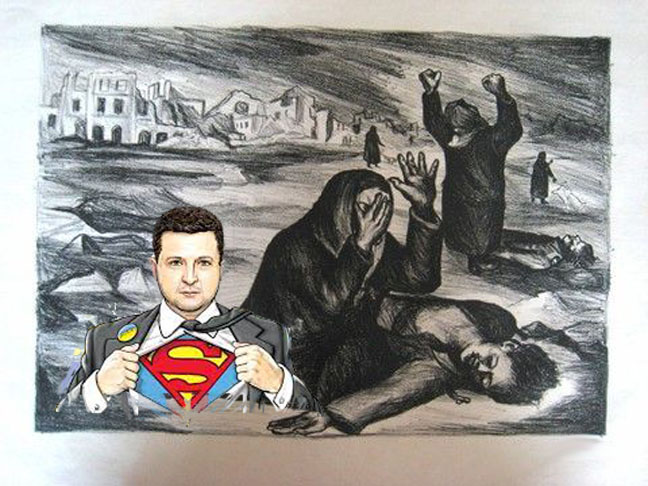
Zelensky’s strategy of defending territory at all costs has been disastrous for Ukraine.
The American Conservative, Douglas Macgregor, Sep 22, 2022,
At the end of 1942, when the Wehrmacht could advance no further east, Hitler switched German ground forces from an “enemy force-oriented” strategy to a “ground-holding” strategy. Hitler demanded that his armies defend vast, largely empty and irrelevant stretches of Soviet territory.
“Holding ground” not only robbed the German military of its ability to exercise operational discretion, and, above all, to outmaneuver the slow, methodical Soviet opponent; holding ground also pushed German logistics to the breaking point. When holding ground was combined with endless counterattacks to retake useless territory, the Wehrmacht was sentenced to slow, grinding destruction.
Ukrainian President Volodymyr Zelensky, (presumably with the advice of his U.S. and British military advisors), has also adopted a strategy of holding ground in Eastern Ukraine. Ukrainian forces immobilized themselves inside urban areas, and prepared defenses. As a result, Ukrainian forces turned urban centers into fortifications for what became “last stands.” Sensible withdrawals from cities like Mariupol that might have saved many of Ukraine’s best troops were forbidden.
Russian forces responded by methodically isolating and crushing the defenders left with no possibility of either escape or rescue by other Ukrainian forces.
Moscow’s determination to destroy Ukrainian forces at the least cost to Russian lives prevailed.
Ukrainian casualties were always heavier than reported from the moment Russian troops crossed into Eastern Ukraine, but now, thanks to the recent failure of Ukrainian counterattacks in the Kherson region, they’ve reached horrific levels that are impossible to conceal. Casualty rates have reached 20,000 killed or wounded a month.
Despite the addition of 126 howitzers, 800,000 rounds of artillery rounds, and HIMARS (U.S. rocket artillery), months of hard fighting are eroding the foundations of Ukraine’s ground strength. In the face of this disaster, Zelensky continues to order counterattacks to re-take territory as a means of demonstrating that Ukraine’s strategic position vis-à-vis Russia is not as hopeless as it seems.
The recent Ukrainian advance to the town of Izium, the link between Donbas and Kharkiv, seemed like a gift to Kiev. U.S. satellite arrays undoubtedly provided Ukrainians with a real-time picture of the area showing that Russian forces west of Izium numbered less than 2,000 light troops (the equivalent of paramilitary police, e.g., SWAT and airborne infantry).
The Russian command opted to withdraw its small force from the area that is roughly 1 percent of formerly Ukrainian territory currently under Russian control. However, the price for Kiev’s propaganda victory was high—depending on the source, an estimated 5,000 to 10,000 Ukrainian troops were killed or wounded in a flat, open area that Russian artillery, rockets, and air strikes turned into a killing field.
Given Washington’s inability to end the war in Ukraine with the defeat of Russian arms, it seems certain that the Beltway will try instead to turn the ruins of the Ukrainian state into an open wound in Russia’s side that will never heal. From the beginning, the problem with this approach was that Russia always had the resources to dramatically escalate the fighting and end the fighting in Ukraine on very harsh terms. Escalation is now in progress. …………………………..
The defense establishment has a long record of success in tranquilizing American voters with meaningless clichés. As conditions favorable to Moscow develop in Eastern Ukraine and the Russian position in the world grows stronger, Washington confronts a stark choice: Talk about having successfully “degraded Russian power” in Ukraine and scale back its actions. Or risk a regional war with Russia that will engulf Europe. ……………………………… more https://www.theamericanconservative.com/holding-ground-losing-war/
UK’s nuclear waste cleanup operation could cost £260bn
“While we are clear about the current legacy of waste which already exists, a GDF would have to handle additional waste from new facilities being developed,” the NWService said. “The actual cost will … depend on the number of new nuclear projects that the UK develops in future and any additional waste from those stations.”
Cost of safely clearing waste from ageing power stations is soaring, say experts,
https://www.theguardian.com/environment/2022/sep/23/uk-nuclear-waste-cleanup-decommissioning-power-stations Sandra Laville Environment correspondent
The cost of decommissioning the UK’s 20th-century nuclear waste could rise to £260bn as the aged and degrading sites present growing challenges, according to analysis presented to an international group of experts.
As the government pursues nuclear energy with the promise of a new generation of reactors, the cost of safely cleaning up waste from previous generations of power stations is soaring.
Degrading nuclear facilities are presenting increasingly hazardous and challenging problems. Ageing equipment and electrical systems at Sellafield, which is storing much of the country’s nuclear waste and is one of the most hazardous sites in the world, are increasing the risk of fire, according to the Nuclear Decommissioning Authority. They require increasing maintenance and present growing risk. Last October a faulty light fitting started a blaze at a Sellafield facility which led to its closure for several weeks.
Analysis by Stephen Thomas, a professor of energy policy at the University of Greenwich, estimates the total bill for decommissioning the UK’s nuclear waste mountain will grow to £260bn.
Thomas told a conference of international experts the cost of decommissioning Sellafield had risen from to £110bn, according to freedom of information requests.
Other sites that need decommissioning are the 11 Magnox power stations, built between the 1950s and 1970s, including Dungeness A in Kent, Hinkley Point A in Somerset and Trawsfynydd in north Wales, and seven advanced gas-cooled reactors built in the 1990s, including Dungeness B, which closed last year, Hinkley Point B and Heysham 1 and 2 in Lancashire.
Deterioration of one of the Magnox stations, Trawsfynydd, which shut down in 1991, is such that substantial work is needed to make it safe, according to the NDA. “Work that would then need to be undone to complete reactor dismantling,” the agency said.
Thomas told the International Nuclear Risk Assessment Group similar problems are expected at other Magnox sites. The timetable for decommissioning the old nuclear power stations has been abandoned, with no new timescale yet published.
The Nuclear Waste Service has said deferring decommissioning for 85 years from shutdown, which was previous policy, is not suitable for all the reactors because of their different ages and physical conditions. Decommissioning of some Magnox stations will have to be brought forward, the NWS has said
Attempts to speed up the decommissioning would only add to the growing bill, Thomas said, which he estimated had increased to £34bn.
In 2005, the cost for decommissioning and disposing of the radioactive waste from nuclear power stations built in the 1950s, 70s and 90s was put at £51bn.
Last year the NDA estimates rose to £131bn, and its latest annual report said £149bn was needed to pay for the clear up. But Thomas said rising costs meant the total bill was on track to reach £260bn.
Part of the soaring increase is the cost of building a large underground nuclear waste dump or geological deposit facility (GDF) to safely store the 700,000 cubic metres of radioactive waste – roughly the volume of 6,000 double decker buses – from the country’s past nuclear programme.
The mammoth engineering project was initially predicted to cost £11bn but the bill is now estimated to be up to £53bn because of uncertainty about where the site will be located, and the need to provide space for an unspecified amount of waste from the new generation of nuclear reactors which the government wants to build.
Four areas of the country are being considered for the GDF but no decision on where it will be located has yet been made.
“While we are clear about the current legacy of waste which already exists, a GDF would have to handle additional waste from new facilities being developed,” the NWService said. “The actual cost will … depend on the number of new nuclear projects that the UK develops in future and any additional waste from those stations.”
The cleanup of past nuclear waste will take more than 100 years, the NDA has said. Highlighting the challenges of the degrading and hazardous facilities, the authority said in its annual report that robots and drones were increasingly being used to carry out site inspections.
Sizewell C: Planning shake-up – getting rid of environmental assessment ‘runs roughshod over objectors’.
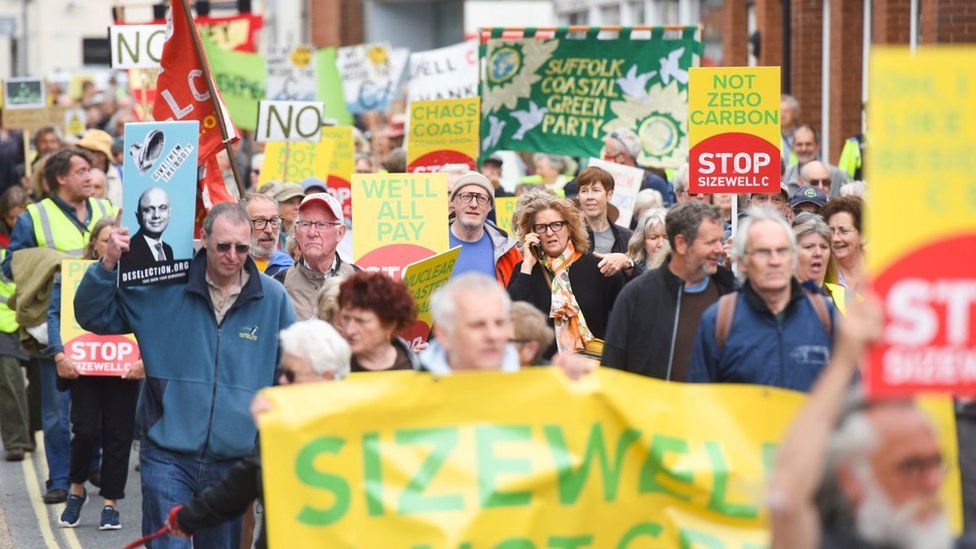
A government shake-up of planning which could bring forward the building of Sizewell C is “deeply dismaying”, campaigners said.
BBC News 24 Sept 22,
New legislation aims to cut planning rules and get rid of environmental assessments to speed up construction.
The nuclear power station in Suffolk is among projects to be “accelerated as fast as possible”, the Treasury said.
Stop Sizewell C said the plan “rode roughshod over the ability to fight damaging projects”.
The scheme, currently estimated to cost £20bn, was given government approval in July, against the advice of the Planning Inspectorate.
The new plant would be built by French-owned EDF next to the existing Sizewell B, which is still generating electricity, and Sizewell A, which has been decommissioned.
Fellow campaigners Together Against Sizewell C (TASC) has instigated a judicial review process over the planning approval, claiming it was illegal.
Chancellor of the Exchequer, Kwasi Kwarteng, who gave Sizewell the go-ahead when he was business secretary, made the latest announcement as part of his Autumn statement.
New legislation would be brought forward to “address barriers by reducing unnecessary burdens to speed-up the delivery of much-needed infrastructure”, the Treasury said………………………….. more https://www.bbc.com/news/uk-england-suffolk-6301233.
Is UK government’s nuclear power policy scientifically feasible? – asks House of Commons Science and Technology Committee .
The deadline to submit to the Commons Science and Technology Committee’s
inquiry on the Government’s approach to developing new nuclear power is
fast approaching. The Committee of MPs is accepting written evidence
submissions until Friday 30 September.
The Committee’s inquiry is looking
for evidence from experts on what is required for the Government to achieve
its aim to approve up to eight new nuclear fission reactors by 2030, as
committed in its energy security strategy, and for nuclear to supply 25% of
electricity by 2050.
More than half of the UK’s 11 nuclear reactors are due
to be retired by 2025 with no immediate replacements, an approach which was
criticised in a recent Public Accounts Committee report. The Science and
Technology Committee’s inquiry is examining how the gap in nuclear
generating capacity, which currently accounts for around 15% of the UK’s
electricity, will be filled and energy supply protected.
Other issues in
scope of the Committee’s inquiry are: the funding and regulation of nuclear
power, including provisions in the Energy Security Bill introduced into
Parliament this year; the status of the different nuclear power
technologies, including fusion, and their role in achieving the net zero by
2050 target; the technical challenges facing the next generation of nuclear
power plants; what further research and development is required to build
capacity and how the management of nuclear waste can be improved.
The House of Commons Science and Technology Committee scrutinises the Government and
exists to ensure that policies and decision-making are based on solid
scientific evidence and advice.
HoC Science & Technology Committee 22nd Sept 2022
https://committees.parliament.uk/work/6864/delivering-nuclear-power/
Moscow unlikely to use nuclear weapons, say ex-Russian generals
Former Russian generals tell Al Jazeera that while the prospect of nuclear war remains slim, the situation could quickly escalate.
Aljazeera, 24 Sept 22,
Russia is unlikely to use nuclear weapons in Ukraine unless NATO puts boots on the ground, two retired Russian generals have told Al Jazeera.
“If the collective West attacks Russia with its conventional armed forces, then Russia’s response could very well be nuclear since there is no comparison between the West’s conventional military potential and that of Russia,” said Evgeny Buzhinsky, a retired lieutenant general who served as the Russian military’s top arms control negotiator from 2001 to 2009.
However, Buzhnisky stressed that Russia had little to gain from using nuclear weapons in Ukraine under the present circumstances.
He argued that the Russian military did not need nuclear weapons to achieve its strategic objectives, such as destroying transport infrastructure used to deliver Western arms shipments or damaging the country’s electricity network.
Mutual destruction
At the same time, Buzhinsky warned that initiating a nuclear attack would almost certainly put Moscow and Washington on a dangerous escalating spiral.
“There can be no limited use of nuclear weapons – to think otherwise is an illusion,” he said.
“Any nuclear conflict between Russia and the United States will lead to complete mutual destruction.”
A similar assessment was given by Leonid Reshetnikov, a retired lieutenant general who spent more than 40 years working in the Soviet and Russian foreign intelligence services.
Reshetnikov told Al Jazeera that the prospect of Russia using tactical nuclear weapons in Ukraine was “impossible and would make little military sense” right now.
He argued that such a move would be a sharp deviation from the risk-averse strategy that Russia has pursued in Ukraine so far, noting that the Kremlin waited nearly seven months before declaring a partial mobilisation.
NATO troops becoming directly involved in the conflict could change Moscow’s calculus, however.
“The United States and practically all of Europe are already participating in this conflict by providing Ukraine with weapons, intelligence, instructors, and volunteers,” Reshetnikov said………………………………………….
Meanwhile, NATO Secretary-General Jens Stoltenberg told the Reuters news agency that the security bloc would “make sure that there is no misunderstanding in Moscow about the seriousness of using nuclear weapons,” while adding that it had not observed any changes in Russia’s nuclear posture.
In an interview with Britain’s Guardian newspaper, Mykhailo Podolyak, a senior aide to Ukrainian President Volodymyr Zelenskyy, urged other nuclear powers to commit to “swift retaliatory nuclear strikes” against Russia if Moscow attempted to use its weapons in Ukraine. https://www.aljazeera.com/news/2022/9/23/little-military-sense-for-nuclear-weapons-ex-russian-.
Poland distributes iodine pills as fears grow over Ukraine nuclear plant
WARSAW, Sept 22 (Reuters) – Poland, concerned about fighting around Ukraine’s Zaporizhzhia nuclear power plant, has distributed iodine tablets to regional fire departments to give to people in the event of radioactive exposure, a deputy minister said on Thursday…………………………………… (subscribers only) more https://www.reuters.com/world/europe/poland-distributes-iodine-pills-fears-grow-over-ukraine-nuclear-plant-2022-09-22/
Italy’s far-right leader Giorgia Meloni favours return to nuclear power and increased gas production.
The front-runner to become Italy’s next prime minister in elections on
Sunday plans to focus on natural gas and nuclear energy, along with other
temporary market interventions to mitigate the country’s energy crisis.
The most recent opinion polls favour Giorgia Meloni, leader of the far-right
Fratelli d’Italia party, to win over her main rival Enrico Letta, leader of
the centre-left Democratic party. Much of the political campaign to replace
outgoing premier Mario Draghi has focused on the current tight energy
supplies, exacerbated by the Russian war in Ukraine, and skyrocketing
bills, which continue to pile pressure on Italian businesses and
households.
Gas, nuclear and EU green policies have emerged as contention
points. Meloni, who has teamed up with centre-right allies Matteo Salvini
and former premier Silvio Berlusconi, supports the reactivation of the
country’s long-shuttered nuclear power plants and an increase in domestic
gas production.
Montel 22nd Sept 2022
https://www.montelnews.com/news/1352753/front-runner-in-italian-election-focuses-on-gas-nuclear
Germany’s Environment Minister reaffirms the phaseout of nuclear power.
Speech by Federal Environment Minister Steffi Lemke on the draft of a
nineteenth law amending the Atomic Energy Act.
The phasing out of nuclear power, decided by a broad consensus in 2011, is coming.
Be proud, dear colleagues from the CDU / CSU , that you decided this with the FDP at the
time . That was responsible politics! Together we have settled a
decades-long social conflict. That is why this is not about Mr Trittin’s
life’s work, but about the fact that Mrs Merkel, as the responsible Federal
Chancellor at the time, implemented this nuclear phase-out in our country
with our support.
And you cannot hide the fact that you are now concerned
with reversing this decision with your draft law. With your draft law, you
not only want to enable an extension of the term until 2024, but beyond.
They want to turn back the wheel of nuclear history and that’s not going to
happen. It is irresponsible to treat this high-risk technology as if it
were a coffee maker that you turn on and off every once in a while, refill
with water, put in a new filter, and then turn it on again.
The valve leakage at the Isar 2 nuclear power plant is not a safety problem, but a
technical problem. Now we have to decide how to deal with it. In addition,
it is a mechanical problem that has been foreseeable for a long time, but
which means that the nuclear power plant will now have to be taken off the
grid in autumn, when we already have a problematic electricity situation
due to the lack of nuclear power plants in France.
The fact that this
information was not communicated to us in good time by the Bavarian nuclear
supervisory authority is something I will leave here without comment. We
will provide the necessary answers to the current energy situation. We are
driving the energy transition forward by massively expanding renewable
energies, focusing on energy efficiency and savings, and by using old
energy supply sources again this winter, thereby also enabling reserve
operation for two of the three nuclear power plants that are still in
operation if it becomes necessary.
German Environment Ministry 22nd Sept 2022
1 This Month





PLEASE OPPOSE HR 8255 AND S.3639 – bills would accelerate satellite deployment, with no environmental review or safeguards – https://ncstd5li.quorum.us/campaign/169331/
To see nuclear-related stories in greater depth and intensity – go to https://nuclearinformation.wordpress.com
-
Archives
- October 2026 (74)
- September 2026 (339)
- August 2026 (330)
- July 2026 (355)
- June 2026 (287)
- May 2026 (306)
- April 2026 (356)
- March 2026 (251)
- February 2026 (267)
- January 2026 (308)
- December 2025 (358)
- November 2025 (359)
-
Categories
- 1
- 1 NUCLEAR ISSUES
- business and costs
- climate change
- culture and arts
- ENERGY
- environment
- health
- history
- indigenous issues
- Legal
- marketing of nuclear
- media
- opposition to nuclear
- PERSONAL STORIES
- politics
- politics international
- Religion and ethics
- safety
- secrets,lies and civil liberties
- spinbuster
- technology
- Uranium
- wastes
- weapons and war
- Women
- 2 WORLD
- ACTION
- AFRICA
- Atrocities
- AUSTRALIA
- Christina's notes
- Christina's themes
- culture and arts
- Events
- Fuk 2022
- Fuk 2023
- Fukushima 2017
- Fukushima 2018
- fukushima 2019
- Fukushima 2020
- Fukushima 2021
- general
- global warming
- Humour (God we need it)
- Nuclear
- RARE EARTHS
- Reference
- resources – print
- Resources -audiovicual
- Weekly Newsletter
- World
- World Nuclear
- YouTube
-
RSS
Entries RSS
Comments RSS

