‘Not wise’ to let Ukraine join NATO – Kissinger
https://www.rt.com/news/563858-kissinger-ukraine-nato-russia/ 1 Oct 22, Russia regarded its sphere of influence in Eastern Europe as a “safety belt,” the former US secretary of state said.
Washington’s attempts to incorporate Ukraine into NATO after the collapse of the Soviet Union were not prudent, former US Secretary of State Henry Kissinger said on Friday.
Speaking to the Council on Foreign Relations, a non-partisan US think tank, the 99-year-old veteran diplomat argued that Washington tried to indiscriminately include all former members of the Soviet bloc under its umbrella after the Berlin wall fell, and that the “whole region between the center of Europe and Russian border became open to restructure.”
“From the Russian point of view, the United States then attempted to integrate this whole region, without exception, into an American-led strategic system,” he said, adding that this development basically removed Russia’s historic “safety belt.”
Kissinger thus stressed that “it was not a wise American policy to attempt to include Ukraine into NATO.”
He does not believe, however, that this justifies attempts by Russian President Vladimir Putin to re-incorporate Ukraine into Moscow’s sphere of influence by a “surprise attack.”
Kissinger said he does not know if it is possible to make peace with the Russian leader, but stressed that the West “must seek an opportunity for an arrangement that guarantees Ukrainian freedom” and keeps the country part of the European system.
Moreover, Kissinger opined that in a way, Russia has “already lost the war” because its capacity to threaten Europe with conventional attacks, which it had enjoyed for decades or even centuries, “has now been demonstrably overcome.”
Despite that, the former secretary of state signaled that sooner or later, the West and Russia must engage in dialogue. “Some dialogue, maybe on an unofficial level, maybe in an exploratory way is very important,” he reiterated, adding that “in the nuclear environment” such an outcome is preferable to a “battlefield decision.”
In early August, Kissinger warned that the US had found itself “at the edge of war with Russia and China on issues which we partly created,” arguing that Washington has rejected traditional diplomacy, as it has been “seeking to convert or condemn their interlocutors rather than to penetrate their thinking.”
NATO in the horns of a dilemma after former Ukrainian regions vote to join Russia
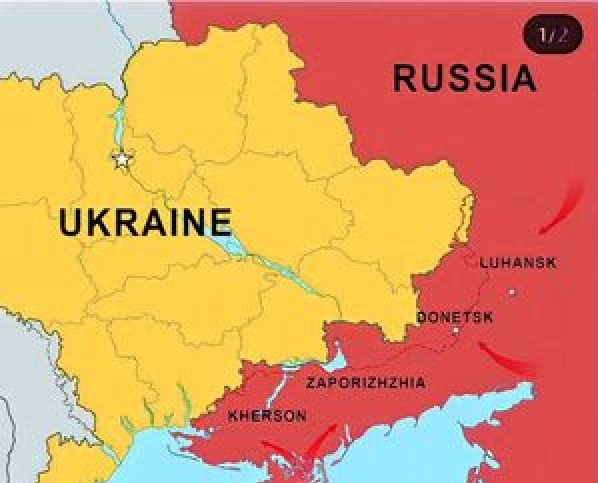
NATO, having overcommitted to Ukraine, now finds itself “on the horns of a dilemma” – if it continues to provide massive material and financial support to Ukraine, it will, in effect, become a direct party to the conflict, something no one in the bloc wants. However, if it backs away from supporting Ukraine, the various Western political leaders and institutions which have made support for Kiev a sacred obligation will be seen as going back on their word.
How NATO opts to proceed has yet to be manifest, but indications are that it will not be in a manner which continues to double down on supporting Ukraine no matter what
https://www.rt.com/russia/563788-referendums-ukraine-nato-dilemma/–-1 Oct 22,
Moscow is flipping the bloc’s script by moving to absorb Kiev’s lost lands, thus switching the fight to its own turf.
By infusing tens of billions of dollars’ worth of military aid into Ukraine, NATO produced a “game-changing” dynamic designed to throw Russia off balance. By undertaking the referendums in Kherson, Zaporozhye, Donetsk, and Lugansk, Russia changed the game altogether.
The ancient Greeks spoke of lemma as representing a logical premise, a matter taken for granted. This contrasted with a dilemma, or “dual premise”, where one would be presented with an either/or proposition. The Romans furthered this notion, referring to a “double premise” as argumentum cornutum, of the “horned argument,” because by answering one argument, an individual would be impaled by the logic of the second. Thus are the ancient roots of the modern idiom, “on the horns of a dilemma.”
This is the ultimate objective of maneuver warfare, for example: to position your forces in such a manner as to present the enemy with no good option – should they react to one pressing threat, they would find themselves overwhelmed by the other.
The Russian military operation that has been underway in Ukraine for more than seven months now has provided ample examples of the military forces of both sides being confronted with a situation that compelled them to alter their preferred course of action; the Russian “diversion” against Kiev early on in the SMO prevented the Ukrainians from reinforcing their forces in eastern Ukraine, and the recently concluded Ukrainian counteroffensive in Kharkov compelled a hasty Russian withdrawal from a significant swath of previously occupied Ukrainian territory.
Both examples cited presented one side with a lemma, or a single problem, which needed to be addressed. But neither was able to put its opponent “on the horns of a dilemma,” forcing a response which would result in impalement regardless of the option chosen. The reason for this is simple – very rarely will competent military commanders allow themselves to be presented with a military problem for which there is no viable response. War, it seems, is hard work, and dilemmas don’t fall from trees.
Or do they? Ever since Boris Johnston flew to Kiev in April to convince Ukrainian President Vladimir Zelensky to pull out of peace talks then ongoing with Russia in the Turkish city of Istanbul, NATO has embarked on a program designed to provide Ukraine with tens of billions of dollars in military and financial assistance, including the transfer of modern heavy weapons and the use of facilities on Western soil where tens of thousands of Ukrainian troops could be trained and organized without fear of Russian intervention.
The purpose behind the NATO infusion of weaponry into Ukraine was straightforward – to empower Ukraine to not only lengthen the conflict, but also to undertake offensive military operations designed to evict Russia from what Kiev and its backers consider occupied Ukrainian territory, including the Donbass and Crimea. The counteroffensive in Kharkov in early September underscored the serious consequences of NATO’s actions – even though, given the massive loss of life and material suffered by the attacking Ukrainian forces, made the Kharkov victory Pyrrhic in nature, it was a Ukrainian victory, and one which compelled a Russian retreat.
By transforming the Ukrainian army into a NATO army which was manned by Ukrainians, the US-led bloc had, in fact, changed the nature of the game from a straightforward Russia-versus-Ukraine “special military operation” into a “Russia-versus-the collective West” struggle where the military resources originally allocated by Moscow to the fight were now insufficient to the task.
Russia, however, was not taking the game-changing actions of NATO standing still. Responding to the new reality on the ground in Ukraine, Russian President Vladimir Putin opted not to simply up the ante in this new NATO-driven game of increasing military power but change the game altogether. Not only did he order the partial mobilization of some 300,000 Russian reservists to reinforce the troops currently committed to the SMO, Putin also approved referendums in the four territories where Russian forces are presently fighting – Kherson and Zaporozhye (formerly occupied Ukrainian regions), and Donetsk and Lugansk (former regions of Ukraine, de-facto independent since 2014). These referendums asked the citizens of these four territories one simple question: do you wish to become part of Russia?
After five days of voting, the results from all four territories were clear – by an overwhelming majority, the participants in the referendums approved the proposition. Shortly thereafter, they were incorporated into the Russian Federation. What was once Ukraine has now become Mother Russia
Russia didn’t just change the rules of the game – it changed the game itself. Instead of Ukrainian forces fighting Russian forces on the territory of Ukraine, any future combat carried out by Ukraine against Russian forces would represent an attack on the Russian homeland itself.
Where does this leave NATO? The bloc’s leadership has made it clear from day one that it is not seeking direct confrontation with Russia. While its members have poured in tens of billions of dollars of material into Ukraine to help reconstitute its military, and provided critical logistics, intelligence, and communications support to Ukraine, it has repeatedly and insistently stated that it has no desire to fight a war with Russia directly and has made it clear that it would rather have the Ukrainians serve as a de facto NATO proxy in resisting Moscow.
NATO has gone “all in” both economically and politically when it comes to supporting Ukraine, to the extent that some of its members, having stripped their respective military structures of equipment and material, have nothing left to give. Despite this, European political and economic elites continue to articulate their strong support for Ukraine going forward.
This support, however, was predicated on the fundamental assumption that by providing Ukraine with this massive level of support, NATO would not get directly involved in a conflict with Moscow. But Russia, by transforming the battleground from one being fought on Ukrainian soil to one where it’s now defending its own land, has flipped the script.
NATO, having overcommitted to Ukraine, now finds itself “on the horns of a dilemma” – if it continues to provide massive material and financial support to Ukraine, it will, in effect, become a direct party to the conflict, something no one in the bloc wants. However, if it backs away from supporting Ukraine, the various Western political leaders and institutions which have made support for Kiev a sacred obligation will be seen as going back on their word.
How NATO opts to proceed has yet to be manifest, but indications are that it will not be in a manner which continues to double down on supporting Ukraine no matter what. Secretary General Stoltenberg’s tepid speech condemning Russia while showing no enthusiasm for Zelensky’s “accelerated application” for membership is indicative of the less-than-resolute nature of its support for Kiev.
NATO now will find its role diminished by the consequences of the Russian mobilization and referendums. Years from now, when the history of the conflict is finally written, the decision by President Putin to simultaneously mobilize the Russian reserves while absorbing the territory of southern and eastern Ukraine into the Russian Federation will serve as one of the premier modern-history examples of putting an adversary “on the horns of a dilemma.” The effective neutering of NATO by this action will more than likely be seen as a turning point in the conflict, one which sealed the fate of Ukraine in the face of an inevitable Russian victory.
King Charles abandoned plans to speak at Cop27 climate summit, now will not attend, on instruction from Prime Minister Liz Truss.
Liz Truss advised King Charles to stay away from Cop27 climate summit. The
King, a passionate environmental campaigner, has abandoned plans to attend
next month’s Cop27 climate change summit after Liz Truss told him to stay
away. He had intended to deliver a speech at the meeting of world leaders
in Egypt. Truss, who is also unlikely to attend the Sharm el-Sheikh
gathering, objected to the King’s plans during a personal audience at
Buckingham Palace last month.
Times 1st Oct 2022
King Charles III has reportedly abandoned plans to attend and deliver a
speech at the Cop27 climate change summit on the advice of Liz Truss. The
monarch, a veteran campaigner on environmental issues, had been invited to
the 27th UN climate change conference in Sharm el-Sheikh, Egypt, next
month. But the prime minister is understood to have raised objections
during a personal audience at Buckingham Palace last month, according to
the Sunday Times. Buckingham Palace has confirmed King Charles III will not
attend the summit.
Guardian 1st Oct 2022
Zaporizhzhia nuclear plant director general detained by Russian patrol
A Russian patrol has detained the director general of Ukraine’s
Russian-occupied Zaporizhzhia nuclear power plant, the state-owned company
in charge of the plant said on Saturday, and the U.N. nuclear watchdog said
Russia had confirmed the move. Ihor Murashov was detained on his way from
the nuclear plant, Europe’s largest, to the town of Enerhodar at around 4
p.m. (1300 GMT) on Friday, the head of state-owned Energoatom, Petro Kotin,
said in a statement.
Reuters 1st Oct 2022
Russia’s oil and gas sanctioned, – but its profitable nuclear trade allowed to roll on!
Russia’s nuclear trade with Europe flows despite Ukraine war. European
Union nations are continuing to import and export nuclear fuel that is not
under EU sanctions on Russia. While the European Union has agreed to
curtail its use of Russian oil and gas, its member nations continue to
import and export nuclear fuel that is not under EU sanctions — to the
chagrin of the Ukrainian government and environmental activists.
A cargo ship carrying uranium that departed from the French port of Dunkirk
traveled across the North Sea on Thursday, heading toward the Russian
Baltic port of Ust-Luga. It was the third time in just over a month that
the Panama-flagged Mikhail Dudin ship docked in Dunkirk to transport
uranium from or to Russia.
Environmental group Greenpeace France denounced
the ongoing shipments and called for stopping all trade in nuclear fuel,
which it said was “financing the war in Ukraine, extending (Europe’s)
energy dependence and delaying the transition to renewable energy.” The
EU’s executive arm, the European Commission, did not propose targeting
Russia’s nuclear sector in its latest sanctions package presented
Wednesday.
ABC News 29th Sept 2022
Giant pensions group Phoenix considers investing in nuclear, but wary of the financial risks
One of Britain’s biggest investors is preparing to back the
Government’s plans for a nuclear renaissance, but only if ministers
overhaul the funding model that previously led to the collapse of proposed
power stations. Andy Briggs, chief executive of pensions giant Phoenix
Group, said he has been in talks with the Government about investing in
nuclear power infrastructure and is exploring how it could support the
creation of new plants.
His support is unusual for the industry, with
pension companies traditionally avoiding nuclear because of the huge
up-front costs involved. However, Mr Briggs also warned that ministers need
to give private sector investors greater clarity on returns around the
investment if the FTSE 100 company is to back future projects. He said:
“We’re in ongoing dialogue regularly [with Government] on this. To
date, we haven’t made significant investments into nuclear, [but] it’s
something we would consider.”
Under the new proposed model, companies
building plants would be paid during the construction phase, cutting down
their development risk and allowing them to secure cheaper financing. Mr
Briggs said: “There’s definitely risks associated with it so we would
need to be comfortable that there’s a robust and safe model around it. It
seems to us likely that it will form part of the [energy] solution going
forward provided it’s done safely and sensibly. “It’s about getting
clarity on the model around it…but it’s definitely an area of potential
interest where there may be attractive returns in long-term, illiquid
assets.”
Telegraph 2nd Oct 2022
https://www.telegraph.co.uk/business/2022/10/02/pension-titan-vows-back-nuclear-power-renaissance/
Sanctions against Russian exports – but that doesn’t apply to NUCLEAR EXPORTS, (while they bring in funding for Russia’s war!)

ED note. When will they all wake up? The nuclear industry is essential for the nuclear weapons so beloved by the governments that have them.
Keeping the nuclear industry going is essential for the wealth, power and influence of the global nuclear lobby, and the future of all their crackpot super-costly ‘advanced’ nuclear gimmicks.
Apparently we can all accept cutting back gas, oil, food ……. but must not let anyone curtail that sacred cow – the nuclear industry
Russia’s nuclear trade with Europe flows despite Ukraine war, By SYLVIE CORBET, September 30, 2022,
PARIS (AP) — While the European Union has agreed to curtail its use of Russian oil and gas, its member nations continue to import and export nuclear fuel that is not under EU sanctions — to the chagrin of the Ukrainian government and environmental activists.
A cargo ship carrying uranium that departed from the French port of Dunkirk traveled across the North Sea on Thursday, heading toward the Russian Baltic port of Ust-Luga. It was the third time in just over a month that the Panama-flagged Mikhail Dudin ship docked in Dunkirk to transport uranium from or to Russia.
Environmental group Greenpeace France denounced the ongoing shipments and called for stopping all trade in nuclear fuel, which it said was “financing the war in Ukraine, extending (Europe’s) energy dependence and delaying the transition to renewable energy.”
The EU’s executive arm, the European Commission, did not propose targeting Russia’s nuclear sector in its latest sanctions package presented Wednesday.
“France ensures strict compliance by economic players with all the European sanctions adopted against Russia. Civil nuclear power is not affected by these sanctions,” the French Foreign Affairs Ministry told the Associated Press.
The ministry that EU nations “did not consider this to be a relevant area for ending Russian aggression against Ukraine.”
Ukraine, meanwhile, is pushing for European sanctions in that area. The Ukrainian president’s economic adviser, Oleg Ustenko, said Wednesday that “in terms of uranium, we think it’s extremely important to impose sanctions, not only on Russian oil.”
“Oil, gas, uranium and coal, all this should be banned. Because they are using this money in order to finance this war,” Ustenko said.
According to Greenpeace France, reprocessed uranium meant to be transported to Russia were loaded onto the Mikhail Dudin on Wednesday. Pauline Boyer, an energy campaigner at Greenpeace France, said the ship’s repeated trips between Russia and France show “the extent to which the French nuclear industry is trapped in its dependence on Russia.”
French authorities have repeatedly said the country does not depend on Russia to supply the nuclear power plants that provide 67% of its electricity — more than any other nation………………………………………..
The Lingen plant is operated by Framatome, which is majority-owned by French utility giant EDF. It is supplying nuclear fuel to plants in France, Belgium, Switzerland, the Netherlands, Britain, Spain, Sweden and Finland.
Faced with activists’ protests, the German government took a critical view toward the uranium shipment but said it couldn’t stop the fuel from being processed because it isn’t covered by the EU’s war-related sanctions on Russia.
At the end of last month, enriched uranium unloaded from the Mikhail Dudin in Dunkirk was destined for the Rhone valley in southern France, which is home to major sites of the French civil nuclear industry, according to Greenpeace France.
The French nuclear sector has a series of contracts with Russian state-controlled energy giant Rosatom, including some to import enriched uranium destined for European nuclear power plants and to export reprocessed uranium to Russia. Rosatom is one of the world’s biggest actors in the nuclear energy market.
Multinational company Orano, headquartered in France, has a contract with Rosatom to buy reprocessed uranium to convert it into nuclear fuel at its Seversk plant, in Siberia, and ultimately use it in reactors to produce energy.
The U.S. power industry also imports uranium from Russia to feed its nuclear plants.
AP recently tracked millions of dollars worth of shipments of radioactive uranium hexafluoride from Russian state-owned Tenex JSC, the world’s largest exporter of initial nuclear fuel cycle products, to Westinghouse Electric Co. in South Carolina. https://apnews.com/article/russia-ukraine-france-global-trade-only-on-ap-business-c521f2248c823f69f0a677735a78e89d
U.S. has not seen acts indicating Russia contemplating nuclear attack
U.S. has not seen acts indicating Russia contemplating nuclear attack
WASHINGTON, Sept 30 (Reuters) – The United States has not yet seen Russia take any action that suggests it is contemplating the use of nuclear weapons amid its invasion of Ukraine, U.S. Secretary of State Antony Blinken said on Friday, despite what he called “loose talk” by Russian President Vladimir Putin about their possible use.
“We are looking very carefully to see if Russia is actually doing anything that suggests that they are contemplating the use of nuclear weapons. To date, we’ve not seen them take these actions,” Blinken told a news conference in Washington with his Canadian counterpart.
“This kind of loose talk about nuclear weapons is the height of irresponsibility and it’s something that we take very seriously,” Blinken said.
Putin on Friday proclaimed Russia’s annexation of a swathe of Ukraine, the biggest annexation in Europe since World War Two. Putin also vowed to press ahead with what he calls a “special military operation” in Ukraine. Russia launched its invasion in February.
In recent weeks, Putin explicitly warned the West that Russia would use all available means to defend Russian territory and accused the West, without offering evidence, of discussing a potential nuclear attack on Russia. Putin on Friday said the United States had set a precedent when it had dropped two atomic bombs on Japan in 1945, but stopped short of issuing new nuclear warnings against Ukraine.
Pentagon spokesperson Brigadier General Patrick Ryder this week said the United States had not seen any changes that would lead it to alter the posture of American nuclear forces.
Putin controls the world’s largest nuclear arsenal, including a new generation of hypersonic weapons and 10 times more tactical nuclear weapons than the West.
Reporting by Simon Lewis and Humeyra Pamuk; Editing by Chizu Nomiyama and Will Dunham
“Eva Bartlett describes Ukraine’s unspeakable genocide of Donbass FULL INTERVIEW (Graphic Content Warning)”
nterview I did on Redacted on September 22.
**Warning: This video contains graphic images of civilians killed by Ukrainian shelling of completely civilian areas of Donetsk.**
Swiss Government wants command centre in case of ‘nuclear event’

Government wants command centre in case of ‘nuclear event’
The Swiss government on Friday laid out responsibilities in case of a nuclear attack or nuclear disaster linked to the war in Ukraine. September 30, 2022
While the defence ministry currently considers this unlikely, the government says it is necessary to be prepared and be able to react rapidly.
It has tasked the defence ministry to set up a Federal Strategic Command Staff if there were to be such an event or it looked likely. This Command Staff will be headed by the secretary-general of the defence ministry and include the secretary generals of all the ministries, the federal government spokesperson, heads of the federal health, civil defence, energy and other key offices as well as representatives of the army, police and fire brigade…………………..more https://www.swissinfo.ch/eng/politics/government-sets-chain-of-command-in-case-of–nuclear-event-/47943850
NATO chief throws cold water on Ukraine’s bid to join NATO
NATO Secretary General Jens Stoltenberg condemned Russia’s move to take over the Donbass, but also threw cold water on Ukraine’s bid to join NATO. 30 Sept 22 “……………………………………………………………………………….Neither side will be getting exactly what they want anytime soon. On Friday, Ukrainian President Volodymyr Zelenskyy announced that Ukraine would seek a “fast-track” application to join NATO. “De facto, we have already made our way to NATO. De facto, we have already proven compatibility with the Alliance’s standards. They are real for Ukraine—real on the battlefield and in all aspects of our interaction,” Zelenskyy said.
Stoltenberg, when asked about the application on Friday, answered as he has in previous engagements, without making any promises and referring to NATO’s rule that “membership, of course, has to be taken by all 30 allies and we take these decisions by consensus.”
That consensus seems a long way off. Hungary is openly opposed to Ukrainian membership and even Germany and France—allies who are supporting Kyiv’s fight against the Russian invaders—have opposed it in the past.
U.S. National Security Advisor Jake Sullivan said that Ukraine’s NATO bid should be taken up “at a different time.” ………………. https://www.defenseone.com/threats/2022/09/nato-chief-slams-russias-nuclear-blackmail-remains-cool-ukraines-membership-bid/377906/
Amid increased threats to military and civilian targets, Sweden increases security around nuclear power stations
Sweden has stepped up security around two nuclear power stations after the
bombing of two subsea gas pipelines in the Baltic. The national security
agency said the threat to military and civilian targets had “broadened
and deepened” and that it was taking additional measures to protect the
reactors at Forsmark, north of Stockholm, and Ringhals, south of
Gothenburg.
Norway promised to make its armed forces “more visible”
around oil and gas installations after the suspected attack on the Nord
Stream 1 and 2 pipelines from Russia to Germany. This morning Nato said the
damage had been caused by “deliberate, reckless and irresponsible acts of
sabotage” after a fourth leak was detected in the waters of Sweden’s
maritime economic zone, meaning that all four pipelines along the Nord
Stream route have been disabled within days.
Times 29th Sept 2022
EU parliamentarian calls to sanction Vanessa Beeley and all observers of Donbass referendums

(The Western) narrative would have reigned supreme if not for the hundred or so international observers who physically traveled to the regions in question to observe the referendum process.
Observers like Vanessa Beeley now face the threat of returning home to the West as wanted outlaws.
“Imposing sanctions on global citizens for bearing witness to a legal process that reflects the self-determination of the people of Donbass is fascism. Should the EU proceed with this campaign, I believe there will be serious consequences because the essence of freedom of speech and thought is under attack.“
In London, meanwhile, the UK government has imposed individual sanctions on Graham Philips, a British citizen and independent journalist, for his reporting from Donetsk.
MAX BLUMENTHAL AND ANYA PARAMPIL·SEPTEMBER 29, 2022,
MEP Nathalie Loiseau of France is lobbying for individual sanctions on all observers of the Russian-organized referendums in the Donbass region. She has singled out journalist Vanessa Beeley not only for her coverage of the vote, but for her reporting on the foreign-back war against Syria’s government.
A French Member of European Parliament (MEP), Natalie Loiseau, has delivered a letter to EU High Representative of Foreign Affairs, Joseph Borrell, demanding the European Union place personal sanctions on all international observers of the recent votes in the Donetsk and Lugansk People’s Republics and certain Russian-controlled territories in eastern Ukraine.
Obtained by The Grayzone from an EU source, the letter is currently being circulated among European parliamentarians in hopes of securing a docket of supportive signatures.
“We, as elected members of the European Parliament, demand that all those who voluntarily assisted in any way the organization of these illegitimate referendums be individually targeted and sanctioned,” Loiseau declared.
The French MEP’s letter came after a group of formally Ukrainian territories held a vote on whether or not to officially incorporate themselves into the Russian Federation in late September. Through the popular referendum, the independent Donetsk and Lugansk People’s Republics, which announced their respective successions from Ukraine in 2014 following a foreign-backed coup against the government Kiev, as well as the regions of Kherson and Zaporozhia, voted overwhelmingly in favor of joining the Russian Federation.
Loiseau singled out Vanessa Beeley, a British journalist who traveled to the region to monitor the vote. Extending her complaint well beyond the referendum, the French MEP accused Beeley of “continuously spreading fake news about Syria and acting as a mouthpiece for Vladimir Putin and Bashar el [sic] Assad for years.”
Loiseau, a close ally of French President Emanuel Macron, specifically demanded Beeley be “included in the list of those sanctioned.”
Beeley responded to Loiseau’s letter in a statement to The Grayzone: “Imposing sanctions on global citizens for bearing witness to a legal process that reflects the self-determination of the people of Donbass is fascism. Should the EU proceed with this campaign, I believe there will be serious consequences because the essence of freedom of speech and thought is under attack.
Russia’s referendums: drawing a line with NATO
In mid-September 2022, Beeley and around 100 other international delegates traveled to eastern Europe in order to observe a vote to join the Russian Federation in the regions of Kherson, Zaporozhia, and the independent republics of Lugansk and Donetsk.
Why did their presence trigger such an outraged response from Western governments? The answer lies in the recent history of these heavily contested areas.
The formally Ukrainian territories of Kherson and Zaporozhia fell under Russian control earlier this year as a result of the military campaign launched by Moscow in February, while the Donetsk and Lugansk People’s Republics declared their independence from the government in Kiev in 2014.
Russia began its special military campaign in Ukrainian territory on February 24. The operation followed Moscow’s decision that same week to formally recognize the independence of the Donetsk People’s Republic and Lugansk People’s Republic (the Donbass Republics) in Ukraine’s eastern Donbass region. Pro-Russian separatists in the Donbass have been embroiled in a bloody trench battle with the US-backed government in Kiev since 2014.
Ukraine’s civil conflict broke out in March 2014, after US and European forces sponsored a coup in the country that installed a decidedly pro-NATO nationalist regime in Kiev which proceeded to declare war on its minority, ethnically Russian population.
Following the 2014 putsch, Ukraine’s government officially marginalized the Russian language while extremist thugs backed by Kiev massacred and intimidated ethnic Russian citizens of Ukraine. In response, separatist protests swept Ukraine’s majority-Russian eastern regions.
The territory of Crimea formally voted to join Russia in March of that year, while the Donetsk and Lugansk Republics in Ukraine’s eastern Donbass region declared their unofficial independence from Kiev that same month. With support from the US military and NATO, Ukraine’s coup government officially declared war on the Donbass in April 2014, launching what it characterized as an “Anti-Terrorist Operation” in the region.
Russia trained and equipped separatist militias in Donetsk and Lugansk throughout the territories’ civil campaigns against Kiev, though Moscow did not officially recognize the independence of the Donbass republics until February 2022. By then, United Nations estimates placed the casualty count for Ukraine’s civil war at roughly 13,000 dead. While Moscow offered support to Donbass separatists throughout the 2014-2022 period, US and European governments invested billions to prop up a Ukrainian military that was heavily reliant on army and intelligence factions with direct links to the country’s historic anti-Soviet, pro-Nazi deep state born as a result of World War II.
Russia’s military formally entered the Ukraine conflict in February 2022, following Moscow’s recognition of the Donbass republics. While Russian President Vladimir Putin defined the liberation of the Donbass republics as the primary objective of the military operation, he also listed the “de-nazification” and “de-militarization” of Ukraine as a goals of the campaign. As such, Russian troops have since secured control of Ukrainian territories beyond the Donbass region, including the territories of Kherson and Zaporozhia.
Facing increased Western investment in the Kiev-aligned bloc of Ukraine’s civil war, authorities in the Donbass republics announced a referendum on membership in the Russian Federation in late September 2022, with Moscow-aligned officials in Kherson and Zaporozhia announcing similar ballot initiatives. Citizens in each territory proceeded to approve Russian membership by overwhelming majorities.
The results of the referendum not only threatened the government in Kiev, but its European and US backers. Western-aligned media leapt to characterize the votes as a sham, claiming Moscow’s troops had coerced citizens into joining the Russian Federation at the barrel of a gun. Their narrative would have reigned supreme if not for the hundred or so international observers who physically traveled to the regions in question to observe the referendum process.
Observers like Vanessa Beeley now face the threat of returning home to the West as wanted outlaws. But as Loiseau’s letter made clear, the British journalist was in the crosshairs long before the escalation in Ukraine.
Beeley among European journalists targeted and prosecuted for reporting from Donetsk
Vanessa Beeley was among the first independent journalists to expose the US and UK governments’ sponsorship of the Syrian White Helmets, a so-called “volunteer organization” that played frontline role in promoting the foreign-backed dirty war against Syria’s government through its coordination with Western and Gulf-sponsored media. Beeley also played an instrumental role in revealing the White Helmets’ strong ties to Al-Qaeda’s Syrian branch, as well as its members’ involvement in atrocities committed by Western-backed insurgents.
Beeley’s work on Syria drew harsh attacks from an array of NATO and arms industry-funded think tanks. In June 2022, the Institute for Strategic Dialogue (ISD), which receives funding from a variety of NATO states, corporations and billionaires, labeled Beeley “the most prolific spreader of disinformation” on Syria prior to 2020. (According to ISD, Beeley was somehow “overtaken” by The Grayzone’s Aaron Mate that year). The group did not provide a single piece of evidence to support its assertions.
Though Beeley has endured waves of smears, French MEP Natalie Loiseau’s call for the EU to sanction the journalist represents the first time a Western official has moved to formally criminalize her work. Indeed, Loiseau made no secret that she is targeting Beeley not only for her role as an observer of the referendum votes, but also on the basis of her opinions and reporting on Syria.
Loiseau’s push to issue personal sanctions against EU and US citizens comes on the heels of the German government’s prosecution of independent journalist Alina Lipp. In March 2020, Berlin launched a formal case against Lipp, who is a German citizen, claiming her reporting from the Donetsk People’s Republic violated newly authorized state speech codes.
Prior to Lipp’s prosecution, the Institute for Strategic Dialogue launched a media campaign portraying her as a disseminator of “disinformation” and “pro-Kremlin content.”
In London, meanwhile, the UK government has imposed individual sanctions on Graham Philips, a British citizen and independent journalist, for his reporting from Donetsk.
And in Brussels, Loiseau’s campaign against Beeley appears to have emerged from a deeply personal vendetta.
Who is Natalie Loiseau?
In April 2021, Beeley published a detailed profile of Loiseau at her personal blog, The Wall Will Fall, painting the French MEP as a regime change ideologue committed to “defending global insecurity and perpetual war.”…………………………………..more https://thegrayzone.com/2022/09/29/eu-parliamentarian-sanction-vanessa-beeley-donbass-referendums/
Poland starts handing out anti-radiation tablets as battle rages around Ukraine nuclear power plant.
- Fears of nuclear exposure have raised in Poland with on-going war in Ukraine
- Neighbouring Zaporizhzhia nuclear power plant in Ukraine is Europe’s largest
- Officials described the move as a ‘preventative’ and ‘preemptive’ measure
- Comes as Putin vows to use ‘all forces’ to protect new annexed regions
Daily Mail, By SUMMER GOODKIND FOR MAILONLINE, 1 October 2022,
Polish officials have started handing out anti-radiation tablets nationwide, as fears grow of nuclear exposure triggered by the war in neighbouring Ukraine.
Fire departments have been handed the tablets as a response to the current fighting around Ukraine’s Zaporizhzhia nuclear power plant – Europe’s largest – which has raised fears of a nuclear disaster.
Officials described the move as a ‘preventative’ and ‘preemptive’ measure………………………………..
The medical representative at the press conference, Doctor Wojciech Zgliczynski, cautioned against taking anti-radiation tablets except when necessary.
He added that children, youths, pregnant women and breast-feeding mothers were most at risk of getting cancer from exposure to radiation.
Pobozy said the potassium iodide tablets were a preventative measure in case of a nuclear accident but would not help in response to a tactical nuclear weapon attack.
Under that scenario ‘entirely different isotypes are released, ones against which there is unfortunately no tablet to protect us,’ he told reporters.
He stressed however that compared to a nuclear accident, an attack was ‘even less likely’. https://www.dailymail.co.uk/news/article-11267671/Poland-starts-handing-anti-radiation-tablets-battle-rages-Ukraine-nuclear-power-plant.html
Russia open to in-person talks with U.S. on nuclear arms treaty
https://ca.news.yahoo.com/russia-open-person-talks-u-134957998.html Thu, September 29, 2022,
MOSCOW (Reuters) – Russia said on Thursday it was studying the possibility of a face-to-face meeting between Russian and U.S. negotiators on a landmark nuclear arms control treaty.
In a briefing in Moscow, Foreign Ministry spokeswoman Maria Zakharova said Russia was open to reviving inspections under the New START treaty and considering the possibility of in-person meetings of a joint commission of representatives from the United States and Russia.
Physical inspections under the treaty have been suspended since 2020, initially as a result of the coronavirus pandemic.
“The topic of resuming them is being considered,” Zakharova said on Thursday. “The possibilities for holding a face-to-face session of the bilateral advisory commission are being studied.”
The treaty sets limits on the number of nuclear arms each side can have deployed, and outlines the terms for verification and inspection of each other’s nuclear arsenals.
Moscow said in August it was considering a new meeting of the commission, as well as a possible resumption of negotiations to extend the treaty, one of the few major diplomatic agreements that remain in place between Moscow and Washington as relations hit rock-bottom over the conflict in Ukraine.
(Reporting by Reuters; Editing by Kevin Liffey)
1 This Month





PLEASE OPPOSE HR 8255 AND S.3639 – bills would accelerate satellite deployment, with no environmental review or safeguards – https://ncstd5li.quorum.us/campaign/169331/
To see nuclear-related stories in greater depth and intensity – go to https://nuclearinformation.wordpress.com
-
Archives
- October 2026 (74)
- September 2026 (339)
- August 2026 (330)
- July 2026 (355)
- June 2026 (287)
- May 2026 (306)
- April 2026 (356)
- March 2026 (251)
- February 2026 (267)
- January 2026 (308)
- December 2025 (358)
- November 2025 (359)
-
Categories
- 1
- 1 NUCLEAR ISSUES
- business and costs
- climate change
- culture and arts
- ENERGY
- environment
- health
- history
- indigenous issues
- Legal
- marketing of nuclear
- media
- opposition to nuclear
- PERSONAL STORIES
- politics
- politics international
- Religion and ethics
- safety
- secrets,lies and civil liberties
- spinbuster
- technology
- Uranium
- wastes
- weapons and war
- Women
- 2 WORLD
- ACTION
- AFRICA
- Atrocities
- AUSTRALIA
- Christina's notes
- Christina's themes
- culture and arts
- Events
- Fuk 2022
- Fuk 2023
- Fukushima 2017
- Fukushima 2018
- fukushima 2019
- Fukushima 2020
- Fukushima 2021
- general
- global warming
- Humour (God we need it)
- Nuclear
- RARE EARTHS
- Reference
- resources – print
- Resources -audiovicual
- Weekly Newsletter
- World
- World Nuclear
- YouTube
-
RSS
Entries RSS
Comments RSS

