Poland picks nuclear power that the International Energy Agency says is “stagnating or in decline”
Poland won’t get energy security from three Westinghouse reactors. It probably won’t even get the reactors. What it will get, however, is junior membership in the Nuclear Club
The love of three lemons, https://beyondnuclearinternational.org/2022/11/06/the-love-of-three-lemons/ By Linda Pentz Gunter, 5 Nov 22,
Congratulations must go to Poland — and to US vice president, Kamala Harris, and US energy secretary, Jennifer Granholm for brokering the deal — for its commitment to purchase a triad of American nuclear lemons.
With breathtaking myopia, the Polish government has signed a deal to partner with the US company, Westinghouse, in the construction of three nuclear reactors in Poland.
Apparently, everyone concerned is happy to ignore the fact that Westinghouse was bankrupted by its disastrous nuclear projects in South Carolina and Georgia. The former was canceled mid-construction and the latter, at Plant Vogtle, is now years behind schedule and well beyond its originally predicted 2016 start-up date, with ever-ballooning cost over-runs that have now topped $30 billion.
Also overlooked was that former Westinghouse Electric Company Senior Vice President, Jeffrey A. Benjamin, was charged with 16 felony counts including conspiracy, wire fraud, securities fraud, and causing a publicly-traded company to keep a false record, over the company’s handling of its now canceled V.C. Summer 2-reactor project in South Carolina.
The official reason that long-shelved plans to build nuclear reactors were suddenly revived is that the war in Ukraine has caused energy shortages in heavily fossil fuel-dependent Poland. But, tellingly, another reason given was Poland’s “lack of immediate renewable substitutes”.
Like France with its nuclear power monopoly, Poland’s reliance on coal and gas stifled renewable energy development. Now there is nowhere else to turn. France is similarly stranded and is importing fossil fuel energy and even reopening closed coal plants.
The backward turn by France in climate mitigation was effectively caused by prioritizing nuclear power for so many decades. Added to that, its aging nuclear reactor fleet is now breaking down with remarkable alacrity — at various times recently more than half of all French reactors have been out of operation. It’s a perfect demonstration of why the nuclear choice is a rash and unreliable one, even without addressing all the inherent dangers and waste issues.
The Polish decision to partner with a bankrupt company that has a track record of failure to deliver on time or on budget, as well as criminal activity, certainly seems like a bizarre choice. So perhaps there is another agenda afoot here?
Poland’s unhappy history of invasion, occupation and shifting boundaries puts the country in a uniquely vulnerable position. Once behind the Iron Curtain and a member of the Warsaw Pact, Poland is now an enthusiastic member of NATO and outspokenly critical of Russia’s invasion of Ukraine. Its multiple shared borders include Ukraine as well as Russian ally, Belarus.
In announcing the Westinghouse contract with Poland, the U.S. State Department called it “a watershed moment in advancing European energy security”.
Polish government spokesman, Piotr Müller, echoed this when he said: “Nuclear energy will be an important element of Poland’s energy security”.
The International Energy Agency defines energy security as “the uninterrupted availability of energy sources at an affordable price”. But, more revealingly, it describes electricity security thus:
“Variable renewable generation has already surged over the past decade, driven by cost reductions and favorable policy environments, a trend that is set to continue and even accelerate in line with climate change objectives. Meanwhile, conventional power plants, notably those using coal, nuclear and hydro, are stagnating or in decline.” [emphasis added]
Poland won’t get energy security from three Westinghouse reactors. It probably won’t even get the reactors. What it will get, however, is junior membership in the Nuclear Club. In possession of nuclear materials, technology, personnel and know-how, it will join other aspirational nations developing nuclear power, not because they need it or can even afford it, but because it delivers some sort of absurd prestige. Not quite a member of the Big Nine — the actual nuclear weapon states — Poland will at least arrive on the doorstep.
In early October, President Andrzej Duda, even said that he had asked to have US nuclear weapons stationed on Polish territory, although the US government denied receiving any such request. None of this is coincidence or unconnected.
The UN Treaty on the Prohibition of Nuclear Weapons, now supported by a majority of the world’s countries, works hard to stigmatize nuclear weapons. We need to do the same for nuclear power. Otherwise it serves as the nuclear drawbridge that is never raised.
Linda Pentz Gunter is the international specialist at Beyond Nuclear and writes for and curates Beyond Nuclear International.
France, depending on nuclear power, now imports more electricity than it exports

Nuclear power provides 70pc of French electricity. The failure to replace
ageing infrastructure has left more than half of the 56 reactors out of
service as the worst winter in living memory approaches.
EDF, whichnoperates the plants, has been nationalised and, for the first time in
decades, France is importing more energy than it exports, only narrowly
avoiding blackouts so far. For the foreseeable future, the country has not
only been overtaken by Sweden as Europe’s leading electricity exporter,
but has lost its vaunted reputation for energy security.
Telegraph 6th Nov 2022
https://www.telegraph.co.uk/business/2022/11/06/how-france-became-trapped-spiral-chaos-decline/
Does the UK need new nuclear plants like Sizewell C to reach net zero?
Does the UK need new nuclear plants like Sizewell C to reach net zero?
With the cost of renewables and batteries plummeting, some academics argue
that the UK doesn’t need to build new nuclear power stations to achieve its
net zero goal.
Eight months ago, the UK government made a big bet on
nuclear, promising to treble the size of the country’s nuclear fleet
between now and 2050. Delivering on that promise would require huge
investment in both large-scale new nuclear plants and small-scale modular
reactors. This follows years of government delay and prevarication.
Ministers at the time told the public this push for nuclear was essential
to achieve the UK’s aim to have net-zero carbon emissions by 2050.
That nuclear-fuelled zero-carbon future could now be in doubt, according to news
reports. A government official told the BBC that plans for the nuclear
power plant Sizewell C, which would supply around 7 per cent of the UK’s
electricity, are “under review” as the government looks to cut
spending.
The prime minister’s spokesperson later denied that it was
under review, saying that negotiations with private firms over funding were
ongoing and the government “hoped to get a deal over the line as soon as
possible”.
However, some academics are questioning whether new nuclear is
even necessary. For years it has been energy orthodoxy to argue that
nuclear will be an essential component of the UK’s energy mix to meet its
net zero goal. Wind and solar would supply most of the country’s energy,
so the thinking went, but some back-up power would be needed for when the
wind doesn’t blow and the sky is cloudy. It is an argument broadly
accepted by the UK government, the Climate Change Committee that advises it
and, reluctantly, many environmental campaigners.
But that is now changing,
says James Price at University College London, author of a study published
in September that suggests the government’s backing for new nuclear is
“increasingly difficult to justify”
New Scientist 4th Nov 2022
Councillor wants to know why there has been an increase in radioactive particles found on Dounreay foreshore.
A Caithness councillor wants to know
why there has been an increase in the number of radioactive particles found
on the foreshore at Dounreay this year. Struan Mackie, a Thurso and
Northwest Caithness Highland councillor and chairman of the Dounreay
Stakeholder Group (DSG), made the call after 15 irradiated particles were
discovered on the foreshore area between February and March. It is
understood to be the highest number since 17 were found in 1996.
Mr Mackie
said: “We wish to ascertain why there has been an increase in particle
detections and whether this was preventable. “Regular public updates are
provided to the Dounreay Stakeholder Group through our Site Restoration
sub-group, and it is of the utmost importance that these matters are dealt
with in a robust but transparent manner.”
Dounreay confirmed there has been
an increase in the number of particles found on the foreshore. A
spokeswoman said: “We closely monitor the environment around the site and
have seen an increase in particles found on the Dounreay foreshore this
year. “The foreshore is not used by the general public. We are looking at
wind and wave data to see if we can pinpoint a trend, and will report our
findings when they are complete. Safety is our number one priority and we
continue to monitor the foreshore on a regular basis.
John O’Groat Journal 4th Nov 2022
UK government might scrap Sizewell nuclear plan

A new nuclear power plant in Suffolk is under review and could be delayed or even axed, as the government tries to cut spending, the BBC has been told. Sizewell C was expected to provide up to 7% of the UK’s total
electricity needs, but critics have argued it will be expensive and take years to build. A new high speed rail line in the north of England could also be axed.
“We are reviewing every major project – including Sizewell C,” a government official told the BBC. The government is due to unveil its tax and spending plans under new Prime Minister Rishi Sunak at the Autumn
Statement on 17 November. Negotiations on raising funds for Sizewell C are understood to be ongoing. It is not expected to begin generating electricity until the 2030s. A Treasury spokesperson said delivering
infrastructure projects was “a priority”.
There was confusion on Thursday as executives at the French energy contractor EDF – already building a new plant at Hinkley in Somerset – and the Business and Energy department seemed blindsided by a potential change in tack on existing government policy, which promises to press ahead with both large and smaller scale nuclear projects. “As far we know, it’s still on”, said one nuclear industry executive close to the matter. New large-scale nuclear plants have been a key part of a government strategy to help reduce the UK’s reliance on fossil fuels. Boris Johnson whilst PM declared it was his intention to build eight new reactors in the next eight years.
A shift away from that position would represent a major change in UK energy policy that some will
lament and some will celebrate. But it would do little to convince investors in the UK – domestic and foreign – that they are dealing with a government with stable policy priorities.
BBC 4th Nov 2022
Attacks on Ukrainian nuclear-power plants challenge treaties, and raise other safety concerns

Researchers and policymakers must ask new questions. Are other locations at risk, given the projected global growth in nuclear energy?
As the crisis at the Zaporizhzhia plant worsens, international agreements need to be extended to ensure nuclear safety during war.
Nature Anthony Burke, 3 Nov 22,
This year marked the first time in which civilian nuclear-power facilities have come under attack during war. As Russian armed forces pushed into Ukraine in February, troops took control of the Chernobyl nuclear exclusion zone, where hundreds of people still manage the aftermath of the catastrophic 1986 meltdown. Thousands of vehicles stirred up radioactive dust as they moved towards Kyiv. Russian soldiers worked and slept in the deadly ‘red zone’ near the abandoned city of Pripyat.
In March, Russian armoured vehicles and tanks took control of the Zaporizhzhia power station — Europe’s largest nuclear power plant. Conditions rapidly deteriorated. Today, all six reactors are shut down. In August, Russia used artillery located at the plant to shell the city of Nikopol, provoking counterattacks from Ukrainian forces. As witnessed by an International Atomic Energy Agency (IAEA) team sent to report on the situation in September, shelling has disconnected main power lines, knocked out radiation-detection sensors and damaged water pipes, walkways, the fire station and the building housing fresh nuclear fuel and solid radioactive waste1. More power losses in October left backup diesel generators as the only electricity supply to keep fuel rods cool. External power was restored, only to be disrupted again by a landmine explosion. One wrong move, and another Chernobyl could be possible.
The international community must urgently address the inadequacy of nuclear-safety architecture, policy and preparedness.
The powers of the IAEA are limited. It has responded in a rapid and principled way to the crisis in Ukraine, after being unable to prevent the Fukushima disaster following the Tohoku earthquake in Japan in 2011. But the international Convention on Nuclear Safety — one of several treaties that the IAEA serves to reinforce — was never designed to grapple with the nightmare of nuclear-power stations coming under military attack. As a ‘soft-law’ instrument, it allows states to create their own regulatory mechanisms with weak international oversight.
Researchers and policymakers must ask new questions. Are other locations at risk, given the projected global growth in nuclear energy? How do Russia’s actions in Ukraine challenge the world’s commitment to the ‘peaceful uses’ of nuclear energy and to international mechanisms for countering nuclear-weapons proliferation? Can current treaties be adapted, or is a more robust legal architecture and rapid-response capability required? And how can political obstacles be overcome?
Unsafe conditions
Conditions at Zaporizhzhia are “not sustainable and could lead to increased human error with implications on nuclear safety”, the IAEA warned in September1. Ukrainian plant staff are working under duress after Rosatom, the Russian energy company, took control and a Russian holding company was established. Energoatom, Ukraine’s state nuclear-energy company, has reported that the plant’s deputy director and head of human resources have been detained and that others are being pressured to sign contracts with Rosatom. The plant’s director, Igor Murashov, was earlier arrested by Russian forces, interrogated and expelled from Russian-held territory.
The integrity of reactor cores and storage pools is the main concern. If fuel rods are exposed, a core meltdown and uncontrolled release of radiation is likely, as happened at Fukushima, Chernobyl and Three Mile Island in Pennsylvania in 19792. “And so, one mine or one missile or whatever”, warned Ukraine’s energy minister Herman Halushchenko, “could stop the working of the generators and then you have one hour and probably 30 minutes, not more than 2 hours, before the reaction starts.”
Russian control of the plant also delayed the IAEA from conducting its required annual inspection, which is crucial for ensuring safety and verifying the secure disposal of nuclear fuel and preventing its diversion for military uses1.
Nuclear-power plants elsewhere in Ukraine are also under threat. Shelling has been reported at the Khmelnytskyy plant in Netishyn, and cruise missiles have overflown the South Ukraine plant in Yuzhnoukrainsk. And Ukraine’s energy infrastructure across the country is coming under attack, including substations linked to nuclear plants.………………………………….
‘Will they, won’t they – great uncertainty over government go ahead for Sizewell C.

It has been a day of mixed messages with reports in the national press and on the BBC that government funding for Sizewell C may be axed being contradicted by a statement issued from the Prime Minister’s office.
The Nuclear Free Local Authorities would sincerely like the costly Suffolk white elephant culled and the money spent instead on insulating cold and damp British homes to reduce energy demand and lower fuel bills. In a letter to Jeremy Hunt MP last month, the organisation urged the Chancellor to ‘leave Sizewell C well-alone’ and to withdraw from the £700 million commitment made by outgoing Prime Minister Boris Johnson and from the concordat agreed between Prime Minister Truss and President Macron to each take a 20% stake in the project.
As the estimated cost to completion is at least £30 billion, this represents a tremendous commitment of taxpayers’ cash, and there is considerable doubt over whether operator EDF Energy, already in huge debt, will be in a financial position to complete the plant or if private-sector players will step in to take the remaining 60% share. Nuclear power projects are notorious for being delivered late and massively over budget so the risk is great that Sizewell C will represent both a lumbering folly and a financial bottomless pit for beleaguered consumers, who would have to pick up the tab through a ‘nuclear tax’ levied through electricity bills.
For the NFLA then, there was great disappointment when in his response to the letter, Climate Minister Graham Stuart, said that ‘commercial discussions have been constructive but are ongoing, and no decisions have been made’ and in a statement made today, a spokesperson for the Prime Minister said ‘Britain’s Sizewell C nuclear power plant project is not being scrapped and negotiations on its funding are progressing’.
So optimistic noises that the project is on track, but there has been speculation that there is an ongoing internal conflict between Whitehall mandarins in the Treasury and the Department of Business Energy and Industrial Strategy as to whether Sizewell C should be in the mix as a project that must be cut alongside HS2 and the Northern Powerhouse Rail as part of the government’s plan to reduce the deficit by £35 billion as Britain enters a new recession.
For the NFLA then, there was great disappointment when in his response to the letter, Climate Minister Graham Stuart, said that ‘commercial discussions have been constructive but are ongoing, and no decisions have been made’ and in a statement made today, a spokesperson for the Prime Minister said ‘Britain’s Sizewell C nuclear power plant project is not being scrapped and negotiations on its funding are progressing’.
U.S. company Westinghouse wants to build a fleet of nuclear reactors in Europe, starting with Poland.
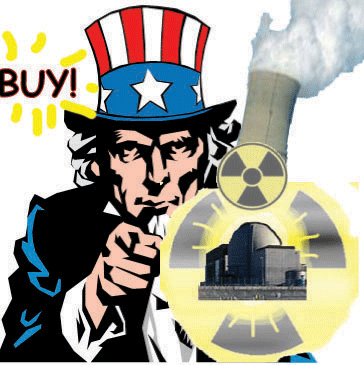
The Council of Ministers has formally approved the decision that the first
nuclear power plant in Poland will use three Westinghouse AP1000 reactors –
with the US company calling it an “historic day” as it looks to build a
fleet of the reactors in central Europe.
World Nuclear News 3rd Nov 2022
When it comes to a nuclear industry project – Europe puts no sanctions on Russia
Despite conflict, Russia sends France giant magnet for nuclear fusion project, Euractiv 4 Nov 22
Russia on Tuesday (1 November) dispatched one of six giant magnets needed for the ITER nuclear fusion programme in France, one of the last international scientific projects Moscow participates in despite the Ukraine conflict.
The ship carrying the Russian-made magnet – or “poloidal field coil” – departed Saint Petersburg on Tuesday under grey skies.
On board, the massive nine-metre-wide coil, which weighs 200 tonnes had been tightly wrapped to withstand a two-week trip to Marseille, southern France.
The ring-shaped magnet built under Russian atomic agency Rosatom’s supervision will make up the top part of the world’s largest “tokamak”.
The tokamak is a magnetic fusion device built in France following the same principle that powers our sun and stars.
The Russian piece was meant to leave in May but sanctions forbidding Russian ships docking in Europe delayed the departure.
Still, the “current situation did not change the fact that we will fullfil our obligations”, Rosatom representative for international projects Viacheslav Perchukov said.
Geopolitical tensions “practically did not affect the realisation of this project”, Perchukov said.
“Without (the Russian coil), the tokamak will not work,” senior ITER centre scientist Leonid Khimchenko told AFP……………………more https://www.euractiv.com/section/energy/news/despite-conflict-russia-sends-france-giant-magnet-for-nuclear-fusion-project/
French nuclear corporation EDF – facing huge debts, but cosily enmeshed with UK government
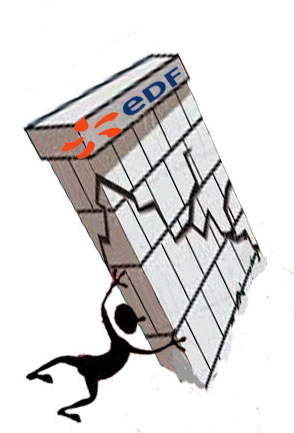
But what about the future? EDF is predicted to stack up 100 billion Euros (£87.8 billion) in debt this year and the French government already pumped €3 billion (£2.6 billion) into the company in Spring.
But as you’ll see below, no matter how bad things are there’s always room to give the CEO a pay rise.
In 2020, CEO Lévy was listed as the 9th highest-paid CEO in the utility sector worldwide taking home a salary of €450,000 (£389,500) and €3,660 (£3,150) in benefits.
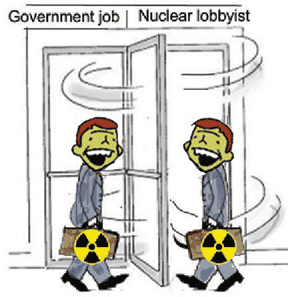
EDF has been getting cosier and cosier with the government.
And the cosiness isn’t set to end anytime soon, EDF stands in good stead under Liz Truss. The new PM nominated former EDF lobbyist Michael Stott as Downing Street’s new business liaison. Stott, who is also an ex-Tory press officer, is expected to lead the government’s new-build nuclear programme.
EDF: WHEN THE STATE GOES FULL CAPITALIST. https://newint.org/features/2022/10/31/edf-when-state-goes-full-capitalist 31 October 2022
What happens when a state energy company goes multinational? In the second installment of its Heat the Rich series on Britain’s big six energy giants, Corporate Watch puts the spotlight on EDF Energy.
EDF is the fifth biggest energy supplier in the UK currently controlling over 10% of the market. The French multinational is best known for “leading the UK’s nuclear renaissance” operating all eight of the UK’s nuclear power stations.
It’s owned by Electricity of France S.A. (Électricité de France, EDF). A multinational energy producer and supplier primarily (and soon to be solely) owned by the French government. It is one of the world’s top five utility companies.
Created in 1946 by the French government, EDF was set up with the intention of rebuilding France’s power grid following World War Two. Now, 70 years on, EDF has branched out a lot further than France, cashing in on energy users from the USA to India. The group is now made up of 144 subsidiaries.
Despite its name, EDF isn’t just in the energy business. EDF is also involved in the data software, vehicle traceability, investment, and real estate sectors, to name just a few.
EDF uses strategic partnership deals to build its brand, for example, the company is a ‘premium partner’ (and official energy supplier) for the Olympic and Paralympic Games in Paris in 2024.
HOW MANY UK ENERGY CUSTOMERS DOES EDF HAVE?
Electricity (excluding pre-payment): 3 million
Gas (excluding pre-payment): 2.1 million
WHO OWNS IT?
EDF Energy (UK) Ltd is ultimately owned by EDF SA, a French company which is majority owned (84%) by the French government and listed on Euronext, the French stock exchange.
In July 2022, the French government announced it would buy out the outstanding 16% of EDF’s shares, reversing the partial privatization of the company in 2005. But it hit a brick wall when investors threatened to sue the government for losses. The French state started finalising their buyout of 100% shares in EDF in September. But at what price? The other shareholders are demanding a fortune, with the government set to pay a total of 9.7 billion euros (£8.7 billion) of French taxpayers’ money. It’s worth noting that the shareholders set to cash in from this nationalization are investment giants Blackrock and Vanguard Group.
IS EDF SUFFERING AS A RESULT OF THE COST OF LIVING CRISIS?
On the face of it, it does seem like EDF profits have nose-dived in recent years. According to EDF Energy (UK) Ltd’s 2021 accounts, EDF operated a €4.8 billion (£4.2 billion) loss compared to €268 million (£239 million) in 2020. No dividends were paid by EDF Energy (UK) Ltd. in 2021 nor in 2020. However, another UK subsidiary, EDF Energy Holdings Ltd did pay dividends of £1 million in 2021, and £60 million in 2020.
Despite these losses, at the end of 2021 EDF Energy (UK) Ltd still had net assets of €17.9 billion (£16 billion).
Regardless of the UK subsidiary’s accounts, the EDF Group achieved all its financial targets in 2021. Group sales for the year amounted to £8,720m, an increase of 8%. The Group reaped profits of €360 million (£324 million) in 2021, a total reverse in performance from 2020 when the Group made a loss of €2.6 billion (£2.3 billion).
But what about the future? EDF is predicted to stack up 100 billion Euros (£87.8 billion) in debt this year and the French government already pumped €3 billion (£2.6 billion) into the company in Spring. But as you’ll see below, no matter how bad things are there’s always room to give the CEO a pay rise.
WHO RUNS EDF?
Jean-Bernard Lévy, the current CEO of the Group, is due to leave six months early after a fallout at the top between Lévy and French president, Emmanuel Macron, over nuclear energy. Lévy is – however – unlikely to be out of a job after EDF. He was formerly CEO of weapons company Thales, and media company Vivendi, and even did a stint as a technical adviser to a government ministry. In 2020, Lévy was listed as the 9th highest-paid CEO in the utility sector worldwide taking home a salary of €450,000 (£389,500) and €3,660 (£3,150) in benefits.
Moreover, Lévy’s probable successor, Luc Remont, cherrypicked by Macron (whose appointment is just waiting for parliamentary approval), will start on on a lucrative footing after the French Government announced that it would like to increase the new EDF CEO’s salary to attract more candidates. The company CEO’s salary is currently capped at €450,000 (£389,500). Whilst no figure has been publicly stated, the EDF Group is known to pay high salaries. In 2013 it was revealed that former UK CEO, Vincent de Rivaz, received a pay package of £1 million annually in remuneration.
Simone Rossi has been at EDF since 2004, Rossi switched roles from Head of the International Division to UK CEO in 2017. But Rossi’s influence goes far beyond the British Isles. As a member of the Executive Committee, Rossi is at the very top of the EDF Group. At first it appears Rossi accepted a big pay cut, with a 2017 payment package capped at just over £100,000. A modest salary in comparison to his predecessor, de Rivaz, who was on £1 million a year. But it is highly probable that Rossi’s remuneration is now identical to de Rivaz at £1 million, as the highest-paid director in EDF Energy Holdings Ltd.
EDF
It’s not just customers at the receiving end of EDF’s profit-led strategy. Kashmir Singh, a Prospect trade union organizer, has been fighting against workplace racism and discrimination for half a century. Singh was presented with a 50-year long-service award in 2021 by Simone Rossi. But Singh’s union released a statement explaining how, during his career, he had been subject to two grievance and disciplinary proceedings for daring to raise EDF’s failure to hire and promote staff from Asian or Black Ethnic (ABLE) backgrounds.
SUBSIDIARIES IN TAX HAVENS
EDF Energy (UK) Ltd owns EDF Energy Holdings Ltd, the top holding company for EDF’s UK subsidiaries. Whilst EDF Energy (UK)’s accounts from 2021 detail tax payments of €905m (£780m) of corporation tax in 2021, some of its subsidiaries are registered in notorious tax havens including a holdings company registered in Hong Kong and an insurance company in Guernsey.
Over the last two decades, EDF has funded the Conservative party to the tune of £38,499.
Most recently, last October EDF Energy Renewables Ltd donated £4,999 to the Conservative Tees Valley Mayor, Ben Houchen. And like clockwork, by March 2022, EDF announced its plan to construct a new hydrogen production centre near the former Redcar steelworks in Teeside. The centre is called Tees Green Hydrogen.
EDF also made two £6,000 in donations to the Labour Party in October 2003 and September 2005. The timing of these donations coincided with Labour PM Tony Blair’s announcement in November 2005 that the government was looking into new nuclear for the UK’s future energy supplies. This set the ball rolling for EDF’s £18 billion government contract for the construction of Hinkley Point C power station.
Over the last decade, EDF has been getting cosier and cosier with the government. The company has had at least five independent opportunities to promote its agenda in meetings with UK prime ministers, once with David Cameron and four times with Boris Johnson. Company representatives even had an intimate one-to-one with Johnson in January 2022 to chat about the UK’s nuclear energy supply, which EDF holds the monopoly over.
Since 2012, company representatives have also attended at least 151 meetings with government ministers, including 24 solo meetings with the former Secretary of State for Business, Energy and Industrial Strategy, Kwasi Kwarteng, who is now the Chancellor of the Exchequer, the person in charge of UK economic policy.
And the cosiness isn’t set to end anytime soon, EDF stands in good stead under Liz Truss. The new PM nominated former EDF lobbyist Michael Stott as Downing Street’s new business liaison. Stott, who is also an ex-Tory press officer, is expected to lead the government’s new-build nuclear programme.
Failure of the “nuclear renaissance” leaves Britain with super-costly closures of reactors, and electricity shortage
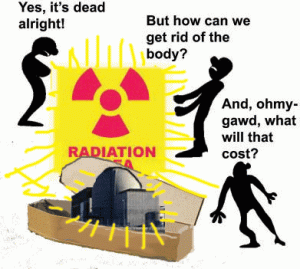
UK facing electricity supply woes after nuclear power stations shut, MPs told
Larger and smaller reactors carry risks, island nation failed to keep pace with nuclear fleet closure
Lindsay Clark, 1 Nov 2022 , Electricity shortages appear inevitable for the UK due to the decommissioning of the nation’s aging estate of nuclear power stations, according to evidence submitted by industry to politicians.
…….. Writing to the Commons Science and Technology Committee, Manchester University’s Dalton Nuclear Policy Group said: “Sadly, it is now much too late to avoid a negative impact on the UK’s electricity supply due to the closure of our nuclear fleet. All eleven of Britain’s Magnox plants have been shut down for many years – the last being the Wylfa plant on Anglesey which ceased operation on New Year’s Eve 2015.
It added: “The fleet of Advanced Gas-cooled Reactors (AGRs) operated by [French energy firm] EDF is also now seeing closures.”
In February, the UK government was warned taxpayers would have to make up a multibillion-pound shortfall to decommission nuclear power stations unless a history of overspending is reversed. EDF Energy runs seven AGR stations in the UK, part of eight second-generation reactors set to be decommissioned which provide 16 percent of the nation’s electricity. The AGR stations are scheduled to stop producing electricity by 2028.
Last year the government injected £5.1 billion ($5.8 billion) into the Nuclear Liabilities Fund – now valued at £14.8 billion ($17 billion) – which it set up in 1996 to meet the costs of decommissioning AGR and Pressurized Water Reactor stations. But EDF’s latest cost estimate to decommission the stations in March last year was £23.5bn ($27 billion). Public spending watchdog the National Audit Office has warned more money will be needed unless the government and EDF avoid overspending.
But as well as overspending, decommissioning also presents a problem for electricity supply.
“It is unlikely that there will be any significant extension to these projected dates, although there may be scope for some slight delays in closure. Once the AGRs are all closed, the UK will only have one reactor from the current nuclear fleet still operational – the pressurised water reactor at Sizewell B,” Dalton Nuclear Policy Group said.
……. “it is due to the failure since 2008 – with the exception of the long-delayed Hinkley Point C – of all proposals for a nuclear renaissance in the UK to move from plans to reality,” the group said.
In May, EDF admitted to another year’s delay and £3 billion ($3.5 billion) extra cost in Hinkely Point C – the UK’s first nuclear power station to be built in 20 years. The revised operating date for the site in Somerset is now June 2027 and total costs are estimated to be in the range of £25 billion to £26 billion ($29 billion).
EDF said it would have no cost impact on British consumers or taxpayers. The power station had been due online by 2017 at a cost of around £20 billion ($22 billion)………………….. The Science and Technology Committee is set to hear oral evidence for its inquiry on Delivering Nuclear Power during hearings this week.
The Register 1st Nov 2022
https://www.theregister.com/2022/11/01/electricity_shortages_uk/
Israeli finance minister added to Kiev’s ‘kill list’
Rt.com 31 Oct 22,
The Mirotvorets website labeled Avigdor Lieberman a “Russian agent of influence,” who took part in acts of “humanitarian aggression” against Ukraine
Israeli finance minister, Avigdor Lieberman has been added to the controversial Mirotvorets website “enemies of Ukraine” database on Sunday.
The authors of the site, which is believed to have links to the Ukrainian security services, described Lieberman as an “agent of influence” for Russia, who had been manipulating publicly significant information in favor of Moscow. They also blamed him for taking part in acts of “humanitarian aggression” against Ukraine.
Among the actions that led to Lieberman being placed on the list, were his refusal to finance an Israeli field hospital in Ukraine in March and his neutral stance on who is to blame for the massacre in the Kiev suburb of Bucha in April. The website also shared a link to an article, claiming that he had ties with Russian gas giant Gazprom.
Ukrainian authorities have frequently expressed their disappointment with the level of support they’ve been getting from Israel during the conflict with Russia. The country has only provided Kiev with humanitarian aid and life-saving defense equipment, but not weapons and munitions. Israel also refrained from joining international sanctions on Moscow. Last week, Liberman said that Israeli assistance to Ukraine since the outbreak of the fighting between Russia and Ukraine in late February amounted to some $40 million……………………………..
The Mirotvorets website, translated as ‘peacemaker’, was launched in 2014, positioning itself as an independent database run by anonymous moderators to help Ukrainian authorities and “special services” apprehend pro-Russian terrorists, separatists, and war criminals, among others.
However, some have branded the database a ‘kill list,’ which is backed by the government, after several individuals, including writer Oles Buzina, politician Oleg Kalashnikov, and Russian journalist Darya Dugina were assassinated shortly after their profiles appeared on the website.
The most recent high-profile additions to Mirotvorets included Kazakhstan’s president, Kassym-Jomart Tokayev, Pink Floyd co-founder Roger Waters. There were claims that the world’s richest man, Elon Musk, was put on the database in mid-October, but swiftly removed from it. The alleged addition happened after Musk offered a peace plan, which envisaged Kiev giving up territories to Moscow. https://www.rt.com/russia/565651-lieberman-israel-ukraine-mirotvorets/
US troops on the ground in Ukraine – media
https://www.rt.com/russia/565747-us-troops-in-ukraine/ 2 Nov 22, The military personnel are reportedly inspecting Western weapons deliveries.
American troops are on the ground in Ukraine, where they are monitoring NATO arms deliveries to the country, an anonymous Pentagon official told several US media outlets on Monday. It is unclear how many personnel are involved, or where they are located.
Speaking to the Associated Press, NBC News, and other members of the Pentagon press pool, the official said that the contingent of troops is led by Brigadier General Garrick Harmon, the US defense attache to Kiev.
“There have been several of these inspections,” the official told reporters, without revealing where the examinations have taken place. He added that the checks are not happening “close to the front lines,” but where security conditions allow.
The US inspected its arms shipments to Ukraine before Russia launched its military operation in February, but pulled its personnel out of the country days before it began. It is unclear how many troops have returned or when the checks restarted.
The Pentagon official would only say that a “small” number of troops are involved.
The US State Department announced last week that it would allocate “personnel to assist the government of Ukraine with handling…of US security assistance,” although it did not mention that these personnel would be drawn from the ranks of the military. The plan was announced after media reports, citing US intelligence agencies, claimed that Washington could not trace the weapons it sends to Ukraine.
One intelligence source told CNN in April that these weapons disappear “into a big black hole” once they enter the country. The anonymous Pentagon official told journalists that Kiev has been “transparent,” and has cooperated with inspectors thus far.
While Americans have fought and died in Ukraine of their own accord, Monday’s announcement marks the first time since February that Washington has acknowledged the presence of uniformed troops in Ukraine.
Russian President Vladimir Putin has cautioned the US and its NATO allies against getting involved in the conflict, and even before the announcement, he stated that the Kremlin views itself as fighting the “entire Western military machine” in Ukraine.
Finland hints at allowing NATO to station nuclear weapons (?targets) on its soil

https://euroweeklynews.com/2022/10/31/finland-hints-at-allowing-nato-to-station-nuclear-weapons-on-its-soil/ By Chris King • 31 October 2022 ,
The Prime Minister of Finland, Sanna Marin, hinted that nuclear weapons could be deployed on Finnish soil should the country’s application to join NATO be approved.
It was recently reported by a newspaper in Helsinki that nuclear weapons could soon be stationed on Finland’s border with Russia if the country’s bid to join NATO is approved. Should it come to that, it is bound to anger Moscow.
Nuclear missiles launched from the Finnish border would take far less than a minute to reach Moscow. That is a very short warning period. It is certain that the Kremlin will not like this at all, but it could soon become reality.
The reason: Finland – together with Sweden – submitted an application to join NATO in response to the Russian invasion of Ukraine. According to the Helsinki newspaper Iltalehti, the draft accession law, as submitted by the Finnish government to Parliament, does not include an exemption for nuclear weapons
Finnish Foreign and Defence Ministers Pekka Haavisto and Antti Kaikkonen both pledged to NATO in July that they would not seek ‘restrictions or national reservations’ if Helsinki’s proposal goes through. This was reported by various defence sources to exxpress.at.
Foreign policy insiders said that NATO nuclear weapons could be moved through Finnish territory or stationed there. In addition, there are no restrictions on establishing NATO bases in the country.
Finnish Prime Minister Sanna Marin told Finnish broadcaster Yle on Saturday 29: “I think it’s very important that we don’t set any preconditions or limit our own room for manoeuvre when it comes to permanent bases or nuclear weapons”. It is thought highly unlikely though that nuclear weapons would be stationed on Finnish soil.
According to the Federation of American Scientists, the US already has around 100 nuclear weapons in Europe. They are located in Belgium, Germany, Italy, the Netherlands, and Turkey. Britain and France, both NATO members, also maintain their own independent nuclear arsenals.
Earlier this month, the Polish government said it had held talks with Washington about hosting US nuclear weapons, but the Americans have not confirmed this. Polish President Andrzej Duda said there was a ‘potential opportunity’ for his country to engage in ‘nuclear sharing’.
NATO Secretary General Jens Stoltenberg welcomed Finland and Sweden’s applications for membership in May, calling the move a ‘historic moment’ for the alliance.
Nuclear gravity bomb more powerful than Hiroshima blast to be added to NATO’s arsenal
it makes using nuclear weapons thinkable for the first time since the 1940s and deploying the B61-12 only encourages this trend further………………….. The new bombs will be able to be dropped from numerous aircraft including B-2 stealth bombers, and smaller warplanes like the F-15, F-35 and Tornado.
The new B61-12 gravity nuclear bomb which can carry a yield more powerful than the Hiroshima blast will be delivered by the US to Europe months earlier than planned
By Rachel Hagan, World News Reporter, 28 Oct 2022
The US is speeding up the delivery of highly accurate guided tactical nuclear weapons to Europe by around four months as tensions rise between Moscow and the West.
The B61-12 gravity bomb was due for Spring 2023 but they are now accelerating plans to have it ready for this December, US officials told NATO allies during a closed-door meeting in Brussels this month.
But what are these weapons and what are they capable of?
The new thermonuclear bombs are “dial-a-yield” devices and are one of the most versatile in the US’ arsenal because its explosive power can be ramped up or down depending on the target.
Specialist defence magazine, the National Interest, called the bomb the most devastating nuclear bomb in the arsenal of the US……………………………
They say it makes using nuclear weapons thinkable for the first time since the 1940s and deploying the B61-12 only encourages this trend further………………….. The new bombs will be able to be dropped from numerous aircraft including B-2 stealth bombers, and smaller warplanes like the F-15, F-35 and Tornado.
1 This Month





PLEASE OPPOSE HR 8255 AND S.3639 – bills would accelerate satellite deployment, with no environmental review or safeguards – https://ncstd5li.quorum.us/campaign/169331/
To see nuclear-related stories in greater depth and intensity – go to https://nuclearinformation.wordpress.com
-
Archives
- October 2026 (67)
- September 2026 (339)
- August 2026 (330)
- July 2026 (355)
- June 2026 (287)
- May 2026 (306)
- April 2026 (356)
- March 2026 (251)
- February 2026 (267)
- January 2026 (308)
- December 2025 (358)
- November 2025 (359)
-
Categories
- 1
- 1 NUCLEAR ISSUES
- business and costs
- climate change
- culture and arts
- ENERGY
- environment
- health
- history
- indigenous issues
- Legal
- marketing of nuclear
- media
- opposition to nuclear
- PERSONAL STORIES
- politics
- politics international
- Religion and ethics
- safety
- secrets,lies and civil liberties
- spinbuster
- technology
- Uranium
- wastes
- weapons and war
- Women
- 2 WORLD
- ACTION
- AFRICA
- Atrocities
- AUSTRALIA
- Christina's notes
- Christina's themes
- culture and arts
- Events
- Fuk 2022
- Fuk 2023
- Fukushima 2017
- Fukushima 2018
- fukushima 2019
- Fukushima 2020
- Fukushima 2021
- general
- global warming
- Humour (God we need it)
- Nuclear
- RARE EARTHS
- Reference
- resources – print
- Resources -audiovicual
- Weekly Newsletter
- World
- World Nuclear
- YouTube
-
RSS
Entries RSS
Comments RSS

