France electricity prices surge past €1,000/MWh as more nuclear reactors close for winter
Wholesale electricity prices in France for the middle of winter surged
above €1,000/MWh ($A1,540/MWh) after the operator of the world’s biggest
nuclear fleet revealed more problems, and more outages at its reactors.
The surge in prices for January delivery came after the utility EdF reduced its
forecast output for the fourth time this year, on this occasion due to
extended outages at four reactors and maintenance delays at others caused
by the waves of strikes that have affected the nation this autumn. It also
dramatically reversed weeks of falling spot and futures prices as gas
stocks improved and the weather remained wild.
But as analysts noted in the height of summer, nuclear problems pose just as big a threat to the EU grid
as the gas problems.
Renew Economy 8th Nov 2022
‘It can’t go on like this’: Power restored to Ukrainian nuclear plant but situation untenable, says IAEA
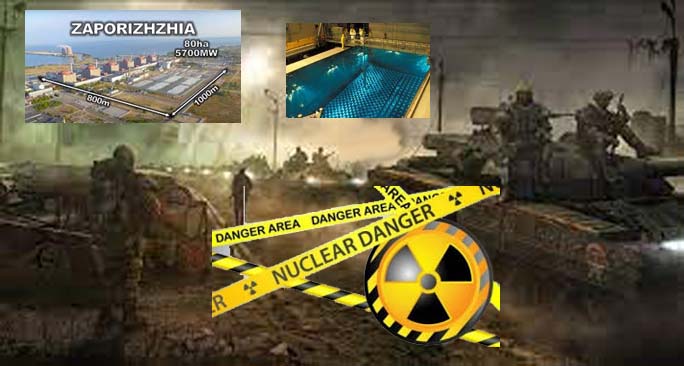
External power has been restored to Ukraine’s Zaporizhzhya Nuclear Power Plant (ZNPP) two days after it
experienced a complete blackout amid Russian shelling, the UN’s
International Atomic Energy Agency (IAEA) said on Saturday. Both of the
plant’s external power lines, a 750kV line and a 330kV back-up line, were
repaired on Friday, re-establishing power to the plant’s six reactors by
10pm.
The reactors have been shut down, although reactors 5 and 6 are in
semi-hot shutdown to provide steam to the site, and arrangements are being
made to further heat-up units 5 and 6 to achieve a “hot shutdown”
state. The other four units in Europe’s biggest nuclear plant remain in
cold shutdown. Ukrainian staff have operated the plant under Russian
occupation since March. The IAEA has had four experts embedded among the
Ukrainian staff since 5 September. It rotated a new team in on Thursday.
Last week, shelling damaged the last two high-voltage lines
connecting ZNPP to the country’s grid, putting it in full blackout mode and
necessitating the activation of all 20 of its diesel back-up generators.
The IAEA said the lines were damaged some 50-60 kilometres from the plant
in Ukrainian-controlled territory.
“The repeated power outages all too clearly demonstrate the extremely serious nuclear safety and security
situation this major nuclear power plant is facing,” said IAEA director
general Rafael Mariano Grossi. He continued: “So far, the brave staff of
the Zaporizhzhya Nuclear Power Plant have always managed to maintain the
safe operation of the six units. But it can’t go on like this. I have
repeatedly called for the urgent establishment of a nuclear safety and
security protection zone around the Zaporizhzhya Nuclear Power Plant to
prevent a nuclear accident. We can’t afford to lose any more time. We must
act before it is too late.”
Global Construction Review 7th Nov 2022
A disaster waiting to happen’: British nuclear-armed sub resurfaces after fire onboard
https://cnduk.org/a-disaster-waiting-to-happen-british-nuclear-armed-sub-resurfaces-after-fire-onboard/?fbclid=IwAR3t-FcdURBZY22Nmf7daG7zZm1F4OTGwxQEQ8hvq0X6RMAt6N9X6OdUgsE A Royal Navy nuclear-armed submarine had to abandon its mission and resurface, after a fire broke out onboard following an electrical fault.
The Ministry of Defence said the incident on HMS Victorious happened six weeks ago. The blaze broke out in an electrical component in one of the submarine’s systems but carbon dioxide injectors built into the module extinguished it. However, all crew were scrambled to tackle the fire and look for others and the sub’s commander had to surface the vessel in the North Atlantic. After the fire was contained, Victorious returned to port at Faslane in Scotland.
Victorious is one of Britain’s four Vanguard-class nuclear-armed submarines with one vessel constantly on patrol ready to launch a nuclear strike. The MoD said the sub wasn’t on patrol during the time of the fire and was en route to the US for wargames.
News of the incident comes after it was revealed in September that another vessel, HMS Vanguard, would remain in dry-dock for the foreseeable future after more technical issues were discovered. Vanguard has been in deep maintenance since 2015 at a cost of £500 million. The delay has compounded problems for the Royal Navy – whose so-called “Continuous at-Sea Deterrence” is reportedly operating at half capacity.
Meanwhile, a whistleblower told STV that staff working at Royal Naval Armaments Depot (RNAD) Coulport – the base where Britain’s nuclear weapons are stored – had to be evacuated due to a “serious radiation breach.”
CND General Secretary Kate Hudson said: “The revelations about HMS Victorious further underline the risks that these weapons present – a disaster waiting to happen. The fact that the sub had to surface and expose itself illustrates both how fallible the technology is and how baseless the myth of ‘invisibility’. The news from Coulport reinforces these concerns. Meanwhile, billions of pounds are being pumped into maintaining these vessels and warheads and billions more in developing news ones. It’s time to stop this irresponsible waste before a real tragedy occurs.”
Incident at France’s Civaux nuclear reactor adds to EDFs problems of stress corrosion crackingin nuclear plants
Stress corrosion cracking: Assessing and remedying cracking problem in
nuclear plants. The full extent of stress corrosion cracking at EDF’s
reactors in France has still to be determined. Nonetheless, lower
production as plants are re-examined has come at the worst possible time
for the company.
Electricite de France SA is investigating an incident
during a test at a halted nuclear reactor last week, just as a series of
repairs jeopardize the country’s power-supply security for the coming
winter. The utility had to stop a high-pressure hydraulic test of the
primary circuit of its Civaux 1 reactor on Nov. 2 when steam was released
in a room of the reactor building. The reactor wasn’t loaded with nuclear
fuel, no one was hurt nor contaminated, and no radioactivity has been
detected outside the building, according to EDF.
The impact of the incident, which is unrelated to so-called stress-corrosion cracks that have
undermined the French nuclear giant’s reactor availability, still needs to
be assessed, Regis Clement, EDF’s deputy-head for nuclear production, said
at a news conference in Paris Tuesday.
The corrosion cracks hobbling EDF
reactors this year have put a hole in its finances and made France —
typically an exporter of power to its neighbors — a net importer. That,
combined with Russia’s dwindling gas deliveries, has contributed to a spike
in energy prices across Europe and stoked concerns of shortages in case of
a windless cold snap this winter.
Bloomberg 8th Nov 2022
EDF nuclear problems increase risk of winter energy shortages
EDF nuclear problems increase risk of winter energy shortages. French
energy prices surge as EDF scales back electricity output predictions
again. The risk of energy shortages in Britain and across the Channel this
winter is growing as French state energy giant EDF faces fresh problems
with its nuclear power stations.
French power prices for January have
surged above €1,000 (£870) per megawatt hour after EDF scaled back
predictions for its nuclear electricity output for the fourth time this
year. Markets were also rattled further on Tuesday as the company warned it
was “too early to say” whether the Civaux 1 reactor would return to
service on schedule following a radiation leak.
Experts said the
developments risked further squeezing the amount of power available in
January and February, the coldest months of the year when demand is usually
highest. That could spell trouble for France and Britain, which hope to
rely on each other for electricity supplies this winter.
Telegraph 8th Nov 2022
EDF Nuclear Reactor Has Test Incident, Deepening Supply Concerns
EDF Nuclear Reactor Has Test Incident, Deepening Supply Concerns, https://www.bloomberg.com/news/articles/2022-11-08/edf-nuclear-reactor-has-test-incident-deepening-supply-concerns#xj4y7vzkg By Francois De Beaupuy, November 9, 2022,
Electricite de France SA is investigating an incident during a test at a halted nuclear reactor last week, just as a series of repairs jeopardize the country’s power-supply security for the coming winter.
The utility had to stop a high-pressure hydraulic test of the primary circuit of its Civaux 1 reactor on Nov. 2 when steam was released in a room of the reactor building. The reactor wasn’t loaded with nuclear fuel, no one was hurt nor contaminated, and no radioactivity has been detected outside the building, according to EDF.
The impact of the incident, which is unrelated to so-called stress-corrosion cracks that have undermined the French nuclear giant’s reactor availability, still needs to be assessed, Regis Clement, EDF’s deputy-head for nuclear production, said at a news conference in Paris Tuesday.
The corrosion cracks hobbling EDF reactors this year have put a hole in its finances and made France — typically an exporter of power to its neighbors — a net importer. That, combined with Russia’s dwindling gas deliveries, has contributed to a spike in energy prices across Europe and stoked concerns of shortages in case of a windless cold snap this winter.
The French nuclear giant so far is keeping the Jan. 8 restart date for Civaux 1 unchanged. It aims to have about 42 of its 56 reactors online in December as repairs at a dozen sites affected by cracks progress, up from 30 on Tuesday morning, Clement said. That number is due to rise to 46 in January.
At Civaux, where heavy repairs of corrosion cracks have been completed, an inner insulation tube of a pipe used to introduce sensors in the reactor vessel was ejected in a room beneath the reactor during the pressure test, Clement said. That’s because equipment installed specifically for the test phase broke, he said.
EDF will send a robot in coming days to put the long radioactive tube in a container, he said. Employees will then be able to access the room, close a valve, and assess damage caused by water that’s still flowing into the room and into a special drain, Clement added.
“It’s way too early to say” how that will affect the restart of the reactor, he said.
Tale Of Two Broken Accords: Oslo And Minsk
Ukraine’s President Zelensky was elected on a platform promising to implement Minsk and end the death toll. Then the neo-Nazis enabled by the U.S. and NATO got to him. I suspect he was threatened with assasination unless he signed on to his country serving as the killing grounds for proxy war to weaken Russia.
https://went2thebridge.org/2022/11/07/tale-of-two-broken-accords-oslo-and-minsk/—
Many people understand that war is hell. That’s why they clamor for negotiated settlements that move belligerents back from the battlefield and set them on a path to reconciliation.
The Oslo Accords established a two-state solution to Israel’s violent occupation of Palestinian homelands and at the time was hailed as a major achievement.
Then came facts on the ground for the last several decades.
It would by now be virtually impossible to create a State of Palestine that was not hopelessly Balkanized into tiny, unconnected territories. At the time of Oslo, many expressed doubt and believed that only a truly democratic one-state solution could work. (Full disclosure: I’m in that camp.)
The insanely belligerent and corrupt Israeli PM Netanyahu has won the recent elections and stands poised to bring even more violence and suffering to the long-occupied Palestinians. And Israel is a nuclear weapons nation. With lots of nuclear threats and innuendoes being thrown around these days, it’s important to keep that in mind.
So we can expect to see a continuation of Israel’s attacks on Palestinians in blockaded Gaza
The Minsk II agreement established a game plan for resolving civil war in Ukraine.
Tens of thousands of civilians and combatants had been killed by missile strikes and more hands-on violence from militias operating freely in the Donbas border region with Russia following a 2014 CIA-sponsored coup in Kyiv. Years later, Ukraine’s President Zelensky was elected on a platform promising to implement Minsk and end the death toll. Then the neo-Nazis enabled by the U.S. and NATO got to him. I suspect he was threatened with assasination unless he signed on to his country serving as the killing grounds for proxy war to weaken Russia.
One wonders why nations sign on to accords and then immediately show no intention of fulfilling them?
It could be a stalling tactic to temporarily reduce international pressure to de-escalate.
Or it could be a case where those who signed on are ousted either by coup or elections, and succeeded by those with a lust for war.
Or maybe diplomatic efforts like accords are doomed in the face of the profit motive provided by modern industrialized killing?
Workers hold the key to stopping wars no matter what the motives of those waging them.
An international general strike would make wars literally impossible.
I pray we are seeing signs of this developing, especially in Europe where the economic impact of the war on Russia via Ukraine has been most intense. Certainly we are seeing signs of alarm from rulers enacting laws that actually criminalize gathering
Campaigners seek early end to Chinese involvement at Bradwell nuclear project

https://www.nuclearpolicy.info/news/campaigners-seek-early-end-to-chinese-involvement-at-bradwell/ 7 Nov 22 Three campaign groups have written to influential parliamentarians asking them to seek an early end to plans by Chinese-state owned CGN to develop a new nuclear power plant at Bradwell in Essex.
In their letter to Conservative MPs, Alicia Kearns and Sir Iain Duncan Smith, the Nuclear Free Local Authorities, the Blackwater Against New Nuclear Group (BANNG), and the Bradwell B Action Network (BAN) have urged them ‘to make urgent representations to government to terminate CGN’s involvement at the Bradwell B site as soon as possible’.
Ms Kearns and Sir Iain are both prominent members of the China Research Group, whose stated position is that ‘Chinese involvement in our nuclear industry is now seen as an unacceptable national security risk’. The three campaign groups are opposed to any new nuclear projects at Bradwell as they believe the site does not meet any of the required national criteria to be suitable for the location of a power plant, however they have especial concerns about a Chinese-led project.
T
n their letter, they state that ‘the construction of a nuclear power plant by a Chinese-state owned entity, using Chinese-designed reactors that are not yet operational anywhere in the world, at a location relatively close to large urban populations, military installations, and other strategic assets and infrastructure, must represent a potentially substantial safety and security risk to the UK’.
Recent pronouncements by the Bradwell project team have contained mixed messages. In a circular to residents, they stated that boreholes dug on site to take soil samples would be filled in; that the site compound would soon be dismantled; and that a second phase of testing would be delayed beyond 2023. However, in a response to the media after the NFLA described this as ‘beating a retreat’, CGN insisted they are going to proceed with further feasibility studies.
This optimism seems ill-judged given the many statements by government ministers that they are hostile to Chinese investment in major British infrastructure projects, including at Sizewell C and Bradwell B. The government has enacted the National Security and Investment Act to allows ministers to restrict or prevent foreign investment in infrastructure projects that could compromise national security. Given the political backdrop, the three campaign groups cannot see how the British government could give the CGN-led Bradwell B development its endorsement
Professor Andrew Blowers OBE, Chair of BANNG, said: ‘For the past fourteen years, we have opposed any nuclear development on the grounds that the site is not in any way ‘potentially suitable’ for a new nuclear power station. We believe the Chinese project will be withdrawn owing to sustained local opposition and security concerns. We are asking politicians to confirm that this is the case.’
Councillor David Blackburn, Chair of the NFLA, added: ‘The Bradwell situation appears to be one in which life imitates art. The Bradwell B team are insisting, like the shopkeeper in the famous Monty Python parrot sketch, that their nuclear power project is ‘not dead, it’s merely resting’, whereas it is highly unlikely that it will ever go forward at a time when parliament believes the Chinese Government is not to be trusted. The NFLA believes it would be best if the government made plain that this is going nowhere to end the uncertainty for staff and the people in the communities surrounding the Bradwell B site.’
France’s Nuclear Power Problems Are Mounting
Oil Price, By ZeroHedge – Nov 07, 2022,
France’s nuclear troubles are mounting due primarily to routine maintenance of the country’s 56 aging reactors. A new update from French electric utility company Electricite de France SA, commonly known as EDF, said an outlook for nuclear power generation was slashed ahead of winter, causing chaos in energy markets.
EDF is the world’s largest owner of nuclear plants. It reported Friday that its fleet of nuclear reactors is expected to produce between 275 and 285 terawatt-hours of energy this year, down from the range of 280 and 300 terawatt-hours.
The reduced outlook comes amid a series of strikes at nuclear plants across the country that delayed planned maintenance work. Nuclear power generation has been sliding all year due to technical issues, and about half of the country’s 56 reactors are shuttered.
“The situation changed drastically this year, when France swung from being one of Europe’s largest exporters of electricity to a net importer because of issues with its reactors. The outages worried officials that France and the broader region might run short of electricity in the winter, when power demand in Europe peaks,” Bloomberg said. …………………………………………………………………………………https://oilprice.com/Latest-Energy-News/World-News/Frances-Nuclear-Power-Problems-Are-Mounting.html
France’s Macron and UK’s Sunak agree on nuclear energy cooperation
https://www.reuters.com/business/energy/frances-macron-uks-sunak-agree-nuclear-energy-cooperation-2022-11-07/ PARIS, Nov 7 (Reuters) – French President Emmanuel Macron and Britain’s Prime Minister Rishi Sunak on Monday pledged “ambitious cooperation” in the field of nuclear energy to cope with the impact on energy supplies of Russia’s invasion of Ukraine.
Reporting by Michel Rose; Writing by Benoit Van Overstraeten; Editing by Andrew Heavens
The two leaders met on the sidelines of climate talks in Egypt, their first meeting since Sunak became prime minister.
The French presidential palace also said Macron and Sunak wanted better coordination on migration.
Finland denies plans to deploy nuclear weapons in the country once it joins NATO
Daniel Stewart, 8 Nov 22. Finland’s President Sauli Niinisto has assured on Monday that Helsinki has no plans to allow the deployment of nuclear weapons on its territory once it joins NATO’s ranks, amid tensions over the war in Ukraine…………………..
he has applauded the efforts of French President Emmanuel Macron and German Chancellor Olaf Scholz to maintain a dialogue with Moscow. “This is solely aimed at stopping the killing. I think it is a worthwhile goal,” he concluded. https://www.msn.com/en-au/news/other/finland-denies-plans-to-deploy-nuclear-weapons-in-the-country-once-it-joins-nato/ar-AA13PjsO
As France’s aging nuclear reactors fail, France may block electricity exports to UK
France may block energy exports to UK as Macron’s ‘ancient’ nuclear
plants rust up. Power giant EDF will slash output following delays in vital
repairs to its fleet of nuclear reactors. The French may block electricity
exports to the UK this winter as a result, causing a fresh energy supply
crunch on these shores. It’s a frightening prospect as winter looms.
Express 5th Nov 2022
UK government denies reports that the Sizewell C nuclear project is in doubt
The UK government has denied plans for Sizewell C are currently under
review, reiterating its commitment in supporting the acceleration of the
nuclear industry. This is contrary to reports that emerged from the BBC in
which it was stated a “government official had disclosed that every major
project was under review including Sizewell C”.
It was reported that the
primary reason behind this was to cut costs as the UK enters the bleak
winter period amid the energy crisis. Dispelling these reports, a
government spokesperson told Current± that its position on the Sizewell C
project “has not changed” and it will continue to support the
development of the nuclear industry as a means to reach net zero.
Current 4th Nov 2022
https://www.current-news.co.uk/news/uk-government-squashes-claims-sizewell-c-is-under-review
Radioactive Waste Flasks to Share Arnside Viaduct with Walkers and Cyclists ?
Movers and Shakers including green minded and not so green minded folk are
pushing ahead with the plan to open the Arnside Viaduct to walkers and
cyclists. Whats wrong with that? Nothing apart from the fact that
radioactive waste travels this route to Sellafield on a regular basis.
Several flasks are sometimes taken across the viaduct at a time with at
least two deisel engines required just in case one breaks down as the load
is so very dangerous to the public ..and a target for goodness knows what.
Along with Nuclear Free Local Authorities and Close Capenhurst, Radiation
Free Lakeland recently put a series of questions to Direct Rail Services
who operate the nuclear waste trains on behalf of UK Government. The
replies have so far been unsatisfactory to say the least given that UK
Government is putting public money into ever increasing nuclear waste
flasks journeying to Sellafield alongside public access for walkers and
cyclists sharing the same route over the Arnside Viaduct.
Radiation Free Lakeland 6th Nov 2022
Europe can’t cut economic ties with Russia unless it cuts nuclear power use as well

Uranium addiction . https://beyondnuclearinternational.org/2022/11/06/uranium-addiction/ By Hannes Czerulla, 6 Nov 22
The new edition of the Uranium Atlas makes it clear that Europe will not be able to detach itself economically from Russia as long as the states continue to use electricity from nuclear power. After all, both Germany and other European states obtain a large part of the uranium needed for this purpose from mines in Russia and Kazakhstan.
The recently updated version of the Uranium Atlas (in German), is published by the Bund für Umwelt und Naturschutz Deutschland (BUND) together with the Nuclear Free Future Foundation, the Rosa Luxemburg Foundation, Greenpeace and “.ausgestrahlt”. According to the report, around 40 per cent of European uranium imports come from Russia and Kazakhstan. Thus, in addition to fossil energy imports, European countries are significantly dependent on Russia.
If Europe really wants to become independent of Russia in the energy sector, “it must also stop its cooperation with Russia in the nuclear sector as soon as possible,” emphasised Uwe Witt, Senior Advisor for Climate Protection and Structural Change at the Rosa Luxemburg Foundation.
The Uranium Atlas highlights the regions of the world where uranium is mined, utilised or disposed of. The history of the uranium industry is mostly marked by exploitation and environmental destruction. In Africa, for example, foreign companies still control the mining of radioactive ore and leave behind contaminated land and a population with impaired health. In Canada and the USA, too, indigenous inhabitants are suffering from the uranium-related contamination of entire regions. Meanwhile, Central Europe is struggling with the legacy of uranium mining.
Nuclear power does not bring security of supplies
At the centre of the Russian uranium industry is the state-owned corporation Rosatom. Founded in 2007 by Russian President Vladimir Putin, it reports directly to the Kremlin and holds stakes in uranium mines mainly in Kazakhstan, but also in Canada and the USA. With an annual output of 7,122 tonnes of uranium, the company produces 15 percent of the global total and is the second-largest uranium producer in the world.
Angela Wolff, nuclear and energy policy officer at BUND, explains: “In the production of enriched uranium, which is needed for the operation of nuclear power plants, the dependency is even greater: more than a third of the global demand comes from the Russian state corporation.”
Eastern Europe in particular is also specifically dependent on Russian fuel elements because reactors in the Czech Republic, Hungary, Bulgaria, Slovakia – and Finland – can only be operated with these hexagonal fuel rods. In total, there are 18 reactors of this type in the EU.
Russia ignores environmental problems
Rosatom is silent about the details of uranium mining in Russia’s three remaining mines. The 225-page annual report contains only production and key figures on uranium mining. No details were mentioned and certainly no problems.
Uranium expert Paul Robinson reports in the Uranium Atlas: “In some houses in the vicinity of uranium mines in Krasnokamensk, radon concentrations of up to 28,000 becquerels per cubic metre have been measured; this value is 190 times above the limit at which, for example in the USA, emergency measures are prescribed by law.”
Closed mines need to be cleaned up in Russia. Environmental protection organisations that wanted to secure them are harassed by the state. The nuclear physicist Oleg Bodrov, for example, had to resign from the leadership of the organisation Green World in 2017 because he had campaigned for the decommissioning of all nuclear power plants in Russia and the cessation of uranium mining.
Import ban for Russia is not enough
While Rosatom is planning to build a total of 35 new nuclear power plants abroad – among others in Belarus, Bulgaria, China, Finland and Hungary – the EU Commission is being forced to act, explained Armin Simon of the anti-nuclear organisation .ausgestrahlt. The EU Commission has justified the inclusion of nuclear power and fossil gas in the EU taxonomy with supply security aspects, Simon said. “This justification has turned out to be false for all to see. Contrary to what is claimed, nuclear power does not contribute to security of supply.”
An import ban on nuclear fuel from Russia, as already demanded by the EU Parliament, falls short, he said. “The EU Commission must revise its position on this. Otherwise, the EU Parliament must pull the emergency brake,” Simon demanded.
BUND points out that despite the precarious situation, CDU/CSU politicians are calling for lifetime extensions for German nuclear power plants. For example, Bavaria’s Prime Minister “Markus Söder is conducting a grotesque sham debate,” said Olaf Bandt, Chairman of BUND. “His calls for nuclear power are a political and moral indictment in light of the nuclear threats from nuclear power plants in the war zone [in Ukraine] and Putin’s nuclear bomb threats.” (Editor’s note: Since this article was originally published, the German government did decide to extend the operating life of two of its remaining three reactors, but only until next April.)
Critics as enemies of the state
In the authors’ view, obtaining the uranium needed in Europe from states other than Russia is not an alternative. The conditions under which the fuel is mined are precarious everywhere. In China, anyone who criticises uranium mining is considered an enemy of the state.
The activist and Nuclear Free Future Award winner Sun Xiaodi is mentioned as an example. He had run a warehouse at one of China’s largest mines and raised questions about health hazards and radiation exposure from 1988 onwards. After giving an interview to a French journalist in 2005, he was placed under house arrest. In 2009, Sun Xiaodi was sentenced to two years in a penal camp for inciting public opinion, according to reports by the medical organisation IPPNW.
Africa does not benefit from mining
Read more: Europe can’t cut economic ties with Russia unless it cuts nuclear power use as wellNowadays, active mines in Africa are found in Niger, Namibia and South Africa. Although Niger is the world’s eighth-largest uranium producer in terms of total historical mining, the population has not benefited from the boom since the 1960s. Today, the country is one of the poorest in the world. At the same time, about 152,000 tonnes of uranium with a current market price of about 40 billion US dollars were exported.
What has been left behind – mainly by the French nuclear company Areva – is radiating waste. In the areas surrounding the mines, the radiation levels in the water are in some cases ten to a hundred times higher than recommended by the World Health Organisation (WHO). Roads have been built out of radiated rock debris. In the mining town of Arlit on the southern edge of the Sahara, 35 million tonnes of radioactive waste are lying around in the open. The background radiation there is 200 times higher. Nevertheless, three new mines are planned.
Under South Africa’s apartheid system, it was standard practice for decades that workers with suspicious symptoms of illness were given a last month’s pay and dismissed. There, uranium is only a by-product of gold mining. However, this was enough to make South Africa the most important uranium producer in Africa.
“Nuclear power contributes nothing to solving the climate crisis.”
The authors of the Uranium Atlas also warn against viewing nuclear power as a “climate saviour”, as is currently repeatedly suggested by interest groups and politicians. “Climate protection is currently the central argument for making nuclear power respectable again,” the Uranium Atlas states.
In its brochure “Nuclear Power and the Paris Agreement”, the International Atomic Energy Agency (IAEA) claims that nuclear power is also needed to achieve the goals of the Paris Climate Agreement. With this justification, the EU Commission also wants to classify nuclear energy as sustainable in the EU taxonomy (in German). (Editor’s note. Since the original publication of this article, this has now become a reality.)
From the authors’ point of view, however, these demands neglect the health and environmental dangers of uranium mining, the possibility of a catastrophe of unimaginable proportions and the still unresolved question of final storage. Horst Hamm, project manager of the Uranium Atlases, therefore declared: “Nuclear power contributes nothing to solving the climate crisis.” Moreover, the construction of new nuclear power plants is too expensive and too slow to make a difference to climate protection in the future, he said.
“Not even existing nuclear power plants are still able to compete with renewable energies, as the example of the USA in the Uranium Atlas shows,” Hamm added. Six US reactors are being shut down there ahead of schedule, and more are to follow. (Editor’s note: there are now moves afoot to subsidize and keep open reactors that planned to close and even to reopen at least one.) The nuclear industry had already been highly subsidised in the past decades and, from a purely economic point of view, was not viable.
New construction projects: Bottomless pit
Worldwide, one in eight new nuclear power plants was abandoned before it went into operation. The reason was often delays in completion and rising costs during construction. Examples include Chile, Indonesia, Jordan, Lithuania, South Africa, Thailand and Vietnam.
However, there are also reactors in Europe whose commissioning has been delayed by years and whose costs continue to rise: The construction of the first European pressurised water reactor (EPR) in Olkiluoto, Finland, started in 2005 and was supposed to be finished in 2009. Now, in the course of 2022, with a delay of 13 years, regular generation of electricity is to begin there. (Editor’s note: In October, cracks in all four feedwater pumps of Finland’s Olkiluoto 3 were found and startup is now delayed until at least late December 2022.)
The new reactor in Flamanville, France has been under construction since 2007 and should have been operational in 2012. Due to technical and industrial problems, it will now be commissioned in 2023 at the earliest. With projected costs of 19 billion Euros, the power plant is expected to be six times as expensive as planned. The costs of the Finnish EPR have risen from an estimated 3 billion Euros to almost 11 billion Euros.
Renewables cheaper than nuclear power
When calculating the costs of nuclear power, items such as the removal of damage from uranium mining as well as the dismantling and final storage of contaminated waste must also be priced in. The latter, however, are difficult to quantify. According to the Uranium Atlas, the nuclear industry has “neither determined the true price of its business nor adequately illuminated its economic situation”. Instead, state subsidies have been paid again and again due to the interconnections with the construction of nuclear bombs and the maintenance of nuclear-powered submarines and warships.
According to calculations made by the Fraunhofer Institute for Solar Energy Systems in 2021, generating electricity with the help of nuclear fission is more expensive than almost any other method. Only energy from gas and hard coal costs even more per kilowatt-hour. The researchers calculated a price of 13.5 Euro cents for a kilowatt-hour of nuclear electricity. A kilowatt-hour from hard coal costs 15.5 cents and from gas 20.2 cents.
In contrast, energy production from renewable resources is in part significantly cheaper. The price of a kilowatt-hour from offshore wind turbines is only 9.7 cents, onshore 6.1 cents, and photovoltaic plants on open land in southern Germany produce the kilowatt-hour for 3.6 cents. In sunnier countries like oil-rich Saudi Arabia, it is even cheaper. There, a 600-megawatt solar project has been connected to the grid that generates the kilowatt-hour for 1.04 US cents.
The authors see the future of sustainable energy generation not in nuclear power, but in renewables like wind and solar. “Renewable energies are now cheaper than coal, gas or nuclear power plants, even if you don’t count their follow-up costs,” said Heinz Smital, nuclear campaigner for Greenpeace. Even old and depreciated plants often cannot keep up.
Last April marked the 36th anniversary of the April 26, 1986 Chernobyl reactor disaster. Nevertheless, nuclear energy is once again being presented as the solution in Europe (in German) today. In light of this, BUND calls on the federal government to stand by its refusal to extend the operating lives of nuclear power plants and to complete the phase-out of nuclear power.
1 This Month





PLEASE OPPOSE HR 8255 AND S.3639 – bills would accelerate satellite deployment, with no environmental review or safeguards – https://ncstd5li.quorum.us/campaign/169331/
To see nuclear-related stories in greater depth and intensity – go to https://nuclearinformation.wordpress.com
-
Archives
- October 2026 (67)
- September 2026 (339)
- August 2026 (330)
- July 2026 (355)
- June 2026 (287)
- May 2026 (306)
- April 2026 (356)
- March 2026 (251)
- February 2026 (267)
- January 2026 (308)
- December 2025 (358)
- November 2025 (359)
-
Categories
- 1
- 1 NUCLEAR ISSUES
- business and costs
- climate change
- culture and arts
- ENERGY
- environment
- health
- history
- indigenous issues
- Legal
- marketing of nuclear
- media
- opposition to nuclear
- PERSONAL STORIES
- politics
- politics international
- Religion and ethics
- safety
- secrets,lies and civil liberties
- spinbuster
- technology
- Uranium
- wastes
- weapons and war
- Women
- 2 WORLD
- ACTION
- AFRICA
- Atrocities
- AUSTRALIA
- Christina's notes
- Christina's themes
- culture and arts
- Events
- Fuk 2022
- Fuk 2023
- Fukushima 2017
- Fukushima 2018
- fukushima 2019
- Fukushima 2020
- Fukushima 2021
- general
- global warming
- Humour (God we need it)
- Nuclear
- RARE EARTHS
- Reference
- resources – print
- Resources -audiovicual
- Weekly Newsletter
- World
- World Nuclear
- YouTube
-
RSS
Entries RSS
Comments RSS

