Russian nuclear weapons, 2026

Bulletin, By Hans M. Kristensen, Matt Korda, Eliana Johns, Mackenzie Knight-Boyle | May 14, 2026
Russia is in the late stages of a multi-decade-long modernization program to replace all of its Soviet-era nuclear-capable systems with newer versions. However, this program is facing significant challenges that will further delay the entry into force of these newer systems. In this issue of the Nuclear Notebook, we estimate that Russia now possesses approximately 4,400 nuclear warheads for its strategic and non-strategic nuclear forces—a slight increase from the previous year. The significant increase in non-strategic nuclear weapons that the Pentagon predicted five years ago has so far not materialized. A nuclear weapons storage site in Belarus appears to be nearing completion. The Nuclear Notebook is researched and written by the staff of the Federation of American Scientists’ Nuclear Information Project: director Hans M. Kristensen, associate director Matt Korda, and senior research associates Eliana Johns and Mackenzie Knight-Boyle
This article is freely available in PDF format in the Bulletin of the Atomic Scientists’ digital magazine (published by Taylor & Francis) at this link.
Russia is nearing the completion of a decades-long effort to replace most of its strategic and non-strategic nuclear-capable systems with newer versions. But despite Moscow’s continued rhetorical emphasis on its nuclear forces, commercial satellite imagery and other open sources indicate that elements of Russia’s nuclear modernization are proceeding much more slowly than planned: Upgrades to intercontinental ballistic missiles (ICBMs) and bombers face significant delays, and the “significant” increase of Russian non-strategic nuclear weapons that US Strategic Command (STRATCOM) predicted five years ago has so far not materialized (Richard 2020, 5).
As of March 2026, we estimate that Russia has a stockpile of approximately 4,400 nuclear warheads assigned for use by long-range strategic launchers and shorter-range tactical nuclear forces. This number is greater than last year, largely due to a change in our estimate of warheads assigned to non-strategic nuclear forces following STRATCOM’s publication of its estimate for the number of warheads in the Russian arsenal. The estimate, which is the first time in more than three decades that the US government has disclosed how many warheads it believes Russia possesses, stated that “Russia’s nuclear warhead arsenal consists of approximately 4,600 nuclear warheads; 2,600 are intended for its strategic triad and up to 2,000 are warheads intended for theater nuclear weapons” (Correll 2026). Given that the US Intelligence Community for several years has estimated Russia has 1,000–2,000 nonstrategic warheads (US Department of State 2025a), the “approximately” in the STRATCOM statement indicates the stockpile is less than 4,600 and the number of nonstrategic warheads is less than 2,000. We were able to match the estimate for strategic warheads, but the total stockpile number
necessitated a revision of our estimate for nonstrategic warheads closer to the estimate we published in 2023 (Kristensen, Korda, and Reynolds 2023).
Of the estimated 4,400 stockpiled warheads, approximately 1,796 strategic warheads are deployed: about 892 on land-based ballistic missiles, about 704 on submarine-launched ballistic missiles, and about 200 at heavy bomber bases. Another approximately 810 strategic warheads are in storage, along with about 1,794 nonstrategic warheads. In addition to the military stockpile for operational forces, a large number—approximately 1,020—of retired but still largely intact warheads await dismantlement, for a total inventory of approximately 5,420 warheads[1] (see Table 1 on original).
Russia’s nuclear modernization program appears motivated in part by the Kremlin’s strong desire to maintain quantitative and qualitative parity with the United States and to maintain national prestige. ………………………………………………………………………………………………………………………………………………………………………………………………………………………………………………………………………………………………………. https://thebulletin.org/premium/2026-05/russian-nuclear-weapons-2026/?utm_source=ActiveCampaign&utm_medium=email&utm_content=The%20Russian%20nuclear%20arsenal%20today&utm_campaign=20260518%20Monday%20Newsletter
Latvia prime minister resigns over “straying” Ukraine drones
Comment: There’s a lot more to the story than a Baltic chihuahua’s inept defense system. Ukraine has been hitting targets so far from itself that there is no way they could reach their objective, UNLESS, the munitions were flown over (or from?) NATO-controlled airspace.
The Straits Times, Thu, 14 May 2026 , https://www.sott.net/article/506352-Latvia-prime-minister-resigns-over-straying-Ukraine-drones
Latvia’s Prime Minister Evika Silina resigned on May 14 after a key party in her coalition withdrew support in a row over Ukrainian drones that strayed into the Baltic nation.
The drones were on an attack mission across the border in Russia, and Ukraine said they crashed into Latvian territory on May 7 after being electronically diverted by the Russian military.
One caused a fire at a disused oil storage site in eastern Latvia.
Ms Silina on May 10 sacked her Defence Minister Andris Spruds over the affair.
She said Latvia’s anti-drone systems had not been deployed quickly enough to counter the drone intrusions.
Mr Spruds’s sacking prompted nine of his allies, fellow members of the left-wing Progressive party, to quit Ms Silina’s ruling coalition, alleging she had made him a scapegoat.
Mr Spruds formally resigned on May 11 and Ms Salina proposed a military officer as his replacement but the Progressive party rejected him.
Their withdrawal left her government with just 41 seats in the 100-seat Parliament and opposition parties said they would call a vote of confidence just five months out from legislative elections.
In a further blow on May 14, Mr Armands Krauze, Minister for Agriculture, from the Union of Greens and Farmers, was briefly detained as part of ongoing enquiries by anti-corruption body KNAB into state aid to firms in the forestry sector.
Ms Silina, from the Unity party, had been prime minister since September 2023.
Announcing her resignation, she told a press conference: “The most important thing for me is the well-being of Latvians and the security of our country.”
She added: “We are fully aware of the times we are all living in. The brutal war waged by Russia in Ukraine has changed the security situation throughout Europe.”
President Edgars Rinkevics has said he will meet party leaders on May 15 for talks on a new government.
Several Russian and Ukrainian drones have crashed in Latvia, Lithuania and Estonia since Russia launched its invasion of Ukraine in 2022.
A Ukrainian drone fell in Latvia on March 25.
Ukraine has stepped up attacks on Russian ports and energy facilities in the region in recent months.
The drone intrusions have not caused victims but they have exposed weaknesses in the Latvia’s air defence system.
Following talks with Mr Rinkevics at a summit in Bucharest on May 13, Ukraine’s President Volodymyr Zelensky said he would send experts to Latvia to help with their air defences.
Ukraine would also work with Latvia “to build a multi-layered air defence system against different types of threats”, he said.
Mr Rinkevics said a “long-term” air defence accord would be prepared.
Comment: There’s a lot more to the story than a Baltic chihuahua’s inept defense system. Ukraine has been hitting targets so far from itself that there is no way they could reach their objective, UNLESS, the munitions were flown over (or from?) NATO-controlled airspace.
How 🇱🇻 Latvia and 🇪🇪 Estonia organized the passage of Ukrainian strike drones to the borders of Russia through their airspace
❗️The facts have been established that official closure (restriction) of the airspace over the eastern part of the Latvian and Estonian Republics was organized for the unimpeded flight of Ukrainian UAVs to strike Russia.
🇱🇻In Latvia, the “Aeronautical Information Supplement (AIP SUP 005/2026)” about the establishment of a temporary flight restriction zone EVR444 EVENTIDE has been published. The airspace is closed from 19.02.2026 to 31.12.2026 on the initiative of the Ministry of Defense of Latvia. The boundaries of the zone are from the surface of the earth (GND) to the FL195 flight level (about 5950 meters). The restrictions are in effect daily from 18:00 to 05:00, and in the summer – from 17:00 to 04:00 according to UTC.
🇪🇪In Estonia, a similar notice (AIP SUP 04/2026) about the establishment of the EER2615 zone has been published. According to the document, the closure of the airspace is in effect from 28.03.2026 to 31.12.2026 around the clock (H24 mode) at altitudes from 500 feet above ground level (AGL) to the FL095 flight level.
It is also worth noting that the Estonian side has closed access to previously published notifications on airspace restrictions, which indicates a desire to hide its involvement in providing airspace for the flights of Ukrainian UAVs.
✨According to our experts, these actions are part of a systematic strengthening of airspace control on the eastern border of NATO. The Latvian documents directly confirm that this is a continuation of restrictions along the borders with the Russian Federation and Belarus🇧🇾.
The zone is a long line along the State border of Latvia with Estonia, Russia, Belarus and Lithuania. It includes an internal side buffer of 5 nautical miles and a vertical top buffer of 1000 feet. It works as a single mass without gaps between military and border sections. Flights are prohibited for any non-participating aircraft.
assive attacks on the seaports of the Leningrad region in February and March of this year became possible with the direct participation of Latvia and Estonia
▪️One of the Ukrainian drones, by the way, hit right into the oil refinery in Rezekne – this is 40 km from Russia, when the UAVs attacked the Leningrad region, but in the end, four tanks of the oil depot in Latvia burned.
Due to the direct involvement of the governments of these countries in the military activity of Ukraine against Russia, the negative consequences for the population of the Baltic states will only increase.
Russia has been warning for weeks now that Ukrainian drone attacks had been using Baltic airspace to hit targets in Russia’s northern regions, directly involving European states in the fight directly against Russia. This reportedly crossed redlines in Moscow that other Russian voices claim has led them to decide to take action against military factories in the West, even risking an Article 5 trigger.
The Defense Minister of Latvia resigned after two Ukrainian drones coming from Russia struck oil storage facilities.
The Defense Minister of Ukraine stated that the drones were intentionally diverted from their targets by Russian electronic warfare systems and redirected toward Latvia instead of targets inside Russia.
Questions grow in Belgium over plan to nationalize Engie nuclear plants.

Government faces scrutiny over reactor restart costs and long-term energy strategy
Seyma Erkul Dayanc, 15 May 2026,
Questions are growing in Belgium over the government’s plan to acquire the Belgian nuclear activities of French energy company Engie, according to French daily Le Monde on Friday.
The project, backed by Prime Minister Bart De Wever, comes as five of Belgium’s seven nuclear reactors remain shut down, with some already undergoing dismantling procedures.
Le Monde reported that restarting the inactive reactors could require investments estimated between €3 billion ($3.4 billion) and €4 billion ($4.5 billion), particularly to comply with post-Fukushima safety standards.
The Belgian government has already decided to extend the operation of two reactors — Tihange 3 and Doel 4 — by 10 years.
The report added that financial and technical audits will be carried out before a memorandum of understanding (MoU) expected by Oct. 1.
“There is always a possibility that there will be no agreement,” Belgian Energy Minister Mathieu Bihet said.
AA 15th May 2026, https://www.aa.com.tr/en/europe/questions-grow-in-belgium-over-plan-to-nationalize-engie-nuclear-plants/3938781
How Russia signals nuclear resolve with civilian nuclear energy infrastructure.
Iran today: a different geopolitical climate for nuclear energy. In the most recent war in Iran, Russia has so far refrained from making explicit nuclear threats, but the United States and Israel may have adopted a similar ad hoc approach that substitutes threats on civilian nuclear energy infrastructure for traditional nuclear threats.
Trump’s threats suggest that the United States has begun blurring the lines between conventional energy infrastructure, nuclear energy infrastructure, and nuclear weapons.
Bulletin, By Elena Tiedens | Voices of Tomorrow | May 14, 2026
The Russian state-run nuclear energy company Rosatom evacuated hundreds of workers from the Bushehr nuclear power plant in Iran in late March. The Rosatom employees who remain are responsible for ensuring the safe operation of a nuclear power plant in a war zone—but may also serve the dual purpose of re-affirming Russia’s interests in the region. Long treated as the peaceful counterpart of nuclear weapons, civil nuclear power plants now play a role as a nuclear signaling option in wartime. (Nuclear signaling can be thought of as a non-explicit reminder, at a step below a direct threat, that is meant to call an adversary’s attention to the risk posed by one’s possession of nuclear weapons—though experts disagree on terminology and definitions.)
Russia began its pattern of power plant-based nuclear signaling at Ukraine’s Zaporizhzhia nuclear power plant. There, Russia has deterred Ukrainian forces from retaking the plant by threatening nuclear destruction, potentially leading to nuclear weapons use, should Ukraine and its allies attack Zaporizhzhia. In recent months, Russia has made similar statements about the potential for nuclear catastrophe at the Bushehr plant, as a deterrent to further US strikes.
Although this type of nuclear signaling is likely not a fully developed aspect of state nuclear strategy, Russia has increasingly relied on nuclear power plants as an ad hoc line of defense during wartime. Given Rosatom’s global footprint—Rosatom’s civil nuclear energy projects are expanding across the world, with at least 41 civil nuclear energy projects planned in 11 countries ranging from Bangladesh to Hungary—states must reconsider their nuclear energy contracts with the nationalized energy company. And because there are indications that the United States and Israel may be following Russia’s lead in their recent
strikes on Bushehr, the global community must redefine and condemn signaling with nuclear power plants as a new nuclear threat.
Nuclear signaling at Zaporizhzhia. The Russian occupation of Ukraine’s Zaporizhzhia plant—the largest nuclear power plant in Europe—was a watershed moment in nuclear history: the first military occupation of a civilian nuclear power plant. Russia first invaded the Zaporizhzhia power plant in March 2022, and after Rosatom’s efforts to redirect the plant’s electricity from the Ukrainian to Russian energy grids failed, the Russian military repurposed the plant as a military base from which to launch further operations in Eastern Ukraine.
Russia warned that attempts to retake the plant could trigger a nuclear disaster, followed by potential Russian nuclear weapons use. In September 2022, Russian President Vladimir Putin said he was not afraid to use nuclear weapons to protect Russian territory, including the Russian-occupied Zaporizhzhia plant. These statements served as a nuclear deterrent without the deployment of a single warhead—and consequently were less risky for Russia. Although Russia’s occupation of the plant constitutes a serious nuclear, environmental, and humanitarian risk, Russia has attempted to reverse the narrative to signal that a Ukrainian effort to retake the nuclear power plant would be an unjustifiable nuclear risk.
In Ukraine, Russia’s occupation of Zaporizhzhia has become an essential aspect of its nuclear posture, which treats a potential Ukrainian defense of the plant as a nuclear redline. Although Russia has faced international condemnation for its activities in Zaporizhzhia, Russia may view statements about the reactor as less risky and escalatory than those involving weapons capabilities.
Nuclear signaling in the Twelve-Day War. During the Twelve-Day War between Iran and Israel in June 2025, Russia proved itself willing to use similar rhetoric about the potential for civil nuclear disaster. After the United States got involved toward the end of the war and bombed Iranian nuclear enrichment facilities in Isfahan, Natanz, and Fordow, Russia sought to deter further attacks—but without providing political support or military hardware that would detract from its objectives in Ukraine. Russian Foreign Minister Maria Zakharova warned that any US strike on the Bushehr plant “would be an extremely dangerous step with truly unpredictable negative consequences.”
Putin went a step further. When asked how Russia was supporting Iran, Putin implied that continued operation of the Bushehr reactor during the June 2025 war was Russia’s primary means of support for Iran. “Isn’t that support? Iran has not asked us for any other support,” Putin said.
Russia’s approaches in Ukraine and in the Twelve-Day War are not identical, but they both demonstrate a willingness to weaponize civilian nuclear infrastructure through deterring attacks and in service of its strategic objectives.
Iran today: a different geopolitical climate for nuclear energy. In the most recent war in Iran, Russia has so far refrained from making explicit nuclear threats, but the United States and Israel may have adopted a similar ad hoc approach that substitutes threats on civilian nuclear energy infrastructure for traditional nuclear threats. Since mid-March, the United States and Israel have launched four separate strikes that have reportedly hit within the perimeter of the Bushehr nuclear complex. Although the United States and Israel have not claimed responsibility for the strikes—and the projectiles have not hit the reactor or resulted in radiation leaks—the possible targeting of a nuclear power plant is an alarming escalation.
This risk is particularly acute in light of US President Donald Trump’s March 21, 2026, threat to “obliterate their [Iran’s] power plants, starting with the biggest one first.” Some experts have speculated that Trump intended to threaten a strike on Bushehr, which is not Iran’s largest power plant but is the country’s largest nuclear plant. While attacks on civilian energy infrastructure are generally illegal under the Geneva Conventions, a strike on Bushehr would also constitute a risky weaponization with serious nuclear escalation risks beyond those associated with non-nuclear civilian energy infrastructure. Although less thoroughly articulated than Russian threats involving Zaporizhzhia, Trump’s threats suggest that the United States has begun blurring the lines between conventional energy infrastructure, nuclear energy infrastructure, and nuclear weapons.
Rosatom’s reactors worldwide and implications for the global nuclear order. Scholars have begun to identify the new role of nuclear energy infrastructure in war, but what is missing is a serious reckoning with not only the environmental and human effects of attacks on nuclear energy infrastructure but also the ways in which such threats intersect with traditional nuclear signaling. Nuclear energy is not a new wartime technology akin to drones or cyber warfare. Instead, it should be understood as an object of evolving strategic thought. This is not to say that signaling with nuclear power plants isn’t dangerous; to the contrary, it is extraordinarily dangerous. But experts should resist the urge to view nuclear energy and nuclear weapons as distinct threats. The risks of nuclear weapons—physical radiation and uninhibited escalation—can also occur in a world in which nuclear powers see nuclear energy as a platform on which to project their strategic objectives.
This moment not only requires a clear articulation of the risks but also a willingness of all states to reject the use of nuclear energy for wartime signaling. This refusal crucially includes nuclear weapons states but also countries across the world who have increasingly become recipients of Rosatom power plants in what has sometimes been dubbed “the new nuclear age.” As Rosatom’s civil nuclear reactor enterprise expands, Russia’s allies and partners, neutral states, and the global nuclear community must take steps to lessen these risks.
Even for Russian allies and partners like Iran, Rosatom’s nuclear power plants do not serve as a meaningful form of defense but rather as a way for Russia to provide rhetorical—but not tangible—support. For example, Iran has not benefited from Russian signaling as it continues to face devastating losses. Meanwhile Russia has received much-needed financial relief from oil sanctions lifted by the Trump administration. Russia’s allies considering contracts with Rosatom might take the Iranian case as a cautionary tale………………………………………………………………………………………………………………………
Nuclear energy at the 2026 NPT Review Conference. At the ongoing NPT Review Conference, states have already raised the alarm about threats to nuclear energy infrastructure during wartime. The European Union, for instance, urged Russia “to refrain from carrying [out] attacks on such infrastructure, which constitute a serious threat to nuclear safety and security.” The Non-Aligned Movement broadly condemned strikes on nuclear infrastructure. Both statements treated risks at nuclear energy installations as the unfortunate byproduct of careless actions and armed conflict in the vicinity of power plants. But the connection between nuclear energy and nuclear escalation is not accidental; it is the result of an increasingly prevalent nuclear signaling strategy.
During the Cold War, US and international diplomats saw nuclear energy and other civil nuclear technologies as the peaceful partner to nuclear weapons, an assumption embedded in the NPT and other global nuclear treaties. But recent developments raise the possibility that nuclear energy installations will increasingly become flashpoints in war.
Preventing this outcome requires states to hold each other accountable and to forcefully denounce the use of nuclear energy infrastructure in nuclear signaling. At the NPT Review Conference, state parties should, at a minimum, resolve to follow and implement the International Atomic Energy Agency’s Seven Indispensable Pillars for nuclear safety and security in Ukraine, which include resolutions to maintain the physical integrity and backup power supply of nuclear plants……………….. https://thebulletin.org/2026/05/how-russia-signals-nuclear-resolve-with-civilian-nuclear-energy-infrastructure/
Russian ship that sank near Spain in 2024 may have carried nuclear reactor parts
By ASSOCIATED PRESS, , 13 May 2026, https://www.dailymail.com/wires/ap/article-15814163/Russian-ship-sank-near-Spain-carried-nuclear-reactor-parts.html
BARCELONA, Spain (AP) – A Russian ship that sank in the Mediterranean over a year ago after its engine room exploded may have been carrying pieces for nuclear reactors used in submarines, a Spanish government document shows.
The Ursa Major sank on Dec. 23, 2024, between Spain and Algeria while allegedly on a journey from St. Petersburg to Russia’s eastern port of Vladivostok. Two crew members were lost while 14 other people were saved by Spanish rescue craft.
In a written response to opposition lawmakers, the Spanish government wrote that the ship´s captain “confessed” that the ship was carrying “components for two nuclear reactors similar to those used in submarines.”
The response was included in a document registered by the Spanish parliament on Feb. 23 and was first reported by CNN on Tuesday. The document has been seen by The Associated Press.
At the time of the sinking, the Russian state-owned ship owner, Oboronlogistika, said that the Ursa Major was sabotaged. It said three powerful explosions damaged the boat just above the water line in what the company described as a “terrorist attack.”
Oboronlogistika was established under Russia´s defense ministry and placed under U.S. and European Union sanctions for its ties to Russia´s military.
According to the document, the boat’s manifest said the boat was carrying 129 containers, two large cranes and “two well covers.”
Officials said that when questioned upon rescue by the Harbor Master in Cartagena, Spain, the boat captain revealed that the well covers were nuclear components. He added that the boat was not carrying nuclear fuel.
Spanish authorities said they were not able to search the ship to confirm the information during the rescue operation which focused on saving the crew and searching for the two missing members. The wreck rests at 2,500 meters (8,200 feet) deep.
Kremlin spokesman Dmitry Peskov told a conference call with reporters on Wednesday that he hasn´t seen the reports regarding the ship´s cargo while adding: “there is nothing for us to comment on here.”
Jeffrey Sachs: New European Military Bloc for War Against Russia
May 13, 2026 , Joshua Scheer, https://scheerpost.com/2026/05/13/jeffrey-sachs-new-european-military-bloc-for-war-against-russia/
Europe’s political class is sleepwalking into a catastrophe of its own design. In a sweeping, blistering conversation with Glenn Diesen, economist and diplomat Jeffrey Sachs lays out how the continent—once poised to build a “common European home” with Russia—is instead resurrecting the most dangerous instincts of the 20th century. What began as NATO expansion for “security” has metastasized into a new, explicitly European military bloc built not with Russia, but against it, and without the American umbrella that once restrained escalation.
Sachs argues that this isn’t strategy—it’s madness: a lethal mix of Eastern European Russophobia, German political amnesia, British imperial nostalgia, and Washington’s long project of hegemony. The result is a Europe preparing for a war it cannot win, against a nuclear superpower, over a security architecture that could have been inclusive, stable, and peaceful.
Highlights “NATO would not move one inch eastward.” Sachs cites the explicit 1990 U.S.–German promise to Gorbachev—now erased from Western memory—as the original betrayal that set today’s crisis in motion.
The rejected alternative: a “common European home.” Gorbachev offered a demilitarized, inclusive security system “from Rotterdam to Vladivostok.” Europe and the U.S. chose bloc politics instead.
NATO expansion wasn’t about defense—it was about hegemony. Sachs: U.S. strategists like Brzezinski saw NATO as the military arm of a unipolar world, with Ukraine as the “geopolitical pivot” to keep Russia permanently weak.
Germany broke its own word—and its own strategic brain. Sachs argues that German leaders—from Merkel’s capitulation in 2008 to Mertz’s open militarism today—abandoned the country’s historic role as Europe’s peace‑anchor.
Eastern Europe’s “visceral Russophobia” is steering the EU. The Baltics and Poland, shaped by Cold War trauma, now drive Brussels’ most aggressive policies—while Western Europe follows to preserve EU unity.
The 2008 Bucharest Summit was the point of no return. Merkel knew NATO’s pledge to bring in Ukraine and Georgia was a casus belli—and folded anyway. Sachs calls this the moment “Europe lost it.”
The Maidan coup as the hinge moment. Sachs describes the 2014 U.S.-backed overthrow as the event that finally installed a government willing to pursue NATO membership despite prior Ukrainian neutrality.
Europe is now preparing for war—without the U.S. shield. Sachs: A new European military bloc including Ukraine “just means war with Russia. It’s nuts.”
Ed Milliband urged to give certainty on nuclear waste plan
by Gareth Cavanagh, Data Reporter, 13 May 26
WHITEHALL ministers have been urged not to ‘kick the can down the road’ and give Cumbria clarity on its future regarding the storage of the UK’s radioactive waste, as the nuclear sector awaits a Government decision on how to move forward with the plans.
https://www.whitehavennews.co.uk/news/26097757.ed-milliband-urged-give-certainty-nuclear-waste-plan/
The risk of relying on EDF to deliver Europe’s nuclear renaissance
The group needs to cut costs and rejuvenate its reactor-building expertise. In
mid-March, France’s President Emmanuel Macron visited Penly in Normandy,
the site of two nuclear reactors due to start generating electricity from
2038. Donning a hi-vis coat and a white helmet, he hailed the “works of
the century”, saying France would “do for its children what our parents
did for us”.
Some 225km to the west, another nuclear power development
demonstrates how enormous that undertaking will be. Last December, the
Flamanville 3 reactor reached full power, 12 years after its scheduled
start-up date and costing seven times its original budget.
New reactors in
the UK have also been beset by delays and budget increases. EDF, the
state-owned company responsible for these projects, is Europe’s leading
nuclear power generator and, for many French, a potent symbol of the
country’s industrial and technological prowess. “There’s pride in the
industry, linked to nostalgia for a winning version of France,” says HEC
Paris professor François Gemenne.
But in the decades since France
commissioned its previous generation of reactors, EDF has mutated into a
sprawling, bureaucratic organisation. Its large workforce wields
considerable political influence. It often finds itself torn between its
own competing priorities and changing injunctions from a government that
has veered between cooling on nuclear and doubling down on it.
This backdrop makes the challenge of controlling costs and refining new
technology, while completing six new reactor units in France, plus four in
the UK over the next decade, all the more daunting. In an era of renewed
energy supply disruptions, EDF’s nuclear reactors are central to energy
security in France and, increasingly, across Europe.
As prices rise again
following the war in Iran, the task of renewing that fleet, and securing
nuclear’s place in a pan-European, low-carbon energy system, has taken on
even more importance. EDF has a lot to prove. The group has pinned its
fortunes on its own design for a water-pressurised reactor, but early
iterations in Finland and France came on stream more than a decade late and
more recent projects in the UK are also delayed.
EDF is also developing a
design for smaller reactors that might one day power data centres and
factories, although it faces competition from both established names such
as Rolls-Royce and Westinghouse and relatively new companies. The most
immediate test of EDF’s newer working methods will be the two reactors at
Sizewell C in the UK. These are supposed to be exact replicas of the
Hinkley Point C reactors in Somerset, which are currently due to enter
service in 2030.
FT 14th May 2026,
https://www.ft.com/content/4c48679b-edc3-4f81-b5be-9768fa2e63e5
New fears over spread of Palantir’s influence after ‘Big Brother’ Met police project extended

The programme, designed to expose officer misconduct, was due to expire last month. The Nerve has established that it was extended to today, May 15, with no indication what happens next. Officers fear they will be under long-term surveillance, while it’s also emerged the project could be rolled out to more staff. Report by Max Colbert and Lucia Osborne-Crowley
Max Colbert & Lucia Osborne-Crowley, May 16, 2026, https://www.thenerve.news/p/met-police-palantir-officer-ai-surveillance-misconduct-extension-contract-federation?utm_source=www.thenerve.news&utm_medium=newsletter&utm_campaign=weekend-edition-stewart-lee-virginia-giuffre-s-ghostwriter-douglas-stuart&_bhlid=19dc488e91dc0a1b5822f18042d7619fad469a5f
The Nerve has discovered that a controversial AI programme developed by Palantir Technologies to monitor for misconduct in British police forces, which was originally intended to close at the end of April, has been extended to today, 15 May – and that, when asked to confirm whether the project would continue after today’s expiration, the Metropolitan police refused to comment.
Multiple officers have expressed fears to the Nerve about the tool’s infringement of their privacy, and concerns about the lack of consultation or negotiation around its implementation. The Police Federation has previously said that the “use of AI to spy on our officers is not proportionate, just or proper”.
The original contract for a pilot project, published on the Government’s Contracts Finder website under the title “Unified Data Platform Phase 1”, originally ran from 1 February to 30 April this year.
Palantir’s tool had been used as part of a plan to surveil police and combine “internal data we already hold from multiple standalone systems into a form which can be used without delay as part of our professional standards work”.
The Met said that the tool had found evidence of serious misconduct and criminality from a small amount of officers, and that three had been arrested for offences including abuse of authority for sexual purposes, fraud, sexual assault, misconduct in public office and misuse of police systems.
The force has refused to state whether, as the extension concludes, the contract will be renewed further, and some Met officers are increasingly worried that their devices might be placed under permanent surveillance using Palantir software.
Other concerns raised among members of the force who have spoken to the Nerve include the accuracy of the programme’s ability to catch rogue officers, the lack of proper consultation with staff, and a glaring absence of clarity on the cost of the extension.
The £489,999 payment awarded for the original work avoided hitting the £500,000 threshold for scrutiny from the Mayor’s Office for Policing and Crime, but London’s mayor, Sadiq Khan, has stated that he may oppose future deals using Palantir’s software because of “concerns about using public money to support firms who act contrary to London’s values”.
Talks about the force signing another, multimillion-pound, contract for automating intelligence analysis for criminal investigations are ongoing.
This continuous 24/7 geolocation tracking is highly intrusive and risks monitoring officers when they are off duty, on rest days, or at home
Matt Cane, general secretary of the Metropolitan Police Federation
The Met press office refused to clarify whether more money had changed hands as part of the contract extension, saying the matter was “commercially sensitive”. They said the pilot “was time-limited with this short extension as outlined”.
A key issue for the serving police officers who have spoken to the Nerve on the condition of anonymity, has been the lack of proper communication regarding how Palantir’s tech will be used to monitor them. In a public statement, the Metropolitan Police Federation – the staff association representing officers – said it “was not informed that the force would be using Palantir’s artificial intelligence to analyse the movements of cops in the capital”.
One officer said that what was sent out to them was an internal intranet message, which they said was “very harshly written”. They read it in the expectation that “we’d be reassured about not being spied on, but it wasn’t like that – it was quite aggressive, and people weren’t happy about it”.
They also said the force was apparently in talks with an unspecified union about installing Palantir software on non-officer staff devices. The Public and Commercial Services union (PCS), confirmed that it had been informally advised by the Met that they intend to start monitoring its staff, but that they had not been given specifics on the software system that would be used. They also said that they had received no formal consultation from the Met about the process.
Another long-serving officer criticised the intrusiveness of Palantir’s work, describing it as “very Big Brother”. They said the Met “signed up to a contract, essentially without telling us or warning us they’ve signed a contract, and they’ve got this tool that scans all electronic information that the Met have on its staff”.
They added that because of a lack of clarity given to police on how Palantir’s tech will be implemented, “we don’t know what information they’re using, but it includes our work mobile phones and laptops, which we’re obligated to use – you can get disciplined for not logging in enough. So we’ve all been wandering around with our work phones and laptops and they can track where we are, where we’ve been … everyone’s very angry about it.”
The second source told the Nerve that “they want us to change [ie replace] our laptops”, and that they were “sceptical” as to why the police would need to use such intrusive measures on their own officers, especially when staff were taking their devices home with them. They said: “If I was to get one of these new laptops, I’d probably put it in one of those Faraday bags and keep it in the garage. I do not want their devices in my house because of fear of invasion of privacy”.
The Metropolitan Police Federation’s general secretary, Matt Cane, said that the “use of AI to spy on our officers is not proportionate, just or proper. It’s an outrageous and unforgivable invasion of privacy … This continuous 24/7 geolocation tracking is highly intrusive and risks monitoring officers when they are off duty, on rest days, or at home.” As a result, the federation has urged officers to be cautious about using work devices when off duty.
‘Palantir’s business model is fundamentally parasitic”
Jim Killock, executive director of the Open Rights Group
The Met claimed last month that 98 officers were being assessed for misconduct relating to “abuse of the IT system that rosters shifts by police officers for personal or financial gain”, and that 500 more had received prevention notices relating to the same offence.
One source described being one of the 500 officers that received a warning for changing one of their days at work on the system. In their case, one of the days they received a warning for was for cancelling an annual leave day on their birthday in order to sit a work-related exam. Had a basic investigation been carried out, they said, this would have been established quickly. They suggested that there was a real possibility of “good cops” being caught up in an unfair process without proper oversight.
While the police have not confirmed whether or not Palantir’s software will be used on officers on a longer-term basis, or if talks are currently going on with regard to further internal monitoring, this seems likely, according to the Nerve’s sources.
This would also follow a frequent pattern in which Palantir takes on work on a trial basis, for a low nominal fee or even free of charge, that transforms into an official, longer-term contract later, often at a greatly inflated cost.
In 2023, the UK’s chief commercial officer wrote to Palantir expressing concern about its “practice of offering services to public sector customers for a zero or nominal cost to gain a commercial foothold, contrary to the principles of public procurement which usually require open competition”, after the company signed a six-month agreement – free of charge – to create a system running the Homes for Ukraine scheme for the Department of Levelling Up, Housing and Communities (DLUHC). The company then went on to receive multiple contract extensions worth tens of millions of pounds.
Similarly, Palantir’s first contract with the NHS, a Covid “datastore” deal awarded without competition during the pandemic for just £1, and originally sold to the public as a short-term emergency response, later resulted in the company being deployed across the health service, eventually securing the lead role in the £330m pound deal to run the Federated Data Platform (FDP), among a host of other awards from both the NHS and DHSC.
Jim Killock, executive director of the Open Rights Group, said that “offering cheap services as loss leaders is a well known tactic of tech vendors and consultants – their aim is dependency, and once dependency is created, prices go up.
“That’s what Palantir mean when they say they want to be the ‘operating system for government’. They mean ‘we want to become so embedded that it will be really painful to remove us’. Palantir’s business model is fundamentally parasitic.”
Other UK police forces, apart from the Met, have already begun deploying Palantir software. Forces in Leicestershire and Bedfordshire have both confirmed working with the company on projects that involve processing data from more than a dozen UK police forces, which – as reported by Liberty Investigates – could serve as a pilot for a national rollout of Palantir technology, giving the company access to swathes of data.
Martin Wrigley, a Liberal Democrat MP who is a member of the Commons science and technology select committee, echoed the concerns of others that the pilot deal could be a way for Palantir to embed itself within policing infrastructure on a permanent basis.
“Once again, we’ve got the early-days experimentation, just like the £1 NHS system, bringing them into spaces where they don’t have prior expertise, and putting them in as the only potential candidate, so once again we predict that they will have a contract without competition, and that’s just not on,” Wrigley said.
Palantir was approached for comment.
Covert NATO initiative turns film into anti-Russia battleground

COMMENT. This is an excellent article, but does have some bias. (E.g it doubts the murder of Litvinenko, though the evidence for this murder is convincing)
I accept the total message of this article, warning of NATO’s war-mongering influence on the entertainment media. I also think that the Russian government does exactly the same sort of thing to demonise the WEst
Many members of the Writer’s Guild of Great Britain invited to the upcoming London summit with NATO operatives expressed anxiety about the military alliance’s brazen interference in popular culture. One Irish scriptwriter told The Guardian the “outrageous” meeting amounted to the arts being used to promote war, while presenting NATO “in a positive light” in countries that are not alliance members, including those that “have suffered under wars that NATO has joined and propagated.” Elsewhere, a veteran screenwriter fretted that film and TV industry attendees would be “seduced into thinking they now have some secret knowledge.”
Kit Klarenberg·May 9, 2026 leaked documents on original, https://thegrayzone.com/2026/05/09/covert-nato-film-russia/
A scandal has erupted over covert NATO conferences with the Western entertainment industry. Leaked documents reviewed by The Grayzone show how NATO has sought to infiltrate film and TV for decades, with UK intel operatives taking the lead.
On May 3, The Guardian revealed that NATO has held a series of secret meetings with film directors, screenwriters and TV producers in cities from Paris to Los Angeles. The disclosure suggests NATO is seeking to employ the entertainment industry in its propaganda operations as a European war looms.
To date, NATO’s “conversations” with scriptwriters have reportedly “inspired, at least in part” three separate unstated projects, which are already in development. At a forthcoming London summit, NATO operatives are set to meet with screenwriters tied to the Writers’ Guild of Great Britain (WGGB). In email correspondence, the union told its members the event will focus on the “evolving security situation in Europe and beyond.”
Organizers claim NATO was “built on the belief that cooperation and compromise, the nurturing of friendships and alliances, is the way forward.” The alliance is actively seeking to influence film and TV projects extolling this mantra, stating, “even if something so simple as that message finds its way into a future story,” as a result of the meeting, “that will be enough.”
But collusion between NATO and the entertainment industry has a well-established history. Over recent decades, NATO has covertly sought to employ film and television creatives as psychological operations specialists, while influencing popular culture. A core driver of this push has been Chris Donnelly, a veteran British Ministry of Defence and military intelligence operative, who led alliance expansion into Central and Eastern Europe during the 1990s.
Donnelly later developed the Integrity Initiative to cultivate support for conflict with Russia through covert networks of influential pro-war pundits and operatives. Hidden behind a seemingly legitimate think tank called the Institute for Statecraft, the Integrity Initiative only became known to the public after independent outlets like The Grayzone reported on leaked emails from Donnelly revealing its existence.
In leaked documents discussing NATO expansion, Donnelly stated, “What I needed in the 1990s and did not have” was a major international public relations firm to “scale up successful activities to have real impact,” and achieve “essential behavioural change” in audiences. To address the problem, he proposed “advertising campaigns on TV promoting change, a TV soap opera looking at the problem of corruption” and other innocent-seeming cultural products aimed at enhancing NATO control.
Donnelly expanded NATO – often against significant public opposition – in the former Soviet Union, Warsaw Pact and Yugoslavia by penetrating target countries’ governments, militaries and even religious institutions. This ensured a NATO-friendly lobby on the streets, and throughout corridors of power, across the region. This experience was fundamental to Donnelly’s founding of now-defunct ‘charity’ the Institute for Statecraft. Through its subsidiary Integrity Initiative, the Institute constructed clandestine nexuses of journalists, academics, and military and intelligence operatives throughout the Western world, known as “clusters”.
These networks could be mobilized to spread pro-NATO propaganda, and encourage public and state-level antagonism towards Russia. Integrity Initiative played a not insubstantial role in laying the Ukraine proxy war’s foundations. An essay published on the Institute’s website in July 2014 by MI6-connected academic Victor Madeira openly laid out this objective, declaring “economic boycott, breach of diplomatic relations” and “propaganda and counter-propaganda” could produce “armed conflict of the old-fashioned sort” with Moscow, “that Great Britain and the West could win.”
In a leaked Institute file, Madeira discusses precisely the kind of “propaganda and counter-propaganda” he meant. “We’ll need to go beyond old-style military ‘romps’ and get entertainment ‘outputs’ that draw out the nature of 21st-century conflict: diffuse, across society, without clear boundaries at times,” he wrote. “That’s the real fight we’re fighting; we can more than hold our own on the military side of things.”
Popular TV show ‘McMafia’ influenced by British intelligence
In February 2018, a veteran writer on US state cultural policy and public diplomacy named Martha Bayles emailed Donnelly to pitch a “multi-episode, multi-season dramatic television series” about Russia in the 1990s. Bayles pointed to a US-UK co-production called McMafia as an example of the “commercial and cultural dominance” of long-form TV with “an avid following among young and old alike.” The widely-watched program drew on former BBC World Service reporter Misha Glenny’s 2008 non-fiction book of the same name.
Bayles believed the “hefty appetite out there for ‘period pieces’ about the recent past” was a “compelling” reason to create a similar series about Russia in the 1990s, when the country descended into neoliberal chaos and oligarchs took control following the collapse of the Soviet Union.
The screenwriter was convinced that Russia’s traumatic time then “in many crucial ways set the stage for the world we now inhabit.” She added that a serial about the traumatic period could be supported by “scholarly and journalistic accounts by both Russian and Western participants and observers.” She suggested Donnelly’s “own experience and knowledge of those years would also be invaluable.”
The program needed to “avoid all taint of propaganda,” Bayles insisted, eschewing “black-hatted villains and white-hatted heroes.” Otherwise, audiences might suspect the show had been developed by some powerful outside force with an ulterior information warfare agenda. Bayles was certain there were “a lot of talented people out there” who could produce such a program. And she was clear about the ultimate objective: “an entertainment-based response to Russian propaganda and disinformation.”
By this point, Donnelly and the British military-intelligence veterans who staffed his now-defunct Institute for Statecraft were hard at work weaponizing popular culture to drive public hostility to Russia. In January 2018, the British state broadcaster interviewed a staffer at Donnelly’s Institute, Euan Grant, about “the impact of suspect Russian money” on London, as part of BBC wider series enquiring “How Real is McMafia?”
Grant styles himself as an expert on “geopolitical transnational organised crime.” According to a self-authored leaked CV, he worked closely with senior MI5 and MI6 operatives on the issue. Come 2018, he remained in close quarters with former MI5 chief Jonathan Evans, the agency’s then-chief Andrew Parker, and numerous veteran MI6 officials. They were among an extensive array of contacts that, Granted bragged, could be leveraged to underhandedly flood the airwaves with anti-Russian propaganda.
This included an array of think tankers, intelligence veterans, and mainstream journalists covering Russian organized crime. Grant boasted of “providing source material” to these individuals on “Russian speaking criminal groups.” Recipients included creatives including fiction authors, and award-winning reporters with the BBC, Financial Times, Guardian, and other major outlets. “Material” supplied by Grant informed “radio, TV and print and online media” output, on the purported “impact of Russian influence” overseas.
Popular culture was a key component of the Institute’s information war. Martha Bayles was listed as a contact, “for making use of fictional work for reinforcing messages” about Russia in the mainstream consciousness. A “memorandum of cooperation” had been sent to her by Grant, “about opportunities jointly and separately in North America, UK and elsewhere in Europe for input into media documentaries and fictional entertainment.”
Another listed contact was McMafia creator Misha Glenny. Grant said he had “recently met” Glenny, who requested a further discussion on “‘ideas’ for his next project,” providing the Institute with “possible input” into McMafia’s then-recently commissioned second series.
As part of the proposed collaboration, NATO would be granted “input” into the show’s script. At the time, the Institute for Statecraft was the British representative of NATO’s Atlantic Treaty Association, a “community of policy-makers, think tankers, diplomats, academics and representatives from industry.” The organization described its mission as “inform[ing] the public of NATO’s role in international peace and security and promote democracy, individual liberty and the rule of law through debate and dialogue.”
Western popular culture infiltrated by NATO for years
Leaked files show Grant masterminded a dedicated Institute project countering supposed “Russian destabilisation” of “international financial sectors.” Contacts in journalism and the arts provided an ideal delivery mechanism. He argued the broadcast of popular TV shows and films referencing Russian organized crime provided an extraordinary propaganda bonanza for the British military-intelligence apparatus, potentially exposing millions of Westerners to anti-Russian programming.
Grant proposed alerting “press, radio, TV” contacts to the “relevance and authenticity” of the fictional serials “to contribute to publicity and discussion ahead of, and during, broadcasting.” Integrity Initiative “cluster” operatives in NATO member states could secretly “arrange similar domestic articles” about the shows, to maximize international impact. Canadian and US media contacts would provide NATO access to “powerful and influential North American” TV and film networks.
In other leaked documents, Grant strategized a covert propaganda blitz to expose how the NATO protectorate of Moldova was supposedly “exploited” by Moscow, for “building Russian and Russian speaking influence in EU, EU applicant and Eastern Partnership countries.” He noted how recent Hollywood films and the smash French drama series Spiral had featured “Moldovan linked” plotlines, providing “opportunities” to Institute for Statecraft propagandists. He suggested the BBC “might also be interested” in covering recent books about Russian organized crime, “set in Moldova.”
Unfortunately for Grant and his boss, Donnelly, the second season of McMafia failed to materialize. However, other leaked files indicate British intelligence has been disseminating pro-NATO propaganda in Central and Eastern Europe through TV shows and films for some time.
London’s psy-war demonizes Russian speakers in former Soviet states
From 2016 onwards, according to the leaked documents, London exploited the megaphone of popular culture to “make a positive impact on how target individuals perceive the UK/EU/Euro-Atlantic values.”
Read more: Covert NATO initiative turns film into anti-Russia battleground
British intelligence defined “Euro-Atlantic values” according to the NATO Stratcom Centre of Excellence’s own conception: “democracy, human rights, freedom of media, trust to international organisations and freedom of speech.” In practice, this took the form of waging psychological warfare operations to demonize and discredit Russia across the realm of the former Soviet Union. In Baltic states, for example, London’s covert propaganda denigrated Russian speakers, who since ‘independence’ in 1991 have been systematically marginalized and discriminated against, portraying them as “individuals who are susceptible to negative Kremlin-aligned messaging.”
British intelligence simultaneously recruited Russophone influencers as pro-NATO assets, working with programming commissioners at state broadcasters to identify “young Russian speaking talent in the online influencer, stand-up comedy and social commentary spaces.”
The British assisted their hand-picked assets in developing three “content ideas” and TV pilots each, then disseminated the products through state broadcasters’ social media channels and on-demand services in order “to test audience responses and viability.”
In one leaked file, a British intelligence contractor known as Zinc Network boasted that its propaganda operations had demonstrated a clear behavioral change in its target audience.
“Our strategic approach moves beyond ‘messaging’ by influencing not only the attitudes and behaviours of our audiences but also the social networks which they are embedded in and the norms and institutions which shape them,” Zinc Network boasted.
NATO works to “seed online conversations”
NATO supplemented its covert culture war in the Baltics with an online army of bots and trolls. It employed M&C Saatchi, a British public relations agency which claims to be “the world’s largest independent creative network,” to recruit a local “network of online influencers and advocates” to stealthily “seed online conversations” with “Euro-Atlantic” themes. Under this “tailored” strategy, British intelligence inserted messaging into “pre-existing conversations,” conducted by real people on social media. Therefore, “young Russian speakers” could unwittingly become British “agents of change.
This included infiltrating online discussions occurring around “key dates and events of significance” to Russian-speakers, such as Victory Day on May 6th, which commemorates the Soviet Union’s defeat of Nazi Germany’s genocidal invasion. M&C Saatchi claimed its techniques had “already been employed successfully and sustainably” for major clients, including Britain’s Home Office and Ministry of Defence, the Pentagon, USAID, Facebook, Google, and NATO.
Were these top serials demonizing Russia organic products?
It is uncertain which recent Western cultural productions have resulted from NATO’s covert meddling. However, inexplicably timed historical dramas in recent years, featuring highly negative portrayals of Russia and Russians, raise serious questions.
Chief among them is Chernobyl, the HBO series which broke viewing records after it first appeared, on May 6 2019. Authored by an anti-Russian ideologue, the show’s script contained countless egregious, politicized falsehoods and grotesque mischaracterizations. The many distortions and outright fabrications were deployed to portray the 1986 nuclear accident as the result of the brutality and incompetence of Moscow, while exaggerating the effects of radiation. “Chernobyl” took so many dramatic liberties, even the New York Times accused its creators of “the imposition of a simple narrative on history” and “the twisting of events.”
Chernobyl was followed three years later by a less elegant production, taking aim at Russian President Vladimir Putin. Aired on British streaming service ITVX, a TV drama called “Litvinenko” dramatized the bizarre supposed 2006 assassination of FSB defector of the same name. Though The Guardian panned the show as “unwatchable,” its broadcast led to renewed interest in the incident thanks to coverage from celebrity gossip magazines, not typically read by individuals with an interest in intelligence intrigues.
British writers fret about NATO interference
This March, an influential pro-NATO, London-based think tank called the Centre for European Reform published a report urging member state governments to “engage with cultural institutions and leaders like theatre directors, screenwriters, film producers and museums to better tell the story” of why increased European defense spending was “needed.” It stressed the importance of targeting militaristic messaging at “audiences who may otherwise not engage with international affairs,” with “specific funding for the arts to contribute to the public conversation on defence and security.”
The Centre further recommended European governments consider “unconventional approaches, designed to reach audiences beyond the defence and national security establishment,” in order to trigger “a national conversation on defence” across member states. NATO’s recent series of meetings with film and TV scriptwriters is clearly consistent with this strategy.
Many members of the Writer’s Guild of Great Britain invited to the upcoming London summit with NATO operatives expressed anxiety about the military alliance’s brazen interference in popular culture. One Irish scriptwriter told The Guardian the “outrageous” meeting amounted to the arts being used to promote war, while presenting NATO “in a positive light” in countries that are not alliance members, including those that “have suffered under wars that NATO has joined and propagated.” Elsewhere, a veteran screenwriter fretted that film and TV industry attendees would be “seduced into thinking they now have some secret knowledge.”
As the leaked documents[on original] presented here demonstrate, NATO’s attempts to infiltrate the film and entertainment industry are nothing new. Films and TV serials have been an alliance-dominated battlefield for decades. The Ukraine proxy war was a direct outcome of NATO’s full-spectrum bombardment on the perceptions of Western populations, with film and TV providing an ideal megaphone for anti-Russian resentment.
Now, as Europe formally prepares its citizens for a wider war, NATO is openly enlisting the arts to bring its longstanding script to an apocalyptic conclusion.
Kit Klarenberg is an investigative journalist exploring the role of intelligence services in shaping politics and perceptions.
Trump’s nuclear message to Iran? Pentagon reveals rare location of missile submarine after rejecting Tehran deal
11 May 26, https://www.ynetnews.com/article/skbelo1kzg
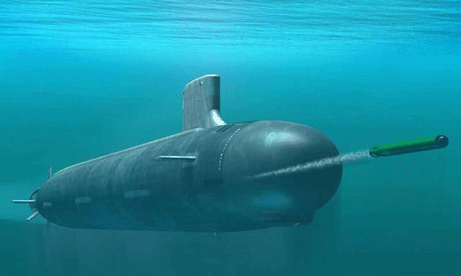
The USS Alaska, one of America’s most secretive nuclear-armed submarines, surfaced in Gibraltar as Trump warned the ceasefire with Iran was on ‘life support’ and dismissed Tehran’s counteroffer as ‘totally unacceptable’.
The Pentagon made an unusually public show of force this week, revealing the location of a U.S. Navy nuclear-armed submarine just a day after President Donald Trump rejected Iran’s latest proposal to end the war.
The Ohio-class ballistic missile submarine arrived Sunday in Gibraltar, the British territory on Spain’s southern coast, the US Sixth Fleet said Monday. Such announcements are rare because the locations of America’s nuclear-armed submarines are usually among the military’s most closely guarded secrets
The Sixth Fleet did not initially identify the submarine by name, but local reports said it was the USS Alaska — one of the largest and most powerful submarines in the US Navy.
“The port visit demonstrates U.S. capability, flexibility and continuing commitment to its NATO allies,” the Sixth Fleet said in a statement. “Ohio-class ballistic missile submarines are undetectable launch platforms for submarine-launched ballistic missiles, providing the U.S. with its most survivable leg of the nuclear triad.”
The timing of the visit immediately drew attention. It came after Trump said the US ceasefire with Iran was on “life support” and described it as “unbelievably weak.” On Sunday, he rejected Iran’s counterproposal to end the war, calling it “totally unacceptable.”
Iran’s reported demands included war reparations, recognition of its sovereignty over the Strait of Hormuz and an end to US sanctions. Trump’s rejection has raised fears that Washington and Tehran are drifting back toward escalation.
The public disclosure of the submarine’s location appeared to send a clear signal. Ohio-class ballistic missile submarines are designed to remain hidden at sea for extended periods, forming the most survivable part of the US nuclear triad. Their mission is deterrence: to guarantee that the United States can respond even if its land-based missiles and bombers are targeted.
The Ohio class includes 14 ballistic missile submarines and four guided-missile submarines. Ballistic missile versions can carry Trident II D5 missiles capable of delivering nuclear warheads. Guided-missile variants can carry more than 150 Tomahawk cruise missiles.
The USS Alaska’s arrival in Gibraltar also carried a diplomatic message. The submarine bypassed the nearby US naval base in Rota, Spain, about 141 kilometers away, and instead docked at the British-controlled territory. British Royal Marines were deployed to receive it, and a 200-meter exclusion zone was set up around the vessel.
The move comes amid strained relations between Washington and Madrid. Spanish Prime Minister Pedro Sánchez has criticized the US war in Iran and reportedly refused to allow the United States to use Spanish bases in Rota and Morón as part of its offensive. Trump responded by threatening to “cut off all trade” with Spain and said he would “probably” remove American troops from the country, where about 3,800 US personnel are stationed.
Spain has objected before to US nuclear submarine stops in Gibraltar. In 2022, Madrid protested after US submarines used services there instead of Rota, arguing that the Spanish base had special protocols for nuclear vessels meant to reduce environmental risk and protect public safety.
The USS Alaska has visited Gibraltar before, including in June 2021. Other Ohio-class submarines, including the USS Florida, USS Rhode Island and USS Georgia, also made stopovers there in 2022.
Authorities have not said how long the Alaska will remain in Gibraltar or what the purpose of the visit is beyond the official US statement about capability, flexibility and commitment to NATO allies.
But the message was hard to miss. As Trump weighs his next move on Iran, the United States has chosen to publicly place one of its most secretive nuclear platforms at the edge of the Mediterranean — close enough to be noticed, rare enough to matter, and powerful enough to remind Tehran what is at stake.
The Nuclear Regulatory Taskforce: The wrong questions, the wrong team, the wrong answers
Policy Brief May 2026
The UK government’s 2025 Nuclear Regulatory Taskforce, established to cut “red tape” blocking nuclear expansion, is fundamentally misconceived. Historical evidence shows that failed nuclear projects collapsed due to financial risk, not regulatory failure. The Taskforce lacked expertise in radiation science, environment, and economics, its recommendations threaten regulator independence, and its reforms will consume government resources without delivering new capacity before the mid-2040s.
1. Introduction
In February 2025 Prime Minister Starmer announced the setting up of a Nuclear Regulatory Taskforce with a press release1 headed “Government rips up rules to fire-up nuclear power” and sub-headed “More nuclear power plants will be approved across England and Wales as the Prime Minister slashes red tape to get Britain building.” This set the tone for future announcements with emotive language and little substance but designed to generate headlines.
The narrative was clear. The planning and regulatory system had failed: “The industry pioneered in Britain has been suffocated by regulations and this saw investment collapse, leaving only one nuclear power plant – Hinkley Point C – under construction.” Any opposition to nuclear projects was trivial and should be ignored – “saying no to the NIMBYs” and “saying no to the blockers who have strangled our chances of cheaper energy, growth and jobs for far too long.”
In April 2025 the leader of the taskforce, John Fingleton, was announced2. In May, the other four members were revealed and the terms of reference3 announced (see Annex 1). An interim report was published in August 20254 with the Final Report published on 24th November, 2025.5 Within two days of its publication, the government had accepted all its recommendations, promising a detailed response in February 2026 and full implementation within two years.6 It is not clear whether government had advance notice of the findings or whether it accepted them without detailed consideration.
The barrage of headline grabbing rhetoric continued throughout, for example, at the publication of the Interim Report, Fingleton described the regulatory system as “not fit for purpose”7. The Final Report said: “We are looking to recommend fundamental once-in-a-generation change in the regulatory system to enable the UK’s nuclear sector to thrive and take full advantage of the global resurgence of nuclear technology.”8
2. Terms of reference
The Review’s terms of reference reflected the clear signals that this was not an open investigation to determine whether delivery of the UK’s nuclear ambitions could be accomplished. The conclusions the government required were signposted and reflected in the terms of reference, which are reproduced in full in Annex 1. In brief, they directed the Taskforce to: gain quick wins by accelerating existing work on international harmonisation, regulatory justification and ALARP; assess whether current practices remain fit for purpose; identify beneficial legislative amendments; reduce regulatory complexity and address resource constraints; refresh expected regulatory outcomes; evaluate regulatory culture and proportionality across the sector; determine how well current arrangements support new and novel nuclear technologies; and explore options for simpler exchange of technologies and companies with advanced nuclear states with aligned priorities.
Most of these are too non-specific to have any analytical value. The one that deserves comment is the first. Its title ‘quick wins’ is strange as what follows does not appear to lead to quick wins.
The specific mention of the application of the concept of keeping risk As Low as Reasonably Practicable (ALARP) is significant. It came in the same month as President Trump instructed the US Nuclear Regulatory Commission to effectively ignore the assumption every credible national and international regulatory and expert body makes, that there is no safe dose of radiation and that the risk increases in a ‘linear’ way with increased exposure: the Linear No Threshold (LNT) assumption. Trump said9:
“Adopt science-based radiation limits. In particular, the NRC shall reconsider reliance on the linear no-threshold (LNT) model for radiation exposure and the “as low as reasonably achievable” [ALARA] standard, which is predicated on LNT. Those models are flawed, as discussed in section 1 of this order.”
This is an extraordinary claim by a US President asserting that the assumption made by every credible regulatory body, LNT, was not science-based. There are detailed differences in emphasis between ALARA and ALARP (ALARP is used more in the UK) but for these purposes they are very similar. Starmer was not as explicit as Trump in questioning LNT but mention of ALARP made it clear that was precisely what he was doing. Making such an instruction calls into question a fundamental principle that should be behind every nuclear safety regulator, that it should be independent of the government.
At first glance, the final reference point, international harmonisation, seems common sense. However, given the record of regulatory bodies not anticipating any of the major accidents or safety challenges – Three Mile Island (1978), Chornobyl (1986), the 9/11 Terror Attack on New York (2001), Fukushima (2011) and now the risk to Zaporizhia from Russia’s invasion of Ukraine – the plurality of separate regulatory bodies coming to their own conclusions, albeit with reference to the work of other regulators, would seem to be a strength worth retaining.
In practical terms, the new reactor designs under review by the UK – the Holtec, GE Vernova, and Rolls Royce Small Modular Reactors (SMRs) – were first reviewed in detail by the UK and are not yet under detailed review by France or the USA. The GE Vernova design only started review in Canada less than a year ago, well behind the UK. So, the demand for international harmonisation is a strawman.
3. Did the Taskforce have the required skills?
The Taskforce comprised five members:
- John Fingleton, Taskforce Lead. He is an economist with much of his career spent in government competition authorities and with a strong record of advocating for the increase in reliance on competitive mechanisms.
- Andrew Sherry. Professor of Materials and Structure at Manchester University with a history of working with UK government-owned bodies such as the National Nuclear Laboratory.
- Mark Bassett. A career in national and international regulatory bodies such as the International Atomic Energy Agency and the Office of Nuclear Regulation.
- Sue Ion. Nuclear engineer with a career primarily in government owned nuclear bodies such as British Nuclear Fuels and a vocal advocate for nuclear power.
- Mustafa Latif-Aramaesh. Planning lawyer with a history of drafting UK laws.
The skills offered by the Taskforce only make some sense if the Terms of Reference are an accurate representation of the issues that have impeded various UK government’s nuclear ambitions. There is no mention of economics or competition in the terms of reference, so it appears the Taskforce Lead did not bring any specific skills to the team. There are references to changes to laws so if it is the legal structure that is holding back nuclear deployment, Latif-Aramesh’s appointment has some logic. Otherwise, the strong impression is of a team comprising members with no record of bringing a critical perspective to the nuclear industry.
Only one member of the Taskforce appears to have specific experience of regulation, and none has any experience of building or operating nuclear plants. The first of the Terms of Reference, so-called ‘quick wins’, relies on a judgement on the Linear No Threshold assumption, yet there is nobody in the Taskforce with the fundamental scientific credentials to make such judgements. There is also considerable discussion of modifying environmental requirements, yet the Taskforce has no expertise in environmental issues. Only Latifah-Aramesh has experience in planning and as a lawyer.
4. What is the evidence and where is the Taskforce’s analysis of it?
The government has been pushing a narrative that the UK is uniquely bad at building nuclear power plants, and that inefficiencies in the planning and regulatory system are to blame. We are told that the UK was a world leader in nuclear technology in the 1960s and reforms to planning and regulation would allow us to reclaim that position in a ‘globally resurgent nuclear industry’ and launch a ‘Golden Age’ for nuclear. What is the evidence for this diagnosis?
In Annex 4 we look at the first two decades of nuclear power in the UK, up to the mid-70s, portrayed as the period when the UK was a world-leader with nuclear power. The analysis shows after the two first Magnox stations, it was a period of decline from, at best, mediocrity. In 1977, Henderson an economist with experience at the UK Treasury stated10 that the AGR and Concorde programmes were “two of the three worst civil investment decisions in the history of mankind.”
4.1. The Thatcher Programme: Sizewell B………………………………………………………………………………………………………………………………………………….. https://policybrief.org/briefs/the-nuclear-regulatory-taskforce-the-wrong-questions-the-wrong-team-the-wrong-answers/
No case for nuclear in Scotland

When the lobby group Britain Remade, proclaimed support for nuclear power in Scotland last year, they declined to disclose that 89% of their own poll supported home-grown energy within our own borders – that desire for self-sufficiency kills nuclear stone dead. Scotland has no uranium mines.
When the lobby group Britain Remade, proclaimed support for nuclear power in Scotland last year, they declined to disclose that 89% of their own poll supported home-grown energy within our own borders – that desire for self-sufficiency kills nuclear stone dead. Scotland has no uranium mines.
by beyondnuclearinternational, https://beyondnuclearinternational.org/2026/05/10/no-case-for-nuclear-in-scotland/
What the country needs is the flexible, affordable power delivered by renewables, writes George Baxter
Editor’s note: With the sweeping victory in last week’s Scottish elections by the pro-independence Scottish National Party, the country’s moratorium against new nuclear power plants, that the SNP leads and supports, remains secure. The London-headquartered UK Labour Government has been pushing Scotland to lift the ban, an approach rightly viewed in Scotland as yet another example of Westminster treating Scotland as a vassal state.
I’ve been through every argument that the nuclear industry makes promoting new nuclear power stations – but scratch the surface and they just melt through the floor.
New nuclear is fundamentally not needed – numerous studies, including by Stanford University and renowned energy modellers at LUT show that the UK, and indeed most, if not all, other countries can meet their energy needs with 100% renewables. Politicians’ fears about the wind and sun and the rain and the waves and tides being unable to meet all our needs are misplaced. Renewables, energy storage, energy efficiency and flexible power with a modern upgraded grid can do it all – cheaper, quicker, safer and a hell of a lot cleaner, and create many more thousands of jobs.
The cost of nuclear power is eye-watering. Look at Hinkley Point C and Sizewell C – nearly £100bn to build them both with massive delays and cost -over-runs. That is enough to install a 5kWh battery in every one of the 28 million homes in Britain, and leave £44bn for other things. Combine that with solar and every home becomes a power station with its own ‘baseload’. Alternatively, £100bn could fund planned upgrades to the grid needed to facilitate large and small renewables, twice over. The Coire Glas pumped hydro storage project in the Highlands could be built 50 times over. £100bn spent on a nuclear-free transition could be revolutionary.
What a renewable based system needs is flexible power, energy storage and a smart, modern grid. Surplus renewable electricity could also be used to generate ”green hydrogen” to generate electricity on calm, dull days. It could also be used to power heavy transport and industry.
Battery systems, including compressed air and pumped storage hydro, alongside vehicle to grid technology, can all be parts of the bedrock of energy security and an energy system that would be cooking with green power 24/7.
Nuclear does nothing to help any of this. Indeed, it is worse, it directly causes wind and solar plants to be switched off when green power is plentiful, because nuclear is so inflexible. Not only does nuclear cost an arm and a leg, it adds cost to the consumer for renewables.
We only have to look at the recent history of nuclear power to see how dangerous and polluting it is. Fukushima remains a slow motion disaster for the region as they scramble to deal with millions of gallons of radioactive water and melted reactor cores. Chornobyl’s 40 year anniversary is another timely reminder, that when things go wrong, they can go very wrong. At least when a wind turbine breaks down – you don’t need an exclusion zone for decades and mass public health measures – you just get some engineers with a crane and some spanners to go fix it. And despite what the ‘nuke, baby, nuke’ lobby says, there is no solution for the waste yet, other than to store and guard the most highly radioactive cores for hundreds of years to cool down out of the way somewhere. That’s the solution!
The hype about Small Modular Reactors is just that, hype. In fact, the only two operational SMRs are in China and Russia, and both have been beset by delays and cost increases. The economies of scale are lost, and studies have shown that they produce more highly radioactive waste for the same generating capacity than their slightly larger cousins.
These projects are pure spin, a clever wheeze by industry lobbyists intended to promote nuclear acceptability- small, click and collect, a kind of middle-aisle at LIDL feel to it. In the words of energy expert Amory Lovins on SMRs: “This illusion neatly fits the industry’s business-model shift from selling products to harvesting subsidies.”
The Rolls Royce SMR – chosen by Great British Energy–Nuclear to be built at Wylfa in North Wales – is a 470MW reactor, not much smaller than the two Torness reactors, which are about 600MW each.
And then there is the fuel – uranium ore is needed and we don’t have any, (and the mining of it is handily missed out in nuclear promotional graphics comparing its land use to renewables, which also fail to point out that the land around solar arrays and turbines can still be used for traditional purposes).
Mind you, there is some recoverable uranium ore on the Orkney mainland – and when it was proposed to dig it up to use it at Dounreay last century, all hell broke loose and Orcadians stopped it by popular protest. So we would have to rely on imports of this global commodity – a market that is dominated by Russia and associates. Pete Roche of SCRAM put this well when commenting on a recent poll indicating only 14% of Scots thought we should focus on uranium fuelled nuclear reactors for our long term energy security needs: “Relying on a uranium-fuelled nuclear future is like jumping out of the oil and gas frying pan and into a nuclear fire – it makes no sense and Scots seem to get that.”
That Survation poll, surveyed 2000 Scots in the middle of the current election campaign, and found an overwhelming public preference to focus on a renewable energy future that would lower energy bills and tackle climate change more effectively. Only 12% of those polled thought the nuclear industry was the most trustworthy about its products, costs, pollutants and safety record.
When the lobby group Britain Remade, proclaimed support for nuclear power in Scotland last year, they declined to disclose that 89% of their own poll supported home-grown energy within our own borders – that desire for self-sufficiency kills nuclear stone dead. Scotland has no uranium mines.
We should just get on with building a country that is a renewable energy powerhouse so that future generations can look back and thank us for choosing a green, clean and sustainable energy route. Nuclear is NOT a natural partner with renewables, indeed, it is a delaying tactic, holding back rapid decarbonisation, and adds extra and unnecessary cost to a renewables-based energy system.
George Baxter is the director of Green Power. He leads Green Power’s team delivering greenfield wind and solar developments both in the UK and Ireland.
Fires break out in exclusion zone around Chernobyl nuclear plant
Arpan Rai & Maira ButtFriday 08 May 2026, https://www.independent.co.uk/bulletin/news/chernobyl-fires-radiation-russia-ukraine-b2973234.html
A forest fire burns in the exclusion zone around the Chernobyl nuclear power plant (AP)
- Russia has said it is carrying out enhanced radiation monitoring after fires broke out in the exclusion zone around the Chernobyl nuclear power plant on Friday.
- The country’s national public health agency said that enhanced radiation monitoring was being conducted and the situation was now “stable”.
- The 1986 Chernobyl disaster is considered to be the world’s worst civil nuclear accident.
- It spread Iodine-131, Caesium-134 and Caesium-137 across parts of Ukraine, Belarus, Russia, northern and central Europe.
- Meanwhile, Ukraine has continued its long-range attacks on Russia with a drone strike one of the country’s largest oil refineries, located in Yaroslav
1 This Month



26 September – International Day for the Total Elimination of Nuclear Weapons


PLEASE OPPOSE HR 8255 AND S.3639 – bills would accelerate satellite deployment, with no environmental review or safeguards – https://ncstd5li.quorum.us/campaign/169331/
To see nuclear-related stories in greater depth and intensity – go to https://nuclearinformation.wordpress.com
-
Archives
- September 2026 (206)
- August 2026 (330)
- July 2026 (355)
- June 2026 (287)
- May 2026 (306)
- April 2026 (356)
- March 2026 (251)
- February 2026 (267)
- January 2026 (308)
- December 2025 (358)
- November 2025 (359)
- October 2025 (375)
-
Categories
- 1
- 1 NUCLEAR ISSUES
- business and costs
- climate change
- culture and arts
- ENERGY
- environment
- health
- history
- indigenous issues
- Legal
- marketing of nuclear
- media
- opposition to nuclear
- PERSONAL STORIES
- politics
- politics international
- Religion and ethics
- safety
- secrets,lies and civil liberties
- spinbuster
- technology
- Uranium
- wastes
- weapons and war
- Women
- 2 WORLD
- ACTION
- AFRICA
- Atrocities
- AUSTRALIA
- Christina's notes
- Christina's themes
- culture and arts
- Events
- Fuk 2022
- Fuk 2023
- Fukushima 2017
- Fukushima 2018
- fukushima 2019
- Fukushima 2020
- Fukushima 2021
- general
- global warming
- Humour (God we need it)
- Nuclear
- RARE EARTHS
- Reference
- resources – print
- Resources -audiovicual
- Weekly Newsletter
- World
- World Nuclear
- YouTube
-
RSS
Entries RSS
Comments RSS
 nuclear-news