Russia says U.S.-built F-16s could ‘accommodate’ nuclear weapons if sent to Ukraine
Reuters June 7, 20234
– Russia’s Foreign Minister Sergei Lavrov said on Monday that U.S.-built F-16 fighter jets can “accommodate” nuclear weapons and warned that supplying Kyiv with them will escalate the conflict further.
“We must keep in mind that one of the modifications of the F-16 can ‘accommodate’ nuclear weapons,” Lavrov said in a speech at a military base in Dushanbe in Tajikistan, according to a transcript on the ministry’s website…………………………………….
Ukraine’s President Volodymyr Zelenskiy has long appealed for the F-16 jets, saying their appearance with Ukrainian pilots would be a sure signal from the world that Russia’s invasion would end in defeat
Biden told G7 leaders last month that Washington supported joint allied training programmes for Ukrainian pilots on F-16 fighters.
U.S. National Security adviser Jake Sullivan, however, said there was no final decision on Washington sending aircraft.
Reporting by Lidia Kelly in Melbourne and Nandita Bose in Washington; Editing by Michael Perry and Marguerita Choy https://www.reuters.com/world/russia-says-us-built-f-16s-could-accommodate-nuclear-weapons-if-sent-ukraine-2023-06-06/
Journalists Are Asking Ukrainian Soldiers To Hide Their Nazi Patches, New York Times Admits
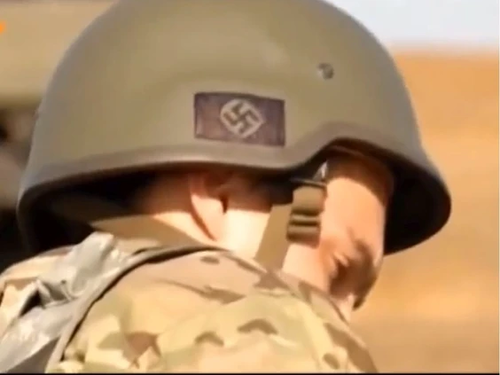
AZOV soldier, UKraine
BY TYLER DURDEN
The New York Times has been forced to very, very belatedly deal with something which had long been obvious and known to many independent analysts and media outlets, but which has been carefully shielded from the mainstream masses in the West for obvious reasons.
The surprising Monday Times headline said that “Nazi Symbols on Ukraine’s Front Lines Highlight Thorny Issues of History.” This acknowledgement comes after literally years of primarily indy journalists and geopolitical commentators pointing out that yes indeed… Ukraine’s military and paramilitary groups, especially those operating in the east since at least 2014, have a serious Nazi ideology problem. This has been exhaustively documented, again, going back years.
But the report, which merely tries to downplay it as a “thorny issue” of Ukraine’s “unique” “History” – suggests that the real problem for Western PR is fundamentally that it’s being displayed so openly. Ukrainian troops are being asked to cover those Nazi symbols please!–as Matt Taibbi sarcastically quipped in commenting on the report.
The authors of the NYT report begin by expressing frustration over the optics of Nazi symbols being displayed so proudly on many Ukrainian soldiers’ uniforms. Suggesting that many journalistic photographs which have in some cases been featured in newspapers and media outlets worldwide (typically coupled with generally positive articles on Ukraine’s military) are merely ‘unfortunate’ or misleading, the NYT report says, “In each photograph, Ukrainians in uniform wore patches featuring symbols that were made notorious by Nazi Germany and have since become part of the iconography of far-right hate groups.”
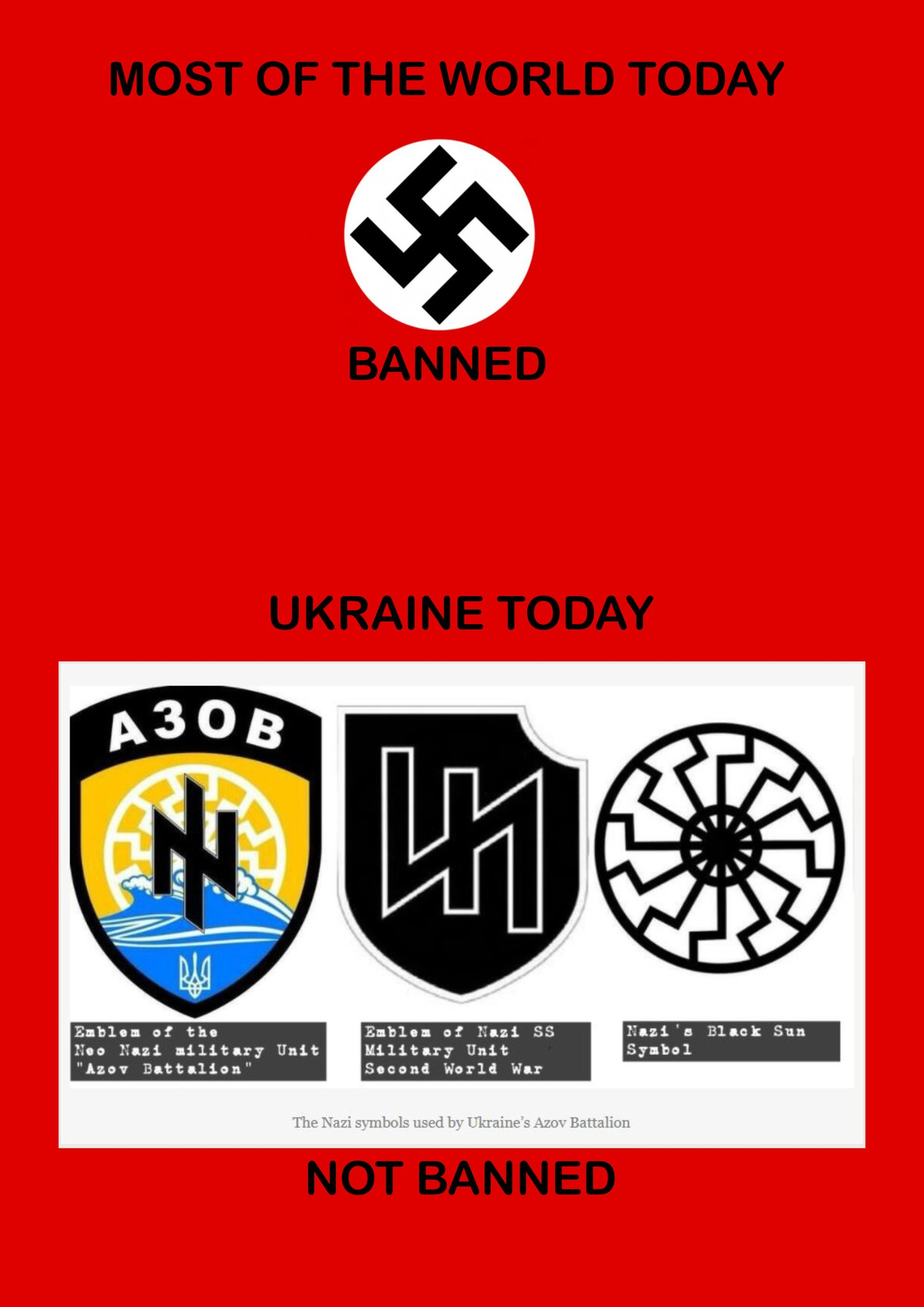
NATO itself has in the recent past been forced to delete images on its official social media accounts due to Nazi imagery being present among Ukrainian troops during photo shoots.
The following line from the report says everything you need to know about the so-called “paper of record” and its one-sided and ultra-simplistic coverage of what many are finally waking up to realize is a war with a deeply complex reality (to say the least), and far from the MSM’s goodies vs. baddies Hollywoodesque narrative of Putler vs. the free world which is typical of networks from CNN to Fox to NBC…
From the NY Times:
“In November, during a meeting with Times reporters near the front line, a Ukrainian press officer wore a Totenkopf variation made by a company called R3ICH (pronounced “Reich”). He said he did not believe the patch was affiliated with the Nazis. A second press officer present said other journalists had asked soldiers to remove the patch before taking photographs.”
Oops!
…………..The iconography of these groups, including a skull-and-crossbones patch worn by concentration camp guards and a symbol known as the Black Sun, now appears with some regularity on the uniforms of soldiers fighting on the front line, including soldiers who say the imagery symbolizes Ukrainian sovereignty and pride, not Nazism.
Some are writing more appropriate and apt headlines for the NYT story…
Only very recently Ukraine’s Defense Ministry and even President Zelensky’s office was caught in the act:
In April, Ukraine’s Defense Ministry posted a photograph on its Twitter account of a soldier wearing a patch featuring a skull and crossbones known as the Totenkopf, or Death’s Head. The specific symbol in the picture was made notorious by a Nazi unit that committed war crimes and guarded concentration camps during World War II.
The patch in the photograph sets the Totenkopf atop a Ukrainian flag with a small No. 6 below. That patch is the official merchandise of Death in June, a British neo-folk band that the Southern Poverty Law Center has said produces “hate speech” that “exploits themes and images of fascism and Nazism.”
To be expected, the Times still tries to run cover while desperately seeking to ‘reassure’ its audience by writing that “In the short term, that threatens to reinforce Putin’s propaganda and giving fuel to his false claims that Ukraine must be ‘de-Nazified’ — a position that ignores the fact that Ukrainian President Volodymyr Zelenskyy is Jewish.”
New levels of cope indeed…
But then still, the NYT concedes awkwardly, “More broadly, Ukraine’s ambivalence about these symbols, and sometimes even its acceptance of them, risks giving new, mainstream life to icons that the West has spent more than a half-century trying to eliminate.” https://www.zerohedge.com/geopolitical/journalists-are-asking-ukrainian-soldiers-hide-their-nazi-patches-nyt-admits
Washington Post reported Ukraine conducted a test strike with HIMARS on the Kahovka dam last year
the Washington Post reported in December 2022 that Ukraine had previously carried out a test strike using American HIMARS (High Mobility Artillery Rocket Systems) on a dam located on the Russian-held side of Ukraine along the Dnieper River in Kahovka. They cited Ukrainian Major-General Andriy Kovalchuk.
Human Events Media Group 06/06/2023
A dam on the Dnieper River was destroyed on Tuesday, flooding a substantial amount of the area where Ukrainian and Russian troops are engaged in fighting, after Ukraine launched their much-anticipated counter-offensive. The dam was in Russian control, and has been since shortly after the February 2022 invasion of Ukraine by Russia.
Ukraine claimed Russia blew up the Nova Kakhovka dam and said it was a war crime, while Russia has said that it was Ukraine who “sabotaged the dam, to distract attention from the launch of a major counteroffensive Moscow says is faltering,” Reuters reports.
Ukraine’s counter offensive has been in the works for some time, specifically targeting the Russian-held city of Kherson, and was just recently launched.
“Russian terrorists,” President Volodymyr Zelenskiy said on Telegram. “The destruction of the Kakhovka hydroelectric power plant dam only confirms for the whole world that they must be expelled from every corner of Ukrainian land.”
However, the Washington Post reported in December 2022 that Ukraine had previously carried out a test strike using American HIMARS (High Mobility Artillery Rocket Systems) on a dam located on the Russian-held side of Ukraine along the Dnieper River in Kahovka. They cited Ukrainian Major-General Andriy Kovalchuk.
“Kovalchuk considered flooding the river,” the Washington Post reported. “The Ukrainians, he said, even conducted a test strike with a HIMARS launcher on one of the floodgates at the Nova Kakhovka dam, making three holes in the metal to see if the Dnieper’s water could be raised enough to stymie Russian crossings but not flood nearby villages. The test was a success, Kovalchuk said, but the step remained a last resort.”……………….. https://humanevents.com/2023/06/06/wapo-reported-ukraine-conducted-a-test-strike-with-himars-on-the-kahovka-dam-last-year
The Ukrainian “counter-offensive”: A new stage in the US-NATO war against Russia
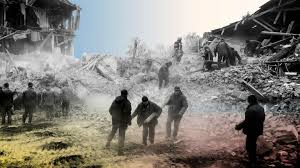
Every aspect of the war, including the “counter-offensive,” is being directed by the Biden administration, the Pentagon and NATO. It is being led by forces trained by NATO and armed with NATO weapons, including depleted uranium shells supplied by the UK. Operationally, it is organized from Washington and the Pentagon. The masses of Ukrainians are being exploited as cannon fodder. Among the first divisions thrown into the battle, many are raw draftees with little or no training.
WSWS Joseph Kishore, David North, 5 June 2023
The US-NATO war against Russia over Ukraine is entering a new stage this week, with reports of a significant increase in fighting along a broad front Monday and enormous casualties.
The Russian Defense Ministry reported on its official Telegram channel that Russian forces countered a Ukrainian offensive on the Vremevka outpost in South Donetsk, which is currently controlled by Russia. It stated that over 1,500 Ukrainian soldiers were killed and that Russia seized 28 tanks, including eight German-made Leopard tanks.
Russia also reported an offensive of Ukrainian troops toward the south, against the territory along the coast of the Sea of Azov that connects Crimea and the Donbas, both held by Russia or pro-Russian forces since 2014. A Russian-appointed official in the city of Zaporizhzhia said that the fighting in the south involved extensive shelling and strikes by Ukraine using British-French Storm Shadow missiles.
It is apparent that Monday’s operations mark the beginning of the long anticipated “summer counter-offensive.” While there is, at present, limited information, one thing can be said with certainty: The fighting will result in a vast increase in the number of deaths, both Ukrainian and Russian.

In an interview with the Wall Street Journal Sunday, Ukrainian President Volodymyr Zelensky acknowledged that “a large number of soldiers are going to die,” but “we are going to do it.” Reliable estimates place the death toll of Ukrainians in the war so far at 300,000.
Every aspect of the war, including the “counter-offensive,” is being directed by the Biden administration, the Pentagon and NATO. It is being led by forces trained by NATO and armed with NATO weapons, including depleted uranium shells supplied by the UK. Operationally, it is organized from Washington and the Pentagon. The masses of Ukrainians are being exploited as cannon fodder. Among the first divisions thrown into the battle, many are raw draftees with little or no training.
The US and the NATO powers are determined to inflict a Russian defeat, with dreams of a military parade of NATO troops in the streets of Moscow. The Financial Times wrote on Monday that “there has been a notable change of tone among senior western officials, who have appeared increasingly skeptical about Russian military capabilities. Antony Blinken, the US secretary of state, last week made a clear case for an outright Ukrainian victory based on ‘territorial integrity’ [that is, retaking all territory presently controlled by Russia] in a speech that also disparaged Russia’s military ‘as the second-strongest in Ukraine.’”
The FT also cited comments by Ben Wallace, the UK defense secretary, that Ukraine could take back Crimea as part of the offensive. “What we’ve seen on the battlefield is that, if you punch Russian forces in the wrong place, they’ll actually collapse,” he said.
Such statements combine propaganda with self-delusion. The Ukrainian military has been bled white over the past 15 months. It is entirely reliant on the US and NATO, not only to provide training and weaponry, but increasingly the manpower necessary for escalating the war.
The operations in Ukraine are only one part of a barely disguised, undeclared war between NATO and Russia, which is expanding in intensity and geographical scope.
Developments on the ground in Ukraine have been timed to coincide with a meeting of NATO foreign ministers in Oslo, Norway late last week. This meeting itself was to prepare a full NATO war summit next month in Vilnius, Lithuania, only a short drive from the Russian border. Behind closed doors, the leaders of the NATO powers are discussing and implementing the next stage in the escalation.
Already, Ukraine, operating under the direction of the US, has launched drone strikes targeting Moscow, begun shelling Russian cities, and organized incursions into Russian territory, using vehicles and equipment provided by the US and its NATO allies. Poland has become directly involved in the conflict, with members of the so-called “Polish Volunteer Corps” of Polish citizens participating in cross-border raids from Ukraine into Russia.
An article in the Washington Post (“Defend ‘every inch’ of NATO territory? New strategy is a work in progress”), published Monday, opens with a description of French paratroopers being dropped into Estonia, which borders Russia and is only 150 km from St. Petersburg. The Post notes that the French war exercises in Estonia are “part of a stepped-up rehearsal of what it would take to reinforce a [NATO] battle group” in the country.
Speaking of what can only be described as a massive military mobilization, the newspaper writes, “NATO has bolstered its eastern flank in part by establishing battle groups in four additional countries: Bulgaria, Hungary, Romania and Slovakia,” with 10,000 troops across eight battle groups. Dozens of ships and hundreds of planes, along with ground-based air defense, have been sent to countries on Russia’s border, particularly the Baltic countries of Latvia, Lithuania and Estonia.
War games are taking place currently throughout Europe, including the massive “Defender Europe 2023” exercise, which began on April 22 and involves 26,000 troops from the US and its allies. The final component of the operations, “Saber Guardian 23,” began last week and is centered on the Black Sea, to the south of Ukraine. It involves soldiers and sailors from Albania, Bulgaria, Belgium, France, Greece, Germany, Italy, the Netherlands, Romania, Slovenia and the United States.
Given the statements of leading US and NATO officials that they are committed to the military defeat of Russia, the Putin government will be compelled to interpret all these actions as possible preparations for NATO incursions into Russian territory. The purpose of all these operations is to support the Ukrainian offensive by distracting Russian military commanders from exclusive focus on the Ukrainian front and compelling them to divert forces to other border regions.
In the capitals of the NATO powers, a mood of reckless hysteria prevails. Over the weekend, German Chancellor Olaf Scholz, confronted by protesters at a gathering of his Social Democratic Party outside of Berlin, unleashed a Hitlerian rant against Russia and denounced Putin as a “murderer” and a “warmonger.”
The White House has rejected calls for a ceasefire or negotiated settlement to the conflict that does not include full capitulation by Russia. Encouraged by Russia’s failure to respond to each escalation, the Biden administration has concluded that there is no “red line” that it cannot cross.
In an article published under the headline “Biden Administration Shrugs Off Ukraine’s Attacks in Russia,” the New York Times wrote on Monday that the White House has discarded the pretense of discouraging direct attacks in Russia by Ukraine, using US-supplied weaponry. “Behind closed doors,” the Times wrote, “senior administration officials have seemed even less fazed. ‘Look, it’s a war,’ one senior Pentagon official said last Thursday. ‘This is what happens in a war.’”………………… https://www.wsws.org/en/articles/2023/06/06/pers-j06.htm
Leaks reveal FBI helps Ukraine censor Twitter users and obtain their info
AARON MATÉ·JUNE 7, 2023, The Grayzone,
The FBI aided a Ukrainian intelligence effort to ban Twitter users and collect their data, new leaks show. Twitter declined to censor journalists targeted by Ukraine, including The Grayzone’s Aaron Maté.
The Federal Bureau of Investigation has aided a Ukrainian intelligence effort to censor social media users and obtain their personal information, leaked emails reveal.
In March 2022, an FBI Special Agent sent Twitter a list of accounts on behalf of the Security Service of Ukraine (SBU), Ukraine’s main intelligence agency. The accounts, the FBI wrote, “are suspected by the SBU in spreading fear and disinformation.” In an attached memo, the SBU asked Twitter to remove the accounts and hand over their user data.
The Ukrainian government’s FBI-enabled targets extend to members of the media. The SBU list that the FBI provided to Twitter included my name and Twitter profile. In its response to the FBI, Twitter agreed to review the accounts for “inauthenticity” but raised concerns about the inclusion of me and other “American and Canadian journalists.”
The FBI’s attempt to ban Twitter accounts at the request of Ukrainian intelligence is among the most overt requests for censorship revealed to date in the Twitter Files, a cache of leaked communications from the social media giant.
The FBI’s censorship request was relayed in a March 27th, 2022 email from FBI Special Agent Aleksandr Kobzanets, the Assistant Legal Attaché at the US Embassy in Kyiv, to two Twitter executives. Four FBI colleagues were copied on the exchange…………………….
If granted, the users on the list would not only have been banned from Twitter but had their phone number, date of birth, and email address disclosed to both the FBI and SBU.
Read the full list of accounts targeted by the FBI and SBU here:
Twitter-Dissinf_20220327 SBU list
In response, Yoel Roth, Twitter’s then-Head of Trust and Safety, informed Special Agent Kobzanets and his FBI colleagues that Twitter would “review the reported accounts under our Rules.” But he warned that the list included “a few accounts of American and Canadian journalists (e.g. Aaron Mate).” Therefore, Roth said, Twitter’s review would “focus first and foremost on identifying any potential inauthenticity.”
Roth then suggested that he would be open to suspending authentic accounts if it could be proven that they have a hidden tie to a foreign government. Journalists “who cover the conflict with a pro-Russian stance are unlikely to be found in violation of our rules absent other context that might establish some kind of covert/deceptive association between them and a government,” Roth wrote. “Any additional information or context in those areas is of course welcome and appreciated.”……………………………………………
The Ukrainian nationals targeted by the SBU’s suppression request include Anatoly Shariy, a video blogger and politician who fled Ukraine in 2012 and subsequently received European Union asylum; and Andriy Portnov, a Ukrainian lawyer and politician who served as a senior official under Ukrainian President Viktor Yanukovych until the latter’s ouster in the February 2014 Maidan coup. (Both Shariy and Portnov’s Twitter accounts remain active).
The disclosure of a collaboration on censorship between the FBI and SBU is the latest documented instance of Ukrainian state-tied attempts to target foreign voices. A Ukrainian website known as Myrotvorets maintains a list of what it calls “enemies of Ukraine.” I was recently added to that list along with The Grayzone’s Anya Parampil, as well as the comedian and YouTube host Jimmy Dore. The Myrotvorets database was co-founded by Anton Gerashchenko, former deputy minister at the Ukraine’s Ministry of Internal Affairs, where he now serves as an advisor.
Last year, the global tech/media conference Web Summit withdrew a speaking invitation to The Grayzone’s Max Blumenthal and me after Olena Zelenska, the wife of Ukrainian President Volodymyr Zelensky, demanded our cancellation. (Another Grayzone colleague, Kit Klarenberg, was recently detained and interrogated about his journalism by British authorities).
News of the FBI’s work with Ukrainian intelligence to censor Twitter users also follows reporting from journalist Lee Fang that the FBI has pressured Facebook to remove accounts and posts deemed by the SBU to be Russian “disinformation.” According to Fang, a senior Ukrainian official in regular contact with the FBI defined “disinformation” in such broad terms that it could mean viewpoints that “simply contradict the Ukrainian government’s narrative.” https://thegrayzone.com/2023/06/07/fbi-ukraine-twitter-users-including-journalists/—
Britain’s taxpayers, slugged with uneconomic Hinkley nuclear plant ‘s costs, now to be slugged again with Sizewell.
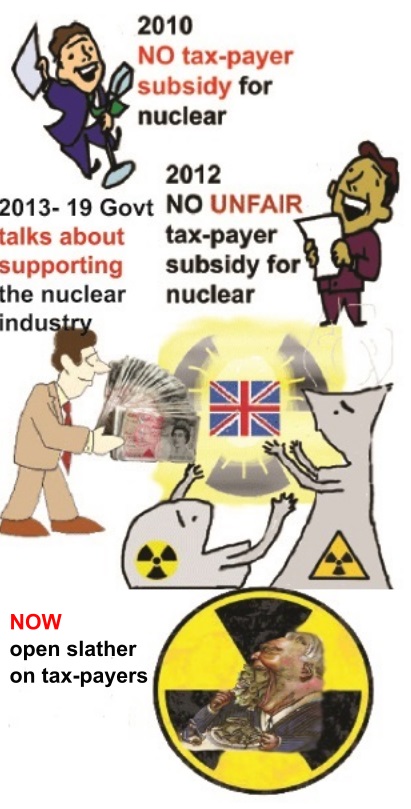
In response to EDF announcing further delays and cost increases at Hinkley
C, Dr Doug Parr, Policy Director at Greenpeace UK, said – “Despite the
enax-payerstirely predictable and widely predicted overshoot of Hinkley C’s costs
and construction, we are still on course to make the same mistake again at
Sizewell, and this time with the taxpayer on the hook.
Why has a government
of free marketeers chosen to pay the French state to build reactors with
public money from the British state? Because the market has read Hinkley
C’s balance sheet and wants nothing to do with this over-priced,
overly-complicated, obsolete technology. The government, on taxpayers
behalf, will spend their money to cover up the failure. When the government
tells you it’s a good deal, remember that no one is willing to put their
own money into it.”
Greenpeace 6th June 2023
https://www.greenpeace.org.uk/press-centre/
Europe’s Nuclear Power Puzzle
By Felicity Bradstock – Jun 07, 2023,
- EU member states hold divergent views on the inclusion of nuclear power in the green energy transition, hindering consensus.
- Nuclear power is seen as a potential solution for energy security and clean energy production, but concerns about nuclear waste persist.
- While some countries are closing nuclear plants, others are investing in new facilities, causing further division within the bloc.
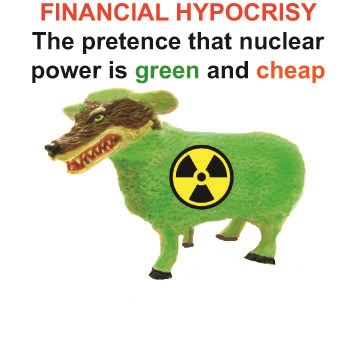
Since the European Commission stated the need for an accelerated green transition that includes nuclear power and natural gas, it seems member states are having a hard time agreeing on nuclear development. While some countries, such as Germany, are closing their nuclear plants, others, including Finland and Hungary, are developing new facilities. So, after years of nuclear power fearmongering and avoidance, where will Europe land on new nuclear development?
In 2022, the European Commission defined both nuclear power and natural gas as climate-friendly energy sources, adding both to the EU “taxonomy” rulebook from 2023 to spur ‘green’ investment in both sectors. This is a decision that was approved by the European Parliament after much deliberation from member states about how these types of energy should be defined. The EU financial services chief Mairead McGuinness explained: “The Complementary Delegated Act is a pragmatic proposal to ensure that private investments in gas and nuclear, needed for our energy transition, meet strict criteria.”
……….. Meanwhile, nuclear energy, although not a renewable source of power, is viewed as clean, as operations do not emit greenhouse gases. However, many argue that the nuclear waste it produces could be detrimental to the environment, particularly as there is no cohesive international agreement on how to appropriately dispose of this waste………..
Despite the inclusion of nuclear power in the EU rulebook under the green taxonomy, many countries continue to disagree on the use of nuclear energy and the development of new projects. And a divide means delays. ………….
While several EU states support the development and use of nuclear power as a clean energy source, others, such as Germany and Belgium, refused to classify nuclear energy as clean. Weeks later, the debate is still ongoing, with France hoping to reopen negotiations over the Green Deal law, but Germany hopes to pass the law in its current state.
………………………………………….. After over a year of debate, various EU member states can still not agree on the use of nuclear power in the region. While many view it as vital to providing energy security and producing vast amounts of clean energy, others say it is detracting from renewable energy projects, and there is still a big question about how to dispose of the potentially harmful nuclear waste. Until this issue can be agreed upon, the Green Deal law will likely remain in a state of limbo. https://oilprice.com/Alternative-Energy/Nuclear-Power/Europes-Nuclear-Power-Puzzle.html
—
Increasing costs and delays in building Hinkley nuclear station.
The Hinkley Point C nuclear plant, the only one currently under
construction in Britain, is facing increasing worries about further delays
and cost overruns. During Keir Starmer‘s recent visit, the opposition
leader accused the government of hindering progress on the project.
Initially expected to be operational in 2023, the Hinkley Point C reactor
is now projected to start producing power in June 2027, highlighting
significant setbacks. Keir Starmer expressed frustration, stating that the
government is “holding the country back”, emphasising that the project
should have been completed by now.
Dr Doug Parr, the Policy Director at Greenpeace UK, raised concerns about the project’s escalating costs and construction delays.
Energy Live News 6th June 2023
Robotic “dogs” to help clean up Dounreay nuclear site
A ‘pack’ of robotic ‘dogs’ have been harnessed to help Dounreay with
monitoring work on site. Spot, a robotic quadruped (‘dog’) from Boston
Dynamics, has the ability to climb stairs, avoid obstacles, and move over
rough ground, allowing it to monitor and collect data in hazardous areas.
Dounreay and Createc, the systems integrator for Spot, are working together
on a series of 7 use cases for the ROV, that will be carried out over the
next 12 months. A dedicated Createc employee will be based on site to
initially lead the projects, and will train Dounreay staff to use the
robot. Heather Fairweather is the innovation team’s project manager for
the work. She says that the use cases will demonstrate the multi-tasking
value of the ROV, and its ability to carry out practical work.
Dounreay 6th June 2023
https://www.gov.uk/government/news/robotic-dogs-arrive-on-site
Russia warns that supplying nuclear weapons to Ukraine would lead to ‘global, irrevocable collapse’
Russian Foreign Ministry spokeswoman Maria Zakharova accuses Ukraine of readiness to destroy its own land
AA Elena Teslova |08.06.2023
Russian Foreign Ministry spokeswoman Maria Zakharova said on Wednesday that if the West supplies Ukraine with nuclear weapons, it would lead to the end of humankind’s existence on the planet.
Asked at a news conference in Moscow if Russia sees as possible nuclear weapons deliveries to Ukraine, Zakharova said: “Why should we comment on their possible insanity or possible control of insanity? This is not our topic.”
She pointed out that in recent months, the Ukrainian authorities took steps that harm the interests of their own country and its population.
“If they want a global, irrevocable collapse, then they will do it (deliver nuclear weapons to Ukraine). You can see what’s going on. The Kyiv regime is ready to destroy its own land…They are ready to infect it with depleted uranium, flood it with water, poison it with ammonia,” she said……………………….
For months, Moscow has been expressing concern over the change in the types of weapons supplied to Ukraine, which started with small arms and now involves deliveries of fighter jets.
Russian authorities also argue that the weapons supplied for the protection of Ukraine’s territory are used for raids into Russian territory…………………………………………………. https://www.aa.com.tr/en/russia-ukraine-war/russia-warns-that-supplying-nuclear-weapons-to-ukraine-would-lead-to-global-irrevocable-collapse/2917099
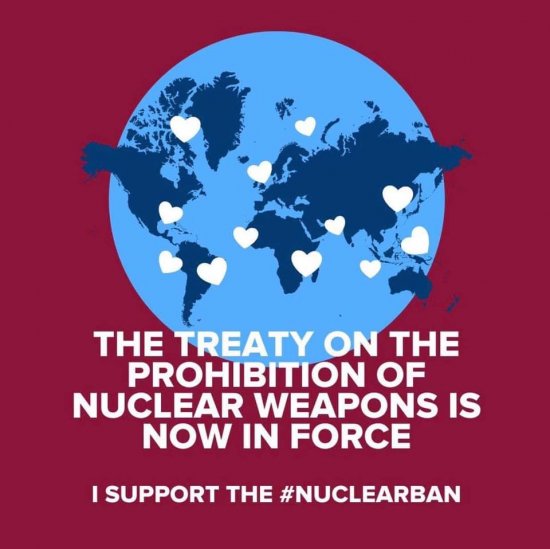
June 2: Nonviolent ecumenical movements call for ratification of the Nuclear Weapons Prohibition Treaty
04.06.23 – Italy – Redazione Italia https://www.pressenza.com/2023/06/june-2-nonviolent-ecumenical-movements-call-for-ratification-of-the-nuclear-weapons-prohibition-treaty/
On the occasion of June 2, Republic Day, associations and organizations from the Catholic world and spiritually based ecumenical and nonviolent movements called at a June 1 press conference for the Italian government to ratify the U.N. Treaty on the Prohibition of Nuclear Weapons as a first step in stemming the war in Ukraine and embarking on a diplomatic path to peace.
“We are in an apocalyptic scenario, today, more than ever, it is necessary that the Treaty be signed because the crest on which we are walking is very dangerous,” said Carlo Cefaloni of the Focolare Movement, opening the press conference at the Chamber of Deputies on behalf of all the movements.
“Tomorrow there will be a military parade, instead we are here to say that we don’t want war; but we really have to decide that,” said Don Renato Sacco of Pax Christi, “because in this last year 2240 billion euros have been invested in armaments; this means that you want war: [therefore] there is a need to choose peace in a strong and determined way.
Also speaking during the press conference was Enkolina Shqau of the Pope John XXIII Association; she stressed that “to say no to war and nuclear weapons is not a matter of being good but of being smart because it is not possible that we still have not learned anything from the disasters of the last century.”
Emanuela Gitto, Vice President of the Youth Sector of Catholic Action stressed that “On the occasion of the June 2 holiday, we want to remember how the Constituent Assembly decided to put the repudiation of war among the founding pillars of our Republic, which is why it is important that the call to silence the weapons and open a true dialogue towards peace starts from these rooms.
“Politics has been lacking in these months, especially a prophetic vision of politics,” said Emiliano Manfredonia, national president of the ACLI, “and so the usual traffickers, including drug and human traffickers have won. Let us commit instead to sign this treaty as a prophetic gesture, as a strong signal to start a real path of peace and to accompany Monsignor Zuppi in this mission of his in Ukraine so that he can really open the necessary paths.”
Maurizio Simoncelli, spokesman for the Italia ripensaci campaign explained that “the Treaty so far has been signed by nations that do not have nuclear production (Translator’s note: They probably mean “nuclear weapons”. Italy hosts nuclear weapons), and it would be nice if instead, Italy was the first to set a good example in this regard because we know that having nuclear weapons does not increase a country’s security, but rather the opposite.”
A number of parliamentarians were also present in the press room of the Chamber of Deputies, including Hon. Paolo Ciani, who wanted to reiterate how important the commitment of politics is “and it is not a credit to European politics that the go-ahead from Strasbourg in these hours will allow the use of PNRR (National Plan for Recovery and Resilience) funds for the production of munitions to be sent to Ukraine.” MP Nicola Fratoianni also commented on the news of the Europarliament vote, saying that “these are acts that have nothing to do with real politics and I am very happy with demonstrations like the
one you organized today because they are necessary to make the decision-makers change direction.”
Mario Marazzitti of the Sant’Egidio Community wanted to add that “the signing of this document certainly does not serve to resolve the conflict in Ukraine, but it is a first step to lower the fever of war and this mad arms race.”
“Good politics is the one that gets us out of the logic of the market,” said Maurizio Certini of the Giorgio La Pira Foundation, “therefore out of the business related to the production of weapons because we need to make everyone understand that bombs bring insecurity.
At the end of the press conference, representatives of the associations gathered in front of the Montecitorio to display a banner that read For a Republic Free of War and Nuclear Weapons.
Mediterranean now a global heating hotspot
Shortly after Easter this year, in the midst of a historic, multi-year
drought, temperatures in parts of the western Mediterranean climbed a
barely believable 20C higher than seasonal norms, hitting a
record-shattering 39C in southern Spain. And that was in April.
As global heating advances, July and August in the world’s most-visited holiday
destination – pre-Covid, more than 300 million tourists a year headed to
the Med, a figure some predict could rise to 500 million by the end of the
decade – risk becoming unbearable.
The Mediterranean basin is a global
heating hotspot. While the world is now about 1.1C warmer than it was in
the 1970s, the region is already up 1.5C and on course for 3C by the end of
the century (or 5C, in a worst-case scenario). Rising temperatures and more
frequent heatwaves are not the only challenge. Most climate models agree
that in most parts of the world, warmer will also mean wetter – but not in
the Med, where rainfall is set to plunge by between 10% and 60%.
Guardian 3rd June 2023
Unseemly scramble as makers of small nuclear reactors try to con UK government

NuScale joins Rolls-Royce and Bill Gates in race to build UK nuclear
reactors. A US nuclear developer is poised to join the race to build new
reactors in the UK and has urged the government to go faster in picking a
preferred technology.
NuScale, based in Oregon, said it was “very
active” in the UK market and that it would “engage with the activity
around the government’s SMR competition”.
The UK is running a contest to
find suppliers of small modular reactors (SMRs), which hold the promise of
zero-emission, lower-cost nuclear power as they can be made in a factory
and assembled on site. This reduces the vast overheads of large nuclear
projects.
NuScale is developing an SMR called VOYGR, which is based on a
traditional nuclear design called a pressurised water-cooled reactor. It is
the first SMR to have been certified by the US Nuclear Regulatory
Commission.
The UK government has set up a new body, Great British Nuclear
(GBN), to select new projects. It is aiming to settle on winning SMR
designs by the autumn.

Tom Mundy, president of VOYGR services and delivery,
said NuScale would not require development money from GBN as its project
was ready to deploy. “We don’t need the support that has been suggested
… We’re ready to deliver the project much earlier than GBN has
suggested,” he said. “GBN suggests people could start building SMRs by
2030. That means taking a final investment decision then. That’s too late
for us. We have got customers taking final investment decisions much
earlier,” Mundy added. “Let’s get going.”
NuScale’s rivals in the
race include GE Hitachi, also of the US, and Rolls-Royce, which wants to
win an order in its home market. TerraPower, a start-up founded and chaired
by Bill Gates, has also indicated that it wants to build nuclear projects
in the UK. It has a type of SMR called an advanced modular reactor (AMR) in
development.
Times 4th June 2023
Concern over low flying aircraft circling over Hunterston nuclear power station
Concerns have been raised with civil nuclear police over low flying
aircraft over Hunterston. Aircraft apps showed that a Pilatus PC-6/B2-H4
plane repeatedly circled the nuclear power plant – leading to the matter
being raised by a concerned resident at a public meeting this week.
West Kilbride community councillor John Lamb, who was attending the Hunterston
Site Stakeholders Group, asked the civil nuclear police if they were aware
that there was low flying aircraft over the power station zone.
The incident happened on May 25 and the fFlightradar app showed that the plane
travelled across Ayrshire before repeatedly circling Hunterston. Mr Lamb
asked if the Civil Aviation Authority had altered the guidance regarding
the ‘no flight zone’ over Hunterston. Inspector Paul Gilmartin of the Civil
Nuclear Police told the meeting that he was unaware of any reports of low
flying aircraft and the matter had not been flagged up to him.
Largs & Millport Weekly News 2nd June 2023
Bellona publishes new report on Ukraine’s besieged Zaporizhzhia nuclear plant
It’s something the world nuclear energy community never thought it would see — and thus never prepared for.
June 1, 2023 by Charles Digges https://bellona.org/news/nuclear-issues/2023-06-zaporizhzhia-nuclear-report
For a year and a half, the world has bourn witness to an unprecedented spectacle: the military occupation of a civilian atomic energy station.
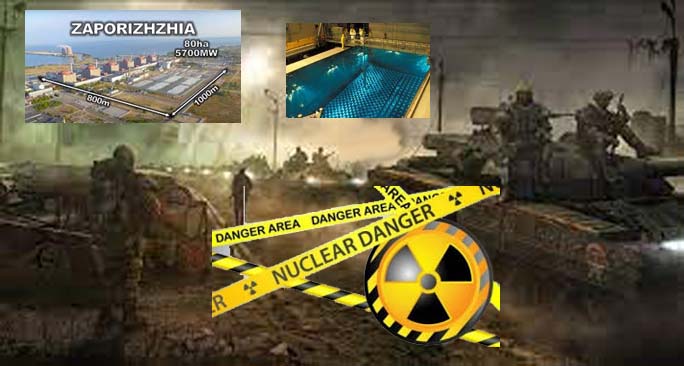
The March 2022 seizure by Russian troops of the Zaporizhzhia Nuclear Power Plant in Southeastern Ukraine has forced six nuclear reactors and pools of spent nuclear fuel onto the front lines of the biggest land war in Europe since World War II.
It’s something the world nuclear energy community never thought it would see — and thus never prepared for. As a result, the world has watched helplessly as heavy ordinance strikes nail-bitingly close to the plant on a regular basis, repeatedly severing outside power to the facility’s cooling and safety systems.
According to Rafael Grossi, who heads the UN’s atomic energy agency —and who has repeatedly beseeched Moscow and Kyiv to create a non-military safe zone around the plant — the situation is a gamble with radioactive stakes.
“We are rolling a dice and if this continues then one day our luck will run out,” he has said more than once.
Unfortunately, the time has come to ponder just what it would look like were that to happen.
This is the subject of a new Bellona report entitled “The Radiation Risks of Seizing the Zaporizhzhia Nuclear Power Plant.”
In it, we analyze a variety of war-time scenarios that could befall the plant and what the consequences of those might be.
What would happen if any of the plant’s six Soviet-built VVER-1000 nuclear reactors were struck by artillery? Or a missile? What about the spent nuclear fuel storage pools? What if those were struck? Where would the radioactive fallout from any of these events go?
And perhaps, in light of recent events, the most salient danger — what would happen if the plant was unable to maintain outside power to run reactor cooling systems? Would that amount to Fukushima redux?
We also present a number of recommendations that should be followed in order to keep the plant safe while it continues to be hostage to the aggression.
Among them, we urge the Russian and Ukrainians struggling for control of the plant to keep the reactors in shut-down mode, which would greatly reduce the severity of a radiological accident. We also recommend that no nuclear fuel be unloaded, packed for storage or transported. These are complex technical tasks that cannot be undertaken by a hostage workforce while a war rages on around them.
Above all, we urge a Russian withdrawal from the plant and Ukraine as a whole, for it is not until then that anything like safe operation of Europe’s largest nuclear power plant can be restored.
1 This Month





PLEASE OPPOSE HR 8255 AND S.3639 – bills would accelerate satellite deployment, with no environmental review or safeguards – https://ncstd5li.quorum.us/campaign/169331/
To see nuclear-related stories in greater depth and intensity – go to https://nuclearinformation.wordpress.com
-
Archives
- October 2026 (39)
- September 2026 (339)
- August 2026 (330)
- July 2026 (355)
- June 2026 (287)
- May 2026 (306)
- April 2026 (356)
- March 2026 (251)
- February 2026 (267)
- January 2026 (308)
- December 2025 (358)
- November 2025 (359)
-
Categories
- 1
- 1 NUCLEAR ISSUES
- business and costs
- climate change
- culture and arts
- ENERGY
- environment
- health
- history
- indigenous issues
- Legal
- marketing of nuclear
- media
- opposition to nuclear
- PERSONAL STORIES
- politics
- politics international
- Religion and ethics
- safety
- secrets,lies and civil liberties
- spinbuster
- technology
- Uranium
- wastes
- weapons and war
- Women
- 2 WORLD
- ACTION
- AFRICA
- Atrocities
- AUSTRALIA
- Christina's notes
- Christina's themes
- culture and arts
- Events
- Fuk 2022
- Fuk 2023
- Fukushima 2017
- Fukushima 2018
- fukushima 2019
- Fukushima 2020
- Fukushima 2021
- general
- global warming
- Humour (God we need it)
- Nuclear
- RARE EARTHS
- Reference
- resources – print
- Resources -audiovicual
- Weekly Newsletter
- World
- World Nuclear
- YouTube
-
RSS
Entries RSS
Comments RSS

