Nuclear-free councils hit out at ‘mad delusion’ of new reactor

By Alan Hendry – alan.hendry@hnmedia.co.uk, 25 May 2024
Calls for a nuclear revival in Scotland – including the possibility of a new Dounreay reactor – have been dismissed as “folly” and a “mad delusion”.
Scottish Nuclear Free Local Authorities (NFLAs), a grouping of councils opposed to civil nuclear power, insisted that renewables “represent the only way forward to achieve a sustainable, net-zero future”.
The secretary of state for Scotland, Alister Jack, confirmed last week that he had asked the UK energy minister to plan for a new nuclear site north of the border as part of a nationwide strategy.
Dounreay had been put forward among the possible locations for a small modular reactor (SMR), a series of 10 power stations that engineering giant Rolls-Royce was planning to build by 2035.
Jamie Stone, the Liberal Democrat MP for Caithness, Sutherland and Easter Ross, was quick to press the case for Dounreay to be considered. After a conversation with the Scottish secretary, Mr Stone claimed there was “all to play for”.
Ross-shire Journal 25th May 2024
SNPs Stephen Flynn claims Labour ‘will divert £20bn of Scotland’s oil cash’ to build nuclear power plants in England
John Ferguson, Sunday Mail political editor, 25 May 24
SNP Westminster leader Stephen Flynn has accused Labour of planning to divert £20billion of tax receipts from Scotland’s oil wealth to build nuclear power plants in England……………………………………………………………………… https://www.dailyrecord.co.uk/news/scottish-news/snps-stephen-flynn-claims-labour-32893362
Taxpayer contribution to Sizewell C nuclear plant could double
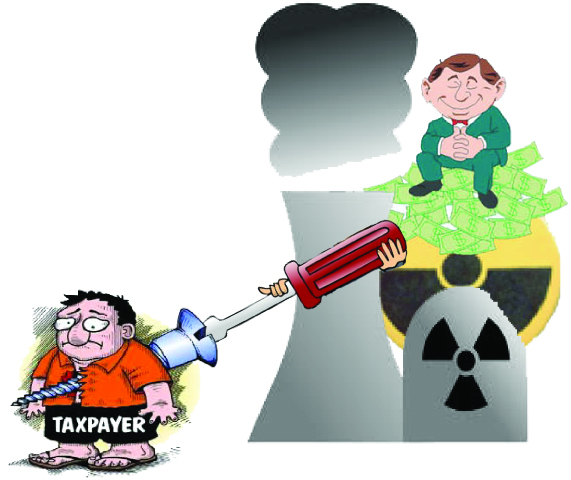
24 May, 2022 By Rob Hakimian https://www.newcivilengineer.com/latest/taxpayer-contribution-to-sizewell-c-nuclear-plant-could-double-24-05-2022/
Construction of the Sizewell C nuclear plant in Suffolk could cost taxpayers more than double what the government has suggested, according to new research
Construction of Sizewell C has not yet been confirmed, with the planning decision having recently been pushed back to July.
However, with the UK set to lose all of its functional advanced gas-cooling reactor (AGR) nuclear plants by 2028, the government is keen to push through plans for new plants as it has made nuclear energy a crux point of its net zero strategy and energy security strategy. It has already committed £100M to Sizewell C and, crucially, agreed to use the regulated asset base (RAB) funding model to pay for it.
The RAB model, which has previously been used to fund Tideway and Heathrow Terminal 5, allows investors to recoup some of their money during the construction phase of the project through taxation. The taxpayer pays for the plant through monthly surcharge on their taxes before they reap the rewards. The government says that, while the taxpayer will have to pay the surcharge during construction, they will save £10 a month through this method once the plant is operational.
However, if a project suffers delays and cost increases, this means the risk falls on the shoulders of the taxpayer. As seen by continual delays and cost hikes on Hinkley Point C, nuclear plants are particularly susceptible.
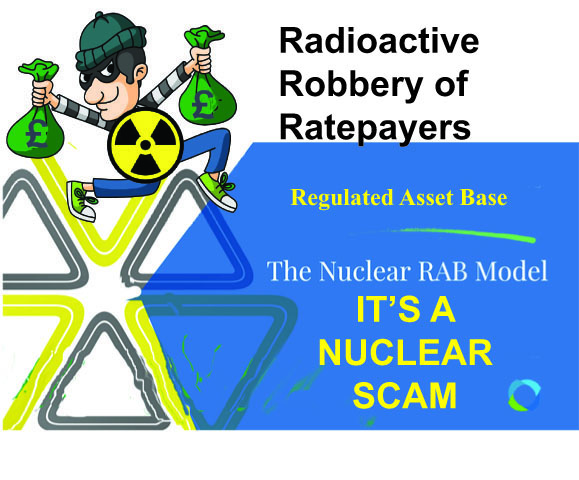
In its own analysis of using the RAB model to fund Sizewell C, the government has said that over the course of the plant’s 13-17 years construction it will add an average surcharge of £1 per month to household bills. However, the University of Greenwich School of Business says that the government’s calculations are based on 2021 prices and do not account for inflation over the course of the next two decades as the plant is built.
Taking into account inflation, based on the Treasury’s target level of 2%, Greenwich Business School has determined that the cost could be up to £2.12 per month on average over the course of the construction time. However, this is a relatively conservative estimate, as inflation could be much greater than 2% over the course of the next 20 years.
The government’s calculation is based on the median expectations for the construction of Sizewell C, i.e. that it will take 15 years (midway between the projected 13-17 years) and cost £35bn (midway between the estimated £26.3bn and £43.8bn).
Greenwich Business School has also looked at the best and worse case scenarios, adding 2% inflation. If the construction were to only last 13 years and cost £26.3bn, the taxpayer would fork out an additional £148.20 over the course (an average of 95p per month). If it is to last 17 years and cost £43.8bn, the taxpayer will pay an additional £431.90 over the duration (an average of £2.12 per month).
This figure could be even higher if the project runs beyond 17 years, costs over £43.8bn and/or inflation rises by more than 2%, all of which are distinct possibilities.
The RAB model, which has previously been used to fund Tideway and Heathrow Terminal 5, allows investors to recoup some of their money during the construction phase of the project through taxation. The taxpayer pays for the plant through monthly surcharge on their taxes before they reap the rewards. The government says that, while the taxpayer will have to pay the surcharge during construction, they will save £10 a month through this method once the plant is operational.
This figure could be even higher if the project runs beyond 17 years, costs over £43.8bn and/or inflation rises by more than 2%, all of which are distinct possibilities.
Both the government’s and Greenwhich Business School’s calculations are based on illustrative figures. More accurate figures will be known once planning has been granted and investment partners found.
This presents another issue, as there are no clear investors champing at the bit. While the government is bullish about nuclear’s potential green benefits, many potential investors are uncertain of its environmental, social and governance (ESG) credentials. Aviva Investors has even called out the government for not providing enough detail for a proper assessment on nuclear’s ESG potential.
University of Greenwich emeritus professor of energy policy Stephen Thomas told NCE: “There are differences between Tideway and Sizewell C. One is scale: Tideway is said to be a huge project, but the cost is not much more than a 10th of what Sizewell C will be, so it will be a big strain on that market.
- You are here: Latest
Taxpayer contribution to Sizewell C nuclear plant could double
24 May, 2022 By Rob Hakimian
Construction of the Sizewell C nuclear plant in Suffolk could cost taxpayers more than double what the government has suggested, according to new research.
Construction of Sizewell C has not yet been confirmed, with the planning decision having recently been pushed back to July.
However, with the UK set to lose all of its functional advanced gas-cooling reactor (AGR) nuclear plants by 2028, the government is keen to push through plans for new plants as it has made nuclear energy a crux point of its net zero strategy and energy security strategy. It has already committed £100M to Sizewell C and, crucially, agreed to use the regulated asset base (RAB) funding model to pay for it.
The RAB model, which has previously been used to fund Tideway and Heathrow Terminal 5, allows investors to recoup some of their money during the construction phase of the project through taxation. The taxpayer pays for the plant through monthly surcharge on their taxes before they reap the rewards. The government says that, while the taxpayer will have to pay the surcharge during construction, they will save £10 a month through this method once the plant is operational.
However, if a project suffers delays and cost increases, this means the risk falls on the shoulders of the taxpayer. As seen by continual delays and cost hikes on Hinkley Point C, nuclear plants are particularly susceptible.
In its own analysis of using the RAB model to fund Sizewell C, the government has said that over the course of the plant’s 13-17 years construction it will add an average surcharge of £1 per month to household bills. However, the University of Greenwich School of Business says that the government’s calculations are based on 2021 prices and do not account for inflation over the course of the next two decades as the plant is built.
Taking into account inflation, based on the Treasury’s target level of 2%, Greenwich Business School has determined that the cost could be up to £2.12 per month on average over the course of the construction time. However, this is a relatively conservative estimate, as inflation could be much greater than 2% over the course of the next 20 years.
The government’s calculation is based on the median expectations for the construction of Sizewell C, i.e. that it will take 15 years (midway between the projected 13-17 years) and cost £35bn (midway between the estimated £26.3bn and £43.8bn).
Greenwich Business School has also looked at the best and worse case scenarios, adding 2% inflation. If the construction were to only last 13 years and cost £26.3bn, the taxpayer would fork out an additional £148.20 over the course (an average of 95p per month). If it is to last 17 years and cost £43.8bn, the taxpayer will pay an additional £431.90 over the duration (an average of £2.12 per month).
This figure could be even higher if the project runs beyond 17 years, costs over £43.8bn and/or inflation rises by more than 2%, all of which are distinct possibilities.
Both the government’s and Greenwhich Business School’s calculations are based on illustrative figures. More accurate figures will be known once planning has been granted and investment partners found.
This presents another issue, as there are no clear investors champing at the bit. While the government is bullish about nuclear’s potential green benefits, many potential investors are uncertain of its environmental, social and governance (ESG) credentials. Aviva Investors has even called out the government for not providing enough detail for a proper assessment on nuclear’s ESG potential.
University of Greenwich emeritus professor of energy policy Stephen Thomas told NCE: “There are differences between Tideway and Sizewell C. One is scale: Tideway is said to be a huge project, but the cost is not much more than a 10th of what Sizewell C will be, so it will be a big strain on that market.
“The second difference is that there is output to sell from Sizewell C. Thames Tideway gets its money by being there and providing a service; if it’s there and it’s not utterly failed then that’s it. Sizewell C has kilowatt hours to sell, and there are risks in that because you don’t know how reliable the plant is going to be, you don’t know what the running costs are going to be, you don’t know what the fuel costs are going to be. So there are risks involved in that.
“The RAB is a bit of an illusion, because the kilowatt hour costs that they will quote are based on whatever it costs to ensure investors make their agreed return, no matter how high the price. It will ignore the surcharge paid during the construction phase, which is a huge subsidy by consumers. It is a blank cheque signed by consumers. It’s a dreadful model.”
A Sizewell C spokesperson said: “The RAB model is a proven financing arrangement which has already been used to raise funds for more than £160bn of infrastructure. Applied to Sizewell C, it will bring the cost of finance down and deliver significant savings to consumers.”
A government spokesperson said: “We firmly stand by our assessment that a large-scale project funded under our Nuclear Act would add at most a few pounds a year to typical household energy bills during the early stages of construction, and on average about £1 a month during the full construction phase of the project.”
Ukraine war briefing: France flies nuclear-capable missile as Russia holds drills
Guardian, Warren Murray and agencies, Thu 23 May
- France has carried out its first test firing of an updated nuclear-capable missile, the ASMPA-R, designed to be launched by a Rafale fighter jet, according to the French defence minister, Sebastien Lecornu. It came a day after Russia said it began nuclear drills in its southern military district, which stretches from Russia into occupied Ukrainian territory. The announcement of Russian drills is partly directed at France after its president, Emmanuel Macron, said he would not rule out sending in troops on Ukraine’s side.
- Lecornu said the missile was fired without a warhead by a plane in an exercise “above national territory … at the end of a flight representing a nuclear air raid”. He congratulated “all the forces, [defence] ministry teams and industrial partners involved” in a “long-planned” operation. France plans to spend about 13% of its military budget over the coming years on its independent nuclear capability, including upgrading to next-generation air-launched missiles by 2035. ……………………………………..
- Russia said there were Ukrainian attacks on its Belgorod region across the border from Ukraine, and in the occupied eastern Ukrainian city of Lysychansk, killing up to three people.
- The Swedish government has announced additional military support to Ukraine totalling 75 billion crowns (US$7bn) over three years. Ukraine’s defence minister, Rustem Umerov, said Swedish-made weapons had “already proven themselves on the battlefield … Archers and CV-90s help Ukrainian defenders drive the enemy out of our land.” https://www.theguardian.com/world/article/2024/may/23/ukraine-war-briefing-france-flies-nuclear-capable-missile-as-russia-holds-drills
In 1939 the Soviet Union ‘planned to send a million troops to stop Hitler if Britain and France agreed pact’
Nick Holdsworth in Moscow, The Telegraph, Sat, 18 Oct 2008 https://www.sott.net/article/491642-Stalin-planned-to-send-a-million-troops-to-stop-Hitler-if-Britain-and-France-agreed-pact
Stalin was ‘prepared to move more than a million Soviet troops to the German border to deter Hitler’s aggression just before the Second World War’
Papers which were kept secret for almost 70 years show that the Soviet Union proposed sending a powerful military force in an effort to entice Britain and France into an anti-Nazi alliance.
Such an agreement could have changed the course of 20th century history, preventing Hitler’s pact with Stalin which gave him free rein to go to war with Germany’s other neighbours.
The offer of a military force to help contain Hitler was made by a senior Soviet military delegation at a Kremlin meeting with senior British and French officers, two weeks before war broke out in 1939.
The new documents, copies of which have been seen by The Sunday Telegraph, show the vast numbers of infantry, artillery and airborne forces which Stalin’s generals said could be dispatched, if Polish objections to the Red Army crossing its territory could first be overcome.
But the British and French side – briefed by their governments to talk, but not authorised to commit to binding deals – did not respond to the Soviet offer, made on August 15, 1939. Instead, Stalin turned to Germany, signing the notorious non-aggression treaty with Hitler barely a week later.
The Molotov-Ribbentrop Pact, named after the foreign secretaries of the two countries, came on August 23 – just a week before Nazi Germany attacked Poland, thereby sparking the outbreak of the war. But it would never have happened if Stalin’s offer of a western alliance had been accepted, according to retired Russian foreign intelligence service Major General Lev Sotskov, who sorted the 700 pages of declassified documents.
“This was the final chance to slay the wolf, even after [British Conservative prime minister Neville] Chamberlain and the French had given up Czechoslovakia to German aggression the previous year in the Munich Agreement,” said Gen Sotskov, 75.
The Soviet offer – made by war minister Marshall Klementi Voroshilov and Red Army chief of general staff Boris Shaposhnikov – would have put up to 120 infantry divisions (each with some 19,000 troops), 16 cavalry divisions, 5,000 heavy artillery pieces, 9,500 tanks and up to 5,500 fighter aircraft and bombers on Germany’s borders in the event of war in the west, declassified minutes of the meeting show.
But Admiral Sir Reginald Drax, who lead the British delegation, told his Soviet counterparts that he authorised only to talk, not to make deals.
“Had the British, French and their European ally Poland, taken this offer seriously then together we could have put some 300 or more divisions into the field on two fronts against Germany – double the number Hitler had at the time,” said Gen Sotskov, who joined the Soviet intelligence service in 1956. “This was a chance to save the world or at least stop the wolf in its tracks.”
When asked what forces Britain itself could deploy in the west against possible Nazi aggression, Admiral Drax said there were just 16 combat ready divisions, leaving the Soviets bewildered by Britain’s lack of preparation for the looming conflict.
The Soviet attempt to secure an anti-Nazi alliance involving the British and the French is well known. But the extent to which Moscow was prepared to go has never before been revealed.
Simon Sebag Montefiore, best selling author of Young Stalin and Stalin: The Court of The Red Tsar, said it was apparent there were details in the declassified documents that were not known to western historians.
“The detail of Stalin’s offer underlines what is known; that the British and French may have lost a colossal opportunity in 1939 to prevent the German aggression which unleashed the Second World War. It shows that Stalin may have been more serious than we realised in offering this alliance.”
Professor Donald Cameron Watt, author of How War Came – widely seen as the definitive account of the last 12 months before war began – said the details were new, but said he was sceptical about the claim that they were spelled out during the meetings.
“There was no mention of this in any of the three contemporaneous diaries, two British and one French – including that of Drax,” he said. “I don’t myself believe the Russians were serious.”
The declassified archives – which cover the period from early 1938 until the outbreak of war in September 1939 – reveal that the Kremlin had known of the unprecedented pressure Britain and France put on Czechoslovakia to appease Hitler by surrendering the ethnic German Sudetenland region in 1938.
“At every stage of the appeasement process, from the earliest top secret meetings between the British and French, we understood exactly and in detail what was going on,” Gen Sotskov said.
“It was clear that appeasement would not stop with Czechoslovakia’s surrender of the Sudetenland and that neither the British nor the French would lift a finger when Hitler dismembered the rest of the country.”
Stalin’s sources, Gen Sotskov says, were Soviet foreign intelligence agents in Europe, but not London. “The documents do not reveal precisely who the agents were, but they were probably in Paris or Rome.”
Shortly before the notorious Munich Agreement of 1938 – in which Neville Chamberlain, the British prime minister, effectively gave Hitler the go-ahead to annexe the Sudetenland – Czechoslovakia’s President Eduard Benes was told in no uncertain terms not to invoke his country’s military treaty with the Soviet Union in the face of further German aggression.
“Chamberlain knew that Czechoslovakia had been given up for lost the day he returned from Munich in September 1938 waving a piece of paper with Hitler’s signature on it,” Gen Sotksov said.
The top secret discussions between the Anglo-French military delegation and the Soviets in August 1939 – five months after the Nazis marched into Czechoslovakia – suggest both desperation and impotence of the western powers in the face of Nazi aggression.
Poland, whose territory the vast Russian army would have had to cross to confront Germany, was firmly against such an alliance. Britain was doubtful about the efficacy of any Soviet forces because only the previous year, Stalin had purged thousands of top Red Army commanders.
The documents will be used by Russian historians to help explain and justify Stalin’s controversial pact with Hitler, which remains infamous as an example of diplomatic expediency.
“It was clear that the Soviet Union stood alone and had to turn to Germany and sign a non-aggression pact to gain some time to prepare ourselves for the conflict that was clearly coming,” said Gen Sotskov.
A desperate attempt by the French on August 21 to revive the talks was rebuffed, as secret Soviet-Nazi talks were already well advanced.
It was only two years later, following Hitler’s Blitzkreig attack on Russia in June 1941, that the alliance with the West which Stalin had sought finally came about – by which time France, Poland and much of the rest of Europe were already under German occupation.
Blinken Pushing To Let Ukraine Hit Russian Territory With US Weapons

Many members of Congress are also calling for President Biden to lift the ban, which risks a major escalation
by Dave DeCamp https://news.antiwar.com/2024/05/23/blinken-pushing-to-let-ukraine-hit-russian-territory-with-us-weapons/?utm_source=substack&utm_medium=email
Secretary of State Antony Blinken is leading a push within the Biden administration to allow Ukraine to use US-provided missile systems and other weapons to hit Russian territory, The New York Times reported on Wednesday.
The report said there is a “vigorous debate” within the administration in the wake of Russia’s new offensive in Kharkiv, which was launched from over the border in Russia’s Belgorod oblast.
It’s unclear how many other high-level officials agree with Blinken, but the pressure is growing on President Biden to lift the prohibition on Ukraine using US weapons on Russian territory, a ban that, according to the Times, is designed to “avoid World War III.”
House Speaker Mike Johnson (R-LA) and many other members of Congress are also calling to lift the ban. Ultra-hawk Victoria Nuland, who left the State Department in March, appeared on ABC News this week to make the pitch for Ukraine to extend its use of US weapons to Russian territory.
“I think there’s also a question of whether we, the United States and our allies, ought to give them more help in hitting Russian bases, which heretofore we have not been willing to do,” Nuland said.
“I think if the attacks are coming directly from over the line in Russia, that those bases ought to be fair game, whether they are where missiles are being launched from or where they are where troops are being supplied from,” she added.
Moscow recently warned the UK that if Ukraine used British weapons on Russian territory, Russian forces would target UK military sites in Ukraine “and beyond.” The warning came after British Foreign Secretary David Cameron said Ukraine had the “right” to use British arms in attacks on Russia.
Russia is currently conducting tactical nuclear drills that it launched in response to provocative rhetoric from Western officials about sending troops to Ukraine. The Times report said that the US was also considering deploying troops for training, although Chairman of the Joint Chiefs of Staff Gen. Charles Q. Brown said there were “no plans” to do so at the moment.
European Investment Bank’s (EIB) financing for nuclear reactor construction remains off the agenda

By Paul Messad | Euractiv France, 24 May 24, https://www.euractiv.com/section/energy-environment/news/eib-financing-for-nuclear-reactor-construction-remains-off-the-agenda/
Despite a leak of the European Investment Bank’s (EIB) roadmap containing nothing new or concrete on nuclear financing, the industry continues to hold out for new money from the bank to support its planned expansion.
“The European Investment Bank is open to financing for nuclear”, said Yves Desbazeilles, Director General of NuclearEurope, the Brussels-based association for the defence of nuclear power, responding to the leak in comments to CarbonPulse last week.
The EIB document, which outlines its planned work for 2023-2027, does mention that ‘R&D for small modular reactors (SMRs)’ will be supported by the EIB. Desbazeilles argued that the new document is an open door for “several other” options for EIB support, such as for reactor construction, but no such reference seems likely in the final text.
However, several industry observers have told Euractiv that the document’s references are no more significant than those in the current roadmap (2021-2025), which already mentions R&D support for nuclear fission and fusion but nothing on electricity generation.
Technology-neutral approach
The financing of nuclear power is a live topic in Brussels, mainly since the President of the European Commission, Ursula von der Leyen, spoke positively about the technology at the Nuclear Summit (NES) in Brussels in March 2024. In recent months, the industry and several national governments have made a concerted push for EIB support for nuclear.
The EIB remains cautious about the prospect of financing nuclear energy.
The bank is the EU’s investment arm and between now and 2025, it plans to channel €1,000 billion into environmental and energy projects.
Within this framework, the bank is adopting a technology-neutral approach and is therefore not closed to supporting nuclear power, illustrated by a €145 million loan granted in December 2023 for safety operations in Romania.
However, irrespective of politics, investment in nuclear power is now less financially attractive than it was in the past.
Over the last 24 years, only €1 billion of EIB funds have been earmarked for nuclear power and only for parallel activities (R&D, safety, etc.). The last EIB investments in electricity generation occurred in 1987, for France’s two first Flamanville nuclear reactors.
Plant construction is where finance is most needed – installed nuclear capacity is set to triple between now and 2050 in Europe, including large and small reactors.
Profitability
The construction of reactors faces a severe problem regarding the prospects of EIB support: profitability.
Although it deploys public money, the EIB’s lending operations are intended to generate a return for the bank and the institution’s prestigious ‘AAA’ credit rating allows it to borrow on international markets at low interest rates.
To maintain this rating, the bank cannot lend where there is a significant risk that it will not get a return on the loan. Where the bank deploys riskier loans, it protects itself by seeking guarantees and demanding that the borrowers are financially solid.
While the solvency condition is more easily met when the applicant nuclear company, such as EDF in France, is state-owned, this provision is harder for start-ups and other private companies to satisfy.
Larger reactors built more recently have struggled with systematic cost overruns and delays. This has seriously tested the confidence of financiers, who worry that they will not get back their investments or that it will be too late.
This concern is despite expert arguments that the cost of future large reactors will fall by 20 to 30, as Europe will benefit from serially producing reactors again.
The business model for large reactors is well known, but for SMRs, “which have new applications, the models have yet to be invented”, Valérie Faudon, General Delegate of the French Nuclear Energy Society (SFEN), explained to Euractiv.
Ultimately, the risk of financing nuclear power remains high, as Thomas Ostros, Vice-President of the EIB, put it in mid-March during the Nuclear Energy Summit.
Le consensus
EIB loans must also be approved by national governments. Germany, Italy, Spain, and France have an important voice because of the significant capital they have subscribed to the bank.
As a result, France cannot rely on the support of the ten states members of the nuclear alliance alone, although it does enjoy the support of the institution’s president, Nadia Calvino of Spain. Italy has made positive noises to support SMR but has not yet provided concrete support for new EIB financing.
The EIB declined to comment on the leaked 2023-2027 roadmap.
[Edited by Donagh Cagney/Alice Taylor]
Wylfa nuclear power plan- a financial basket case- and no developer will take on the risks.
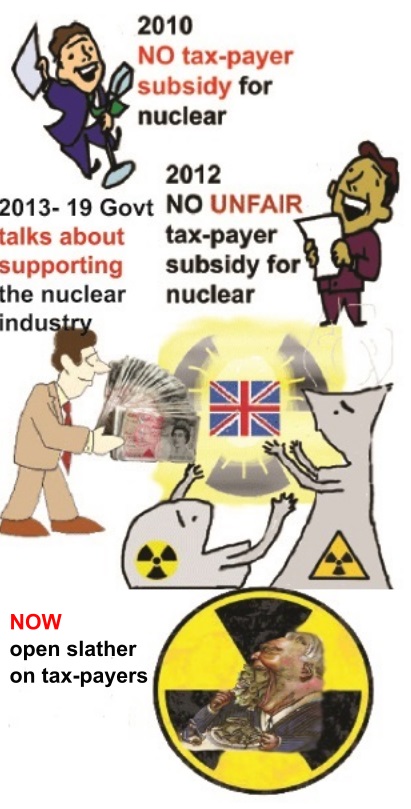
Dr Doug Parr, Chief Scientist for Greenpeace UK, said: “Government
announcements about new reactors have a theatrical quality that doesn’t
inspire confidence, particularly when the financial disaster movie of
Hinkley is still rolling in the background.
But Wylfa poses an additional
danger because, after the damage suffered by EDF, no developer will take on
the financial risks of construction. And so in the unlikely event of this
reactor being built, bill payers will be on the hook for billions of cost
overruns.
Just how badly that can play out is revealed by the one location
where the kind of funding structure favoured by the government has been
tried, in South Carolina in the USA. The bill payers of the state have seen
billions added to their bills even though the planned reactors have been
abandoned uncompleted. Even worse, this financial basket case is one of the
reactor designs the government is considering for Wylfa.”
Carmarthenshire News 23rd May 2024
UK Election! And no Final Investment Decision made on Sizewell nuclear project

https://mailchi.mp/stopsizewellc/election?e=c3c4307b44 24 May 24
Last night’s announcement of a snap election has convinced us that the government’s commitment to reach a Final Investment Decision (FID) on Sizewell C within the current parliament is essentially impossible to fulfil. We explain why below, and why Sizewell C’s future is dependent on the election outcome.
We are already making plans to set up actions that will enable you to contact parliamentary candidates about Sizewell C – certainly in Suffolk but hopefully countrywide – and planning an energy hustings in East Suffolk with our allies. Meanwhile we have sent the following comment and briefing to the media.
“The impossibility of a Final Investment Decision on Sizewell C being made before the election lets the Conservatives off the hook for signing away another HS2. It also presents a likely Labour government, looking to drive down bills and reach net zero by 2030, an opportunity to focus on more cost effective renewable projects. We are going to do everything in our power to ensure that this election signals the death knell for slow, expensive, risky Sizewell C.”
- Stop Sizewell C understands that the capital raise is still ongoing, and final bids have yet to be submitted, reportedly due by the end of June. A likely change in government may increase the risks perceived by investors and influence or even deter bids. The capital raise will be subject to a Value for Money (VfM) assessment. If, as reported, investors are seeking high returns, the VfM – and therefore the capital raise – is likely to fail.
- In this event, Ministers would have to decide whether to take a FID with the taxpayer as Sizewell C’s majority stakeholder. An additional VfM assessment will be required as well as multiple internal procedural steps and approvals.
While Labour’s stated position is in favour of Sizewell C, the implications of having to make a FID requiring billions of pounds of taxpayers’ money and which would additionally push much of the risk onto household bills via use of the RAB funding model, in addition to the impossibility of Sizewell C contributing to the goal of net zero by 2030, may give pause. Rising costs and inflation make the current government’s estimate of a Sizewell C RAB costing consumers on average £1 month improbable.
A new government would be expected to conduct a Spending Review ahead of an autumn budget, which seems likely to also lead to a pause before any decision about a Sizewell C FID was made.
Sizewell C Chair Rob Holden acknowledged the risk associated with a change in government telling the The Times recently “Clearly there has to be a risk there. There is with any big decision on this.” In the same interview Rob Holden also highlighted that further widening of the gap between Hinkley Point C and Sizewell C would reduce any replication “benefits”.
Even in the very unlikely event a FID could be fast-tracked, pre-election guidance states that Ministers should “observe discretion” in making big announcements. This must be especially pertinent if a large commitment of taxpayers’ money was necessary for a Sizewell C FID. Having sucked up £2.5bn in taxpayers’ money already, which we understand is all committed, it’s possible yet more funds will be allocated to keep the project going over this period of uncertainty.
Nuclear Free Local Authorities (NFLAs) join Stop Sizewell in urging 120 local authorities not to back Sizewell C
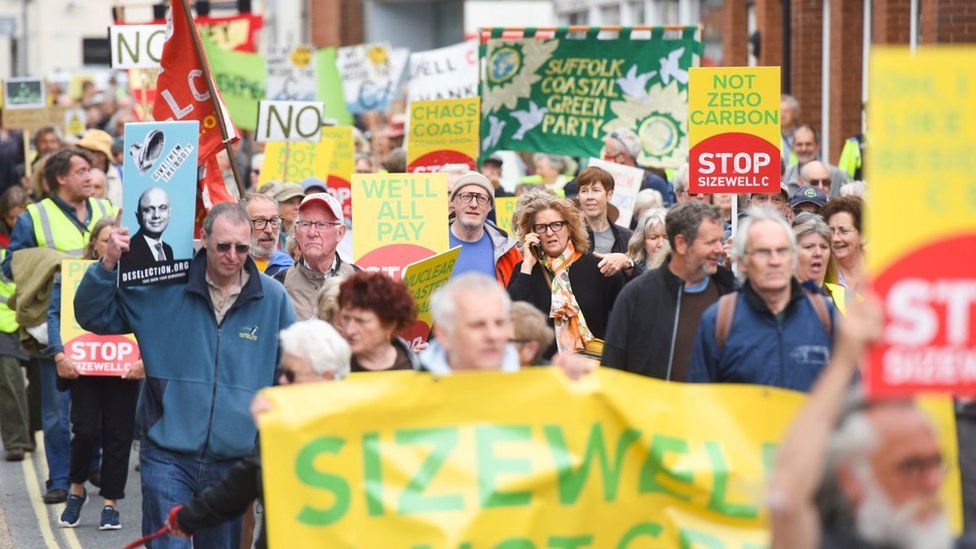
The UK/Ireland Nuclear Free Local Authorities have joined campaigners at Stop Sizewell in writing to pension fund administrators providing benefits to members in at least 120 UK local authorities urging them not to finance the Sizewell C nuclear power plant project in Suffolk.
In recent months, Government ministers and EDF have been busy courting pension funds seeking private sector finance. UK taxpayers have already been unwittingly forced to stump up £2.5 billion in pledges made by the government to kick start preparatory works on the site, but government will need billions more to commence construction.
The estimated cost of completing Sizewell C’s sister plant Hinkley Point C in Somerset could be as high as £46 billion, and civil nuclear projects are notorious for being delivered late and hugely over budget.
Now NFLA Secretary Richard Outram has joined Stop Sizewell Executive Director Alison Downes in writing to Council pension funds urging them to invest in renewables instead of nuclear, particularly in light of the many resolutions passed by Councils to take urgent action to tackle climate change.
Stop Sizewell have also prepared an excellent briefing outlining why backing Sizewell C would be a bad investment:
……………………………………………..more https://www.nuclearpolicy.info/news/nflas-join-stop-sizewell-in-urging-120-local-authorities-not-to-back-sizewell-c/
Ukrainian missiles hit Crimea as Russia launches nuclear drills in area
By Alessio Dell’Anna with AP, 24/05/2024 , https://www.euronews.com/my-europe/2024/05/24/ukrainian-missiles-hit-crimea-as-russia-launches-nuclear-drills-in-area
The exercise in the Southern Military District, which includes the occupied Ukrainian peninsula of Crimea, involves tactical nuclear weapons which can be used on a battlefield even in proximity of allied forces.
Ukraine struck two Crimean targets late on Thursday, the Russian head of the annexed peninsula said.
Two people were killed in a missile attack near Simferopol, Crimea’s main administrative centre. They also hit a building near Alushta, on Crimea’s Black Sea coast.
Moscow said the facility was empty, while Ukraine’s resistance group in Crimea Atesh has reported multiple casualties.
The attack comes as Russia gets underway drills in its Southern Military District, which also includes the occupied peninsula of Crimea.
The exercise involves tactical nuclear weapons, such as air bombs, warheads for short-range missiles and artillery munitions.
Tactical nuclear weapons are less powerful than conventional strategic nuclear weapons, but they can be employed on the battlefield, even with friendly forces nearby.
Russia regularly holds exercises involving tactical nuclear weapons. However, this is reportedly the first time the Kremlin has publicly announced it.
The announcement came after French President Emmanuel Macron reiterated that he doesn’t exclude sending troops to Ukraine, and UK Foreign Secretary David Cameron said Kyiv’s forces will be able to use British long-range weapons to strike targets inside Russia.
The Kremlin branded those comments as dangerous, further inflaming tensions between Russia and NATO.
Sizewell C nuclear: Uncertainty surrounds final investment decision as parliamentary session shortened

New Civil Engineer 24 MAY, 2024 BY TOM PASHBY
The final investment decision (FID) for Sizewell C has been thrown into limbo by the early dissolution of parliament, with prime minister Rishi Sunak having called an election for 4 July.
Conservative politicians were caught off guard by the announcement, made at around 5pm on 22 May. This means Parliament will dissolve on Thursday 30 May.
Earlier in the day of the General Election announcement, the energy secretary Claire Coutinho issued a written statement about the proposed nuclear power station at Wylfa in north Wales where she also commented on the in-development Suffolk nuclear station, saying: “We intend to take a final investment decision on Sizewell C before the end of this Parliament.”
It can be assumed that Coutinho was unaware that the end date of the current parliament was due to be brought forward by the calling of the general election.
Nuclear minister Andrew Bowie also said earlier this month that an FID would be announced by end of this Parliament.
With Parliament now to dissolve next Thursday, the period known as ‘wash-up’ is underway where the government tries to pass a selection of remaining pieces of legislation.
The government has to date invested £2.5bn in the project in numerous tranches but intends to find private investors to cover the majority.
The government commenced the search for investment partners in the circa £20bn project last September. It said it is seeking companies with “substantial experience in the delivery of major infrastructure projects” and added “ministers will be looking for private investors who can add value to the project and will only accept private investment if it provides value for money, while bolstering energy security”.
Potential investors were required to register their interest by early October 2023 but there has been little news in the more than half a year since.
The shortening of the current parliamentary period means there is now uncertainty about whether the government will have time to make an FID.
A government source confirmed to NCE that progress continues towards FID.
The source said the government would continue to fund the project in the pre-election period using investment funds which had already been made available and said operations at the site would be business as usual in the lead-up to polling day.
If the current government does not make an FID for Sizewell C, it will fall to the next government due to be elected on 4 July to do so. If there is a hung Parliament, there may be a further delay to the formation of a new government.
A Sizewell C spokesperson said: “We are continuing to engage with investors and prepare for FID and we are moving ahead as planned on our construction site.”
However, campaign group Stop Sizewell C believes it is now impossible for a FID to be made before the General Election.
A spokesperson for the group said that this “lets the Conservatives off the hook for signing away another HS2”.
They continued: “It also presents a likely Labour government, looking to drive down bills and reach net zero by 2030, an opportunity to focus on more cost effective renewable projects.
“We are going to do everything in our power to ensure that this election signals the death knell for slow, expensive, risky Sizewell C.”
The money invested in the Sizewell C project will look to be recouped through a regulated asset base (RAB) model for funding, which would see the investors money returned through a surcharge on consumer energy bills……………………. https://www.newcivilengineer.com/latest/sizewell-c-uncertainty-surrounds-final-investment-decision-as-parliamentary-session-shortened-24-05-2024/
Hinkley C – don’t say I didn’t warn you!
It is worth remembering that while construction costs are in the £42 to £48 billion range, the 35 years of electricity at £87.50 or £92.50/MW in 2012 money, adjusted for inflation will cost UK energy users a gargantuan £111 or £116 billion over the next 35 years. Could we use that money better? You bet.
2016 was a missed opportunity, most likely the last opportunity to scrap the benighted project, one of the worst blunders in the history of public procurement and of the UK’s energy industry
In 2016, I called for Hinkley C to be scrapped. Now its commissioning has been pushed back to the end of the decade and its costs have ballooned to as much as £48 billion in 2024 money. I was right.
Thoughts of Chairman Michael , MICHAEL LIEBREICH, JAN 25, 2024
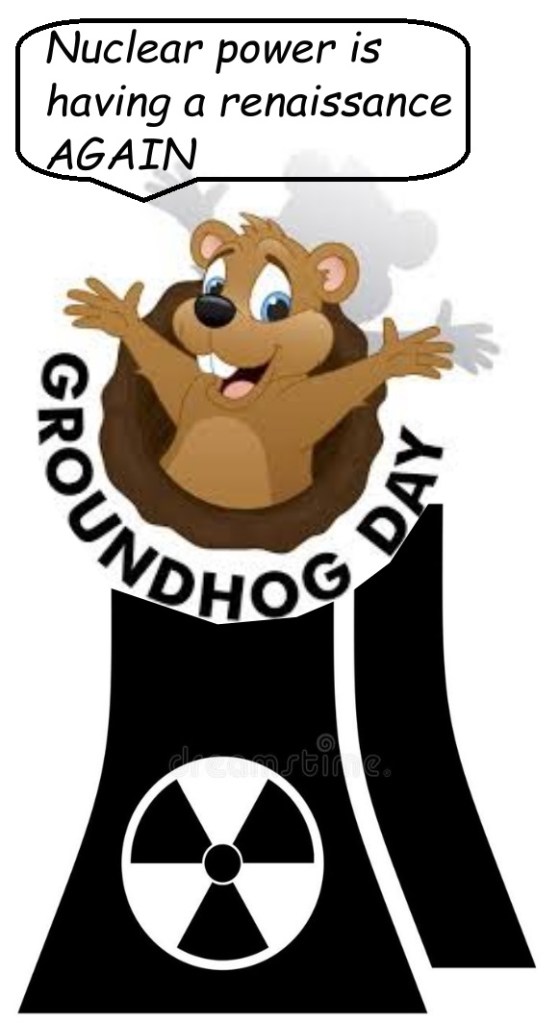
by EDF in 2017), announced a “Nuclear Renaissance” and was lobbying for a new build programme in the UK to replace aging plants set for retirement. In the absence of evidence, they claimed new plants would produce power for £24 per MWh (£39/MWh in 2024 money, or $50/MWh).
The Labour Party, long dead set against nuclear power, were convinced. In January 2008, Prime Minister Gordon Brown declared, in the preface to a White Paper on nuclear power entitled “Meeting the Energy Challenge” that “nuclear should have a role to play in the generation of electricity, alongside other low carbon technologies.” The White Paper estimated the total cost of building a 1.6GW nuclear plant at £2.8 billion – which would translate into £5.6 billion for Hinkley C’s 3.2GW (£9.0 billion or $11.5 billion in 2024 money).
EDF’s UK CEO Vincent de Rivaz was cock-a-hoop, predicting that Brits would be cooking their turkeys with power from Hinkley C by Christmas 2017. But remember that figure – £9.0 billion for 3.2GW.
By October 2013, Osborne and Davey had agreed a Contract for Difference with EDF for electricity production at a strike price of £92.50/MWh in 2012 money (£132/MWh in today’s money or $169/MWh) – rising with inflation for 35 years, but dropping to £87.50 (£125/MWh in today’s money or $173/MWh) if a second EPR were to be built. That EPR is Sizewell C – of which more later.
At that point, Hinkley C was expected to cost £16 billion in 2015 money (£22 billion in 2024 money or $28 billion). It was due to come online in 2023 and continue cooking Christmas turkeys for 60 years.
Since then, on five separate occasions EDF has announced that costs have increased, and the commissioning date pushed back. The only delay which was not fully in the control of EDF and it suppliers in the nuclear and construction industries was Covid – which can be blamed for around a year of delay and a couple of billion of cost increase, but not more.
Last week – yet another delay and cost increase
So then last week, we learned that the plant would be lucky to open much before 2030 – that’s 13 years after de Rivaz’s 2017 promise – and costs would be between £31 and £35 billion in 2015 terms (2015 is used because the CfD figures were set in 2015 money). That is £42 to £48 billion in 2024 money, or up to $61.4 billion).
Remember, we were first promised it would cost £9 billion in today’s money, so that’s an increase of between 4.6 and 5.4 times.
Now, I know that supporters of the project and hard-core nuclear fans will be bursting blood vessels at this point, desperate to jump in an explain that most of the difference between £9 billion and nearly £50 billion is down to financing cost resulting from the use of the CfD mechanism, regulatory cost, delay in government decision-making and so on. But I’m going to say it: I don’t care.
If the nuclear industry says it can build something for £9 billion, it needs to build it for £9 billion. That’s what happens in other industries. If the right number, including finance costs was £22 billion, it should have said so all along. And if it knows that there is a good chance of cost over-runs more than doubling the cost, it should include an appropriate contingency when it promotes and negotiates projects.
How big things (don’t) get done
It is not like cost over-runs in nuclear projects are a big secret. The world’s leading academic expert on project management is Danish Professor Bent Flyvbjerg, author of How Big Things Get Done, who joined me on Cleaning Up last year. Having build a huge database of projects of different sources, he can definitively show that nuclear plants are worse only than Olympic Games in terms of cost over-runs. On average they go 120% over the budget, with 58% of them going a whopping 204% over budget.
The common trope among nuclear fans is that it is only in the western world that nuclear new build is either problematic or exorbitantly expensive, and this is driven by excessive regulation.
While excessive delays in emerging nuclear powers are certainly less common, there is no transparency over how this is achieved. There are ample examples of problems: the use of fake certification documents, the sealing of deals for reactor sales by military inducements, cutting corners on safety, failure to maintain control of the fuel supply chain, failure to disclose problems and accidents; unexplained accidents on aging plants.
There is also no transparency over the real cost of their plants. Put simply, these are are whatever their leaders say they are: it is they who decide the cost of capital, state guarantees, whether safety standards meet or exceed international standards, whether safety standards are enforced, the environmental standards applied to the supply chain, the speed projects proceed through licencing, the need or not to provision for decommissioning costs, the diversion of costs to military, energy or industrial budgets, and so on.
Back to 2016
Now let’s get back to Hinkley C, and 2016. One of the first things Theresa May did when she took over from David Cameron was to ask her security advisors to review the wisdom of allowing state-owned China General Nuclear to invest £6 billion in the project. In the end May backed down and allowed the investment to go ahead, but that is the background to my piece: the project’s future was in doubt, and it was the last realistic chance to kill it before tens of billions of pounds had been invested. And this is what I wrote: The case for Hinkley Point C has collapsed: It’s time to scrap it.
Perhaps of most interest, given the recent breathless announcements by French ministers of their desire to build a lot more new nuclear power stations, and the money being thrown by the UK government at Sizewell C before it has reached a final investment decision, is this section:
There are at least three ways in which [Greg Clark, the freshly-appointed Minister at BEIS] could potentially replace its supply contribution more cheaply, more quickly, and with more impact on UK industry and exports.
He could mandate more renewable generating capacity, paired with interconnections and a range of technologies to manage intermittency. He could push through a fleet of new gas power stations and get serious about carbon capture and storage. Or he could spend a lot less than £37bn on energy efficiency, simply removing the demand for 3.2 GW of base-load power.
Alternatively, if the government still has a nuclear itch, Clark needs to ask why Hinkley C is the right way to scratch it. After decades of technological stagnation, new nuclear technologies are approaching commercialisation, offering passive safety, so they can’t melt down in the event of a power failure, and smaller scale, so they shouldn’t take 15 years to see the light of day.
It is worth remembering that while construction costs are in the £42 to £48 billion range, the 35 years of electricity at £87.50 or £92.50/MW in 2012 money, adjusted for inflation will cost UK energy users a gargantuan £111 or £116 billion over the next 35 years. Could we use that money better? You bet.
Summary
So there you have it. 2016 was a missed opportunity, most likely the last opportunity to scrap the benighted project, one of the worst blunders in the history of public procurement and of the UK’s energy industry……………… https://mliebreich.substack.com/p/hinkley-c-dont-say-i-didnt-warn-you
Zaporizhzhia nuclear plant’s main power line down for hours, no safety threat
MOSCOW, May 23 (Reuters) – Russia said the main power line supplying the Russian-controlled Zaporizhzhia nuclear power plant (ZNPP) in Ukraine was down for more than three hours on Thursday, though there was no threat to safety.
The six reactors at the Zaporizhzhia plant, held by Russia and located close to the front line of the conflict in Ukraine, are not in operation but it relies on external power to keep its nuclear material cool and prevent a catastrophic accident.
The Russian management said on their official channel on the Telegram app that the reasons for the outage, which had not caused any change in radiation levels, were being investigated.
It had initially said the main 750 kilovolt (kV) “Dniprovska” power line went down at 1:31 p.m. local time (1031 GMT), while the 330 kV “Ferosplavnaya” line was supplying power to the plant now.
It later reported that the Dniprovska line was restored at 4:49 p.m. local. Power supply to ZNPP is possible via both lines, it added.
The Dniprovska power line also went down for almost five hours on March 22, highlighting what the International Atomic Energy Agency (IAEA) said were “ever present dangers to nuclear safety and security” from the Russia-Ukraine war.
Russia and Ukraine have each accused the other at various times of shelling the Zaporizhzhia plant, which is Europe’s largest. Both deny such accusations.
The IAEA has said that the ZNPP has been experiencing major off-site power problems since the conflict began in early 2022, exacerbating the nuclear safety and security risks confronting the site.
US military aid to Ukraine is ‘grift’ – Blackwater founder to Tucker Carlson
The equipment Washington sends to Kiev will never change the tide of battle, Eric Prince has said
https://www.rt.com/news/598015-us-military-aid-ukraine-blackwater/ 22 May 24
US weapons shipments to Ukraine are senseless since they are not capable of changing the course of the conflict, Eric Prince, the founder of private American military contractor Blackwater, told journalist Tucker Carlson in an interview published on Tuesday.
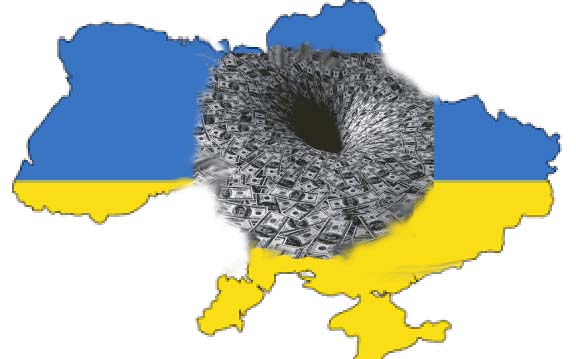
The military aid to Ukraine is nothing but a “massive grift paid by the Pentagon,” Prince stated, adding that the latest major aid package worth $61 billion approved by Congress and signed by President Joe Biden in April will end up lining the coffers of US defense industry giants. Prince, himself a former Navy SEAL officer, resigned and divested from his company after the 2007 Iraqi massacre scandal.
“Most of that money goes to five major defense contractors to replace at five times the cost the weapons that we have already sent the Ukrainians,” the Blackwater founder said, adding that “it does not change the outcome of the battle.”
“The Biden administration believed that all this American weaponry would have saved the day. It has not,” Prince said.
The Russian military has published photos and videos of damaged and destroyed Western-made military equipment in Ukraine, including US-supplied Abrams tanks. One of them ended up at a trophy exhibition in Moscow, alongside a German-made Leopard main battle tank and dozens of other pieces.
Kiev’s forces are already spread “very thin” and are about to face an “ugly summer,” according to Prince. “All the defenses that were supposed to be built by Ukrainians are much smaller or non-existent,” he said, mostly due to “corruption issues.”
Moscow’s forces are “going to have a very good summer” and will seek to “absolutely humiliate the West and make sure they never have a problem with Ukraine again,” the Blackwater founder believes.
The interview comes amid Russian offensives in Donbass and Ukraine’s northeastern Kharkov Region, where Moscow’s forces have been steadily gaining ground. Last month, Russia’s former defense minister, Sergey Shoigu, said Moscow’s forces had seized the initiative and “dispelled the myth of the superiority of Western weapons.”
Prince went on to say that he never believed Ukraine could push Russia out of Donbass and Crimea. “The war should never have [been] started.”
The only thing Washington and its allies will achieve in Ukraine is “facilitating the demise of the Ukrainian men” and “destroying” this nation “for future generations,” the Blackwater founder said.
Moscow has warned that Western arms shipments to Ukraine will only prolong the conflict without changing the outcome. It has also accused the West of forcing Kiev to “fight to the last Ukrainian.” In early May, Shoigu said that Kiev has lost more than 111,000 troops this year alone.
1 This Month

22 June – Virtual Event –Climate Change: New Data, New Debate

Monday, June 22, 2026 2:30 p.m. – 3:15 p.m. CT
YouTube. Register here

Protect Sazan Island from the Trump family! https://secure.avaaz.org/campaign/en/protect_sazan_island_from_the_trump_family_loc/?bqFCVab&v=174511&cl=22707147157&_checksum=5e9dde668860e8231c33699735e16a1fbf22ab2cb01da50c999fe8732b9775ef&utm_source=email&utm_medium=blast_email&utm_campaign=174511

25 June- THE PUKE ON NUKES
Thursday, June 25, 2026
7pm Central Time (8pm ET, 6pm MT, 5pm PT) UTC – 5
From NRC & DOE Deregulation to Techno-Fascist Billionaires Going Nuclear, Plus a Few Songs from Atomic Cabaret REGISTER
26 June – Radiation Trainwreck at the NRC / Join the Protect Better Campaign – https://us02web.zoom.us/meeting/register/4ZlZ5_qLSHGiLSCg8FF6Bg#/registration


Cuba Is Not a Failed State – It Is a Besieged State
PETITION: “Global Appeal to Endorse Palestinian Right of Return of Refugees”
To see nuclear-related stories in greater depth and intensity – go to https://nuclearinformation.wordpress.com
-
Archives
- June 2026 (211)
- May 2026 (306)
- April 2026 (356)
- March 2026 (251)
- February 2026 (268)
- January 2026 (308)
- December 2025 (358)
- November 2025 (359)
- October 2025 (376)
- September 2025 (257)
- August 2025 (319)
- July 2025 (230)
-
Categories
- 1
- 1 NUCLEAR ISSUES
- business and costs
- climate change
- culture and arts
- ENERGY
- environment
- health
- history
- indigenous issues
- Legal
- marketing of nuclear
- media
- opposition to nuclear
- PERSONAL STORIES
- politics
- politics international
- Religion and ethics
- safety
- secrets,lies and civil liberties
- spinbuster
- technology
- Uranium
- wastes
- weapons and war
- Women
- 2 WORLD
- ACTION
- AFRICA
- Atrocities
- AUSTRALIA
- Christina's notes
- Christina's themes
- culture and arts
- Events
- Fuk 2022
- Fuk 2023
- Fukushima 2017
- Fukushima 2018
- fukushima 2019
- Fukushima 2020
- Fukushima 2021
- general
- global warming
- Humour (God we need it)
- Nuclear
- RARE EARTHS
- Reference
- resources – print
- Resources -audiovicual
- Weekly Newsletter
- World
- World Nuclear
- YouTube
-
RSS
Entries RSS
Comments RSS
 nuclear-news