Italy opposes Ukraine using long-range weapons to strike Russia
https://www.rt.com/russia/598477-italy-opposes-ukraine-strike-russia-nato-weapons/ 31 May 24
Italian Foreign Minister Antonio Tajani has specified where missiles his country sends to Kiev can be used
Italy will never send troops to Ukraine and any weapons it has supplied to Kiev should not be used deep inside Russian territory, Italian Foreign Minister Antonio Tajani said on Thursday.
He made the remarks as pressure builds on NATO members to allow Kiev use long-range Western weapons to strike targets inside Russia. NATO Secretary General Jens Stoltenberg last week urged Western arms donors to allow attacks against targets behind the conflict zone on Russian soil.
“All the weapons leaving from Italy [to Ukraine] should be used within Ukraine,” Tajani said in an interview with public broadcaster RAI.
Italy, although a staunch supporter of Ukraine, has rebuked Stoltenberg over his call for more strikes on Russia with Italian Prime Minister Giorgia Meloni and other top officials accusing him of escalating tensions with Moscow.
“I don’t know why Stoltenberg said such a thing, I think we have to be very careful,” Meloni told Italy’s RAI 3 TV channel on Sunday.
Italian Deputy Prime Minister Matteo Salvini described the NATO chief as “dangerous.”
French President Emmanuel Macron however said on Tuesday that Kiev should be allowed to hit military sites deep inside Russia.
“We think we should allow them neutralize military sites from which missiles are fired, military sites from which Ukraine is attacked,” he told a joint news conference with German Chancellor Olaf Scholz.
The German leader now also supports Ukrainian strikes with Western long-range weaponry deep inside Russia, despite his earlier concerns about escalation with Moscow. Speaking alongside Macron, Scholz said that “if Ukraine is attacked, it can defend itself” under international law.
Latvian President Edgars Rinkevics told CNN on Monday that he sees “no rational pragmatic reason not to allow Ukraine to use those weapons against Russia in a way that is the most efficient.”
Ukrainian officials have claimed that the limitations imposed by the West are responsible for Russia’s recent advances in Kharkov Region. Vladimir Zelensky has repeatedly called for increased NATO involvement in the conflict and has argued that the West should not fear Russia’s reaction.
According to Moscow, claims that restrictions on the use of US munitions are in place are false and designed to maintain the illusion that the West is not part of the conflict.
The ghost of Concorde stalks the Franco-British nuclear renaissance
Critics fear history is repeating itself as Flamanville opens late and vastly over budget
AMBROSE EVANS-PRITCHARD, 29 May 2024
Critics fear history is repeating itself as Flamanville opens late and
vastly over budget. France’s first nuclear plant for a quarter century is
finally going ahead at Flamanville on the coast of Normandy, 12 years late
and six times over budget.
EDF has loaded the fuel of the giant European
Pressurised Reactor or EPR1. The first nuclear reaction will take place
within weeks, reaching full power of 1.65 gigawatts (GW) by year’s end.
It will be the most powerful reactor on the planet, to be joined eventually
by two sister reactors at Hinkley Point, and another at Sizewell C if
anybody can find the money.
To fans, Flamanville is an ultra-safe feat of
advanced engineering, with three layers of protective barriers. It can
withstand an earthquake, a tsunami, a head-on crash by an Airbus A380, or
even (arguably) a meltdown of the core. It is built to last 60 years,
perhaps a century.
To critics, it is a ruinous misadventure, the ultimate
over-refinement of obsolete fission technology that can never compete on a
commercial basis.
Delays have left France dependent on old reactors that
are literally falling apart. EDF has racked up debts of €54bn (£46bn)
and had to be renationalised in 2022. To those of us in the middle –
friendly to nuclear, if cheap enough – it is striking that Korea seems
able to roll out workhorse reactors relatively quickly at half the cost.
Korea Hydro & Nuclear Power’s modified APR1000 reactor was certified in
Europe last year. All is forgiven, apparently, even though a parallel EPR1
plant at Olkiluoto in Finland – opened last year – had similar delays
and cost overruns, and even though the Taishan I variant in China had to
shut down for a year due to damaged fuel rods.
Emmanuel Macron began his
presidency by closing a working reactor near the German border in order to
please Angela Merkel. He had a Damascene conversion after Putin’s
invasion of Ukraine. Mr Macron now wants to build 14 modified EPR2 reactors
– supposedly cheaper – in a repeat of France’s “dash for nuclear”
under premier Pierre Messmer in 1974.
It is a heroic undertaking for a
country with a structural budget deficit of 5pc of GDP and a debt ratio
stuck at 112pc, with rating agencies on the prowl. Much the same can be
said about Britain’s nuclear renaissance, targeting 24 GW by mid-century.
The bet is that the average cost per EPR will fall by 30pc as the series
rolls out a scale. That would cut the putative bill for Sizewell C to £85
MWh in today’s money, or lower if you treat it as a 60-year venture in
accounting terms. Reste à voir, as the French say.
Telegraph 29th May 2024
U.S. concerned about Ukraine strikes on Russian nuclear radar stations

Washington conveyed to Kyiv that attacks on Russian early-warning systems could be destabilizing.
By Ellen Nakashima and Isabelle Khurshudyan, May 29, 2024 https://www.washingtonpost.com/national-security/2024/05/29/us-ukraine-nuclear-warning-strikes/
The United States fears that recent Ukrainian drone strikes targeting Russian nuclear early–warning systems could dangerously unsettle Moscow at a time when the Biden administration is weighing whether to lift restrictions on Ukraine using U.S.-supplied weapons in cross-border attacks.
“The United States is concerned about Ukraine’s recent strikes against Russian ballistic missile early-warning sites,” said a U.S. official, who spoke on thecondition of anonymity because of the matter’s sensitivity.
Washington has conveyed its concerns to Kyiv about two attempted attacks over the last week against radar stations that provide conventional air defense as well as warning of nuclear launches by the West. At least one strike in Armavir, in Russia’s southeastern Krasnodar region, appeared to have caused some damage.
“These sites have not been involved in supporting Russia’s war against Ukraine,” the U.S. official said. “But they are sensitive locations because Russia could perceive that its strategic deterrent capabilities are being targeted, which could undermine Russia’s ability to maintain nuclear deterrence against the United States.”
A Ukrainian official familiar with the matter, however, said that Russia has used the radar sites to monitor the Ukrainian military’s activities, particularly Kyiv’s use of aerial weaponry, such as drones and missiles. The official, speaking on the condition of anonymity to discuss a sensitive security matter, confirmed that Ukraine’s Military Intelligence Directorate, known by its initials as GUR, was responsible for the strikes.
Ukraine is facing a continuing threat to its existence from a Russian enemy force — which boasts the world’s largest nuclear arsenal — that has gained ground of late, in part due to its sophisticated radar and weapons-jamming technology, which has rendered virtually useless some U.S.-provided guided missiles and artillery shells. This capability has also enhanced Moscow’s ability to track British and U.S.-provided longer-range weaponry and drones, which have caused serious damage to Russia’s Black Sea fleet and military installations in Crimea, the southern peninsula illegally seized from Ukraine in 2014.
The Ukrainian official said the goal of the strikes was to diminish Russia’s ability to track the Ukrainian military’s activities in southern Ukraine. The drone that targeted the radar station near Orsk, in Russia’s Orenburg region along Kazakhstan’s northern border, traveled more than 1,100 miles, making it one of the deepest attempted strikes into Russian territory. The Ukrainian official declined to say whether the strike, on May 26, caused any damage.
U.S. officials said they are sympathetic to Ukraine’s plight — administration officials are actively weighing whether to lift restraints on the use of U.S.-provided weapons to strike inside Russia. But were Russia’s early-warning capabilities to be blinded by Ukrainian attacks, even in part, that could hurt strategic stability between Washington and Moscow, the U.S. official said.
The perception issue is likely fueled by “an erroneous conviction that Ukraine’s targeting is directed by Washington,” said Dmitri Alperovitch, security analyst and chairman of Silverado think tank. “But that means attacks by Kyiv on Russian nuclear deterrence infrastructure has potential to trigger a perilous escalation with the West. At the end of the day, nuclear command and control and early-warning sites should be off-limits.”
Some analysts were puzzled at the targets: While Krasnodar is close enough to Ukraine to track missiles and drones, the radar station near Orsk is focused on the Middle East and China, they said.
Asked why they would target a site so far away, the Ukrainian official asserted that Russia “switched all of its capabilities for war against Ukraine.”
Following Ukraine’s disappointing counteroffensive last year, Russia has regained the initiative on the battlefield in recent months, advancing in the eastern Donetsk region and recently launching a new assault in the northeastern Kharkiv region along the border. Kyiv, meanwhile, has with increasing frequency targeted sites deep in Russia — a capability many doubted was possible without Western support and sign-off.

About three weeks ago, shortly after Russia began its assault on Kharkiv, Ukraine asked the United States to ease long-standing restrictions on using U.S.-provided weapons to attack targets inside Russia. Some senior officials favor such a move, including Secretary of State Antony Blinken, who has urged President Biden to agree to lift the restraints. The White House is considering such a proposal, but no action has been taken yet, officials say.
At a news conference Wednesday in Moldova, Blinken said the United States has “not encouraged or enabled strikes outside of Ukraine, but Ukraine, as I’ve said before, has to make its own decisions about the best way to effectively defend itself.”
Blinken added that the United States has “adapted and adjusted” to changing conditions on the battlefield and that as Russia pursues new tactics of “aggression” and “escalation,” was “confident that we’ll continue to do that.”
There is no restriction on Ukraine using U.S.-supplied air defenses to shoot down Russian missiles or fighter jets over Russian territory “if they pose a threat to Ukraine,” the U.S. official said.
But U.S. officials have previously expressed concern to Ukrainian officials over Kyiv’s attacks on Russian soil, sometimes even intervening during the planning stage. Ahead of the one-year mark of the war, theGUR was planning attacks on Moscow, according to a leaked classified report from the U.S. National Security Agency that was later confirmed by two senior Ukrainian military officials.
Days before the attack, U.S. officials asked Kyiv to scrub their plans, fearing it could provoke an aggressive response from the Kremlin; the Ukrainians complied, according to the leaked U.S. documents and the senior Ukrainian officials.
In a more recent example, Washington took exception to Ukrainian drones targeting oil refineries inside Russia — a request that came directly from Vice President Harris to Ukrainian President Volodymyr Zelensky at the Munich Security Conference in February, according to officials familiar with the matter. U.S. officials believed the strikes would raise global energy prices and invite more aggressive Russian retaliation inside Ukraine.
Amid growing concern over Russia’s battlefield advances, Washington is facing pressure from NATO and several key European allies to allow Ukraine to use the full force and range of U.S.-provided weapons.
If you cannot attack the Russian forces on the other side of the front line because they are on the other side of the border, then of course you really reduce the ability of the Ukrainian forces to defend themselves,” NATO Secretary General Jens Stoltenberg, the alliance’s top political official, said during a visit to Bulgaria on Monday.
Khurshudyan reported from Kyiv. Siobhán O’Grady in Kyiv and Alex Horton in Washington contributed to this report.
Let Ukraine freely strike Russia with Western arms – NATO chief
https://www.rt.com/news/598218-nato-ukraine-stikes-russia/ 26 May 24
Moscow has dismissed claims that Kiev’s sponsors somehow restrict its use of weaponry.
NATO Secretary-General Jens Stoltenberg has argued that members of the US-led military bloc should let Ukraine freely use their weapons to launch strikes deeper into Russian territory.
“The time has come for allies to consider whether they should lift some of the restrictions they have put on the use of weapons they have donated to Ukraine,” Stoltenberg said on Friday in an interview with The Economist.
“Especially now when a lot of the fighting is going on in Kharkov, close to the border, to deny Ukraine the possibility of using these weapons against legitimate military targets on Russian territory makes it very hard for them to defend themselves.”
Stoltenberg noted that some NATO members have already lifted restrictions on using their weapons to attack targets in Russian territory. Asked whether he was referring to the US as the one major holdout, he said, “I think what we see now demonstrates the need to reconsider those restrictions, not least because we have fighting going on along the border between Russia and Ukraine.”
However, according to Moscow, the rhetoric about restrictions on the use of US munitions are false and designed to maintain the illusion that the West is not part of the conflict. Russian Foreign Minister Sergey Lavrov said that US weapons, such as ATACMS missiles armed with cluster warheads, have already been used on attacks inside Russia, including strikes against civilian targets.
“We proceed from the fact that American and other Western weaponry strikes targets on the territory of Russia, primarily civilian infrastructure and residential areas,” he told reporters on Friday.
The NATO chief’s comments come at a time when Western leaders are making increasingly bold statements about attacks on Russian territory. US President Joe Biden held back on sending long-range weapons to Ukraine in the early days of the conflict with Russia, citing concern over the possibility of triggering a wider conflict. When more advanced weaponry was later approved, it came with strings attached, including a prohibition on hitting Russian territory. However, as the New York Times reported on Thursday, views on those restrictions have shifted as Russian forces make battlefield gains.

After making a “sobering” visit to Ukraine earlier this month, US Secretary of State Antony Blinken reportedly began urging the administration to let Kiev’s forces use American weapons as it sees fit. A group of US lawmakers sent a letter to Secretary of Defense Lloyd Austin earlier this week, pressing him to give the Ukrainians the permissions they have requested.
Stoltenberg said he believes NATO members can thread the geopolitical needle by supporting Ukraine’s defense without becoming direct parties to the conflict. “We provide training, we provide weapons, ammunition to Ukraine, but we will not be directly involved from NATO territory in combat operations over or in Ukraine,” he said. “So, that’s a different thing.”
China and Russia Issue Nuclear Warnings
CEPA. By Michael Sheridan, May 28, 2024
The leaders of Russia and China have jointly shifted their stance on nuclear weapons, signaling a move away from decades of cautious Chinese thinking.
The Chinese-Russian accord is significant because it was accompanied by a joint challenge to the West’s buildup of its alliances and military presence in the Asia-Pacific region.
While the nuclear element of the joint communique following the May 16 summit of Xi Jinping and Vladimir Putin was not trumpeted and received little media attention, the two countries spelled out points of agreement on issues of significance.
The backdrop is China’s accelerated expansion of its nuclear forces and new fields of missile silos, leading the Pentagon to predict it may more than triple its capability to 1,500 weapons by 2035.
While Beijing is believed to adhere to a historical pledge that it would not be the first to use nuclear weapons, its actual doctrine remains obscure, there is a worrying absence of military dialogue with its rivals and recent purges at the top of its nuclear forces add to the uncertainties.
Nonetheless, it is clear that President Xi sees nuclear weapons as pieces on the global chessboard in a way that no previous leader of the People’s Republic thought necessary or desirable. Mao Zedong himself dismissed the atomic bomb as “a paper tiger.”…………………………………………………………………………….
Xi and Putin expressed “serious concern” that the US “under the pretext of conducting joint exercises with its allies that are clearly aimed at China and Russia” was acting to deploy land-based intermediate-range missile systems in the Asia-Pacific region (possibly a reference to plans to sell 400 Tomahawk cruise missiles to Japan and defend the so-called first island chain that rings China’s coasts.)
They did not specify the systems referred to but warned the US and NATO against providing “extended deterrence” to individual allies. They also singled out the AUKUS pact tightening defense cooperation between the US, Britain, and Australia.
In unusually specific language, the two leaders warned against “building infrastructure in Australia, a signatory to the South Pacific Nuclear Free Zone Treaty, that could be used for US and British nuclear forces to conduct operations and to carry out US-UK-Australian nuclear submarine co-operation.”………………………………….. https://cepa.org/article/china-and-russia-issue-nuclear-warnings/
Putin warns West about consequences of long-range strikes on Russia
https://www.rt.com/russia/598350-putin-serious-consequences-west/ 29 May 24
Ukraine won’t be able to make such attacks without direct external assistance, the president has warned
Kiev’s Western backers need to understand that long-range strikes on Russian territory using weaponry they have supplied would represent a conflict escalation and lead to “serious consequences,” Russian President Vladimir Putin outlined on Tuesday.
Speaking to reporters at the end of a two-day visit to Uzbekistan, Putin addressed recent Ukrainian demands for NATO to permit the use of its weapons to attack deep inside Russia as well as comments by the US-led bloc’s head, Jens Stoltenberg, appearing to endorse the tactic.
“To be honest, I don’t know what the NATO secretary-general is saying,” Putin told reporters, adding that Stoltenberg “did not suffer from any dementia” when he worked constructively with Russia as the prime minister of Norway (2005-2013).
This constant escalation can lead to serious consequences. If these serious consequences occur in Europe, how will the US behave, bearing in mind our parity in the field of strategic weapons? Hard to say. Do they want global conflict?
Putin explained that long-range precision strikes require space reconnaissance assets – which Kiev does not have, but the US does – and that this targeting is already done by “highly qualified specialists” from the West, without Ukrainian participation.
“So, these representatives of NATO countries, especially in Europe, especially in small countries, must be aware of what they are playing with,” the Russian president said, noting that a lot of these countries have “a small territory and a very dense population.”
Putin told reporters that their colleagues in the West are ignoring Ukrainian attacks on Belgorod and other Russian regions along the border, and only focusing on the Russian advance on Kharkov.
“What caused this? They did, with their own hands. Well, then, they will reap what they have sown. The same thing can happen if long-range precision weapons are used,” the Russian president added.
Asked if Russia was refusing to negotiate with Ukraine, Putin told reporters that such claims by the West were baffling.
“We don’t refuse!” he said. “I’ve said it a thousand times, it’s like they don’t have ears!”
The Ukrainian side initialed an agreement with Russia in March 2022, then publicly reneged and refused to negotiate any further, Putin explained. He described Kiev’s current “peace conference” effort in Switzerland as an attempt to get some kind of international buy-in for its entirely unrealistic “peace platform,” which isn’t working out.
US Endgame in Ukraine — War Without End, Amen

Even the mainstream press, loathe to report the setbacks the Armed Forces of Ukraine (AFU) have suffered, describes Russia’s northeast campaign, which began a few weeks ago, as a rout. The Kremlin says it has no interest in taking Kharkiv, and this so far appears to be the case.
the well-coordinated if not very artful American propaganda machine has begun preparing the public for a wider war that is to extend, as a matter of policy and military strategy, into Russian territory.
What happens when a powerful nation cannot afford to lose a war it has already lost?
By Patrick Lawrence, Special to Consortium News May 28, 2024
It is now two and a half years since Moscow sent two draft treaties, one to Washington, one to NATO in Brussels, as the proposed basis of talks toward a new security settlement — a renovation of relations between the trans–Atlantic alliance and the Russian Federation.
An urgently needed renovation, we must quickly add. And after that we must also quickly add the Biden regime’s rejection of Russia’s proposals as a “nonstarter” faster than you can say “deluded.”
Let us pause for a sec to bring to mind all those who have died in the war that erupted in Ukraine a year and a few months after Joe Biden refused, even mocked, Vladimir Putin’s honorable diplomatic demarche. All the maimed and displaced, all the towns and cities destroyed, all the farmland turned into moonscape.
And the all-but-complete peace accord, negotiated in Istanbul a few weeks into the war that the U.S. and Britain rushed to scuttle. And of course all the billions of dollars, somewhere north of $100 billion now, not spent on improving Americans’ lives but spent instead on arming a regime in Kiev that steals aid extravagantly while fielding an army with professed neo–Nazis.
It is useful to recall these things because they give context to a string of recent developments it’s important to understand, even if our corporate media discourage any such understanding.
If we keep recent history in mind, we will be able to see that the viscously irresponsible decisions of a couple of year ago, so wasteful of human life and common resources, are now repeated such that it is now certain the brutalities and waste will continue indefinitely even as their pointlessness is now way, way, way beyond denying.
The doorway opening on to this new sequence of events is the recent advance of the Russian military in Ukraine’s northeast. This new incursion now threatens Kharkiv, which is Ukraine’s second-largest city and lies a mere 25 miles from the Russian border.
Even the mainstream press, loathe to report the setbacks the Armed Forces of Ukraine (AFU) have suffered, describes Russia’s northeast campaign, which began a few weeks ago, as a rout. The Kremlin says it has no interest in taking Kharkiv, and this so far appears to be the case.
But the AFU’s rapid retreat bears a strong whiff of final defeat wafting in from not so far off in the distance. “Several Ukrainian combat brigades have not defected, or considered doing so,” Seymour Hersh, quoting his customary “I have been told” sources, reported in his newsletter last week, “but have made it known to their superiors that they will no longer participate in what would be a suicidal offensive against a better trained and better equipped Russian force.”
Brigades average 4,000 to 5,000 soldiers each and can run to 8,000 or even more. Hersh’s report suggests that a considerable number of Ukrainian troops, and maybe a very considerable number, are now effectively in mutiny against the AFU’s high command.
In evident response to Russia’s swift new incursion and the direction of the war altogether, the well-coordinated if not very artful American propaganda machine has begun preparing the public for a wider war that is to extend, as a matter of policy and military strategy, into Russian territory. This effort began with a New York Times interview with Volodymyr Zelensky, which was videoed and published in last Wednesday’s editions. A transcript of the interview is here.
This document is plainly intended to appeal to kale-consuming, Biden-supporting liberals who must be assured of the Ukrainian president’s just-like-us humanity and good judgment. He talked about his children and his dogs — there must be dogs in this sort of imagery — and how he reads fiction every night but is too tired to get very far.
But the core point, beyond the window dressing, was to insist that it is time to begin bombing Russian territory and that the Biden regime must reverse its prohibition of such operations.
A key passage:
“So my question is, what’s the problem? Why can’t we shoot them down? Is it defense? Yes. Is it an attack on Russia? No. Are you shooting down Russian planes and killing Russian pilots? No. So what’s the issue with involving NATO countries in the war? There is no such issue.
Shoot down what’s in the sky over Ukraine. And give us the weapons to use against Russian forces on the borders.”
Zelensky, a television actor we must not forget, has played this role on numerous occasions: Badger us for tanks, planes, long-range artillery, and missiles, the script written in Washington reads, and we will hesitate briefly before granting you your pressing needs as you defend democracy, the free world, and all those other “values” in the Cold War inventory.
Two days later, two, the Times reported exclusively that U.S. Secretary of State Antony Blinken, returning from “a sobering visit to Kyiv,” has of a sudden decided it is indeed time to broaden the war in the direction of a direct confrontation with Russia…………………………………………………………..
Let us all declare we feel unsafe as we realize what these people are talking about and what they are risking. Any allowance for expanded use of U.S.–made weapons against Russian targets, which will require American personnel on the ground in Ukraine, will unambiguously escalate the proxy war into a direct conflict between the U.S. and the Russian Federation.
Quagmire, anyone?
Reuters filed an impressive, equation-changing exclusive last week featuring unmistakably intentional leaks from the Kremlin signaling President Putin’s desire to stop the war in Ukraine and negotiate a ceasefire. Guy Faulconbridge and Andrw Osborn cited interviews with “five people who work with or have worked with Putin at a senior level in the political and business worlds.”
Time to sit up.
“Three of the sources, familiar with discussions in Putin’s entourage,” the two correspondents reported, “said the veteran Russian leader had expressed frustration to a small group of advisers about what he views as Western-backed attempts to stymie negotiations and Ukrainian President Volodymyr Zelenskiy’s decision to rule out talks.”
They then quoted one of their sources, “a senior Russian source who has worked with Putin and has knowledge of top-level conversations in the Kremlin,” as asserting, “‘Putin can fight for as long as it takes, but Putin is also ready for a ceasefire—to freeze the war.’”
While Putin has sent such signals on numerous occasions over the course of the past decade of war, this is big, in my view. For one thing, it strongly indicates what the new Kharkiv campaign is all about. Moscow does not want to take Kharkiv, the Faulconbridge and Osborn reporting suggests: It wants to enter talks from the position of strength all sides in all conflicts seek in the pre-negotiation phase.
Some other details confirm what distinguishes this set of signals from the Kremlin from others sent previously…………………………………………………………………………………………………..
Via his leaky confidants, who were almost certainly authorized, Putin proposes what amounts to an armistice. Both sides would stop shooting, and territorial dominion would remain as it is—not necessarily etched into the earth, but until both sides can negotiate on to another step toward a lasting settlement.
No, Kiev would not regain Crimea or the four republics that voted in September 2022 to rejoin Russia; and no, Russia would neither have demilitarized nor de–Nazified Ukraine, as it has many times stated as its aims……………………………………………………………………
The net response to the new Russian advances toward Kharkiv and the Kremlin’s artful leaks last week is to launch a new phase in a proxy war the West has already lost — a phase that also seems to have little chance of success, but holds more danger than any truly responsible statesman would ever risk.
Dmitry Peskov, the Kremlin’s dapper spokesman, told Faulconbridge and Osborn the other day that Russia didn’t want “an eternal war,” a forever war in the American idiom. This is a good thing not to want.
Neither Biden nor Zelensky, on the other hand, wants this war to end: They cannot afford it for a variety of reasons. This is the reality. They are the main impediment to peace. They have painted the conflict as some kind of cosmic confrontation between good and evil, and in so doing they have also painted themselves into a corner.
But what happens when a powerful nation cannot lose a war it has already lost? https://consortiumnews.com/2024/05/28/patrick-lawrence-us-endgame-in-ukraine-war-without-end-amen/?eType=EmailBlastContent&eId=aed8d1d4-5275-4b05-9f51-750290521dba
Russian think tank proposes ‘demonstrative’ nuclear blast to deter Western support for Ukraine
Livemint , Written By Shivangini 30 May 2024 https://www.livemint.com/news/world/russian-think-tank-proposes-demonstrative-nuclear-blast-to-deter-western-support-for-ukraine-11717034780694.html
A senior member of a Russian think tank, whose ideas often influence government policy, has proposed a ‘demonstrative’ nuclear explosion to deter the West from allowing Ukraine to use its arms against targets inside Russia, Reuters reported on Thursday, May 30.
Dmitry Suslov, a member of the Moscow-based Council for Foreign and Defence Policy, made the proposal shortly after President Vladimir Putin warned that NATO members in Europe were “playing with fire” by proposing to let Kyiv use Western weapons to strike deep inside Russia. As quoted by Reuters, Putin indicated that such actions could trigger a global conflict.
Ukraine’s leadership argues that it needs the capability to strike Russian forces and military targets inside Russia with long-range Western missiles to defend itself and prevent air, missile, and drone attacks. The report added that this view has garnered some support among Western countries, though not from Washington.
Russia, which has the world’s largest nuclear arsenal, has warned that allowing Ukraine to strike inside Russia would be a grave escalation, potentially drawing NATO and involved countries into direct conflict with Moscow and increasing the risk of nuclear war.
Suslov, whose think tank has been praised by Putin and whose ideas sometimes influence government policy, suggested that Russia must act decisively to deter the West from crossing a red line.
“To confirm the seriousness of Russia’s intentions and to convince our opponents of Moscow’s readiness to escalate, it is worth considering a demonstrative (i.e., non-combat) nuclear explosion,” Suslov wrote in the business magazine Profil. “The political and psychological effect of a nuclear mushroom cloud, which will be shown live on all TV channels around the world, will hopefully remind Western politicians of the one thing that has prevented wars between the great powers since 1945 and that they have now largely lost – fear of nuclear war,” Suslov wrote according to Reuters.
Suslov’s proposal is the latest in a series of similar suggestions by Russian security experts and lawmakers. It has raised concerns among Western security experts that Russia might be inching towards such a test, which could usher in a new era of major power nuclear testing.
There was no immediate comment on Suslov’s proposal from the Kremlin, which has stated that Russia’s nuclear policy remains unchanged. However, the Kremlin signalled its displeasure with increasingly aggressive Western rhetoric on arming Kyiv earlier this month by ordering tactical nuclear weapons drills.
Suslov also suggested that Russia initiate strategic nuclear exercises, warn any country whose weapons are used by Kyiv to attack Russia that Moscow reserves the right to strike that country’s targets anywhere in the world, and caution that it could use nuclear weapons if that country retaliates conventionally.
In November, Putin signed a law withdrawing Russia’s ratification of the global treaty banning nuclear weapons tests, a move intended to align Russia with the United States, which signed but never ratified the treaty. Russian diplomats have said that Russia, which has not conducted a nuclear test since the Soviet era, would not resume testing unless Washington does.
The Soviet Union last conducted a nuclear test in 1990, and the United States last did so in 1992. North Korea is the only country to have conducted a nuclear test this century.
Earlier this month, Russia warned Britain that it could strike British military installations and equipment both inside Ukraine and elsewhere if British weapons were used by Ukraine to strike Russian territory. This warning followed British Foreign Secretary David Cameron’s statement that Kyiv had the right to use UK-supplied weapons to strike targets inside Russia.
Dounreay nuclear site workers strike in pay dispute
More than 500 workers at the Dounreay nuclear site have gone on strike in
a dispute over pay. Unite and GMB members have walked out after rejecting a
revised offer from Nuclear Restoration Services (NRS) made earlier this
month. Prospect union members accepted the deal after previously being
involved in the dispute at the complex near Thurso. Unite and GMB are
planning a further 24-hour strike on 19 June.
BBC 28th May 2024
Ukraine: Stoltenberg calls for lifting restrictions on the use of NATO weapons to strike in Russia
“Denying Ukraine the ability to use these weapons against legitimate military targets in Russian territory makes it difficult for them to defend themselves especially now that there is a lot of fighting going on in the Kharkiv region,” explained the secretary general of the Atlantic Alliance
London. May 25, 2024, Agenzia Nov https://www.agenzianova.com/en/news/Ukraine-Stoltenberg-calls-for-lifting-restrictions-on-the-use-of-NATO-weapons-to-attack-Russia/
Ukraine should also be able to strike targets in Russia with the use of weapons donated by NATO countries. This is what the secretary general of the Atlantic Alliance suggested, Jens Stoltenberg, in an interview with the British weekly “The Economist”. “The time has come for NATO member countries to consider whether they should lift some of the restrictions on the use of the weapons they donated to Ukraine,” she said. “Denying Ukraine the ability to use these weapons against legitimate military targets on Russian territory makes it difficult for them to defend themselves especially now that there is a lot of fighting going on in the Kharkiv region, near the border,” Stoltenberg explained.
Regarding the Russian offensive in the region, the NATO secretary general believes that this will not lead to a breakthrough by Moscow. “They will continue to make marginal advances, for which they are willing to pay a high price,” he said. Stoltenberg, however, admitted that the situation is delicate for Kiev. “The European allies promised one million rounds of artillery ammunition and we have yet to see anything like this,” the secretary general lamented.
Comment: Ukraine is already attacking inside Russia, and many, if not most, of these targets are civilian: Belgorod, The New Donetsk: Report From Russian City Where Ukraine Targets Civilians
It appears that, along with Israel, the West is becoming increasingly desperate, and reckless, and should it cross Russia’s stated red lines and partake in direct attacks on Russian soil, Moscow may be forced to retaliate by neutralising the installations and command centres of the guilty parties in the West: more https://www.sott.net/article/491699-Stoltenberg-urges-alliance-to-allow-Ukraine-to-use-NATO-weapons-for-attacks-inside-Russia
The announcement of Wylfa as the favoured site for a new nuclear plant is nothing more than blatant electioneering

27 May 2024, Dylan Morgan, People Against Wylfa B (Pawb) https://nation.cymru/opinion/the-announcement-of-wylfa-as-the-favoured-site-for-a-new-nuclear-plant-is-nothing-more-than-blatant-electioneering/
The morning of May 22 certainly had a feeling of April Fool’s Day about it with the announcement by the energy minister, Claire Coutihno that Wylfa is in the government’s view, a favoured site for building large nuclear reactors.
In case you haven’t been following the planned renaissance of nuclear power in the British State over the past 20 years, Wylfa was included by Tony Blair’s government as one of eight possible new build nuclear sites in 2006.
It is well documented how the German consortium of REW and E.ON set up Horizon Nuclear Power in 2007 with a view to build new reactors at Wylfa.
Following the Fukushima nuclear disaster in 2011 and how that strengthened already strong anti-nuclear views in Germany, the consortium were lucky some months after announcing they would not proceed with Wylfa B in March 2012, to sell Horizon at a profit for £750 million to Hitachi in October 2012.
Hitachi then spent another £1.25 billion on the Wylfa B project until January 2019, before deciding to suspend any more investment.
The project was finally scrapped completely in September 2020.
So Wylfa has been in the government plans for the past 20 years. To pretend that this was somehow a new step was nonsense.
It was nothing more than blatant electioneering on behalf of Virginia Crosbie in her attempt to keep Ynys Môn in the Conservative fold.
Planning Inspectorate
Under Hitachi’s ownership, Horizon presented a full planning application for new nuclear reactors at Wylfa to the Planning Inspectorate who are responsible for evaluating all major infrastructure planning applications.
Independent inspectors were appointed to scrutinise the proposals at public sessions in October 2018 and early spring 2019 and in private group discussions among the inspectors.
Their final report was not published until Hitachi had announced a suspension of investment in the project. Their conclusions were striking to say the least.
“Expert planning officers felt that the proposals failed to meet some of the United Nations’ biological diversity standards and also listed concerns over the project’s impact on the local economy, housing stock and the Welsh language.
“The planning inspectors’ report said there was a lack of scientific evidence put forward by developers to demonstrate that the Arctic and Sandwich tern (seabird) populations around the Cemlyn Bay area would not be disturbed by construction.
There were fears that these birds would abandon the Bay as a result. It also raised wider concerns over the general impact on Cemlyn Bay, the Cae Gwyn site of special scientific interest and Tre’r Gof…
“… it found the influx up to 7500 workers during construction “could even with the proposed mitigation, adversely affect tourism, the local economy, health and wellbeing and Welsh language and culture”.
“It concluded: “Having regard to all the matters referred in this report, the ExA’s conclusion is that, on balance, the matters weighing against the proposed development outweigh the matters weighing in favour of it. The ExA therefore finds the case for development is not made and it recommends accordingly.”
‘Drop in the ocean’
It was reported in Jeremy Hunt’s final budget this spring that the government were going to pay Hitachi £160 million for the Horizon sites at Wylfa and Olbury, a loss of around £600 million for Hitachi.
Even if this payment is made, it is still only a drop in the ocean in the wider context of the cost of nuclear power stations.
When construction started on the only new nuclear project in England at Hinkley Point C in Somerset in 2015 led by the French nuclear developer EdF, the original cost estimate was £18 billion.
That sum has now rocketed to £46 billion with 2031 as the nearest possible completion date. EdF then want to turn their attention to Sizewell C to replicate the work carried out at Hinkley.
If the Hinkley project is completed by sometime in the 2030’s and work is started on Sizewell, that follow-up nuclear build would take another 15 to 20 years taking us to around 2050.
Nuclear skills
Nuclear industry insiders have publicly admitted that the British State only has enough nuclear skills to build one nuclear development in a given period. Indeed, Simon Bowen, the Chairman of Great British Nuclear stated clearly in that body’s blog on 9 September, 2023 that there is a “lack of skills to meet the coming nuclear challenge”.
In another interview on January 29, 2024 to World Nuclear News he underlines what we have always argued, that the civil and military nuclear sectors are intrinsically linked:“…unless we share skills and we find mechanisms for sharing skills across the nuclear sector, both in defence and civil and across the boundaries, then it is going to be very, very difficult to succeed”
Nuclear power is dangerous, dirty, outdated, a huge threat to environmental and human health as the Chernobyl and Fukushima disasters have shown, and extortionately expensive.
It goes totally against the flow of smart money investment in electricity generating projects world wide.
Net loss
The International Energy Agency Annual Report for 2023 published early this year showed another net loss of nuclear power generation leaving it with a 9.2% share of electricity generation worldwide.
For the same year, electricity from the various renewable technologies had increased to 30.2% of the global market. That figure is anticipated to increase to 42% by 2028.
That is just four years away and is a remarkable figure. At that rate of growth, within another decade, renewables can realistically expect to supply over 50% of global electricity.
The world is waking up despite the big oil and nuclear corporations desperately trying to hang on and be relevant.
Future generations will not forgive us if we plough huge amounts of money as taxpayers and through a nuclear tax on our electricity bills into new nuclear reactors in the next twenty years, thereby adding to the huge headache of the legacy radioactive waste of the past 60 to 70 years stored at the decaying Sellafield complex.
All hot radioactive waste produced from high burn up uranium which will be used at Hinkley Point and any other possible new nuclear reactors, will have to be stored on site for at least 150 years.
These are the brutal facts of nuclear power and politicians from all parties contesting the General Election should be challenged, especially if they blindly support nuclear technology which is limping towards irrelevance and oblivion.
Pledge sought that laid-up Rosyth subs won’t go to Australia
By Clare Buchanan 27 May 24, https://www.dunfermlinepress.com/news/24344727.pledge-sought-laid-up-rosyth-subs-wont-go-australia/
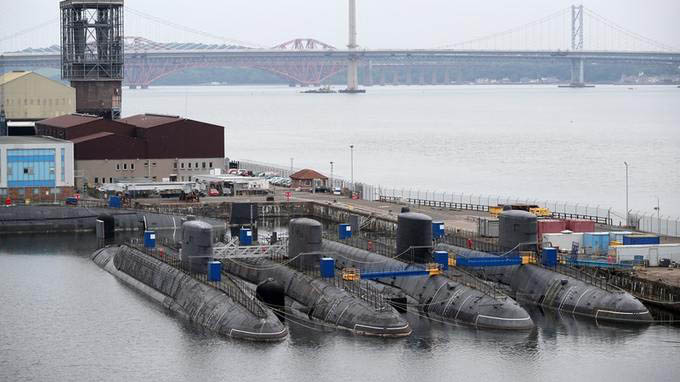
A ROSYTH councillor has called for assurances that rotting nuclear submarines will not be sent to Australia for disposal.
Brian Goodall, who is UK/Ireland Nuclear Free Local Authority’s spokesperson on nuclear submarine decommissioning, said he has written to the UK’s foreign and defence secretaries.
He’s asked for confirmation that vessels will not go overseas if a new Australian law passes without amendments.
Seven old subs have been laid up at Rosyth Dockyard for decades with Dreadnought being there for the longest – more than 40 years – waiting to be scrapped.
The UK and USA signed a pact with Australia to build and operate a new fleet of nuclear submarines which includes the provision of new conventionally armed, but nuclear powered, vessels for the Australian Navy.
To support the pact, legislators down under have proposed a new Australian Naval Nuclear Power Safety Bill 2024.
This appears to allow the disposal of high level radioactive waste from British and American submarines on Australian soil, and also for the storage of such materials in Australia from “a submarine that is not complete”.
In his letter to Lord Cameron and Grant Shapps, Cllr Goodall expressed concern that this could theoretically mean permitting “the towing of redundant UK boats from Rosyth and Devonport down under for disposal”.
He said he fears that this could result in the loss of local expertise and jobs if it comes into practice.
He adds: “Surely as the operators of our own submarines, the UK Government should remain responsible for the storage of the resultant high-level waste and for their safe decommissioning in home ports?
“Not only will this preserve the expertise in these matters that has developed after many years of trial and error, but, as a ward member for the Rosyth Dockyard, it will also preserve the jobs in my local community.”
Back in 2022, the Press reported pledges from the UK Government that all laid-up submarines would be gone as part of plans to “de-nuclearise Rosyth” by 2035.
Councillors were given an update on the programme to remove radioactive waste and turn the seven boats that have been parked at the dockyard for decades into “tin cans and razor blades”.
The Ministry of Defence have previously faced heavy criticism for the delays and sky-high costs in dealing with the nuclear legacy, with 27 Royal Navy subs to be scrapped in total.
The Slow-Motion Execution of Julian Assange Continues .
Free speech is a key issue. If Julian is granted First Amendment rights in a U.S. court it will be very difficult for the U.S. to build a criminal case against him, since other news organizations, including The New York Times and The Guardian, published the material he released.
The ruling by the High Court in London permitting Julian Assange to appeal his extradition order leaves him languishing in precarious health in a high-security prison. That is the point.
CHRIS HEDGES, MAY 24, 2024, https://chrishedges.substack.com/p/the-slow-motion-execution-of-julian-986?utm_source=post-email-title&publication_id=778851&post_id=144930141&utm_campaign=email-post-title&isFreemail=true&r=ln98x&triedRedirect=true&utm_medium=email
The decision by the High Court in London to grant Julian Assange the right to appeal the order to extradite him to the United States may prove to be a Pyrrhic victory. It does not mean Julian will elude extradition. It does not mean the court has ruled, as it should, that he is a journalist whose only “crime” was providing evidence of war crimes and lies by the U.S. government to the public. It does not mean he will be released from the high-security HMS Belmarsh prison where, as Nils Melzer, the UN Special Rapporteur on Torture, after visiting Julian there, said he was undergoing a “slow-motion execution.”
It does not mean that journalism is any less imperiled. Editors and publishers of five international media outlets —– The New York Times, the Guardian, Le Monde, El Pais and DER SPIEGEL —– which published stories based on documents released by WikiLeaks, have urged that the U.S. charges be dropped and Julian be released. None of these media executives were charged with espionage. It does not dismiss the ludicrous ploy by the U.S. government to extradite an Australian citizen whose publication is not based in the U.S. and charge him under the Espionage Act. It continues the long Dickensian farce that mocks the most basic concepts of due process.
This ruling is based on the grounds that the U.S. government did not offer sufficient assurances that Julian would be granted the same First Amendment protections afforded to a U.S. citizen, should he stand trial. The appeal process is one more legal hurdle in the persecution of a journalist who should not only be free, but feted and honored as the most courageous of our generation.
Yes. He can file an appeal. But this means another year, perhaps longer, in harsh prison conditions as his physical and psychological health deteriorates. He has spent over five years in HMS Belmarsh without being charged. He spent seven years in the Ecuadorian Embassy because the U.K. and Swedish governments refused to guarantee that he wouldn’t be extradited to the U.S., even though he agreed to return to Sweden to aid a preliminary investigation that was eventually dropped.
The judicial lynching of Julian was never about justice. The plethora of legal irregularities, including the recording of his meetings with attorneys by the Spanish security firm UC Global at the embassy on behalf of the CIA, alone should have seen the case thrown out of court as it eviscerates attorney-client privilege.
The U.S. has charged Julian with 17 counts under the Espionage Act and one count of computer misuse, for an alleged conspiracy to take possession of and then publish national defense information. If found guilty on all of these charges he faces 175 years in a U.S. prison.
The extradition request is based on the 2010 release by WikiLeaks of the Iraq and Afghanistan war logs — hundreds of thousands of classified documents, leaked to the site by Chelsea Manning, then an Army intelligence analyst, which exposed numerous U.S. war crimes including video images of the gunning down of two Reuters journalists and 10 other unarmed civilians in the Collateral Murder video, the routine torture of Iraqi prisoners, the covering up of thousands of civilian deaths and the killing of nearly 700 civilians that had approached too closely to U.S. checkpoints.
In February, lawyers for Julian submitted nine separate grounds for a possible appeal.
A two-day hearing in March, which I attended, was Julian’s last chance to request an appeal of the extradition decision made in 2022 by the then British home secretary, Priti Patel, and of many of the rulings of District Judge Baraitser in 2021.
The two High Court judges, Dame Victoria Sharp and Justice Jeremy Johnson, in March rejected most of Julian’s grounds of appeal. These included his lawyers’ contention that the UK-US extradition treaty bars extradition for political offenses; that the extradition request was made for the purpose of prosecuting him for his political opinions; that extradition would amount to retroactive application of the law — because it was not foreseeable that a century-old espionage law would be used against a foreign publisher; and that he would not receive a fair trial in the Eastern District of Virginia. The judges also refused to hear new evidence that the CIA plotted to kidnap and assassinate Julian, concluding — both perversely and incorrectly — that the CIA only considered these options because they believed Julian was planning to flee to Russia.
But the two judges determined Monday that it is “arguable” that a U.S. court might not grant Julian protection under the First Amendment, violating his rights to free speech as enshrined in the European Convention on Human Rights.
The judges in March asked the U.S. to provide written assurances that Julian would be protected under the First Amendment and that he would be exempt from a death penalty verdict. The U.S. assured the court that Julian would not be subjected to the death penalty, which Julian’s lawyers ultimately accepted. But the Department of Justice was unable to provide an assurance that Julian could mount a First Amendment defense in a U.S. court. Such a decision is made in a U.S. federal court, their lawyers explained.
Assistant U.S. Attorney Gordon Kromberg, who is prosecuting Julian, has argued that only U.S. citizens are guaranteed First Amendment rights in U.S. courts. Kromberg has stated that what Julian published was “not in the public interest” and that the U.S. was not seeking his extradition on political grounds.
Free speech is a key issue. If Julian is granted First Amendment rights in a U.S. court it will be very difficult for the U.S. to build a criminal case against him, since other news organizations, including The New York Times and The Guardian, published the material he released.
The extradition request is based on the contention that Julian is not a journalist and not protected under the First Amendment.
Julian’s attorneys and those representing the U.S. government have until May 24 to submit a draft order, which will determine when the appeal will be heard.
Julian committed the empire’s greatest sin — he exposed it as a criminal enterprise. He documented its lies, routine violation of human rights, wanton killing of innocent civilians, rampant corruption and war crimes. Republican or Democrat, Conservative or Labour, Trump or Biden — it does not matter. Those who manage the empire use the same dirty playbook.
The publication of classified documents is not a crime in the United States, but if Julian is extradited and convicted, it will become one.
Julian is in precarious physical and psychological health. His physical and psychological deterioration has resulted in a minor stroke, hallucinations and depression. He takes antidepressant medication and the antipsychotic quetiapine. He has been observed pacing his cell until he collapses, punching himself in the face and banging his head against the wall. He has spent weeks in the medical wing of Belmarsh, nicknamed “hell wing.” Prison authorities found “half of a razor blade” hidden under his socks. He has repeatedly called the suicide hotline run by the Samaritans because he thought about killing himself “hundreds of times a day.”
These slow-motion executioners have not yet completed their work. Toussaint L’Ouverture, who led the Haitian independence movement, the only successful slave revolt in human history, was physically destroyed in the same manner. He was locked by the French in an unheated and cramped prison cell and left to die of exhaustion, malnutrition, apoplexy, pneumonia and probably tuberculosis.
Prolonged imprisonment, which the granting of this appeal perpetuates, is the point. The 12 years Julian has been detained — seven in the Ecuadorian Embassy in London and over five in high-security Belmarsh Prison — have been accompanied by a lack of sunlight and exercise, as well as unrelenting threats, pressure, prolonged isolation, anxiety and constant stress. The goal is to destroy him.
We must free Julian. We must keep him out of the hands of the U.S. government. Given all he did for us, we owe him an unrelenting fight.
If there is no freedom of speech for Julian, there will be no freedom of speech for us.
Q&A – Germany’s nuclear exit: One year after

CLEAN ENERGY WIRE, FACTSHEET, 16 Apr 2024, Benjamin Wehrmann
Decades of debates came to an end in April 2023, when Germany finally shuttered its last nuclear power plants after the energy crisis. One year on, predictions of supply risks, price hikes and dirty coal replacing carbon-free nuclear power have not materialised.
Instead, Germany saw a record output of renewable power, the lowest use of coal in 60 years, falling energy prices across the board and a major drop in emissions. Industry representatives warn that an effect on power costs may still become visible once Germany’s economy moves out of recession.
At the same time, many countries plan to expand nuclear power, suggesting the country’s phase-out has not found many followers. Yet, global nuclear power market numbers indicate that a nuclear revival is not imminent either. [UPDATES Government advisor says power prices higher due to exit; majority in survey says nuclear exit was a mistake]
Content
- How has the phase-out been conducted?
- Was there any supply security risk in the aftermath?
- What was the gap left by nuclear power filled with?
- What changed in electricity imports and why?
- Did power prices go up due to the phase-out?
- What happens with the retired nuclear plants and waste materials?
- How did the national debate about nuclear power develop?
- How did the nuclear debate move on in the rest of the world?
………………………………………………………………………………………………………………..more https://www.cleanenergywire.org/factsheets/qa-germanys-nuclear-exit-one-year-after—
UK Nuclear Plant Sizewell Continues Fundraising Before Election

- Banks offered to lend as much as £12.5 billion for Sizewell C
By Will Mathis, May 24, 2024
The developer of the UK’s Sizewell C nuclear power plant is pushing ahead to complete
financing for the project this year even as a looming election risks
complicating the timeline.
A group of banks offered to lend as much as
£12.5 billion ($15.9 billion) to help finance the plant in eastern
England, according to a person familiar with the matter. They include HSBC
Holdings Plc, NatWest Group Plc and Banco Santander SA, the person said.
Debt will play a role in a multibillion-pound funding effort that also
includes an ongoing effort to raise equity from private investors.
“The two main political parties are committed to Sizewell C and we are carrying
on with the capital raise, preparing for a final investment decision and
mobilizing teams on our site,” a spokesperson for Sizewell said,
declining to comment on the debt specifically.
HSBC and Santander declined to comment. NatWest didn’t immediately comment.
The government had vowed
to reach a final investment decision on the proposed 3.2-gigawatt Sizewell
C station in the current parliament, a process that was on track to
complete this summer. That means the final stage of the fund-raising
process could be among Labour leader Keir Starmer’s first acts if he
becomes prime minister. “Sizewell needs to move forward at pace,”
Starmer said during a visit to another nuclear plant last year. “New
nuclear has to be part of that mix.”
Bloomberg 23rd May 2024
1 This Month

22 June – Virtual Event –Climate Change: New Data, New Debate

Monday, June 22, 2026 2:30 p.m. – 3:15 p.m. CT
YouTube. Register here

Protect Sazan Island from the Trump family! https://secure.avaaz.org/campaign/en/protect_sazan_island_from_the_trump_family_loc/?bqFCVab&v=174511&cl=22707147157&_checksum=5e9dde668860e8231c33699735e16a1fbf22ab2cb01da50c999fe8732b9775ef&utm_source=email&utm_medium=blast_email&utm_campaign=174511
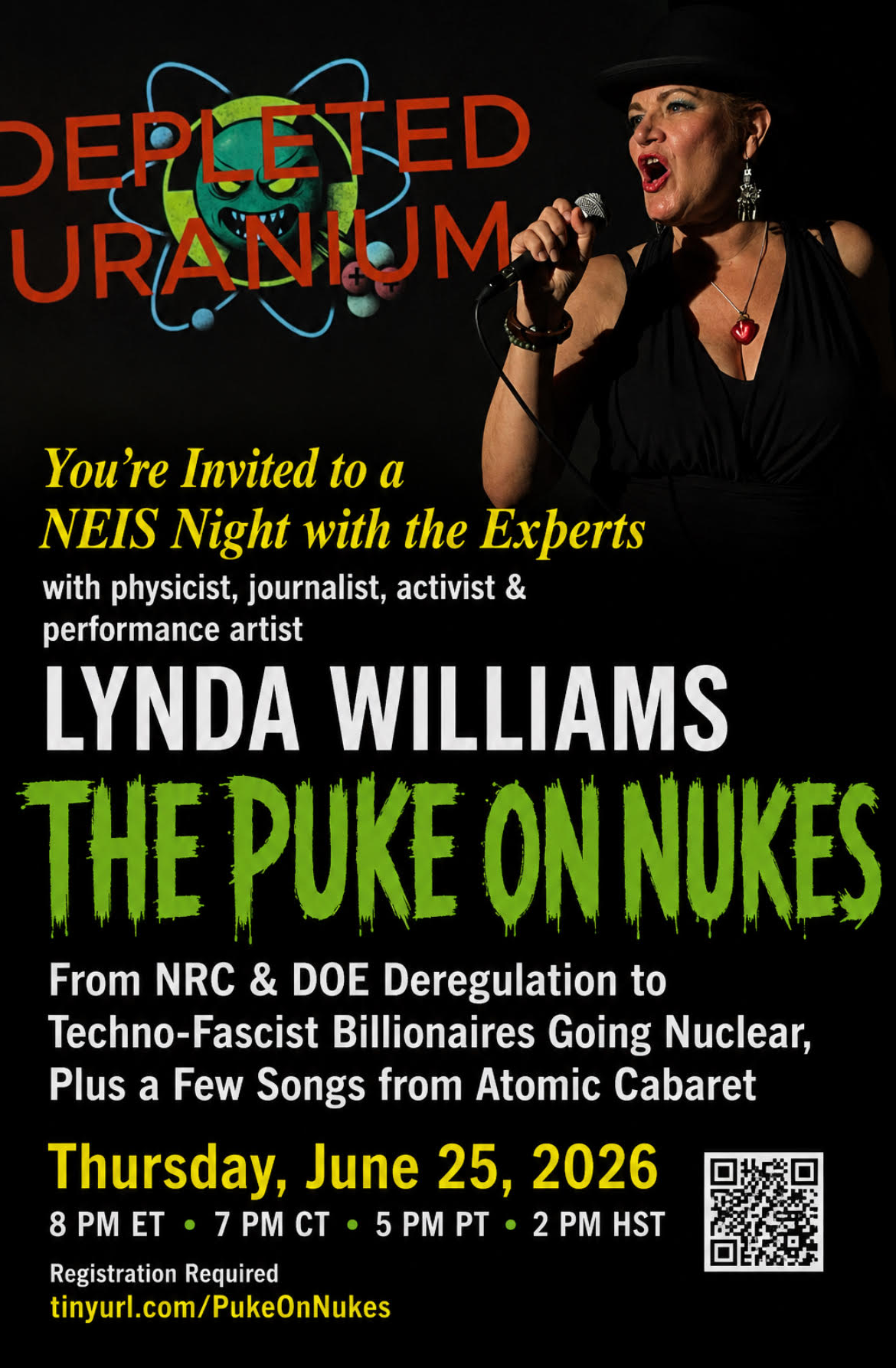
25 June- THE PUKE ON NUKES
Thursday, June 25, 2026
7pm Central Time (8pm ET, 6pm MT, 5pm PT) UTC – 5
From NRC & DOE Deregulation to Techno-Fascist Billionaires Going Nuclear, Plus a Few Songs from Atomic Cabaret REGISTER
26 June – Radiation Trainwreck at the NRC / Join the Protect Better Campaign – https://us02web.zoom.us/meeting/register/4ZlZ5_qLSHGiLSCg8FF6Bg#/registration


Cuba Is Not a Failed State – It Is a Besieged State
PETITION: “Global Appeal to Endorse Palestinian Right of Return of Refugees”
To see nuclear-related stories in greater depth and intensity – go to https://nuclearinformation.wordpress.com
-
Archives
- June 2026 (202)
- May 2026 (306)
- April 2026 (356)
- March 2026 (251)
- February 2026 (268)
- January 2026 (308)
- December 2025 (358)
- November 2025 (359)
- October 2025 (376)
- September 2025 (257)
- August 2025 (319)
- July 2025 (230)
-
Categories
- 1
- 1 NUCLEAR ISSUES
- business and costs
- climate change
- culture and arts
- ENERGY
- environment
- health
- history
- indigenous issues
- Legal
- marketing of nuclear
- media
- opposition to nuclear
- PERSONAL STORIES
- politics
- politics international
- Religion and ethics
- safety
- secrets,lies and civil liberties
- spinbuster
- technology
- Uranium
- wastes
- weapons and war
- Women
- 2 WORLD
- ACTION
- AFRICA
- Atrocities
- AUSTRALIA
- Christina's notes
- Christina's themes
- culture and arts
- Events
- Fuk 2022
- Fuk 2023
- Fukushima 2017
- Fukushima 2018
- fukushima 2019
- Fukushima 2020
- Fukushima 2021
- general
- global warming
- Humour (God we need it)
- Nuclear
- RARE EARTHS
- Reference
- resources – print
- Resources -audiovicual
- Weekly Newsletter
- World
- World Nuclear
- YouTube
-
RSS
Entries RSS
Comments RSS
 nuclear-news