Keir Starmer’s Trident triple lock: how Britain’s obsession with nuclear weapons has become part of election campaigns

The nuclear debate is also wrapped up in a gendered narrative that sees a commitment to nuclear weapons as strong, sensible, rational and masculine, and anything else as weak, irrational and feminine
Nick Ritchie, Professor, Department of Politics & International Relations, University of York, June 7, 2024 https://theconversation.com/keir-starmers-trident-triple-lock-how-britains-obsession-with-nuclear-weapons-has-become-part-of-election-campaigns-231834
With a campaign slogan of “change”, Keir Starmer is on a mission to persuade the electorate that the Labour party of 2024 is different to the one of 2019. Part of this is his unequivocal “triple lock” commitment to Trident, the UK’s nuclear weapon system.
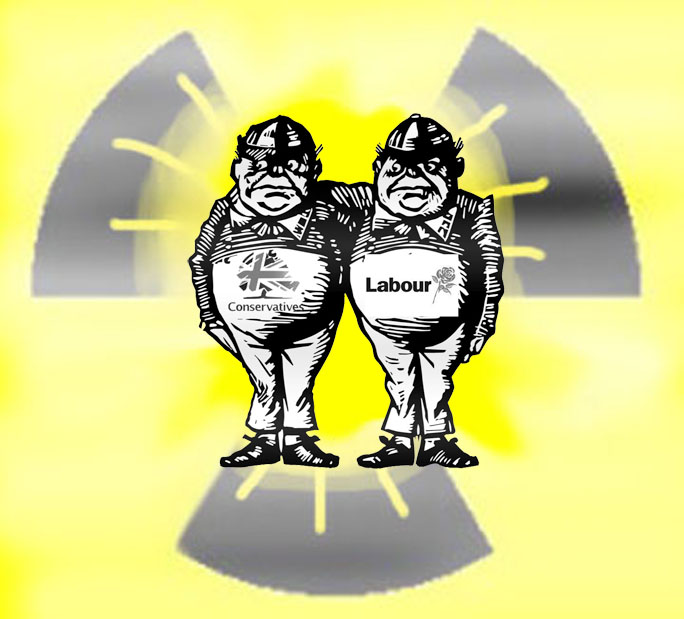
At a time when the risk of a major European war is higher than it has been for decades, Starmer has reiterated his support for a massive programme to replace the Trident system (submarines, warhead, missiles and infrastructure), initiated by former Labour prime minister Tony Blair, in 2006. The triple lock is a commitment to the current programme to build four new ballistic missile submarines, keep one of the four always at sea on operational patrol and keep the system up to date.
Starmer is pushing back against Conservative claims that Labour is “weak”, “cannot be trusted” and is a “danger to national security”, accusations that have plagued his predecessor Jeremy Corbyn, a lifelong opponent of nuclear weapons.
Ideas of British national identity and Britain’s place in the world connect to a commitment to nuclear weapons. This identity is also tied to the idea of Britain as a military power in Europe, and Labour’s current identity of being strong on defence.
Prospective prime ministers are effectively required to publicly declare that they would be prepared to use nuclear weapons. Commitment to nuclear deterrence has become a de facto criterion for entering No 10.
Corbyn found this out in 2017 when he told the BBC’s Andrew Marr he would never use nuclear weapons first, or perhaps ever, if he were prime minister. In an unprecedented intervention, serving and former chiefs of the defence staff said that Corbyn’s response showed he “should not be trusted … with the nation’s defence and security”, and was unfit to be prime minister. Corbyn’s opposition to Trident is still being used to attack Starmer and Labour years later.
Starmer first signalled his commitment to Trident in 2021. Two years later, shadow defence secretary John Healey and shadow foreign secretary David Lammy declared their “unshakable” commitment to nuclear weapons as part of “Labour’s heritage”. But concerns about the morality and efficacy of using nuclear weapons have long divided Labour.
This is quite different to how nuclear weapons, which are based in Scotland, are framed by the Scottish National Party. In their conception of an independent Scotland’s national identity nuclear weapons are associated with imposed, undemocratic, Tory “imperialism” in which Labour has been complicit, and contrary to the SNP’s version of progressive internationalism. The SNP has said they would remove nuclear weapons from Scotland in the event of Scottish independence.
The nuclear debate is also wrapped up in a gendered narrative that sees a commitment to nuclear weapons as strong, sensible, rational and masculine, and anything else as weak, irrational and feminine.
The nuclear ‘consensus’
This Whitehall nuclear consensus closes down democratic debate on if, how and why the prime minister might use nuclear weapons. But views in the country are far from settled.
Recent polling shows 53% supports or strongly supports the UK having nuclear weapons, with about 30% opposed or strongly opposed. For women, the split is 50:50. For under 25s, it is 28% in favour and 43% against. In Scotland it is 35% in favour and 41% against (the rest say they don’t know).
The UK prime minister is one of a handful of people in the world with the power to inflict truly catastrophic levels of violence upon another society. Nuclear weapons should therefore be subject to intense scrutiny and debate, especially in a liberal democratic society. Starmer should appreciate this as a human rights lawyer, since practically any use of nuclear weapons would transgress international humanitarian and human rights law.
The nuclear programme is also hugely expensive. At a time when public services including health and education are under serious pressure, this arguably makes democratic debate even more necessary.
In March 2024 the House of Commons public accounts committee reported that the cost of the Ministry of Defence’s 10-year equipment plan was over budget by £17 billion, despite a budget increase of £46.3 billion. The greatest cause of this was the nuclear programme, where costs have increased by £38.2 billion (62%) since the last plan. The nuclear programme is now 34.5% of the £288.6 billion defence equipment plan, which itself is 49% of the total MoD budget.
In particular, the programme to deliver the new Dreadnought ballistic missile submarines has become the MoD’s highest priority. The department will redirect funds from conventional military programmes to support it if it can’t get more money from the Treasury. Labour and the Conservatives have both committed to increase the defence budget, especially for conventional forces, but have not said where the money will come from.
There are other political reasons why Starmer has come out strong for Trident. In particular, the thousands of jobs that the production and maintenance of nuclear-powered submarines supports in England and Scotland, and the power of the unions in the Labour party. The “triple lock” language also mirrors the triple lock commitment on pensions. This may appeal to older voters, who are more likely to vote (and vote Conservative).
Starmer’s “triple lock” might make sense politically from his perspective, but it is symptomatic of a nuclear consensus in Whitehall politics that brooks little dissent. The result is that debate on these difficult and serious security, economic, legal and moral choices on nuclear weapons routinely gets shut down and reduced to political performance. In the words of retired senior British Army officer General Sir Richard Shirreff, it infantilises a deadly serious issue.
Russia doesn’t need nuclear weapons to succeed: Putin
Canberra Times. June 8 2024
Russian President Vladimir Putin says there is no need to use nuclear weapons to deliver victory for Moscow in Ukraine, the strongest signal yet from the Kremlin chief that there will not be a nuclear strike.
Putin, whose forces have been making advances in eastern Ukraine in recent months, said on Friday he did not see the conditions for the use of such weapons and requested that people stop discussing the nuclear topic.
However Putin, who leads the world’s biggest nuclear power, said he did not rule out changes to Russia’s nuclear doctrine, which sets out the conditions under which such weapons could be used.
He also said that if necessary Russia could test a nuclear weapon, though he saw no need to do so at the present time……………………………………….
Russia’s published 2020 nuclear doctrine sets out the conditions under which a Russian president would consider using a nuclear weapon: broadly as a response to an attack using nuclear or other weapons of mass destruction, or to the use of conventional weapons against Russia “when the very existence of the state is put under threat”.
“If necessary, we will conduct tests. So far, there is no need for this either, since our information and computer capabilities allow us to produce everything in its current form.”……………………………….. more https://www.canberratimes.com.au/story/8656114/russia-doesnt-need-nuclear-weapons-to-succeed-putin/
France to give fighter jets to Ukraine – Macron
The French president also reiterated that Kiev can carry out long-range missile strikes on Russian soil
French President Emmanuel Macron has announced that France will supply Kiev with Mirage 2000 fighter jets and train Ukrainian pilots on the jets. However, Macron did not specify how many planes would be provided, or when they would arrive.
“Tomorrow we will launch a new cooperation and announce the transfer of Mirage 2000-5 fighter jets to Ukraine, made by French manufacturer Dassault, and train their Ukrainian pilots in France,” Macron told France’s TF1 broadcaster on Thursday.
Alongside US-made F-16 fighters, Kiev has long requested Mirage 2000 warplanes. In a post on social media in January, the commander of the Ukrainian Air Force said that these jets – roughly comparable to the F-16 but considered more maneuverable – could “increase the combat potential” of Ukraine’s Soviet-era fleet.
France has around 26 Mirage 2000-5 and 65 older Mirage 2000-D aircraft in active service, according to Flight International’s World Air Forces rankings. It is unclear whether Macron intends to spare any of the French Air Force’s active duty fleet, or whether out-of-service jets will be recommissioned for Kiev.
Belgium, Denmark, the Netherlands, and Norway have all pledged to supply Ukraine with F-16 fighters, although none have actually been delivered. Last month, Ukrainian leader Vladimir Zelensky announced that Belgium would supply 30 1980s-built F-16s, bringing to 85 the number pledged in total.
At the outset of the Ukraine conflict, Macron positioned himself as a voice of caution, warning other NATO member states that sending heavy weapons to Kiev could be too escalatory a move. However, he has since emerged as one of the most pro-interventionist NATO leaders, declaring earlier this year that the idea of sending Western ground troops into combat against Russia “could not be ruled out.”
Ukrainian army chief Aleksandr Syrsky said last week that French military instructors would soon be deployed in Ukraine. While the Ukrainian defense ministry quickly walked back these claims, French Prime Minister Gabriel Attal said that the question of sending French instructors to the country was “not taboo.”
Russian Foreign Minister Sergey Lavrov has said that there are “numerous facts” indicating that French instructors are already working in Ukraine and warned that these operatives represent an “absolutely legitimate target” for Russia’s armed forces.
Macron told TF1 that he is not worried about escalating the conflict. The French president then announced that he would back the formation of a 4,500-strong “French brigade” of French-trained and equipped Ukrainian soldiers, and repeated his announcement last week that Ukraine can use French missiles for long-range strikes on Russian soil.
“We stand with the Ukrainians. Ukraine is allowed to strike targets where missiles have been fired [from],” he told the network, adding that “we forbid hitting civilians with our weapons.”
Speaking to reporters on Wednesday, Russian President Vladimir Putin said that Moscow would consider arming the enemies of Western nations who give Ukraine the means to carry out these strikes. “This is a recipe for very serious problems,” he warned.
No talk of peace at Zelensky’s ‘peace conference’ – Germany
Rt.com 6 Jun, 2024
Olaf Scholz has admitted that the high-profile summit is not aimed at ending the conflict
German Chancellor Olaf Scholz is not traveling to Vladimir Zelensky’s so-called ‘peace conference’ to initiate peace talks, but to rally as many countries as possible to the Ukrainian leader’s side, he told parliament on Thursday.
In a speech focusing on security issues, Scholz told lawmakers that “there will be no peace negotiations” at the summit, which is due to take place in Switzerland next weekend.
“We are still a long way from that,” Scholz continued, adding that he intends to use the conference “to engage countries around the world in order to make it clear to Moscow: We stand by international law and the Charter of the United Nations.”
Zelensky invited more than 160 delegations to the Swiss conference, with Russia not receiving an invitation. While dozens of Western leaders and diplomats will attend – including Scholz, French President Emmanuel Macron, and Canadian Prime Minister Justin Trudeau, US President Joe Biden will skip the event, with the White House announcing this week that Vice President Kamala Harris will attend in his stead.
Beijing has snubbed the gathering entirely, with the Chinese Foreign Ministry explaining on Monday that any peace conference aimed at ending the Ukraine conflict must involve the equal participation of Moscow and Kiev, and the consideration of multiple peace plans…………………………………………more https://www.rt.com/news/598889-scholz-zelensky-peace-conference/—
Should USS Investment Builder invest in nuclear power?

Government talks about sharing the benefits if the project comes in ahead of time and cost, but this is fantasy land. Nuclear projects are invariably late and overbudget. From a reputational point of view, USS’s investment in Thames Water has been damaging, but association with Sizewell C could turn out far worse.
Steve Thomas, Coordinating Editor, Energy Policy, Emeritus Professor of Energy Policy
Public Services International Research Unit (PSIRU), Business School , University of Greenwich 5 June 24 https://divestuss.org/news/
The British government is scouring the world for investors willing to invest in its Sizewell C project. USS has been named as one of six investors shortlisted for the project, perhaps with a stake of about £600m. Would investing in Sizewell C using the Regulated Asset Base (RAB) model be a wise investment for USS funds? From a wider perspective, would it contribute usefully to the government’s target of ‘net zero’ greenhouse gas emissions by 2050 and would it offer cheap power?
Sizewell’s predecessor, the Hinkley Point C project to build two EPR reactors has been a disaster both for UK consumers and for its main owner, Electricité de France (EDF). In 2008 when the project was announced, EDF claimed Christmas turkeys would be cooked using power from the plant in 2017 and the government claimed the reactors would cost £5.6bn. By the time the final investment decision was taken in 2016, completion had slipped to 2025 and the cost had gone up to £18bn (2015 money). The price consumers would have to pay for the power was high, £92.5/MWh (2012 money) or about £130/MWh in 2024 money. The one saving grace for consumers was that the price was fixed in real terms and when construction costs escalated, they fell on EDF. In January 2024, the cost and time estimate for Hinkley had increased to £31-35bn (2015 money) or up to £46bn in 2024 money with completion in 2029-31.
Luckily, Britain was not relying on Hinkley to keep the lights on. As a result, in its most recent annual report, EDF announced it was writing off €12.9bn, a large proportion of its investment to date. Press reports talk about the Sizewell project, claimed to be a duplicate of Hinkley, costing about £20bn, implying it could be built for less than half the cost of Hinkley and this is clearly implausible. Even if it could be built for 20% less than Hinkley, that would still imply a cost of nearly £40bn.
European predecessor projects using the same technology as Hinkley and Sizewell, Olkiluoto in Finland and Flamanville in France, have also been disasters taking 18 years to build and coming in at 3-4 times overbudget.
Soon after the Hinkley investment decision was taken, EDF realised its error and abandoned plans to build Sizewell using the same financial model as Hinkley.
Continue readingA Nuclear-Armed European Union? A Proposal Under Fire
By Thalif Deen, UNITED NATIONS, Jun 7 2024 (IPS) – The continued veiled threats from Russia, warning of nuclear attacks on Ukraine, have prompted some politicians in Europe to visualize a nuclear-armed European Union (EU).
But Volkert Ohm, Co-Chair of the International Association of Lawyers Against Nuclear Arms (IALANA) in Germany, told IPS that the call for nuclear weapons for the EU contradicts international law.
The Advisory Opinion of the International Court of Justice (ICJ) is that even in extreme circumstances of self-defense, states may only defend themselves with weapons that fulfil the conditions of international humanitarian law.”
“Nuclear weapons do not fulfill them. Nuclear radiation is inherent in any nuclear weapon; thus, “clean” nuclear weapons cannot exist. Debates and statements by politicians in the EU, and particularly in Germany, are neglecting international law on many levels,” he pointed out.
Facing the potential return of Donald Trump to the White House, the head of the EU’s biggest political grouping is calling for Europeans to prepare for war without support from the United States and to build their own nuclear umbrella, according to POLITICO, a US-based online publication.
Manfred Weber, leader of the center-right European People’s Party (EPP), has described Trump and Russian President Vladimir Putin as “the two who set the framework” for 2024.
The 27 member states of the European Union (EU) are: Austria, Belgium, Bulgaria, Croatia, Cyprus, the Czech Republic, Denmark, Estonia, Finland, France, Germany, Greece, Hungary, Ireland, Italy, Latvia, Lithuania, Luxembourg, Malta, the Netherlands, Poland, Portugal, Romania, Slovakia, Slovenia, Spain, and Sweden.
But France is the only EU member that is also one of the world’s nine nuclear powers, along with the US, UK, China, Russia, India, Pakistan, Israel, and North Korea.
John Burroughs, Vice President, International Association of Lawyers Against Nuclear Arms and Senior Analyst, Lawyers Committee on Nuclear Policy, told IPS that interest in some quarters in the European Union (EU) or some European entity acquiring nuclear weapons stems in part from the illegal Russian invasion of Ukraine accompanied by illegal nuclear threats.
But the solution is not some form of increased European reliance on nuclear arms. Rather, it is bringing Russia’s war on Ukraine to an end soon, which would involve painful compromises on Ukraine’s part, he said.
“That would eliminate the very real potential for nuclear war arising out of the conflict, and it would open the way for getting arms control and disarmament negotiations with Russia back on track.”
This, he pointed out, is a far better path than the acquisition of nuclear weapons by the EU or another European entity. That would violate the Nuclear Non-Proliferation Treaty, as the IALANA Germany statement points out, reinforce nuclear arms racing already underway, and tend to greenlight the spread of nuclear weapons in other regions.
“The interest in European nuclear weapons has also been spurred by concern over statements by former and possible future US President Donald Trump implying US disengagement from NATO. This concern is exaggerated.”……………………………………………………………………………………………….
Dr M.V. Ramana, Professor and Simons Chair in Disarmament, Global and Human Security School of Public Policy and Global Affairs at the University of British Columbia, Vancouver, told IPS that the vast majority of the countries that are part of the European Union have signed the Nuclear Non Proliferation Treaty (NPT) as non-nuclear-weapon State Parties.
According to Article 2 of the NPT, each “non-nuclear-weapon State Party to the Treaty undertakes not to receive the transfer from any transferor whatsoever of nuclear weapons or other nuclear explosive devices or of control over such weapons or explosive devices directly or indirectly.”
Likewise, nuclear-weapon State Parties to the NPT that are either part of the EU (i.e., France) or not (e.g., the United States) are obligated under Article 1 of the NPT “not to transfer to any recipient whatsoever nuclear weapons or other nuclear explosive devices or control over such weapons or explosive devices directly or indirectly; and not in any way to assist, encourage, or induce any non-nuclear-weapon State to manufacture or otherwise acquire nuclear weapons or other nuclear explosive devices, or control over such weapons or explosive devices,” he said.
Even without going into the details of who might control these proposed “nuclear weapons for the EU”, it is clear that such an arsenal would contradict the spirit of the NPT and weaken the already weak non-proliferation and disarmament norms.
As IALANA says, EU states should distance themselves from this idea and work for a world free of nuclear weapons, declared Ramana.
Note: This article is brought to you by IPS Noram, in collaboration with INPS Japan and Soka Gakkai International, in consultative status with UN ECOSOC. https://www.ipsnews.net/2024/06/a-nuclear-armed-european-union-a-proposal-under-fire/?utm_source=rss&utm_medium=rss&utm_campaign=a-nuclear-armed-european-union-a-proposal-under-fire
European Nuclear Deterrent a Harebrained Illegal Proposal

Putin actually tabled a proposed agreement two weeks before Russia invaded Ukraine, promising not to take action if Ukraine remained neutral and was not accepted into NATO.
By Alice Slater, NEW YORK, Jun 6 2024 (IPS) https://www.ipsnews.net/2024/06/european-nuclear-deterrent-harebrained-illegal-proposal/ –
It is quite astonishing and clearly insane, that Manfred Weber, the German leader of the European Union’s center-right European People’s Party, now expected to come in first in the European Parliament election scheduled on June 6-9th, is calling for the EU’s own nuclear “deterrent”—arguing that the US-stationed nuclear weapons in five NATO states, Germany, Italy, Belgium, the Netherland, and Turkey, may be inadequate protection for Europe’s security should Trump, that great friend of Russia, be elected!
There is a total disconnect from reality in the western world. It is driven by what has been described as an expansion of the warning of former General Eisenhower, commander of US World War II forces that worked with Russia to defeat the Nazi onslaught, which happened to kill the astounding number of 27 million Russians, in his outgoing presidential address.
Eisenhower warned against the undue influence of the Military Industrial Complex–which has been described by Ray McGovern, former CIA agent and founder of VIPS (Veterans Intelligence Professionals for Sanity) as the MICIMATT– the Military, Industrial, Congressional, Intelligence, Media, Academic, Think Tank complex! They are all making a killing on killing!
The US, leading this doomsday machine, is hurtling us towards destruction based on a flouting of all the laws and treaties that have been painfully negotiated and put in place to avoid WWIII, for what it calls its “rules-based order”.
This was the alibi it used when it bombed Kosovo over Russia’s UN Security Council veto, despite its UN treaty obligation not to commit any war of aggression without Security Council approval unless under “imminent threat of attack”, which could hardly be rationally expected to come from Kosovo!
Although the US violated no treaty, it’s steady expansion of NATO eastward, despite well documented promises to Gorbachev, when he miraculously dissolved the Warsaw pact, without a shot, and expressed his apprehension at the Nazi slaughter Russia had suffered with a hope that a unified Germany would not be part of NATO.
Reassurances were given to him that we would never allow Germany to commit aggression again and that we would not expand NATO one inch to the east. At one point, Russia was so threatened by the expansion of NATO that Putin proposed to Clinton that Russia be invited to join. The US turned him down.
And of course, Putin actually tabled a proposed agreement two weeks before Russia invaded Ukraine, promising not to take action if Ukraine remained neutral and was not accepted into NATO. Bush walked out of the 1972 ABM Treaty we had with the USSR to stop the proliferation of anti-ballistic missiles, and the US put missile bases in Romania and Poland.
Russia (as well as China-the other enemy we are creating to keep the war machine going) has been very forthcoming in seeking nuclear disarmament and peace. After the devastating destruction in Hiroshima and Nagasaki, Stalin asked Truman to turn the bomb over to the UN which we jointly founded “to end the scourge of war” and the US turned him down. So, Russia got the bomb!
Gorbachev, after the wall came down, asked Reagan to join the USSR in eliminating nuclear weapons, provided the US gave up its Star Wars policy to “dominate and control the military use of space”. Reagan turned him down. Russia and China both tabled treaties for a space weapons ban at the Committee on Disarmament in Geneva where consensus is required to discuss negotiations.
The US vetoed it, refusing even any discussion in 2008, and again in 2014. Putin proposed to Clinton that we cut our nuclear arsenals to 1,000 bombs each and call the six other nuclear armed countries to the table for a treaty to abolish them. The US turned him down.
When the US and Israel boasted about their use of the Stuxnet virus to destroy Iran’s uranium enrichment plant, Putin approached Obama to negotiate a cyberwar ban treaty. The US turned him down.
The demonization of Russia and Putin and now China as well, is a major project of the MICIMATT! The EU has bought the brainwashing caused by the manufacture of a false narrative to keep the war machine going.
In the words of Pogo Possum, a Walt Kelly cartoon character during the first Red Scare, “We have met the enemy, and he is us!”
Alice Slater serves on the Boards of World BEYOND War and the Global Network Against Weapons and Nuclear Power in Space. She is the UN NGO Representative for the Nuclear Age Peace Foundation and on the Advisory Board of Nuclear Ban U.S. in support of the 2017 Treaty for the Prohibition of Nuclear Weapons.
IPS UN Bureau
‘We Want Peace’: Spain Applies to Join ICJ Genocide Case Against Israel
“We do it out of commitment to the United Nations and to international law,” said the Spanish foreign minister, calling for an end to civilian deaths.
Common Dreams, EDWARD CARVER, Jun 06, 2024
Spain’s foreign minister announced Thursday that the country had applied to join the genocide case against Israel at the International Court of Justice, just over a week after formally recognizing a Palestinian state alongside other European countries.
South Africa brought the case and has led it through its early stages, which culminated on May 24 with the ICJ, the United Nations’ highest court, ordering Israel to halt its military offensive on Rafah in the southern Gaza Strip—an order that Israel ignored. Mexico, Colombia, Nicaragua, Libya, and the Palestinians have already applied to join the case, while Chile and Ireland have also announced plans to intervene in support of the case.
We do it out of commitment to the United Nations and to international law,” José Manuel Albares, Spain’s foreign minister, said Thursday in a social media post that included a video of his announcement speech. “To support the work of the court. To avoid more civilian deaths. For the peace.”
“We take the decision because of the ongoing military operation in Gaza,” Albares said, according toThe Associated Press. “We want peace to return to Gaza and the Middle East, and for that to happen we must all support the court.”…………………………………………
Spain is one of several European countries that have recognized a Palestinian state in recent weeks; indeed, Madrid has been central to organizing the European effort. Israel responded by threatening “severe consequences” to nations that recognize Palestine, and it held out a special level of ire for Spanish leaders……………
Spain’s foreign minister announced Thursday that the country had applied to join the genocide case against Israel at the International Court of Justice, just over a week after formally recognizing a Palestinian state alongside other European countries.
South Africa brought the case and has led it through its early stages, which culminated on May 24 with the ICJ, the United Nations’ highest court, ordering Israel to halt its military offensive on Rafah in the southern Gaza Strip—an order that Israel ignored. Mexico, Colombia, Nicaragua, Libya, and the Palestinians have already applied to join the case, while Chile and Ireland have also announced plans to intervene in support of the case.
“We do it out of commitment to the United Nations and to international law,” José Manuel Albares, Spain’s foreign minister, said Thursday in a social media post that included a video of his announcement speech. “To support the work of the court. To avoid more civilian deaths. For the peace.”
“We take the decision because of the ongoing military operation in Gaza,” Albares said, according toThe Associated Press. “We want peace to return to Gaza and the Middle East, and for that to happen we must all support the court.”
Albares is a member of the Spanish Socialist Workers’ Party (PSOE), a center-left party that leads a coalition government. Sumar, a new left-wing party that is the junior partner in the coalition, has been strongly pro-Palestine; the party’s ministers have called Israel’s war in Gaza a genocide. Podemos, a left-wing party that was part of previous coalitions but now holds only five seats in parliament and has been largely replaced by Sumar, has taken a similarly strong position; its leader had previously called for Spain to back the ICJ genocide case.
The ICJ is one of several international institutions that pro-Palestine governments are using to try to isolate Israel and hold it to account for its ongoing assault on Gaza, which has killed more than 36,000 people, mostly women and children, in the last eight months. Israel’s military killed dozens early Thursday by bombing a school where refugees were sheltering. Most of the dead were women and children, the APreported.
Spain is one of several European countries that have recognized a Palestinian state in recent weeks; indeed, Madrid has been central to organizing the European effort. Israel responded by threatening “severe consequences” to nations that recognize Palestine, and it held out a special level of ire for Spanish leaders.
“Hamas thanks you for your service,” Israeli Foreign Minister Israel Katz wrote in a message to Spain’s Prime Minister Pedro Sánchez on social media, along with a video that, in Al Jazeera‘s description, “flipped between images of flamenco dancers and apparent scenes of the Palestinian group’s incursion into southern Israel on October 7.”
The move for recognition has widespread support among the Spanish public—78%, based on a Madrid think tank’s survey, according to Al Jazeera………………….. https://www.commondreams.org/news/spain-genocide-case
Scots urged to vote in anti-nuclear MPs to ‘take target off our backs’
The National By Adam Robertson, @adam_robertson9 Multimedia Journalist, 6 June 24
THE Scottish Campaign for Nuclear Disarmament (CND) has launched a major new project amid campaigning for the General Election, highlighting how Scots have “targets on our backs” due to the nuclear weapons on the Clyde.
The Scottish CND’s new campaign aims to push voters to back candidates who support the UN Treaty on the Prohibition of Nuclear Weapons (TPNW).
We previously reported how the SNP said they would support signing the document, which would entirely outlaw nuclear weapons across the globe, after achieving independence. …………………………………………..(Subscribers only) https://www.thenational.scot/news/24368745.scottish-cnd-launch-new-campaign-amid-general-election/
As Ukraine Disintegrates – Hedging Bets Begins in Italy
New Eastern Outlook, 05.06.2024 Author: Phil Butler
The remarkable news that Italy’s Defence Minister is calling for the West to make a concerted effort to end the conflict in Ukraine may give some people hope. Guido Crosetto recently told the daily Il Messaggero that negotiation with Vladimir Putin is the only way to end the bloodshed. However, doublespeak statements from Italian politicians and business people mirror the EU’s and NATO’s rudderless single mindedness. Indecision is spelling the end of Ukraine as a nation.
Crosetto, a staunch supporter of Ukraine, has also criticized Western sanctions against Russia as ineffective. As one of the founders of the national-conservative Brothers of Italy (FdI), he has also pointed out the overestimation of the Western order’s economic influence by American and European leadership. He believes that arming Ukraine could expedite the conditions for a truce and ultimately peace. In other words, the solution lies in a strategic approach that leads to peace, not in a perpetual state of conflict.
Conflicts of Interest and Financial Motivations
It is worth mentioning here that Italy’s Defense Minister is also involved in the arms industry, building corvettes, frigates and aircraft carriers via Orizzonte Sistemi Navali, a joint venture between Fincantieri and Leonardo S.p.A. In true deadly sidewinder fashion, Crosetto now says he advised Ukraine’s Zelensky against the counter-offensive aimed at the Russian lines, but that Zelensky did not take his advice seriously. So, an Italian politician and tycoon who changes parties as often as he does his underwear seek to ride the fence on Ukraine no
If the Russian military continues its slow offensive moves westward, no degree of arms or monetary support will prevent the inevitable. The Ukraine side will soon have too few soldiers to use new tranches of weapons, and money laundering schemes will dry up as fast as Zelensky’s cabal exits the country. However, the recent Crosetto fence riding has more to do with making billions off of arms sales to NATO and non-Nato countries. A multi-billion euro deal between Abu Dhabi-based defense contractors EDGE Group and Shipbuilding Giant Fincantieri. At the time of the agreement, Crosetto was quoted thus:………………………………………………………………………….. more https://journal-neo.su/2024/06/05/as-ukraine-disintegrates-hedging-bets-begins-in-italy/
Stockpiling nuclear weapons? That will do nothing for national security, Keir Starmer
Until the UK and other nuclear states are brave enough to disarm, the Doomsday Clock will keep ticking towards midnight.
Until the UK and other nuclear states are brave enough to disarm, the Doomsday Clock will keep ticking towards midnight
Jeremy Corbyn, https://www.theguardian.com/commentisfree/article/2024/jun/05/stockpiling-nuclear-weapons-national-security-keir-starmer-jeremy-corbyn
Seventy-seven years ago, a group of scientists created a symbolic Doomsday Clock to measure humanity’s proximity to self-destruction, or “midnight”. The hands move closer to – or further away from – midnight, depending on what existential threats exist at that particular time. Addressing the UN general assembly last year, the UN secretary-general, António Guterres, announced that the clock had moved to 90 seconds to midnight, declaring that humanity was perilously close to catastrophe. “This is the closest the clock has ever stood to humanity’s darkest hour,” he said. “We need to wake up – and get to work.” Guterres named three perilous challenges. One, extreme poverty. Two, an accelerating climate crisis. And three, global nuclear war.
“Lie flat in a ditch and cover the exposed skin of the head and hands.” In 1980, Margaret Thatcher’s government published a pamphlet, Protect and Survive, advising people what to do in the event of a nuclear attack. In what was in essence a DIY handbook, people were instructed to hide under a table, place bodies of dead relatives in another room or, if outside, lie on the floor and hope for the best. Adopting an optimistic attitude toward our extinction, the 32-page booklet was ridiculed by a population that knew there was no survival kit for nuclear annihilation.
The government no longer distributes booklets that advise us how to survive nuclear war. Instead, it buries its head in the sand entirely, turning a blind eye to the fact that we are getting closer and closer to midnight. After a period of gradual decline that followed the end of the cold war, the number of operational nuclear weapons has risen again. There are now more than 12,500 warheads around the world, with 90% belonging to Russia and the United States alone.
Which brings us to Keir Starmer’s most recent speech. “National security will always come first,” he said, as he pledged to increase defence spending and update Britain’s nuclear arsenal. He is right that security is important, but endless escalation is not the answer. What about standing up to the fossil-fuel giants jeopardising the security of our planet? Or abolishing the two-child benefits cap to end atrocious levels of food insecurity across our country? If he really cared about global insecurity, he would defend a foreign policy of peace and human rights, to ensure we get on with our neighbours in pursuit of a more stable world.
Ever since Russia’s illegal invasion of Ukraine in February 2022, many of us have warned of the rising risk of nuclear escalation – a risk that was heightened last year when Russia announced plans to halt participation in New Start, the last remaining nuclear arms control treaty with the US. In a recent worrying development, Kyiv intelligence sources have reported that a Ukrainian drone has targeted a long-range radar deep inside Russia, the primary function of which is to alert the security forces of a nuclear attack.
It is estimated that a nuclear war between Russia and the US could kill 200 million people in the near term. The former defence secretary Ben Wallace has previously said he expects the UK to be at war by the end of this decade, which is used as a basis for a continued increase in our already bloated defence budget. The Labour party has also signalled it will raise defence spending. But why can’t our media ask politicians some simple questions: what are you doing to prevent the descent into a protracted, all-out-war with Russia? Why can’t you learn from Latin American and African countries and establish zones of peace?
Meanwhile, nuclear threats have loomed over the Middle East because our political leaders lack the ability and willingness to facilitate de-escalation and diplomacy. Our government could have called for a ceasefire in Gaza from the very beginning. They instead ignored warnings from the anti-war movement for de-escalation – and came far too close to an all-out conflict with Iran. Even without the involvement of more global players with nuclear capabilities, the human consequences of such a war would have been catastrophic for the entire world. Remember, doomsday need not be nuclear for it to be an extinction-level event; the first two months of Israel’s bombardment of Gaza produced more greenhouse gases than the annual emissions of 20 of the world’s most climate-vulnerable countries combined. The only winners are the arms companies making huge profits from death and destruction.
Many justify their entertainment of the prospect of mass extinction with the myth of nuclear deterrence. There are several examples that show the threat of nuclear retaliation has failed to deter an invasion. And there are several factors to explain why, when war has been averted, it was not the threat of destruction that got people to the negotiating table. Ultimately, we should not have to debate the failures of deterrence theory. Just speaking to the descendants of the survivors of Hiroshima or Nagasaki – known as the hibakusha – should be enough to dissuade our political class from their red-button grandstanding.
Some may say that war is a bad time to talk about nuclear disarmament. In reality, there is no better time to do so. If the next government wants to be a global leader, it would advance the cause for nuclear disarmament by signing the treaty on the prohibition of nuclear weapons, which bans the development, production, possession, use or threat of use of nuclear weapons. Currently, it cannot even honour the treaties it has already signed. Our government claims it is still committed to the treaty on the non-proliferation of nuclear weapons (signed by Harold Wilson in 1968), but its stockpiles speak louder than words.
Security is not the ability to threaten and destroy your neighbour. Security is getting on with your neighbour. It’s giving children a habitable future. It’s ensuring people have a roof over their head. And it’s when everybody has enough resources to live a happy and healthy life. A report from 2020 calculated that the government spent £8,300 every minute on nuclear weapons that year. Imagine if we instead spent that money on renewable energy, social housing, public healthcare, schools and lifting children out of poverty?
Many of us grew up with the real and terrifying threat of nuclear destruction during the cold war. I don’t want our children learning how to duck and cover in preparation for its return. Those who beat their chests in the name of national security must know that, in the event of a nuclear war, nobody wins. If our politicians care about the legacy they leave behind, they may want to consider the following possibility: if they carry on down this path, there may not be anybody around to remember them at all.
- Jeremy Corbyn was leader of the Labour party from 2015 to 2020
Jeremy Corbyn was smeared for rejecting the use of nuclear weapons – but he was right,

 Corbyn was smeared for rejecting the use of nuclear weapons – but he was right https://leftfootforward.org/2020/01/corbyn-was-smeared-for-rejecting-the-use-of-nuclear-weapons-but-he-was-right/, Kate Hudson
– It’s time to smash the narrative that using nuclear weapons is ‘patriotic,
|
A recurrent trope in the post-election analysis has been Jeremy Corbyn’s supposed lack of patriotism. It’s worth examining. Rather than arriving at this conclusion by demonstrating that Corbyn doesn’t love his country – for which there is no evidence whatsoever – it seems largely to be based on his unwillingness to commit to killing millions of innocent civilians at the touch of a button. The media seemed hell-bent on pushing this approach during the election (and it’s resurfacing in the leadership debate). Fortunately others in the public eye, footballer Gary Lineker for one, have more common sense. ‘Nuclear thing is bonkers’ he tweeted, ‘We’re all f**ked if they’re ever used.’ Quite so. And he went on to say – in a twitter debate with TV presenter Piers Morgan – that Trident should be scrapped. Morgan tried to assert the strange logic that because we had them they hadn’t been used. Lineker quite sensibly pointed out that nuclear weapons would not have been used if there were no nuclear weapons. This is a point we have been making for some time. It reminds me of a debating point made by some pro-nuclear advocates that ‘we have them in order not to use them’. Clearly a silly approach – we could save ourselves £205 billion by not having them in order not to use them! But having blighted the election with a knee-jerk prime ministerial virility test this is now resurfacing during the Labour leadership contest. Candidates – most notably and recently, Rebecca Long Bailey on Tuesday’s Today programme – are again being asked their position on the use of nukes. Because willingness to press the button has come to falsely symbolise strong leadership, patriotism and a commitment to Britain’s status in the world, who is going to say no? Nothing could show more clearly the urgent need to have a genuine debate about nuclear weapons, what they are and what their use would mean. We also need politicians to realise that nuclear weapons are not something to posture wildly about – they are indeed weapons of mass destruction. There will be no life worthy of the name after their use. Survivors will envy the dead. Most concerning is the fact that unquestioning attachment to a totemic but anachronistic weapons system prevents a real assessment of what is needed to meet our security needs in the 21st century – and what we need to spend our defence budget on. It is an open secret that the MoD is overcommitted on ‘big ticket’ projects. Yet no one seems to dare to question Trident, presumably on the grounds that they would be immediately characterised as a lily-livered traitor. National security strategies since 2010 have identified cyber warfare, terrorism, climate change, pandemics and organised crime as some of the key contemporary threats we face. Nuclear threats have actually been downgraded in risk level but nevertheless Trident replacement is proceeding – with significant opportunity cost to other higher level defence priorities. Even former advocates of nuclear weapons, like Lord Des Browne, are speaking out. He was the Defence Secretary who pushed the decision on Trident replacement through parliament in the Blair years. Now he has raised serious concerns about the impact of new technology on Trident and its replacement. When Trident was launched in the 1990s it was the gold standard of nuclear weapons, undetectable under the waters, 24/7. Now, he states, the replacement will be obsolete before it’s launched: the rapid development of underwater drone technology will render subs fully detectable and advanced hacking skills will jeopardise the security of targeting and missile use. So this is the problem with reducing serious questions about our national security to the level of a ‘will they/won’t they press the button?’ game show, trapping politicians in a ridiculous zero-sum game where actually everyone loses. Our real security needs are ignored and underfunded. It’s time for change – rethinking our security is well overdue. Kate Hudson is General Secretary of the Campaign for Nuclear Disarmament. |
|
NATO plans Europe-wide escalation of war against Russia

Alex Lantier
© Daily MailSince the failure last year of the Ukrainian army’s “counteroffensive” against Russia, NATO countries have relentlessly escalated their war with Russia in Ukraine, authorizing the Kiev regime to launch missile strikes on Russia and pledging to send their own troops to Ukraine. An interview with top NATO officials published yesterday in Britain’s Daily Telegraph, titled “NATO land corridors could rush US troops to front line in event of European war,” highlights that NATO plans to escalate the war from Ukraine across Europe.
Examining the Telegraph article puts paid to arguments that NATO’s escalation against Russia aims to defend Ukraine’s borders or European democracy. NATO is preparing a continental war, sending hundreds of thousands of troops for operations along Russia’s entire western border, from Finland to the Balkans. Even if the implementation of NATO’s plans did not immediately trigger nuclear war, which is a very real danger, it would plunge Europe into mass slaughter on a scale unseen since World War II.
Lt. General Alexander Sollfrank of NATO’s Logistics Command told the Telegraph that NATO plans to take over Europe’s port and ground transport infrastructure in order to send US troops arriving in Europe’s Atlantic ports across the continent to Russia. In these transport corridors, which NATO expects would face devastating air attacks, local laws would be suspended.
The Telegraph published a diagram of planned “transport corridors” across Europe. Initial NATO plans call for US troops to land in Rotterdam or Hamburg, in northwestern Europe. However, they can also arrive at the western Italian ports of Genoa or La Spezia; in Athens; in the Norwegian port of Bergen; or in Turkish ports. NATO military officers would take over key road and rail infrastructure to send US troops across Europe to the Russian border. The Telegraph wrote:
NATO is developing multiple ‘land corridors’ to rush US troops and armour to the front lines in the event of a major European ground war with Russia. American soldiers would land at one of five ports and be channelled along pre-planned logistical routes to confront a possible attack by Moscow, officials told The Telegraph. … But arrangements are also being made behind the scenes to expand the routes to other ports to ensure the ground line of communications cannot be severed by Moscow’s forces.
“In these corridors, national militaries will not be restricted by local regulation,” the Telegraph added, “and will be free to transport consignments without normal restrictions.”
These plans for military rule and war are the outcome of Ukraine war planning that has gone on for at least a year, behind the backs of the people. The Telegraph noted:
Logistical routes have become a key priority since NATO leaders agreed to prepare 300,000 troops to be kept in a state of high readiness to defend the alliance at a summit in Vilnius, Lithuania, last year.
Russia has thousands of high-precision ballistic missiles with nuclear or conventional warheads, and NATO expects its “land corridors” would be under relentless attack. “NATO only has 5 percent of the necessary air defences to cover its eastern flank,” the Telegraph stated. Indeed, Sollfrank told the Telegraph that the task of defending Europe’s major ports and transport hubs is all but hopeless.
“With regards to air defence, it’s always scarce. I cannot imagine a situation that you have enough air defence,” he said.
Observing and assessing the Russian war in Ukraine, we have observed Russia has attacked Ukraine’s logistics bases. That must lead to the conclusion that it is clear that huge logistics bases, as we know them from Afghanistan and Iraq, are no longer possible, because they will be attacked and destroyed very early on in a conflict situation.
NATO therefore plans to disperse US troops across other, unidentified European ports, even before the main ports are destroyed. Given the likelihood that “NATO forces entering from the Netherlands are hit by Russian bombardment, or northern European ports are destroyed,” the Telegraph said, “arrangements are also being made behind the scenes to expand the routes to other ports to ensure the ground line of communications cannot be severed by Moscow’s forces.”
These lines in the Telegraph reveal the mood of criminal recklessness that is spreading over the entire political and media establishment in the NATO countries. The firebombing of Rotterdam by the Nazis and Hamburg by the British air force were horrific imperialist war crimes of World War II. Yet the Telegraph casually mentions these ports’ destruction, without asking the cost in lives, the catastrophic impact this would have on Europe’s economy — or, above all, what could be done to avert an escalation towards such an outcome……………………………………………………………………..more https://www.sott.net/article/491990-NATO-plans-Europe-wide-escalation-of-war-against-Russia
Putin warns West over Ukraine armaments, nuclear arsenal in news conference
Russia’s president reiterated that attacking NATO countries was a ‘crazy’ idea but warned against Ukraine interference.
Russian President Vladimir Putin has warned that his country would not rule out using nuclear weapons if its sovereignty or territory were threatened.
On Wednesday, Putin met in person with leaders from international news agencies, including Reuters and The Associated Press, for the first time since Russia launched its full-scale invasion of Ukraine in 2022.
He answered questions ranging from the threat of nuclear war to possible repercussions for countries that support Ukraine’s efforts to launch attacks within Russian territory.
When asked about the prospect of using Russia’s nuclear arsenal, Putin said it was not out of the question.
“For some reason, the West believes that Russia will never use it,” Putin responded, pointing towards the country’s 2020 nuclear doctrine
It authorises the Russian government to consider nuclear options if a weapon of mass destruction is used against the country or if “the very existence of the state is put under threat”.
“We have a nuclear doctrine. Look what it says. If someone’s actions threaten our sovereignty and territorial integrity, we consider it possible for us to use all means at our disposal. This should not be taken lightly, superficially.”
“You should not make Russia out to be the enemy. You’re only hurting yourself with this, you know?” Putin said at the news conference.
Article 5 of the treaty establishes that an attack against one country in the organisation is considered an attack against all members.
Putin has repeatedly dismissed the idea of launching an attack on NATO, despite tensions with its member states.
But Ukrainian President Volodymyr Zelenskyy told CBS News earlier this year that Putin’s “aggression” could reach Europe, prompting a NATO response. And in April, Germany’s top military leader said “an attack against NATO soil could be possible” in five to eight years.
Still, Putin reiterated his stance on Wednesday. “They thought that Russia wanted to attack NATO,” he said. “Have you gone completely crazy? That is as thick as this table. Who came up with this? It is just complete nonsense, you know? Total rubbish.”
Putin issues warning over Russia strikes
However, Putin also hinted at the possibility of heightened tensions – and even “asymmetrical” military steps – if Western countries like Germany and the United States were to supply Ukraine with weapons used on Russian soil.
He explained that the use of certain weapons, including the use of advanced missile technology, would be tantamount to participation in Russia’s war with Ukraine.
“That would mark their direct involvement in the war against the Russian Federation, and we reserve the right to act the same way,” he said.
“If they consider it possible to deliver such weapons to the combat zone to launch strikes on our territory and create problems for us, why don’t we have the right to supply weapons of the same type to some regions of the world where they can be used to launch strikes on sensitive facilities of the countries that do it to Russia?”
His remarks came after Germany decided in January to supply Leopard 2A6 battle tanks to Ukraine. And last month, both Germany and the US agreed to allow Ukraine to use certain missiles to hit targets inside Russia.
The Associated Press reported earlier on Wednesday that Ukraine has indeed used US weapons to strike within Russia, though Washington restricts which arms can be used.
Advanced weapons like the Army Tactical Missile System (ATACMS) and other long-range missiles remain off-limits.
Asked about the prospect of a wider range of Western missiles being approved for Ukraine’s use in Russia, Putin was defiant: “We will improve our air defence systems and destroy them.”
UK Labour talks up nuclear weapons to banish Corbyn’s shadow
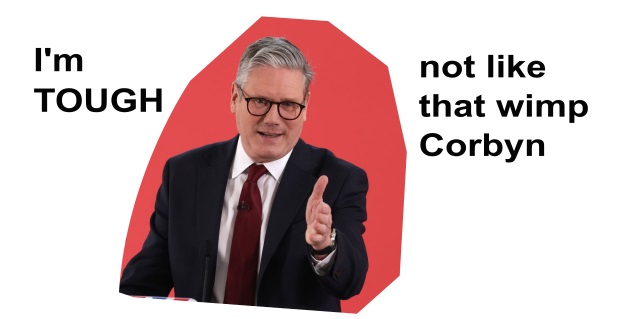
Keir Starmer says he would be prepared to use nuclear weapons, unlike his predecessor.
JUNE 3, 2024 BY ANDREW MCDONALD, https://www.politico.eu/article/uk-labour-talks-nukes-escape-jeremy-corbyn-shadow/—
LONDON — Want to show you’ve moved on from your far-left predecessor? Try a nuclear strike.
Labour leader Keir Starmer on Monday told reporters he would push the button on Britain’s nuclear deterrent if necessary, as the party aims for election victory on July 4 and tries to demonstrate it’s moved on from the tenure of former party chief Jeremy Corbyn.
“On the nuclear deterrent, it is fundamental, it is a vital part of our defense — and of course that means we have to be prepared to use it,” Starmer said.
In keeping with Western nuclear doctrine, Starmer did not set out the circumstances in which he would actually use the U.K.’s nuclear arsenal — at the center of which is the Trident program of nuclear submarines based in Scotland.
But the commitment alone was an eye-opening moment in the campaign — and an important one for Starmer, who has sought to define himself in contrast to Corbyn, the NATO skeptic and lifelong opponent of nuclear weapons who shifted Labour to the left from 2015 to 2019.
Distance from Corbyn
Corbyn was a long-time supporter of the anti-nukes Campaign for Nuclear Disarmament and voted against renewing Trident in 2016, after giving his MPs a free vote on the issue. Despite his own views, however, he did not shift his party’s overall position on the nuclear deterrent, and Labour manifestos under Corbyn did not commit to scrapping Trident.
But Corbyn did come under fire when, in one of his first interviews as Labour leader in 2015, he said he would instruct the U.K.’s defense chiefs never to use nuclear weapons if he became prime minister. “I am opposed to the use of nuclear weapons,” he said at the time. “I am opposed to the holding of nuclear weapons. I want to see a nuclear-free world. I believe it is possible.”
Starmer, who served under Corbyn as a shadow minister, has tried to distance himself from his former boss since becoming leader — despite initially talking up the policies of his “friend” while running for the party leadership in 2020. Corbyn has since been expelled from the party.
Speaking Monday, Starmer sought to hammer home the party’s new direction under his leadership.
With my changed Labour Party, national security will always come first,” Starmer said.
The Labour leader also stressed that his top team is fully behind him in supporting the nuclear deterrent — even though his Shadow Foreign Secretary David Lammy and Deputy Leader Angela Rayner joined Corbyn to vote against the renewal of Trident in 2016.
“I lead this party, I’ve changed this party … and I’ve got my whole shadow cabinet behind me,” Starmer said.
1 This Month
22 June – Virtual Event –Climate Change: New Data, New Debate

Monday, June 22, 2026 2:30 p.m. – 3:15 p.m. CT
YouTube. Register here

Protect Sazan Island from the Trump family! https://secure.avaaz.org/campaign/en/protect_sazan_island_from_the_trump_family_loc/?bqFCVab&v=174511&cl=22707147157&_checksum=5e9dde668860e8231c33699735e16a1fbf22ab2cb01da50c999fe8732b9775ef&utm_source=email&utm_medium=blast_email&utm_campaign=174511
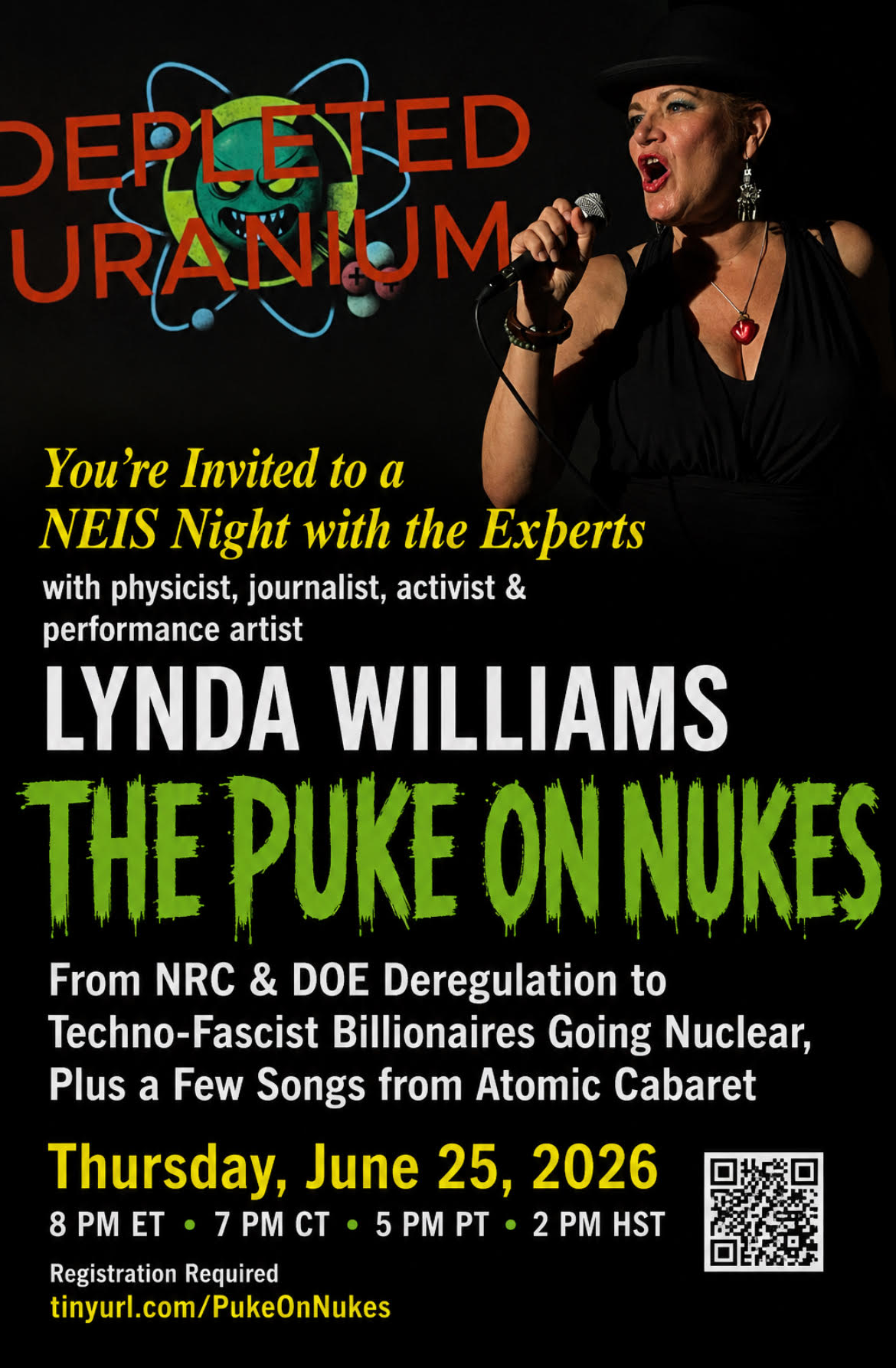
25 June- THE PUKE ON NUKES
Thursday, June 25, 2026
7pm Central Time (8pm ET, 6pm MT, 5pm PT) UTC – 5
From NRC & DOE Deregulation to Techno-Fascist Billionaires Going Nuclear, Plus a Few Songs from Atomic Cabaret REGISTER
26 June – Radiation Trainwreck at the NRC / Join the Protect Better Campaign – https://us02web.zoom.us/meeting/register/4ZlZ5_qLSHGiLSCg8FF6Bg#/registration


Cuba Is Not a Failed State – It Is a Besieged State
PETITION: “Global Appeal to Endorse Palestinian Right of Return of Refugees”
To see nuclear-related stories in greater depth and intensity – go to https://nuclearinformation.wordpress.com
-
Archives
- June 2026 (202)
- May 2026 (306)
- April 2026 (356)
- March 2026 (251)
- February 2026 (268)
- January 2026 (308)
- December 2025 (358)
- November 2025 (359)
- October 2025 (376)
- September 2025 (257)
- August 2025 (319)
- July 2025 (230)
-
Categories
- 1
- 1 NUCLEAR ISSUES
- business and costs
- climate change
- culture and arts
- ENERGY
- environment
- health
- history
- indigenous issues
- Legal
- marketing of nuclear
- media
- opposition to nuclear
- PERSONAL STORIES
- politics
- politics international
- Religion and ethics
- safety
- secrets,lies and civil liberties
- spinbuster
- technology
- Uranium
- wastes
- weapons and war
- Women
- 2 WORLD
- ACTION
- AFRICA
- Atrocities
- AUSTRALIA
- Christina's notes
- Christina's themes
- culture and arts
- Events
- Fuk 2022
- Fuk 2023
- Fukushima 2017
- Fukushima 2018
- fukushima 2019
- Fukushima 2020
- Fukushima 2021
- general
- global warming
- Humour (God we need it)
- Nuclear
- RARE EARTHS
- Reference
- resources – print
- Resources -audiovicual
- Weekly Newsletter
- World
- World Nuclear
- YouTube
-
RSS
Entries RSS
Comments RSS
 nuclear-news