Campaigners welcome international investors to UK summit but urge them to boycott “toxic investment” Sizewell C 14.10.24
Campaigners opposed to Sizewell C unfurled two banners saying “Sizewell
C is a Toxic Investment” this morning outside the City of London’s
Guildhall. The protest took place as world business leaders gathered for
Labour’s first International Investment Summit, and the Labour government
launched its Industrial Strategy consultation.
A Sizewell C Final Investment Decision (FID) has been delayed and rumours are swirling around about which, if any, of the small pool of private investors reported to be
taking part in the equity raise are still involved. Alison Downes of Stop
Sizewell C said “It’s fantastic that Britain is open for business, but
we’re here to tell international investors that, unless they want to find
themselves embroiled in another HS2, they should put their money into
renewables instead of slow, risky, expensive, “toxic” Sizewell C. The
reality is that Sizewell C cannot help the Labour government achieve its
Energy Mission, and if UK investors won’t touch it, neither should
international ones, nor the taxpayer.” https://tasizewellc.org.uk/campaigners-welcome-international-investors-to-uk-summit-but-urge-them-to-boycott-toxic-investment-sizewell-c-14-10-24/
Stop Sizewell C 14th Oct 2024
Senior U.S. Diplomats, Journalists, Academics and Secretaries of Defense Say: the U.S. Provoked Russia in Ukraine
by Donald A. Smith, PhD, The Ukraine Papers, 14 Oct 24
It took some years for Americans to realize they’d been lied to about the war in Vietnam. Thanks to the publication of the Pentagon Papers, and thanks to the antiwar movement, Americans eventually learned about the injustices and failures of that war.
Likewise, it took several years after the starts of the wars in Iraq and Afghanistan for Americans to realize they’d been lied to about those wars as well.
Americans are just now starting to realize that they’ve been lied to about the war in Ukraine. (The propaganda effort has been quite effective, with the New York Times, in particular, acting as a mouthpiece for the government’s position.) More and more mainstream publications are exposing the lies, and a majority of Americans now oppose further arming of Ukraine.
This essay is a summary of what the U.S. government has been hiding about the war in Ukraine, with links to sources for further information
According to Brown University’s Costs of War project, U.S. military actions since 9/11 directly killed over 900,000 people, with an additional 3.5 million people dying from indirect effects. The wars cost Americans at least $8 trillion and displaced over 38 million people from their homes. The U.S. spends over a trillion dollars a year on its military, if you count all expenditures.
If we go back to the 1960s, the number killed by U.S. wars includes the several million killed in the Vietnam war, the approximately 1 million killed by U.S. support for Indonesian military’s attacks on left wing groups, and the hundreds of thousands, at least, killed in proxy wars and government overthrows in Latin America.
The wars, overthrows, and associated sanctions caused mass migrations worldwide — particularly in Europe and at the southern U.S. border — and destabilized politics. Yet almost nobody (except for whistleblowers) was held accountable for these disasters; indeed, many of the same people are in Congress or work for the government or the weapons industry.
Moreover, the U.S. government lied about almost all the wars — in particular, about the wars in Vietnam, Iraq, and Afghanistan, but also about the war in Yugoslovia, as documented in Harper’s Magazine, here (Chapter 3), and here. (In short, the Kosovo Liberation Army that the U.S. supported was, basically, a terrorist organization funded by the CIA, and U.S. propaganda greatly overstated the nobility of the U.S. intervention.)
So, it should come as no surprise that our government is lying now about the war in Ukraine. Specifically, claims by President Biden and others that the Russian invasion was “unprovoked” are greatly exaggerated.
Read what these diplomats, secretaries of Defense, journalists, academics, politicians, and others have to say:………………………………………………………………………………………………………………………………………………………………………………………………more https://theukrainepapers.org/senior-US-diplomats-academics-journalists-and-secretaries-of-defense-say-the-US-provoked-Russia-in-Ukraine.html
Nuclear – not the way ahead

12 Oct 24 https://renewextraweekly.blogspot.com/2024/10/nuclear-not-way-ahead.html
Renewable energies consistently outperform nuclear power in terms of cost and deployment speed and are therefore chosen over nuclear power in most countries’ – so says this years independent World Nuclear Industry status report (WNISR). It notes that in 2023, 5 new nuclear reactors (5 GW) started up and 5 were closed (6 GW), capacity thus declining by 1 GW. So overall it says that nuclear energy’s share of global commercial gross electricity generation declined from 9.2 % to 9.1%, little more than half of its peak of 17.5 % in 1996. In 2023, total investment in non-hydro renewable electricity capacity reached a record US$623 billion, 27 times the reported global investment decisions for the construction of nuclear power plants, with solar and wind power capacities growing by 73% and 51%, respectively.
Nevertheless, some countries are still pushing on with new nuclear, despite its poor economics, including the UK and Sweden. Sweden has mooted a new financing model but its critics say support for nuclear ‘is like throwing money down the drain’ since ‘the expansion of solar energy will make nuclear power obsolete and push it out of the electricity market by the 2030s’. In the UK, and also in France, it has been argued that part of the reason for the political commitment to new nuclear is link between civil and military nuclear, with cross-funding and technical collaboration seen as beneficial.
However, be that as it may, Emeritus Profs. Stephen Thomas (University of Greenwich) and Andrew Blowers (OU) do not see nuclear civil power prospering in the UK, indeed they say that ‘it is time to expose the Great British nuclear fantasy once and for all.’ They claim that ‘no amount of political commitment can overcome the lack of investors, the absence of credible builders and operators or available technologies let alone secure regulatory assessment and approval. Moreover, in an era of climate change there will be few potentially suitable sites to host new nuclear power stations for indefinite, indeed unknowable, operating, decommissioning and waste management lifetimes. And there are the anxieties and fears that nuclear foments, the danger of accidents and proliferation and the environmental and public health issues arising from the legacy of radioactive waste scattered on sites around the country’.
They go on to suggest backing off new nuclear projects. They do recognise that ‘abandoning Sizewell C and the SMR competition will lead to howls of anguish from interest groups such as the nuclear industry and trade unions with a strong presence in the sector. It will also require compensation payments to be made to organisations affected. However, the scale of these payments will be tiny in comparison with the cost of not abandoning them’.
Certainly the cost of construction is vast- and expanding. The EPR being built by EDF at Hinkley Point may in the event cost £35bn, with there’s still being a way to go- 2030 for unit 1 start up, maybe 2031 for Unit 2. And as industry commentators have noted ‘as the cost of Hinkley Point has increased, the backers have had to provide more funding. The souring of relations between Britain & China saw CGN stop providing any more money, leaving EDF to fund the shortfall. EDF has called upon the UK government to help out with the escalating cost but it has refused. EDF was fully nationalised in 2023, leaving the French taxpayer to pick up the tab for the cost overruns’.
UK consumers will of course pay the high cost of the power when it comes on the grid. They will also be expected to shell out for the next EPR that is planned in the UK, at Sizewell, but this time in advanced of completion, under the RAB financing system. However, although the government has provided £5.5bn to move things along, the final (private) investment decision on Sizewell C keeps being delayed. EDF aimed to secure funding by the end 2024, but that may now be extended to 2025 – and EDF is still looking for £4bn to finish Hinkley Point!
All in all, with EDF’s finances in a mess, and few other companies keen to take risks with this technology, it looks a bit uncertain. Even the UK government seems to be having doubts, with plans for a new large project on Wylfa in Wales may be subject to a review. Proposals are currently being considered for small modular reactors under a UK SMR competition, but the US NuScale PWR has just been eliminated from the race. It was once seen as the leader, but it had lost a US order. EDF had earlier dropped out. So that leaves Rolls-Royce, GE-Hitachi, Westinghouse, and Holtec Britain, with the newly formed agency, Great British Nuclear, expected to announce 2 winners later this year or early next year. Up to £20bn is at stake. However few see any power being available anywhere from SMRs until the early or mid 2030s. Despite a lot of hype, in reality it has been slow going. And there are risks.
Overall then, the prospects for new nuclear in the UK, or indeed elsewhere, do not look too good. Even in China, renewables are expanding very much faster, with according to the WNISR/IRENA, at the end of 2023, there being over 1000GW of wind and solar and around 421GW of hydro in place, compared to just 53GW of nuclear. Given the scale and rate of deployment, and the costs, it’s pretty clear which should be the way forward in terms of energy supply there and everywhere else.
Nuclear fission may have a small role to play in some isolated locations and in some applications, and fusion may be viable at commercial scale at some stage, but we have to be aware of hype and overselling in this area, and also in the wider nuclear debate, with nuclear sometimes being sold as the answer to climate change. It’s not. As I have indicated in earlier posts, there is no shortage of studies from around the world confirming the view that nuclear is a costly and risky distraction from renewables, which are the main energy supply solutions to climate change. And Germany has shown how the exit from nuclear can be done, led by renewables. Although they do have some issues in terms of balancing, renewables, along with energy efficiency, demand management and storage, are the way ahead to an economically viable and sustainable energy future.
BBC viewers urge everyone to watch ‘bleak’ war film that has only ever been shown four times
Threads was the first film to ever show what devastation a nuclear winter would cause
Greg Evans, Friday 11 October 2024 ,
https://www.independent.co.uk/arts-entertainment/tv/news/threads-bbc-iplayer-1984-movie-b2627786.html
BBC iPlayer viewers are encouraging others to watch the nuclear war film Threads, often described as one of the most harrowing movies ever made.
The 1984 film was made for BBC TV by The Bodyguard director Mick Jackson and Kes writer Barry Hines, with Jackson wanting to focus on the scientific ramifications of a nuclear attack and its fallout.
Threads was first aired on BBC Two on 23 September 1984 at the height of the Cold War, when nuclear tensions were as prevalent a talking point as they are today.
Although the film revolves around the conflict between the United States and the Soviet Union, after the latter invades Iran, it predominantly focuses on the lives of a couple in Sheffield, England and how the war impacts their lives.
The South Yorkshire city was chosen due to the belief that the Soviets would opt to strike an industrial city in the UK and that the local council, at the time, had a “nuclear-free zone” policy.
Despite having a budget of just £400,000, Threads was the first film to ever depict what a nuclear winter would actually look like, giving an uncompromising and brutally bleak outlook on the implications of nuclear war and the devastation it would create. It has been widely praised by critics and audiences alike ever since and holds a 100 per cent rating on Rotten Tomatoes.
It has only been repeated on BBC TV three times since its original broadcast, with the most recent being on 9 October, to celebrate its 40th anniversary.
The film is now available to watch on iPlayer, with many encouraging those who haven’t seen it to watch it despite the heavy subject matter.
On X/Twitter, one person wrote: “Watching Threads as a youngster (too young really) was a massively transformative experience for me. If you haven’t watched it, you owe it to yourself to do so.”
Another said: “One of the earliest films to not treat nuclear bombs as the end point. But instead focus on the horrors and hauntings that accompany surviving their impact. Rarely shown on TV, a must watch.”
A third added: “I beseech you, if you’ve never watched Threads before, make sure you do now. It’s only been shown 4 times on telly in 40 years and it’s a bleak, harrowing, but essential watch. Something you’ll never forget.”
Watching it for the first time, one viewer said: “Waking up the morning after seeing Threads for the first time… … Like all great art, shakes you to the core and makes you see the world in a new way. While the kitchen sink (antithesis of Hollywood) context makes it all the more terrifying.
Renewable Energy Surge Lowers UK Blackout Risk

The risk of blackouts in the winter months in the U.K. has fallen to its lowest in four years thanks to the rise of the country’s renewable energy capacity.
To ensure a steady supply of electricity to households, Neso will encourage consumers to reduce their energy use during peak times by offering financial incentives through its demand flexibility scheme.
By Felicity Bradstock – Oct 12, 2024
https://oilprice.com/Alternative-Energy/Renewable-Energy/Renewable-Energy-Surge-Lowers-UK-Blackout-Risk.html
- The UK has significantly reduced its blackout risk by increasing renewable energy capacity and diversifying its energy sources.
- The closure of the UK’s last coal-fired power plant marks a major milestone in the country’s transition to clean energy.
- The government is actively encouraging energy conservation during peak times to further enhance grid stability.
The U.K. has been gradually boosting its energy security by increasing its renewable energy capacity while continuing to produce natural gas. It has done this while also moving away from the ‘dirtiest’ fossil fuel, coal. The diversification of the U.K.’s energy mix is helping the island country to develop its resilience and help it accelerate the green transition. Now, the government must ensure that the country’s transmission infrastructure is prepared for an influx of new clean energy projects in the coming years, and can reliably deliver clean energy to tens of millions of households across the U.K.
The risk of blackouts in the winter months in the U.K. has fallen to its lowest in four years thanks to the rise of the country’s renewable energy capacity. The National Energy System Operator predicts that the U.K.’s winter power supplies will outpace demand by nearly 9 percent this year. Neso is the new company in charge of keeping the lights on, which was bought by the government in September from National Grid for $825.5 million. The boost in the power supply margin is supported by the recent deployment of large-scale battery storage projects, small-scale renewables and imported electricity, according to Neso.
As well as producing greater quantities of clean energy at home, the U.K. has also begun importing renewable energy from Denmark through the world’s longest high-voltage power cable – the Viking power link. This cable now provides clean electricity for around 2.5 million U.K. homes, showing the significant potential for clean power sharing across countries.
The optimistic forecast comes in spite of the closure last month of the U.K.’s last coal-fired power plant. At the beginning of the year, the Ratcliffe-on-Soar coal plant was used to provide 2.3 percent of the country’s electricity supply during a period of cold weather. Britain kept its coal facilities on standby following the Russian invasion of Ukraine and subsequent sanctions on Russian energy, mainly natural gas, to ensure there would be power even in the face of severe gas shortages. However, there will be no such backup this year, and, according to Neso, no such need for a backup.
Gas reserves across Europe have been restored to around 95 percent full. The U.K. is no longer dependent on Russia for its gas, having doubled down on its long-standing relationship with Norway for its LNG supply. Britain will now import gas via Norwegian pipelines and tanker from the U.S. and Qatar during the winter months to use in its power plants, factories and residential buildings. To ensure a steady supply of electricity to households, Neso will encourage consumers to reduce their energy use during peak times by offering financial incentives through its demand flexibility scheme.
The U.K. was finally able to close its last coal-fired power plant in September, a target which was stated during the COP26 climate summit in Glasgow in 2021, after 142 years of reliance on coal. The U.K. was the birthplace of coal power, and it is the first G7 country to end coal production. The rapid transition away from a dependence on coal is impressive given that coal contributed 39 percent of the U.K.’s power in 2012. The U.K. established its first legally binding climate targets in 2008, which supported the phasing out of coal. In 2015, the then-energy and climate change secretary, Amber Rudd, stated that the country would stop using coal within the next decade. This has been made possible by the rapid expansion of the U.K.’s renewable energy capacity, with green energy rising to contribute over half of the country’s power in the first half of 2024, from just 7 percent in 2010.
Most of the U.K.’s electricity came from renewable energy sources for the first time in 2020, at around 43 percent. The green energy mix consists mainly of wind, solar, bioenergy and hydroelectric sources. In 2023, wind power contributed 29.4 percent of the U.K.’s total electricity generation, biomass contributed 5 percent, solar power accounted for 4.9 percent and hydropower added 1.8 percent of the mix. While the U.K. is currently depending on a mix of homegrown green and fossil fuel energy, as well as imports of energy from renewables and natural gas, the government plans to dramatically increase its renewable energy capacity by the end of the decade to solidify the country’s energy security. This includes increasing offshore wind output to 50 GW and solar capacity to 70 GW, as well as developing new nuclear plants.
Investing in the diversification of the U.K.’s energy mix has helped the country boost its energy security, as well as move away from a heavy reliance on fossil fuels. As the U.K. undergoes a green transition, the government is working in collaboration with utilities and regulators to ensure that the country does not face shortages, particularly in the winter months. This is further supported by strong energy agreements with other countries in Europe, North America and the Middle East, which will help to alleviate the burden of instability associated with renewable energy sources.
The climate crisis threatens societal collapse—how many more hurricanes will it take for us to wake up?
As a new scientific report warns that the world is on the ‘brink of an irreversible climate disaster’, why do politicians and the media seem so uninterested?

By Alan Rusbridger, October 11, 2024, https://www.prospectmagazine.co.uk/world/environment-news/climate-change/68197/how-many-more-hurricanes-before-we-wake-up-to-the-climate-crisis
It took a dangerous category 3 hurricane in Florida to force climate change onto some, but not all, newspaper front pages. Normally this is a subject for gentle condescension.
You’ll have read a dozen such pieces. Climate change is genuine—there’s no denying that—but let’s be real about so-called “net zero”. We need to be “financially prudent as well as environmentally responsible”, as the Times intoned this week in endorsing BP’s retreat from agreed targets. We must stand against the politicisation of the weather, as Florida governor Ron De Santis is fond of speechifying. Blah, blah, blah, as Greta Thunberg would say.
A mega storm lashing into Florida is difficult to ignore: well-off Americans as victims, lots of vivid film footage etc. And so Hurricane Milton will receive many more eyeballs and clicks than, say, the 1,700 people killed in 2022 when torrential flooding hit Pakistan, submerging a third of the country and affecting 33m people. For some reason this was considered not so newsworthy.
News judgements over such things can be fickle. The day before Milton made landfall a group of respected scientists issued a report which warned that “the future of humanity hangs in the balance” and that we could be facing “partial societal collapse”.
Now, it’s been some time since I worked in daily news, but this feels like what we call “a story”. Not just a story, but what is known in the trade as a “marmalade-dropper”—a story so gripping that it could lead to a distracted breakfast accident. The internal machinations of the Conservative party are important, sure, but how do they compare with the future of humanity?
The report was barely covered. Did any news editor deign to glance at this academic paper, in the journal Bioscience? If they had, they might have been struck by the very startling language of the scientists who wrote it.
“We are on the brink of an irreversible climate disaster,” it began. “This is a global emergency beyond any doubt. Much of the very fabric of life on Earth is imperilled. We are stepping into a critical and unpredictable new phase of the climate crisis.”
Let’s imagine a range of news desk reactions to this alarming news. The first might be a stifled yawn—as in “we’ve heard all this before, tell us something new.” The second might be to question: “Who are these so-called experts?”
There’s something in the first reaction: we have, indeed, heard dire warnings before—albeit not always in such stark terms. As to the second, the 14 authors are easily Googled: they come from top-notch universities around the world. The journal, published by Oxford University Press, comes from the American Institute of Biological Sciences. I think we can call this kosher.
But there are two deeper problems with the way the media thinks about climate change. The first is that it has become the subject of ideology more than science. Our imaginary news editor will have to factor in any prejudices his/her editor, or proprietor, may have in regard to the climate crisis. If the general newsroom feeling—arrived at by a process of mysterious osmosis—is that it’s all a load of overblown woke nonsense, then our news editor will ignore the story. The science doesn’t stand a chance.
The second problem is that journalism is most comfortable when looking in the rearview mirror. Something that happened yesterday is news: something that might, or might not, happen in 30 years’ time is prediction.
How can journalism adapt so that it can—with the assistance of experts—look forward as well as back? “I think journalism has to help us imagine and comprehend the true scale of what will happen if we don’t change course,” is how Wolfgang Blau, who created an Oxford University programme in climate journalism, puts it. It is sometimes referred to as “anticipatory journalism”.
But there are plenty of things in the here and now to be covered. One question might be, “Who is funding Kemi Badenoch?” The information is hiding in plain sight. Her register of interests shows that she’s accepted £10,000 for her leadership campaign from the chair of a climate science denial group.
Let’s make this really easy. Google the excellent research outfit desmog.com and you’ll find that climate campaigners have done the heavy lifting already, investigating the donation from Neil Record, a millionaire Tory donor and founder of the investment firm Record Financial Group. He is chair of Net Zero Watch (NZW), the campaign arm of the Global Warming Policy Foundation (GWPF).
“Based in 55 Tufton Street, Westminster, the GWPF is the UK’s leading climate science denial group,” reports desmog. The GWPF’s director Benny Peiser has suggested it would be “extraordinary anyone should think there is a climate crisis”, while the group has also expressed the view that carbon dioxide has been mischaracterised as pollution, when in fact it is a “benefit to the planet”.
What’s more, it turns out—and thanks to Bloomberg for this nugget of information—that Badenoch has been running her leadership campaign from Mr Record’s home. While she has declared the £10,000 donation from Mr Record, the use of the house has not been declared. A spokesman for the candidate suggested she had done nothing wrong.
Badenoch has previously criticised the UK’s climate targets, calling them “arbitrary” in a 2022 interview. Badenoch has previously suggested that she would be in favour of delaying the UK’s commitment to reach net zero by 2050. She argued that new fossil fuel licences were compatible with the UK’s climate targets.
Badenoch’s rival for the Tory leadership, Robert Jenrick, has also been examined by desmog, which found a growing record of attacks on climate action. He denounces “net zero zealotry” and has labelled the UK’s net zero target as “dangerous fantasy green politics unmoored from reality.” He has supported the opening of new coal mines.s previously critic.
Worth covering? Perhaps by the same newshounds who have so enthusiastically gone in search of the generous donors who have kept Labour’s top team in smart suits, Taylor Swift tickets and football freebies?
Hurricane Milton will soon be off the front pages. Normal service will resume. But it’s hard, once you’ve read it, to dislodge the spectre of “partial societal collapse” if we continue to pretend climate change isn’t an urgent threat to our way of life. We will all have to adapt—including politicians and journalists.
Alan Rusbridger is the editor of Prospect and the former head of Lady Margaret Hall, Oxford. He was editor of the Guardian from 1995 to 2015.
Renewables based systems are reducing blackouts in UK and USA!

David Toke, Oct 11, 2024, https://davidtoke.substack.com/p/renewables-based-systems-are-reducing
The truth is gradually emerging that far from threatening electricity systems with blackouts, renewable energy-based systems are preventing them for occurring! This has a lot to do with the fact that the installation of batteries to deal with renewable output variability has the side-effect of improving grid resilience. Solar power is also reducing possibilities for blackouts in hot places.
Batteries stopped widespread blackouts just three days ago, on October 8th in the UK, when, the UK-Norwegian electricity interconnector suddenly crashed leading to a loss of 1.4 GW of power. Without rapid action, frequency levels would have fallen leading to widespread blackouts as the system tried to preserve grid stability. But 1.5 GW of batteries rapidly clicked into service saving the day (see HERE). Of course the build-up of batteries in the UK is only happening because of the growth of renewable energy!
Similar stories of how blackouts are being averted are coming from other places with growing renewables penetration, including Texas and California in the USA. In both cases, earlier blackouts were caused by conventional power system problems, but widely blamed on renewables by anti-renewables lobbies. But now as renewables, and battery systems, proliferate further, blackout rates are actually being reduced.
Speaking about the October 8th UK incident, Roger Hollies from the ARENCO Group, who originally posted about the outage response on linkedin (HERE) commented: ‘It’s exciting to see batteries casually keeping the lights on whilst delivering diversity of activity to maximise revenue. I count 9 markets and services being participated in by these 12 batteries during this 50 min window alone! This complexity is only going to continue with Quick Reserve coming online later this year, local markets expanding, more renewables coming online and we STILL are not using the +/-3Gvar of reactive power the installed BESS fleet can supply!’
In California, the number of blackouts has been dramatically reduced over the last couple of years. ‘Batteries were the biggest reason California didn’t see the power go out’ says Benjamin Storrow (see HERE). There has been a very big increase in battery installation in California. This has been driven partly by a State-led investment programme. In addition, the increase in battery capacity follows on from the new opportunities in spreading production from the increasing quantity of solar panels over longer periods of the day.
Texas has been saved from a summer power blow-out by a combination of solar pv and batteries. Climate-change inspired hotter summers have put a strain on the Texas grid to cope with the rising demands for air conditioning to meet the summer heat spikes. Once again, solar pv and batteries have come to the state’s rescue. See HERE.
Of course a lot of work still needs to be adapt the electricity from its traditional centralised dispatch mode to a decentralised way of operation. These include incentivising longer duration batteries, something encouraged by a ‘cap and floor’ incentive system for batteries announced by the Government today. See HERE. Initiatives to replace the inertial load system provided by traditional centralised power plant with new inertial sources needed to support variable renewable energy are also in play, for instance promoted by Statkraft’s Guy Nicolson HERE.
Acknowledgement to Dave Andrews from the Claverton Group for the alert on the Norway link tripping event.
Threads brings nuclear war fears to a new audience
“It is only in the last couple of years that the world is lurching towards world war three, that people start thinking about it again”
“the power station was a key target”
Julia Bryson, BBC News, 11 Oct 24
A television drama about a fictional nuclear attack on the city of Sheffield had a profound effect on many who watched it in the 1980s. Now it has aired once again, we spoke to some first and second-time viewers to gauge their reaction.
First broadcast in 1984, Threads has only been repeated a handful of times since – but having gained something of a cult following, it was repeated on BBC Four on Wednesday night to mark its 40th anniversary.
Andrea Cattermole, 56, from Sowerby Bridge, West Yorkshire, said she loved the realism – but it made her “really anxious that it could really happen”.
She said: “It made me think if it did happen, I’d rather be one of the first to die and not have to live through it, with all the effects it has on everyone in the long term.
Ms Cattermole said she thought everyone should watch Threads to “understand the dreadful problems it causes to everyone and the planet for many years after the event”.
The post-apocalyptic film was created by Kes author Barry Hines, and watching it has become something of a rite of passage for people in his home city of Sheffield.
Val Yates, from Retford, Nottinghamshire, remembered watching Threads for the first time in the 1980s, because it was around the time of her 16th birthday.
Now 56, she said watching it for a second time was “like going back to being 16”.
“When we grew up in the 80s we lived with the threat of nuclear war,” she said.
“It has suddenly become poignant again, it’s happening again now but for a new generation.”
As a teenager, Ms Yates lived in the village of Clarborough, which was only about five miles from West Burton power station, where her father worked.
“I think I probably watched it on my own in my bedroom first time round, my dad worked at the power station, so it was even more scary,” she said.
“There was a lot of propaganda around at the time, even in schools we learned about the Cold War and the Cuban missile crisis, it was very realistic.
“We were told the power station was a key target because it’s infrastructure.
“They said if a bomb went off in Sheffield it would take 11 minutes to reach us – there was a graphic which showed how quickly it would sweep the area and it terrified me.”
She added: “Everything settles down and today’s kids have no idea what it was like.
“It is only in the last couple of years that the world is lurching towards world war three, that people start thinking about it again,” she said……
The story is focused around two families who live in Sheffield when a nuclear bomb is detonated.
In the aftermath of the blast, increasingly desperate people are seen trying to seek medical help and food, and civilised society eventually breaks down. Within a generation, language has died out and survivors live in medieval conditions…………………………..
“It remains the most accurate depiction of what nuclear winter would look like,” said Mr Mann – whose documentary “Survivors – The Spectre of Threads” is set to be released next year.
“Nothing has ever captured what the consequences would be, and I think that is what the producer Mick Jackson intended to do.
“He made a stark warning of what that would look like. It is accurate and I think that is why it continues to scare people,” he added.
“It is not something at the immediate forefront of the consciousness at all times but it could still happen and I think that is why people find it so scary.”
Threads is now available to watch on BBC iPlayer. https://www.bbc.co.uk/news/articles/c2dp8197y3eo
UK and Ireland partners congratulate 2024 Nobel Peace Prize winner
Nuclear Free Local Authorities, 11 Oct 24,
On hearing the news that the Japanese Hibakusha survivor network Nihon Hidankyo (No More Hibakusha) has been awarded this year’s Nobel Peace Prize, NFLA and Mayors for Peace Chapter Secretary Richard Outram lost no time in sending the worthy winners our congratulations.
The Nobel Peace Prize Committee made their customary announcement on 11 October, two months before the formal award ceremony takes place in Oslo.
Founded on August 10, 1956, Nihon Hidankyo is the only Japanese national organisation of A-bomb survivors of Hiroshima and Nagasaki (Hibakusha). It has branches in all 47 Japanese prefectures, thus representing almost all organized Hibakusha. Impressively, its officials and members are all Hibakusha. Although most Hibakusha live in Japan, several thousand more live in Korea and in other parts of the world.
The website states that the organisation’s main objectives are:
1) The prevention of nuclear war and the elimination of nuclear weapons, including the signing of an international agreement for a total ban and the elimination of nuclear weapons. The convening of an international conference to reach this goal is also part of Hidankyo’s basic demand.
2) State compensation for the A-bomb damages. The state responsibility of having launched the war, which led to the damage by the atomic bombing, should be acknowledged, and the state compensation provided.
3) Improvement of the current policies and measures on the protection and assistance for the Hibakusha.
Although the Nihon Hidankyo website records that in March 2016 there were 174,080 Hibakusha living in Japan, since that time these numbers are fast dwindling as many are in their eighties or above. Doubtless this factor, and the fact that the organisation will be the holder of the current Nobel Peace Prize throughout 2025 when the world remembers and commemorates the 80th anniversary of the atomic bombings, have played their part in their worthy selection as this year’s winners.
More information can be found on the organisation’s website:
The text of the letter of congratulation follows…………………………………………….more https://www.nuclearpolicy.info/news/uk-and-ireland-partners-congratulate-2024-nobel-peace-prize-winner/
A desire to leave not a ‘compelling need’ under nuke dump compo scheme say Nuclear Waste Services

Residents no longer able to live under the continued threat of a potential nuclear waste dump will be unable to avail themselves of compensation if they simply sell up at a loss under the terms of the scheme recently announced by Nuclear Waste Services.
Last month, Nuclear Waste Services launched the Property Value Protection Scheme to compensate homeowners who sell their properties in the three GDF Search Areas in West Cumbria and East Lincolnshire for a sum that is lower than the ‘market price’ because the market has been blighted by the threat of a Geological Disposal Facility.
Given that a big factor in determining property price is ‘location, location, location’, future residency in an area hosting a GDF which we described as ‘a massive mining project akin to building the Channel Tunnel, into which the UK’s most deadly stockpile of radioactive waste would be deposited for eternity’, must inevitably result in blight, particularly in quiet, seaside retirement communities and those with no historic association with the nuclear industry.
In response, the NFLAs published a critique of the scheme as overly complex and too restrictive.[1]
Eligibility for compensation requires the applicant to hurdle five key conditions and supply complex evidence. One key hurdle is the need to demonstrate a ‘compelling need’ to sell.
On reading our critique, a Cumbrian resident and local Parish Councillor set out for the NFLAs their circumstances:
“I currently live in a rural hamlet with open countryside surrounding me, with far reaching views over the countryside to the mountains beyond. It is quiet and peaceful. This is the type of property and lifestyle I have chosen. I did not choose to live near a 1 KM square head works for a GDF with the long-term build and operating life with the noise, visual disturbance and general impact the development would bring. I would not live in that environment.”
The Secretary read out this scenario to NWS officials at the Nuclear Decommissioning Authority’s Stakeholder Summit in September and asked them if the desire to escape the prospect of a future GDF development would be accepted as a ‘compelling need’’.
After a follow up exchange of emails, the response was a resounding No: ‘A desire to move away from an area being considered to host a potential GDF would not meet the “compelling” need criteria of the PVP scheme.’
Although on the face of it, the NWS reply represents for people wishing to move a massive disappointment, the actual position may – as per usual with the GDF process – be more nuanced. For under the published guidance, ‘Section 3.5 – Criteria 5: Compelling need to sell’ it states that a compelling need includes ‘a significant change in health’.
It is clear from public questions posed at recent meetings of the East Lindsey District Council that the continued uncertainty is taking a toll on the emotional, mental and physical health of some residents. Surely then, in circumstances where they have had to obtain related professional medical treatment, the need to move must constitute a ‘compelling need?’ To the NFLAs taking a counterview would be inhumane.
Regrettably they will be unable to rely on any sympathy from any member with local residency and knowledge of the situation on the ground; for it has been made clear to the NFLAs that only specialists with relevant experience of administering similar compensation schemes used with other large national infrastructure projects will be eligible for appointment as ‘independents’ to the five-member panel that will consider applications. Tellingly no positions will be reserved for members of the Community Partnerships.
For more information, please contact Richard Outram, NFLA Secretary by email to richard.outram@manchester.gov.uk
Nuclear lobby takes over tertiary education, with blatant lies about “clean” “green” nuclear

X-energy plans fleet of 40 Xe-100 reactors across the UK. More than 100
businesses from across Teesside and the UK met to learn how they can work
with X-energy on its proposed nuclear new build project. X-energy, along
with deployment partner Cavendish Nuclear, discussed the potential fleet
production of its Xe-100 advanced modular nuclear reactors, likely
timescales, scope of contracts for companies of all sizes across multiple
sectors, and what is required to win business. The event at Hartlepool
College of Further Education was followed by a workshop…………… https://www.thenorthernecho.co.uk/news/24645271.x-energy-plans-fleet-40-xe-100-reactors-across-uk/
Hartlepool College of Further Education hosts 70 businesses to set out opportunities for X-energy’s multi-billion pound Hartlepool nuclear reactor project
By Madeleine Raine, 8 October 24
More than 100 representatives from local and national companies are meeting in Hartlepool to hear about the opportunities offered by X-energy’s proposed nuclear reactor project.
On Tuesday, October 8, businesses from across the UK are coming together at Hartlepool College of Further Education to find out about the role regional and British engineering, manufacturing and construction companies can have in building the next generation of [?] clean power production nationwide.
X-energy and deployment partner Cavendish Nuclear are going to be discussing the potential production of advanced modular nuclear reactors…………………………………………
“What X-energy is proposing with its AMR technology will make Hartlepool the epicentre of this country’s transition to a [?] green energy superpower with billions of pounds worth of generational investment”………………………….. https://www.hartlepoolmail.co.uk/news/people/hartlepool-college-of-further-education-hosts-70-businesses-to-set-out-opportunities-for-x-energys-multi-billion-pound-hartlepool-nuclear-reactor-project-4814707
Nuclear power stations are neither wanted nor needed in Scotland.
I REFER to the letter headed “Vote Sarwar if you want broken nuclear future” (Sunday National, Oct 6) from Leah Gunn Barret in which she summarises why Scotland doesn’t need nuclear power as proposed by the Labour government.
This is a position adopted by HANP (Highlands
Against Nuclear Power) since our formation. It appears that a lot more
lobbying and campaigning is needed, as the position taken by, for example,
environmental campaigner George Monbiot, is that nuclear is a clean energy
and needs to be “part of the mix” of energy sources.
Long-standing and new supporters of nuclear seem to ignore the reasons for nuclear not
needing to be “part of the mix” including: Generating electricity
through nuclear is twice as expensive as through renewables, and when
construction costs can’t be raised from the private sector the taxpayer
will pick up the bill.
Nuclear is not “carbon-free” or green, as uranium
has to be mined as the raw material required and there are high CO2
emissions during the average 15-year build period. All nuclear power
stations pose a risk to health and the environment both during operation
and decommissioning. Years after the fast breeder at Dounreay closed, there
are still radioactive particles being found on the foreshore around
Dounreay and there have been leaks of radioactive sodium.
The National 10th Oct 2024
The National 10th Oct 2024 https://www.thenational.scot/community/24644810.nuclear-power-stations-neither-wanted-needed-scotland/
Farmers warn over Hinkley Point C’s saltmarsh plan
Burnham & Highbridge Weekly News 12th October, By John Wimperis,
PLANS to turn a huge swathe of land in North Somerset into a marsh to make up for the environmental impact of Hinkley Point C would “destroy” homes and livelihoods, farmers have warned.
Bosses at Somerset’s new nuclear power station are proposing creating new saltmarsh habitats along the Severn to compensate for the number of fish that will die by being sucked into the power station’s cooling systems. But this means communities along the river and estuary face losing hundreds of acres of farmland.
In Kingston Seymour in North Somerset, the plans to turn 1,500 acres of prime agricultural land between Weston-super-Mare and Clevedon into salt marshes have caused outcry. Farmers, who were left in “extreme distress,” after finding out their land was under threat blocked access to wildlife surveys for the plans in protest on Tuesday (October 8).
A public meeting with EDF — the energy company building Hinkley Point C — is set to be held in Kingston Seymour Village Hall on October 14 at 7.45pm.
Farmers across the affected area have urged EDF to drop the plan.
Young farmer Sophie Cole of the farm at Wharf House said: “I am a third-generation young farmer in Kingston Seymour and all my land and property is directly impacted by this proposal.
“No amount of money can compensate me for the loss of my livelihood and exciting plans for the future.”
Peter and Karen Stuckey of Channel View Farm said: “We have a thriving commercial business which provides employment and services to local people.
“We also have agricultural land and several dwellings which provides much needed local housing.
“This proposal will destroy our home and livelihood and is causing us a great deal of worry and anxiety.”
They added: “This will destroy everything we have built up over the last 50 years.”
Meanwhile, at Dowlais Farm, Kathrin and David Kirk said: “We have rebuilt Dowlais Farm from near derelict to a great family home (grade II listed) as well as a thriving campsite and two holiday cottages.
“We purchased the farm seven years ago from North Somerset Council and have invested everything we have both financially and physically into this business and built it up from scratch.
“This proposal would destroy our livelihood and our home. It would also destroy wildlife habitats for otters, bats, badgers, foxes, deer as well as birds such as owls, kestrels and buzzards who all nest in the trees on our land.”
Dan Kostyla of Sea Wall Farm, another young farmer, said: “My family have been farming here for generations — I am fourth generation — and have invested heavily in the farm business. We have a large dairy and beef farm business.
“All of this will be lost from the food chain and our business will be unviable/destroyed.”
Another young farmer, Dan Kostyla of Sea Wall Farm said: “My family have been farming here for generations — I am fourth generation — and have invested heavily in the farm business. We have a large dairy and beef farm business.
“All of this will be lost from the food chain and our business will be unviable/destroyed.”
EDF said it is obligated to make environmental improvements such as salt marshes to compensate for the power station’s impact on fish populations, which the energy company said would be limited………….
A public consultation will be held on any plans before they go ahead……………………………………………………………… https://www.burnhamandhighbridgeweeklynews.co.uk/news/24646958.farmers-warn-hinkley-point-cs-saltmarsh-plan/
EDF Seeks to Raise Up to £4 Billion to Help Fund Construction of UK’s Hinkley Nuclear Plant
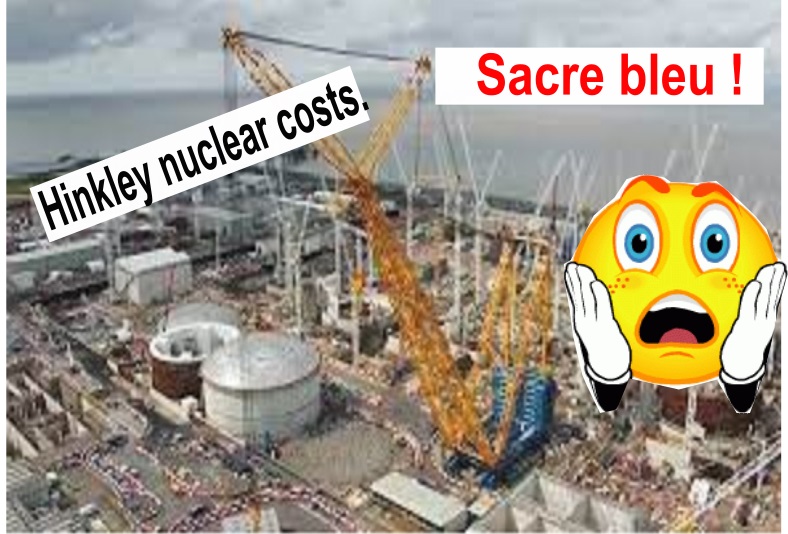
- Company is talking to funds for a stake sale in Hinkley Point
- EDF would reimburse investors if the nuclear project fails
Electricite de France SA is holding talks with investors over funding for
the Hinkley Point C nuclear power plant under construction in the UK, as
the French utility grapples with the ballooning cost of the project.
EDF is seeking to raise as much as £4 billion ($5.2 billion) through a bespoke
financial instrument which would give investors a stake in the Hinkley
project, people familiar with the matter said asking not to be named
because the discussions are private. Investors would be reimbursed if the
construction isn’t completed, one of the people said.
Bloomberg 10th Oct 2024
NATO state’s PM pledges to block Ukrainian membership
https://www.rt.com/news/605332-nato-state-kiev-never-join/ 11 Oct 24
Admitting Kiev into the US-led bloc could trigger a global war, Slovak Prime Minister Robert Fico has said
Slovak Prime Minister Robert Fico has said that his country will not allow Ukraine to join NATO as long as he is in power. Admitting Kiev into the US-led military alliance would trigger a new world war, he warned in an interview with STVR on Sunday.
“As long as I am the prime minister of the Slovak Republic, I will lead the legislators, whom I have control over as a party chairman, to never agree to Ukraine’s membership in NATO,” Fico said. “Ukraine’s entry into NATO would serve as a good basis for a third world war.”
Fico, a longtime critic of Western military and financial aid to Ukraine, has insisted that the conflict must be resolved through diplomatic means. He has repeatedly warned against further escalation with Moscow.
The accession of new countries must be approved by all of NATO’s 32 members, with national parliaments voting in favor of or against new candidates.
Kiev formally applied to join NATO in September 2022, citing the conflict with Russia. While many Western states publicly back Ukraine’s aspirations, they have refused to provide a concrete roadmap or timetable for accession. Ukrainian leader Vladimir Zelensky acknowledged in July that “we will not be in NATO until the war is over in Ukraine.”
Russia views NATO’s expansion eastward as a security threat and has cited Ukraine’s cooperation with the bloc as one of the main reasons behind the conflict.
President Vladimir Putin warned last month that using Western-supplied longer-range weapons for strikes deep inside Russia would be tantamount to “direct involvement” of NATO in the conflict.
1 This Month
26 September – International Day for the Total Elimination of Nuclear Weapons





PLEASE OPPOSE HR 8255 AND S.3639 – bills would accelerate satellite deployment, with no environmental review or safeguards – https://ncstd5li.quorum.us/campaign/169331/
To see nuclear-related stories in greater depth and intensity – go to https://nuclearinformation.wordpress.com
-
Archives
- September 2026 (323)
- August 2026 (330)
- July 2026 (355)
- June 2026 (287)
- May 2026 (306)
- April 2026 (356)
- March 2026 (251)
- February 2026 (267)
- January 2026 (308)
- December 2025 (358)
- November 2025 (359)
- October 2025 (375)
-
Categories
- 1
- 1 NUCLEAR ISSUES
- business and costs
- climate change
- culture and arts
- ENERGY
- environment
- health
- history
- indigenous issues
- Legal
- marketing of nuclear
- media
- opposition to nuclear
- PERSONAL STORIES
- politics
- politics international
- Religion and ethics
- safety
- secrets,lies and civil liberties
- spinbuster
- technology
- Uranium
- wastes
- weapons and war
- Women
- 2 WORLD
- ACTION
- AFRICA
- Atrocities
- AUSTRALIA
- Christina's notes
- Christina's themes
- culture and arts
- Events
- Fuk 2022
- Fuk 2023
- Fukushima 2017
- Fukushima 2018
- fukushima 2019
- Fukushima 2020
- Fukushima 2021
- general
- global warming
- Humour (God we need it)
- Nuclear
- RARE EARTHS
- Reference
- resources – print
- Resources -audiovicual
- Weekly Newsletter
- World
- World Nuclear
- YouTube
-
RSS
Entries RSS
Comments RSS

