Green jobs and green skills – the state of play

October 26, 2024, https://renewextraweekly.blogspot.com/2024/10/green-jobs-and-green-skills-state-of.html
In 2023, the global renewable energy sector witnessed a record increase in jobs, rising from 13.7 million in 2022 to 16.2 million. China led with an estimated 7.4 million renewable energy jobs, representing 46% of the global total. The EU followed with 1.8 million jobs, while Brazil had 1.56 million. The US and India each contributed nearly one million jobs. The strongest growth was seen in the solar photovoltaics sector, which accounted for 7.2 million jobs globally, with 4.6 million jobs located in China.
However, as I have reported in earlier posts, green skill shortages may slow progress and, exploring this issue in the UK context, an Imperial College Futures Lab briefing paper has investigated the Net-Zero job skills and training requirements in the UK’s energy system. It notes that the governments advisory Committee on Climate Change (CCC) estimates that between 135,000 and 725,000 net new jobs could be created in the UK by 2030 directly in low-carbon sectors, this wide range highlighting uncertainties in estimates about the number of workers required to support the transition to Net-Zero. The Futures Lab study identifies ongoing barriers and opportunities for expanding low-carbon job competencies, culminating in a set of policy recommendations to create clear, inclusive training pathways into low-carbon energy jobs.
Using three sectoral case studies, the paper investigates challenges and opportunities for improving skills and training. Firstly it shows how the building energy retrofit sector faces a significant shortage of skilled workers, particularly in heat pump installation, energy efficiency measures, retrofit coordination, and digital roles. Despite the potential to create 120,000–230,000 new jobs by 2030, it says ‘inconsistent policies and funding have hindered private investment in training’. Secondly, the offshore wind sector is forecast to employ over 100,000 workers in 2030, compared to 32,000 in 2022. But it says ‘offshore wind struggles with skills gaps in electrical, digital, consenting, and marine roles, relying on experienced workers and those from other industries to fill these gaps’. Thirdly, the paper claims the electric vehicles sector ‘could generate at least 80,000 new jobs over the next 10-15 years’ but says that this ‘is contingent on gigafactory development, with key skills needed in charging point installation, vehicle recycling, battery manufacturing, and electrification engineering.’
Most of these cases involve expanding training for specific green energy technologies and electrification, but the report says that ‘not all industrial decarbonisation can be achieved through direct electrification, and particularly across hard-to-abate industries, decarbonisation will depend on the development of hydrogen and CCUS sectors’. It notes that ‘growth of these sectors is considered highly conditional, subject to the competitiveness of international markets, the availability of skilled labour, and levels of investment,’ but reports that the CCC estimates that ‘these industries could create between 1,500 and 97,000 new jobs by 2030’. It adds that ‘the current offshore oil and gas workforce is expected to provide a large number of skills required in these sectors’.
That’s good news (arguably blue hydrogen/CCUS apart) but making it happen won’t be easy. It is interesting in this context that there has recently been a call for £1.9bn a year to help oil and gas workers move into clean energy, with the Green Jobs Taskforce also estimating that ‘the low-carbon transport sector could create 78,000 new jobs by 2040, including 24,500 in battery manufacturing, 43,500 in the battery supply chain, and 10,000 in EV manufacturing’.
Looking to the way ahead, the Future Lab identify a series of barriers facing this type of job transition. First come straight forward ‘skills transferability’ barriers. For example it notes that it has been estimated that 100,000 jobs in the UK’s offshore energy sector will be filled by workers transferring from oil and gas into offshore renewable roles, and by new entrants from outside the sector. But it says ‘there is debate about how transferable skills across high- and low-carbon sectors actually are, and whether a ‘topping up’ of skills or more rigorous retraining will be required for those transitioning’.
Then there are mobility barriers. ‘Whether or not workers are able to take low-carbon jobs will depend on where and when existing jobs are being lost and new jobs become available. It will also depend on the supply of and demand for relevant training, which is likely to be unevenly distributed in terms of quantity and quality. If green jobs or re-skilling opportunities do not appear in areas where jobs have been phased out, workers will either have to lose out on opportunities, seek employment in other high-carbon sectors, or relocate, which risks reinforcing existing regional inequalities.’
That links up to regional barriers. It says ‘UK regions with a higher concentration of energy-intensive industries, such as the North East, Yorkshire and the Humber, and the West Midlands, stand a higher chance of being negatively affected by the transition. These regions are often also those whose economies have seen the least growth in recent decades. They are also likely to have less capacity and resources to be able to provide adequate re-skilling support’.
And finally there are diversity barriers. The report notes that ‘the current energy sector is predominantly represented by white male workers. Available statistics suggest that only 5% of the workforce comes from BAME backgrounds. Unless active measures are taken to support underrepresented groups joining the Net-Zero energy workforce, occupational gender & ethnicity gaps are likely to persist’.
Some of the reports recommended actions are obvious enough from the foregoing analysis. For example green sectors should be ‘inclusive and respectful places to work, where underrepresented groups not liable to be discriminated against’, and we should build ‘closer links between high- and low-carbon energy sectors to create direct routes into new jobs.’
More specifically ‘current public financing mechanisms for skills, including the Apprenticeship Levy, the National Skills Fund, and the Adult Education Budget, should be reviewed to see how funding can be better directed towards the development of training for green jobs. Additional public funding should also be leveraged to support long-term development of skills for Net-Zero, specifically for FE colleges and training providers to be able to develop new, high-quality green courses and overcome low participation rates. There is also a case for targeted funding for SMEs who cannot afford to send staff to be trained or take on apprentices’. And more generally, ‘introduce a national Net-Zero Skills Commission to take on monitoring, research and advisory roles to support development of skills for the Net-Zero transition in England.’
Plenty of good ideas. Let’s hope some are implemented soon, and meantime, the UK government is pushing ahead with its ‘skills passport’ initiative. In parallel, we hope helpfully, OU Visiting Research Fellow Terry Cook and I are putting together a journal paper on this whole area, looking in particular at what governments can do at the strategic level, by making new energy technology funding/subsidies conditional on the provision of green skill training programmes.
CND condemns ‘outrageous railroading’ of US-UK nuclear agreement renewal through Parliament.
Anti-arms campaigners today condemned the
“outrageous railroading” of the US-UK Mutual Defence Agreement (MDA)
renewal through Parliament. The MDA, active since 1958, enables vital
nuclear material and technology transfers between the US and Britain,
reviewed every 10 years. But the Campaign for Nuclear Disarmament (CND)
condemned the government’s intention to make the treaty permanent by
removing the clause that requires the treaty to be extended and enables
debate and amendment, including rejection.
Morning Star 25th Oct 2024 https://morningstaronline.co.uk/article/cnd-condemns-outrageous-railroading-us-uk-nuclear-agreement-renewal-through-parliament
Slovenia cancels referendum on new nuclear plant
By Reuters, October 25, 202, Reporting by Daria Sito-Sucic; Editing by Christina Fincher-
https://www.reuters.com/world/europe/slovenia-cancels-referendum-new-nuclear-plant-2024-10-24/
Slovenian lawmakers on Thursday voted to cancel a referendum on building a new nuclear plant after environmental groups and experts filed complaints questioning its legality at the constitutional court.
The new JEK 2 plant was due to be constructed next to Slovenia’s existing Krsko nuclear power plant, which is jointly owned by Slovenia and Croatia and meets about 20% of the electrical energy demand in Slovenia and 16% in Croatia.
Sixty-nine MPs in the 90-seat parliament voted to cancel the public referendum, one was against and one abstained from voting. The referendum had been due to take place on Nov. 24.
Earlier this month, Slovenia’s parliament decided to call the referendum with the question: “Do you support the implementation of the JEK 2 project, which together with other low-carbon sources will ensure a stable supply of electricity?”
But public criticism of both the question and the project led the parliamentary groups to withdraw their support for the referendum.
Lawmakers said there were valid doubts about whether voters could make an informed, autonomous and responsible decision on such an issue.
“I am personally satisfied that there will be no referendum,” Slovenia’s President Natasa Pirc Musar was quoted as saying by state STA news agency. “I will always emphasize that significantly more information is needed for such a referendum.”
But observers say the cancellation of the referendum next month does not mean it might not take place at a later time.
The government has said it will work on the preparation of a special law on JEK 2, and that the state-owned GEN Energija will continue working on the development of the project, which has been estimated to cost between 9.6 billion euros ($10.37 billion) and 15.4 billion euros.
Slovenia and Croatia agreed in 2023 to prolong the lifespan of the Krsko plant by 20 years until 2043. The thermal power capacity of Krsko is 1,994 Megawatts (MW) with net power output of 696 MW.
UK Snubs Council of Europe Over Assange Inquiry
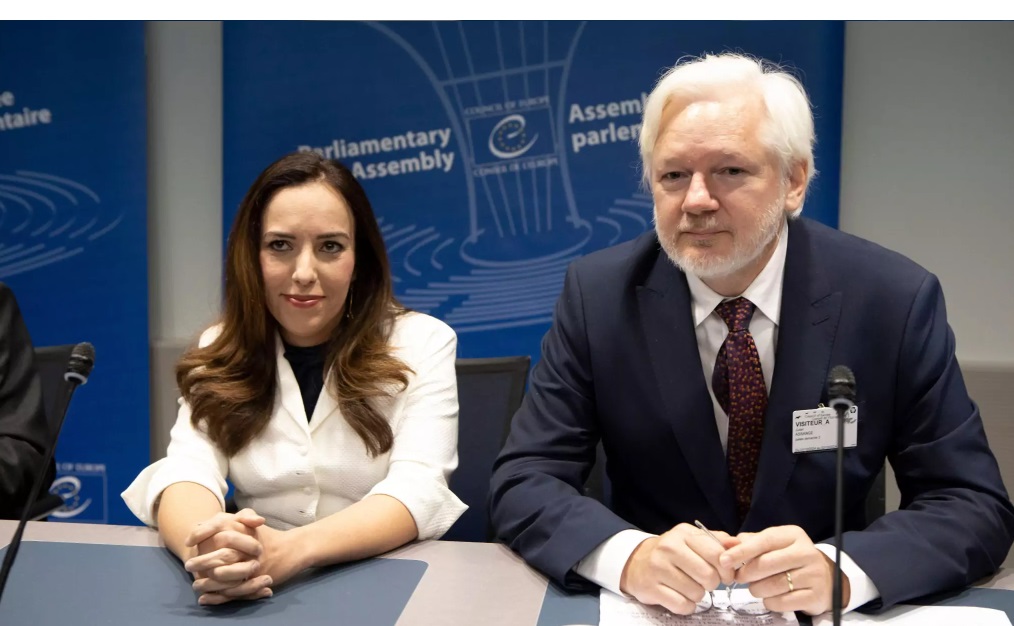
Politicians across Europe want Britain to investigate why the WikiLeaks founder spent five years in jail.
MARK CURTIS, 25 October 2024, https://www.declassifieduk.org/uk-snubs-council-of-europe-over-assange-inquiry/
Britain’s Home Office is making a “grave mistake” by ignoring a call from the Council of Europe to review its treatment of Julian Assange, the WikiLeaks founder’s wife has warned.
The Council’s parliamentary assembly, of which the UK is a member, passed a resolution earlier this month designating Assange as a “political prisoner”.
Assange endured five years in Belmarsh maximum security prison in London before being released in June, and flying to his native Australia. The UK government had incarcerated him while the US pursued extradition proceedings in the British courts.
His treatment has outraged the Council of Europe, which was created in the aftermath of World War Two with strong backing from Winston Churchill.
Its resolution urged the UK authorities to conduct a review “with a view to establishing whether he [Assange] has been exposed to torture or inhuman or degrading treatment or punishment, pursuant to their international obligations”.
It found the UK authorities “failed to effectively protect Mr Assange’s freedom of expression and right to liberty, exposing him to lengthy detention in a high-security prison despite the political nature of the most severe charges against him.”
Declassified asked Britain’s Home Office what its response was to the Council of Europe’s call.
The government department deflected the question, replying: “The longstanding extradition request for Julian Assange has been resolved. As is standard practice, all extradition requests are considered on an individual basis by our independent courts and in accordance with UK law.”
The demands of the parliamentary assembly are not binding on European governments but they are “obliged to respond”.
‘Cover-up’
Stella Assange, Julian’s wife, told Declassified the Home Office is making a “grave mistake” in refusing to heed the Council of Europe’s call.
She said: “We know that the Crown Prosecution Service has disappeared key documents relating to Julian’s imprisonment and refused to provide information, first to a journalist, and now to the court, that might shed a light on the political side of Julian’s persecution in the UK.
“It is one thing for rogue elements in the CPS to collude with foreign governments to persecute a publisher and attempt to cover their tracks. It is quite another for the UK government to stonewall in this manner in the wake of an independent report by the Council of Europe and a vote by the overwhelming majority of the chamber calling on the UK to carry out an investigation.”
She added: “The UK government is effectively partaking in the cover-up, in a way that only a guilty party would.”
‘Psychological torture’
Assange’s detention in maximum security Belmarsh was “out of proportion in relation to his alleged offence”, the Council of Europe’s resolution found.
It recalled the findings of the then United Nations special rapporteur on torture, Nils Melzer, that Assange had been exposed to “progressively severe forms of cruel, inhuman or degrading treatment or punishment, the cumulative effects of which can only be described as psychological torture”.
Melzer’s report, produced in 2019 while Assange had secured asylum in the Ecuadorian embassy in London, called on UK officials to be investigated for possible “criminal conduct” in their treatment of Assange. It was never reported in the UK national media.
The Council of Europe found that the UK authorities “appear to have ignored” Melzer’s findings.
Its resolution was passed with 88 in favour, 13 against and 20 abstentions. All four UK members of the parliamentary assembly voted against, including Lord Richard Keen, a Conservative peer, who expressed a dissenting opinion.
Keen argued that it was “legally incorrect” to find that Assange had been detained unlawfully, as he had violated bail conditions before and was considered a flight risk.
Keen also rejected the accusation of torture against the UK, saying that Assange’s “regrettable psychological state” identified by Melzer was due to Assange’s “self-imposed lengthy isolation in the Ecuadorian embassy in London and cannot be blamed on the UK authorities.”
‘Chilling effect’
The Council of Europe concluded that the treatment of Assange “creates a dangerous chilling effect and a climate of self-censorship affecting all journalists, publishers and others reporting matters essential for the functioning of a democratic society”.
It added: “It severely undermines the role of the press and the protection of journalists and whistle-blowers around the world.”
The resolution also noted that the Council was “alarmed” by reports that the US Central Intelligence Agency had covertly surveyed Assange while he was in the Ecuadorian embassy in London and was allegedly developing plans to poison or even assassinate him on UK soil.
Rebecca Vincent, campaigns director at Reporters Without Borders, told us that Julian Assange’s sentencing by UK courts to 50 weeks in prison for breaking bail was “disproportionate”.
She added: “His subsequent prolonged detention in a high-security prison with no charges against him in the UK, held purely on remand, constituted a gross violation of his rights.”
Vincent said: “We faced unusual restrictions from UK authorities in trying to do our jobs advocating in this case, including extreme difficulties securing consistent access to monitor extradition proceedings against Assange in UK courts, and access to visit him in Belmarsh prison. These aspects all merit a serious independent review.”
Fighting for More Evidence of Assange’s Political Prosecution
Italian journalist Stefania Maurizi has been in court trying to get some missing emails — or data about them — that could further expose the political motivation behind the prosecution of the WikiLeaks publisher.
Joe Lauria and Mohamed Elmaazi / Consortium News, October 23, 2024
A tribunal in Britain is set to decide whether to order the government’s Crown Prosecution Service (CPS) to prove it deleted emails that may have covered up more evidence of a politically motivated prosecution of Julian Assange.
The three judges heard arguments on Sept. 24 in the nearly decade-long freedom of information saga regarding the emails that top British prosecutors say were deleted.
They involved an exchange with Sweden during a Swedish prosecutor’s attempt, beginning in 2010, to extradite the WikiLeaks publisher from Britain. ……………………………………………………….
It was only when the U.S. realized it would lose on appeal after a four-year extradition battle that the Department of Justice cut a plea deal with Assange who was released on June 24 and returned to his native Australia.
Assange had been charged in the United States under the Espionage Act for possessing and publishing defense information, which revealed evidence of U.S. war crimes.
Britain took an active role in Assange’s prosecution. Its Crown Prosecution Service sought to stop Sweden from going to the embassy to question him.
Seeking to learn more about Britain’s role against Assange, Italian investigative journalist Stefania Maurizi first made a Freedom of Information Act (FOIA) request in 2015 for all emails between the British and Swedish governments concerning Assange.
Some of the emails she obtained showed political motivation on the part of the lead British prosecutor, Paul Close. One email Maurizi obtained from the Swedish Prosecution Authority (SPA) revealed that Close appeared to be pressuring Swedish prosecutors to continue seeking Assange’s extradition instead of dropping the case or questioning him at the Ecuadorian embassy, where Assange had been granted asylum………………………….
After Maurizi noticed a sizeable gap in the emails released to her she filed another FIOA seeking to obtain the missing emails.
The CPS first claimed that it had destroyed the emails. It said that when Close retired, his account along with his emails, were automatically destroyed.
But Maurizi did not buy it. She asked the court at the hearing last month to order the CPS to turn over “metadata” — data about data, such as file creation and modification dates, email sender and recipient addresses, timestamps, email routing information, keywords, and subject lines — proving the emails really were deleted and when.
“We have NO certainty whatsoever” that the emails were destroyed, Maurizi wrote in a message to Consortium News. Maurizi is in court because she believes the allegedly deleted emails could provide additional evidence of a politically motivated prosecution of Assange.
……………………………………………‘When, How & Why’ Were the Emails Deleted?
Maurizi, who travelled to London from Rome to attend the Sept. 24 hearing at the First-Tier Tribunal (General Regulatory Chamber), is challenging the ongoing failure of the CPS to respond adequately to her December 2019 FOIA about the missing emails.
………………………………………………………………….Maurizi is betting the tribunal will agree with her that metadata is clearly information that can be requested under the Act and which can clearly be provided with little difficulty. If she succeeds, future FOIA requests will also be able to demand metadata if and when an individual thinks it may be useful.
Hillary, who was called to testify for the CPS, freely admitted to the tribunal that she could easily provide the metadata Maurizi requested and that she would be happy to do so, as long as any information which identified individuals is redacted.
The tribunal will also consider whether to “order the CPS to carry out a proper, full search for information held” as to “when, how and why?” the thousands of emails were allegedly deleted while Assange’s Swedish extradition case was still very much active.
No date has yet been set for the announcement of the tribunal’s decision. https://consortiumnews.com/2024/10/23/fighting-for-more-evidence-of-assanges-political-prosecution/
Last German nuclear power plant to receives decommissioning and dismantling permit
WNN Thursday, 24 October 2024
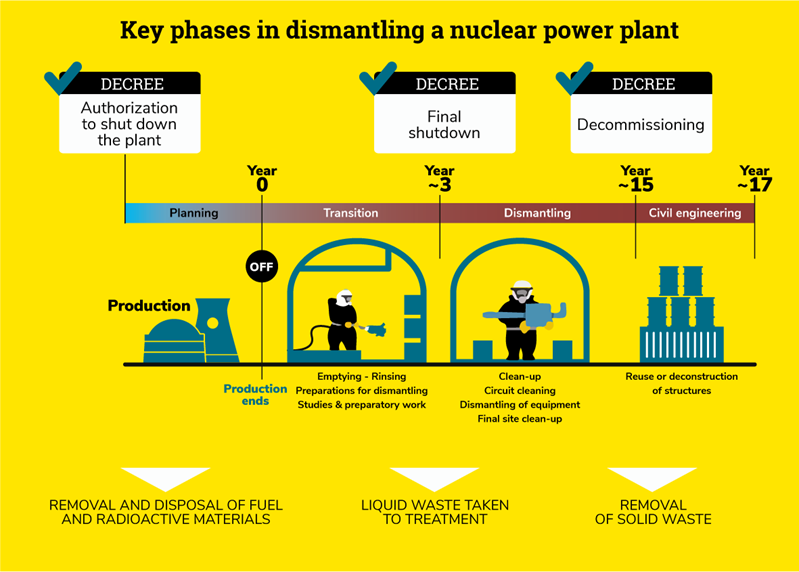
The Schleswig-Holstein Ministry for Energy Transition, Climate Protection, Environment and Nature has issued the first decommissioning and dismantling permit to PreussenElektra for the Brokdorf nuclear power plant. Brokdorf is the last German nuclear power plant to receive this approval and begin dismantling.
PreussenElektra – a subsidiary of EOn Group – applied for approval to decommission and dismantle the 1410 MWe pressurised water reactor in December 2017. The plant was shut down on 31 December 2021.
Phase 1 of the plant’s decommissioning and dismantling has now been approved. This includes the decommissioning and dismantling of the plant components that are no longer required and subject to nuclear regulatory supervision, with the exception of the reactor pressure vessel and the biological shield.
Since Brokdorf’s closure, the conditions for dismantling the plant have been created in close coordination with the authorities. These include the decontamination of the primary cooling circuit, systems and plant components that are no longer required have been taken out of service, and the workforce has been adjusted. A large proportion of the fuel elements still present in the plant have already been moved to the interim storage facility on site and replacement systems for the plant’s energy supply have been installed.
…………….. The next steps will be to create new logistics routes within the control area and set up a waste processing centre for the dismantled masses. In addition, systems and plant components that are no longer required will be prepared for dismantling.
A second dismantling permit is required to dismantle the reactor pressure vessel and the biological shield. This requires the removal of all fuel elements and special fuel rods, which are expected to be transported to the interim storage facility at the site in 2025. PreussenElektra submitted the application for the second dismantling permit on 30 August this year. This is currently being examined by independent experts.
………………………………. In December last year, PreussenElektra, together with EOn group companies, announced plans for the construction at the Brokdorf site of the largest battery storage facility in the EU to date. The facility – to store electricity from renewable sources – is to be expanded in two stages to up to 800 MW of power and a storage capacity of up to 1600 MWh. Commissioning could begin as early as 2026. https://www.world-nuclear-news.org/articles/decommissioning-permit-granted-for-brokdorf-plant
Cost overruns at Sellafield nuclear waste site to hit £136bn

Storage facility is not delivering value for money as large projects are running
behind schedule, warns spending watchdog.
The cost of managing Britain’s most hazardous nuclear waste has risen by almost a fifth to £136 billion due to a failure to set a realistic budget, the government’s spending
watchdog has concluded.
Sellafield, which is home to about 85 per cent of the UK’s nuclear waste and stores the most hazardous waste, is not delivering value for money as large projects are running behind schedule and over budget, according to the National Audit Office’s latest
assessment.
The site in Cumbria is operated by the Nuclear Decommissioning
Authority (NDA), a mainly taxpayer-funded body, and over its lifetime will
retrieve about 3.3 million m3 of waste from ageing facilities and store it
in more modern silos. The cost of maintaining the site into the next
century, when Sellafield is scheduled for demolition, is likely to cost
£136 billion after adjusting for inflation, up from £84 billion at March
2019, but could run to £253 billion under a worst-case scenario.
None of the budgets for the four big projects under way at Sellafield in 2018, when
the audit office last scrutinised the waste storage site, accounted for
“optimism bias”, which assumes work will be delivered on time and
within budget. More realistic costings were only included in 2018, despite
the watchdog recommending the NDA require Sellafield to do so in 2012.
There has been some progress made since the National Audit Office last
scrutinised Sellafield, including savings of about £170 million a year by
operating the sites as subsidiaries rather than contracting out their
management and the government indemnifying the decommissioning authority
against certain risks so it no longer needs to buy insurance. The
Department for Energy Security and Net Zero said that the NAO’s report
showed “significant progress” had been made by Sellafield and the NDA
but “there is still more to do”.
Times 23rd Oct 2024, https://www.thetimes.com/business-money/energy/article/cost-overruns-at-sellafield-nuclear-waste-site-to-hit-136bn-zjklxk3p7
Alistair Osborne: Nuclear is waste of time and money

The National Audit Office has found that the Sellafield nuclear waste dump is still a mess,
with costs spiralling and projects delayed. As rebranding jobs go, it’s
hard to beat. Somehow, the nuclear lobby has managed to convince
politicians that the industry is not only green, but “clean”.
Just about all of them have fallen for it, not least our energy supremo Ed
Miliband. Here he is last month: “Homegrown clean energy from renewables
and nuclear offers us a security that fossil fuels simply cannot
provide”. On the energy security point, fair enough. But isn’t he
forgetting something about nukes that you don’t get with windmills and
sunbeams?
Luckily, the National Audit Office is not so easily taken in, as
it’s just proved with a nice reality check: its latest report on
Sellafield, the radioactive waste dump in Cumbria owned by the state-backed
Nuclear Decommissioning Authority (NDA). True, there is a glimmer of good
news: the spending watchdog says the “management of major projects has
begun to improve”. But it must have been off a chronically low base,
given the problems the NAO finds.
As it notes, of the NDA’s 17 sites
“Sellafield is the UK’s most complex and challenging”: home to
“seven former nuclear reactors” and Britain’s “entire stockpile of
civilian-owned plutonium”. Indeed, much of the “highly hazardous”
stuff knocking around has been deemed by the government to “pose an
intolerable risk”. Cleaning it up is a thankless task, too. On NDA
estimates, it “will take until 2125”.
Times 23rd Oct 2024, https://www.thetimes.com/business-money/companies/article/nuclear-is-waste-of-time-and-money-ljmxhqklh
Fears salt marsh plan could lead to ‘destruction’ of Severn Vale
Gazette, 21st October 24
THERE are fears plans for new salt marshes linked to the construction of nuclear power plant Hinkley C would lead to “wholesale destruction of the Severn Vale”.
EDF bosses have been severely criticised for their environmental improvement plans in Gloucestershire which are linked to the new Hinkley C site in Somerset.
Their original plan for Hinkley Point was to install an acoustic fish deterrent system to scare fish away from the site as the Bristol Channel is home to numerous species such as eels, herring, salmon and sprats.
However, the French government-owned energy firm feel this will no longer be viable and have instead drawn up alternative plans to create salt marshes along the River Severn.
In the area, they have identified sites in Arlingham and Littleton Upon Severn near Thornbury in South Gloucestershire.
Other proposed sites include Rodley near Westbury-on-Severn in Gloucestershire and Kingston Seymour in Somerset.
But the proposals, which were aired at a recent parish council meeting, have been met with strong opposition in the Severn Vale.
David Seal, a local resident, believes the plans would “likely bring an end to most ideas of future development of the village, farming, farmland, miles and miles of hedgerow, trees and just about everything we all love about the green serenity of the village”.
“All this to ‘offset’ Hinckley C destroying 182 million fish in the estuary per year over 60 years,” he said.
“EDF has all the technical know-how to dig two enormous cooling water tunnels 3.3km out under the Bristol Channel, yet they say it’s ‘too risky’ to fit an acoustic deterrent to mitigate the problem at source in the same estuary.
“What is too risky is messing about with the River Severn and destroying the land we and nature live off…………………………………………………….
https://www.gazetteseries.co.uk/news/24665869.fears-salt-marsh-plan-lead-destruction-severn-vale/
Sellafield cleanup cost rises to £136bn amid tensions with Treasury

National Audit Office questions value for money as predicted bill for decommissioning increases by £21bn
Alex Lawson and Anna Isaac, Wed 23 Oct 2024 , https://www.theguardian.com/business/2024/oct/23/sellafield-cleanup-cost-136bn-national-audit-office
The cost of cleaning up Sellafield is expected to spiral to £136bn and Europe’s biggest nuclear waste dump cannot show how it offers taxpayers value for money, the public spending watchdog has said.
Projects to fix buildings containing hazardous and radioactive material at the state-owned site on the Cumbrian coast are running years late and over budget. Sellafield’s spending is so vast – with costs of more than £2.7bn a year – that it is causing tension with the Treasury, the report from the National Audit Office (NAO) suggests.
Officials from finance ministry told the NAO it was “not always clear” how Sellafield made decisions, the report reveals. Criticisms of its costs and processes come as the chancellor, Rachel Reeves, prepares to plug a hole of about £40bn in her maiden budget.
Europe’s most hazardous industrial site has previously been described by a former UK secretary of state as a “bottomless pit of hell, money and despair”. The Guardian’s Nuclear Leaks investigation in late 2023 revealed a string of cybersecurity problems at the site, as well as issues with its safety and workplace culture.
The NAO found that Sellafield was making slower-than-hoped progress on making the site safe and that three of its most hazardous storage sites pose an “intolerable risk”.
The site is a sprawling collection of buildings, many never designed to hold nuclear waste long-term, now in various states of disrepair. It stores and treats decades of nuclear waste from atomic power generation and weapons programmes, has taken waste from countries including Italy and Sweden, and is the world’s largest store of plutonium.
Sellafield is forecast to cost £136bn to decommission, which is £21.4bn or 18.8% higher than was forecast in 2019. Its buildings are expected to be finally torn down by 2125 and its nuclear waste buried deep underground at an undecided English location.
The underground project’s completion date has been delayed from 2040 to the 2050s at the earliest, meaning Sellafield will need to build more stores and manage waste for longer. Each decade of delay costs Sellafield between £500m and £760m, the NAO said. Meanwhile, the government hopes to ramp up nuclear power generation, which will create more waste.
Sellafield is owned by the Nuclear Decommissioning Authority (NDA), a taxpayer-owned and -funded quango. The NDA believes the cost of decommissioning Sellafield could range from £116bn to £253bn, depending on the length and complexity of the cleanup.
Plans to clean up three of its worst ponds – which contain hazardous nuclear sludge that must be painstakingly removed – are running six to 13 years later than forecast when the NAO last drew up a report, in 2018. The NAO said deteriorating buildings, Covid restrictions, staffing and equipment breaking down were to blame. Sellafield had “retrieved much less waste than it had planned” since 2020, it said.
Sellafield could spend more on demolishing buildings earlier to be more efficient and offer better value for money, the NAO said.
One pond, the Magnox swarf storage silo, is leaking 2,100 litres of contaminated water each day, the NAO found. The pond was due to be emptied by 2046 but this has slipped to 2059. The Guardian investigation revealed it could continue leaking until 2050.
The NAO said: “Sellafield has demonstrated that it can remove safely the most hazardous waste, but is not progressing quickly enough to meet its plans.”
Last year, Sellafield defied the Treasury and without consultation increased its headcount from 11,200 to 12,000, despite previous commitments to reduce its employee numbers by becoming more efficient, the report said.
In one blunder, Sellafield paid out £2.1m more in staff bonuses than it should have done – about £200 a person – in 2023. This was paid after a management decision that the NAO suggests was questionable.
Sellafield had expected to replace a testing facility that is more than 70 years old and in “extremely poor condition”, but after racking up £265m over more than seven years the project is under review amid concerns over delays and the condition of buildings on the site. The NAO said this was the single biggest risk to Sellafield’s future, as workers needed to carry out many different regular scientific tests.
Gareth Davies, the head of the NAO, said: “Despite progress achieved since the NAO last reported, I cannot conclude Sellafield is achieving value for money yet, as large projects are being delivered later than planned and at higher cost, alongside slower progress in reducing multiple risks.”
He added: “Continued underperformance will mean the cost of decommissioning will increase considerably, and ‘intolerable risks’ will persist for longer.”
This month, Sellafield was fined £332,500 for cybersecurity failings and the chief magistrate in the case, Paul Goldspring, said it fell into a category “bordering on negligence”.
The NAO said the nuclear site had again admitted that its cybersecurity efforts were falling short.
David Peattie, the NDA’s chief executive, said: “Sellafield is one of the most complex environmental programmes in the world. We’re proud of our workforce and achievements being made, including the unprecedented retrieval of legacy waste from all four highest hazard facilities.
“But as the NAO rightly points out there is still more to be done. This includes better demonstrating we are delivering value for money and the wider significant societal and economic benefits through jobs, the supply chain and community investments.”
Secrecy over radioactive pollution from nuclear bases

The Ferret, Rob Edwards, October 22, 2024
The Ministry of Defence has blocked the Scottish Government’s environmental watchdog from releasing information about radioactive pollution from the Clyde nuclear bomb bases for the last nine years.
Emails released under freedom of information (FoI) law reveal that the Ministry of Defence (MoD) asked the Scottish Environment Protection Agency (Sepa) not to publish information about “environmental issues with radioactivity” at Faslane and Coulport near Helensburgh to protect “national security”.
In response to FoI requests from The Ferret, Sepa has refused to release more than 20 files about radioactive problems at the bases since 2016, and redacted others. We have appealed to the Scottish Information Commissioner, David Hamilton…………………………………………………………………………………………………………………..
Sepa’s refusal to release the files is under investigation by the Scottish Information Commissioner, following two appeals by The Ferret in August and September 2024.
‘Difficult’ to withhold information about radioactive pollution
Now, in response to another FoI request, Sepa has released email correspondence with the MoD about The Ferret’s FoI requests on Faslane and Coulport. These show that the MoD asked Sepa not to publish certain files.
Sepa emailed the MoD in October and November 2023 with files it proposed to release asking whether they “should be disclosed”. The MoD replied on 27 November saying that “HQ colleagues” wanted information withheld, though exactly how much or what has been redacted……………………………………………………………………………………………………………………………………………………………..
Secrecy over radioactive pollution ‘unacceptable’
Professor Campbell Gemmell was Sepa’s chief executive between 2003 and 2012 when it released more than 400 pages about safety at Faslane and Coulport. The MoD were “very challenging to deal with”, he recalled.
He said: “The UK ministry applied pressure repeatedly on radioactive waste issues seeking to keep relevant environmental information out of the public domain. Putting similar effort into remedy would be better.”………………………….
The Scottish Campaign for Nuclear Disarmament pointed out that it was well known that the four nuclear-armed Vanguard-class submarines based on the Clyde were ageing and overstretched. They were more likely to leak, argued the group’s co-vice chair, David Kelly.
“This information is not a threat to national security. But it is a threat to the image of a responsible Ministry of Defence, that pollutes our environment with ever-increasing amounts of radioactive isotopes in the name of keeping us safe.”………………………………………………………………………………………………………
https://theferret.scot/radioactive-pollution-clyde-nuclear-bases/
‘Millions of fish could die’ under current Hinkley Point C plan
Environmental advocates demand EDF takes action
By Lewis Clarke, Somerset Live , 22nd Oct 2024
A solutions-focussed, scientifically backed answer to the critical environmental situation at Hinkley Point C has been released by a coalition of scientists, engineers, and innovators, showing that the Acoustic Fish Deterrent (AFD) is both a necessary and feasible requirement for the builders of Hinkley Point C – EDF Energy – to apply.
An AFD Delivery Report, launched on October 16, gives evidence that the AFD can be installed safely and effectively in the Severn Estuary. It highlights the innovations in technical ability, technology, logistics, and science which will reduce maintenance times from 72 days per year down to just 19. The report debunks common misconceptions about noise levels, diving time, and more with scientifically backed evidence, and urges EDF to ensure the system is installed, tested, and operational before the station starts to abstract cooling water.
In light of the critical environmental situation at Hinkley Point C, a parliamentary debate led by Sir Ashley Fox MP was held last week on Wednesday 9th October 2024. During the debate, Sir Ashley Fox addressed that EDF Energy’s mosaic of mitigation measures, specifically the proposed saltmarsh plans, are a completely illogical choice.
The saltmarsh plans are a proposed alternative to the Acoustic Fish Deterrent (AFD), a system designed to protect aquatic life by deterring fish from entering the cooling systems of the power plant, and was included in the initial design plans of Hinkley Point C.
The AFD system remains mandated in the Development Consent Order (DCO). It is also considered best practice for screening estuarine intakes in the UK by the Environment Agency, and has been scrutinised by a Welsh Government Report (2021), a Public Inquiry (2022), and the ruling by Secretary of State Kwasi Kwarteng (2022) which all stated that the AFD must be installed. EDF Energy has been working to remove this vital environmental protection measure for nearly eight years, arguing on the grounds of health and safety concerns, noise pollution and effect on mammals, and further delay of the completion of Hinkley Point C.
The AFD Delivery Report provides a solution to the current impasse, but without the AFD, it has been warned by the Welsh Government Commission that approximately 182 million fish would be killed annually, including sensitive species like shad, sprat, Atlantic salmon, and herring.
In the AFD Delivery Report, Professor Mark Everard, University of West of England says “There can in my scientific view be no justification for removal of AFD. It makes absolutely no sense to permit very substantial damage to marine biodiversity and hope then that modest mitigation entailing a degree of recruitment only of species reliant on the saltmarsh can offset it.
“Cost reduction is cited by EDF as one element of its plan to remove the mandated AFD and would appear to be its principal consideration, but one that obviously overlooks the vital purpose of deflecting fish from the intake. Ideally, saltmarsh restoration should be implemented ADDITIONALLY to the AFD to mitigate the still substantial likely entrainment of multiple life stages of fish and invertebrates, even with deflection from the intake.”
South Gloucestershire Council understands that EDF will make another application to the Secretary of State to remove the requirement for an AFD in the new year, and so has written to the Secretary of State for Energy, Security & Net Zero, the Rt Hon Ed Milliband, requesting that he upholds the existing requirement to install an AFD.
Councillors Maggie Tyrrell and Ian Boulton, said in their letter to the Secretary of State: “We are writing to express our gravest concern regarding the scale of impact on the migratory fish populations of the Severn Estuary Special Area of Conservation (SAC) which will result from the massive water abstraction at Hinkley Point C of 120,000 litres of seawater a second for 60 years once the power station is operational.
“This impact would be made significantly worse by the proposed application for a change to the 2013 Development Consent Order to remove the required Acoustic Fish Deterrent (AFD).
“A Welsh Government report on the AFD cites evidence that removal of the AFD would capture at least 182 million fish per year, a significant proportion of which would be killed. Put simply, removing the AFD would cause critical levels of wildlife destruction.”
The council is also concerned that EDF are approaching local landowners about a plan to create new salt marshes, which they would propose as alternative compensation habitat for fish in place of the AFD. It is understood that local landowners are deeply concerned about the idea, which has been turned down in other areas when raised by EDF, and experts query EDFs claims that new saltmarshes would offer suitable habitat for fish killed by the water intake of the new power station.
The council’s letter also highlighted that even with the AFD, that compensation will still be needed as some fish will still be drawn into the intake and killed. Alongside the letter, the Secretary of State was also provided with information about priorities to deliver improvements for fish passage in the Bristol Avon river and Coastal Catchments……………………
https://www.somersetlive.co.uk/news/somerset-news/millions-fish-could-die-under-9641529
Secrets and Lies: This is how the West doomed Ukraine

Glenn Diesen, By Glenn Diesen, professor at the University of South-Eastern Norway Wed, 16 Oct 2024, https://www.sott.net/article/495541-Secrets-and-Lies-This-is-how-the-West-doomed-Ukraine
The desire of the US and UK to conduct a proxy war destroyed the Istanbul+ process.
In February 2022, Russia started its military operation against Ukraine to impose a settlement after a group of NATO countries had undermined the Minsk II peace agreement for seven years. On the first day after the start of hostilities, Vladimir Zelenskyconfirmedthat Moscow had contacted him to discuss negotiations based on restoring Ukrainian neutrality.On the third day, Russia and Ukraineagreedto start peace negotiations based on a Russian military withdrawal in return for this. Zelensky responded favorably to this condition, and he even called for a “collective security agreement” to include Russia to mitigate the security competition that had sparked the war.
The talks that followed are referred to as the Istanbul negotiations, in which Russia and Ukraine were close to an agreement before the US and UK sabotaged it, according to numerous claims by people close to the process.
Washington rejects negotiations without preconditions
For Washington, there were great incentives to use the large proxy army it had built in Ukraine to weaken Russia as a strategic rival, rather than accepting a neutral Kiev. On the first day after the start of the military operation, when Zelensky responded favorably to starting negotiations without preconditions,US State Department spokesperson Ned Pricerejectedthis stance – saying Russia would first have to withdraw all its forces.
This was a demand for capitulation as the Russian military presence in Ukraine was Moscow’s bargaining chip to achieve the objective of restoring Kiev’s neutrality. Less than a month later, Price was asked if Washington would support peace talks, to which he replied negatively as the conflict was part of a larger struggle:
“This is a war that is in many ways bigger than Russia, it’s bigger than Ukraine… The key point is that there are principles that are at stake here that have universal applicability everywhere, whether in Europe, whether in the Indo-Pacific, anywhere in between.”
The US and UK demand a long war: Fighting Russia with Ukrainians
In late March 2022, Zelensky revealed in an interview with The Economist:
“There are those in the West who don’t mind a long war because it would mean exhausting Russia, even if this means the demise of Ukraine and comes at the cost of Ukrainian lives.”
Israeli and Turkish mediators have since confirmed that Ukraine and Russia were both eager to make a compromise to end the war before the US and UK intervened to prevent peace from breaking out.
Zelensky had contacted former Israeli Prime Minister Naftali Bennett to help with the talks. Bennett noted that Putin was willing to make “huge concessions” if Ukraine would restore its neutrality to end NATO expansion. Zelensky accepted this condition and “both sides very much wanted a ceasefire.”
However, Bennett argued that the US and UK intervened and blocked the peace agreement as they favored a long war. With a powerful Ukrainian military at its disposal, the West rejected the Istanbul peace agreement and there was a “decision by the West to keep striking Putin” instead of pursuing peace.
The Turkish negotiators reached the same conclusion: Russia and Ukraine agreed to resolve the conflict by restoring Ukraine’s neutrality, but NATO decided to fight Russia with Ukrainians as a proxy. Turkish Foreign Minister Mevlut Cavusogluarguedthat some NATO states wanted to extend the war to bleed Russia:
“After the talks in Istanbul, we did not think that the war would take this long… But following the NATO foreign ministers’ meeting, I had the impression that there are those within the NATO member states that want the war to continue – let the war continue and Russia gets weaker. They don’t care much about the situation in Ukraine.”
Numan Kurtulmus, the deputy chairman of Turkish President Recep Tayyip Erdogan’s political party, confirmed that Zelensky was ready to sign the peace agreement before the US intervened:
“This war is not between Russia and Ukraine, it is a war between Russia and the West. By supporting Ukraine, the United States and some countries in Europe are beginning a process of prolonging this war. What we want is an end to this war. Someone is trying not to end the war. The US sees the prolongation of the war as its interest.”
Ukrainian Ambassador Aleksandr Chalyi, who participated in peace talks with Russia, confirms that Putin “tried everything” to reach a peace agreement and they were able “to find a very real compromise”. David Arakhamia, a Ukrainian parliamentary representative and head of Zelensky’s political party, said Russia’s key demand was Ukrainian neutrality.
“They were ready to end the war if we, like Finland once did, would accept neutrality and pledge not to join NATO. In fact, that was the main point. All the rest are cosmetic and political ‘additions.'”
Aleksey Arestovich, the former adviser of Zelensky, also confirmed that Russia was mainly preoccupied with restoring Ukraine’s neutrality.
The main obstacle to peace was thus overcome as Zelenskyofferedneutrality in the negotiations. The tentative peace agreement was confirmed by Fiona Hill, a former official at the US National Security Council, and Angela Stent, a former National Intelligence Officer for Russia and Eurasia. Hill and Stent penned an article inForeign Affairsin which theyoutlinedthe main terms of the agreement:
“Russian and Ukrainian negotiators appeared to have tentatively agreed on the outlines of a negotiated interim settlement: Russia would withdraw to its position on February 23, when it controlled part of the Donbas region and all of Crimea, and in exchange, Ukraine would promise not to seek NATO membership and instead receive security guarantees from a number of countries.”
Boris Johnson goes to Kiev
What happened to the Istanbul peace agreement? On April 9, 2022, UK Prime Minister Boris Johnson went to Kiev in a rush to sabotage the agreement and cited the killings in Bucha as the excuse. Ukrainian media reported that Johnson went to Kiev with two messages:
“The first is that Putin is a war criminal, he should be pressured, not negotiated with. And the second is that even if Ukraine is ready to sign some agreements on guarantees with Putin, they [the UK and US] are not.”
In June 2022, Johnson told the G7 and NATO:
“The solution to the war was ‘strategic endurance’ and now is not the time to settle and encourage the Ukrainians to settle for a bad peace.”
Johnson also published an op-ed in the Wall Street Journalarguing against any negotiations:
“The war in Ukraine can end only with Vladimir Putin’s defeat.”
Before Johnson’s trip to Kiev, historian Niall Ferguson interviewed several American and British leaders who confirmed:
“A decision had been made for the conflict to be extended and thereby bleed Putin,” as “the only end game now is the end of Putin regime.“
Retired German General Harald Kujat, the former head of the German Bundeswehr and former chairman of the NATO Military Committee, confirmed that Johnson had sabotaged the peace negotiations. Kujat said:
“Ukraine had pledged to renounce NATO membership and not to allow any foreign troops or military installations to be stationed,” while “Russia had apparently agreed to withdraw its forces to the level of February 23.” However, “Boris Johnson intervened in Kiev on the 9th of April and prevented a signing. His reasoning was that the West was not ready for an end to the war.”
According to Kujat, the West demanded a Russian capitulation. He explained that this position was due to the US war plans against Russia:
“Now the complete withdrawal is repeatedly demanded as a prerequisite for negotiations. Perhaps one day the question will be asked who did not want to prevent this war… Their declared goal is to weaken Russia politically, economically, and militarily to such a degree that they can then turn to their geopolitical rival, the only one capable of endangering their supremacy as a world power: China… No, this war is not about our freedom… Russia wants to prevent its geopolitical rival USA from gaining a strategic superiority that threatens Russia’s security.”
What was Ukraine told by the US and UK?Why did Zelensky make a deal given that he was aware some Western states wanted to use Ukraine to exhaust Russia in a long war – even if it would destroy Ukraine? Zelensky likely received an offer he could not refuse:
If Zelensky would pursue peace with Russia, then he would not receive any support from the West and he would predictably face an uprising by the far-right/fascist groups that the US had armed and trained. In contrast, if Zelensky would choose war, then NATO would send all the weapons needed to defeat Russia, NATO would impose crippling sanctions on Russia, and NATO would pressure the international community to isolate Russia.
Zelensky could thus achieve what both Napoleon and Hitler had failed to achieve – to defeat Russia.
Arestovich explained in 2019 that a major war with Russia was the price of joining NATO. He predicted that the threat of Ukraine’s accession to NATO would “provoke Russia to launch a large-scale military operation against Ukraine,” and Ukraine could join NATO after defeating Russia.
Victory over Russia was assumed to be a certainty as Ukraine would merely be the spearhead of a wider NATO proxy war.
“In this conflict, we will be very actively supported by the West – with weapons, equipment, assistance, new sanctions against Russia and the quite possible introduction of a NATO contingent, a no-fly zone etc. We won’t lose, and that’s good.”
NATO turned on the propaganda machine to convince the public that a war against Russia was the only path to peace.
The Russian ‘invasion’ was “unprovoked”; Moscow’s objective was to conquer all of Ukraine to restore the Soviet Union; Russia’s withdrawal from Kiev was not a sign of good will to be reciprocated but a sign of weakness; it was impossible to negotiate with Putin; and NATO Secretary-General Jens Stoltenberg subsequently asserted that “weapons are the way to peace.”
The Western public, indoctrinated with anti-Russian propaganda over decades, believed that NATO was merely a passive third party seeking to protect Ukraine from the most recent reincarnation of Hitler. Zelensky was assigned the role as new Churchill – bravely fighting to the last Ukrainian rather than accepting a bad peace.
The inevitable Istanbul+ agreement to end the war
The war did not go as expected. Russia built a powerful army and defeated the NATO-built Ukrainian army. Sanctions were overcome by reorienting the economy to the East, and instead of being isolated, Russia took a leading role in constructing a multipolar world order.
How can the war be brought to an end? The suggestions of a land-for-NATO membership agreement ignores that Russia’s leading objective is not territory but ending NATO expansion, as it is deemed to be an existential threat. NATO expansion is the source of the conflict and territorial dispute is the consequence, thus Ukrainian territorial concessions in return for NATO membership is a non-starter.
The foundation for any peace agreement must be the Istanbul+ formula. An agreement to restore Ukraine’s neutrality, plus territorial concessions as a consequence of almost three years of war. Threatening to expand NATO after the end of the war will merely incentivize Russia to capture strategic territory from Kharkov to Odessa, and to ensure that only a dysfunctional Ukrainian rump state will remain that is not capable of being used against Russia.
This is a cruel fate for the Ukrainian nation and the millions of Ukrainians who have suffered so greatly. It was also a predictable outcome, as Zelensky cautioned in March 2022.
“There are those in the West who don’t mind a long war because it would mean exhausting Russia, even if this means the demise of Ukraine and comes at the cost of Ukrainian lives.”
Path to peace in Ukraine is thru negotiated settlement, not escalatory war that could go nuclear.

Walt Zlotow, West Suburban Peace Coalition, Glen Ellyn IL 21 Oct 24
Ethan Finegold’s October 20 letter ‘The US has the power to end the war in Ukraine’ offers just one simplistic remedy to achieve a Ukrainian victory over Russia. Finegold argues the US must approve long range missile strikes by Ukraine with the missiles we’ve already provided but restrict their long range use.
There are 2 problems with this solution. First, long range missile strikes will have no effect on achieving a Ukrainian victory. This is not just the opinion of we in the community including esteemed University of Chicago political science expert John Mearsheimer. It’s the opinion of his polar opposite, Defense Secretary Lloyd Austin, who argues such strikes will have no effect because Russia has already moved over 90% of its strategic targets beyond the range of these long range missiles.
The second reason is decidedly more ominous. Russia has made clear both publicly at the UN and privately in backchannel talks with the Biden administration, that such attacks using US/UK missiles, fired using US technology and logistics, will put Russia at war with NATO. These communications so unnerved Biden that he rebuffed UK Prime Minister Keir Starmer and Ukraine President Volodymyr Zelensky last month who both sought US approval for such strikes. Russia upped the ante against such strikes by publicly revising its nuclear strategy to allow for use of nuclear weapons if a non-nuclear state strikes deep into Russia supported by weaponry from a nuclear state. So far, President Biden has wisely gotten the message.
Finegold is correct in stating “Every day that this war is allowed to continue is another day that risks Russia’s use of nuclear weapons on the battlefield.” That is precisely why the US must pivot from endless weaponizing this 32 month long unwinnable war to a sensible negotiated peace.
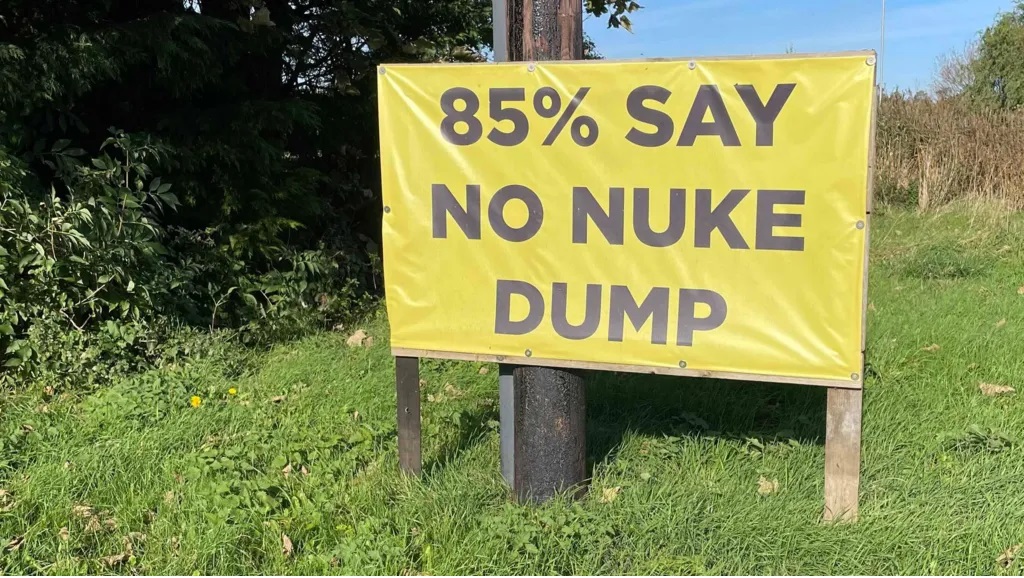
‘Nuclear waste would be disaster for our seaside’
BBC News, Paul Murphy, Environment Correspondent, 21 Oct 24
Campaigners opposed to plans for a nuclear waste disposal site on the Lincolnshire coast say it could be “disastrous” for the seaside economy.
The former Theddlethorpe gas terminal on the Lincolnshire coast is one of three sites being considered for an underground facility.
Guardians of the East Coast (GOTEC) said a survey of more than 1,000 visitors to the resorts of Mablethorpe and Skegness found the “great majority” would be put off coming to the area.
GOTEC said it had carried out “extensive research” into the potential impact of the facility.
The group has produced a 60-page booklet called The Nuclear Option.
According to chairman Mike Crookes, the facility would “blight this area” and the economic impact on tourism could be “profound” and “catastrophic”.
“The tourism industry in this area brings £600m of economic benefit and 8,000 jobs,” he said. “We need to protect this at all costs.”
A survey of 1,100 people along the coastline from Mablethorpe to Skegness, carried out by GOTEC, found “83% of them would not visit this area if that facility was built”, Mr Crookes added.
NWS is considering the site for what is known in the waste industry as a geological disposal facility (GDF).
Other possible sites have been mooted in Hartlepool and Cumbria………………………………………………………………………..
Most of the radioactive waste generated by the UK’s nuclear power stations is being temporarily stored at Sellafield in Cumbria, but longer term storage is needed for substances that remain hazardous for many thousands of years.
The idea of a nuclear waste site, or GDF, was first proposed for Theddlethorpe more than three years ago.
Local councillors have called for a referendum on the development.
According to the Theddlethorpe GDF Community Partnership, a facility would only be built in an area where the community “demonstrates if it is willing to host one”, following a “test of public support“, such as a referendum or consultation.
…………………………………… “The government has committed to providing multi-million-pound investment to the community that hosts a GDF. This investment could support better transport links which could help to enhance tourism in a local area.”
https://www.bbc.co.uk/news/articles/cy4d3y33y3go
1 This Month
26 September – International Day for the Total Elimination of Nuclear Weapons





PLEASE OPPOSE HR 8255 AND S.3639 – bills would accelerate satellite deployment, with no environmental review or safeguards – https://ncstd5li.quorum.us/campaign/169331/
To see nuclear-related stories in greater depth and intensity – go to https://nuclearinformation.wordpress.com
-
Archives
- September 2026 (323)
- August 2026 (330)
- July 2026 (355)
- June 2026 (287)
- May 2026 (306)
- April 2026 (356)
- March 2026 (251)
- February 2026 (267)
- January 2026 (308)
- December 2025 (358)
- November 2025 (359)
- October 2025 (375)
-
Categories
- 1
- 1 NUCLEAR ISSUES
- business and costs
- climate change
- culture and arts
- ENERGY
- environment
- health
- history
- indigenous issues
- Legal
- marketing of nuclear
- media
- opposition to nuclear
- PERSONAL STORIES
- politics
- politics international
- Religion and ethics
- safety
- secrets,lies and civil liberties
- spinbuster
- technology
- Uranium
- wastes
- weapons and war
- Women
- 2 WORLD
- ACTION
- AFRICA
- Atrocities
- AUSTRALIA
- Christina's notes
- Christina's themes
- culture and arts
- Events
- Fuk 2022
- Fuk 2023
- Fukushima 2017
- Fukushima 2018
- fukushima 2019
- Fukushima 2020
- Fukushima 2021
- general
- global warming
- Humour (God we need it)
- Nuclear
- RARE EARTHS
- Reference
- resources – print
- Resources -audiovicual
- Weekly Newsletter
- World
- World Nuclear
- YouTube
-
RSS
Entries RSS
Comments RSS

