Faslane nuclear base tugboats may be built in China
UK Defence Journal By George Allison, January 12, 2026
New tugboats intended to support operations at HM Naval Base Clyde, the UK’s nuclear submarine hub at Faslane, may be constructed in China under a major fleet replacement programme, depending on how the contractor applies its global production model.
The vessels form part of the Defence Maritime Services Next Generation programme, under which Serco is replacing a wide range of Royal Navy harbour and support craft. The programme covers tugs, pilot boats and barges used at naval bases across the UK, including Faslane, which hosts the UK’s continuous at-sea nuclear deterrent.
Under the current arrangements, the Ministry of Defence pays Serco to provide support services at the Royal Navy’s principal bases, and allows Serco, as the prime contractor, to determine its own supply chain for vessel replacement.
Build locations and Damen’s production model
Damen operates a distributed shipbuilding model, with construction spread across a network of yards in Europe and Asia depending on vessel type and production capacity. The company has historically built a range of smaller commercial and support vessels at yards in China and Vietnam, including certain classes of tugboats, while other workboat types are constructed at European facilities in countries such as Poland and Romania. Final outfitting, integration and delivery preparation are often carried out in the Netherlands or at European partner yards, depending on the contract.
Neither Serco nor Damen has publicly confirmed the specific build locations for individual vessels within the programme. However, Damen’s established production model suggests that some tugboats could be built outside Europe, including at shipyards in China that form part of Damen’s wider manufacturing network……………………………………………………………………………………………….
Not the first time
A similar issue emerged in Australia in 2025, when the national broadcaster ABC reported that a new fleet of tugboats ordered for the Royal Australian Navy had been built in China under a contract awarded to Dutch shipbuilder Damen. The report said certification documents showed the vessels were constructed at Damen’s Changde shipyard in China, before being delivered to Australia under a civilian-operated support arrangement.
In response to the reporting, Australia’s Department of Defence confirmed that the tugboats had been built in China, while stating that they were not commissioned naval vessels and would be operated by a civilian contractor. Defence officials emphasised that sustainment activity would take place domestically and that the vessels were intended for harbour support roles rather than frontline operations…………………….
Wider security context
In a separate but related context, the Ministry of Defence has in recent months issued internal guidance concerning the use of vehicles containing Chinese-manufactured components, amid broader concerns about information security and connected systems. Media reporting has said warning notices were placed in some MoD-leased vehicles advising personnel not to discuss sensitive matters inside them or connect official devices, and that certain vehicles were restricted from accessing sensitive military sites. The measures were described as precautionary, with no publicly confirmed security breach.
Parliamentary questions have also raised wider issues about reliance on overseas-manufactured systems within defence and government operations. Ministers have acknowledged the need to assess potential vulnerabilities linked to global supply chains, while maintaining that decisions are taken on a case-by-case basis and that there has been no evidence of compromise.
Competing views on cost, transparency and social value
Those defending the programme argue that the arrangements reflect commercial shipbuilding norms rather than a deliberate policy decision. They note that hull construction in Asia can reduce costs and production timelines, with final outfitting, systems integration and acceptance carried out later in Europe under established regulatory oversight. Critics argue that the lack of transparency over build locations risks undermining confidence, especially where vessels operate at nuclear sites. They contend that clearer public disclosure is needed on where vessels are constructed and what safeguards apply during the build process.
Louise Gilmour, secretary of GMB Scotland, said the decision to source the workboats overseas represented a missed opportunity to support domestic shipbuilding capacity, particularly at Ferguson Marine, where the union represents the largest section of the workforce. She said the vessels were well suited to the type of work the yard had carried out for generations and argued that contracts of this scale could play a role in sustaining skills and employment in Scotland.
https://ukdefencejournal.org.uk/faslane-nuclear-base-tugboats-may-be-built-in-china/
The Non-Peaceful Atom
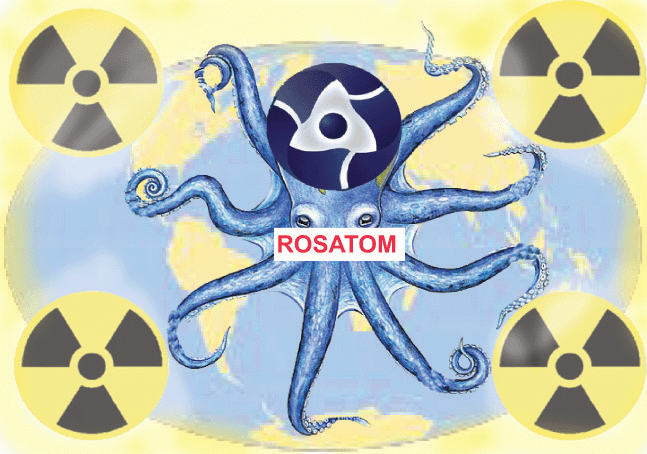
Vladimir Slivyak, January 7, 2026, https://www.posle.media/article/the-non-peaceful-atom
In what ways does Russia use nuclear energy as a strategic tool? Why have sanctions failed to end Europe’s dependence on the Russian nuclear industry? How is Rosatom involved in the war? Vladimir Slivyak, co-chair of the Eco-Defense group, answers these questions
As a strategic instrument of the Kremlin, Rosatom helps to create and entrench geopolitical dependencies. This dependence rests on the promotion of nuclear energy but has ramifications that extend far beyond the energy sector. Rosatom is both directly and indirectly involved in Russia’s war against Ukraine. In particular, Rosatom played a key role in Russia’s seizure of the Zaporizhzhia nuclear power plant and has offered to procure materials and components for Russian arms manufacturers under sanctions.
Nevertheless, the European nuclear industry continues to collaborate with Rosatom. For instance, Rosatom supplies uranium to Framatome’s ANF nuclear fuel plant in Lingen, Germany. Rosatom is also involved in expanding this facility, even though the German authorities have not yet approved such cooperation. If the Framatome-Rosatom project, which has been in development for over three years, goes ahead, the Russian regime will further strengthen its political influence in Western Europe despite the war in Ukraine.
Rosatom as a Civil-Military State Corporation
Rosatom is a state-owned corporation that operates in both the civilian and military spheres of nuclear energy and nuclear weapons. As the successor to Russia’s Ministry of Atomic Energy, Rosatom brings together over 350 companies engaged in nuclear activities. The corporation was created by a decree by Russian President Vladimir Putin in 2007.
Rosatom is directly owned by the Russian state. It is one of seven Russian “state corporations,” grouped together with Rostec, Roscosmos, and others. In 2012, former Prime Minister Dmitry Medvedev described Rosatom as a “corporation of a special kind” that not only seeks to expand its activities but also carries out “certain ministerial tasks.”
The corporation’s Supervisory Board is its main decision-making body. This board includes Sergey Kirienko, the deputy head of the Russian presidential administration, who is currently under sanctions from the EU, the UK, and the US, as well as Sergei Korolev, the first deputy director of the Federal Security Service of the Russian Federation (the main successor to the Soviet KGB). In relation to the war in Ukraine, Korolev has also been sanctioned by the EU, Australia, Canada, New Zealand, Switzerland, the UK, and Ukraine. The Supervisory Board also includes two Russian deputy prime ministers and two aides to President Vladimir Putin.
The European Parliament has repeatedly called for sanctions on Rosatom and for an end to all nuclear cooperation with Russia, including uranium imports and investments in critical infrastructure.
Participation in the War
Since Russia’s full-scale invasion of Ukraine began, Rosatom has been directly and indirectly involved in the war. According to a letter obtained by Ukrainian intelligence and published in the American press, Rosatom offered assistance to the Russian arms industry in securing goods needed for the production of weapons, tanks, and aircraft after that sector had been hit by international sanctions.
In his December 2022 address to Rosatom on the occasion of its 15th anniversary, President Vladimir Putin praised the corporation for its “enormous contribution to the development and deployment of advanced weapons systems and military equipment.”
In the early days of the invasion, Rosatom employees assisted Russian troops who occupied the Chernobyl exclusion zone in Ukraine. The Russian state corporation also facilitated the illegal seizure of Ukraine’s Zaporizhzhia Nuclear Power Plant. Rosatom employees have taken over key management positions at the facility. Following a decree by the Russian president, Rosatom created a new subsidiary specifically tasked with taking control of the plant.
In October 2023, Ukrainian nuclear operator Energoatom reported that the safety culture at the plant was deteriorating under Rosatom’s control. This deterioration included poorly performed work, insufficient staffing, and inadequate inspections. The company stated that these problems had led to significant damage to critical components of the Zaporizhzhya Nuclear Power Plant (NPP), including leaks in the radioactive primary coolant circuit. There is also credible evidence that Rosatom employees assisted the Russian military in selecting targets at the Zaporizhzhya NPP; they reportedly “helped direct Russian artillery fire at the plant.”
Rosatom as a Geopolitical Tool
Rosatom is a central player in the Russian regime’s “geopolitics.” The company’s goal is to make as many countries as possible dependent on Russian nuclear technology, services, and fuel. Rosatom purchases essential equipment for nuclear reactors under construction from European companies and supplies the EU with unenriched and enriched uranium, fuel, and other nuclear services. This cooperation helps fund the continuation of the war in Ukraine. It also locks Europe into dependence on Russian nuclear fuel and services, which ultimately translates into political influence.
Hungary is perhaps the clearest example. It is almost entirely dependent on Russia for nuclear energy services and has repeatedly blocked any attempt by the EU to impose sanctions on Rosatom. Russia controls the supply of nuclear fuel and the maintenance of existing Hungarian reactors and has provided a €10 billion loan for the construction of Paks-2 nuclear power plant. In addition, Siemens Energy and Framatome are providing key equipment and control systems for new Russian-made reactors in Hungary.
Rosatom states that it is currently building more than 30 new reactors in about a dozen countries. Last year, its subsidiaries exported approximately $2.2 billion worth of nuclear energy-related goods and materials. The Russian state budget covers more than 90% of the cost of Rosatom’s construction of new nuclear power plants around the world.
Rosatom has signed agreements with nearly 20 African countries to build nuclear power plants and research reactors. So far, however, only one plant is actually under construction: the Al Dabaa plant in Egypt. Rosatom has also purchased a uranium mine in Tanzania. A previous attempt to build a nuclear power plant in South Africa collapsed due to resistance from environmental activists. In South America, Rosatom is involved in smaller but still significant projects, such as a research reactor and lithium mining in Bolivia.
Despite Russia’s war in Ukraine, the French nuclear company Framatome continues to purchase uranium from Rosatom. Between 2022 to 2023, at least ten shipments of uranium went from Russia to the ANF nuclear fuel plant in Lingen, a Framatome subsidiary. According to the German government, these deliveries took place under two federal government licenses issued in September, November, and December 2022, as well as in April and May 2023. In August 2023, German authorities granted a new license authorizing up to 40 more shipments. Deliveries are still ongoing.
Prospects
In the four years since Russia’s full-scale invasion began, the EU has adopted nearly twenty packages of sanctions against the Russian economy and industry. Other countries, including the United States, the United Kingdom, Canada, and Japan, have also imposed sanctions. However, Russia has faced virtually no pressure in the field of nuclear energy, one of its key sectors with both civilian and military significance. On the contrary, Rosatom has expanded its operations and almost tripled its profits from trade with Western countries.
Europe’s dependence on Russia in the nuclear sphere is roughly comparable to its reliance on pipeline gas supplies before the war. First, Putin used gas deliveries as leverage over Europe, and then the Russian pipeline was destroyed in an act of sabotage. Without these developments, we would now likely be talking about the EU’s crippling dependence on Russia for both uranium and pipeline gas. In such a situation, it is reasonable to assume that Ukraine would not have been able to rely on the level of support it currently enjoys in Europe.
This dependence on Russian supplies did not arise by a happy accident for Moscow but from strategic steps the Russian regime has taken over the past 10–15 years. It is not known for certain whether Putin had been planning a full-scale war throughout this entire period. However, it is clear that making Europe’s economy as dependent as possible on Russian energy supplies was one of Moscow’s strategic priorities. Under this strategy, many European countries were meant to end up in the position Hungary finds itself in today.
As a result of the war in Ukraine, Europe’s dependence on Russian supplies has fallen sharply, though it has not disappeared. For instance, Germany, the EU’s largest economy, no longer relies on Russian pipeline gas. The fight against the “shadow fleet” transporting Putin’s oil to fund the war is under way, albeit with mixed results. Furthermore, Russian coal has been completely banned from Europe. Russia’s coal industry, one of the most profitable, is currently in a deep crisis — direct evidence that Russia has been unable to offset the consequences of Europe’s refusal to buy Russian coal. Even in the nuclear energy sector, the least affected by sanctions, there have been notable shifts. For instance, Finland has abandoned plans to build a major nuclear power plant with Russian involvement. In several cases, European companies have been unable to supply Rosatom with equipment for its projects in other countries.
Unfortunately, efforts to reduce dependence on Russian uranium are progressing extremely slowly, and there is still no clear timeline for this process. A full break with Russian uranium in the foreseeable future seems unlikely, especially if Hungary goes ahead with a new nuclear power plant project involving Rosatom. Russia is also trying to increase its liquefied natural gas exports to Europe. However, it now seems unlikely that European authorities will once again allow a situation in which Vladimir Putin can make their economies dependent on Russia.
Rosatom is arguably the biggest Russian thorn in Europe’s flesh today, and half-measures won’t remove it. A “surgical extraction” would cause severe and painful shocks to the economies — and, in turn, the politics — of several EU member states. The problem is not that the threat is underestimated; Europe understands it perfectly well. The issue is that freeing itself from this nuclear dependence would require enormous time and effort. The question is: will there be enough of either?
Here’s who really weaponizes children in the Russia-Ukraine conflict
As accusations of abductions resurface, it’s clear the West doesn’t care about facts on the ground if they contradict the narrative.

By Eva Bartlett, a Canadian independent journalist. She has spent years on the ground covering conflict zones in the Middle East, especially in Syria and Palestine (where she lived for nearly four years). 9 Jan, 2026 https://www.rt.com/news/630762-russia-ukraine-abducted-children/
For the last three years, Ukraine and concerted legacy media campaigns have been screaming that Russia has abducted, or forcibly displaced, thousands of Ukrainian children – even up to 1.5 million!
The accusations resurged in December, with a UN General Assembly vote on a draft resolution on the return of Ukrainian children.
During the meeting, Ukraine’s Deputy Foreign Minister Mariana Betsa once again pushed claims that “at least 20,000 Ukrainian children have been deported to Russia,” in spite of the fact that months prior, during the June Istanbul talks, the Ukrainian side finally provided a list of the children it accuses Russia of abducting: 339 children, surprisingly far fewer than the number alleged for years.
The absence of over 19,500 on the list indeed leads to many questions, mainly: is Ukraine lying again? Recall that in 2022, the accusations by the (now former) Ukrainian ombudswoman, Lyudmila Denisova, about “sexual atrocities” allegedly committed by Russian soldiers, were revealed to be lies and propaganda. So much so that Denisova was sacked. But before her dismissal, legacy media and the UN all backed the lies.
Some recent accusations are that children were being sent to labor camps in Russia – “165 re-education camps where Ukrainian children are militarized and Russified” – or even of being sent to North Korea, as Katerina Rashevskaya of the Ukrainian Regional Center for Human Rights told the US Subcommittee on State, Foreign Operations, and Related Programs on December 3.
The footnotes of the claims made by Rashevskaya, instead of a source for the information, say “The Regional Human Rights Center can provide information upon request.” In other words, her sources are “trust me, bro.”
Regarding the North Korean camp in question, if two Russian teens were sent there, they’d potentially be made to enjoy water slides, basketball and volleyball courts, an arcade room, a rock climbing wall, art and performance halls, an archery range, a private beach, and hikes in the mountains.
Regarding the list of 339 children Ukraine says were abducted by Russia, Russian Foreign Ministry Spokeswoman Maria Zakharova remarked, “30 percent of the names on the list could not be verified, as most of those children were never in Russia, are now adults, or have already returned to their families. As for the Ukrainian children who are actually in our country, they are under state care in appropriate institutions. They are safe now; in many cases, their evacuation from combat zones saved their lives. Local children’s rights commissioners are now working to reunite them with their relatives.”
Just as legacy media has whitewashed the eight years of Ukraine’s war against Donbass civilians prior to Russia commencing its military operation in 2022, including the Ukrainian shelling which killed 250 children starting in 2014, media likewise ignore the children Russia says are missing.
During the talks in Istanbul, Zakharova noted, “the Russian side presented Ukraine with a list of 20 Russian children who are either currently in Ukraine or relocated from Ukraine to Western Europe, including to countries that endorsed this very statement. Now, the burden falls on these states to provide Russia with a substantive response regarding our ‘list of 20.’”
Over 500 Ukrainian orphans abused in Türkiye
Recently, Donbass-based journalist Christelle Néant wrote about a report published on a pro-Ukrainian website which broke the story of 510 Ukrainian children who had been evacuated by a Ukrainian oligarch in 2022 from Dnepropetrovsk to Türkiye, where the benevolent foundation which brought them there allegedly allowed its staff to beat the children, sexually assault them, and deny them food if they refused to perform on camera to raise funds for their lodging. These are just some of the reported violations of the orphans’ rights.
The details of the report show that the children suffered physically and psychologically. Additionally, two underage teens were impregnated by staff at the hotel they stayed in, with educators allegedly aware of the interactions.
According to Néant, the orphanage director’s response to the fact of one of the teens in her care becoming pregnant was to blame the girl: “This young girl comes from an asocial family. Well, this way of life is already inscribed in every cell, in the blood of these children.”
“In almost 10 years of work in Donbass,” Néant wrote, “I have conducted or filmed many humanitarian missions to orphanages in the region. And never ever have I heard a director make such vile remarks about one of the children in her care. Even the most difficult and recalcitrant were cared for with pedagogy, love, and patience.”
Ukraine hunting down children
In April 2023, Christelle Néant and I interviewed Artyomovsk civilians who had recently been rescued by Russian soldiers. In addition to being deliberately shelled by Ukrainian forces who knew they were sheltering in the basement of a residential building, the civilians we spoke to told us about Ukrainian military police hunting for children.
The evacuees told us some of these police went by the name ‘White Angels’, and were taking childrenaway without their consent or that of their parents.
Around that time, more reports came out about these abductions or attempted abductions, including an 11-year-old girl who spoke of how White Angels, who introduced themselves as military police, came to the basement she was sheltering in with a photo of her, looking for her, and saying they needed to take her away, because “Russia killed her mother.” According to the girl, her mother was alive and with her.
Reports of these abductions also emerged in Avdeyevka, Kupyansk, Slavyansk, Chasov Yar and Konstantinovka, as well as in Ukrainsk and Zhelannoye.
Néant wrote of a July 2023 conference on Ukraine’s crimes against the Donbass children, in which Liliya and her daughter Kira from Schastye, in the Lugansk People’s Republic, spoke.
They gave evidence of how, “at the start of the special military operation (when Ukraine controlled Schastye), around ten children were taken from a school in Schastye to western Ukraine by the headmistress of the school, on orders from Kiev, without informing their parents.”
The children were even forbidden to call their parents, Néant wrote, “But Kira knew her mother’s telephone number by heart and managed to call her to let her know that they were in Lviv and then Khoust. Thanks to Liliya’s determination to find her daughter, we discovered how Kiev ‘exports’ the children it abducts.” Ukraine had forged a new “original” birth certificate for Kira. The girl said she and the other children were to be sent to Poland.
Former SBU officer Vasily Prozorov spoke at the same conference, where he explained, according to Néant, “that one of his investigations had revealed that some of the children abducted by Ukraine are sent to pedophile networks in Great Britain, via a whole network of Ukrainian and British officials or former officials who work together. On the British side, members of MI6 and the Foreign Office are involved.”
Prozorov, she wrote, spoke of “another of his investigations on organizations registered in EU countries involved in ‘exporting’ children from Ukraine under the pretext of providing them with shelter. These organizations take unaccompanied Ukrainian children out of Ukraine. What happens to them afterwards is unknown.”
Evacuees from Kherson reject ‘abduction’ claims
In November 2022, in the southern Russian seaside city Anapa, I met numerous people displaced from Kherson who were being lodged in hotels and apartments in the city.
The first site I visited was a few minutes by taxi outside of the city, one of many hotels along the coast. The hotel director showing me around said they don’t call them refugees, “we call them guests of the building,” and spoke affectionately of them, how grateful they were to be there, far from any shelling. Just under 500 refugees had been living there since October, she told me.
No guards monitored the entrance/exit; the refugees walked around tidy grounds. But in any case, I asked about their freedom of movement, or lack thereof.
“They move freely, of course. We don’t prohibit them from going out. Many aren’t here now because they’re in town, looking for jobs, getting documents. Children are at school.”
With my hired translator, I spoke with two Kherson women, a young mother and her own mother, to hear their stories.
“We were living with explosions at night, it was very scary, not only for myself, but for my children and for my grandchildren,” the older woman said. “When you go to bed, you don’t know if you will get out of bed in the morning. We were forced to leave.”
I asked who was shelling them. “Word of mouth transmits very clearly, and people around us spoke about it. We were bombed by the Armed Forces of Ukraine. Russian soldiers protected us.”
The younger woman said she used to speak with the Russian soldiers there. “They are friendly. We wanted to hug them, because we felt protected. They helped us, gave us humanitarian aid, brought it to the house.”
Some minutes’ taxi ride away, I visited an apartment complex that could have served tourists in summer. There, fifty buildings housed around 1,500 refugees who had also arrived in October, mostly from Kherson Region.
My translator and I walked around, passing playgrounds, a pharmacy, a library, a swimming pool, a gym, a small petting zoo with peacocks, and a kindergarten. Near a playground, I spoke with a mother sitting on a bench with two of her four children.
“In the early days, there was bombing. We spent two and a half weeks in the basement. It was unbearable, the children were very afraid.” One of her daughters became ill. “She had acute inflammation of the lower jaw, we think due to hypothermia. We took her to Simferopol and she had surgery.”
In Anapa, she said, her children had full medical examinations. “We were helped by the mayor of the city of Anapa. We are grateful for everything.”
I mentioned that according to Western media, she and her family were kidnapped by Russia. She replied that her husband’s parents had demanded to see the children, having been told that children were being separated from their parents in Russia.
“His mother called three days in a row, saying, ‘Where are the children?’ We answered, ‘They went to the cinema. They’re playing, etc.’ She said, ‘Show me the children, they say that they took your children from you.’”
Details matter
Whereas legacy media continue to push the “Evil Russia child kidnapper” narrative, there is ample evidence that Ukraine is guilty of doing precisely what it accuses Russia of. The is also a significant absence of evidence regarding the ‘20,000 kidnapped children’ claims still being pushed.
Will media investigate the reports of abuse of Ukrainian children in Türkiye? Surely not. It wouldn’t suit their scripted anti-Russia bias.
The Coalition of the Willing has achieved nothing
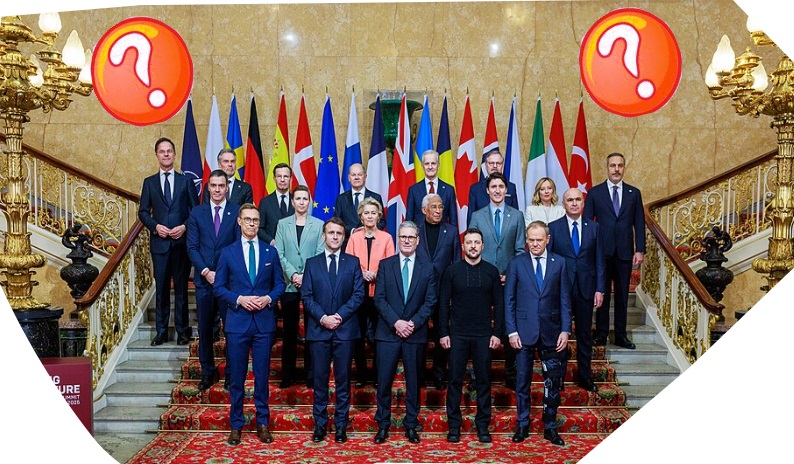
‘we agreed to finalise binding commitments setting out our approach to support Ukraine in the case of a future armed attack by Russia. These may include, military capabilities, intelligence and so on.’
In diplomatic parlance, agreeing to finalise commitments that may include basically means that nothing has been agreed.
What the declaration does achieve is to commit European nations to paying Ukraine to maintain an army of 800,000 personnel after the war ends which, by the way, is significantly higher than the total number of armed forces personnel of Germany, France and Britain combined.
Time to be more direct in telling Zelensky what he should do
Ian Proud, Jan 13, 2026, https://thepeacemonger.substack.com/p/the-coalition-of-the-willing-has?utm_source=post-email-title&publication_id=3221990&post_id=184
The war in Ukraine happened because western nations insisted that Ukraine be allowed to join NATO but were never willing to fight to guarantee that right.
That reality has never changed. Last week’s latest Summit of the Coalition of the Willing confirmed that it will not change any time soon.
The only countries that appear remotely willing to deploy troops to Ukraine in a vague and most certainly limited way are the British and French.
Both would need parliamentary approval which can’t be guaranteed. Reform Leader Nigel Farage has already come out to say that he wouldn’t back a vote to deploy British troops to Ukraine because we simply don’t have enough men or equipment, a point recently reinforced by General (ret’d) Sir richard Shirreff.
Even though Keir Starmer has the parliamentary numbers to pass any future vote on deploying British troops, it would almost certainly damage his already catastrophic polling numbers.
Macron is clinging on to his political life and would probably face a tougher tussle to get his parliament to approve the French sending their troops to Ukraine, potentially leaving the UK on its own.
In any case, it is completely obvious that Russia won’t agree to any deployment in Ukraine by NATO troops. This shows once again that western leaders have learned absolutely nothing over the past decade. It will never be possible to insist that Russia sues for peace under terms which is has long made clear are unacceptable at a time when it was winning on the battlefield, and European nations refuse to fight with their own troops.
Hawkish British journalist Edward Lucas, with whom I disagree on most things, summed it up well in an opinion in the Times Newspaper when he said
We are promising forces we do not have, to enforce a ceasefire that does not exist, under a plan that has yet to be drawn up, endorsed by a superpower (read the US) that is no longer our ally, to deter an adversary that has far greater willpower than we do.’
President Putin has shown an absolute determination not to back down until his core aims, namely to prevent NATO expansion, are achieved. And as I have said many times, the west can’t win a war by committee.
All of these pointless Coalition of the Willing meetings happen in circumstances where Europe refuses to talk to Russia upon whom an end to the war depends. Peace will only break out after Ukraine and Russia sign a deal, and the west appears deliberately to be doing everything possible to ensure that Russia never signs.
Instead, we entertain Zelensky with hugs and handshakes, reassuring him that we will do anything he wants for as long as he needs, only to offer insufficient help all of the time.
And, as Zelensky is in any case unelected, not likely to win elections in Ukraine as and when they happen, overseeing a corrupt regime that is adopting increasingly repressive tactics to keep a losing war going, it is not in his interest to see the war anyway.
His calculus continues to be that, if he clings on for long enough, the west will finally be dragged into a direct war with Russia. So, he’s happy to drag out an endless cycle of death by committee in which European leaders never agree to give him exactly what he wants and he uses that as a pretext not to settle.
Zelensky went on from Paris to Cyprus where, among other things, he has been pushing for more sanctions against Russia. At no point since 2014 have sanctions looked remotely likely to work against Russia, for reasons I have outlined many times.
The European Commission is now planning its twentieth round of sanctions to coincide with the fourth anniversary of the war on 24 February 2026. So with peace talks ongoing, Ursula von der Leyen and Kaja Kallas as always are doing their bit to ensure that nothing gets agreed.
None of this brings the war any closer to an end nor does it provide any security guarantees to Ukraine. As always, the biggest security guarantee should be the offer by European allies to intervene militarily in Ukraine should Russia decide to reinvade after any future peace deal.
But that was not agreed in Paris. Instead, the Paris Declaration said, ‘we agreed to finalise binding commitments setting out our approach to support Ukraine in the case of a future armed attack by Russia. These may include, military capabilities, intelligence and so on.’
In diplomatic parlance, agreeing to finalise commitments that may include basically means that nothing has been agreed.
The declaration also said:
We stand ready to commit to a system of politically and legally binding guarantees. However, the final communique gave individual countries opt outs from those guarantees by saying that any guarantees would be, ‘in accordance with our respective legal and constitutional arrangements’.
So, again, in diplomatic parlance, what this means is that some coalition members may be able to opt out of the security guarantees if they decide that their domestic framework does not allow for such an arrangement, thinking here in particular of Hungary, Italy and Spain, for example.
What the declaration does achieve is to commit European nations to paying Ukraine to maintain an army of 800,000 personnel after the war ends which, by the way, is significantly higher than the total number of armed forces personnel of Germany, France and Britain combined.
Even though these are Ukrainian troops, not European, Russia will undoubtedly see EU funding of a large Ukrainian army on its border as a form of NATO lite. Which, of course, Zelensky would welcome.’
So the process of holding near weekly Coalition of the Willing summits is entirely pointless, though perhaps that is the point. Since 2022, western leaders have been completely unable to say no to Zelensky, either through guilt or stupidity, or both.
Yet at some point, if only for their own political survival, Starmer and others will have to politely decline to offer more support and make it clear to Zelensky that he has no choice but to sue for peace. To me, at least, the European offer to Zelensky follows these lines:
Ukraine cannot join NATO (sorry we lied to you about that) but you can join the European Union and we will help you make the reforms you need to do so.
You will get significant investment when the war ends that boosts your economy. As your people return home, we believe Ukraine has potential to grow quickly and reconstruct.
However, it may still be many years before you receive EU subsidies on the level of other European Members, and you possibly may not receive them at all.
And you will have to become financially sustainable, including meeting the EU’s fiscal deficit like other EU member states.
I’m afraid that means that you won’t be able to maintain an army of 800,000 people at Europe’s expense (sorry we reassured you that you could).
But, as a European Union member you would have a security guarantee by virtue of your membership of this community, even though only Macron’s France has said it would send you troops (je m’excuse).
You should also be aware that Europe sees benefit in a normalised economic relationship with Russia, that includes purchasing cheap Russian energy. We can’t go on buying massively expensive US LNG just to avoid hurting your feelings.
Sanctions may have been a policy or war, but they won’t be a policy of peace, and you will need to accept that we will drop them too.
We have now reached the limit of the financial support that we can provide to you so we have reached the point of now or never in your signing a peace deal.
That requires you to make hard choices about de facto recognition of land on the lines of the peace deal that the US is trying right now to finalise with Russia.
Without that, he will simply continue this charade of endless pointless Summits and the war will drag Europe even further into the mire.
That’s a lot to take in and we’ve already apologised enough as it is. Look, we lied to you okay, but everyone makes mistakes.
Somehow, though, I predict the Europeans will continue to drift in circles. I wonder where the next Coalition of the Willing Summit will be? I hope it’s soon, as Zelensky might actually have to spend some time inside of Ukraine if there’s a delay. And he likes it in Europe as it’s the only place where everyone seems to love him.

Who is to blame for blocking a new ‘golden era’ for nuclear power?
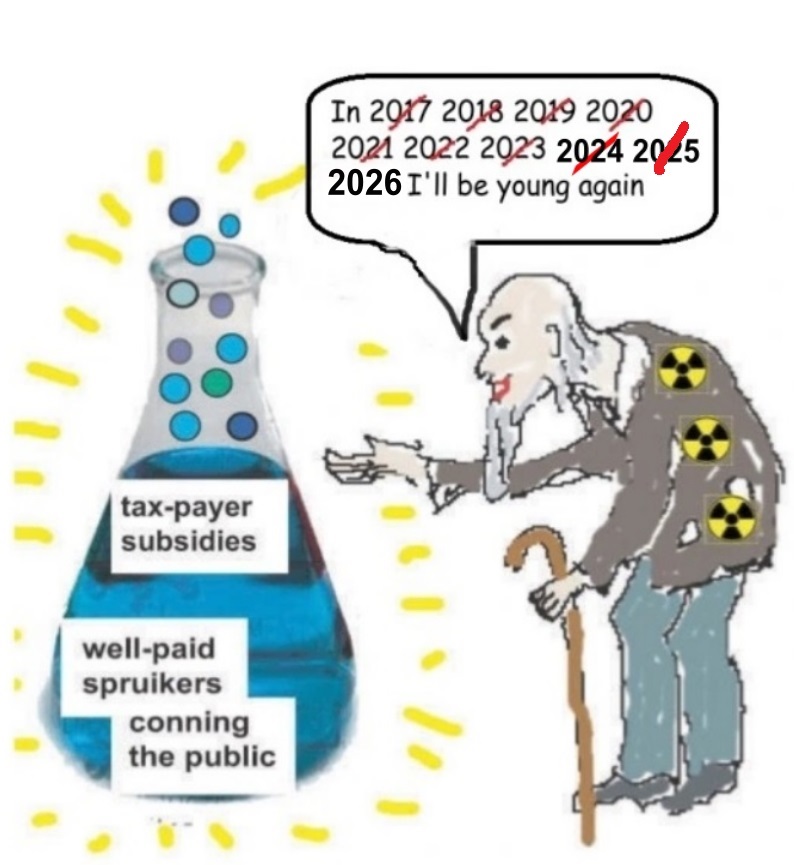
It is not the regulators or we so-called ‘blockers’ who are the main impediment to nuclear. It is the systemic failure of the nuclear industry to produce viable projects such as the much-hyped but non-existent Small Nuclear Reactors; its predictable inability to prevent cost overruns or to meet deadlines; let alone its lack of credible ideas to deal adequately with risk, safety and the management of its dangerous and interminable wastes. Nuclear is an industry that is bound to fail
7 January 2026, https://www.banng.info/news/regional-life/who-is-to-blame-for-blocking-nuclear-power/
Andrew Blowers tackles this question in the January edition of Regional Life magazine
The mantra that nuclear technology ‘is essential for achieving national security, energy security and Net Zero targets’ proclaimed by the Government’s Nuclear Regulatory Task Force has become the unequivocal, if deeply flawed, basis for government policy. The Government has pledged to ‘turbo-charge the build-out of new nuclear power stations and enter a ‘golden era’ of nuclear power.
Standing in its way are ‘gold-plated’ regulations and community groups like BANNG committed to protecting local environments, ecology and human health. The Task Force Review report just published (December) asserts, entirely without supporting evidence, that ‘The primary barrier’ to revitalising nuclear’s role is ‘systemic failure within the regulatory framework’.
So, here we have a familiar confrontation between energy and economic growth on the one side and environmental protection on the other. We have been here before. Every decade or so a new nuclear revival is promised but, after much huffing and puffing very little materialises. At the beginning of the century Tony Blair declared new nuclear was back ‘with a vengeance. In 2011 eight sites, including Bradwell, were declared ‘potentially suitable’ for new nuclear power plants.
In the event, only one, Hinkley Point, materialised and has become notorious for being too late, promised for 2017 but unlikely to power up until the next decade. Its cost overruns have become legendary. According to the Government, the culprits are environmental regulations and campaign groups who insist that previously agreed audio fish deterrents (AFDs) must be installed to help save millions of fish from becoming entrained and entrapped in the colossal intake and outflow pipes going into the Severn estuary. The developer has prevaricated, proposing cheaper but environmentally destructive methods of abatement. Politicians, including Sir Keir Starmer, have mindlessly mocked the ADF as a ‘fish disco’. It makes one wonder how they might deride oysters from the Blackwater if they stood in the way of nuclear power at Bradwell.

It is not the regulators or we so-called ‘blockers’ who are the main impediment to nuclear. It is the systemic failure of the nuclear industry to produce viable projects such as the much-hyped but non-existent Small Nuclear Reactors; its predictable inability to prevent cost overruns or to meet deadlines; let alone its lack of credible ideas to deal adequately with risk, safety and the management of its dangerous and interminable wastes. Nuclear is an industry that is bound to fail.
Meanwhile the importance of regulations imposed by independent regulators designed to protect people and the environment cannot be overstressed. And the essential role of community groups and councils in seeking to ensure the environmental protection and health and wellbeing of the places they represent is something to be cherished, not denigrated. It is a pity the Government does not see it that way.
7 January 2026
Andrew Blowers tackles this question in the January edition of Regional Life magazine
The mantra that nuclear technology ‘is essential for achieving national security, energy security and Net Zero targets’ proclaimed by the Government’s Nuclear Regulatory Task Force has become the unequivocal, if deeply flawed, basis for government policy. The Government has pledged to ‘turbo-charge the build-out of new nuclear power stations and enter a ‘golden era’ of nuclear power.
Standing in its way are ‘gold-plated’ regulations and community groups like BANNG committed to protecting local environments, ecology and human health. The Task Force Review report just published (December) asserts, entirely without supporting evidence, that ‘The primary barrier’ to revitalising nuclear’s role is ‘systemic failure within the regulatory framework’.
So, here we have a familiar confrontation between energy and economic growth on the one side and environmental protection on the other. We have been here before. Every decade or so a new nuclear revival is promised but, after much huffing and puffing very little materialises. At the beginning of the century Tony Blair declared new nuclear was back ‘with a vengeance. In 2011 eight sites, including Bradwell, were declared ‘potentially suitable’ for new nuclear power plants.
In the event, only one, Hinkley Point, materialised and has become notorious for being too late, promised for 2017 but unlikely to power up until the next decade. Its cost overruns have become legendary. According to the Government, the culprits are environmental regulations and campaign groups who insist that previously agreed audio fish deterrents (AFDs) must be installed to help save millions of fish from becoming entrained and entrapped in the colossal intake and outflow pipes going into the Severn estuary. The developer has prevaricated, proposing cheaper but environmentally destructive methods of abatement. Politicians, including Sir Keir Starmer, have mindlessly mocked the ADF as a ‘fish disco’. It makes one wonder how they might deride oysters from the Blackwater if they stood in the way of nuclear power at Bradwell.
It is not the regulators or we so-called ‘blockers’ who are the main impediment to nuclear. It is the systemic failure of the nuclear industry to produce viable projects such as the much-hyped but non-existent Small Nuclear Reactors; its predictable inability to prevent cost overruns or to meet deadlines; let alone its lack of credible ideas to deal adequately with risk, safety and the management of its dangerous and interminable wastes. Nuclear is an industry that is bound to fail.
Meanwhile the importance of regulations imposed by independent regulators designed to protect people and the environment cannot be overstressed. And the essential role of community groups and councils in seeking to ensure the environmental protection and health and wellbeing of the places they represent is something to be cherished, not denigrated. It is a pity the Government does not see it that way.
Why the coalition should be willing to say no to Zelensky
But they won’t, as they are unable to agree on anything useful
Ian Proud, Jan 09, 2026, https://thepeacemonger.substack.com/p/why-the-coalition-should-be-willing?utm_source=post-email-title&publication_id=3221990&post_id=183930866&utm_campaign=email-post-title&isFreemail=true&r=1ise1&triedRedirect=true&utm_medium=email
The latest in a line series of self-congratulatory Coalition of the Willing Summits in Paris, only confirmed that no one is willing to fight Russia on Ukraine’s behalf.
So, well dressed western leaders posed for the cameras and agreed nothing that would bring the war in Ukraine any closer to an end.
Zelensky doesn’t seem to mind, though, as it’s not in his interests to settle.
The Americans appear to be growing increasingly reluctant to get involved. leaving European tax payers to foot the billl.
In this video I outline what European leaders should say to Zelensky as the best offer on the table for Ukraine. Though I don’t expect them to do so as they are incapable of rational analysis and, in any case, unable to make a decision on anything useful.
Zelensky Names Canada’s Chrystia Freeland, Notable Anti-Russia Hawk As Top Advisor
Zero Hedge Tuesday, Jan 06, 2026
Apparently Zelensky is simply skipping his own people and going straight to appointing officials within foreign governments to top advisory positions.
Ukraine has named former Canadian Deputy Prime Minister Chrystia Freeland as an economic advisor amid a broader reshuffle of senior government positions, also coming on the heels of the massive energy ministry related corruption scandal which has unleashed chaos within his administration.
It should also be noted that Canada is a founding member of NATO – so handing Freeland a position in the Ukrainian presidential office won’t go down well at the Kremlin, which will see this as yet more justification for its vehement condemnation of NATO expansion.
Chrystia is a professional… and has significant experience in attracting investments and conducting economic transformations,” President Zelensky announced on Telegram Monday.
Freeland was Canada’s deputy prime minister from 2019 to 2024 under Prime Minister Justin Trudeau and was appointed Canada’s special representative for Ukraine’s reconstruction in 2025………. https://www.zerohedge.com/geopolitical/zelensky-names-canadas-chrystia-freeland-anti-russia-hawk-top-advisor
The New German Warfare State
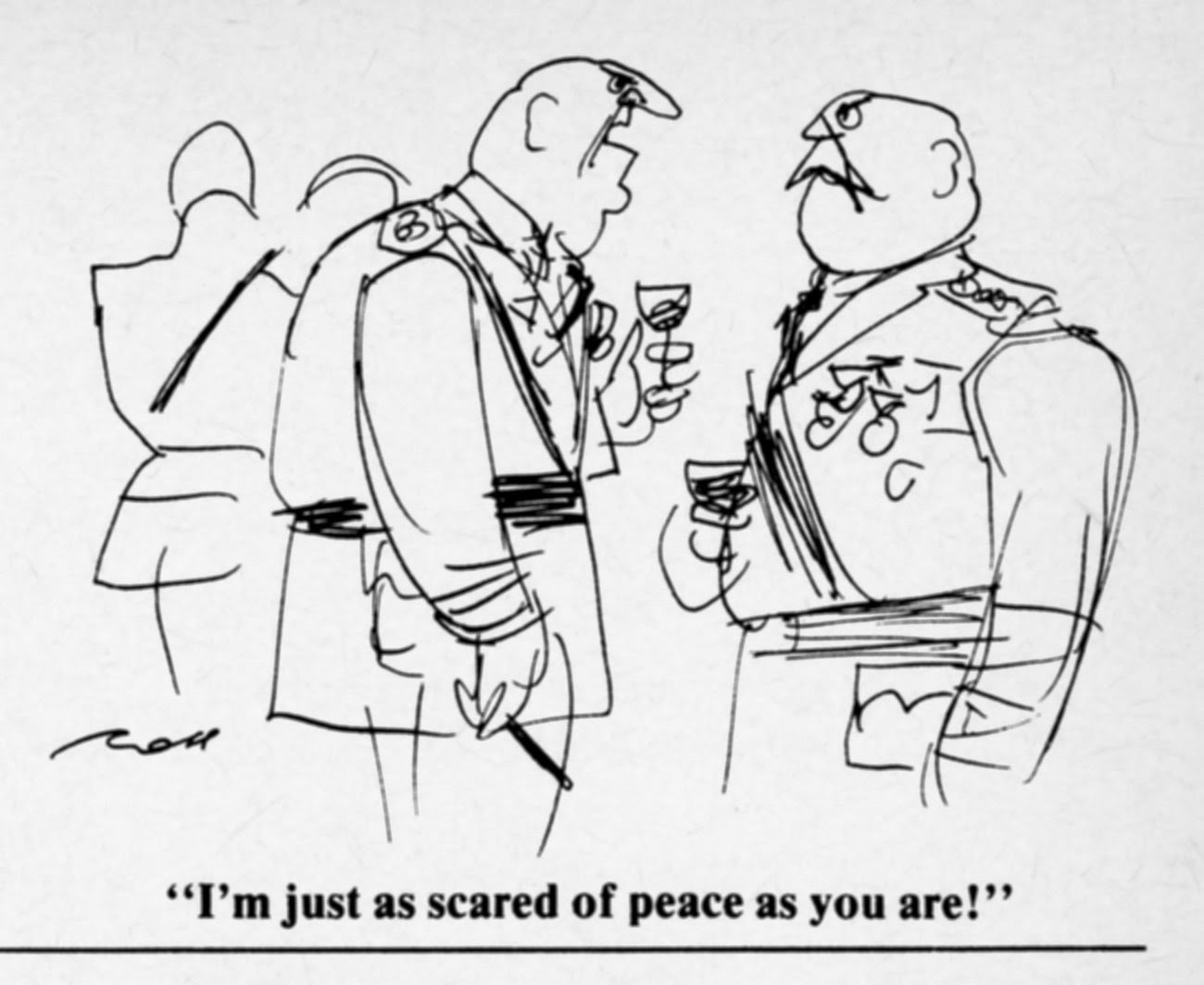
a leading sector of the political and economic elites in Germany and the EU view the project of rampant militarization as a means to counter the massive upheavals that are threatening their power on a geopolitical, domestic, and economic level. And for this purpose, the maintenance of a major threat, of a terrifying enemy that will not go away quickly, is indispensable. If the Russian threat, in contrast, turned out to be not as serious as it is portrayed, and if Russia could be accommodated with a peace deal that includes Ukrainian neutrality, the complete system of justification for the military build-up would crumble.
Fabian Scheidler, Substack, Jan 06, 2026
How boundless militarization has become the key project of Germany and the European Union in the unfolding polycrisis.
The European Union, Britain and other European NATO members have embarked on a path of massive militarization, which in its speed and ambition is unprecedented since World War II. While most NATO members had previously been unwilling or unable to meet the goal of spending two percent of their GDP for the military, a target set in 2014, they suddenly jumped to a commitment of five per cent per year at the 2025 NATO summit, bowing to Donald Trump’s pressure. Only the Spanish government refused to comply.
What NATO, its member states and major media are not communicating is the fact that five per cent of GDP corresponds to around 50 per cent of national budgets. If states were indeed to implement their commitments, they would have to drastically reduce spending on welfare, including education and healthcare, while simultaneously swelling their national deficits. The Financial Times summed up the agenda in a March 2025 headline: ‘Europe Must Trim its Welfare State to Build a Warfare State’. In other words, the planned militarization is class war from above. Although governments have somewhat watered down their commitments, stating that only 3.5 per cent will go directly to the military while 1.5 per cent is meant to revamp infrastructures for military use, even 35 per cent of national budgets would still be a major blow for what is left of the European welfare model.
Massive cuts to public spending in order to channel the funds into the military-industrial complex are on the agenda in most European countries. The German government is among the most zealous in this respect. Finance Minister Lars Klingbeil from the Social Democratic Party (SPD) pledged to triple the military budget from 52 billion € in 2024 to an unprecedented 153 billion in 2029, while chancellor Friedrich Merz (CDU) has already announced drastic cuts in unemployment benefits to fill some of the gap. Resistance within the Bundestag is eerily feeble. The Greens have long been among the most ardent advocates of rearmament and in March 2025 they voted in favour of a constitutional amendment that has removed all budget constraints for the military and intelligence services while maintaining austerity for all other types of spending. The right-wing Alternative für Deutschland (AfD), which has been leading in some recent polls, is equally devoted to the military build-up and a cutback of the welfare state. While Die LINKE officially opposes this agenda, their representatives in the second federal chamber, the Bundesrat, have voted for the constitutional amendment, causing unrest within the party. For some observers, the lack of parliamentary opposition has brought back sinister memories of the war credits in 1914, which were unanimously approved in the Reichstag – with the votes of the SPD.
In other European countries, however, more resistance has emerged. In the UK, Keir Starmer met fierce opposition to his plans to cut welfare benefits, even within his own Labour Party, and was forced to backtrack. In France, prime minister François Bayrou was toppled by a motion of no confidence over a € 44 billion budget cut plan. In Spain, mass demonstrations against rearmament have put significant pressure on prime minister Sanchez to limit military spending.
While it remains unclear to what extent European governments will be able to push through their ‘all guns, no butter’ agenda, the onslaught on public services and the working class is ongoing and pervasive. Unbound militarization has become the key project of the European Union, which is trying to mend its fractured foundations by forging a military union.
The militarization of German society
In Germany, a wave of militarization that would have been unthinkable a few years ago is sweeping through the country, affecting schools, universities, the media, and public spaces. Tramways are painted in military camouflage. Huge advertisements for the army depict war as a great adventure that strengthens team spirit. The Bundeswehr is aggressively recruiting young people in the streets, at school, and at universities. Even minors under 18 are being recruited, in violation of the principles of the UN Convention on the Rights of the Child, as organizations such as Terre des Hommes point out. Youth officers are sent into classrooms where they are advertising the army in front of students who are sometimes barely 13 years old. Rather than encouraging debates about the military at school, the army is being given free rein. The administration is also planning to introduce regular civil defense drills in schools, with the explicit intention of preparing the students mentally for war.
In the media, the German public broadcaster ARD has started to promote the army and its preparations for war in its children’s program ‘9 ½’, with recommendations on how to get involved. The program does not ask any critical questions about the army, nor does it mention the fact that deployment to war zones can result in death and trauma. The same is true of the second public broadcaster, which advertises the army as a cute and charitable force of peace in its children’s program ZDFtivi.
Universities are increasingly being forced to cooperate with the military. While a few federal states still prohibit military research in public universities and around 70 universities have voluntarily committed to engage exclusively in civil research, Robert Habeck (The Greens) declared in early 2025, when he was vice chancellor, that we ‘need to rethink the strict separation of military and civilian use and development’ in academia. In Bavaria, the administration has already banned any ‘civil clauses’ in universities, eliminating the option of declining military research. Furthermore, the German Army has developed a comprehensive classified ‘Operation Plan Germany’ to subordinate civil institutions to military objectives.
These concerted efforts to create a Warfare State are not least intended to transform the attitudes of the German population, which in its majority has been skeptical of the military, and of foreign involvements in particular, for decades……………………………………………………………………………………………
The ‘rules-based international order’ and the Gaza genocide
The project of the Warfare State, and the sacrifices that the population is supposed to make for its creation, is portrayed by political leaders both in Germany and the EU as being without alternative. The argument justifying this position is based on two pillars. The first one is the claim that massive rearmament is required to defend democracy, ‘Western values’, and international law against a despotic rogue state that is willing to dismantle the ‘rules-based international order’. ……………………………………………………………………………………………….
Within Europe, German governments have particularly excelled in trampling on international law when it comes to Palestine. After the Israeli onslaught began, the German government increased its arms exports to Israel tenfold, to a total 326 million euros in 2023 alone, making it the world’s second-largest supplier of arms to Israel, behind only the US. In November 2023, when overwhelming evidence of systematic Israeli war crimes had long been available, German Chancellor Olaf Scholz (SPD) declared that Israel ‘is committed to human rights and international law and acts accordingly’. Even after the International Court of Justice deemed South Africa’s genocide lawsuit against Israel to be ‘plausible’ in January 2024, the German government did not alter its stance. …………………………………
…………………. Germany has been the main force in the EU blocking all initiatives to sanction Israel for its behavior, for example by suspending the EU-Israel Association Agreement. German authorities and institutions have also engaged in suppressing freedom of speech on a scale unprecedented in recent German history, including attempts to prevent the UN Special Rapporteur on the Occupied Territories, Francesca Albanese, from speaking in Berlin……………………………………………………………………
The Russian threat
While the argument that the new arms race is about defending a rules-based international order and the inviolability of borders (which Israel violates on a daily basis) has lost credibility, and with Ukraine’s chances of winning back their territories dwindling, another narrative has emerged to justify the military build-up: the threat of a Russian invasion of NATO countries. In June 2024, German Defense Minister Boris Pistorius stated that Germany must become ‘fit for war’ because Russia will be able to invade NATO by 2029.
However, there is no indication that Russia has any intention of attacking NATO countries, let alone Germany. Even the annual US intelligence report clearly states that the Kremlin ‘is almost certainly not interested in a direct military conflict with US and NATO forces’.[10] Admiral Sir Tony Radakin, Commander-in-Chief of the British Armed Forces and anything but a Russian stooge, confirmed: ‘Vladimir Putin does not want a direct war with NATO.’ In fact, there are no plausible motives for an attack on NATO, which would plunge Russia into a devastating conflict with the most powerful military alliance in human history. Even if the Russian leadership were utterly insane and suicidal (for which there is no evidence), they would lack the means to undertake such an endeavor. For years, Russia has made only slow advances against an exhausted Ukrainian army. NATO’s military budget is still ten times larger than Russia’s, and European NATO states alone spend more than three times as much and are overwhelmingly superior to Russia militarily.
Given that the Russian threat to NATO is clearly greatly exaggerated, even in the eyes of Western intelligence, the question arises as to why the German government, along with other European leaders, continues to circulate the narrative of an impending invasion. The question becomes even more pertinent given that the EU and its most powerful member states are actively undermining serious peace negotiations, thus increasing the risk of a major confrontation with Russia. The proposal to send NATO troops to Ukraine in the wake of a possible ceasefire, for example, increases the incentives for Russia to continue fighting, since preventing NATO troops from being deployed to Ukraine was a key motive for starting the war in the first place. While the EU should have a clear interest in extinguishing the fire on its doorstep, it continues to pour more oil on it, compromising its own security interests as well as Ukraine’s. What is driving this seemingly irrational behavior?
The geopolitical upheaval and the ‘international division of humanity’
A possible answer to this puzzle is that a leading sector of the political and economic elites in Germany and the EU view the project of rampant militarization as a means to counter the massive upheavals that are threatening their power on a geopolitical, domestic, and economic level. And for this purpose, the maintenance of a major threat, of a terrifying enemy that will not go away quickly, is indispensable. If the Russian threat, in contrast, turned out to be not as serious as it is portrayed, and if Russia could be accommodated with a peace deal that includes Ukrainian neutrality, the complete system of justification for the military build-up would crumble.
To consider this argument more carefully, we need to take a closer look at the historical context. Geopolitically, the West is losing its dominant position in the world-system that it has occupied for centuries, a process that has triggered severe turbulence and fractures within the Western bloc. The US is deploying all possible strategies to regain its once hegemonic position, not hesitating to throw the EU under the bus if necessary. . After the Biden administration’s strategy of weakening Russia through the Ukraine war failed, driving Russia in the arms of Beijing, the Trump administration has been desperately trying to pull out of Ukraine in order to pivot to Asia and contain its main rival China. For this reason, the US is attempting to shift the financial burden of the war to Europe.
For European governments, and the German administration in particular, which have been following US instructions to the letter while subordinating their own interests, this U-turn has provoked considerable chaos and confusion. First of all, they had bowed to US pressure to cut all ties with Russia. While this did nothing to end the Ukraine war, it caused severe economic pain, especially to Germany. …………………………………………………………………………………………………
Despite the rivalry and in-fighting among Western nations, the new wave of militarization has at least one common geopolitical denominator: the maintenance of what Vijay Prashad has called the ‘international division of humanity’. The capitalist world-system has been based for centuries on the dominance of white Western nations over the peoples of the Global South through colonization and neocolonial rule. This order is threatened by the rise of the Global South and the BRICS, and Germany, much like other European powers, is not willing to let the ‘darker nations’ have an equal say in world affairs and give up its own privileged position among the top predators of the food chain. Given that the economic leverage and the soft power of Germany are in decline, its leaders seem to believe that they can reverse trends by increased militarization.
Economic decay and remilitarization
On the economic and domestic level, Germany has become, like many other Western countries, a society in decline. …………………………………………………………………………………………………………………………………….
If the program was indeed about restarting the national economy by creating domestic demand the question arises as to why German governments, as in other Western countries, have been and still are so unwilling to spend more money on education, healthcare, and other public services, which would create domestic demand much more effectively. The March 2025 constitutional amendment gets to the heart of this paradox: While maintaining austerity for society at large, it has enabled limitless spending and borrowing for the military and the deep state.
……………………………………………………………………………………………………………………………………………….. With ideological coherence in the West crumbling, the War State can provide a sense of direction and unity among the governing elites. Moreover, the threat of an overwhelming enemy, whether real or fictitious, allows the imposition of a state of exception on society as a whole.
……………………………………. the latent or manifest state of war is a perfect means of distracting an increasingly skeptical population from considering the systemic root causes of the deepening polycrisis. Whether it is inequality or climate chaos, the logic of war calls on us to put these issues aside in order to defend Western civilization against the Saurons and Voldemorts of the barbaric East.
………………………. war seems to be the only remaining option for a body politic that has no answers for anything, whether it is mass poverty, climate chaos, popular anger, or geopolitical challenges. While it is often said that politics is about the solution of problems, the War State project is about distracting from all real problems by hypnotizing the public and focusing its attention on an external threat.
………………………………………………………………………………………………… Welfare, not warfare
The convergence of movements around the issue of peace will play a key role in determining whether the race to the abyss can be stopped. The attacks on welfare in order to finance the arms build-up have already incited mass popular resistance in countries like Britain, Spain, France, and Italy. While the German peace movements are still historically weak due to internal splits, a series of major demonstrations this autumn, both on the issues of Gaza and Ukraine, might indicate a turning point. Stopping the military build-up and the new bloc confrontation is a key issue for the left in Europe, as all possible progressive achievements in terms of workers’ rights, democracy, and environmental justice would be wiped out if EU leaders get their way with the War State agenda. After all, it’s about welfare, not warfare, today more than ever. https://fabianscheidler.substack.com/p/the-new-german-warfare-state
Plunging Toward Armageddon: U.S. and Russia on the Brink of a New Nuclear Arms Race

Beginning on February 6th, Russian and American leaders will face no barriers whatsoever to the expansion of those arsenals or to any other steps that might increase the danger of a thermonuclear conflagration.
Both the United States and Russia have already committed vast sums to the “modernization” of their nuclear delivery systems
By Michael Klare. 8 Jan 26, https://tomdispatch.com/plunging-into-the-abyss/
Plunging Into the Abyss. Will the U.S. and Russia Abandon All Nuclear Restraints?
For most of us, Friday, February 6, 2026, is likely to feel no different than Thursday, February 5th. It will be a work or school day for many of us. It might involve shopping for the weekend or an evening get-together with friends, or any of the other mundane tasks of life. But from a world-historical perspective, that day will represent a dramatic turning point, with far-reaching and potentially catastrophic consequences. For the first time in 54 years, the world’s two major nuclear-weapons powers, Russia and the United States, will not be bound by any arms-control treaties and so will be legally free to cram their nuclear arsenals with as many new warheads as they wish — a step both sides appear poised to take.
It’s hard to imagine today, but 50 years ago, at the height of the Cold War, the U.S. and Russia (then the Soviet Union) jointly possessed 47,000 nuclear warheads — enough to exterminate all life on Earth many times over. But as public fears of nuclear annihilation increased, especially after the near-death experience of the 1962 Cuban Missile Crisis, the leaders of those two countries negotiated a series of binding agreements intended to downsize their arsenals and reduce the risk of Armageddon.
The initial round of those negotiations, the Strategic Arms Limitation Talks I, began in November 1969 and culminated in the first-ever nuclear arms-limitation agreement, SALT-I, in May 1972. That would then be followed in June 1979 by SALT-II (signed by both parties, though never ratified by the U.S. Senate) and two Strategic Arms Reduction Treaties (START I and START II), in 1991 and 1993, respectively. Each of those treaties reduced the number of deployed nuclear warheads on U.S. and Soviet/Russian intercontinental ballistic missiles, submarine-launched ballistic missiles, and long-range bombers.
In a drive to reduce those numbers even further, President Barack Obama and Russian President Dmitry Medvedev signed a New Strategic Arms Reduction Treaty (New START) in April 2010, an agreement limiting the number of deployed nuclear warheads to 1,550 on each side — still enough to exterminate all life on Earth, but a far cry from the START I limit of 6,000 warheads per side. Originally set to expire on Feb. 5, 2021, New START was extended for another five years (as allowed by the treaty), resetting that expiration date for February 5, 2026, now fast approaching. And this time around, neither party has demonstrated the slightest inclination to negotiate a new extension.
So, the question is: What, exactly, will it mean for New START to expire for good on February 5th?
Most of us haven’t given that a lot of thought in recent decades, because nuclear arsenals have, for the most part, been shrinking and the (apparent) threat of a nuclear war among the great powers seemed to diminish substantially. We have largely escaped the nightmarish experience — so familiar to veterans of the Cold War era — of fearing that the latest crisis, whatever it might be, could result in our being exterminated in a thermonuclear holocaust.
A critical reason for our current freedom from such fears is the fact that the world’s nuclear arsenals had been substantially diminished and that the two major nuclear powers had agreed to legally binding measures, including mutual inspections of their arsenals, meant to reduce the danger of unintended or accidental nuclear war. Together, those measures were crafted to ensure that each side would retain an invulnerable, second-strike nuclear retaliatory force, eliminating any incentive to initiate a nuclear first strike.
Unfortunately, those relatively carefree days will come to an end at midnight on February 5th.
Beginning on February 6th, Russian and American leaders will face no barriers whatsoever to the expansion of those arsenals or to any other steps that might increase the danger of a thermonuclear conflagration. And from the look of things, both intend to seize that opportunity and increase the likelihood of Armageddon. Worse yet, China’s leaders, pointing to a lack of restraint in Washington and Moscow, are now building up their own nuclear arsenal, only adding further fuel to the urge of American and Russian leaders to blow well past the (soon-to-be-abandoned) New START limits.
A Future Nuclear Arms Race?
Even while adhering to those New START limits of 1,550 deployed nuclear warheads, both Russia and the United States had taken elaborate and costly steps to enhance the destructive power of their arsenals by replacing older, less-capable intercontinental ballistic missiles (ICBMs), submarine-launched ballistic missiles (SLBMs), and nuclear bombers with newer, even more capable ones. As a result, each side was already becoming better equipped to potentially inflict catastrophic damage on its opponent’s nuclear retaliatory forces, making a first strike less inconceivable and so increasing the risk of precipitous escalation in a crisis.
The Russian Federation inherited a vast nuclear arsenal from the former Soviet Union, but many of those systems had already become obsolete or unreliable. To ensure that it maintained an arsenal at least as potent as Washington’s, Moscow sought to replace all of the Soviet-era weapons in its inventory with more modern and capable systems, a process still underway. Russia’s older SS-18 ICBMs, for example, are being replaced by the faster, more powerful SS-29 Sarmat, while its remaining five Delta-IV class missile-carrying submarines (SSBNs) are being replaced by the more modern Borei class. And newer ICBMs, SLBMs, and SSBNs are said to be in development.
At present, Russia possesses 333 ICBMs, approximately half of them deployed in silos and the other half on road-mobile carriers. It also has 192 SLBMs on 12 missile-carrying submarines and possesses 67 strategic bombers, each capable of firing multiple nuclear-armed missiles. Supposedly, those systems are currently loaded with no more than 1,550 nuclear warheads (enough, of course, to destroy several planets), as mandated by the New START treaty. However, many of Russia’s land- and sea-based ballistic missiles are MIRVed (meaning they’re capable of launching multiple independently targetable reentry vehicles) but not fully loaded, and so could carry additional warheads if a decision were ever made to do so. Given that Russia possesses as many as 2,600 nuclear warheads in storage, it could rapidly increase the number of deployed nuclear weapons at its disposal beginning on February 6, 2026.
Rather than confront such challenges, the leaders of both countries may instead choose to retain the New START limits voluntarily. Indeed, Vladimir Putin has already agreed to a one-year extension of this sort, if the United States is willing to do likewise. But pressures (which are bound to increase after February 5th) are also building to abandon those limits and begin deploying additional warheadsmost missile-tracking radars.
The United States is engaged in a comparable drive to modernize its arsenal, replacing older weapons with more modern systems. Like Russia, the U.S. maintains a “triad” of nuclear delivery systems — land-based ICBMs, submarine-launched SLBMs, and long-range bombers, each of which is now being upgraded with new warheads at an estimated cost over the next quarter century of approximately $1.5 trillion.
The existing New START-limited U.S. nuclear triad consists of 400 silo-based Minuteman-III ICBMs, 240 Trident-II SLBMs carried by 14 Ohio-class submarines (two of which are assumedly being overhauled at any time), and 96 strategic bombers (20 B-2s and 76 B-52s) armed with a variety of gravity bombs and air-launched cruise missiles. According to current plans, the Minuteman-IIIs will be replaced by Sentinel ICBMs, the Ohio-class SSBNs by Columbia-class ones, and the B-2s and B-52s by the new B-21 Raider bomber. Each of those new systems incorporates important features — greater accuracy, increased stealth, enhanced electronics — that make them even more useful as first-strike weapons, were a decision ever made to use them in such a fashion.
When initiated, the U.S. nuclear modernization project was expected to abide by the New START limit of 1,550 deployed nuclear warheads. After February 5th, however, the U.S. will be under no legal obligation to do so. It could quickly begin efforts to exceed that limit by loading all existing Minuteman-IIIs and future Sentinel missiles on MIRVed rather than single-warhead projectiles and loading the Trident missiles (already MIRVed) with a larger number of warheads, as well as by increasing production of new B-21s. The United States has also commenced development of a new delivery system, the nuclear-armed sea-launched cruise missile (SLCM-N), supposedly intended for use in a “limited” regional nuclear conflict in Europe or Asia (though how such a conflagration could be prevented from igniting a global holocaust has never been explained).
In short, after the expiration of the New START agreement, neither Russia nor the United States will be obliged to limit the numbers of nuclear warheads on their strategic delivery systems, possibly triggering a new global nuclear arms race with no boundaries in sight and an ever-increasing risk of precipitous nuclear escalation. Whether they choose to do so will depend on the political environment in both countries and their bilateral relations, as well as elite perceptions of China’s nuclear buildup in both Washington and Moscow.
The Political Environment
Both the United States and Russia have already committed vast sums to the “modernization” of their nuclear delivery systems, a process that won’t be completed for years. At present, there is a reasonably broad consensus in both Washington and Moscow on the need to do so. However, any attempt to increase the speed of that process or add new nuclear capabilities will generate immense costs along with significant supply-chain challenges (at a time when both countries are also trying to ramp up their production of conventional, non-nuclear arms), creating fresh political disputes and potential fissures.
Rather than confront such challenges, the leaders of both countries may instead choose to retain the New START limits voluntarily. Indeed, Vladimir Putin has already agreed to a one-year extension of this sort, if the United States is willing to do likewise. But pressures (which are bound to increase after February 5th) are also building to abandon those limits and begin deploying additional warheads.
In Washington, a powerful constellation of government officials, conservative pundits, weapons industry leaders, and congressional hawks is already calling for a nuclear buildup that would exceed the New START limits, claiming that a bigger arsenal is needed to deter both a more aggressive Russia and a more powerful China. As Pranay Vaddi, a senior director of the National Security Council, put it in June 2024, “Absent a change in the trajectory of the adversary arsenal, we may reach a point in the coming years where an increase from current deployed numbers is required, and we need to be fully prepared to execute if the president makes that decision.”
Those who favor such a move regularly point to China’s nuclear buildup. Just a few years ago, China possessed only some 200 nuclear warheads, a small fraction of the 5,000 possessed by both Russia and the U.S. Recently, however, China has expanded its arsenal to an estimated 600 warheads, while deploying more ICBMs, SLBMs, and nuclear-capable bombers. Chinese officials claim that such weaponry is needed to ensure retaliation against an enemy-first strike, but their very existence is being cited by nuclear hawks in Washington as a sufficient reason for the U.S. to move beyond the New START limits.
Russian leaders face an especially harsh quandary. At a moment when they are devoting so much of the country’s state finances and military-industrial capacities to the war in Ukraine, they face a more formidable and possibly expanded U.S. nuclear arsenal, not to mention the (largely unspoken) threat posed by China’s growing arsenal. Then there’s President Trump’s plan for building a “Golden Dome” missile shield, intended to protect the U.S. from any type of enemy projectile, including ICBMs — a system which, even if only partially successful, would threaten the credibility of Russia’s second-strike retaliatory capability. So, while Russia’s leaders would undoubtedly prefer to avoid a costly new arms buildup, they will probably conclude that they have little choice but to undertake one if the U.S. abandons New START.
Racing to Armageddon
Many organizations, individuals, and members of Congress are pleading with the Trump administration to accept Vladimir Putin’s proposal and agree to a voluntary continuation of the New START limits after February 5th. Any decision to abandon those limits, they argue, would only add hundreds of billions of dollars to the federal budget at a time when other priorities are being squeezed. Such a decision would also undoubtedly provoke reciprocal moves by Russia and China. The result would be an uncontrolled arms race and a rising risk of nuclear annihilation.
But even if Washington and Moscow were to agree to a one-year voluntary extension of New START, each would be free to break out of it at any moment. In that sense, February 6th is likely to bring us into a new era — not unlike the early years of the Cold War — in which the major powers will be poised to ramp up their nuclear war-fighting capabilities without any formal restrictions whatsoever. That comfortable feeling we once enjoyed of relative freedom from an imminent nuclear holocaust will also then undoubtedly begin to dissipate. If there is any hope in such a dark prognosis, it might be that such a reality could, in turn, ignite a worldwide anti-nuclear movement like the Ban the Bomb campaigns of the 1960s, 1970s, and 1980s. If only.
British and European leaders have shown themselves weak and complicit in the kidnapping of Maduro.
Ian Proud, Jan 08, 2026, https://thepeacemonger.substack.com/p/british-and-european-leaders-have?utm_source=post-email-title&publication_id=3221990&post_id=183823495&utm_campaign=email-post-title&isFreemail=true&r=1ise1&triedRedirect=true&utm_medium=email
The US attack on the Venezuelan capital of Caracas and kidnapping of President Maduro and his wife was illegal under international law. British and European leaders tacitly supporting US actions through silence is weak and will damage further their reputations in the developing world.
The UN Charter was agreed in 1945 to ensure that countries no longer interfered in the sovereign affairs of other countries. Of course, that legal basis was built on shaky foundations, as the outline of post-war borders was complex and in many parts of the world disputed, including in Europe. The Second World War ended at a time when Britain and other European nations were accelerating their departure from colonialism, creating wholly new sovereign states based on former colonial boundaries.
The UN charter didn’t and does not try to rewrite the map of the world. Nor does it seek to impose a template for how countries are governed. The countries of the world continue to be led by a mix of monarchies, democracies and autocracies in many shapes and sizes.
No country has a right to impose its will or preferred mode of governance on another country, however dysfunctional that country may be. In the case of Venezuela, few would argue that it is a democracy in the purest sense, despite the holding of elections. That some countries consider prior Venezuelan elections to have been rigged is immaterial under the UN Charter. No third country can interfere violently in the affairs of another state, even if that state appears a violent dictatorship.
I personally do regard Nicolas Maduro as, at the very least, an authoritarian leader who is predisposed to undemocratic and repressive means to govern his people. But I could say the same about countless other countries, not only in Latin America but in Africa, the middle east and Asia.
Europe itself, while governed by seemingly democratic systems, has stood accused by the US in this past year of being anti-democratic by stifling free speech and choreographing the appearance of democracy with the help of a compliant media. The institutions of Europe are by design anti-democratic, as citizens do not have the opportunity directly to choose any of the six so-called Presidents in charge, nor their unelected aides-de-camp, however they are called.
So, love him or, in many liberal cases, loathe him, western leaders aren’t given a say under international law about whether Nicolas Maduro is the rightful leader of Venezuela.
In the case of the US, that country has justifiable concerns about the flood of drugs channelled through Venezuela that reach its shores and ruin the lives of people addicted to substance misuse. This is undoubtedly a legitimate national security interest for the Americans and gives them the right to act to prevent these hostile acts, including, should they choose, through the use of force. Without getting into the wider debate about US attacks on alleged drug boats, those actions, nevertheless, are still governed by international human rights law.
They do not give the USA the right forcibly to depose a serving President, however unpalatable a character he may be.
That UK and European leaders have tacitly, though their silence of US actions, come out in support of the overthrow of Maduro speaks more of international relations, not international law.
They have set themselves up as judge and jury from affair, on the basis that they agree with the US assessment that Maduro is the wrong sort of leader for Venezuela. For all the pontification about letting Venezuelan people decide, Euro-elites aren’t bright enough to realise that they are aiding and abetting Donald Trump in making a choice on Venezuela’s behalf.
This theatre played out vividly at the UN Security Council on Monday 5 January in which the various European states represented at the table, one by one, refused even to mention the actions of the US in overthrowing Maduro in their statements. Echoing Prime Minister Keir Starmer’s refusal to denounce US actions, the UK’s Representative at the table, James Kariuki, who unfortunately I know of old, stuck to remarking on the undemocratic nature of Nicolas Maduro, the need for a transition to democracy and to abide by international law. And nothing else.
No mention of the fact that US actions were in breach of international law. No mention of the unilateral military attack by the US on Venezuela’s capital nor the kidnapping of Maduro. Simply, Maduro is bad, too bad, let’s find someone new to replace him, of whom, implicitly, we approve.
Every other European state at the table, including Greece, France, Latvia and Denmark, offered a slightly longer-winded version of the same position. The Danes were a little more nuanced, given their not misplaced fear, that they may be next, if America decides to make a move to annex Greenland illegally.
And therein the root cause of the British and European positioning. European foreign policy appears to rest almost entirely on a desire not to offend President Trump.
In London, Riga, Paris and Copenhagen, leaders still cling to the hope that President Trump will, through flattery, still support their efforts to maintain a proxy war in Ukraine.
That if they refuse to denounce him over Venezuela, he might eventually come round again to the idea of regime change in Moscow, through a war in Ukraine that leaders continue to fantasise is winnable when all the evidence suggests otherwise.
So, the requirements of international law have become entirely incidental to the foreign policy imperative of defeating President Putin and, hopefully, perhaps, seeing him, cuffed and blindfolded, whisked off in a US military helicopter to a kangaroo court in New York. Everything else, including the requirements of the UN Charter, is simply inconvenient detail.
Yet, ultimately, Britain and Europe remain weak and unable substantively to influence President Trump’s actions, rendering them weak and as passengers on a runaway US train as it relates to Ukraine policy.
Unfortunately, countries across the developing world – including the Latin American countries at the Security Council who to varying degrees denounced the US move – will have been shocked by the position Britain and Europe has taken. That their leaders are clinging on vicariously to a western hegemon, in which the US acts as global policemen, and they stand back, aghast, while offering obsequious applause.
The main beneficiary of this will, of course, be China and to some extent Russia who have progressively railed against western dominance through alternative global political fora for dialogue and mutually beneficial cooperation. I should think the queue of countries lining up to join BRICS will grow longer after this illegal US attack on Venezuela.
Golden Dome changes both NATO and the EU.

Now the wording is changed to: “The United States will deter – and defend its citizens and critical infrastructure – against any airstrike against its territory“. The level of ambition has been raised significantly.
Av Ingolf Kiesow, The Royal Swedish Academy of War Sciences (Kungliga Krigsvetenskapsakademien 22 dec 2025
SIPRI’s 2024 yearbook is titled “Role of nuclear weapons grows as geopolitical relations deteriorate.” The content of that statement has grown in importance in 2025.
Golden Dome
On January 27, 2025, just a few days after taking office for a new term as President of the United States, Donald Trump signed an “Executive Order” to the US Department of Defense – now called the “War Department” – to build a missile defense system, what he later came to call “The Golden Dome”.
According to a statement by the then Department of Defense (now the “Ministry of War”), the Golden Dome will “unify a range of capabilities to create a system of systems to protect the United States from air attack by any aggressor“. Congress approved $24,5 billion for the purpose on September 5.
Donald Trump has said that this grant should be seen as a first installment and that the entire project should be fully operational before his presidential term ends.
He said in May that the total cost could be estimated at $175 billion. The Congressional Budget Office has since estimated that it will cost more than $500 billion. Other observers argue that the need to continuously replace satellites in the system, as Earth’s gravity pulls them out of orbit, means that the cost will exceed a trillion or several trillion dollars before it can be operational.
A first contract under Golden Dome was signed on November 4. Space X will receive $2 billion to build a system of 600 satellites with Lockheed Martin to create an “Air Moving Target Indicator (AMTI).” These low-altitude satellites will detect and track advanced threats from maneuvering glide missiles and stealth aircraft and then feed the data obtained into the US missile defense targeting system.
Congress has pointed out that the US missile defense strategy has so far been formulated as the US striving afterr “to defend against rogue states as well as against unauthorized or accidental missile launches while relying on nuclear weapons to deter China and Russia from striking American territory“.
Now the wording is changed to: “The United States will deter – and defend its citizens and critical infrastructure – against any airstrike against its territory“. The level of ambition has been raised significantly.
The relationship between the White House and Congress on the Golden Dome is marked by suspicion. In a statement, the Congressional Office laments that the administration has failed to provide the public with a detailed account of the project, has not held meetings with representatives of the business community, and has reportedly instructed military officials not to discuss the Golden Dome publicly.
Reactions to the Golden Dome
On May 8, China and Russia issued a joint statement criticizing the project for undermining the link between strategic offensive weapons and strategic defensive weapons, i.e. the very idea of a nuclear balance. Russian press spokesman Peskov said that while a decision on Golden Dome is a sovereign matter for the United States, it is also in the common interest of both countries to create a new legal framework to replace the no longer functioning nuclear arms treaties between the United States and Russia.
However, as of the end of October 2025, no preparations for negotiations on US-Russian arms control have been initiated. Donald Trump is said to have said that it might be a good idea, but without wanting to discuss the matter in more detail. On January 5, 2026, the only Russian-American arms control agreement still in force, the so-called New START agreement, expires.
In addition to China and Russia, there has also been criticism in the West that the US is trying to make the US invulnerable to nuclear attack with Golden Dome and thereby create a strategic advantage. This would damage the balance that has so far rested on the theory of mutual deterrence, a concept that also presupposes a certain degree of mutual vulnerability.
China shows off its weapons
China celebrated the eightieth anniversary of its victory over Japan in World War II with a military parade in Beijing on October 3 of this year. The parade was characterized by three things: coordination with the authoritarian countries of the world, the focus of Chinese defense on preparations for a war with the United States, and the belief that the next war will be fought globally.
Vladimir Putin and Kim Jong Un sat on either side of Xi Jinping during the parade, and among the invited guests were a large majority of presidents and prime ministers from the global south.
The new weapons systems on display included new advanced fighter jets, tanks, hypersonic anti-ship missiles and long-range rocket artillery. Three different groups of missile systems were displayed: five nuclear-capable systems, three cruise missile systems and three hypersonic missile systems.
The direction has been interpreted abroad as a warning to the United States not to try to oppose a possible upcoming attempt to invade Taiwan and to keep the United States away from the waters along China’s coasts in the Pacific Ocean.
FOBS has been a headache for the Pentagon
The presence of a Fractional Orbital Bombardment System (FOBS) in both Russia and China has been a particular concern for Western defense forces in recent times. This is especially true since China conducted a pair of test flights in the summer of 2021, when a launch vehicle was launched into orbit around the Earth and a hypersonic glide missile was released, which re-entered the atmosphere on the other side of the world and hit a designated target. The launch vehicle remained in a relatively low-altitude orbit (around 150 kilometers) and the entire crew moved at hypersonic speed the entire way, making them very difficult – almost impossible – to detect and combat.
Some of the missiles displayed at the military parade may be included in FOBS, which would mean that production and supply to units is ongoing.
After China’s first hypersonic missile flight, it took the United States several years to build a similar system and get the missiles flying, which has been a major concern for the Pentagon. The lack of a US system to defend against FOBS has been explicitly cited by the Defense Intelligence Agency as one of the reasons for introducing Golden Dome.
Truce in the trade war with China, but not peace and no deal………………………………………………………………………………….
……………………………………………………………………. Since NATO is designed to function under American leadership, Europe must now create its own organization in peacetime in order to be able to function without or at least with weakened support in wartime. That is the only conclusion that seems logical to draw in the light of this article. Whether such an adaptation can take place within the framework of NATO or can best be done within the EU or through the creation of an entirely new European defense organization has become a pressing question.
How Europe should dispose of its own nuclear weapons assets to deter Russia from attacking is also an issue that is now demanding attention even in peacetime.
Conclusions for Europe.
In any case, the connection between economic and military strength will play a central role. If the US fails to mobilize the financial resources required for Golden Dome and if the EU fails to find the means to both help Ukraine avoid defeat in the war with Russia and at the same time build up our own defenses, the situation may become difficult to manage.
Since Donald Trump came to power, however, the US has committed serious violations of international law, such as the prohibition of genocide in connection with its support for Israel’s war in Gaza and against the rules on freedom of the seas and human rights in connection with the killing of suspected smugglers from Venezuela and Colombia without prior trial. Being part of NATO and being part of the same alliance as the US is beginning to feel embarrassing to a European.
The nonchalance with the rules of international law also raises uncertainty about how serious the US is about its own membership in NATO and its obligations to help the EU preserve sovereignty over its territory.
Donald Trump’s fickleness and the uncertainty about what the investment in Golden Dome will entail create uncertainty for Europe and the rest of the “West”. For Europe, this means having to walk a balance between the desire not to lose the US as an ally in the long term and, on the other hand, the prospect of perhaps having to face a growing threat from Russia alone. In addition, the US may demand help in its power struggle with China, something that it is not in Europe’s interest to allocate resources to.
Can the EU prepare for a period of reduced American support without irreparably damaging the relationship with the US? Can the EU build a partnership with countries in the global south and even with China that resembles the world trade and payments system that functioned before Xi Jinping and Donald Trump came to power in their respective countries?
Puppet dreams? Yes, maybe, but what choice do we have?
The author is an ambassador and member of KKrVA. https://en.kkrva.se/golden-dome-forandrar-bade-nato-och-eu/
Nuclear Power: Private Sector -Question for UK government
Question for Department for Energy Security and Net Zero
UIN HL13206, tabled on 18 December 2025
Lord Spellar: To ask His Majesty’s Government when they intend to publish a new framework for a private sector route to market for advanced nuclear
technologies.
Lord Vallance: The government will provide a framework that
will set out a pathway for privately led advanced nuclear projects, this framework will be published early this year.
Hansard 6th Jan 2026 https://questions-statements.parliament.uk/written-questions/detail/2025-12-18/HL13206
The French Resistance at Bure: the campaign to oppose a nuclear waste dump.

Richard Outram, NFLA Secretary, 6 January 2026
Introduction.
The outline for this briefing was first written almost two years ago for British and Canadian campaigners working collaboratively in opposing plans to establish high level radioactive waste repositories in their respective nations, either an off-shore and undersea Geological Disposal Facility (UK) or an inshore and underground Deep Geological Repository (Canada).
It was intended to raise their awareness of the decades long struggle waged by colleagues against the similar Cigéo Project under development in France.
Contrary to the positive articles published by Nuclear Waste
Services Community Partnerships and puff pieces that have appeared in the pro-nuclear Cumbrian media all is not ‘sweetness and light’, for there have been public protests involving local people and environmental activists against this project for decades.
Protests have often been opposed by police using tear gas, water cannons, and stun grenades to disperse demonstrators. Authorities maintain a heavy police presence in the area, and multiple injuries have been reported on both sides during serious confrontations. The French state has also resorted to spying and the wholesome clearance and destruction of protestors’ camps.
This then is a background paper to the campaign in opposition to the Cigéo Project, and the tactics employed by the French State and Police in opposing them…………………………
Lengthy detailed history. with excellent photos and graphics.
Conclusion.
With sections of the media reporting that the British Government is looking to abandon the ‘consent based’ approach, and with the former Nuclear Minister suggesting that such a move is inevitable, there must be concerns that a nuclear waste dump might eventually be imposed on a wholly unwilling community in the UK.
Such an announcement would most likely lead to more robust public opposition. Could this lead in turn to the UK Government looking to resort to the heavy-handed policing seen at Bure?
Although UK police services have historically operated based on consent, this is perhaps less fanciful than it might appear. Ministerial approval has already been given to deploy armed officers of the Civil Nuclear Constabulary at national energy infrastructure sites outside of nuclear power stations and Ministers announced as part of the 2025 Defence Review that an armed auxiliary civilian guard force would be created for a similar purpose.
If the UK Government does move away from a ‘consent-based approach’ to GDF siting, Bure may provide a salutary lesson for an unwilling, and disenfranchised, community in the UK faced with the prospect of a highlevel nuclear waste facility being imposed by the British State.
Forewarned is forearmed. https://www.nuclearpolicy.info/wp/wp-content/uploads/2026/01/A446NB332-The-French-Resistance-at-Bure-the-campaign-to-oppose-a-nuclear-waste-dump-Jan-2026.pdf
Babcock to provide dock for new Dreadnought nuclear subs: will they be carrying nuclear weapons?
By Ally McRoberts, Dunfermline Press 6th Jan 2026
PREPARATIONS are underway in Rosyth for a contingent docking facility to accommodate the next generation of nuclear submarines.
Dunfermline and Dollar MP Graeme Downie had asked about the planned timescale for the work which will see the Dreadnought class berth at the yard during sea trials.
Rosyth will “bridge a gap” by offering a temporary home for the new subs, and last month the Ministry of Defence told local councillors they will not reveal if any of the boats that need repairs or maintenance will be carrying nuclear weapons……………………………………………..
“For operational security reasons further details cannot be released as to do so could be used to undermine the security and capability of our Armed Forces.”
……………………The Royal Navy’s new subs, the Dreadnought class, will be launched from Barrow-in-Furness towards the end of this decade.
The vessels will be maintained at Faslane, however the site on the Clyde won’t be ready until the mid 2030s……………………………
At last month’s South and West Fife area committee, Grant Reekie, head of radioactive waste and health physics at Babcock, had explained: “We have been asked to provide a contingent facility by the MoD to bridge a gap of submarines coming into service in late 2020s from 2029 through to mid 2030s when they will no longer be required as it will be done in Faslane.
………………At the same meeting the MoD told councillors they will not reveal if nuclear weapons will be aboard submarines being repaired at the yard.
They also confirmed that local residents would be given potassium iodate tablets to block radiation in the event of an emergency. https://www.dunfermlinepress.com/news/25743485.babcock-provide-dock-new-dreadnought-nuclear-subs/
A game of chicken between the US and Denmark
The people of Greenland are merely pawns on a neo-colonial chessboard
Ian Proud, Jan 08, 2026, https://thepeacemonger.substack.com/p/a-game-of-chicken-between-the-us?utm_source=post-email-title&publication_id=3221990&post_id=183816648&utm_campaign=email-post-title&isFreemail=true&r=1ise1&triedRedirect=true&utm_medium=email
Trump’s attempt to claim Greenland as his own is running up against plucky Denmark. This is a David v Goliath game of chicken in which Trump hopes the Danes will back down and they, in turn, are waiting Trump out, hoping that his increasingly unhinged foreign policy leads to a change in power in 2029, whereupon the issue will go away.
Until then, the people of Greenland will remain pawns on a neo-colonial chessboard.
Even though they’ll get no support from European military powers, Denmark should call Trump’s bluff over military action and signal a willingness to defend, even though they would be quickly defeated. Their biggest ally is US public opinion.
But whatever happens, the Greenlanders have the right to self-determination under the 2009 Act and may ultimately be swayed by Trump’s cash.
1 This Month

of the week – Shut Down Drone Warfare!


Tell the Ukrainian Government to Drop Prosecution of Peace Activist Yurii Sheliazhenko

Petition to revoke the licensing of the Near Surface Nuclear Disposal Facility (NSDF) at Chalk River. https://www.ourcommons.ca/petitions/en/Petition/Details?Petition=e-7247
To see nuclear-related stories in greater depth and intensity – go to https://nuclearinformation.wordpress.com
-
Archives
- April 2026 (68)
- March 2026 (251)
- February 2026 (268)
- January 2026 (308)
- December 2025 (358)
- November 2025 (359)
- October 2025 (376)
- September 2025 (257)
- August 2025 (319)
- July 2025 (230)
- June 2025 (348)
- May 2025 (261)
-
Categories
- 1
- 1 NUCLEAR ISSUES
- business and costs
- climate change
- culture and arts
- ENERGY
- environment
- health
- history
- indigenous issues
- Legal
- marketing of nuclear
- media
- opposition to nuclear
- PERSONAL STORIES
- politics
- politics international
- Religion and ethics
- safety
- secrets,lies and civil liberties
- spinbuster
- technology
- Uranium
- wastes
- weapons and war
- Women
- 2 WORLD
- ACTION
- AFRICA
- Atrocities
- AUSTRALIA
- Christina's notes
- Christina's themes
- culture and arts
- Events
- Fuk 2022
- Fuk 2023
- Fukushima 2017
- Fukushima 2018
- fukushima 2019
- Fukushima 2020
- Fukushima 2021
- general
- global warming
- Humour (God we need it)
- Nuclear
- RARE EARTHS
- Reference
- resources – print
- Resources -audiovicual
- Weekly Newsletter
- World
- World Nuclear
- YouTube
-
RSS
Entries RSS
Comments RSS
 nuclear-news