The UK nuclear lobby’s festival of joyous propaganda.
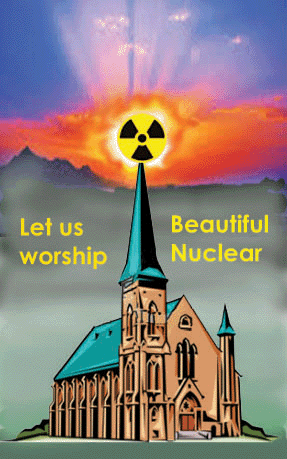
The Sizewell C team has been raising awareness of the new nuclear power
project at community events across the county this summer. From The Suffolk
Show and the First Light Festival to Sotterley Country Fair, the team have
been engaging with thousands of people across the county as the project
continues to make significant progress.
“We’re really lucky in Suffolk to
have some of the best summer festivals and community events in the
country,” says Marjorie Barnes, Head of Regional External Affairs and
Development, Sizewell C. This week, Sizewell C volunteers attended the
Aldeburgh Carnival, and in September the team will be at the first Leiston
Book Festival.
Sizewell C 23rd Aug 2024
Hungary again breaks with West: Ukrainian attack on Kursk is ‘wrong’
Tyler Durden, Zero Hedge , 24 Aug 2024
Hungary has broken with its NATO and EU allies in condemning Ukraine’s Kursk incursion, calling it out as not purely ‘defensive’ but as part of needlessly provocative offensive operations against Russian territory.
Gergely Gulyas, top advisor and spokesman for Hungarian Prime Minister Viktor Orbán said in a Thursday press briefing that Budapest is staunchly “pro-peace” – and when asked about the ongoing Kursk invasion, he said: “Ukraine is not only defending, but also attacking. We want a ceasefire and peace.”
Gulyas went on to explain that Hungary is against anything which thwarts potential diplomatic settlement to the war. He said this is “wrong” given the offensive includes a “spillover of the hostilities into Russian territory.”
………………………………………………………………….. Orban has certainly not shared the same enthusiasm for developments in Kursk as other European leaders. For example, recently the EU’s top diplomat Josep Borrell “reiterated the EU’s full support to the [Ukrainian] people’s fight.”
…………………………….Interestingly, there’s been similar pushback coming from Italy of late related to the Kursk offensive, akin to Hungary’s criticisms:
Italy’s Defence Minister Guido Crosetto has ignited a political firestorm with comments that appear to question Ukraine’s military operations inside Russian territory, POLITICO reported. In an interview, Crosetto warned that ‘no country should invade another country’ and expressed concerns over the conflict escalating into Russian territory, which could complicate efforts toward peace. His remarks have raised doubts about Italy’s commitment to Ukraine, despite Prime Minister Giorgia Meloni’s staunch support for Kyiv since the start of Russia’s invasion.
Crosetto emphasized that the weapons provided to Ukraine by Italy are intended strictly for defensive purposes, clarifying that these arms ‘do not have the possibility of being used for an attack on Russian territory’.
On a strategic level, while Ukraine forces have certainly dealt a serious morale blow to Kremlin leadership, Russia is still on the advance in the Donbass, where the front line to the conflict is located. If and when Ukraine’s Kursk operation utterly fails, it will have translated into no actual strategic gains in eastern Ukraine. https://www.zerohedge.com/geopolitical/hungary-again-breaks-west-ukrainian-attack-kursk-wrong
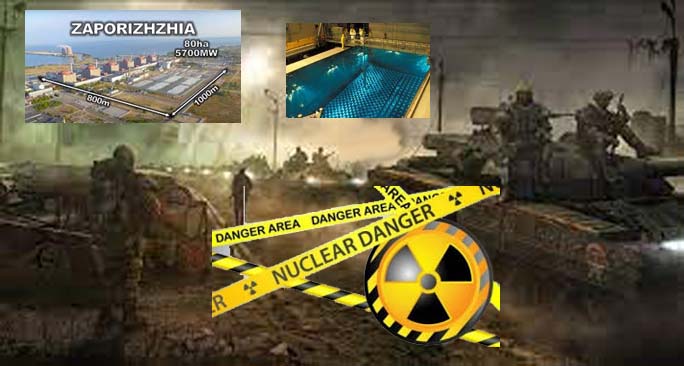
Fire at Zaporizhzhia elevates meltdown risk
13 Aug 24, https://cnduk.org/fire-at-zaporizhzhia-elevates-meltdown-risk/
CND scientific advisor, radiation expert Dr Ian Fairlie writes about the elevated risks posed by the recent fire at the Zaporizhzhia nuclear plant.
The recent fire at the Russian-occupied Zaporizhzhia nuclear plant in Ukraine is causing much concern throughout Europe.
Ukraine’s nuclear energy company, Energoatom, which operated the site until Russian forces seized control in the early days of the war, confirmed that flames broke out at the service water supply facility, later engulfing one of the cooling towers. Both Vladimir Putin and Volodymyr Zelensky have traded blame for the fire. The six nuclear reactors at Zaporizhzhia are in cold shutdown and no nuclear activity was recorded on Sunday August 11, but the overall risk of nuclear meltdown remains elevated.
In 1986, the huge nuclear accident at the Chornobyl nuclear station in Ukraine resulted in radioactive fallout throughout Europe including all of the UK.
Ideally, the UK government should make arrangements to pre-distribute prophylactic iodide tablets (to protect against thyroid cancer) to all individuals who wish them, as occurs in many countries, but it has resisted previous calls for this. Current UK official advice on iodide tablets merely states “you will be given official advice from government or emergency services on how to get them, when to take them and how much to take”.
In the absence of timely official UK advice, readers may wish to consult official US advice or the WHO’s advice.
“Final Investment Decision (FID) ” in Sizewell C nuclear station might never happen

There are media reports that a Final Investment Decision (FID) “risks
dragging into 2025″ over negotiations with investors. See Bloomberg’s
report, also New Civil Engineer and Energy Live News. These articles do not
consider whether a FID might not in fact ever happen, but we are keeping up
the pressure. Interestingly, while Bloomberg mentions four of the known
possible investors (see list below on original), USS and Equitix are absent. It’s
unclear what, if anything, this means but we are attempting to find out. If
you have not yet written to these companies to urge them not to invest, now
would be an excellent time to do so.
Stop Sizewell C 22nd Aug 2024
Zelensky’s Misadventures in Kursk

This operation is likely to be working upside-down to what we are reading in corporate media.
Not long prior to the incursion, the Biden regime had given Kiev dispensation to use U.S.–made weapons against Russian targets so long as these were deployed in self-defense and against military targets.
the question remains. What is the point as the Kursk operation continues?
By Patrick Lawrence / Original to ScheerPost, 23 Aug 24
It has been three weeks since ground units of the Armed Forces of Ukraine crossed into the Kursk province in southwestern Russia, surprising — or maybe not surprising — the U.S. and its clients in the North Atlantic Treaty Organization. Two days later, the AFU began artillery and drone attacks in Belgorod, a province just south of Kursk. It has been a little more than a week since explosions at the Zaporozhye nuclear power plant, which lies in what is now Russian territory along the Dnipro River, ignited a fire in one of the plant’s two cooling towers. All six reactors are now in cold shutdown.
In the still-to-be-confirmed file, BelTA, the Belarusian news agency, reported last weekend that Ukraine has amassed significant forces along the Belarus–Ukraine border. Aleksandr Lukashenko, the Belarusian president, put the troop count at an improbable 120,000. Further out in speculative territory, RT International reported at the weekend that the AFU is “preparing a nuclear false flag—an explosion of a dirty atomic bomb,” targeting nuclear-waste storage sites at the Zaporozhye plant. RT cited “intelligence received by Russia” and a military correspondent and documentarian named Marat Khairullin.
Hmmm.
When I began my adventures in the great craft at the New York Daily News long years ago, two of the better shards of wisdom I picked up were, “Go with what you’ve got” and “When in doubt, leave it out.” Let us proceed accordingly as we consider Ukraine’s latest doings in the proxy war it wages. I will leave aside the BelTA and RT International reports pending further developments, but with this caveat: Amassing units along the Belarus border would be entirely in keeping with the AFU’s recent forays into Russian territory. As for the imminence of a dangerous false flag op at the Zaporozhye plant, I would not put it past a regime that has acted recklessly and irrationally on numerous occasions in the past.
Why, we are left to ask of what we know to be so, did the AFU send troops, tanks, artillery, drone units, and assorted matériel into Kursk on Tuesday, Aug. 6? And then the ancillary operation in Belgorod? Everyone wondered this at first—supposedly everyone, anyway. This is our question, and I will shortly get to the “supposedly.”
On the eve of the incursion, Kiev was losing ground steadily to a new Russian advance in eastern Ukraine. Critically short of troops, the Ukrainian forces are, indeed, about to lose a tactically significant town, Pokrovsk, on their side of the Russian border. The thought that the AFU would sustain and expand its Kursk operation to bring the war to Russian territory in any effective way is prima facie preposterous. What was the point? Where is the strategic gain?
In his speech Monday evening at the Democratic Party convention in Chicago, Joe Biden defended his proxy war in Ukraine as a just war waged in the name of democracy and liberty. Oh? setting aside the emptiness of this characterization, the question remains. What is the point as the Kursk operation continues? The AFU now holds one Russian town and six villages, according to the latest reports, which also indicate they have set about destroying bridges critical to Russian supply lines. But where to from here? I do not see a sensible answer.
There is no question the Russians were caught off guard when the AFU crossed into the border village of Sudzha and proceeded with evidently little initial resistance further into Russian territory. Hundreds of thousands of Russians have been evacuated; the governor of Belgorod quickly declared a state of emergency after the drone and artillery strikes of Aug. 14.
But we cannot count this as any kind of astute strategic move. I do not pretend to have an inside read as to Russia’s apparent intelligence failure or what looks like its flat-footed response. But I do not think we can correctly mark down events to date to the AFU’s superior strength or the Russians’ weakness or incompetence. Western correspondents are having a fine old time reporting that klutzy, clumsy Moscow is once again stumbling, but I buy none of it. In my view this is probably another case of Russian restraint: The AFU is using U.S. — and NATO — supplied weapons, and the Kremlin has all along been acutely sensitive to the risk of escalation against Kiev’s Western sponsors.
My conclusion: No one’s script has flipped. This operation is likely to be working upside-down to what we are reading in corporate media. The best explanation they have come up with so far is that Kiev’s plan was to draw Russian forces away from the front on the Ukrainian side of the border. That has plainly not happened, however much The Times indulges in denial on this point. “And now Moscow has begun withdrawing some troops from Ukraine in an effort to repel Kyiv’s offensive into western Russia, Constant Méthuet reported Aug. 14 — before adding “according to U.S. and Ukrainian officials.” Crapulous journalism. Simply crapulous. There is no evidence of this whatsoever—only of further Russian gains as noted above.
Inversely, the Kursk adventure required a lot of Ukrainian units to get going and more now to sustain. It is Kiev that is wasting resources on what is bound to end in retreat. The Russian military has not marshaled anything approaching its full force. This is likely to end when Moscow decides it should, and in the meantime the Russians appear to wage the same wearing war of attrition that has reduced the AFU to something close to a desperate force on the home front.
The initial press reports of the Kursk adventure had it that top officials in Washington were caught entirely by surprise and were as perplexed as the rest of us as to the “Why?” of the thing. I do not accept this at face value, either. The Times ran a lengthy report on the Ukrainians’ preparations, featuring residents in the towns bordering Kursk remarking for weeks about the buildup of AFU units and matériel before the operation began. Russian intelligence took note, The Times also reported. And the Pentagon, the intelligence agencies, and the administration were all taken by surprise? To quote an East European emigre I knew in the old days, “Gimme break.”
Not long prior to the incursion, the Biden regime had given Kiev dispensation to use U.S.–made weapons against Russian targets so long as these were deployed in self-defense and against military targets. And the only reason the U.S. is at all interested in Ukraine, we must remind ourselves—forget about freedom and democracy, for heaven’s sake—is for its use in prosecuting the West’s long, varied campaign to subvert “Putin’s Russia.” This remains the ultimate objective. In the matter of Washington’s hand in directing the Zelensky regime from one adventure to another, Biden’s national security people wear more fig leaves than you find on a tree in Tuscany. …………………………………………………………………………………………………………………
Maybe Zelensky wants some Russian real estate as a bargaining advantage in negotiations with Russia he has come to accept as inevitable. It is possible but does not fit with his adamant insistence that the full restoration of Ukrainian territory, including Crimea, is non negotiable — a precondition to any diplomacy. And as in Netanyahu’s case, a settlement would put his political future greatly in doubt.
In any case, Zelensky chose badly when the AFU crossed into Russian territory at Kursk. The Red Army’s defeat of the Wehrmacht at Kursk, in 1943, was the largest battle in the history of warfare and left roughly 1.7 million Russians dead, wounded, or missing. Along with Stalingrad, it marked a decisive moment in the Allied victory over the Reich. Russians do not forget this kind of thing, especially when German weapons are part of the AFU’s arsenal. The thought of Ukrainian troops and tanks holding Kursk is another of the miscalculations that litter the story of this war since it began with the U.S.–inspired coup 10 years ago. https://scheerpost.com/2024/08/22/patrick-lawrence-zelenskys-misadventures-in-kursk/
A new French fairy tale: “Cheap” nuclear electricity in France is not what it appears.

The French public are paying for their nuclear addiction — and will pay even more when the plants need decommissioning.

By Axel Mayer, 11 Sept 23, https://beyondnuclearinternational.org/2023/09/11/a-new-french-fairy-tale/—
“Bread and games”(Panem et circenses) were the enforcement strategies in the Roman Empire to maintain power. “Cheap petrol, cheap electricity and football” are popular campaign strategies under a democracy, says Axel Mayer, Vice-President of the Trinational Nuclear Protection Association (TRAS).
In France, the nuclear industry is in decline and the nuclear company EDF is heavily in debt. At the same time, President Macron is once again promising cheap nuclear power and wants to have new small nuclear power plants built. A small part of the French nuclear industry’s financial problems is to be solved with EU money.
In this context, the fairy tale of cheap French nuclear power is happily spread in France and also in Germany and the use of nuclear energy is praised as the miracle weapon in the losing war against nature and the environment. However, the price of electricity in France is only apparently cheap.
According to a report of the supreme audit court in France, the research and development, as well as the construction of the French nuclear power plants, cost a total of 188 billion euros. Since in France the “civilian” and the military use of nuclear power cannot be separated, the sum is probably much higher. Retrofitting France’s outdated reactors will cost over 55 billion euros. Liberation magazine reports retrofitting costs of nearly 100 billion euros by 2030.
People of France are paying for expensive nuclear power with their taxes
According to a report by the French Ministry of Economy, the semi-state-owned EDF had debts of about 41 billion euros at the end of 2019, an amount that is expected to be nearly 57 billion euros by 2028. To avoid domestic political problems, EDF is not allowed to raise the price of electricity for political reasons. EDF liabilities are driving up France’s national debt massively. The people of France (and especially their grandchildren) are paying for the seemingly cheap, but in reality expensive nuclear power with their taxes.
This cost does not include the dismantling of the nuclear power plants or any costs of a severe accident. A serious nuclear accident would have devastating consequences in France. A government study estimates the cost at 430 billion euros.
Demolition costs of over 100 billion euros
In France, EDF operates 56 outdated reactors that are now becoming old and decrepit almost simultaneously, but the company has built up almost no reserves for decommissioning. In Germany, the government is very optimistic about a 47 billion euros cost for decommissioning and final storage. The decommissioning of the large number of French nuclear power plants could cost well over 100 billion euros as costs rise, if no savings are made on safety. There is a distinct possibility that the nuclear industry could bankrupt the French state even without a nuclear accident that could happen at any time.
A “European Pressurized Water Reactor” (EPR) has been under construction on France’s Atlantic coast in Flamanville since 2007. The flagship project was originally scheduled for completion in 2012 at a fixed price of 3.2 billion euros. Since then, the start of operation has been postponed again and again, and the Court of Auditors now puts the cost at over 19 billion euros. Whether the EPR can go online in 2024 is questionable. The model reactor will never work economically.
In countries with a functioning market, no new nuclear power plants are building
Swiss nuclear lobbyist and Axpo CEO Christoph Brand puts the kibosh on dreams of cheap nuclear power from new, small nuclear plants. “The production costs for the electricity supplied by new nuclear power plants are currently about twice as high as those of larger wind and solar plants,” Brand said. “No matter how one assesses the risks of nuclear power, it is simply not economical to rely on new nuclear plants,” he said in the pro-nuclear NZZ on Oct. 21, 2021.
In countries with a functioning market, no new nuclear power plants are being built. When in doubt, it always helps to look at EDF’s share price, which has fallen massively over the long term, to assess the market chances of the nuclear renaissance announced by President Macron.
“Bread and games” with artificially low nuclear electricity prices can work in election campaigns. Low-cost, risk-free electricity is generated today with photovoltaics and wind energy. (AM/hcn)
Putin says Ukrainian forces tried to strike Kursk nuclear plant
The Russian leader does not offer any evidence for his claim but says the UN nuclear watchdog has been alerted.
Russian President Vladimir Putin says Ukrainian forces have tried to attack the Kursk Nuclear Power Station in an overnight raid.
The Russian leader did not offer evidence for the claim but said on Thursday that Moscow has informed the United Nations nuclear watchdog, the International Atomic Energy Agency (IAEA), about the incident.
Ukraine has not responded to Russia’s allegations.
“The enemy tried to strike the nuclear power plant at night. The IAEA has been informed,” Putin said in a televised government meeting.
Putin made the claim as Ukrainian forces continued to fight inside Russia more than two weeks after launching an ambitious cross-border attack, which has become an embarrassing headache for Moscow.
While the strategic aims of Ukraine’s Kursk incursion remain uncertain, President Volodymyr Zelenskyy on Thursday said the attack is part of an effort to bring the war to an end on terms amenable to Ukraine…………………………. https://www.aljazeera.com/news/2024/8/22/putin-says-ukrainian-forces-tried-to-strike-kursk-nuclear-plant
Sizewell C seeks permit for ‘water vole displacement activities’.
Sizewell C is seeking a permit to “undertake water vole displacement activities” on two rivers near the development.
Sizewell C seeks permit for ‘water vole displacement activities’.
Sizewell C is seeking a permit to “undertake water vole displacement
activities” on two rivers near the development.
ENDS 21st Aug 2024
Report on nuclear power in Wales is so secret the UK Government won’t even disclose its name

21 Aug 2024, Martin Shipton, https://nation.cymru/news/report-on-nuclear-power-in-wales-is-so-secret-the-uk-government-wont-even-disclose-its-name/
A campaigner wanting to find out how power from a possible new nuclear power plant on Anglesey would be channelled into the national grid has been refused all information, including even the name of an official report on the matter.
Dr Jonathan Dean, a trustee of the Campaign for the Protection of Rural Wales, wrote to the UK Government’s Department of Energy Security and Net Zero (DESNZ), asking: “Please could I get a copy of the evaluation report where it was concluded that Wylfa on Ynys Môn should be selected as the next large nuclear site after Sizewell C.”
His request was rejected. He wrote back stating: ”I wondered if it would be possible to obtain a redacted copy of the report you mention. I have little interest in any commercial details. Ideally the whole report suitably redacted, but at least those sections dealing with the connection to the national grid; use of waste heat as per section 4.8 of national policy statement EN-1; location and area of land considered on Ynys Môn; and means of overcoming the many reasons given by the Planning Inspectorate in their recommendation to the Secretary of State in 2019/2020 to refuse the DCO [Development Consent Order] application made by Horizon Nuclear Power.
“Would it be possible to know the title and any reference number for this report to aid future requests?”
Confidential information
He was then told: “The report has been withheld in full under regulation 12(5)(b) of the Environmental Information Regulations 2004 and no part of the report is available for disclosure … [The] report does not have a reference number and the title of the report is confidential information.”
Later the Department said it had quoted the wrong section of the regulations as the reason for turning down Dr Dean’s request . The correct section was regulation 12(5)(e), which states: “(The) confidentiality of commercial or industrial information where such confidentiality is provided by law to protect a legitimate economic interest.”
Dr Dean told Nation.Cymru: “There have been tentative ideas to connect the transmission grid in north Wales to that in the south since at least 2009 that I am aware of. Then the idea was a subsea connection from Wylfa to Pembroke And back in 2012 NGET [National Grid Electricity Transmission] wanted to build a 400 kV transmission line to Lower Frankton from Cefn Coch to service mid Wales wind farms.
“The Offshore Transmission Network Review in 2020 again suggested a subsea connection linking Lancashire to Wylfa to Pembroke, taking in the new Irish Sea wind farms.
“The Holistic Network Design (HND) of 2022 changed things. It brought power subsea from Scotland into Pentir (Bangor) and took power from Pentir to Swansea North substation. Although heavily caveated as just indicating a network need, and not indicating technology or route, it was described as a ‘double circuit’ which could be interpreted as meaning pylons.
“In the ‘Beyond 2030’ report this year the ESO [Electricity System Operator] says that the subsea link into Pentir will be double the capacity (4 GW?) of that in the HND, but interestingly show the extra capacity connecting to Bodelwyddan not Pentir.
“Meanwhile NGET have planned a substation at Gwyddelwern, supposedly for north Wales wind farms, and Llandyfaelog for mid Wales wind farms.
“Last week, the Beyond 2030 Celtic Sea report revealed Llandyfaelog will be one of the landing points for the Celtic Sea wind farms, and that Swansea North substation has no free capacity or space to expand
“Pentir is constrained ‘behind’ both Eryri and the new north east Wales national park (currently Area of Outstanding Natural Beauty). If all the capacity from Scotland came into Bodelwyddan and headed south from there, depending on the final limits of the new national park, there may be no obvious hard constraints to pylons.
“So what might be possible? The line could go down the vale of Clwyd, maybe via the new substation in Gwyddelwern, to Cefn Coch (previously desired substation site) then Newtown (132 kV link), Builth and down the Tywi to the new substation in Llandyfaelog.
“Vyrnwy Frankton wouldn’t be needed, Tywi Usk wouldn’t be needed, and with a bit of re-jigging, Teifi Tywi wouldn’t be needed. Technically it would be a far superior transmission solution (at least the correct transmission voltage!) with up to 6 GW capacity and meet the HND objectives of linking north to south Wales. It would likely be 50m pylons carrying 400 kV double circuits.
“If there wasn’t the desire to extract wind power from mid Wales, the alternative could be a HVDC [High Voltage Direct Current] ‘bootstrap’ from Pentir to Pembroke (as per 2009). The two double circuit lines out of Pembroke can carry 12 GW so can easily accept 6 GW from north Wales (4 GW of it from Scotland) and 3 GW from the Celtic Sea, while still having space for the 2 GW Pembroke power station which will, apparently, be converted to hydrogen and/or carbon capture.
“But this is just my feverish imagination. We will have to wait and see.”
Grid connection
Responding to the UK Government’s secrecy over the transmission link from Wylfa, Dr Dean said: “I have always had an interest in Wylfa as I brought my family to Ynys Môn in the 1960s. I remember going to one of the first public meetings about Wylfa B in 1976 to hear my father talk.
“When Hitachi were developing the last iteration of Wylfa B I was involved with the campaign to have the grid connection put underground or subsea. This campaign was supported by Albert Owen, Rhun ap Iorwerth and then Virginia Crosbie. However Hitachi refused to consider a subsea connection and National Grid refused to consider a buried connection
“The Hitachi proposal was ultimately recommended for refusal by the Planning Inspectorate for multiple reasons. Knowing the north Wales grid will be so constrained by 2030, due to the growth of renewables, so much so that pylons are required from Bangor to Swansea, I was shocked at the announcement of a GW scale station. I had expected a series of SMRs [Small Modular Reactors]. There will be no spare grid capacity in the whole of north Wales for nuclear.
“As trustee of CPRW I was concerned that a new line of pylons would be put through Eryri, against UK planning policy, as there is no way around the national park other than under the sea. The UK. planning policy for nuclear has never considered grid connections, so I assumed that the DESNZ report must have addressed this. A power station without a grid connection would just be an enormous white elephant
“I still don’t understand why such technical details should be withheld from the public, given there was a very clear announcement the power station would happen. The fact the report has a ‘secret’ title, and no reference number, makes me think it doesn’t actually exist! But I cannot believe governments announce new power stations based on no analysis or consideration. Surely not?
“All I want to know is, will it be a subsea cable or more pylons all the way to Connah’s Quay? I really don’t see the need for such secrecy.
‘Very serious’ nuclear situation could happen ‘at any moment’ in Ukraine, says IAEA chief
Cathy Newman, Presenter 4 News 20 Aug 24
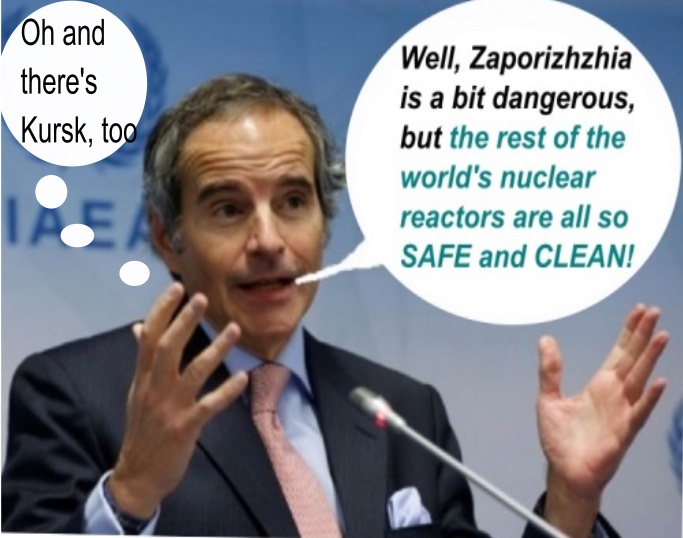
We spoke to Rafael Grossi, Director General of the International Atomic Energy Agency.
Cathy Newman: Let’s start with Zaporizhzhia, because earlier you said that safety was deteriorating there after this drone strike. How critical would you say it is?
Rafael Grossi: Well, we could have a very serious situation any moment. Because when you see the amount of military activity surrounding the plant………………………….The physical integrity of the facility is being challenged. So, this is why we say that what we see is a deterioration. The condition of the plant, I should say, is that it’s not producing energy at the moment, is in jargon what we call shut down. But there’s a lot of material there, a lot of nuclear material there. There’s a lot of spent fuel there. Fresh fuel. So, things that if impact could trigger the release of radioactivity.
Cathy Newman: So the risk has been minimised, but it hasn’t been removed, clearly. I mean, in theory, another Chernobyl is possible?
Rafael Grossi: ………………………………………… I would say, as I was just mentioning, you have all of this material around and you could have a situation theoretically where because of the loss of external power, which has occurred, we had nine episodes of complete blackouts of the plant. So no cooling function. So if you lose all that, you could eventually have a meltdown.
Cathy Newman: So it’s perilous, clearly. I wonder whether you think the risk of the Kursk plant, ……………. Russia is now fortifying around that plant. I mean, is that potentially more risky because it’s a much more volatile situation.
Rafael Grossi: It is certainly serious and we should take it very, very seriously. We are taking it, the agency at the IAEA, very, very seriously. This nuclear power plant is, I would say, within artillery range already. You have just informed that the incursion of the Ukrainian troops, is a few miles, a couple dozen kilometres into Russian territory and just a few miles, in kilometres is about between 20 and 30 km from the plant itself. And there is a technical aspect here. You were just mentioning Chernobyl. The reactors here, you have six reactors in Kursk. You have two reactors that are being decommissioned. You have two reactors that are operating. No shutdown, operating when you have hot reactors. Anything that could happen there could be maximised in this sense.
And then two other units being built. The two reactors that are operating are of a type called RBMK, which is exactly the type of reactors, an old model type of reactor was the one, like the ones that were in Chernobyl. These reactors have a particularity. Normally when you look at a nuclear reactor is a dome. There is a concrete and metal protection. These two reactors don’t have that, don’t have any of that. The core of these reactors is open. Is like, as if you were here and you could see the fuel elements there. So, God forbid, was there an impact on the plant, we could have a very serious situation…………………………………………………………………………………. https://www.channel4.com/news/very-serious-nuclear-situation-could-happen-at-any-moment-in-ukraine-says-iaea-chief
Defence Correspondents: The Journalistic Wing of the Military?
There are stenographers – and then there are UK defence correspondents.
DECLASSIFIED UK, DES FREEDMAN, 19 August 2024
An analysis of broadcasters’ online coverage of defence spending and strategy since Keir Starmer won the election shows that reporting is virtually 100% in line with the government’s own priorities.
Critical voices, where they are included, are entirely from the right.
All 20 articles posted under ‘defence’ since 4 July – 14 from Sky, 5 from the BBC and 1 from ITV – faithfully reproduce the government’s agenda.
These include its proposals for a defence review, its promise to increase military spending to 2.5% of GDP, its commitment to Ukraine and NATO (described on the BBC by foreign secretary David Lammy as ‘part of Britain’s DNA’).
Its notion that there is a need to restore confidence in the military in order to face up to “rapidly increasing global threats” (as Sky quoted defence secretary John Healey) also features.
The only critical voices that appear are Conservative shadow ministers, hawkish think tank spokespeople and military ‘experts’, all speaking about how vital it is to boost defence spending, which currently stands at £64.6bn a year (2.32% of GDP).
Such spending is apparently necessary to confront what the army’s chief Sir Roland Walker has described as an “axis of upheaval” composed of Russia, China, Iran and North Korea.
Sky quoted Walker without comment on 23 July as saying that “there was an ‘urgent need’ for the British Army to rebuild its ability to deter future wars with credible fighting power”.
Churnalism
Much of the coverage feels like a press release from the Ministry of Defence, which is hardly surprising given that MoD statements are liberally incorporated – without challenge – into news reports.
For example, ITV News’ report of 16 July on Labour’s “root and branch” review of defence draws heavily on the MoD’s release earlier that day
Its only deviation from government spin is that it also quotes the shadow armed forces minister Andrew Bowie saying that “the country didn’t need another review, and instead ‘we just need to get on and spend more money on defence’.”
Both the BBC and Sky ran lengthy, gushing reports on the speeches given by the defence secretary and General Walker at the Royal United Services Institute’s ‘Land Warfare’ conference on 22/23 July, unambiguously pushing the line that increasing defence spending was crucial to securing peace.
None of these pieces featured comments about the huge political and economic risks of increasing defence spending and a possible acceleration, not reduction, of instability.
Guns not butter
This isn’t just a matter of excluding voices from the left arguing for a completely different set of priorities. There isn’t even room for mainstream economists like Paul Johnson from the Institute for Fiscal Studies, criticising the way recent governments have presented the proposed hike and making the obvious, if important, point that “[m]ore money for defence means less for everything else”…………………………………………………………………………………………..
‘Pre-war world’
The tone of recent coverage is, however, entirely in line with what has gone on before where news broadcasters have acted more as cheerleaders of the UK government’s strategic defence priorities than impartial journalists.
For example, following a widely reported speech in January by then defence secretary Grant Shapps, committing the UK to spending 2.5% of GDP on defence, Sky News launched a series called “Prepared for War?” in April.
This examined whether the UK was ready for the “possibility of armed conflict” and was based on interviews with defence specialists, former military officers and academics, all of whom were singing to the same pro-war hymn sheet.
It reported on the emergence of a “national defence plan” to deal with “mounting concerns about Russia, China and Iran” and uncritically embraced the idea that we are now in a “pre-war world”.
This has all the trappings of a drive to war.
Seduced
Broadcasters’ favourite defence-related stories appear to be ones where they can show dazzling images of the latest military hardware.
As Richard Norton-Taylor, former defence correspondent for the Guardian and now contributor to Declassified UK, has noted: “The MoD knows how to seduce journalists, especially those writing for specialist defence publications – often used as primary sources by mainstream journalists – by showing off new weapons.”
So in January, Sky News ran a puff piece on a new laser system, DragonFire, developed by the MoD to the tune of around £100m, that spoke of its “pinpoint accuracy” taken straight from the MoD’s own press release. ……………………………………………………………………………………………………………..
As always, an uncritical embrace of the UK’s strategic geopolitical interests comes before any commitment to transparency and even to exploring the claim that increasing military spending might not be the best way of de-escalating rising tensions across the globe.
How do we account for this deference on the part of defence correspondents?
Declassified UK has run several stories examining this question and revealing the preferential treatment of favoured journalists, sanctions against those who ask tough questions, the close contacts between correspondents and defence and security-related officials and indeed the existence of a revolving door between journalism and military PR.
When it comes to reporting on defence and security, ‘[d]eference, as much as secrecy, remains the English disease’, notes Norton-Taylor.
Indeed, all too often, it’s not a specific strategy so much as ideological congruence between the defence establishment and defence journalists about what is understood to be protecting the “national interest”.
That means that while the UK ramps up its support for Ukraine and continues to stand by Israel in defending it from possible attacks from Iran, British broadcast journalists are operating effectively as part of a coordinated effort to boost defence spending.
Their silence on stories such as the training of Israeli troops inside the UK or the number of UK military flights from Cyprus to Israel is just as troubling as their more visible and uncritical amplification of successive UK governments’ defence priorities.
This isn’t journalism but public relations https://www.declassifieduk.org/defence-correspondents-the-journalistic-wing-of-the-military/
Ukraine could trigger ‘another Chernobyl’ – ex-US Army officer.

A meltdown at the Kursk Nuclear Power Plant would make the region uninhabitable, Stanislav Krapivnik has warned
https://www.rt.com/russia/602744-ukraine-may-trigger-another-chernobyl/ 21 Aug 24
Ukraine’s armed forces could cause a nuclear disaster that would affect most of Europe if they strike the Kursk Nuclear Power Plant, former US Army officer Stanislav Krapivnik has warned.
In an interview with RT on Saturday, Krapivnik discussed the difference between a dirty bomb and a nuclear bomb, explaining that while a dirty bomb does not have the critical mass or enriched material, it could cause large scale contamination if it hits nuclear waste.
If the coolant system in an active plant is targeted, it would cause a “nuclear meltdown” which could lead to an incident similar to Fukushima or Chernobyl, he added. Such an event would impact most of Europe, especially at this time of the year “when the wind blows northwest.”
Krapivnik predicted that “if there is enough evidence” of the threat, it would “force a very large reaction” from the Russian government, as a meltdown at the Kursk plant would make the region uninhabitable.
“And the fallout is going to go straight to the northwest into Europe,” he said, adding: “It’s going to hit the Poles, the Germans, the Danes, the Scandinavian countries,” right into the UK. “But apparently the leadership of those nations really doesn’t give a damn.”
On Friday, Russian military journalist Marat Khairullin reported, citing sources, that Kiev is preparing to detonate a dirty atomic bomb targeting nuclear waste at either Russia’s Zaporozhye NPP or the Kursk NPP.
While the nuclear plant in Zaporozhye, the largest such facility in Europe, has been shut down, the plant in Kursk Region is operational.
The Russian Defense Ministry responded to the reports by saying that any attempts to create a “man-made disaster in the European part of the continent” would be met with “tough military and military-technical countermeasures.” Foreign Ministry spokeswoman Maria Zakharova called on the international community “to immediately condemn the provocative actions prepared by the Kiev regime.”
Kiev has denied the allegations. Neither the UN nor the International Atomic Energy Agency have addressed the threat.
Nuclear unicorn Newcleo to move holding company from UK to France to tap EU funds
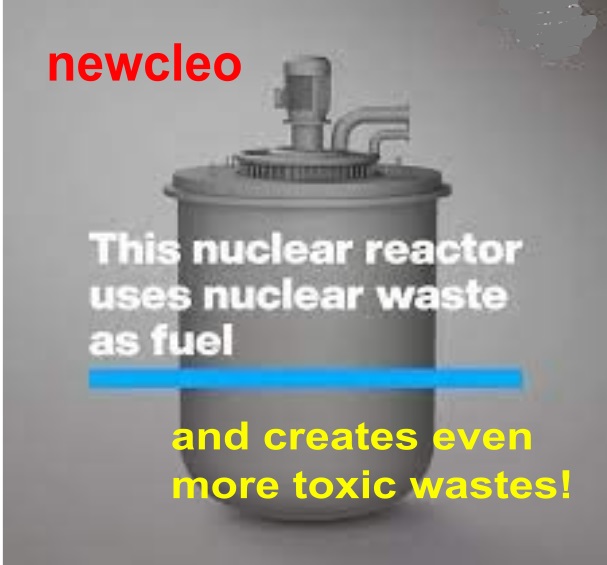
The move comes as the startup targets a €1bn equity round
Sifted Kai Nicol-Schwarz, 21 Aug 24
Nuclear power startup Newcleo is moving its holding company from the UK to France, as the company looks to tap EU funding pools in its bid to raise a €1bn equity round.
Newcleo said in its annual accounts, released yesterday, that it had announced to shareholders and employees in January that it was making the move to increase the potential of attracting “significant funding from EU financial institutions”.
“While we are moving the location of our holding company, our plans for the UK are unchanged and we remain committed to investing and building next-generation SMRs to generate electricity for the UK grid and industry,” a Newcleo spokesperson told Sifted. Sifted understands that the move would not involve employees relocating.
…………………………………………………………. founder and CEO Stefano Buono told Sifted in May that the company would need to raise billions more if it’s to realise its ambitions of building a revenue-making commercial reactor by the early 2030s.
Newcleo is hoping French and EU institutional funding can help it get there. “The rationale for the restructure is partly to improve the potential to attract funding from French and other EU financial institutions in the future,” the company said in its accounts.
French government-funded investment bank Bpifrance has “strict” requirements on holding companies being based in the country, explains Tommy Stadlen, cofounder and partner at Giant Ventures.
………………………………..Newcleo’s average monthly cash burn is €13m for the first half of 2024 and it made a loss of €57.5m in 2023 — up from €18.1m in 2022 — according to its accounts. The company had €221m of cash in the bank on 30 June 2024.
https://sifted.eu/articles/nuclear-newcleo-raise-startup-france
Final investment decision on new nuclear plant Sizewell C is delayed
The crucial final investment decision (Fid) for the new nuclear power
plant Sizewell C is unlikely to be agreed until 2025, according to recent
reports. Financial sector publication Bloomberg reported that anonymous
sources close to the project said negotiations between potential private
investors were moving more slowly than had been expected.
The Fid had already been delayed by the general election, but new energy secretary Ed
Miliband indicated his support for Sizewell in an early speech to
parliament before the 2024 summer recess. Bloomberg reported negotiations
with Centrica, Emirates Nuclear Energy Corporation, Amber Infrastructure
Group and Schroders Greencoat are ongoing.
Earlier in July, Centrica chiefnexecutive officer Chris O’Shea said: “An investment decision this year would be dependent upon how the government and the Sizewell company want to
move. “We are able to move as quickly as the other parties, but I think
we should be realistic that the government have been in office less than
three weeks and they need to figure out what they want to do.”
New Civil Engineer 20th Aug 2024
UK’s nuclear facilities ‘at high risk of atomic blackmail’ from Putin

the British sites can be seen in the same way as those in Ukraine in being susceptible to sabotage and infiltration.
The full-scale invasion of Ukraine has brought with it high-level warnings that the UK is headed for a direct military confrontation with Russia.
Josh Layton https://metro.co.uk/2024/08/19/uks-nuclear-facilities-at-high-risk-atomic-blackmail-putin-21449130/
The UK’s nuclear facilities are at high risk from hostile states who are tipping the world into war, according to an expert in risk management.
Dr Simon Bennett warned that World War Three is only a matter of years away, with Russia already pursuing a strategy of ‘atomic blackmail’.
Dr Bennett revived author Bennett Ramberg’s Cold War-era theory of how nuclear power facilities can be weaponised for political ends in calling on the UK government to ramp up defence spending.
He also believes the potential exists for a cornered Vladimir Putin to escalate from psyops to a deliberate use of the Zaporizhzhia nuclear power plant as a dirty bomb, which would have devastating consequences for Ukraine and neighbouring countries.
The risk management expert, of the University of Leicester, warned that the UK government has ‘lost sight’ of its primary duty to protect its citizens amid a slide to global conflict.
‘The full-scale invasion of Ukraine by Russia is the first large-scale conflict where there are potentially numerous nuclear power plants at risk,’ he said.
‘Not only at Zaporizhzhia, which is Europe’s largest power plant, but in Russia, where the current incursion could see the Ukrainians reach the Kursk nuclear power station if they drive hard to the east.
In the 80s, Bennett Ramberg came up with the hypothesis of atomic blackmail, which is based on the premise that as the number of nuclear power stations grows, so does the potential for an aggressor to use them to gain leverage over the owners
‘The potential for a facility like Zaporizhzhia to be used very crudely against an opponent is clear to see.
‘If the plant, which has six reactors, was rigged with powerful demolition mines, and they were detonated, the radiation would be off the scale.
‘It’s possible the Russians have already placed explosives there.’
Dr Bennett, director of the university’s Civil Safety and Security Unit, told Metro.co.uk that Putin — who is under pressure after Ukraine’s invasion of Russia’s Kursk region — is capable of the unthinkable.
He a drew a comparison with one of the darkest days of history.
‘Using Zaporizhzhia for atomic blackmail gives Putin leverage over not just Ukraine but the entire world,’ Dr Bennett said.
One of the latest safety incidents at Zaporizhzhia came last week when smoke was filmed rising from one of the cooling towers at the Russian-held facility in eastern Ukraine.
Experts doubted there was any risk of an explosion, with Ukraine saying that the fire was started deliberately by setting light to tyres.
However the use of the plant in this way, which follows continued reports of incidents involving drones and shelling, fits with Ramberg’s theory — and has implications for the UK’s own security, according to Dr Bennett.
On Saturday, the safety situation at Zaporizhzhia was ‘deteriorating’ after a nearby drone strike, the International Atomic Energy Agency said.
The party behind the explosion, just outside the site’s protected area, has not been identified. Under Rishi Sunak, the British government announced the biggest expansion in nuclear power for 70 years, and the new prime minister is also committed to building new facilities.
Through Ramberg’s thesis, the British sites can be seen in the same way as those in Ukraine in being susceptible to sabotage and infiltration.
‘If we think more laterally, the number of power stations in the UK is growing, and through the optics of Ramberg’s theory, we are offering our enemies more targets and potentially more leverage over us in a conflict,’ Dr Bennett said.
The Russian FSB security agency and GRU military intelligence are very good at hybrid warfare, so what they could be doing at the moment is recruiting and running individuals as “sleepers” within the British state and potentially within the nuclear industry, ready to be activated at any moment. Three civil servants have recently been charged under the National Security Act and my understanding is that they are alleged to have been spying for China.’
The full-scale invasion of Ukraine has brought with it high-level warnings that the UK is headed for a direct military confrontation with Russia.
British sites, including a shipyard housing nuclear submarines in Barrow-in-Furness, were last week reported by the Financial Times to be on the Kremlin’s list of targets.
Tobias Ellwood, former chair of the Commons Select Committee, responded by saying: ‘We must wake up — storm clouds are gathering.’
Dr Bennett said: ‘The British state needs to take these nuclear threats far more seriously not just within the optics of the Ukraine-Russia war but because, in my opinion, there will be a world war in the next five to 10 years. It will start in the Asia-Pacific, where China will invade Taiwan and, because of the Aukus pact, we will be directly involved in defending Taiwan.
‘Russia will be involved because of its ties with China, leading to a multi-hemisphere conflict.’

Dr Bennett, whose book ‘Atomic Blackmail?’ examines the weaponisation of nuclear facilities in the Russia-Ukraine war, has raised the issues in letters and emails to various governments, including that of Rishi Sunak, but to date has not received any acknowledgement.
‘In my opinion, the government obsession with net zero and climate change agreements distracts from a far greater threat to safety, namely atomic blackmail,’ he said.
‘The primary purpose of the state is national security and in my view we have lost sight of that purpose. The Labour government is carrying out a defence review when what we really need is to raise the 2% of GDP we spend on defence to a minimum 4% of GDP.’
The prospect of an apocalyptic conflict in a matter of years has gained traction during the Ukraine-Russia war and China’s continued pressure on Taiwan, which it views as its own territory.
The author intends to continue trying to raise the alarm.
1 This Month

22 June – Virtual Event –Climate Change: New Data, New Debate

Monday, June 22, 2026 2:30 p.m. – 3:15 p.m. CT
YouTube. Register here

Protect Sazan Island from the Trump family! https://secure.avaaz.org/campaign/en/protect_sazan_island_from_the_trump_family_loc/?bqFCVab&v=174511&cl=22707147157&_checksum=5e9dde668860e8231c33699735e16a1fbf22ab2cb01da50c999fe8732b9775ef&utm_source=email&utm_medium=blast_email&utm_campaign=174511
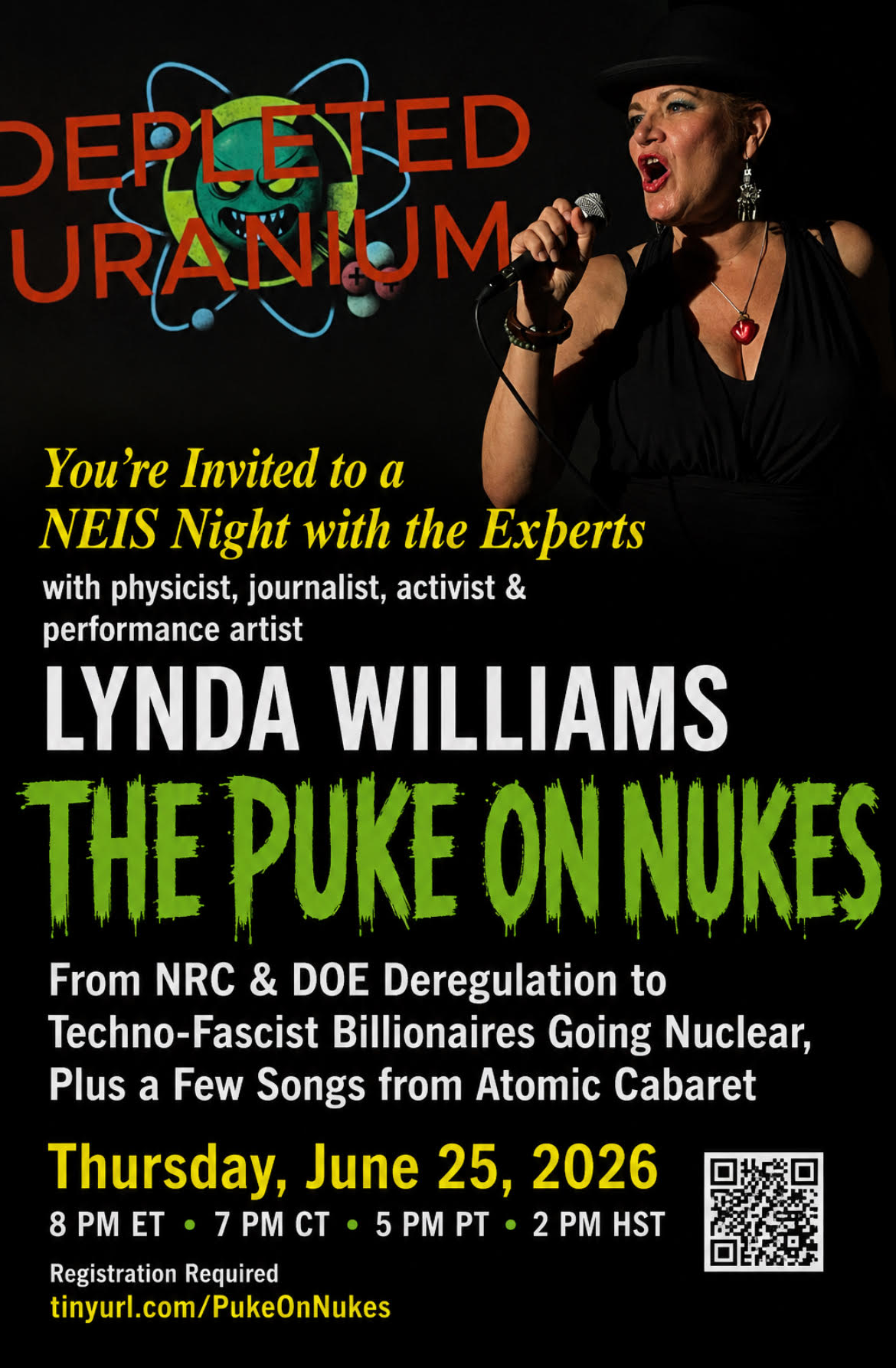
25 June- THE PUKE ON NUKES
Thursday, June 25, 2026
7pm Central Time (8pm ET, 6pm MT, 5pm PT) UTC – 5
From NRC & DOE Deregulation to Techno-Fascist Billionaires Going Nuclear, Plus a Few Songs from Atomic Cabaret REGISTER
26 June – Radiation Trainwreck at the NRC / Join the Protect Better Campaign – https://us02web.zoom.us/meeting/register/4ZlZ5_qLSHGiLSCg8FF6Bg#/registration


Cuba Is Not a Failed State – It Is a Besieged State
PETITION: “Global Appeal to Endorse Palestinian Right of Return of Refugees”
To see nuclear-related stories in greater depth and intensity – go to https://nuclearinformation.wordpress.com
-
Archives
- June 2026 (193)
- May 2026 (306)
- April 2026 (356)
- March 2026 (251)
- February 2026 (268)
- January 2026 (308)
- December 2025 (358)
- November 2025 (359)
- October 2025 (376)
- September 2025 (257)
- August 2025 (319)
- July 2025 (230)
-
Categories
- 1
- 1 NUCLEAR ISSUES
- business and costs
- climate change
- culture and arts
- ENERGY
- environment
- health
- history
- indigenous issues
- Legal
- marketing of nuclear
- media
- opposition to nuclear
- PERSONAL STORIES
- politics
- politics international
- Religion and ethics
- safety
- secrets,lies and civil liberties
- spinbuster
- technology
- Uranium
- wastes
- weapons and war
- Women
- 2 WORLD
- ACTION
- AFRICA
- Atrocities
- AUSTRALIA
- Christina's notes
- Christina's themes
- culture and arts
- Events
- Fuk 2022
- Fuk 2023
- Fukushima 2017
- Fukushima 2018
- fukushima 2019
- Fukushima 2020
- Fukushima 2021
- general
- global warming
- Humour (God we need it)
- Nuclear
- RARE EARTHS
- Reference
- resources – print
- Resources -audiovicual
- Weekly Newsletter
- World
- World Nuclear
- YouTube
-
RSS
Entries RSS
Comments RSS
 nuclear-news