The Phony Ceasefire
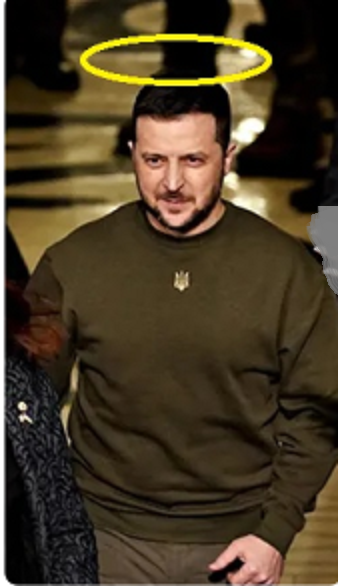
European leaders, who’ve staked their reputations on not losing in Ukraine, can apparently see no other way than to scaremonger a Russian threat and meet it by unnecessarily militarizing the continent. They need their publics to support this.
Knowing well in advance that Russia would reject it, the U.S. and Ukraine announced with fanfare that its ceasefire deal was in “Russia’s court” in what was an exercise of pure public relations, writes Joe Lauria.
by Joe Lauria, Consortium News, 16 Mar 25 more https://consortiumnews.com/2025/03/16/the-phony-ceasefire/
Nothing could have been clearer than Russia’s repeated conditions for a permanent end of the war, rather than a temporary ceasefire: Ukraine’s neutrality, its demilitarization and denazification, the inclusion of four Russian-speaking oblasts into the Russian Federation and treaties establishing a new security architecture in Europe.
Equally clear was Ukraine’s utter rejection of these conditions, demanding instead the return of every inch of its territory, including Crimea, and Ukraine’s membership in NATO.
It is the reason the two sides are still fighting a war. It is a war, however, that Ukraine is badly losing. Obscuring that fact is an important aim of Ukraine and its European allies to keep their publics onside.
But it isn’t only their publics that need convincing to continue supporting Ukraine, but the president of the United States too.
After the Oval Office dustup, in which Donald Trump and J.D. Vance laid it on the line to Zelensky in public, the Europeans held two summits. At both they made loud noises about continuing to support Zelensky, but also made clear they couldn’t do it without the United States.
Much as they loathe him, Zelensky and the European leaders need Donald Trump. So they set Zelensky up to writing a letter sucking up to Trump, a man clearly susceptible to flattery.
Very likely also influenced by his Secretary of State Marco Rubio and National Security Advisor Michael Waltz, both of whom had previously expressed neocon support for Ukraine and condemnation of Russia, Trump was apparently turned around, convinced to propose the 30-day ceasefire.
Trump then somehow got the notion that Vladimir Putin, despite his oft repeated conditions for ending the war, would yield to pressure. It could be Trump thinks he is a neutral mediator who needs to bully both sides to force them to do a deal.
So after the ceasefire was floated, Trump resumed arms and intelligence flows to Ukraine, new sanctions on Russia were threatened and Ukraine fired 350 drones at residential areas of Moscow just as Trump’s envoy Steve Witkoff was arriving in Moscow to discuss the ceasefire.
Like Casting a Lone Veto
All this was designed to push Putin to accept it or appear like a man guilty of rejecting peace. If U.S. arms, intelligence and sanctions had not deterred Putin before, why would it now?
Putin saw this as the public relations exercise that it is and treated it as such. He responded with public relations of his own.
Instead of firmly saying the expected, “No,” he said, “Yes,” followed by “nuances,” such as who would monitor such a ceasefire along a 2,000-kilometer front?
He said such a ceasefire could not begin as occupying Ukrainian troops were encircled on Russian territory; and, crucially, that a 30-day ceasefire — with no Ukrainian rearmament — could only mark the start of talks for a permanent settlement. Putin exposed the motive to give Ukrainian troops on the run a chance to regroup.
Just as designed, Zelensky and European leaders blasted Putin for being a man who loves war, and hates peace.
At the U.N. Security Council, which I covered as a correspondent for a quarter of a century, I often saw countries introduce resolutions for a vote even though they were certain one of the five permanent members would veto it.
Diplomats explained that this was done on purpose to force the arm of that nation’s ambassador to be the lone one raised in opposition to the measure for all the world to see, causing it maximum public embarrassment.
That is precisely the exercise we have seen with this phony ceasefire proposal. The Europeans and the Ukrainians are trying to milk it for all it’s worth. Zelensky did a selfie video to call Putin a “manipulator” of world leaders.
British Prime Minister Keir Starmer said: “The Kremlin’s complete disregard for President Trump’s cease-fire proposal only serves to demonstrate that Putin is not serious about peace.”
Starmer deployed the scare tactic that Putin is bent on European conquest, saying: “Russia’s appetite for conflict and chaos undermines our security back here in the United Kingdom.” He even tried to blame his political difficulties at home on Russia for “driving up energy costs.”
Meanwhile Starmer says a European peacekeeping force is moving to “operational phase” ahead of a Thursday meeting of European leaders. Only with a ceasefire and Russia’s consent could such a force be deemed “peacekeepers” however.
European leaders, who’ve staked their reputations on not losing in Ukraine, can apparently see no other way than to scaremonger a Russian threat and meet it by unnecessarily militarizing the continent. They need their publics to support this.
In the end, the “ceasefire” gambit may indeed create more public sympathy for Ukraine and more irrational fear of Russia. But the big question is whether it will harden Trump against Russia by continuing arms shipments and intelligence and perhaps levelling new sanctions against Moscow.
All that would do, however, is prolong the death and destruction. Without NATO’s direct participation in the war against Russia, which would risk nuclear annihilation, the outcome of the war is certain. Because of that, Trump could resume pressure on Zelensky to essentially give up instead.
The ball is now in Trump’s court. On Sunday he told reporters he would be discussing land and control of powet plants in telephone call with Putin scheduled for Tuesday. “We want to see if we can bring that war to an end,” he said. “Maybe we can. Maybe we can’t, but I think we have a very good chance.”
The course of this three-year conflict since Russia’s intervention makes clear that the longer Ukraine tries to fight, the worse deal it will get, no matter how many public relations points it might win along the way.
Joe Lauria is editor-in-chief of Consortium News and a former U.N. correspondent for The Wall Street Journal, Boston Globe, and other newspapers, including The Montreal Gazette, the London Daily Mail and The Star of Johannesburg. He was an investigative reporter for the Sunday Times of London, a financial reporter for Bloomberg News and began his professional work as a 19-year old stringer for The New York Times. He is the author of two books, A Political Odyssey, with Sen. Mike Gravel, foreword by Daniel Ellsberg; and How I Lost By Hillary Clinton, foreword by Julian Assange.
Britain wants Ukraine’s minerals too
It’s not just Trump. The UK views critical minerals as a government priority and wants to open up Ukraine’s vast resources to British corporations.
MARK CURTIS, 11 March 2025,
more https://www.declassifieduk.org/britain-wants-ukraines-minerals-too/?utm_source=Email&utm_medium=Button&utm_campaign=ICYMI&utm_content=Button
When UK officials signed a 100 year partnership with Ukraine in mid-January, they claimed to be Ukraine’s “preferred partner” in developing the country’s “critical minerals strategy”.
Yet within a month, Donald Trump had presented a proposal to Ukraine’s President Volodymr Zelensky to access the country’s vast mineral resources as “compensation” for US support to Ukraine in the war against Russia.
Whitehall was none too pleased about Washington muscling in.
When foreign secretary David Lammy met Zelensky in Kyiv last month he reportedly raised the issue of minerals, “a sign that Starmer’s government is still keen to get access to Ukraine’s riches”, the iPaper reported.
Lammy earlier said, in a speech last year: “Look around the world. Countries are scrambling to secure critical minerals, just as great powers once raced to control oil”.
The UK foreign secretary was correct, but Britain itself is one of those powers, and Ukraine is one of the major countries UK officials – as well as the Trump administration – have their eyes on.
It’s no surprise why. Ukraine has around 20,000 mineral deposits covering 116 types of minerals such as beryllium, manganese, gallium, uranium, zirconium, rare earth metals, and nickel.
The country, whose economy has been devastated by Russia’s brutal war, also possesses one of the world’s largest reserves of graphite, the largest titanium reserves in Europe, and a third of the continent’s lithium deposits.
These resources are key for industries such as military production, high tech, aerospace, and green energy.
In recent years, the Ukrainian government has sought to attract foreign investment to develop its critical mineral resources and signed strategic partnerships and held investment fora to showcase its mining opportunities.
The country has also begun auctioning exploration permits for minerals such as lithium, copper, cobalt and nickel, offering lucrative investment opportunities.
Media narratives largely parrot the UK government’s interests in Ukraine being about standing up to aggression. But Whitehall has in the past few years stepped up its interest in accessing the world’s critical minerals, not least in Ukraine. www.liberalsagainstnuclear.au
Walt Zlotow: Trump pushing Ukraine peace for simple reason: he has no cards to play either.
Walt Zlotow, West Suburban Peace Coalition, Glen Ellyn IL 17 Mar 25
At his Oval Office kerfuffle with Ukraine President Zelensky, President Trump told Zelensky he had to make peace with Russia. This followed Zelensky’s plea for more US weapons to keep the war going till Ukraine prevails. Trump disabused him of that notion by saying “You have no cards to play”, colloquial for ‘Make peace, not war.’
Trump knows he has no cards to play as well in the ongoing peace negotiations in Saudi Arabia. That’s why he is anxious to end the war. He knows predecessor Biden made a catastrophic mistake provoking the war over 3 years ago. He knows Ukraine is on the brink of military collapse in spite of the $175 billion in weapons Biden poured into Ukraine that has merely turned it into a failed state. Trump knows Biden sabotaged the imminent peace treaty Putin and Zelensky were prepared to sign ending the war in its first 2 months.
He wants none of that disastrous Biden war policy attached to his foreign policy resume.
Every American, every Ukrainian, every Russian should support the Trump peace initiative that could end the war, bring security to the region, allow reconstruction of the 80% of what’s left of Ukraine, provide resumption of normal US Russia diplomatic relations. Most importantly, it will end the risk of this war going nuclear, a threat hanging over peoplekind every one of the 1,120 days of this totally unnecessary, lost war.
Trump didn’t change sides. He’s not abandoning an ally. He’s not a Russian agent. He’s not a traitor. Unlike Biden, he’s merely a realist who looked at his empty hand, saw Russian President Putin was holding 4 aces, and decided to walk away lest another 100,000 Ukrainians are needlessly sacrificed for America’s lust to control European geopolitics.
On this issue President Trump deserves our support.
Nuclear plant boss Julia Pyke: ‘It’s a tough gig, developing big infrastructure projects in the UK’.
Julia Pyke is on a mission to show the nuclear industry is filled with “nice, normal people”. As joint managing director of Sizewell C, a planned nuclear power station on
England’s Suffolk coast, she has to win over campaigners, as well as the
UK government, which has already committed billions of pounds towards the
project.
Her attempts have included an unconventional move to set up a
choir at the facility. “We want to make ourselves much more
accessible,” says Pyke, herself a former choral scholar. She brought the
singers to London for the nuclear industry’s annual bash to perform
“Let it Be, Sizewell C”, a take on The Beatles’ song, to assembled
dignitaries. “It made me laugh,” she says. “Obviously people were
drunk, but by the end of it they were waving their phones in the air.”
Pyke’s affability, she hopes, is an advantage as the company seeks to
improve the perception of the nuclear industry — which she says has
“really undersold itself”.
Amid fierce opposition from many in the
local community, Pyke must convince detractors not just of the importance
of Sizewell C in Britain’s transition to cleaner energy but also as an
economic hub that creates jobs.
The stakes are high as officials are set to
make the final funding decision within months. Industry and Whitehall
figures estimate build costs could rise to as much as £40bn, double the
£20bn estimate given by developer EDF and the UK government in 2020. Pyke
points to the government’s earlier statement that it does not recognise
the figure.
Sizewell’s sister project, the Hinkley Point C plant in
Somerset, is billions of pounds over budget and several years delayed,
contributing to widespread scepticism about the nuclear industry’s
ability to deliver. Meanwhile, the UK’s reputation for building big
infrastructure projects has been tarnished by delays and high costs on
other developments.
FT 16th March 2025,
https://www.ft.com/content/8613326a-213c-44a3-9e01-a2c8db078919
Regulators get targets to cut red tape and boost the economy
Ministers will make Britain’s 16 biggest regulators undergo twice-yearly performance reviews as part of a strategy to speed up big infrastructure projects.
Rachel Reeves will meet UK regulators on Monday after calling for more
action to restrict red tape and spur economic growth. The chancellor argued
that government plans would reduce costly delays and disputes, saving
businesses billions, and said regulators must accept a more streamlined
decision-making process. Reeves is expected to use the meeting to announce
more detail on how the government will cut the cost of regulation by a
quarter and set out plans to slim down or abolish regulators themselves.
High on the chancellor’s target list are the costly hold-ups to major
infrastructure projects when environmental concerns are raised.
Guardian 17th March 2025, https://www.theguardian.com/business/2025/mar/17/reeves-to-outline-plan-to-cut-regulation-costs-and-boost-growth
Europe’s ‘nuclear umbrella’ risks catastrophic escalation

political leaders need to get a grip on reality. Bankrupting Britain and Europe in some desperate attempt to replace the US’s $800 billion military spending in Nato will destroy our societies and worsen all these global crises.
Morning Star 15th March 2025,
https://morningstaronline.co.uk/article/europes-nuclear-umbrella-risks-catastrophic-escalation
As Macron and Merz propose French nuclear-armed jets be stationed in Poland and Germany, the dangerous implications for peace and the possibility of nuclear confrontation grow, warns SOPHIE BOLT
AS Trump brutally hammers out a settlement for Ukraine and Russia, he’s also been hammering Europe for vast, cold-war levels of military spending. And European leaders seem very keen to oblige.
Along with Keir Starmer’s so-called peace plan for a 30,000-strong European army, France’s Emmanuel Macron and Germany’s chancellor-in-waiting Friedrich Merz are pushing for a European “nuclear umbrella” — where France could deploy its nuclear-capable jets outside its borders. Merz also wants Britain to step up and deploy its British nuclear submarines to “defend” Europe against Russian aggression.
So what does this “nuclear umbrella” really mean in practice — and what are the risks?
Currently, France has 290 warheads that can be launched by nuclear-capable fighter jets and nuclear-powered submarines. While France’s nuclear weapons doctrine states the weapons are to “defend” its “vital interests,” in 2020, Macron announced that France’s “vital interests now have a European dimension.”
However, he also stated in 2022 that France’s vital interests “would not be at stake if there was a nuclear ballistic attack in Ukraine or in the region.” So, Macron would have to radically shift French nuclear doctrine if the “defence” of Ukraine was to be incorporated. It would mean France being prepared to launch a nuclear strike on Russia, a country that currently possesses over 5,000 nuclear weapons.
Speculation about how this nuclear umbrella would work includes the possibility of nuclear-armed jets being stationed in Germany or Poland (both countries have expressed interest).
Stationing nuclear weapons in countries that don’t have them — known as nuclear sharing — is in violation of the Nuclear Non-Proliferation Treaty. If a nuclear-sharing agreement was secured between France and Poland, nuclear-armed jets could be deployed along Poland’s 130-mile border with Russia.
If a future ceasefire arrangement was breached, could French nuclear jets deployed in Germany and Poland be used against Russia?
Another suggestion is that these French bombers could patrol European borders. Would such borders also include Ukraine’s? In the event of a ceasefire breach, would nuclear-armed French bombers also be deployed in Ukraine?
While Macron’s “nuclear umbrella” idea is getting widespread coverage, these terrifying scenarios — and the human cost of such confrontations — are not.
Behind these wild proposals is the speculation that the US under Trump will withdraw its military and nuclear presence in Europe — and turn off the nuclear tap for its “critical” partner, Britain.
In Britain, figures like former defence secretary Malcolm Rifkind are arguing that Britain has to work more closely with France in case “US reliability ever came into question” in “defending Europe against Russian aggression.”
It has also prompted more challenges to Britain’s so-called special relationship with the US. And shone a welcome spotlight on Britain’s nuclear dependence, with widespread reporting that the ballistic missiles launched from Britain’s nuclear submarines are leased from the US, and that the warheads are a US design.
In fact, the whole nuclear weapons system is under US-led Nato command. So, if Britain wanted its nuclear-armed submarines to be part of a European nuclear umbrella, it would effectively have to get permission from US President Donald Trump.
In response, military analysts like Marion Messmer argue that to end its nuclear dependence on the US, Britain should build an entirely new, air-launching nuclear weapons system. Paid for, no doubt, by British and French taxpayers.
This would be on top of the £205 billion the British government is already wasting on the system’s replacement. A programme the government’s own watchdog has labelled as “unachievable” and unaffordable.
Prime Minister Keir Starmer is silent on the European nuclear umbrella. Having positioned himself against Trump, as champion of Ukraine’s Nato membership, he shifted rapidly to parroting Trump’s “peace through strength” rhetoric.
He now argues that his “peace plan” should be made “in conjunction with the US” because “it’s that ability to work with the US and our European partners that has kept the peace for 80 years now.”
Such an alliance has, of course, totally failed to keep peace, and instead has driven war and poverty globally, causing humanitarian catastrophe, economic crises and environmental devastation.
Instead, political leaders need to get a grip on reality. Bankrupting Britain and Europe in some desperate attempt to replace the US’s $800 billion military spending in Nato will destroy our societies and worsen all these global crises.
Sustainable peace for Europe, Ukraine and Russia cannot be achieved by troops and missiles, backed by the constant, looming threat of nuclear war. That means developing a sustainable security architecture that can ensure long-term peace and prosperity for the entire region.
It means withdrawing US nukes from Europe and Russian ones from Belarus. And it means the US, Russia, Britain and France developing programmes to get rid of their own nuclear weapons. As Trump has said he wants nuclear disarmament, Starmer should be working with him to do so.
Sophie Bolt is general secretary of the Campaign for Nuclear Disarmament.
The Script of Anxiety: Poland’s Nuclear Weapons Fascination
we can only assume that the desire to have massively lethal weapons on one’s own soil that would risk obliterating life, limb and everything else is but a sporting parlour game of misplaced assumptions.
March 17, 2025 Dr Binoy Kampmark , https://theaimn.net/the-script-of-anxiety-polands-nuclear-weapons-fascination/
With the Ukraine War and the retreat of the United States from what has routinely been called Europe’s security architecture, states are galloping to whatever point of presumed sanctuary is on offer. The general presumption is that the galloping is done in the same step and rhythm. But Europe, for all the heavy layers of union driven diplomacy, retains its salty differences.
Poland is particularly striking in this regard, having always positioned itself as a defender against the continent’s enemies, perceived or otherwise. This messianic purpose was well on show with the exploits of King John III Sobieski in his triumphant defence of Vienna against the Ottoman Empire in 1683. The seemingly endless wars against Russia, including the massacres and repressions, have also left their wounding marks on a fragile national psyche. These marks continue to script the approach of Warsaw’s anxiety to its traditional enemy, one that has become fixated with a nuclear option, in addition to a massive buildup of its armed forces and a defence budget that has reached 4.7% of its national income. While there is some disagreement among government officials on whether Poland should pursue its own arsenal, a general mood towards stationing the nuclear weapons of allies has taken hold. (As a matter of interest, a February 21 poll for Onet found that 52.9 percent of Poles favoured having nuclear weapons, with 27.9 percent opposed.)
This would mirror, albeit from the opposite side, the Cold War history of Poland, when its army was equipped with Soviet nuclear-capable 8K11 and 3R10 missiles. With sweet irony, those weapons were intended to be used against NATO member states.
The flirtatious offer of French President Emmanual Macron to potentially extend his country’s nuclear arsenal as an umbrella of reassurance to other European states did make an impression on Poland’s leadership. Prudence might have dictated a more reticent approach, but Prime Minister Donald Tusk would have none of that before the Polish parliament. In his words, “We must be aware that Poland must reach for the most modern capabilities also related to nuclear weapons and modern unconventional weapons.” According to the PM, “this is a race for security, not for war.”
The Polish President, Andrzej Duda, is also warm to the US option (he has been, over his time in office, profoundly pro-American), despite Tusk’s concerns about a “profound change in American geopolitics.” He was already ruminating over the idea in 2022 when he made the proposal to the Biden administration to host US nuclear weapons, one that was also repeated in June 2023 by then-Prime Minister Mateusz Morawiecki. To have such weapons in Poland was a necessary “defensive tactic […] to Russia’s behaviour, relocating nuclear weapons to the NATO area,” he explained to the BBC. “Poland is ready to host this nuclear weapon.”
Duda then goes on to restate a familiar theme. Were US nuclear weapons stored on Polish soil, Washington would have little choice but to defend such territory against any threat. “Every kind of strategic infrastructure, American and NATO infrastructure, which we have on our soil is strengthening the inclination of the US and the North Atlantic Alliance to defend this territory.” To the Financial Times, Duda further reasoned that, as NATO’s borders had moved east in 1999, “so twenty-six years later there should also be a shift of the NATO infrastructure east.”
Much of this seems like theatrical, puffy nonsense, given Poland’s membership of the NATO alliance, which has, as its central point, Article 5. Whether it involves its protection by a fellow NATO ally using conventional or nuclear weapons, hosting such nuclear weapons is negated as a value. Poland would receive collective military aid in any case should it be attacked. But, as Jon Wolfsthal of the Federation of American Scientists reasons, an innate concern of being abandoned in the face of aggression continues to cause jitters. Tusk’s remarks were possibly “a signal of concern – maybe to motivate the United States, but clearly designed to play on the French and perhaps the British.”
The crippling paranoia of the current government in the face of any perceived Russian threat becomes even less justifiable given the presence of US troops on its soil. According to the government’s own information, a total of 10,000 troops are present on a rotational basis, with US Land Forces V Corps Forward Command based in Poznań. In February, Duda confirmed to reporters after meeting the US envoy to Ukraine Gen. Keith Kellogg that there were “no concerns that the US would reduce the level of its presence in our country, that the US would in any way withdraw from its responsibility or co-responsibility for the security of this part of Europe.”
Duda goes further, offering a sycophantic flourish. “I will say in my personal opinion,America has entered the game very strongly when it comes to ending the war in Ukraine. I know President Donald Trump, I know that he is an extremely decisive man and when he acts, he acts in a very determined and usually effective way.” With those remarks, we can only assume that the desire to have massively lethal weapons on one’s own soil that would risk obliterating life, limb and everything else is but a sporting parlour game of misplaced assumptions.
Putin Signals He’s Open to Ceasefire as Witkoff Arrives for Talks.
An aide to Putin said the proposal would only help Ukraine regroup and that it would need to be adjusted to meet Moscow’s position
by Dave DeCamp March 13, 2025, https://news.antiwar.com/2025/03/13/us-envoy-arrives-in-russia-to-discuss-30-day-ceasefire-proposal-with-putin/
Russian President Vladimir Putin has signaled that he’s open to a ceasefire in Ukraine but that he has “questions” about the 30-day US-Ukraine proposal that need to be discussed.
“The idea itself is the right one, and we definitely support it,” Putin said, according to The New York Times. “But there are questions that we need to discuss, and I think that we need to talk them through with our American colleagues and partners.”
The Russian leader listed potential conditions for a 30-day truce, including a guarantee that Ukraine wouldn’t be supplied with more weapons. “We also want guarantees that during the 30-day ceasefire, Ukraine will not conduct mobilization, will not train soldiers, and will not receive weapons,” he said, according to RT.
Putin also questioned who would monitor the ceasefire. “Who will determine where and who has violated a potential ceasefire agreement along a 2,000-kilometer line? Who will attribute blame for any violations? These are all questions that require thorough examination from both sides,” he said.
The Russian leader said any long-term peace deal needs to address the “root causes” of the war. He made the comments as US envoy Steve Witkoff arrived in Russia to discuss the proposal. Yuri Ushakov, a Kremlin official, said Witkoff would be holding a closed-door meeting with Putin.
Ushakov also said the US-Ukraine proposal would only give Ukraine a chance to regroup, and it would need to be adjusted to meet Moscow’s interests.
“As for the 30-day temporary ceasefire, what is it about? There is nothing in it for us. It will only provide the Ukrainians with the opportunity to regroup and gain strength to continue doing what they are doing,” he said, according to Russia’s TASS news agency.
“These are some hasty actions that do not benefit a long-term settlement … We will need to work on it, to think it over so that it reflects our position, too. It reflects only Ukraine’s stance at this point,” he added.
Ushakov said that Russia wanted a long-term peace deal and that the “official” Russian position on the US-Ukraine proposal would be formulated by Putin.
Russian Foreign Minister Sergey Lavrov made similar comments opposing the idea of a temporary ceasefire, pointing to the Minsk Accords, which were first reached in 2014 for a truce in Ukraine’s eastern Donbas region. Lavrov also mentioned the “Istanbul agreement,” referring to a peace deal that was on the table in March and April 2022, which was discouraged by the US and its allies.
“I’m talking about the Minsk Accords, the deal that was discarded after the 2014 coup, and the Istanbul agreements. All of those included a ceasefire. And every time, it turned out that they had lied to us. The Ukrainians lied with the support of their European partners,” Lavrov said.
A joint statement between the US and Ukraine that was released after talks in Saudi Arabia on Tuesday said that Ukraine had “expressed readiness to accept the US proposal to enact an immediate, interim 30-day ceasefire, which can be extended by mutual agreement of the parties, and which is subject to acceptance and concurrent implementation by the Russian Federation.”
The statement also said that the US had resumed military aid and intelligence sharing for Ukraine, which was briefly paused. US Secretary of State Marco Rubio has said that if Russia doesn’t accept the 30-day proposal, the US would then know who the “impediment” to peace is, signaling he wants the proxy war will continue as usual if a deal isn’t reached.
China, Russia back Iran as Trump presses Tehran for nuclear talks

By Ryan Woo, Xiuhao Chen and Laurie Chen, March 14, 2025,
- Summary
- China, Russia, Iran say talks should be based on mutual respect
- They say ‘unlawful’ unilateral sanctions should be lifted
- China, Russia urge respect for Iran’s right to peaceful uses of nuclear energy
BEIJING, March 14 (Reuters) – China and Russia stood by Iran on Friday after the United States demanded nuclear talks with Tehran, with senior Chinese and Russian diplomats saying dialogue should only resume based on “mutual respect” and all sanctions ought to be lifted.
In a joint statement issued after talks with Iran in Beijing, China and Russia also said they welcomed Iran’s reiteration that its nuclear programme was exclusively for peaceful purposes, and that Tehran’s right to peaceful uses of nuclear energy should be “fully” respected………………………………………………… https://www.reuters.com/world/asia-pacific/china-iran-russia-kick-off-talks-beijing-over-irans-nuclear-issues-2025-03-14/
Royal Navy: Powerful new nuclear submarines being built costing £41bn – when will they enter the fleet?

Ben Obese-Jecty MP, Conservative MP for
Huntingdon, enquired about the construction in a parliamentary written
question to the Ministry of Defence (MoD). Minister of defence procurement,
Maria Eagle, said: “The programme remains on track to manufacture four
Dreadnought Class submarines within the original cost estimate of £41bn,
consisting of £31bn and a contingency of £10bn. The First of Class, HMS
Dreadnought, will enter service in the early 2030s.”
Portsmouth News 14th March 2025.
https://www.portsmouth.co.uk/news/defence/royal-navy-new-nuclear-submarines-when-5033798
How multi-billion nuclear weapons facility aims to overcome challenge of limited supply chain
New Civil Engineer 14th March 2025, By Tom Pashby
The UK’s nuclear warhead manufacturing organisation is facing recruitment challenges as it attempts to attract civil engineering firms to work on its multi-billion pound Future Materials Campus (FMC) project.
What is AWE’s FMC?
AWE (the Atomic Weapons Establishment) is seeking construction and engineering partners to build a new manufacturing facility at its AWE Aldermaston site in Berkshire for its next generation ‘Astraea’ nuclear warhead.
AWE said: “[The FMC] is part of a wider, multi-year multi-billion-pound portfolio of infrastructure investment that will support us in our overall purpose to protect the UK through nuclear science and technology and enable nuclear science for generations to come.”
AWE recognises supply chain capacity is ‘one of the biggest challenges’
NCE spoke with AWE to learn about what the organisation is doing to address supply chain constraints as the civil nuclear sector – and infrastructure more broadly – gears up for expected increase in investment and demand.
“One of the biggest challenges we anticipate is ensuring sufficient supply chain capacity and capability to deliver a programme of this scale and complexity,” AWE said.
……………………………………….NCE recently spoke with University of Sussex principal research fellow Phil Johnstone, who said that the demand for more skills capacity in the wider UK nuclear sector is push factor for the demand for the FMC, in addition to its role in providing warheads. This aligns with AWE’s assertion that its FMC will “enable nuclear science for generations to come”……………………………………………………………………………………..
Civil engineering trade representative says all projects facing skills challenges………………………………………………………………………………. https://www.newcivilengineer.com/latest/how-multi-billion-nuclear-weapons-facility-aims-to-overcome-challenge-of-limited-supply-chain-14-03-2025/
Europe going nuclear would be a catastrophic mistake
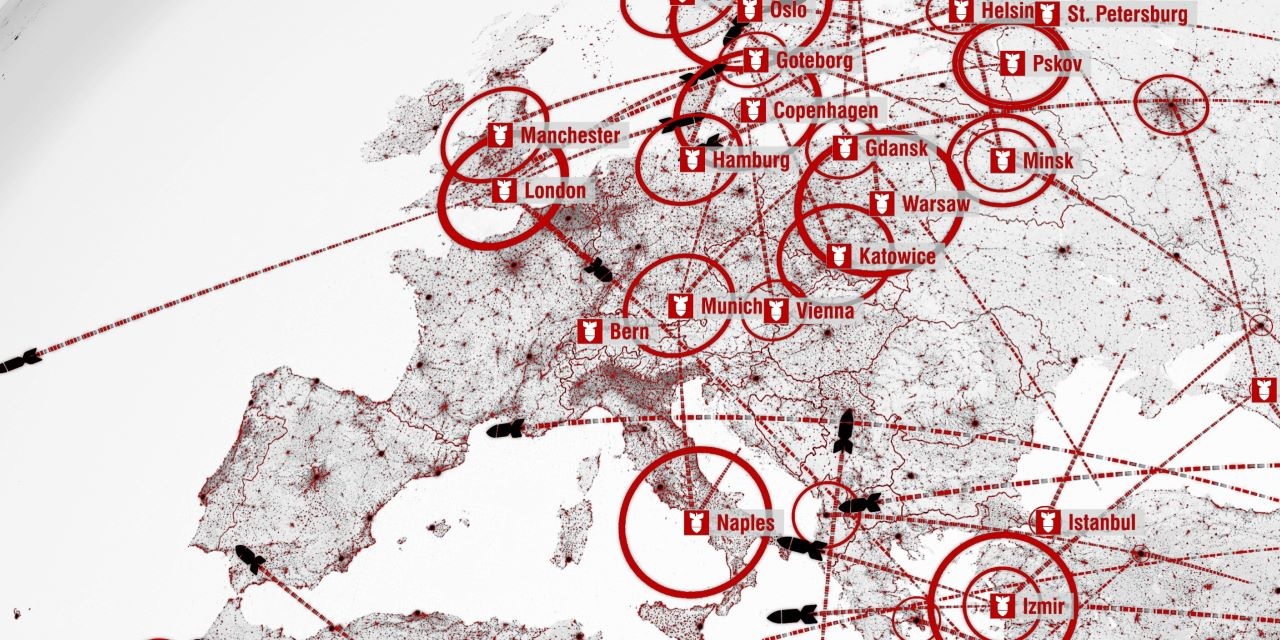
Proposals for nuclear sharing as a form of deterrence risk bringing more insecurity to Europe.
Olamide Samuel, International security expert, 11 Mar 25 https://www.aljazeera.com/opinions/2025/3/11/europe-going-nuclear-would-be-a-catastrophic-mistake
The second administration of US President Donald Trump has brought about tectonic shifts in the European security calculus. Growing anxieties about American retrenchment and the collapse of post-World War II security arrangements have sent European leaders scrambling to put forward alternatives.
Ahead of the German elections last month, Friedrich Merz, the head of the Christian Democratic Union, who was already expected to become the next German chancellor, opined: “We need to have discussions with both the British and the French – the two European nuclear powers – about whether nuclear sharing, or at least nuclear security from the UK and France, could also apply to us”.
Last week, French President Emmanuel Macron said that in response to Merz, he has decided to “open the strategic debate on the protection of our allies on the European continent through our [nuclear] deterrence”.
The proposal for some form of European nuclear sharing arrangement with France and the United Kingdom to protect against threats from Moscow is not new. Versions of it have been floated around for decades.
But today, resurfacing this proposal is not just a geopolitical miscalculation; it is a strategic dead end. It reflects a misreading of both the nuclear balance of power and the existential risks of fragmenting Europe’s security architecture further. Rather than bolstering deterrence, this gambit risks accelerating the very instability it seeks to avert.
Amid the growing unpredictability of United States-Russia relations under the second Trump administration, Europe must pivot from nuclear escapism to a bold agenda of diplomatic engagement on nuclear disarmament.
The fantasy of European nuclear sharing
The proposal for European nuclear sharing founders on arithmetic and strategic reality. Russia’s nuclear arsenal boasts 5,580 warheads, including hypersonic Avangard glide vehicles and Sarmat intercontinental ballistic missiles (ICBMs). This dwarfs the combined Anglo-French stockpile of 515 warheads.
This asymmetry isn’t merely quantitative; it is also doctrinal. Moscow’s “escalate to de-escalate” strategy represents a calculated approach to conflict escalation designed to coerce adversaries into concessions. It is a strategy the British and French nuclear arsenals, optimised for minimal deterrence, cannot counter.
Data on defence spending reveals a deeper flaw: Europeans do not have the funds or the technological capabilities to carry it out while executing their ambitious rearmament plans.
Germany’s 90.6-billion euro ($98bn) military budget remains crippled by inefficiencies, with only 50 percent of army equipment meeting NATO readiness standards. Meanwhile, France and the UK lack the conventional force multipliers – global surveillance networks, intelligence capabilities, or even complete nuclear triads – that underpin US extended deterrence. Even if every euro cent of the European Union’s recently announced 800 billion-euro ($867 billion) defence boost were spent on nuclear weapons programmes, cold-starting the sort of production complexes required for a credible deterrent would still take decades.
Attempting to replicate NATO’s nuclear-coalition model at a European level ignores six decades of integrated command structures and fails to address hybrid threats now defining modern conflict.
What is more, replacing one dependency with another solves nothing. Proponents claim nuclear sharing offers protection, but the reality is that it can lead to strategic subjugation.
Neither France nor the UK is likely to give up control over its nuclear arsenals and transfer it to the EU. That means that a nuclear-sharing agreement would reduce Germany and other European countries participating in the arrangement to Franco-British warhead warehouses with no real agency. This Potemkin deterrence—all ceremony, no substance—would only further irritate Washington.
Trump has already shown that he has no qualms about abandoning allies if he sees no benefit for the US strategic interest. His recent moves to stop intelligence sharing and military aid for Ukraine and his conditioning mutual defence on military spending have exposed NATO’s fraying norms – the alliance is witnessing a collapse of shared purpose.
As experts note, Trump’s “MAGA Carta” foreign policy explicitly rejects strategic altruism. A European nuclear caucus would signal panic, validating Trump’s transactional world view while undermining NATO’s cohesion.
A European nuclear club would deepen fragmentation, emboldening revisionist actors like Russia and China while diverting resources from critical gaps in AI advancement, sustainable economic output, and energy resilience that define 21st-century power.
The economic argument compounds the folly. Pouring billions of euros from Europe’s finite resources into redundant warheads while neglecting practical gaps in conventional capability isn’t statecraft—it’s generational malpractice.
Disarmament and fiscal realpolitik
The EU’s opportunity lies not in nuclear posturing, but in revitalising arms control and mediation. The collapse of the US-Russia strategic dialogue since the invasion of Ukraine has left critical arms control frameworks in disarray.
The New START treaty, which limits deployed strategic nuclear warheads to 1,550 each for Russia and the US, remains the last pillar of bilateral arms control. Its expiration in 2026 without a successor would mark the first time since 1972 that the world’s nuclear superpowers operate without mutually verified limits—a scenario that could trigger a new nuclear arms race.
Herein lies Europe’s opportunity. Rather than pursuing a European nuclear umbrella, it could lead efforts to revive nuclear disarmament dialogue.
Austria, an EU member, has already played a key role in nuclear talks between the West and Iran as well as the 2020 US-Russia-China trilateral arms control discussions. This positions it as an ideal venue for restarting negotiations on nuclear risk reduction issues, especially at a time when Washington is open to renewed dialogue with Moscow.
Taking a lead on nuclear disarmament would be the sort of leadership that would reflect a more mature interpretation of security policy, as opposed to seeking an impossible nuclear deterrence.
Some critics maintain that negotiating with Russia rewards aggression. Yet history shows even bitter adversaries can cooperate on arms control when interests align. The 1987 Intermediate-Range Nuclear Forces Treaty, which eliminated 2,692 missiles, was finalised after years of heightened tensions between the USSR and the US in the early 1980s.
The treaty succeeded not because US President Ronald Reagan and Soviet leader Mikhail Gorbachev trusted each other, but because dismantling missiles saved both sides a significant amount of funds that would have gone into continuing the arms race and maintaining the destroyed ordinance.
Today, with Russia’s economy faltering amid the war in Ukraine and Trump’s fixation with cost-cutting, there is an opportunity to pursue another deal if disarmament is framed not as idealism, but as fiscal pragmatism. Europe can help broker a deal that serves all parties’ wallets—and humanity’s survival.
The unintended consequences of Trump’s first-term nuclear gambits – escalated arms racing, eroded alliances, and emboldened adversaries – offer cautionary lessons. His second term, however, can offer an opportunity to shift the Doomsday Clock back from its position of 89 seconds to midnight.
Europe now faces a choice: to cling to Cold War relics while the planet burns, or to pioneer a security paradigm prioritising planetary survival over great-power vanity. The decision it makes will define not just Europe’s future—but all of humanity’s.

Olamide Samuel. International security expert
Dr Olamide Samuel is a renowned international security expert and Network Specialist at the Open Nuclear Network. Previously, he served as Special Envoy of the African Commission on Nuclear Energy (AFCONE), established by the African Nuclear-Weapon-Free Zone Treaty, also known as the Treaty of Pelindaba.
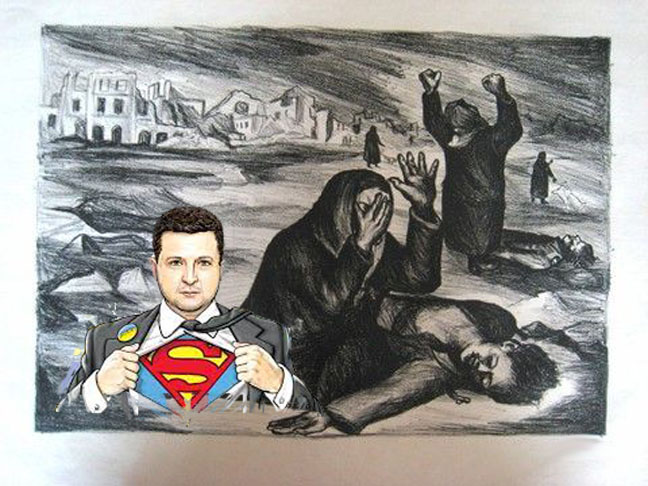
‘Ukraine will not recognize any territory occupied by Russia’: Zelensky
Tyler Durden, Zero Hedge, Wed, 12 Mar 2025, https://www.zerohedge.com/geopolitical/moscow-studying-30-day-truce-plan-while-making-steady-battlefield-gains-meantime
On Wednesday Zelensky shut the door on territorial concessions, awkwardly at a moment Ukraine has just agreed to a US plan for a 30-day ceasefire intended to pave the way for extended peace negotiations. An initial statement from the Kremlin said that Putin likely to eventually agree to truce but with own terms as Moscow “studies” the Trump-sponsored proposal hammered out during the Tuesday Jeddah talks.
Zelensky said in fresh comments:
“We are fighting for our independence. Therefore, we will not recognize any occupied territories as Russia’s. This is a fact. Our people have fought for this, our heroes died. How many injured, how many passed. No one will forget about it… This is the most important red line. We will not let anyone forget about this crime against Ukraine.”
But Russia’s red line in any near-future negotiations will be to demand recognition of the Russian Federations sovereign control over the four easter territories of Donetsk, Luhansk, Kherson and Zaporizhia regions – which President Putin has previously referred to as “our citizens forever.”
As for Zelensky’s new proclamation that he won’t cede territory, US Secretary of State Marco Rubio told reporters just after the Ukraine-US talks in Saudi Arabia that discussions with Kiev’s delegations included “territorial concessions” as part of a negotiated settlement. The suggestion from the US side is that Ukraine showed openness and willingness on this question. So either the two allies can’t get on the same page (which is no surprise), or else Zelensky is trying to tank these negotiation efforts before they ever get off the ground, also as the White House has pressed Kiev to hold new presidential elections.
Fresh comments from Zelensky asserting Ukraine will NOT recognize any territory occupied by Russia…
Certainly Russia sees no need to rush into negotiations, especially if Zelensky is unwilling to budge on territory in the east, given all the battlefield gains of late. Kursk will also soon return to full Russian control, as Ukrainian forces there are reportedly in disarray, and as Moscow has taken back over a dozen key sites just this week.
The Kremlin says it is “studying” statements issued by the US and Ukrainian delegations following yesterday’s talks in Jeddah, and further describes Russian officials are waiting for a fuller briefing from the US on the proposal. The 30-day ceasefire plan calls for a halt to all the fighting on land, sea and in the air – whichcan be extended by mutual agreement, with a hoped-for path to a permanent truce based on negotiations in the interim.
Zelensky in a Tuesday X post said the ceasefire will apply to missile, drone and bomb attacks “not only in the Black Sea, but also along the entire front line” – though its as yet unclear what mechanism there will be to monitor this.
The joint statement issued from Jeddah said the sides “will communicate to Russia that Russian reciprocity is the key to achieving peace.” Thus nothing will happen unless Moscow agrees.
Washington has agreed to lift the Trump ban on arms and intelligence for Kiev, while at the same time Kiev and Washington agreed on inking a deal on Ukraine’s critical minerals “as soon as possible”.
Russian state media is meanwhile reporting that President Putin is open to holding a telephone conversation with his US counterpart.
On the potential for a new Trump call to discuss progress toward setting up negotiations and a truce, spokesman Dimitry Peskov said Wednesday:
“We also do not rule out that the topic of a call at the highest level may arise. If such a need emerges, it will be organized very quickly. The existing channels of dialogue with the Americans make it possible to do this in a relatively short time.”
If it happens this would mark the second call since Trump’s inauguration, after the prior February 12 call. Theoretically this could lead to an in-person meeting between the two leaders if all goes well.
Secretary of State Marco Rubio is traveling back from the meeting in Saudi Arabia, and gave some remarks to a press conference in Ireland:
Deterrence against future attacks on Ukraine will be a crucial element of future negotiations.- The US-Ukraine minerals deal benefits both nations and deepens Washington’s interest in Ukraine, but “I would not couch it as a security guarantee”.
- European sanctions against Russia will be part of the negotiations, making Europe’s involvement in the process essential.
- Any truce could be effectively monitored, but “one of the things we’ll have to determine is who both sides trust on the ground” to oversee it.
Ukraine continues to hold little to no leverage, given Russia is fast taking back its territory in Kursk as of mid-week. Over a dozen settlements have been liberated, and by all accounts Ukraine forces are in retreat there, also as Russian troops are currently in the center of Sudzha town.
One regional sources says that the Russian advance has been swift especially after one particularly daring operation: “Reports over the weekend claimed that 800 Russian special forces had crawled for 15 kilometers through an unused section of pipeline, which once carried Russian gas to Europe via Ukraine, in order to carry out a sneak attack on Ukrainian forces in Sudzha,” writes Moscow Times.
These developments mean that Putin is even less likely to agree to any temporary pause in fighting. In January statements he had warned the Kremlin will not sign off on any temporary truces – given Ukraine could just use it to rearm, resupply, and regroup. Moscow has less incentive to sign onto a deal unless territorial concessions are part of it, given that at this rate it can just keep advancing in territory, particularly in the Donbass.
Poland’s president urges U.S. to move nuclear warheads to Polish territory, FT reports
By Reuters, March 13, 2025, Reporting by Gnaneshwar Rajan in Bengaluru, Pawel Florkiewicz and Alan Charlish in Warsaw; Editing by Christopher Cushing and Gareth Jones, https://www.reuters.com/world/polands-president-urges-us-move-nuclear-warheads-polish-territory-ft-reports-2025-03-13/
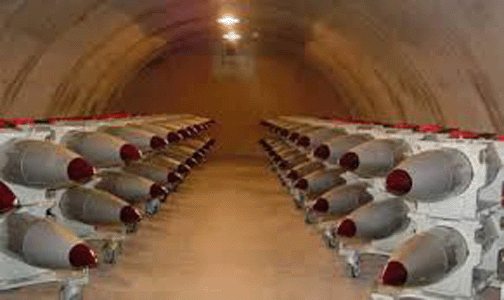
WARSAW, March 13 (Reuters) – Poland’s president has called on the U.S. to transfer nuclear weapons to its territory as a deterrent against future Russian aggression, the Financial Times reported on Thursday.
President Andrzej Duda also told the newspaper he had discussed the proposal recently with U.S. President Donald Trump’s special envoy for Ukraine and Russia, Keith Kellogg.
Poland has previously said it would be ready to host U.S. weapons under a nuclear arms sharing programme, and Polish policymakers have also more recently expressed interest in an idea floated by French President Emmanuel Macron that Paris’s nuclear umbrella could be extended to its European allies.
The borders of NATO moved east in 1999, so 26 years later there should also be a shift of the NATO infrastructure east. For me this is obvious,” the FT cited Duda as saying in an interview.
It would be safer if those weapons were already in the country, Duda added.
Polish Prime Minister Donald Tusk, a political opponent of Duda, said on Thursday he thought it was better to address such issues discreetly rather than in media interviews, although he added that he believed the president had good intentions.
“We should formulate certain expectations… publicly when we are certain, or have reasons to be convinced, that such appeals or calls will be heard and that the addressee, in this case the American administration, President Trump, is prepared for a positive response,” Tusk told reporters.
Galvanised by Russia’s invasion of neighbouring Ukraine three years ago, Poland now spends a higher proportion of its gross domestic product (GDP) on defence than any other NATO member, including the United States.
Last year Poland’s defence spending reached 4.1% of GDP, according to NATO estimates, and it plans to hit 4.7% this year. Duda has suggested enshrining defence spending of at least 4% of GDP in the Polish constitution.
Anas Sarwar U-turns on Scottish Labour nuclear weapons policy
SCOTTISH Labour are facing calls to clarify their stance on the UK’s
nuclear weapons after Anas Sarwar appeared to pull a unilateral U-turn at
First Minister’s Questions. Speaking at Holyrood on Thursday, the Labour
group leader called for First Minister John Swinney and the SNP to reverse
their stance on Trident – the UK’s nuclear weapons system which is
housed on the Clyde.
The SNP oppose nuclear weapons and oppose renewing
Trident, want to see the system removed from Scotland, and support an
international treaty banning the bomb.
Previously, Scottish Labour’s
membership passed a motion opposing the renewal of Trident – and in 2021
Sarwar backed it despite Keir Starmer’s support for the policy. Sarwar
has now suggested that he supports the UK’s nuclear weapons being
renewed. Speaking at FMQs, the Scottish Labour leader said: “Global
events are reshaping the world before our eyes. This is a generation
defining moment, and all political parties and both of Scotland’s
governments must adjust to this new reality and rethink previous red
lines.”
The National 13th March 2025, https://www.thenational.scot/news/25005720.anas-sarwar-seems-u-turn-scottish-labour-nuclear-weapons-policy/
1 This Month
26 September – International Day for the Total Elimination of Nuclear Weapons





PLEASE OPPOSE HR 8255 AND S.3639 – bills would accelerate satellite deployment, with no environmental review or safeguards – https://ncstd5li.quorum.us/campaign/169331/
To see nuclear-related stories in greater depth and intensity – go to https://nuclearinformation.wordpress.com
-
Archives
- September 2026 (305)
- August 2026 (330)
- July 2026 (355)
- June 2026 (287)
- May 2026 (306)
- April 2026 (356)
- March 2026 (251)
- February 2026 (267)
- January 2026 (308)
- December 2025 (358)
- November 2025 (359)
- October 2025 (375)
-
Categories
- 1
- 1 NUCLEAR ISSUES
- business and costs
- climate change
- culture and arts
- ENERGY
- environment
- health
- history
- indigenous issues
- Legal
- marketing of nuclear
- media
- opposition to nuclear
- PERSONAL STORIES
- politics
- politics international
- Religion and ethics
- safety
- secrets,lies and civil liberties
- spinbuster
- technology
- Uranium
- wastes
- weapons and war
- Women
- 2 WORLD
- ACTION
- AFRICA
- Atrocities
- AUSTRALIA
- Christina's notes
- Christina's themes
- culture and arts
- Events
- Fuk 2022
- Fuk 2023
- Fukushima 2017
- Fukushima 2018
- fukushima 2019
- Fukushima 2020
- Fukushima 2021
- general
- global warming
- Humour (God we need it)
- Nuclear
- RARE EARTHS
- Reference
- resources – print
- Resources -audiovicual
- Weekly Newsletter
- World
- World Nuclear
- YouTube
-
RSS
Entries RSS
Comments RSS

