Germany and UK selling out from uranium enrichment company
German Paper: RWE and E.ON Consider Urenco Sale, Nuclear Street, Sep 8 2011 Reports indicate two German utilities are preparing to sell their stake in Urenco, a uranium enrichment company that recently opened a new centrifuge plant in New Mexico.
Urenco’s other owners include the governments of the United Kingdom and the Netherlands. In recent years, the UK also has indicated it wants to sell its 33 percent stake in the company. ….
Germany’s renewable technologies showing their value
 Germany proves the promise of renewable energy: hits 20 percent renewables, By Karimeh Moukaddem, mongabay.com September 06, 2011A s many people in the United States question whether renewable energy is a viable alternative to fossil fuels, Germany now derives 20.8 percent of its electricity from renewable sources—a 15 percent increase since 2000, reports Der Spiegel. In contrast, the United States generates only 10 percent of its electricity from renewable sources, 6 percent of which comes from hydroelectric power, which some environmentalists see as unacceptably damaging. Continue reading
Germany’s renewable energy use increases to 20%
 Green Energy Use in Germany Passes 20 Percent of Total Power Mix Environmental News Network, 4 Sept 11, During the first half of 2011, Germany for the first time generated more than 20 percent of its electricity from renewable sources, a new report says. While the country’s total electricity demand remained stable during the first six months of 2011, the share generated by renewable sources increased from 18.3 percent to 20.8 percent, according to the German Association of Energy and Water Industries.
hat increase provides a boost to government initiatives to produce 35 percent of the country’s electricity from renewable energy sources by 2020, while phasing out all of the nation’s nuclear reactors, an aggressive target announced after the Fukushima disaster in Japan.
Alternative Energy and Fuel News: Green Energy Use in Germany Passes 20 Percent of Total Power Mix
Germany’s nuclear reactors to remain closed
Nuclear reactor not to be kept on stand-by, The Local 31 Aug 11 Germany’s Federal Network Agency has decided not to keep any nuclear power stations operational as back-up in case of electricity shortfalls this winter. Eight reactors were shut down earlier this year after the Fukushima disaster in Japan reignited German fears. Continue reading
100% renewable energy to run Germany’s railways
Germany’s road to a 100% renewable railway, Nuclear power was once a go-to source for keeping German trains on the go. Fukushima changed that. In response to Japan’s nuclear disaster, Germany decided to put the brakes on its nuclear plants by 2020. Now, Deutsche Bahn, the country’s biggest electricity consumer, is looking elsewhere. Smart PLanet, By Melissa Mahony | August 24, 2011
The national railway operator plans to switch over entirely to renewable energy by 2050. Continue reading
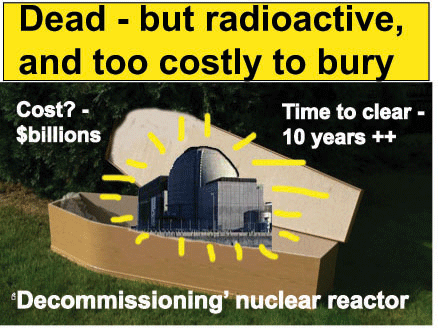
15 years later -work still continuing on getting rid of nuclear reactor
Visitors allowed into the decontamination workshop at Lubmin must wear radioactivity detectors and change into special protective clothing.
Working from inside containers, equipped with portholes, employees use high-pressure water, abrasive dust jets and acid baths to decontaminate the rooms one at a time.
“Don’t think radioactivity just disappears. It stays there as ground dust which has to be disposed of,” says Uwe Kopp, in charge of one of the workshops…..
Contaminated material from the plant is held in dozen of containers and barrels, awaiting a final government decision on a site for long-term storage.
Renewable energy development – the rational German example
Oh, the beauty of a system that is easy to understand and predictable……
Germany Shows How Renewable Energy Should Be Done, Daily Finance, ByTravis Hoium, The Motley Fool 08/01/11 Germany is doubling its efforts to be a renewable-energy power over the next 50 years, and it’s expanding beyond just solar power. After the country put thekibosh on exploding solar installationsby cutting feed-in tariffs (FIT), it has increased the FIT for biomass, geothermal, and offshore wind while simplifying solar rates. The wet blanketcurrently covering the German nuclear industrymeant the country needed to find a way to push renewable-energy installations to meet national renewable-energy goals before plants began closing. Continue reading
Germany’s strategic approach to renewable energy and energy efficiency
This package of proposals forms the basis for Germany’s confidence that it can phase out one source of energy and phase in renewable energy and energy efficiency. The combination of a mix of policies (emissions trading, standards, regulations, incentives) with planning and investments in the longer-term infrastructure is the pathway Germany has chosen.
 How Germany plans to succeed in a nuclear free, low-carbon economy, | guardian.co.uk, 29 July 11, Germany plans to meet ambitious greenhouse gas reduction targets while it phases out nuclear power Germany has taken some fundamental energy decisions in recent months, ones that are interesting for other countries to study and learn from. The most “famous” decision recently has been to phase out nuclear power in the next ten years. This move builds on years of debate and a societal decision after Japan’s Fukushima Daiichi nuclear accident to move away from nuclear energy.
There has been much less focus, however, on the phasing in of other sources of energy. Nor has there been much focus on how Germany can remain the economic powerhouse of Europe, and the world’s second largest exporting country, while removing a significant source of energy from its grid.
This phase-in story is vital to understand, especially taking into account that Germany plans to meet ambitious greenhouse gas reduction targets while it phases out nuclear power. So, how will this work?……. Continue reading
Germany’s electric bicycles, powered by renewable energy
Germans get on their e-bikes – ABC News (Australian Broadcasting Corporation),29 July 11, Electric bikes may be the bicycle industry’s next big thing if German users are anything to go by.Demand in Germany, one of Europe’s largest markets for electronic bicycles along with the Netherlands, tripled in 2010 and is set to grow by 50 per cent to 300,000 this year, according to bicycle industry association ZIV.This attitude reflects a broader trend in Germany, where the Greens party is gaining popularity, for people to buy a range of “green”, environmentally friendly products…..Germans get on their e-bikes – ABC News (Australian Broadcasting Corporation)
Court action in Germany aimed at removing USA nuclear warheads
 Activist takes Germany to court over nuclear warheads , Gabriel Borrud, Deutsche Welle, 15 July 11, Retired pharmacist versus Germany: a Cologne court has begun hearing the case of an activist intent on having Germany remove US nuclear warheads being stored at a military base located in western Germany. Continue reading
The end of nuclear, an economic boon for Germany
a shift to a renewable energy powered economy comes with costs. However, this price tag is modest in comparison to the heavy burden that nuclear brings. Over the last 40 years, the German nuclear industry has been pampered with more than 200 billion Euros in subsidies. In comparison, renewable energy technologies have been incentivized by about 4.8 billion Euros in 2010. By replacing fossil fuel imports and avoiding health costs, renewables already pay off today.
 Auf Wiedersehen! Germany’s goodbye to nuclear power will accelerate the transition towards a low-carbon economy, THE HILL, By Arne Jungjohann: Director for the Environment Program of the Heinrich Böll Foundation-07/08/11 ……….A decade ago, Germany started transitioning towards a low carbon economy. The share of renewable power has tripled. Wind farms, solar modules, biogas, and hydro power provide 18 percent of Germany’s power supply. Today, renewables are a reliable and indispensable pillar of Germany’s power supply that keep trains running and factories humming. The sector is fast growing and provides 370,000 good-paying jobs – much more than the 22,000 jobs in Germany’s lignite coal industry. Many of these jobs are within traditional industries, such as steel workers, farmers and the ceramic and glass industries. Continue reading
German Parliament seals nuclear exit plan
The nuclear exit scheme cleared its final hurdle in the Bundesrat upper house, which represents the 16 regional states, after the legislation passed the Bundestag lower house with an overwhelming majority last week.
Germany’s seven oldest reactors were already switched off after Japan’s massive March 11 earthquake and tsunami knocked out cooling systems at the Fukushima Daiichi plant, causing reactors to overheat and radiation to leak.
A further reactor has been shut for years because of technical problems.
The nine reactors currently on line are due to be turned off between 2015 and 2022, an even faster pace than envisaged when Chancellor Angela Merkel announced the decision in May.
Polls indicate a large majority of Germans oppose nuclear power due to fears of a reactor catastrophe and unresolved issues on the long-term storage of highly radioactive atomic waste……http://www.google.com/hostednews/afp/article/ALeqM5gnJH-sZ9D1lD39l-ekmBrnx2xuyg?docId=CNG.789d47896547d432d46c547221e2b880.461
In anti-nuclear Germany, Conservatives may partner with the Greens
 Environment Minister Norbert Roettgen said Monday the nuclear exit could end decades of ugly fighting in society. It may also render Mrs. Merkel a new coalition partner — the Greens.
Will Merkel’s Nuclear Exit Lead to Coalition With the Greens? WSJ, June 7, 2011 Germany’s bold strategy for an exit from atomic power by 2022 was only announced by the cabinet of Chancellor Angela Merkel Monday. Yet it has already been attacked on multiple fronts, varying from the International Energy Agency and environmental organizations to “friendly fire” from within Mrs. Merkel’s center-right government coalition. What most critics are missing, however, is that Mrs. Merkel’s alternative to a rapid exit from nuclear energy would be an almost certain loss of power in general elections two years from now at the hands of an increasingly antinuclear electorate…. Continue reading
Power transmission companies benefit from Germany’s nuclear shutdown
 Dealtalk: German nuclear exit a boon for Siemens, ABB, By Marilyn Gerlach, FRANKFURT | Jun 10, 2011 (Reuters) – Germany’s nuclear exit and power shortages in China may help boost demand for switchgears and transformers, benefiting European power transmission suppliers such as Siemens and ABB.
Germany’s parliament began debating its new energy bill on Thursday, clearing the way for the shutdown of 17 nuclear reactors from 2015. Analysts say the nuclear capacity gap could be replaced mostly by renewables, which are volatile sources of energy and so trigger a need to invest in grid transmission infrastructure. ….http://www.reuters.com/article/2011/06/10/us-germany-siemens-idUSTRE7592YQ20110610
Merkel calls on lawmakers to back moves to end nuclear energy
Merkel Asks Lawmakers to Back Shift From Nuclear NYT, By JUDY DEMPSEY June 9, 2011 BERLIN — Calling Germany’s plan to phase outnuclear energy by 2022 a “Herculean task,” Chancellor Angela Merkel told lawmakers on Thursday that the country was poised to lead the world in renouncing nuclear energy. Continue reading
1 This Month

of the week – Shut Down Drone Warfare!


Tell the Ukrainian Government to Drop Prosecution of Peace Activist Yurii Sheliazhenko

Petition to revoke the licensing of the Near Surface Nuclear Disposal Facility (NSDF) at Chalk River. https://www.ourcommons.ca/petitions/en/Petition/Details?Petition=e-7247
To see nuclear-related stories in greater depth and intensity – go to https://nuclearinformation.wordpress.com
-
Archives
- April 2026 (68)
- March 2026 (251)
- February 2026 (268)
- January 2026 (308)
- December 2025 (358)
- November 2025 (359)
- October 2025 (376)
- September 2025 (257)
- August 2025 (319)
- July 2025 (230)
- June 2025 (348)
- May 2025 (261)
-
Categories
- 1
- 1 NUCLEAR ISSUES
- business and costs
- climate change
- culture and arts
- ENERGY
- environment
- health
- history
- indigenous issues
- Legal
- marketing of nuclear
- media
- opposition to nuclear
- PERSONAL STORIES
- politics
- politics international
- Religion and ethics
- safety
- secrets,lies and civil liberties
- spinbuster
- technology
- Uranium
- wastes
- weapons and war
- Women
- 2 WORLD
- ACTION
- AFRICA
- Atrocities
- AUSTRALIA
- Christina's notes
- Christina's themes
- culture and arts
- Events
- Fuk 2022
- Fuk 2023
- Fukushima 2017
- Fukushima 2018
- fukushima 2019
- Fukushima 2020
- Fukushima 2021
- general
- global warming
- Humour (God we need it)
- Nuclear
- RARE EARTHS
- Reference
- resources – print
- Resources -audiovicual
- Weekly Newsletter
- World
- World Nuclear
- YouTube
-
RSS
Entries RSS
Comments RSS
 nuclear-news