Renewable energy revolution is paying off in Germany
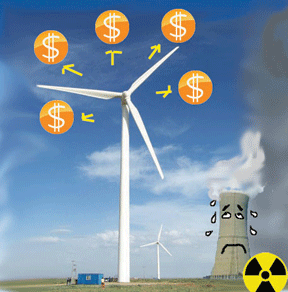 German Green on Wind Energy Benefits & Nuclear Phaseout SEPTEMBER 21, 2012 BY ZACHARY SHAHAN Here’s a nice bit of a Guardian interview with Cem Özdemir, Chair of the German Green party , that was just published yesterday:
 Clean Technica (http://s.tt/1nZNl) “…….We are looking at a third industrial revolution, and just as there were once those who opposed the invention of the steam engine, there are now those who hark back to nuclear energy. In Germany we now have just over 20% of our energy coming from renewable sources. All predictions from the past have turned out not to be true: when I went to school, my teachers used to say that maybe, just maybe we might have 3% of renewable energy one day. Angela Merkel says we’ll have 35% by 2020; we at the Green party say it’ll be 45%. My guess is: we’ll both be wrong, because it’ll be even more than that….
don’t listen to what the Greens have to say, listen to what Siemens is doing. Siemens are not switching from nuclear to clean energy because they want to lose money: they want to make profit. And I’d warn anyone who questions whether they’ll manage: industrial policy, that’s one thing the Germans know how to get right. If the Brits would rather hand the first mover advantage down to us, then so be it – as a German, I thank them for it. We already cater for many of the markets for renewable energy around the globe, and our future competitors are more likely to come from China than from the other side of the Channel.
In Germany, industry is now starting to thank us for pestering in the past, because it forced them to go through the kind of innovations that the rest of the world is now catching up with. The Brits are still discussing whether they should insulate their houses better in the future, and we insulate them. http://cleantechnica.com/2012/09/21/german-green-on-wind-energy-benefits-nuclear-phaseout/
A village shows how to make a good profit out of renewable energy
Bavarian village rakes in $5.7m a year by selling green energy http://reneweconomy.com.au/2012/bavarian-village-rakes-in-5-7m-a-year-by-selling-green-energy-33024 Cleantechnica 30 August 2012 By Chelsea Small towns have no more excuses. Bavarian village Wildpoldsreid, with a population of about 2,600, has created a local economy that produces 321 per cent more energy than it needs, selling the excess back to the national grid at a rate of $US5.7 million annually. This little German powerhouse has utilised solar, biogas digesters, windmills, hydro power plants, and a natural wastewater system to reduce its own use and increase its energy positive output. Every hamlet, township, city, metropolis, and megalopolis can learn something from Wildpoldsreid. Continue reading
Developing storage systems for renewable energy
 Storage systems for renewable energy, Energy Harvesting Journal , 13 Aug 12, Energy storage systems are one of the key technologies for the energy turnaround. With their help, the fluctuating supply of electricity based on photovoltaics and wind power can be stored until the time of consumption.
At Karlsruhe Institute of Technology (KIT), several pilot plants of solar cells, small wind power plants, lithium-ion batteries, and power electronics are under construction to demonstrate how load peaks in the grid can be balanced and what regenerative power supply
by an isolated network may look like in the future.
“High-performance batteries on the basis of lithium ions can already be applied reasonably in the grid today,” says Dr. Andreas Gutsch, coordinator of the Competence E project. As stationary storage systems, they can store solar or wind power until it is retrieved by the grid. “When applied correctly, batteries can also balance higher load and production peaks and, hence, make sense from an economic point of view.”
The Competence E project is presently developing several pilot systems consisting of photovoltaics and wind power plants coupled to a lithium-ion battery. Over a development phase of two years, a worldwide battery screening was made. “Now, we know which lithium-ion cells are suited best for stationary storage systems,” says Gutsch.
The first stage of the modular systems will be constructed on KIT Campus North by the end of 2012. It will have a capacity of 50 kW…..
http://www.energyharvestingjournal.com/articles/storage-systems-for-renewable-energy-00004648.asp?sessionid=1
German utility company thriving following exit from nuclear power
E.ON triples net profit as nuclear past fades Aug 13, 2012
* H1 net 3.13 billion euros vs 948 million year ago
* Trading and Optimisation unit seen posting full-year profit
* Could close some power plants
* Shares up 1.2 pct (Recasts, adds trading unit, analyst)
By Christoph Steitz and Vera Eckert FRANKFURT, Aug 13 (Reuters) – E.ON AG, Germany’s largest utility, said net profit more than tripled in the first half of the year, benefiting from a gas price deal with Russia’s Gazprom and absence of charges related to Germany’s exit from nuclear power.
German utilities have posted strong first-half results so far, thanks to renegotiated gas purchase contracts and higher selling prices, in a recovery from the downturn caused by the government’s decision last year to shut nuclear power stations.
Last month, EnBW, Germany’s third-largest utility, said first-half sales at its gas unit rose a third because of an expansion in gas trading activity….
http://in.reuters.com/article/2012/08/13/eon-results-idINL6E8JD1220120813
Burying dead nuclear reactors – expensive, but lucrative for some!
consultancy Arthur D. Little has put the total costs at no less than €18 billion…..
Dismantling a nuclear plant until it has completely vanished can take several decades, depending on which technique is used.
the process of fully decommissioning a plant can take more than 40 years,
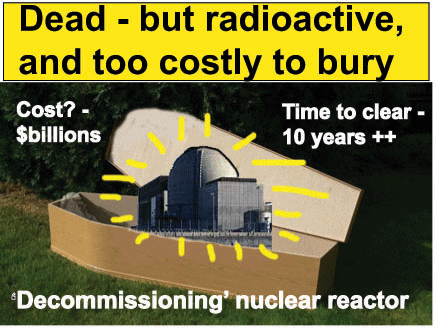
 Germany’s pricey nuclear burial, Climate Spectator , 18 Jul 2012, Christoph Steitz and Tom Käckenhoff “…..by 2014, almost nothing will be left of what once was Germany’s first commercial boiling water reactor. Germany’s decision to shut down all nuclear plants by 2022,
sparked by last year’s Fukushima nuclear disaster in Japan, is a done deal……
… a giant hole in the ground where the reactor vessel used to be. Work to decommission plants mainly includes removing and disposing of contaminated material as well as decommissioning the plants themselves while making sure that no radiation spreads.
Spent fuel from reactors needs to be encased and then transported to safe fuel dumps while cooling towers, often regarded a blight on landscapes, then need demolishing…..
Today, the four operators of nuclear plants in Germany – E.ON, RWE, EnBW and Vattenfall – have made a total of more than €30 billion ($36.7 billion) in provisions for the dismantling of the plants and the disposal of nuclear waste. Continue reading
Mainstream media waking up to Fukushima danger, and Germany’s renewables leadership
 The second energy event of this past weekend was uplifting and extraordinary, due to an extremely sunny weekend, half of Germany’s electricity was generated by solar power two days. The decision to close down and eventually shut all of Germany’s nuclear reactors now appears to have been justified
Germany’s Solar Success and Fukushima’s Crisis: Intelligent Energy Priorities, HUFFINGTONPOST, Vivian Norris 06/01/2012  Last weekend, events took place which should make us think about the future of energy on this planet. Firstly, radioactive bluefish tuna was caught off the coast of California. The radioactivity, though in fairly small amounts, could be directly traced to the releases from the disasters at the reactors at Fukushima Daichi, following the devastating earthquake and tsunami.
And more importantly, the public finally received some answers from those supposedly in charge in Japan during the accident. Former Prime Minister Kan testified that the ties between regulators and TEPCO was so intertwined, and the accident so profound, that he called for Japan to stop all use of nuclear energy. For once, it appeared that mainstream media paid attention and published both Kan’s words, as well as articles on serious concerns about the status of fuel pools at Fukushima. Experts and more fringe elements on the internet had been publishing good information for over a year. It is to the New York Times’ credit that they acknowledged the role that the pressure from these groups played in forcing TEPCO and the Japanese government to admit they had not been forthcoming. Continue reading
Germany’s dazzling success with small scale solar energy
the really meaningful story starts with a different number: 189.24 GWh. That’s the amount of electrical energy generated from more than a million PV solar systems spread all over the country on that record day. Not only was this almost 14% of Friday’s total electricity consumption in Germany, it was also, actually, not that unusual.
For the last couple of weeks, the output of PV solar peaked within an inch of the 20 GW line several times, and it never peaked very low throughout the month. The lowest peak load was 8 GW, while the average peak load of PV solar was 16 GW. So, it seems that solar is not as unreliable as conventional wisdom and media outlets often lead people to believe. Because I can tell you that we didn’t have 4 weeks straight of sunshine here in Germany, that’s for sure.
In-Depth: Germany’s 22 GW Solar Energy Record Clean Technica, MAY 31, 2012 BY THOMAS Last Friday, on the 25th of May 2012, Germany set a new world solar energy record in photovoltaic solar energy: 22.4 GW of photovoltaic energy on the grid covering over 30% of all energy demand! That’s the equivalent of 20 huge conventional fossil or nuclear power plants. This is clearly amazing news that made headlines around the world and was accompanied by either praise or the typical anti-solar bickering that is rather dominant in big media outlets even today (or especially today).
The latter didn’t mind even using this incredible clean energy accomplishment to repeat the usual ignorant talking points, disinformation, or flat out lies. Unfortunately, those news pieces and early articles praising the event didn’t fully exploit the opportunity to explain the true significance of having so much solar energy in the energy mix, especially when looking at the technological developments and opportunities of the coming years. Continue reading
Distributed solar energy, and distributed energy storage
In-Depth: Germany’s 22 GW Solar Energy Record Clean Technica, MAY 31, 2012 BY THOMAS“…….Millions of Batteries in Buildings — Utopian? …… it is very easy to show that it’s just a matter of time until the combination of energy storage for homes with rooftop solar energy and/or small-wind becomes viable and even profitable.
Today, there are still about 6.4 million oil tanks in homes and buildings all over Germany storing energy in the form heating oil. Installing such a tank costs several thousand Euros today. So, why shouldn’t independent power producers start putting up new forms of energy storage in the same numbers as soon as it makes economic sense?
How would 6 million home storage systems change the energy system? Well, 6 million 10 kW / 25 kWh would mean a distributed storage system with 60 GW maximum output/input and 150 GWh of capacity. That’s already enough storage for 10% of the current daily consumption, more than enough to power all German households through the night. It’s also coming a long way to fill the gap between renewable baseload power (hydro and biomass) and variable sources like wind and solar.
That 10-kW/25-kWh battery is not fiction by the way. It’s quite similar to the battery pack that powers the Nissan Leaf right now, Just one battery that will soon reach production volumes in the hundreds of thousands as factories in Japan, Europe, and the US crank up production by 2013.
It’s true that the $15,000 price tag for the battery is too high right now. But, since all kinds of competitors are investing in this market, economics of scale, innovation and optimization will certainly reduce the cost of such batteries in the coming years. In the case of multi-kWh batteries, this development is a lot more obvious than what happened with the price for solar cells just 7 years ago. The fall of prices surprised many analysts back then. Today, prices for solar cells are 70%-80% cheaper than what they were in 2007, putting the cost of solar systems well below $2 per Watt in Germany…. .. https://mail.google.com/mail/u/0/?shva=1#inbox/137a6ed1432cd545
Germany doing well with nuclear phaseout – despite the nuclear lobby’s lies about this
 Busting the carbon and cost myths of Germany’s nuclear exit, Guardian UK Damian Carrington, 23 May 12 Critics of the atomic phase-out said energy emissions, costs and imports would all rise. They were wrong. it’s worth taking a look at what actually happens when you phase out nuclear power in a large, industrial nation.
That is what Germany chose to do after the Fukushima nuclear disaster, closing eight plants immediately – 7GW – and another nine by 2022. The shrillest critics predicted blackouts, which was always daft and did not happen.
But more serious critics worried that the three things at the heart of th eenergy and climate change debate – carbon, cost and security of supply – would all head in the wrong direction. Here in Berlin, I have found they were wrong on every count. Continue reading
German government working carefully on phasing out nuclear power
Germany beefs up monitoring of nuclear shutdown, Google News By JUERGEN BAETZ, Associated Press 24 May 12, BERLIN (AP) — The German government will more closely oversee the country’s move from nuclear power to renewable energy, Chancellor Angela Merkel said Wednesday — a mammoth 10-year project for Europe’s biggest economy that has been going slowly so far.
Merkel said she will be meeting with all of Germany’s 16 state governors twice a year to take stock of the transformation’s progress and shortcomings, stressing that everything must be done to avoid blackouts and ensure affordable energy. Continue reading
Germany to be nuclear free within 10 years
 includes VIDEO http://www.todaysthv.com/news/article/210528/288/Germany-plans-to-go-nuclear-free-within-a-decade Germany plans to go nuclear free within a decade, May 10, 2012 “…. Protest against nuclear energy in Germany began shortly after the Fukushima disaster in 2011 and Berlin reacted. After a safety review Angela Merkel’s government decided to shut down eight of Germany’s 17 reactors immediately and abandon nuclear energy altogether by 2022. She says, “We want to make sure that our power supply is safe,” Merkel said. “But at the same time it must be reliable.”
Germany’s answer is renewables! Aside from solar power, the country embarked on an ambitious quest to build dozens of off shore wind parks with thousands of turbines in the North and Baltic Seas. Most of the assembly happens in the northern town of Bremerhaven and local officials say the rush into renewables has led to an economic boom here. Nils Schnorrenberger says, “We had an unemployment rate of 25 per cent six years ago. Now it is 14 per cent and the companies gave 2000 people jobs just here in Bremerhaven.”..
. Ever since the Chernobyl disaster, Germans have had a troubled relationship with
nuclear energy with regular protests against new plants and nuclear waste transports. Since Fukushima, however, the country’s decision to quit atomic power seems irreversible, even in the face of challenges and uncertainties ahead. http://www.todaysthv.com/news/article/210528/288/Germany-plans-to-go-nuclear-free-within-a-decade
The history of Germany’s anti nuclear movement
The Germans also had an anti-nuke party as of 1980, namely the Greens, who carried the concerns of the mass movement into the national parliament, the Bundestag. No other country in the world has had a force so determined and influential in taking on the powerful atomic energy lobby.
From Advocates to Enemies: Nuclear Decline in Germany World Policy Blog May 10, 2012 -By Paul Hockenos “……….it wasn’t until the early 1970s when protests broke out in Germany’s southwestern-most corner that Germans began looking twice at the nuclear power facilities and waste repositories in their backyards. The anti-nuclear energy movement was born in the wine-growing region of the Black Forest abutting the borders of Switzerland and France’s Alsace-Loraine. There, in the tiny hamlet of Wyhl, the area’s staunchly conservative farmers, joined by left-wing activists from the nearby university city of Freiburg, as well as concerned French and Swiss citizens, organized to stop the construction of a planned reactor.
The Wyhl coalition bore many of the characteristics that would define the movement for years to follow: It was locally led, politically diverse, and committed to non-violent civil disobedience. Initially, the farmers’ objection was that the steam clouds from the reactor’s cooling towers would block the sun light in their vineyards, not that radioactivity as such was a hazard. This changed as the community learned more about the health effects of low-level radiation, such as that produced by nuclear power plants on pregnant women in their vicinity.
Against all odds, the Wyhl coalition forced the utility giant to back down and scrap its plans. Continue reading
The world watches as renewables succeed in Germany, as nuclear power fades
A vast majority of Germans have made up their minds on the need to phase out nuclear. And what happens in Germany will be a major indicator for other countries….. The world is watching Germany’s Energiewende.”Germany: Fighting Climate Change And Phasing Out Nuclear Power Are Two Sides Of The Same Coin Think Progress, Apr 27, 2012 by Arne Jungjohann Recently, the editorial board of the Washington Post asked if the world can fight global warming without nuclear power, looking to Germany and Japan for the answer.Both countries are known for a nuclear shutdown path. In Japan, only one of the 54 nuclear reactors currently remains in operation. Germany has closed eights reactors following the nuclear catastrophe of Fukushima in March 2011 and the remaining nine are scheduled to be closed by 2022.
That obviously must lead to rising emissions, the Post claims. …. If you look at the most recent emissions data, however, the opposite is happening. Germany reduced its carbon emissions in 2011 by 2.1 percent despite the nuclear phase out. How can that be? Continue reading
Germany needs to make sure that nuclear companies pay for nuclear decommissioning
 Germany open to nuclear shutdown fund – minister Greenpeace calls for state to run nuclear dismantling fund
* Environment minister says Greenpeace proposal can be examined
* Major utilities reject idea
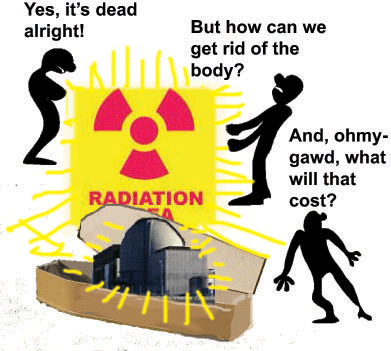
DUESSELDORF, Germany, April 11 (Reuters) – Germany would consider ringfencing billions of euros to be put aside by utilities for disposing of radioactive waste, the environment minister said, to ensure decommissioning of the country’s nuclear power plants is completed decades from now. He was speaking on Wednesday in response to a call from environmental group Greenpeace that wants the government to administer some of the money earmarked for nuclear decommissioning.
German Chancellor Angela Merkel’s decision last year, following Japan’s nuclear plant disaster, to phase out nuclear power by 2022 has thrown big utilities on the defensive, weakening their finances and forcing them to rethink their business models.
Germany’s top four nuclear operators – E.ON, RWE , EnBW and Swedish’s Vattenfall – are footing the bill to dismantle the plants and dispose of radioactive waste. They have already made provisions of more than 30 billion euros ($39.3 billion).
Managing the disposal of waste will take decades after the last nuclear plant is due to shut in 2022 and Greenpeace fears that the companies may not be able to honour their obligations in the future or could try to wriggle out of them.
Parking the companies’ money in a separate state-run fund would protect German taxpayers should one or more of the firms become insolvent, Greenpeace said. “This is an idea that can be examined,” Environment Minister Norbert Roettgen told Reuters on Wednesday, adding it was clear that the operators of nuclear plants were responsible for dismantling them. ”We need to look at whether a combined fund is a better solution than relying on individual responsibility,” he added.
Greenpeace has also called for provisions to be raised to 44 billion euros. http://www.reuters.com/article/2012/04/11/germany-nuclear-idUSL6E8FB2XT20120411
Success of solar photovoltaic power is worrying utility companies
Why power generators are terrified of solar http://www.crikey.com.au/2012/03/27/why-generators-are-terrified-of-solar/ Crikey.com by Giles Parkinson, of RenewEconomy, 28 March 12, “….. the merit order effect and the impact that solar is having on electricity prices in Germany; and why utilities there and elsewhere are desperate to try to rein in the growth of solar PV in Europe. It may also explain why Australian generators are fighting so hard against the extension of feed-in tariffs in this country….. that solar PV is not just licking the cream off the profits of the fossil fuel generators — as happens in Australia with a more modest rollout of PV — it is in fact eating their entire cake…..
Deutsche Bank solar analyst Vishal Shah noted in a report last month that EPEX data was showing solar PV was cutting peak electricity prices by up to 40%, a situation that utilities in Germany and elsewhere in Europe were finding intolerable. “With Germany adopting a drastic cut, we expect major utilities in other European countries to push for similar cuts as well,” Shah noted.
Analysts elsewhere said one quarter of Germany’s gas-fired capacity may be closed, because of the impact of surging solar and wind capacity. Enel, the biggest utility in Italy, which had the most solar PV installed in 2011, highlighted its exposure to reduced peaking prices when it said that a €5/MWh fall in average wholesale prices would translate into a one-third slump in earnings from the generation division……
1 This Month

of the week – Shut Down Drone Warfare!


Tell the Ukrainian Government to Drop Prosecution of Peace Activist Yurii Sheliazhenko

Petition to revoke the licensing of the Near Surface Nuclear Disposal Facility (NSDF) at Chalk River. https://www.ourcommons.ca/petitions/en/Petition/Details?Petition=e-7247
To see nuclear-related stories in greater depth and intensity – go to https://nuclearinformation.wordpress.com
-
Archives
- April 2026 (68)
- March 2026 (251)
- February 2026 (268)
- January 2026 (308)
- December 2025 (358)
- November 2025 (359)
- October 2025 (376)
- September 2025 (257)
- August 2025 (319)
- July 2025 (230)
- June 2025 (348)
- May 2025 (261)
-
Categories
- 1
- 1 NUCLEAR ISSUES
- business and costs
- climate change
- culture and arts
- ENERGY
- environment
- health
- history
- indigenous issues
- Legal
- marketing of nuclear
- media
- opposition to nuclear
- PERSONAL STORIES
- politics
- politics international
- Religion and ethics
- safety
- secrets,lies and civil liberties
- spinbuster
- technology
- Uranium
- wastes
- weapons and war
- Women
- 2 WORLD
- ACTION
- AFRICA
- Atrocities
- AUSTRALIA
- Christina's notes
- Christina's themes
- culture and arts
- Events
- Fuk 2022
- Fuk 2023
- Fukushima 2017
- Fukushima 2018
- fukushima 2019
- Fukushima 2020
- Fukushima 2021
- general
- global warming
- Humour (God we need it)
- Nuclear
- RARE EARTHS
- Reference
- resources – print
- Resources -audiovicual
- Weekly Newsletter
- World
- World Nuclear
- YouTube
-
RSS
Entries RSS
Comments RSS
 nuclear-news