Germany meeting the challenges of intermittent renewable energy
 We can let fission fizzle out in a renewable world, New Scientist, 20 May 2013 by Jochen Flasbarth“……One of the most pressing challenges of a 100 per cent renewable world is how best to use energy sources that by their very nature do not run constantly. Your average German wind turbine operates for 1600 hours of the year. Equally, there are times when wind turbines or solar panels produce too much electricity. How to store this excess? This can be done conventionally by pumping water to fill a reservoir during the day, and using it to produce hydroelectric power at night.
More sophisticated is power-to-gas: carbon dioxide and water are combined in a series of steps to produce methane. Renewables will supply the electricity and the methane can be fed into the gas network to heat homes, fuel cars or generate electricity. The technology has yet to mature. But firms such asAudi are trying to get it off the ground commercially.
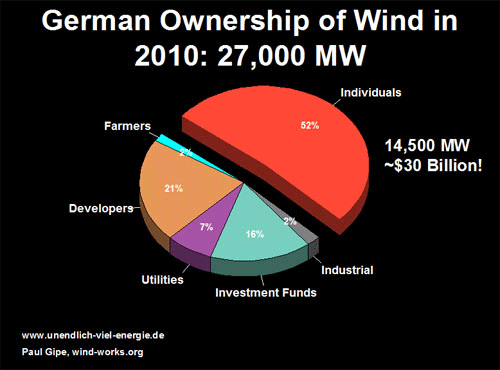
Another challenge is to transport power from the wind-rich north to the more populous southern and central Germany. That will mean building hundreds of kilometres of new power lines. Opposition is predicted. But this could be tackled by offering locals a financial share in mid-scale, private solar power installations or wind farms.
A quick word on prices: the financial support for renewables has taken some flak. Critics argue that ladling out money for solar panels has overheated the market and created too much capacity at too high a price. But this can be dealt with. Cuts to payments to panel owners for the electricity they generate, the feed-in tariff, have been made, more will follow. To put things in perspective: under the present system the average German is expected to pay €5 a month towards the feed-in tariff. This is a sound investment in clean technology, protecting us from the spiralling prices of conventional energy.
In a recent study we showed that in 2030, renewable electricity on average will cost 7.6 cents per kilowatt hour; electricity from gas or coal-fired power plants will probably be 9 cents. Onshore wind turbines already match prices of some fossil fuels…… http://www.newscientist.com/article/mg21829170.200-we-can-let-fission-fizzle-out-in-a-renewable-world.html

Germany’s post-nuclear vision is working, a practical transition to renewables
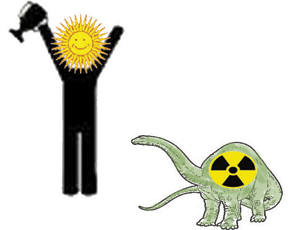 the sudden shutdown of seven nuclear power plants had no detrimental effect on security of supply, and was compensated for within the German energy infrastructure
Nuclear futures: renewables blossom in Germany’s post-nuclear vision .http://theconversation.com/nuclear-futures-renewables-blossom-in-germanys-post-nuclear-vision-14364 Erik Gawel, Sebastian Strunz 22 May 2013, When the Fukushima Daiichi nuclear power plant in Japan was hit by a tsunami in March 2011, the disaster had a profound effect on German energy policy. Chancellor Angela Merkel reasoned that “Fukushima has forever changed the way we define risk in Germany.”
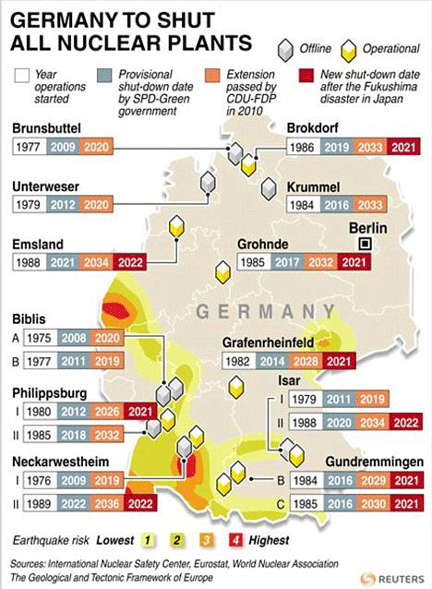
Three days after the news of meltdown in three of Fukushima’s reactors, Chancellor Merkel drew a line under German nuclear power. The seven oldest nuclear power plants in Germany were immediately taken off the grid, and two months later the government made this permanent. The remaining German nuclear power plants, it was decided, would be shut down by 2022.
This decision was a spectacular policy U-turn, as the same conservative government had only recently overturned an earlier attempt to ban nuclear power in Germany. In 2010, Chancellor Merkel’s coalition had argued that nuclear power was a “bridge technology” ecessary to pave the way towards a carbon-free energy system. The prolonged use of nuclear power would be indispensable in order to guarantee security of supply, it was claimed.
This raises two questions: did removing seven power plants endanger the security of supply to the German national grid? And what convincing long-term strategy is there in place to manage the shift to carbon-free energy without nuclear power? Continue reading
Germany’s move away from nuclear is part of a rational European trend
Nuclear futures: renewables blossom in Germany’s post-nuclear vision, The Conversation, 23 may“….The idea that it is irrational German angst that has led Germany to forge a path distinct from its neighbours doesn’t stand up to scrutiny: of 27 European Union member states, 11 have no civil nuclear power, and most have no intention of developing any. Four other European countries are joining Germany in phasing out nuclear power, while Italy closed its last nuclear power station in the 1980s, and in 2011 rejected plans to look at the issue again.
So Germany turning away from nuclear power is not a panicky reaction that endangers the country’s security of supply, more an important and well-integrated part of her transformation to use renewables exclusively.
Which is not to say that the Energiewende is without problems. Rising electricity bills and the costs of expanding many thousands of miles of transmission lines threaten to strain public acceptance. Rampant nimbyism and ecological and economic trade-offs have to be addressed; any plan for large offshore-wind farms that promise to provide efficient, renewable energy inevitably leads to conflicts with environmentalists.
Maintaining the power grid’s stability in a renewable-based system remains a challenge. But there is nothing to suggest that turning off nuclear power will jeopardise Germany’s clean energy vision. And where Germany leads, others may follow.http://theconversation.com/nuclear-futures-renewables-blossom-in-germanys-post-nuclear-vision-14364
Renewable energy – Germany’s impressive export of electricity
Germany Continues to Export Power Despite Nuclear Exit http://climatecrocks.com/2013/05/21/germany-continues-to-export-power-despite-nuclear-exit/ Climate Denial Crock of the Week with Peter Sinclair May 21, 2013
They said it couldn’t happen. They keep trying to trash the EnergieWende – Germany’s planet-leading transformation to renewable energy. But the pesky Germans keep perking along. Wall Street Journal:
FRANKFURT–Germany exported more electricity than it imported for the seventh consecutive year in 2012, despite an accelerated exit from nuclear-power generation that included the immediate and permanent shut-down of nearly half of the country’s atomic reactors in 2011.
Germany exported about 22.8 terrawatt-hours of electricity more than it imported in 2012, the Federal Statistics Office, Destatis, said Tuesday in a written statement.
The main destinations for German-produced electricity were the Netherlands, Switzerland and Austria, said the statistics office, citing data supplied by Germany’s four power transmission grid operators. The main sources of power imports into Germany were France, Denmark and the Czech Republic, it said.
The statistics office didn’t provide any reasons for the continued power exports, despite the fact that Germany shut down eight of 17 nuclear reactors in the wake of the Fukushima disaster in Japan in March 2011.
The rapid expansion of solar- and wind-power installations are seen as the main reason for continued German electricity exports, as well as the erosion of wholesale power prices under which many of Europe’s utilities are presently suffering.
The long haul for cleaning up Germany’s radioactive trash
Klaus-Günter Warnecke, the mayor of Remlingen, has been monitoring progress at the Asse nuclear waste site for nearly 20 years. Recent local media reports say he may have to wait another 20 years before the clearance of the site begins.
Living above Germany’s old nuclear waste, DW, 20 May 13, A German law has recently come into effect ordering the cleanup of 126,000 barrels of radioactive waste at the Asse nuclear dump site. But it seems the process could take a lot longer than locals initially hoped for….. Heike Wiegel is not just a resident here, she’s also a member of the citizen group ‘aufpASSEn’ – meaning ‘watch out’ in German – which helps raise awareness about issues from the Asse nuclear waste site.
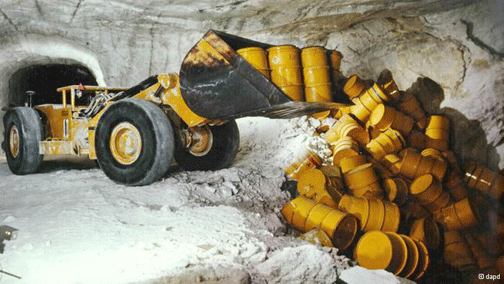
There are a number of other anti-Asse groups in the region. Now, with the law ordering the removal of waste from the site, they want to make sure that the mistakes of the past are not repeated.
“What happened back then at the Asse site should never have happened,” Wiegel says after a long pause. “That such an old, unstable salt mine would be used for nuclear waste, which, in the end, was just thrown in barrel by barrel.” Continue reading
Germany continues move to clean energy, though it is not easy
 Germany grapples with nuclear energy phaseout The Local Germany’s energy transition project – in which nuclear power will be phased out and replaced with energy from renewable sources – is facing the challenges of cheap coal, unresolved energy storage and an out-of-date electricity grid. 20 May 13 “…The hard-to-predict flow of renewable energies compared to fossil or nuclear power is one of the many challenges of the energy transition which Chancellor Angela Merkel rang in following Japan’s 2011 Fukushima nuclear disaster.
The goal is to be nuclear-free by 2022 and to combat pollution and climate change by boosting the share of clean and safe renewables to 80 percent by 2050.
Across Germany, solar panels, made popular by state subsidies and falling unit prices, now cover many home roofs and stretches of farmland.
New laws have allowed home owners to sell excess power back into the grid, while other incentives promote home insulation and other efficiency gains.
Germany’s solar power capacity has risen exponentially to reach a current level of about 30 gigawatts. Another 25 to 30 gigawatts come from wind farms across vast
stretches of Germany’s flat, coastal north and offshore parks in the North and Baltic seas.
Merkel, a physicist by training, said last week that, under optimal conditions, the total now falls just shy of Germany’s usual demand of 65 to 70 gigawatts Continue reading
Radioactive cargo on German ship gutted by fire
 Ship with radioactive cargo gutted by fire in Hamburg harbour http://indymedia.org.au/2013/05/18/ship-with-radioactive-cargo-gutted-by-fire-in-hamburg-harbour , 17 May 2013 – – A freighter which burned spectacularly in Hamburg harbour had highly dangerous radioactive substances aboard.
The north German city-state’s social democrat government only today released details of the fire on 1 May because the opposition Greens had put a question on notice.
As well as 8.9 tonnes of uranium hexafluoride the “Atlantic Cartier” also had some 180 tonnes of highly flammable ethanol, several tonnes of explosives, including munitions, and rocket fuel on board.
The highly toxic uranium hexafluofide is a compound used in centrifuges and other plants to enrich uranium. An area contaminated with it would be uninhabitable for a very long time. Continue reading
Step by step shutdown of nuclear energy in Germany
Germany aims to become one of the greenest countries in the world – with a huge shift towards renewable energy and massive energy savings
Germany moving ahead on renewable energy storage
Germany’s Energy Storage Incentives Start May 1 http://www.energymatters.com.au/index.php?main_page=news_article&article_id=3694 17 April 13, New renewable energy subsidies in Germany may do for battery storage globally what the nation did for solar power.

In February we reported Germany would apparently soon formally confirm a start date for an initiative to support the purchase of battery based energy storage systems integrated with solar panel arrays. It took a little longer than rumoured, but that moment seems to have arrived. Continue reading
Germany’s nuclear waste nightmare- the Gorleben salt mines
Abyss of Uncertainty: Germany’s Homemade Nuclear Waste Disaster Spiegal online, By Michael Fröhlingsdorf, Udo Ludwig and Alfred Weinzier, 21 Feb 13, Some 126,000 barrels of nuclear waste have been dumped in the Asse II salt mine over the last 50 years. German politicians are pushing for a law promising their removal. But the safety, technical and financial hurdles are enormous, and experts warn that removal is more dangerous than leaving them put……
Germany’s Federal Office for Radiation Protection (BfS) has been responsible for Asse since 2009. This is an agency that was originally founded to monitor things such as the safety of workers in nuclear research facilities. In early 2010, the federal government ordered the BfS to assess whether the radioactive waste in the Asse mine can be retrieved. The agency estimated that it would take three years to prepare the project. Most recently, the BfS said it would need 10 years for the fact-finding phase alone.
The BfS still has no detailed concept for the retrieval, no timetable, no script that maps out the technical procedures. It’s essentially a flight by the seat of the pants, and problems are encountered for which no solutions have been found anywhere in the world…. Continue reading
Germany moving ahead with solar energy storage
Germany To Announce Energy Storage Subsidy? http://www.energymatters.com.au/index.php?main_page=news_article&article_id=3584 Germany blazed the trail for solar PV uptake and it appears the nation may be about to do the same for energy storage.
Rumour has it that early this week Germany’s government will announce an initiative to support the purchase of battery based energy storage systems integrated with solar panel arrays.
Owners of solar power systems up to 30kW capacity will be entitled to low-interest loans from state-owned bank KfW and a repayment allowance from the Ministry of Environment that will cover 30% of the cost of an energy storage system. Continue reading
Germany shows how to thrive without nuclear energy
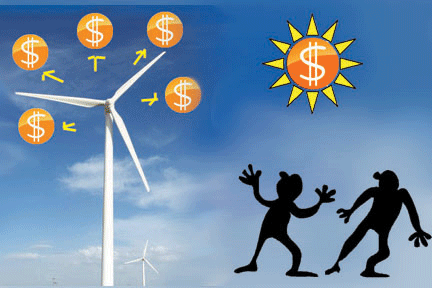 Germany Thrives Without Nuclear http://www.greenchipstocks.com/articles/german-renewable-energy-impresses/2179 By Jeff Siegel January 24th, 2013
Freezing temperatures in both Belgium and Germany have put both countries’ power systems to the test this week, but neither country has experienced electricity blackouts despite the lack of nuclear power.
Two of Belgium’s seven nuclear reactors – Doel 3 and Tihange 2 – were switched off this summer, following the discovery of cracks, cutting 2,000 MW of electricity-generating capacity from Belgium’s electricity network. Even without this nuclear capacity online, the network survived this winter’s peak electricity demand of 13,166 MW on 17 January, L’Echo, a Belgian newspaper, reported.
Belgium’s electricity supply is guaranteed by a small amount of energy imports – including gas from the Netherlands and solar and wind from Germany – and a diverse energy portfolio, one in which renewable energy has a rising share, the paper said.
Belgium’s electricity portfolio is currently: 39% gas, 36% nuclear, 9% hydro, 4% wind, 4.5% coal, 1.5% oil, 6% solar.
Similar news emerged from Germany: Reuters reported that the country’s electricity supply is adequate this winter, despite the nuclear switch off which started in 2011 following the Fukushima nuclear accident.
Meanwhile, Greenpeace Germany has reported that more than half of the coal-power projects planned in 2006 have since been abandoned thanks to Germany’s energy policies which have seen a shift to renewable energy.
An article in French daily Le Monde noted that not only is coal one of the most polluting sources of energy, in particular lignite – of which there is plenty in Germany – but coal is facing economic problems. Coal-fired electricity plants are the oldest in Germany’s electricity portfolio and they cannot provide power on a flexible basis – it takes a long time to put out a coal fire.
Le Monde reported that the rising share of renewables in Germany’s energy mix requires more flexibility – when the sun shines and the wind blows more electricity is produced than needed meaning that renewable electricity is available at prices that threaten the profitability of coal. A lignite coal-powered station coming online in 2015 will make an overall loss over its 40 year lifetime, according to Christian von Hirsch-hausen, Research Director at the German Institute for economic research (DIW). In a system with a rising share of renewables, lignite does not have any economic benefits, he added.
Gross contradiction: Germany stopping domestic nuclear power, but promoting it overseas
“a gross contradiction, that we are pushing forwards with the change in energy generation while supporting atomic energy abroad.”
Germany still supports foreign nuclear power http://www.thelocal.de/national/20130121-47451.html#.UP7XzR19JLs
21 Jan 13 Despite the German government’s dedication to ridding the country of nuclear power, it will continue to use public money to guarantee the construction of such power stations in other countries, it was reported at the weekend. The parliamentary committee for sustainable development voted unanimously at the end of last year to recommend the government stop financial backing for foreign atomic energy projects.
The change in energy policy only applies to domestic production, the letter says. The government considers it a “sovereign decision of other states to choose a different construction for their own energy policy.”
Chairman of the committee, Andreas Jung, from Chancellor Angela Merkel’s Christian Democratic Union, said it was “a gross contradiction, that we are pushing forwards with the change in energy generation while supporting atomic energy abroad.”
The government is currently promoting its policy with the slogan, “High time that something changed”, while Environment Minister Peter Almaier has been talking of establishing an international club of countries stepping away from nuclear energy.
Pakistan gets affordable solar panels, a winning strategy in Asia
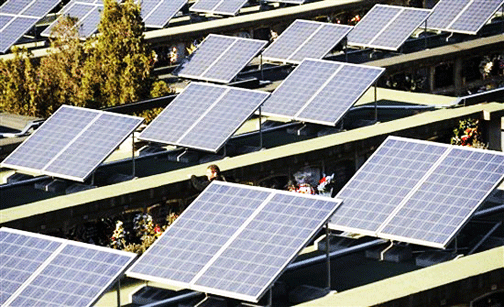 “We are aiming to make sure that any person who installs the house solar system will have monthly instalments equal to their current monthly electricity bill,” said Khurram. Given the fact that grid electricity in Pakistan is cheap, but unreliable, it is likely that many will find that proposition highly tempting.
The company is confident that the venture will prove to be financially viable. Adeel Anwar, the finance director of the company, said that he expects its revenues to touch €150 million (Rs19.2 billion) within the first year. CAE officials feel they can then double that number within three years.
 Renewable energy: German firm to set up first solar panel plant in Pakistan http://tribune.com.pk/story/491194/renewable-energy-german-firm-to-set-up-first-solar-panel-plant-in-pakistan/ By Imran Rana January 8, 2013 FAISALABAD: German renewable energy company CAE plans to invest more than €100 million (Rs12.9 billion) in setting up the first solar panel manufacturing facility in Pakistan, and the second of its kind in Asia.
In an exclusive interview with The Express Tribune, Shahzada Khurram, the only Pakistani director of the company, shared its plans of becoming a leading supplier of renewable energy equipment in the country. “Pakistan is going through one of the worst energy crises, and it is time to think about renewable energy as a way to make good money in the sector,” said Khurram. Continue reading
New EU law permits export of nuclear waste, but Germany won’t do that
Merkel confirms Germany won’t export nuclear waste, DW, 6 Jan 13, The
German chancellor has said the country is to dispose of its nuclear
waste within its own borders. The announcement came after her
environment minister denied a report that the government planned to
export it.
Chancellor Angela Merkel delivered her message on her government’s
nuclear waste disposal policy on Saturday at her Christian Democrat
Party’s (CDU) convention in the north western state of Lower Saxony.
It’s clear “that we’ll dispose our own [radioactive] waste here,” she
said, adding that this position had been “well-established.”
Merkel’s confirmation of her party’s position served to back her
environment minister, Peter Altmaier, who had spoken out on the issue
on Friday….. The current scheduled date for a complete German
shutdown is 2022. http://www.dw.de/merkel-confirms-germany-wont-export-nuclear-waste/a-16500965
Possible export of nuclear waste draws criticism, DW 5 Jan 13,
“…..A new law would allow Germany and other EU countries to export
radioactive material….., a new draft law has emerged in the midst of
the waste site debate. Changes to the existing law would allow the
possible export of spent nuclear fuel to storage facilities abroad.
The law is required because of EU guidelines from 2011 that must be
enshrined in national law by all member states by August 2013.
EU guideline
The draft, which Deutsche Welle has seen, allows the “permanent
storage” of nuclear waste abroad when “at the time of delivery there
is a valid accord between the Federal Republic of Germany and the
third-party country.” In other words, German nuclear waste may be
stored outside of Germany, provided certain conditions are met: for
example, that the storage facility in which the German waste is to be
stored was already operational prior to the export of the waste.
In response to criticism from environmental groups, the German
government has denied that plans are afoot to send German nuclear
waste abroad. However, Berlin emphasized that Germany is obliged under
European law to insert the criticized paragraph into existing German
law…… http://www.dw.de/possible-export-of-nuclear-waste-draws-criticism/a-16500605
1 This Month
26 September – International Day for the Total Elimination of Nuclear Weapons





PLEASE OPPOSE HR 8255 AND S.3639 – bills would accelerate satellite deployment, with no environmental review or safeguards – https://ncstd5li.quorum.us/campaign/169331/
To see nuclear-related stories in greater depth and intensity – go to https://nuclearinformation.wordpress.com
-
Archives
- September 2026 (281)
- August 2026 (330)
- July 2026 (355)
- June 2026 (287)
- May 2026 (306)
- April 2026 (356)
- March 2026 (251)
- February 2026 (267)
- January 2026 (308)
- December 2025 (358)
- November 2025 (359)
- October 2025 (375)
-
Categories
- 1
- 1 NUCLEAR ISSUES
- business and costs
- climate change
- culture and arts
- ENERGY
- environment
- health
- history
- indigenous issues
- Legal
- marketing of nuclear
- media
- opposition to nuclear
- PERSONAL STORIES
- politics
- politics international
- Religion and ethics
- safety
- secrets,lies and civil liberties
- spinbuster
- technology
- Uranium
- wastes
- weapons and war
- Women
- 2 WORLD
- ACTION
- AFRICA
- Atrocities
- AUSTRALIA
- Christina's notes
- Christina's themes
- culture and arts
- Events
- Fuk 2022
- Fuk 2023
- Fukushima 2017
- Fukushima 2018
- fukushima 2019
- Fukushima 2020
- Fukushima 2021
- general
- global warming
- Humour (God we need it)
- Nuclear
- RARE EARTHS
- Reference
- resources – print
- Resources -audiovicual
- Weekly Newsletter
- World
- World Nuclear
- YouTube
-
RSS
Entries RSS
Comments RSS

