Germany’s Chancellor Merkel got it right, on switch from nuclear to renewables
 Nuclear Cuts Vindicate Merkel as RWE Profit Dips, Bloomberg By Julia Mengewein – Jul 5, 2013 Germany’s $710 billion green-energy drive is cutting production at nuclear reactors, the nation’s most profitable large-scale plants, as power prices slump to a six-year low. The proportion of hours during which electricity traded at less than 30 euros ($39) a megawatt-hour, the level at which UBS AG says reactors start losing money, rose to 50 percent last month, the most since 2007 and 92 percent more than a year ago, data from the Epex Spot SE exchange show. RWE AG (RWE) cut output at its Gundremmingen plant near Munich 31 times in the first half as solar and wind output jumped, compared with 18 times in 2012, according to data compiled by Bloomberg.
The reductions, which typically last for hours at a time, underscore how Chancellor Angela Merkel’s plan to replace atomic power with renewable energy within a decade is gaining ground at the expense of profit at utilities from RWE to EON SE. The boom in green power, coupled with the lowest demand in 10 years, sent the average operating margin at 15 European utilities to the lowest since 2002, company data compiled by Bloomberg show.
“We will see more of those situations where renewable output is so high, that spot prices collapse below the level of the cash costs for nuclear plants,” Patrick Hummel, an analyst at UBS in Zurich, said July 2 by e-mail. “This really is a double-whammy for power producers. Fewer running hours means less power is sold and that happens at a lower price.”….. Continue reading
Germany’s nuclear waste “depository site law”
 What to do with nuclear waste? DW 28 June 13 Fifty years after Germany began using nuclear power, the country is once again looking for a suitable nuclear waste storage facility. Search priorities include transparency, safety and scientific criteria.
The German government, together with the opposition, hopes to approve a so-called depository site law for nuclear waste ahead of federal elections in September. The Bundestag, Germany’s lower house of parliament, on Friday (June 28) will vote on the planned legislation.
After a nearly 35-year controversy over the suitability of a salt mine in Gorleben in northern Germany as a potential site for storing high-level nuclear waste, the search for a storage site will begin again. The bipartisan compromise is considered historic. Continue reading
A critical question – who pays for long term nuclear waste storage?

 What to do with nuclear waste? DW 28 June 3 “……..Who pays? The forum Ecological-Social Market Economy has evaluated the Swiss study and, based on its findings, estimated the future costs for storing nuclear waste from Germany’s eight deactivated and nine active nuclear power plants. According to conservative calculations by the researchers, Germany can reckon with storage costs of about 18 billion euros in the future.
The German Atom Forum, comprised of all German nuclear power plant operators, intends to pay as little as possible for storage and rejected shouldering costs for the new site search. In their opinion´”there is no legal basis” for them to pay and all costs should be “financed by taxpayers.”
Environment Minister Peter Altmaier has a different view. He intends to have the nuclear plant operators take responsibility for the waste they generate. http://www.dw.de/what-to-do-with-nuclear-waste/a-16755844
World looks to Germany in the energy revolution
the people of Berlin seem to gravitate towards an environmentally conscious energy discussion. Bike commuters abound, energy efficiency and environmental concerns are a tenant of the informed public. In the relatively hot summer – 37 degree highs on average – the most noticeable omission from most building’s energy profile is air conditioning……..
Germany spearheads global renewable energy awareness Mohammed Alshoai Saudi Gazette, 24 June 13 BERLIN – The streets of Berlin face a different kind of traffic than those of Riyadh: bicycle traffic, which speaks multitudes in a city cultured with environmental awareness, so much so that Energiewende – literally: energy transformation – has become a word recognized in every household and office building in the German capital.
Following the Fukushima incident in 2011, the Germans took an almost unanimous vote on moving away from nuclear energy and promoting renewables. This vote has lead to a consensus on nuclear phaseout, which has become a tenant of Energiewende, emphasized by the high public tension surrounding nuclear energy.
Rainer Baake, currently the director of Agora Energiewende and formerly State Secretary at the Federal Ministry for the Environment, Nature Conservation and Nuclear Safety said at a roundtable: “Nobody wants to get back into nuclear. It is very clear that everybody wants to expand on renewables.” Renewable energy is an economic, environmental and political concern in Germany, currently emphasized by their upcoming elections in September. The main sources of renewable energy in Germany are wind power, solar and photovoltaic cells, collectively making up between 23 and 25 percent of the European nation’s energy structure, according to Agora Energiewende, along with several government organizations in Berlin.
One current issue being discussed on a political level, Baake said, is the expansion of Germany’s grid system versus a capacity market bent on storing energy for low peak production times and high consumption seasons, particularly in Germany’s cold winters.
“Grids are much more important than storage,” Baake said, adding that it is a much more affordable option, where heating in winter attributes a peak demand of 80 gigawatts. Baake added that the price per megawatt has gone significantly down from €90 to €100 in 1998 to approximately €30 to €50 today. Continue reading
Closing of Germany’s nuclear reactors
Nuclear Decommissioning Surge Is Investor Guessing Game, Bloomberg by Stefan Nicola in Berlin at snicola2@bloomberg.net; Julie Johnsson in Chicago at jjohnsson@bloomberg.net editor responsible for this story: Reed Landberg at landberg@bloomberg.net 16 June 13 “………German Closings Germany closed eight units after Fukushima and will shutter another nine by 2022. Its four utilities have set aside about 33 billion euros for decommissioning their 21 reactors and handling the deadly waste from them. The utilities set up GNS, a company that supplies 125-ton Castor dry casks to store and transport spent nuclear fuel, and also employ in-house decommissioning staff.
EON is 10 years into the job on its oldest commercial-scale unit, the 672-megawatt Stade plant in Lower Saxony, slated for completion by 2014. It started tearing down its 670-megawatt Wuergassen reactor in 1995, and plans to also complete that next year.
RWE said tearing down its 1970s-era Muelheim-Kaerlich reactor will cost about 750 million euros; it didn’t give cost estimates for the two pressurized water reactors at the 2,525-megawatt Biblis plant, which was closed after Fukushima, citing a lack of permits for their deconstruction plans.
EON declined to reveal the individual bill for the Wuergassen and Stade projects. It said costs are at about 1 billion euros depending on the reactor type, citing a “benchmark report for Germany,” in an e-mailed reply to questions.
Green Opposition
The opposition Green Party, which was in government from 1998 until 2005 and helped draft Germany’s first nuclear phase-out agreement, has called for the money to be put in a government-administered fund.
“Projects are often more expensive and longer than anticipated,” Sylvia Kotting-Uhl, a lawmaker with the Greens, said in an interview. “The question is: Will the money be available when it’s needed? A public fund would ensure that.”….”
EON and RWE said the current system shouldn’t be changed in favor of a state-run fund. The German system of setting aside money via utilities’ balance sheets “has proven itself,” Lothar Lambertz, a spokesman for RWE, said in an e-mailed reply to questions.http://www.bloomberg.com/news/2013-06-16/nuclear-decommissioning-surge-is-investor-guessing-game.html
Nuclear phaseout proving to be a success in Germany
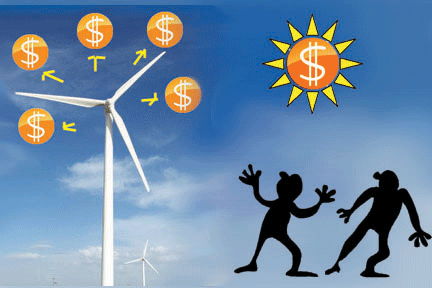 We can let fission fizzle out in a renewable world, New Scientist, 20 May 2013 by Jochen Flasbarth If Germany can phase out nuclear power and still thrive, why would other nations pursue a uranium-fuelled future? AT THE start of this year Germany officially entered the Dark Ages again – at least according to its state weather service. A mere 22.5 hours of sunshine were recorded in January – a 60-year low. Despite this, the country’s power supply, which has a world leading input from solar panels, firmly stood its ground, even without the eight nuclear reactors that were switched off in 2011.There was sufficient energy for charging smartphones, running dishwashers and the like – and enough for slightly more essential things such as industry or life-support systems in hospitals. And people in need of a fake tan could easily get one.
Such good news probably did not go down well with the pro-nuclear lobby. Grim and cold spells of this type had been their favourite doomsday scenario. Talk of a Stromlücke, or electricity gap, made headlines after the 2011 decision to shut nearly half of Germany’s 17 reactors in the wake of Japan’s Fukushima disaster.
The fear ran rampant that, without a nuclear backbone, blackouts might push German industry out of business – or at least out of the country. This proved groundless. Continue reading
Germany meeting the challenges of intermittent renewable energy
We can let fission fizzle out in a renewable world, New Scientist, 20 May 2013 by Jochen Flasbarth“……One of the most pressing challenges of a 100 per cent renewable world is how best to use energy sources that by their very nature do not run constantly. Your average German wind turbine operates for 1600 hours of the year. Equally, there are times when wind turbines or solar panels produce too much electricity. How to store this excess? This can be done conventionally by pumping water to fill a reservoir during the day, and using it to produce hydroelectric power at night.
More sophisticated is power-to-gas: carbon dioxide and water are combined in a series of steps to produce methane. Renewables will supply the electricity and the methane can be fed into the gas network to heat homes, fuel cars or generate electricity. The technology has yet to mature. But firms such asAudi are trying to get it off the ground commercially.
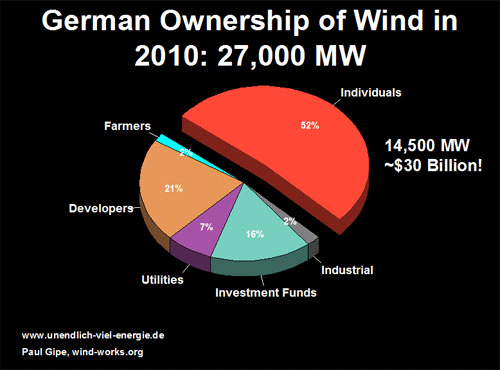
Another challenge is to transport power from the wind-rich north to the more populous southern and central Germany. That will mean building hundreds of kilometres of new power lines. Opposition is predicted. But this could be tackled by offering locals a financial share in mid-scale, private solar power installations or wind farms.
A quick word on prices: the financial support for renewables has taken some flak. Critics argue that ladling out money for solar panels has overheated the market and created too much capacity at too high a price. But this can be dealt with. Cuts to payments to panel owners for the electricity they generate, the feed-in tariff, have been made, more will follow. To put things in perspective: under the present system the average German is expected to pay €5 a month towards the feed-in tariff. This is a sound investment in clean technology, protecting us from the spiralling prices of conventional energy.
In a recent study we showed that in 2030, renewable electricity on average will cost 7.6 cents per kilowatt hour; electricity from gas or coal-fired power plants will probably be 9 cents. Onshore wind turbines already match prices of some fossil fuels…… http://www.newscientist.com/article/mg21829170.200-we-can-let-fission-fizzle-out-in-a-renewable-world.html

Germany’s post-nuclear vision is working, a practical transition to renewables
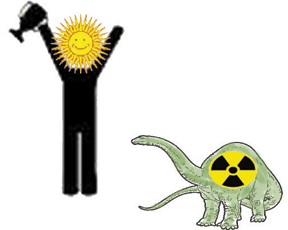 the sudden shutdown of seven nuclear power plants had no detrimental effect on security of supply, and was compensated for within the German energy infrastructure
Nuclear futures: renewables blossom in Germany’s post-nuclear vision .http://theconversation.com/nuclear-futures-renewables-blossom-in-germanys-post-nuclear-vision-14364 Erik Gawel, Sebastian Strunz 22 May 2013, When the Fukushima Daiichi nuclear power plant in Japan was hit by a tsunami in March 2011, the disaster had a profound effect on German energy policy. Chancellor Angela Merkel reasoned that “Fukushima has forever changed the way we define risk in Germany.”
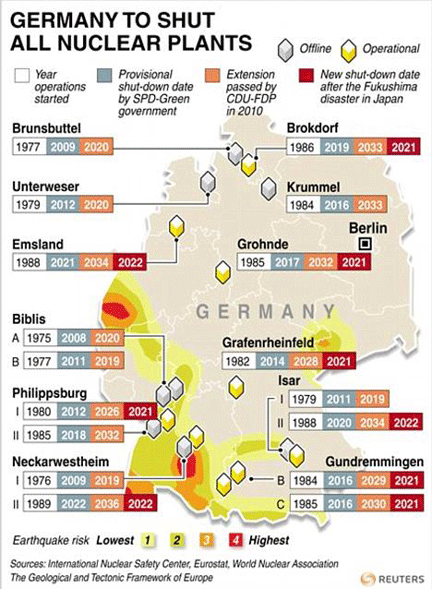
Three days after the news of meltdown in three of Fukushima’s reactors, Chancellor Merkel drew a line under German nuclear power. The seven oldest nuclear power plants in Germany were immediately taken off the grid, and two months later the government made this permanent. The remaining German nuclear power plants, it was decided, would be shut down by 2022.
This decision was a spectacular policy U-turn, as the same conservative government had only recently overturned an earlier attempt to ban nuclear power in Germany. In 2010, Chancellor Merkel’s coalition had argued that nuclear power was a “bridge technology” ecessary to pave the way towards a carbon-free energy system. The prolonged use of nuclear power would be indispensable in order to guarantee security of supply, it was claimed.
This raises two questions: did removing seven power plants endanger the security of supply to the German national grid? And what convincing long-term strategy is there in place to manage the shift to carbon-free energy without nuclear power? Continue reading
Germany’s move away from nuclear is part of a rational European trend
Nuclear futures: renewables blossom in Germany’s post-nuclear vision, The Conversation, 23 may“….The idea that it is irrational German angst that has led Germany to forge a path distinct from its neighbours doesn’t stand up to scrutiny: of 27 European Union member states, 11 have no civil nuclear power, and most have no intention of developing any. Four other European countries are joining Germany in phasing out nuclear power, while Italy closed its last nuclear power station in the 1980s, and in 2011 rejected plans to look at the issue again.
So Germany turning away from nuclear power is not a panicky reaction that endangers the country’s security of supply, more an important and well-integrated part of her transformation to use renewables exclusively.
Which is not to say that the Energiewende is without problems. Rising electricity bills and the costs of expanding many thousands of miles of transmission lines threaten to strain public acceptance. Rampant nimbyism and ecological and economic trade-offs have to be addressed; any plan for large offshore-wind farms that promise to provide efficient, renewable energy inevitably leads to conflicts with environmentalists.
Maintaining the power grid’s stability in a renewable-based system remains a challenge. But there is nothing to suggest that turning off nuclear power will jeopardise Germany’s clean energy vision. And where Germany leads, others may follow.http://theconversation.com/nuclear-futures-renewables-blossom-in-germanys-post-nuclear-vision-14364
Renewable energy – Germany’s impressive export of electricity
Germany Continues to Export Power Despite Nuclear Exit http://climatecrocks.com/2013/05/21/germany-continues-to-export-power-despite-nuclear-exit/ Climate Denial Crock of the Week with Peter Sinclair May 21, 2013
They said it couldn’t happen. They keep trying to trash the EnergieWende – Germany’s planet-leading transformation to renewable energy. But the pesky Germans keep perking along. Wall Street Journal:
FRANKFURT–Germany exported more electricity than it imported for the seventh consecutive year in 2012, despite an accelerated exit from nuclear-power generation that included the immediate and permanent shut-down of nearly half of the country’s atomic reactors in 2011.
Germany exported about 22.8 terrawatt-hours of electricity more than it imported in 2012, the Federal Statistics Office, Destatis, said Tuesday in a written statement.
The main destinations for German-produced electricity were the Netherlands, Switzerland and Austria, said the statistics office, citing data supplied by Germany’s four power transmission grid operators. The main sources of power imports into Germany were France, Denmark and the Czech Republic, it said.
The statistics office didn’t provide any reasons for the continued power exports, despite the fact that Germany shut down eight of 17 nuclear reactors in the wake of the Fukushima disaster in Japan in March 2011.
The rapid expansion of solar- and wind-power installations are seen as the main reason for continued German electricity exports, as well as the erosion of wholesale power prices under which many of Europe’s utilities are presently suffering.
The long haul for cleaning up Germany’s radioactive trash
Klaus-Günter Warnecke, the mayor of Remlingen, has been monitoring progress at the Asse nuclear waste site for nearly 20 years. Recent local media reports say he may have to wait another 20 years before the clearance of the site begins.
Living above Germany’s old nuclear waste, DW, 20 May 13, A German law has recently come into effect ordering the cleanup of 126,000 barrels of radioactive waste at the Asse nuclear dump site. But it seems the process could take a lot longer than locals initially hoped for….. Heike Wiegel is not just a resident here, she’s also a member of the citizen group ‘aufpASSEn’ – meaning ‘watch out’ in German – which helps raise awareness about issues from the Asse nuclear waste site.
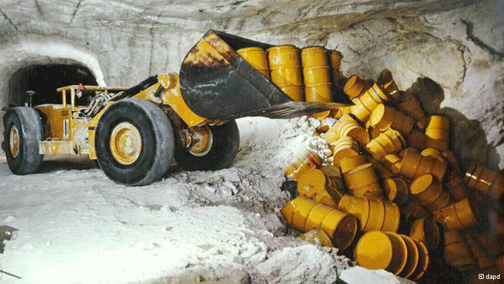
There are a number of other anti-Asse groups in the region. Now, with the law ordering the removal of waste from the site, they want to make sure that the mistakes of the past are not repeated.
“What happened back then at the Asse site should never have happened,” Wiegel says after a long pause. “That such an old, unstable salt mine would be used for nuclear waste, which, in the end, was just thrown in barrel by barrel.” Continue reading
Germany continues move to clean energy, though it is not easy
 Germany grapples with nuclear energy phaseout The Local Germany’s energy transition project – in which nuclear power will be phased out and replaced with energy from renewable sources – is facing the challenges of cheap coal, unresolved energy storage and an out-of-date electricity grid. 20 May 13 “…The hard-to-predict flow of renewable energies compared to fossil or nuclear power is one of the many challenges of the energy transition which Chancellor Angela Merkel rang in following Japan’s 2011 Fukushima nuclear disaster.
The goal is to be nuclear-free by 2022 and to combat pollution and climate change by boosting the share of clean and safe renewables to 80 percent by 2050.
Across Germany, solar panels, made popular by state subsidies and falling unit prices, now cover many home roofs and stretches of farmland.
New laws have allowed home owners to sell excess power back into the grid, while other incentives promote home insulation and other efficiency gains.
Germany’s solar power capacity has risen exponentially to reach a current level of about 30 gigawatts. Another 25 to 30 gigawatts come from wind farms across vast
stretches of Germany’s flat, coastal north and offshore parks in the North and Baltic seas.
Merkel, a physicist by training, said last week that, under optimal conditions, the total now falls just shy of Germany’s usual demand of 65 to 70 gigawatts Continue reading
Radioactive cargo on German ship gutted by fire
 Ship with radioactive cargo gutted by fire in Hamburg harbour http://indymedia.org.au/2013/05/18/ship-with-radioactive-cargo-gutted-by-fire-in-hamburg-harbour , 17 May 2013 – – A freighter which burned spectacularly in Hamburg harbour had highly dangerous radioactive substances aboard.
The north German city-state’s social democrat government only today released details of the fire on 1 May because the opposition Greens had put a question on notice.
As well as 8.9 tonnes of uranium hexafluoride the “Atlantic Cartier” also had some 180 tonnes of highly flammable ethanol, several tonnes of explosives, including munitions, and rocket fuel on board.
The highly toxic uranium hexafluofide is a compound used in centrifuges and other plants to enrich uranium. An area contaminated with it would be uninhabitable for a very long time. Continue reading
Step by step shutdown of nuclear energy in Germany
Germany aims to become one of the greenest countries in the world – with a huge shift towards renewable energy and massive energy savings
Germany moving ahead on renewable energy storage
Germany’s Energy Storage Incentives Start May 1 http://www.energymatters.com.au/index.php?main_page=news_article&article_id=3694 17 April 13, New renewable energy subsidies in Germany may do for battery storage globally what the nation did for solar power.

In February we reported Germany would apparently soon formally confirm a start date for an initiative to support the purchase of battery based energy storage systems integrated with solar panel arrays. It took a little longer than rumoured, but that moment seems to have arrived. Continue reading
1 This Month

of the week – Shut Down Drone Warfare!


Tell the Ukrainian Government to Drop Prosecution of Peace Activist Yurii Sheliazhenko

Petition to revoke the licensing of the Near Surface Nuclear Disposal Facility (NSDF) at Chalk River. https://www.ourcommons.ca/petitions/en/Petition/Details?Petition=e-7247
To see nuclear-related stories in greater depth and intensity – go to https://nuclearinformation.wordpress.com
-
Archives
- April 2026 (68)
- March 2026 (251)
- February 2026 (268)
- January 2026 (308)
- December 2025 (358)
- November 2025 (359)
- October 2025 (376)
- September 2025 (257)
- August 2025 (319)
- July 2025 (230)
- June 2025 (348)
- May 2025 (261)
-
Categories
- 1
- 1 NUCLEAR ISSUES
- business and costs
- climate change
- culture and arts
- ENERGY
- environment
- health
- history
- indigenous issues
- Legal
- marketing of nuclear
- media
- opposition to nuclear
- PERSONAL STORIES
- politics
- politics international
- Religion and ethics
- safety
- secrets,lies and civil liberties
- spinbuster
- technology
- Uranium
- wastes
- weapons and war
- Women
- 2 WORLD
- ACTION
- AFRICA
- Atrocities
- AUSTRALIA
- Christina's notes
- Christina's themes
- culture and arts
- Events
- Fuk 2022
- Fuk 2023
- Fukushima 2017
- Fukushima 2018
- fukushima 2019
- Fukushima 2020
- Fukushima 2021
- general
- global warming
- Humour (God we need it)
- Nuclear
- RARE EARTHS
- Reference
- resources – print
- Resources -audiovicual
- Weekly Newsletter
- World
- World Nuclear
- YouTube
-
RSS
Entries RSS
Comments RSS
 nuclear-news