Germany’s renewable energy output lowers European electricity prices

 Electricity Prices Fall In Europe As German Renewable Energy Output Increases http://www.triplepundit.com/2014/04/electricity-prices-fall-europe-german-renewable-energy-increases/ Gina-Marie Cheeseman | Tuesday April 15th, 2014 For the fifth consecutive month, electricity prices in countries neighboring Germany have decreased, recently released Platts data reveals, due in large part to increased solar and wind generation in Germany.
The Platts Continental Power Index (CONT), described as a “demand-weighted base load average of day-ahead contracts assessed in Germany, Switzerland, France, Belgium and the Netherlands,” dropped steadily in early 2014. The index decreased to €35.06 (or about $48.50) per megawatt hour in March, an 18 percent drop from February. Overall, the index is down by more than 39 percent since peaking at €50.50/MWh in November of last year.
“A mid-March surge in German wind output followed seven days of peak solar output, which rose above 20 gigawatts (GW) to a new monthly record of 23 GW on March 20,” Andreas Franke, Platts managing editor of European power and gas said in a news release.
“German power prices for March 16 delivery turned negative as wind power output rose above 24 GW combined with stronger solar production,” Franke continued. “Further along the curve, German year-ahead power prices fell below €34/MWh in March for the first time in more than nine years as the price CO2 fell drastically and coal prices retreated.”
Germany currently gets about 25 percent of its electricity from renewable energy, and the goal is to increase that number to at least 80 percent by 2050. German wind and solar output for the first three months of 2014 increased by 40 percent — or 6.5 terawatt-hours — compared with last year, according to the Platts data. Wind power increased 31 percent from the first quarter of 2013, while solar power increased 74 percent from more than a year earlier. Germany’s combined wind and solar portfolio is more than 70 gigawatts, making them the country’s largest sources of power when measured by installed capacity.

Data for the past three years from the Fraunhofer Institute shows that wind and solar power generation increased, while energy generation from natural gas fired power plants decreased significantly. Solar and wind power generation in Germany in 2013 increased by 36 percent in export surplus from 2012 levels. Photovoltaic power also increased by 44 percent from 2011 to 2012.
Reuters reported last week that German Chancellor Angela Merkel’s cabinet approved a reform measure for the country’s renewable energy law. The reform measure “will slow the growth of green energy…and force new investors in green power to take some risk,” according to Reuters. The German government wants to keep electricity affordable while allowing the renewable energy sector to grow. And growth in renewables is something that the government wants. Under the reform measure, the government wants to increase renewable energy generation to 40 to 45 percent of total electricity production by 2025 and 55 to 60 percent by 2035.
Wind energy blasts ahead in Germany
 Germany boosts wind power at green energy summit, DW 4 April 14, State and federal politicians have renegotiated planned reforms to Germany’s Renewable Energy Act at a summit in Berlin. They agreed to drop proposed limits on the country’s wind power facilities. Germany’s wind power industry has emerged victorious at Tuesday’s (01.04.2014) energy summit in Berlin. The talks brought together German Chancellor Angela Merkel and the country’s 16 state premiers.
The country is planning a shift away from fossil fuels and nuclear power. “We have now made the first big step to safeguard the energy transition,” said German Economics and Energy Minister, Sigmar Gabriel.
Gabriel’s initial plans to reform the country’s Renewable Energy Act (known locally as the EEG) had included drastically reducing subsidies for renewable energy power systems and capping the rollout of domestic wind power to 2500 megawatts per year.
But, southern German states like Baden-Württemberg rejected the plans. They argued that this would effectively destroy the renewable energy technology market they have built over years. States like Lower Saxony and Schleswig-Holstein were also angry, saying the new plans would reduce their ability to create power in the wind-intensive northern states.
Wind energy blasts ahead
According to Gabriel, federal and state ministers have now moved from a top limit to a flexible cap. That means more wind farms will profit from subsidies…….
The balancing act continues
German Chancellor Angela Merkel confirmed her view at the meeting that the “renewable energy surcharge needs to be limited, while at the same time a path for the energy turnaround needs to be ensured.”
Both goals have been met with this new compromise, says Merkel, but there are challenges ahead……..
So far, big energy users in Germany have been excluded from paying the surcharge. The European Commission in Brussels is investigating the EEG law on these grounds.
Sigmar Gabriel says that he will continue to support this exemption, in order to help German industry. After the summit Gabriel thanked the states for their support during the EU investigation. “We are in agreement on what we have to achieve with Brussels, namely, that we have to continue to exempt energy-intensive industry in Germany from this surcharge in a way that doesn’t breach competition regulations.”
The altered draft bill reforming the Renewable Energy Act will be discussed by the German cabinet next week. http://www.dw.de/germany-boosts-wind-power-at-green-energy-summit/a-17536470
Seven months ahead of schedule, Bavarian nuclear reactor is shut down
EON notified the Bundesnetzagentur regulator and grid operator TenneT TSO GmbH of its plan to close the 1,275-megawatt Grafenrheinfeld plant at the end of May 2015 “because of its lack of profitability,” the Dusseldorf-based utility said in a statement.
“The continued operation of nuclear power stations in Germany only makes economic sense if they can operate for a sufficient length of time without the burden of the nuclear-fuel tax,” EON said in the statement. The early shutting of Grafenrheinfeld is “unavoidable.”
France’s nuclear electricity costing industry 35% more does Germany’s electricity
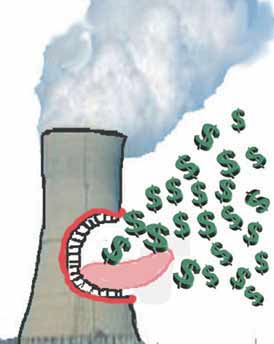
 France’s Industrial Giants Call for Price Cap on Nuclear http://www.bloomberg.com/news/2014-03-17/france-s-industrial-giants-call-for-price-cap-on-nuclear.html by Tara Patel Mar 17, 2014 France’s biggest electricity users urged the government to cap Electricite de France SA (EDF)’s wholesale nuclear-power price at the current level to help industrial consumers compete with German rivals.
The competitiveness of large French power consumers has “dropped off in a way that is extremely worrying,” the Uniden lobby group said today in a statement. The regulated rate is set at 42 euros ($58.50) a megawatt-hour. Uniden has written a position paper in response to a state consultation on power prices. While the body’s 41 members, which include PSA Peugeot Citroen (UG) and Total SA (FP), strive to compete with foreign peers, EDF has embarked on a cost-cutting drive as spending increases to maintain and upgrade its 58 reactors.
France has said it will announce any revisions to the power rate or the way it’s calculated at the end of the month. The government already forces state-controlled EDF to sell about a quarter of its nuclear output to other French distributors to increase domestic competition. The country gets about three-quarters of its power production from EDF’s atomic fleet.
Large German industrial power users will pay 35 percent less for their electricity next year than those in France, Uniden said. “Even more preoccupying” is France’s inability to compete with North America, where the boom in shale gas has lowered the cost of energy supply, it said.
EDF, based in Paris, has said it can’t make ends meet unless it gets permission to raise the price of wholesale nuclear power. “One can’t demand of a company to sell a quarter of its output below cost in the long term,” Chief Executive Officer Henri Proglio said last month. The regulated rate helps EDF make “a step toward” meeting its costs of 50 euros a megawatt-hour, he said. Uniden called for tighter control of EDF’s costs and more “visibility” on the power price over the next five years.
Dispelling the false story that Germany imports nuclear power
since the nuclear phaseout of March 2011, power exports in Germany have boomed. Germany remained a net power exporter in 2011 (PDF). 2012 was a record year. So was 2013. 2014 in shaping up to be a fierce competitor for the title (PDF).
So no, Germany has not imported more nuclear power from abroad during its nuclear phaseout.
German imports of nuclear power – the myth revisited REneweconomy, By Craig Morris on 13 March 2014 Energy Transition When Germany shut down nearly half of its nuclear capacity in the week after Fukushima, critics charged that the country would only be importing more nuclear power from its neighbors as a result. Craig Morris says it is a physical impossibility.
Perhaps the best example of such claims is an article published in September 2011 by Der Spiegel. The opening paragraph sums up the argument well: “the country is now merely buying atomic energy from neighbors like the Czech Republic in France.” Later, we read that “the Czech nuclear industry went into the export business. These days, it’s sending roughly 1.2 gigawatts-hours of electricity across the border every day.”
Embarrassingly, it gets worse from there: Continue reading
Germany’s profitable agriculture – farming the sun and the wind
 German farmers reap benefits of harvesting renewable energy Ft.com By Jeevan Vasagar in Reussenköge , 2 Dec 13, Dirk Ketelsen is a farmer but these days most of his income comes from harvesting the wind. On Germany’s North Sea coast, where a fierce sea breeze blasts in across the polders, the generous financial support the government has poured into renewable energy has reared a crop of wind turbines as far as the eye can see.
Mr Ketelsen began using wind to generate electricity on his organic farm in 1990. The next year, Germany adopted legislation that set guaranteed tariffs for power generated from renewables as part of an effort to encourage less polluting forms of energy.
Such policies have unleashed a boom for wind, sun and other sources of renewable energy, which now account for 23 per cent of the electricity consumption of Europe’s biggest economy.
They have also proved highly lucrative for farmers like Mr Ketelsen. The tariffs set by the Renewable Energy Act, known as the EEG, not only give renewables priority access to the electricity grid – ahead of the electricity produced by traditional power plants – they ensure their owners a guaranteed return over 20 years.
“Before the EEG, we said we’ll do this for ecological reasons. Even if there’s just a little bit of profit. Then came the EEG, and it worked out very well financially,” Mr Ketelsen said.
Record production of renewable energy in Denmark and Germany
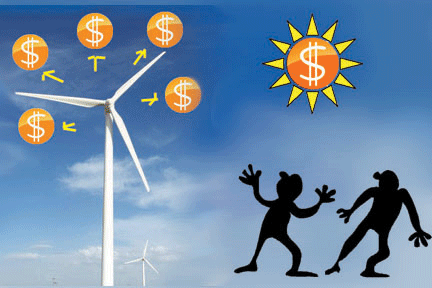 Renewable Energy Generation Hits All Time Highs in Denmark and Germany Permaculture Magazine | Friday, 15th November 2013 Denmark’s and Germany’s wind and solar electricity generation is peaking, covering much of their countries’ need, setting the trend for renewable energy systems that do not cost the Earth. In the last month, solar and wind energy has been reaching record breaking figures in some countries in Europe.
 On November 4th this year, Denmark’s wind turbines covered 122% of the countries demand for electricity.
“This is the highest registered figure so far,” says Preben Maegaard, director of the Nordic Folkcenter for Renewable Energy.
A month before on October 3rd, Germany’s renewable energy peaked at 59.1% with a combination of solar and wind. Across the entire day, 36% of total electricity generation was achieved, with solar contributing 11% at 20.5 gigawatts at its peak.
“It was around midday on October 3, which just happened to be Germany’s annual Reunification Day holiday, when the sun was at its fullest and the significant peak was reached. Over the entire day, 36.4% of total electricity generation was achieved with solar and wind power; solar panels contributed 11.2% on their own. At its peak, solar accounted for 20.5 gigawatts.
“Although the electrical grid withstood the large amount of renewable energy flowing to it, you’ll be pleased to know that electricity prices also dived. A drop in demand from big, conventional power plants led the electricity price index at 2:00pm to 2.75 cents per kilowatt hour. The index covers Germany, Austria, France, and Switzerland.
“So there you have it. A country as large and industrialized as Germany can and did operate successfully, albeit on a national holiday, using a large percentage of renewable energy. And this is only the beginning,” comments Jim Winstead.
These surges not only showed that renewable energy can supply energy needs, but neither power grids broke down under the surge…..http://www.permaculture.co.uk/news/1511134008/renewable-energy-generation-hits-all-time-highs-denmark-and-germany
Call for German utilities to pay more of nuclear decommissioning costs
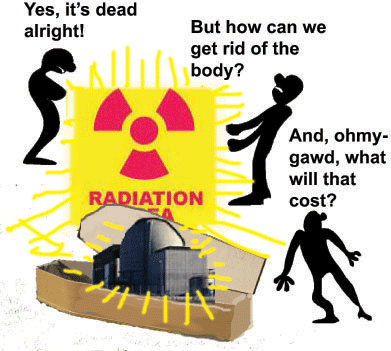 German parties want utilities to shoulder nuclear shutdown costs BY MARKUS WACKET BERLIN Thu Nov 14, 2013 (Reuters) – German parties negotiating the formation of a coalition government want to make utilities pay more to dismantle their nuclear power plants and protect taxpayers from billions of euros in related costs, documents obtained by Reuters show.
Such a move, if adopted by a coalition of Chancellor Angela Merkel’s conservatives and the Social Democrats (SPD), would be a blow to E.ON, RWE, Vattenfall and EnBW who have already put aside 30 billion euros in provisions.
“A … fund could be considered to safeguard the financing of the disposal of nuclear assets,” the paper from the working group on environmental policies said.
Under the new proposal, the utility companies could be forced to pay into the fund which would be under political control.
Over a dozen working groups are hammering out policy compromises on a range of issues with the aim of forming a government in December. The nuclear proposal would have to be approved by a larger coalition panel led by Merkel and other party leaders before it was set in stone.
“We expect cooperation from the nuclear power operators in the switch to renewable energy and an acknowledgement of their responsibility for the orderly ending of the use of atomic energy,” the paper said.
The idea of a fund reflects concerns that Germany’s four nuclear power companies have taken insufficient precautions to pay for the dismantling of the plants and storage of atomic waste…….
The SPD is also keen to raise nuclear fuel tax and to extend the levy beyond 2016, when it is currently due to expire. However conservatives oppose this notion.
(Writing by Madeline Chambers; Editing by Susan Fenton) http://www.reuters.com/article/2013/11/14/us-germany-coalition-nuclear-idUSBRE9AD0HN20131114
Germany’s grid copes with Renewable energy load – 59% of all energy produced
Germany Reaches 59% Renewable Energy Peak, Power Grid Doesn’t Blow Up http://www.the9billion.com/2013/10/30/germany-59-percent-renewable-energy-peak/ by JOHN JOHNSTON on 10/30/2013 Earlier this month on a very sunny and windy day, Germany managed to hit a peak of 59.1% renewable power generation, and what’s more, the heavily industrialized county’s power grid did not explode, Greentechmedia has pointed out. t was around midday on October 3, which just happened to be Germany’s annual Reunification Day holiday, when the sun was at its fullest and the significant peak was reached. Over the entire day, 36.4% of total electricity generation was achieved with solar and wind power; solar panels contributed 11.2% on their own. At its peak, solar accounted for 20.5 gigawatts.
Although the electrical grid withstood the large amount of renewable energy flowing to it, you’ll be pleased to know that electricity prices also dived. A drop in demand from big, conventional power plants led the electricity price index at 2:00pm to 2.75 cents per kilowatt hour. The index covers Germany, Austria, France, and Switzerland.
So there you have it. A country and large and industrialized as Germany can and did operate successfully, albeit on a national holiday, using a large percentage of renewable energy. And this is only the beginning.
Focus shifts to investing in renewable energy – German power provider RWE
RWE’s “business of renewable energy will provide stable value contributions and remain the only area for growth investments”
 Germany’s RWE looks for renewable energy push Eco News, 30 Oct 13 Germany’s major power producer RWE recently surprised by revealing it was departing from its traditional business model and would “create value by leading the transition to the future energy world”.
Now, RWE is looking for new ways to boost its renewable power business, including partnerships with investors, according to an internal document seen by Reuters Newsagency.
In the past Germany’s largest power producer, has traditionally based its business model based on large-scale thermal power production.
European media reports say the new strategy was decided on at a meeting of RWE’s Supervisory Board in the Polish capital, Warsaw, in September and will be revealed publicly soon.
RWE plans to “develop new partnership models with financial investors” to fund renewable projects, according to the document.
Its technological focus has been on wind power, which is better suited to larger utilities due to its plant-sized parks and requires large investments. A steep drop in wholesale power prices and a boom in renewable energy, which has driven conventional power plants into loss-making territory, have hit hard at RWE, along with other German utilities E.ON and EnBW.
RWE, which is scheduled to report nine-month results on November 14, could not immediately be reached for comment.
RWE’s “business of renewable energy will provide stable value contributions and remain the only area for growth investments”, Reuters reports the document saying….. http://econews.com.au/news-to-sustain-our-world/germanys-rwe-looks-for-renewable-energy-push/
Germany’s people powered renewable energy success
Three reasons Germans are killing it on renewable energy http://reneweconomy.com.au/2013/three-reasons-germans-are-killing-it-on-renewable-energy-56628 By John Farrell on 24 October 2013 CleanTechnica Germany is racing past 20% renewable energy on its electricity grid, but news stories stridently warn that this new wind and solar power is costing “billions.” But often left out (or buried far from the lede) is the overwhelming popularity of the country’s relentless focus on energy change (energiewende).
How can a supposedly expensive effort to clean up the energy supply be so popular?
1. It’s about the cost, not the price
Most news stories focus on the cost of electricity in Germany, which has some of the highest rates per kilowatt-hour in the world. But they don’t note that the average German electricity bill – about $100 a month – is the same as for most Americans. Germans are much more efficient users of energy than most, so they can afford higher rates without having higher bills. (Note to self: check out options for energy efficiency).
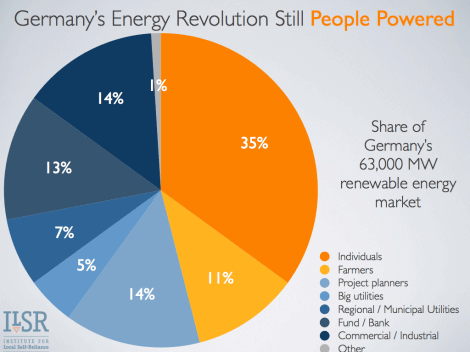 Ger,amy’s people-powered renewabl eenergy success
2. It’s about vision Continue reading
Refuting the lies of anti renewable energy propaganda
 Myth-busting Germany’s energy transition Smart Planet By Chris Nelder | October 12, 2013 Major English-language media have been propagating a false narrative about the stunning success of Germany’s transition to renewable energy: theEnergiewende. To hear them tell it, the transition has been a massive failure, driving up power prices, putting Germany’s grid at risk of blackouts, and inspiring a mass revolt against renewables.
Nothing could be further from the truth……..
I debunked a few of the hoary tropes about the Energiewende one year ago, such as the notion that the grid can’t handle a large share of variable renewable power. But apparently many in the major Western media still haven’t gotten the memo.
So let’s clear out the fog and debunk a few of the favorite myths about theEnergiewende.
Myth: “After the Fukushima nuclear accident in Japan two-and-a-half years ago, Merkel quickly decided to begin phasing out nuclear power and lead the country into the age of wind and solar.” (This one is from the above-mentioned Der Spiegel article.)
Fact: Germany’s switch to renewables started in 1991, and the nuclear phaseout started in 2002. Continue reading
Germany shows political success of its renewable energy transition
it is a clear signal that citizens are favouring a publicly owned, decentralised energy system with a leading role of renewables.”
The German result is likely to present good news. HSBC believes the IPCC report – despite its criticism in some quarters, and particularly by the fossil fuel lobby – could mark “a new phase in climate action”.
Germany votes for energy transition, and to buy back the grid http://reneweconomy.com.au/2013/germany-votes-for-energy-transition-and-to-buy-back-the-grid-50110 By Giles Parkinson on 25 September 2013
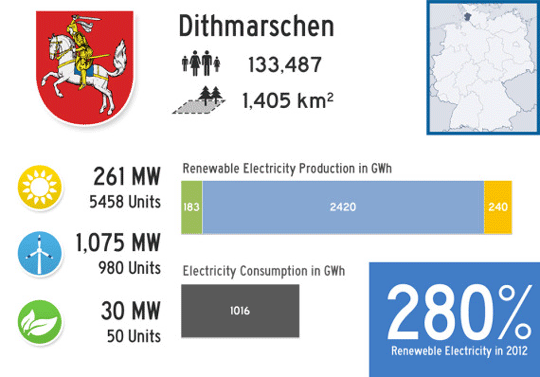
As the dust settles on the election results, and Chancellor Angela Merkel begins the process of selecting a new coalition partner, most observers are suggesting that the poll results are positive for Germany’s Energiewende, the ambitious energy transition program that aims to have Europe’s strongest industrial economy powered 50 per cent by renewables by 2030, and 80 per cent by 2050. (Below renewable energy in just one province of Germany 2012)
German utilities losing money on coal, gas, and nuclear plants
 German energy giants pull plug on coal, nuclear The Local, 18 Aug 2013 Ever since Chancellor Angela Merkel announced a phase-out of nuclear energy over the next decade and pledged to generate as much as 80 percent of the country’s electricity from renewables by 2050, big question marks have been hanging over the future of coal and gas-fired plants in Germany.
Merkel, seeking a third term in general elections on September 22nd, is a staunch supporter of this hugely popular policy move.
But the turnaround is depriving utilities, including market leaders RWE and E.ON, of massive profits from their atomic plants and turning their gas and coal-fired stations into loss-makers as they are sidelined by rival renewable sources of energy.
Last week, the two biggest players in the German sector unveiled steep drops in profits, and “many of our plants are operating at a loss,” complained RWE’s finance chief Bernhard Günther.
Indeed, RWE announced that it would shut down a number of plants –representing combined capacity of 4,300 megawatts — in both Germany and the Netherlands. And more could follow, Continue reading
Germany opposes EU plan to subsidise nuclear industry
 Germany rebuffs European nuclear power subsidy proposal By Charlie Dunmore and Henning Gloystein BRUSSELS/LONDON, July 19 (Reuters) – Germany on Friday rebuffed draft plans by the European Commission to allow European Union member states to directly subsidise nuclear power.
Several European governments, such as Britain and France, plan to build new nuclear power stations, but many companies are shying away from investing in the expensive technology without the safeguard of government support. The Commission’s draft, seen by Reuters and titled “Paper of the Commission Services containing draft guidelines on environmental and energy aid for 2O14-2O20”, proposes to allow governments to provide direct state aid for nuclear power……..
“This document was not endorsed by the Commission, but is a preparation document for a public consultation,” European Commission spokesman for competition policy Antoine Colombani said in Brussels.
“The European Commission does not wish in any way to encourage subsidies to nuclear power… However, it appears that some member states do wish to subsidise nuclear power, and the Commission is in charge of state aid control, so whenever a member state notifies a measure we are obliged to examine it,” he added.http://www.reuters.com/article/2013/07/19/europe-nuclear-energy-idUSL6N0FP2P820130719
1 This Month
6 June – WEBINAR- Get Inspired by Protests Against Military Bases!


Cuba Is Not a Failed State – It Is a Besieged State
PETITION: “Global Appeal to Endorse Palestinian Right of Return of Refugees”


of the week– Nuclear Reactor Information Task Force
To see nuclear-related stories in greater depth and intensity – go to https://nuclearinformation.wordpress.com
-
Archives
- June 2026 (34)
- May 2026 (306)
- April 2026 (356)
- March 2026 (251)
- February 2026 (268)
- January 2026 (308)
- December 2025 (358)
- November 2025 (359)
- October 2025 (376)
- September 2025 (257)
- August 2025 (319)
- July 2025 (230)
-
Categories
- 1
- 1 NUCLEAR ISSUES
- business and costs
- climate change
- culture and arts
- ENERGY
- environment
- health
- history
- indigenous issues
- Legal
- marketing of nuclear
- media
- opposition to nuclear
- PERSONAL STORIES
- politics
- politics international
- Religion and ethics
- safety
- secrets,lies and civil liberties
- spinbuster
- technology
- Uranium
- wastes
- weapons and war
- Women
- 2 WORLD
- ACTION
- AFRICA
- Atrocities
- AUSTRALIA
- Christina's notes
- Christina's themes
- culture and arts
- Events
- Fuk 2022
- Fuk 2023
- Fukushima 2017
- Fukushima 2018
- fukushima 2019
- Fukushima 2020
- Fukushima 2021
- general
- global warming
- Humour (God we need it)
- Nuclear
- RARE EARTHS
- Reference
- resources – print
- Resources -audiovicual
- Weekly Newsletter
- World
- World Nuclear
- YouTube
-
RSS
Entries RSS
Comments RSS
 nuclear-news