Germany’s Renewable Energy Generated Almost Double The Amount From Nuclear
 Renewable Energy In Germany Generated Almost Double The Amount From Nuclear http://cleantechnica.com/2015/10/29/renewable-energy-in-germany-generated-almost-double-the-amount-from-nuclear/ by Jake Richardson Originally published on Solar Love.
PV solar power generation in Germany is already 5% higher in the first nine months of this year than all of last year. Germany’s PV systems generated 33,193 gigawatt hours of solar electricity through the end of September, according to the German Association of Energy and Water Industries. Wind power in the first nine months of 2015 has generated 52% more than it did in all of 2014. 59,006 gigawatt hours has been produced, according to the same source.
114,723 gigawatt hours of electricity in Germany came from renewable sources in the first nine months of 2015, which was almost double the amount produced from nuclear sources. Additionally, some electricity prices have decreased from the previous year. For example, the cost of peak load power is nearly at 2002 levels.
This is all good news….the crazy thing about it is that you probably won’t hear about it anywhere but niche news sites like this one. This media oversight is a tragic deficiency, but the fact that Germany has come so far so rapidly confirms the effectiveness of renewables. This is not a small country like Costa Rica achieving 100% electricity from renewables for two months for 4.8 million people. Germany’s population is about 80 million!
Switching gradually from nuclear to renewables for such a large nation is very obviously a tremendous undertaking. How far along the path is Germany now? Some might say it won’t and can’t happen soon, but it seems to be progressing well.
Given that the price of PV solar power systems continues to drop, will there be an even greater acceleration in the rate of solar adoption? Price has been one of the major barriers, but is no longer nearly as much a factor. Another has been the lack of backup power or energy storage, but that one is being diminished too by the fact that the energy storage industry is growing quickly.
It should be pointed out that the decision to decrease reliance on nuclear power and increase investment in renewables was done before the most dramatic drop in solar power and the emergence of energy storage solutions. It will be fascinating to see how much more German renewable energy will grow in the next several years.
Germany says nuclear utilities can pay for decommissioning reactors
 Germany Says Utilities’ Reserves Adequate for Nuclear-Power http://www.wsj.com/articles/germany-says-utilities-reserves-adequate-for-nuclear-power-exit-1444464002 Exit In wake of Fukushima, country plans to exit nuclear power by 2022 By STEFAN LANGE And MONICA HOUSTON-WAESCH Oct. 10, 2015 FRANKFURT—German utilities’ reserves for the country’s planned exit from nuclear power are adequate, the ministry for economics and energy said, citing a government-commissioned report on the matter.
“The affected companies have fully covered the costs with the designated provisions,” economics minister Sigmar Gabriel said in a statement.
The Federal Ministry of Economic Affairs and Energy had called for the stress test to determine whether utilities’ reserves are up to the task of financing nuclear waste and the decommissioning of plants. In the wake of the Fukushima disaster in 2011, Chancellor Angela Merkel said Germany would exit nuclear power by 2022, taking utilities by surprise. In the interim, politicians have voiced concern that nuclear operators could try to duck the long-term costs, leaving taxpayers with the bill.
Existing reserves for the country’s nuclear exit amount to €38.3 billion, the report said. In a worse-case scenario, costs could come to as much as €77 billion, however this assumes an average interest rate of a negative 1.6% until the year 2099, a highly unlikely event, the report noted.
Utilities have said that since the government supported the construction of nuclear facilities, it should also participate in dismantling them. Earlier this month, the economics ministry dashed those hopes.
“There will be no state assistance,” a ministry spokeswoman said on Oct. 5.
Separately, Germany’s cabinet is due to pass a draft law within days, giving utilities longer-lasting liabilities for the costs of a nuclear exit. In mid-September, shares of RWE AG and E.ON SE, the two largest utilities in the country, plummeted over 10% amid speculation that initial results of the test showed utilities’ reserves were inadequate. At the time, Mr. Gabriel said no preliminary results were available, and that the stress test was just one factor of many in determining future policy.
At the end of 2014, E.ON had earmarked €16.6 billion, while RWE set aside €10.4 billion in reserves for the nuclear exit.
“In real terms, these are the highest provisions for an asset like this on the planet,” E.ON chief executive Johannes Teyssen said in September following his company’s decision to retain its German nuclear operations. E.ON has three nuclear plants in operation and minority stakes in a number of others.
Mr. Teyssen made the comments after the company scrapped plans to shift its nuclear operations to a new company, Uniper. E.ON will proceed with plans to split, moving conventional power, trading and exploration and production to Uniper, but E.ON will keep its German nuclear operations, it said. At the time, the company also said it expected a substantial net loss for the full year.
Write to Stefan Lange at stefan.lange@wsj.com and Monica Houston-Waesch at nikki.houston@wsj.com
Massive Protest Planned Against New Atomic Weapons In Germany
 US Nuclear Weapons In Europe: Massive Protest Planned Against New Atomic Weapons In Germany, IBT, By Christopher Harress @Charress c.harress@ibtimes.com on October 01 2015 Nearly 100,000 people in Germany have signed a petition protesting a plan to introduce U.S. nuclear weapons on German soil. The U.S. military was supposed to place new weapons in the country toward the end of 2015, but a statement from officials said that the transfer would likely take place closer to 2020.
However, this has not stopped the mass petition from moving forward, according to report by Russian state news site Sputnik. “Since this is about strengthening offensive weapons, we call on the federal government, the Parliament, the chancellor and the federal president to stop nuclear armaments on German soil,” the petition said……
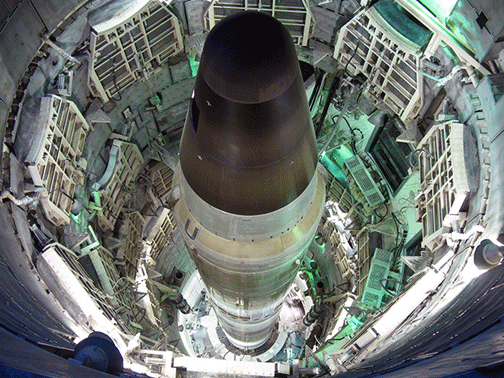
The U.S. continues to maintain nuclear carrying facilities in Germany, Belgium, the Netherlands, Italy and Turkey through a NATO sharing program. Host countries make decisions on weapons policy, maintain equipment required for the use of nuclear weapons and carry out consultations. France and the United Kingdom are the only countries in Europe that maintain state-owned nuclear arsenals.
In March 2010, a majority of German MPs decided that the government should “urge American allies to withdraw US nuclear weapons from Germany.” But instead of eliminating the weapons, the U.S. made plans to deploy 20 more, according to Sputnik. http://www.ibtimes.com/us-nuclear-weapons-europe-massive-protest-planned-against-new-atomic-weapons-germany-2122692
German public strongly support renewables, not coal or nuclear
German support for renewables still high, low for nuclear and  coal http://reneweconomy.com.au/2015/german-support-for-renewables-still-high-low-for-nuclear-and-coal-26906 By Craig
Morris on 24 September 2015 Energy Transition
A recent survey conducted among the German public finds continuing support for the Energiewende. Furthermore, only a third said the cost was too high. Craig Morris says a closer look also reveals that people who already have systems close by are less likely to oppose them. The average German household currently pays 18 euros per month for the renewable energy surcharge. A survey conducted in August by TNS Emnid for renewable energy organization AEE finds that only 31 percent of the participants believe that is too much, compared to 57 percent who believe that amount is acceptable and six percent who think more needs to be paid. Overall, a whopping 93 percent of those surveyed said that further growth of renewables was “important” or “very important.”
The survey also included a question about the acceptability of specific electricity generation systems. While 68 percent support renewable energy systems in general, only seven percent like coal plants – and only four percent nuclear. Note that in all cases, acceptance increased when people already had experience living close to such plants.
Acceptance of solar power plants was the greatest at 77 percent, compared to only 59 percent for wind turbines. But notice the huge discrepancy: a far higher number (72 percent) of people who have experienced wind farms nearby support the technology.
In contrast, support for biogas units was the lowest at a mere 39 percent, rising only to 53 percent among those who already have experience or live close by to those units. This low level of support is one reason for why the government has clamped down on bioenergy in general; the other reason is cost.
Finally, the survey asked what people expect of the Energiewende. The top answer was “making the future safer for our children and grandchildren” at 77 percent, followed by “”protecting the climate” at 73 percent. In contrast, only 33 percent believe the energy transition will “lower costs for consumers in the long term.”
Questions about energy democracy – “citizens can take part in energy supply” and “more competition with power corporations” – revealed middling expectations at 57 and 50 percent, respectively. Note, however, that the question was not why people supported the Energiewende, but what outcome they expected it to produce.
Similar questions were asked in a survey from September 2013, which also found exactly 93 percent in support for the growth of renewables. Likewise, support for the various technologies has only shifted slightly, as have the expectations, which had the exact same order (with slightly different numbers) two years ago. In other words, over the past two years, support for the Energiewende has hardly changed.
German utility E.ON gives up plan to set up anew nuclear company, in view of new liability law proposed
E.ON Faces Massive Loss After Scrapping German Nuclear Spinoff
Utility said it would post a hefty net loss this year after booking billions of euros in impairments, WSJ, MONICA HOUSTON-WAESCH and FRIEDRICH GEIGER Sept. 10, 2015 BERLIN—E.ON SE will post a massive loss this year after ditching plans to unload its German nuclear operations into a new company, in a nod to government proposals to saddle utilities with liabilities related to nuclear energy.
E.ON expects to book impairment costs this quarter of as much as €9 billion ($10 billion), triggering a multibillion-euro loss. Its shares plunged to an all-time low on Thursday, dropping 6% to €9.09.
The German utility had planned to move its nuclear operations into Uniper, a company being established to operate conventional power, trading, exploration and production. The spinoff will proceed but without German nuclear activities, said E.ON, which also has Swedish nuclear operations……..
E.ON’s decision was prompted by government proposals for legal changes that would make utilities permanently liable for the costs of nuclear waste and plant decommissioning……..
E.ON now plans to bundle its German nuclear operations into an independent unit within E.ON. Its Swedish nuclear operations will be spun off into Uniper as planned……http://www.wsj.com/articles/e-on-drops-plan-to-spin-off-german-nuclear-plants-1441865094
German govt to change nuclear liability law – to make utilities pay up for nuclear exit costs
 Germany proposes changes to nuclear liability law- draft law http://www.reuters.com/article/2015/09/02/germany-nuclear-idUSB4N10101R20150902 BERLIN, SEPT 2 The German government has proposed changes to a law to prevent German utilities from evading the payment of billions of euros needed to fund the country’s nuclear exit, according to a copy of the draft law seen by Reuters.
The document says that utilities will be liable for the costs of shutting down power plants and disposing of nuclear waste even if they give up control of subsidiary companies or spin-offs.
A spokesperson for the economy ministry said the draft law was currently being discussed by government departments.
Under current corporate laws, companies are liable for spun off units for five years, but there has been concern utilities might break up to avoid paying for the dismantling of Germany’s nuclear plants, the last of which will be shut for good in 2022. (Reporting byGernot Heller; Writing by Caroline Copley; Editing by Madeline Chambers)
Germany’s new nuclear waste plan shows how dangerous radioactive trash is
 the plan for dealing with the waste has a much longer time-scale, one which makes clear just how dangerous nuclear waste is to dispose of.
an actual location won’t be chosen until 2031, and it will take until 2050 to convert that site until it is ready to store the waste. The process of moving the waste there will then take several more decades.
Germany draws up new plan to dispose of nuclear waste http://www.dw.com/en/germany-draws-up-new-plan-to-dispose-of-nuclear-waste/a-18645069 12 Aug 15 The German government has presented its plan for permanently disposing of nuclear waste. Critics say the proposal is a tacit admission that it is a bigger problem than it has ever acknowledged before. Pausing only to get the okay from the cabinet, Environment Minister Barbara Hendricks gave a press conference on Wednesday to present the government’s brand new plan for dealing with radioactive waste. Continue reading
Smart economics: Germany’s decision to phase out nuclear power
Why Germany’s decision to phase out nuclear power is smart economics , REneweconomy, By Erik Gawel & Sebastian Strunz on 4 August 2015 London School of Economics
Germany has made a formal commitment to phase out the use of nuclear power by 2022. Erik Gawel and Sebastian Strunz write on the implications of the strategy for Germany’s future energy mix and whether the approach adopted in the country could function as a model for other European states. They argue that while the target is undeniably challenging, long-term it is economically sensible and feasible to phase out both fossil fuels and nuclear energy in favour of renewables.
Political responses to climate change and other negative consequences of conventional energies within Europe (e.g. oil spills, radioactive waste, open pit coal mining) are highly diverse. While the UK is promoting nuclear as a carbon-free energy source, for instance, Germany has embarked on a completely different path with its plan to phase out nuclear energy altogether. What is the background of Germany’s phase-out decision and how sensible is it from an economic point of view?
In order to fully answer this question, several aspects need to be acknowledged. First, the phase-out is no impulsive reaction to the Fukushima incident, which came out of the blue. Germany’s powerful anti-nuclear movement dates back to the 1970s; it bred the Green Party which entered the Parliament in 1983 and ascended to the government in 1998 by forming a coalition with the Social Democrats. In 2000 this centre-left coalition put a nuclear phase-out into law for the first time. The early 2020s were identified as the target date for a nuclear free energy system. While subsequent revisions of the law have changed the specifics, the currently stipulated year for the last plant to be shut down, 2022, is well in line with this original perspective. Thus, the phase-out project has always been crafted as a long-term and step-wise process.
Second, the Fukushima disaster effectively killed the narrative that nuclear power was necessary as a ‘bridging technology’ toward a renewables-based energy system. While conservatives had previously argued in line with this logic (and the government led by Chancellor Merkel in 2010 diluted the first phase-out law from 2000 by extending the running times of nuclear plants), they reversed their position after Fukushima. The most immediate consequence of Merkel’s shift on nuclear was the prompt shutdown of seven nuclear power plants in spring 2011. Due to overcapacities, this drop has neither proven to be problematic for the security of supply (contrary to the conservatives’ claims before 2011) nor has it led to an enduring increase of wholesale prices or a requirement to import foreign nuclear power. In fact, Germany is still a net exporter of electricity.
Third, Germany is not alone in phasing out nuclear power. As can be seen from Table 1, [in original] there are several countries in Europe that do not rely on nuclear power or have also declared their intention to stop nuclear energy production. While some of the countries without nuclear are smaller EU member states, it is noteworthy that Italy, another highly industrialised economy and member of the G7, has never used nuclear power. The highly diverse picture of nuclear energy in Europe becomes complete when the huge differences in nuclear-shares among countries are considered, as well as the fact that countries such as Poland intend to enter this form of energy………..
Is nuclear power a necessary part of a future energy mix?
All things considered, is nuclear power necessary for decarbonising the energy supply while also ensuring security of supply? The German experience shows that renewable energies may contribute major shares of the electricity supply – without jeopardising energy security in a highly industrialised economy and even under challenging natural frame conditions in Germany for renewables, provided that there is a long-term transition perspective and a stable political consensus.
Moreover, it may be questioned whether the long-term risks associated with nuclear power really fit the requirements of any sustainable energy system which demands being more than simply carbon-free. But even apart from such sustainability issues, the apparent need for heavy subsidies to render new nuclear plants economically viable undercuts the claim that nuclear is cheaper than renewable energy sources, even in terms of financial costs only. On the contrary, a recent Prognos study estimates that “new wind and solar can provide carbon-free power at up to 50 per cent lower generation costs than new nuclear”. Accounting for backup requirements in times without wind or sun, a combined system of wind, solar and gas is still 20 per cent cheaper than a system of nuclear and gas.
Sure enough, Germany has to cope with the side-effects of the transition (e.g. current rises in retail electricity prices) and interactions with other developments (e.g. increasing electricity production from lignitemainly due to high gas prices and the record low emission allowance prices). Yet, nuclear energy is rarely an inevitable part of decarbonising energy provision. Until now, Germany’s political consensus is very solid in this respect – and while the transition effort is indeed challenging, this does not diminish its merits from an economic point of view: in the long run, it seems both sensible and feasible to phase out fossil and nuclear energies in favour of renewables, thus treading a long but well-considered path towards comprehensive sustainability of energy provision, including long-term cost-effectiveness.
Source: This article was first published at the LSE’s Europblog http://reneweconomy.com.au/2015/why-germanys-decision-to-phase-out-nuclear-power-is-smart-economics-49500
Germany sets new record for renewable energy – 78% renewable electricity July 25
Germany Just Got 78 Percent Of Its Electricity From Renewable Sources, Think Progress BY ARI PHILLIPS JUL 29, 2015 ON SATURDAY, JULY 25, GERMANY SET A NEW NATIONAL RECORD FOR RENEWABLE ENERGY BY MEETING 78 PERCENT OF THE DAY’S ELECTRICITY DEMAND WITH RENEWABLES SOURCES, EXCEEDING THE PREVIOUS RECORD OF 74 PERCENT SET IN MAY OF 2014.

According to an analysis by German energy expert Craig Morris at the Energiewende blog, a stormy day across northern Europe combined with sunny conditions in southern Germany led to the new record, the exact figures of which are still preliminary. Morris writes that most of Germany’s wind turbines are installed in the north and most of its solar panels are in the south.
If the figures hold, it will turn out that wind and solar generated 40.65 gigawatts (GW) of power on July 25. When this is combined with other forms of renewables, including 4.85 GW from biomass and 2.4 GW from hydropower, the total reaches 47.9 GW of renewable power — occurring at a time when peak power demand was 61.1 GW on Saturday afternoon. To bolster his analysis, Morris points to early figures from Agora Energiewende, a Germany energy policy firm, that have renewables making up 79 percent of domestic power consumption that day.
Renewable sources accounted for 27.8 percent of Germany’s power consumption in 2014, up from 6.2 percent in 2000. The expansion of renewables and another weather phenomenon — a relatively mild winter — led to Germany’s greenhouse gas emissions falling for the first time in three years in 2014, a 4.3 percent year-over-year drop. Greenhouse gas emissions are now down to their lowest level since 1990, according to analysts at Agora Energiewende.
This made 2014 a big year for Germany’s renewable energy transition, known as Energiewende, which requires the phasing out of nuclear energy by 2022 and reducing greenhouse gases at least 80 percent by 2050. The government also wants the at least double the percentage of renewables in the energy mix by 2035………..
As more and more wind turbines and solar panels come online there is a major technology push to create better forecasting software and to increase the efficiency and enhance the location of these forms of power. IBM and the National Renewable Energy Laboratory (NREL) recentlyannounced that they are working on a producing solar and wind forecasting that’s at least 30 percent more accurate than conventional methods.
“There is good reason to believe that with better forecasts, it might be possible to push solar’s energy contribution up to 50 percent [by 2050],” IBM Research Manager Hendrick Hamann recently said about the United States. “As we continue to refine our system in collaboration with the DOE, we hope to double the accuracy of the system in the next year. That could have a huge impact on the energy industry — and on local businesses, the economy and the natural environment.” http://thinkprogress.org/climate/2015/07/29/3685555/germany-sets-new-renewable-energy-record/
German government requiring nuclear utilities to pay up in costs for disposing of radioactive trash
Berlin says utilities can’t dodge responsibility for nuclear waste http://www.reuters.com/article/2015/07/03/us-germany-energy-nuclear-waste-idUSKCN0PD18A20150703
BERLIN
German Economy Minister Sigmar Gabriel said on Friday that if the provisions by utilities for shutting down nuclear power plants were not sufficient, the government needed to discuss asking the companies to make further payments.
Gabriel also said that Berlin wanted to rule out quickly by law the possibility for utilities to reduce their financial liability regarding the de-nuclearization of the country.
Germany’s four nuclear operators — E.ON, RWE, EnBW and Vattenfall — have set aside around 36 billion euros ($39.99 billion) in provisions for shutting down nuclear power plants and building a safe disposal site for highly radioactive waste.
(Reporting by Gernot Heller; Writing by Michael Nienaber; Editing by Michelle Martin)
Grafenrheinfeld nuclear reactor closes, as Germany’s renewable energy surges ahead
 Germany’s Energy Revolution goes from strength to strength as the Grafenrheinfeld nuclear reactor closes http://www.greenpeace.org/international/en/news/Blogs/nuclear-reaction/grafenrheinfeld-nuclear-reactor-closure/blog/53355/
One less nuclear reactor threat to the people of Europe with the early closure of the Grafenrheinfeld nuclear reactor. Germany’s 33 year-old Grafenrheinfeld nuclear reactor will be shut down permanently on June 27th as the country’s phase out of nuclear power continues. It’s the first reactor to close since Germany passed its Atomic Energy Act in July 2011 which requires the closure of all commercial nuclear reactors by the end of 2022.
The reactor is being shutdown seven months early as the disastrous economics of nuclear power and Germany’s drive for clean and sustainable energy have made it impossible for its owner E.ON to operate the reactor and make a profit.
E.ON and other large nuclear utilities only have themselves to blame. They failed to anticipate the growth of renewable energy and so they failed to invest in it. At the same time, electricity prices have fallen making their nuclear power plants even less profitable.
That said, even E.ON is waking up to the new energy future of Germany. “The transformation of Europe’s energy system continues to offer us attractive growth opportunities in renewables and distributed energy,” said the company in a report from March this year.
But what are the implications of the closure of Grafenrheinfeld? Won’t it leave an energy gap?
In short: no. Continue reading
Germany closes a nuclear power plant, moves ahead on renewable energy
‘Green superpower’ Germany plots the way to a low-carbon world by closing Grafenrheinfeld nuclear power plant, SMH, June 20, 2015 Peter Hannam Environment Editor, The Sydney Morning Herald
Leaving nuclear is not without its critics, especially among big utilities: Sweden’s Vattenfall is reportedly suing the German government for €4.7 billion ($6.9 billion) to compensate for its losses.
And yet, German policymakers seem determined to stick to an ambitious – and unilateral – goal of slashing greenhouse gas emissions by 40 per cent on 1990 levels, even if that means shutting near zero-carbon nuclear plants along the way. The cuts deepen to 55 per cent by 2030 and 80-95 per cent by 2050.
The country is also betting big that renewable energy mainly from wind, solar and hydro power will continue to surge beyond its current share of about 28 per cent of total supply…….
The dramatic plunge in renewable energy prices – with solar panels becoming about 20 per cent cheaper for every doubling of output – has undermined whatever business case existed for nuclear energy, Kraemer says.
“Solar is competitive with new coal and new nuclear [power plants], and even with old coal if you price the carbon emissions properly,” Kraemer says. [Andreas Kraemer, founder and director emeritus of the Ecologic Institute, a Berlin-based think tank.]
Germans freely admit that overly generous feed-in tariffs paid to those supplying renewable energy to the grid meant the country paid billions of euros too much to install solar panels on the roofs of some 3.5 million homes and small businesses in a country not known for its bounteous sunshine. Sunshine hours in Berlin, a relatively northern city, peak at an average of eight hours a day in May-July, but drop to just one hour by December, according to a local tourist guide.
The levy now costs users 6.17 euro cents (9¢) per kilowatt-hour, boosting residents’ costs for power to about 26 euro cents/KW-hour. [By contrast, this correspondent pays about 31¢ in Sydney for 100 per cent renewable power.]
The subsidies underpin Germany’s Energiewende, or energy transition, a policy which is gaining international attention. The word is apparently the most commonly searched-for German word, eclipsing angst and blitzkrieg, according to one local supporter.
Renewable energy’s share of the country’s total electricity supply has almost quadrupled. Nuclear’s share has roughly halved over the same period from 27 per cent to about 14 per cent………http://www.smh.com.au/environment/climate-change/green-superpower-germany-plots-the-way-to-a-lowcarbon-world-by-closing-grafenrheinfeld-nuclear-power-plant-20150619-ghpbcf.html
Court rules in favour of Germany’s nuclear fuel tax
German nuclear fuel duty is legal, says European court, World Nuclear News 05 June 2015 Germany’s tax on nuclear fuel conforms to European Union laws, the European Court of Justice (ECJ) ruled yesterday.
Since January 2011, each gram of fissile nuclear fuel loaded into a German reactor has carried a levy of €145 ($161). The tax is expected to bring in about €2.3 billion ($2.6 billion) in revenues annually.
That tax was imposed by the state as a consequence of an amendment to the 2002 Atomic Energy Act that allowed longer operating lives for German reactors. However, the government adhered to the new tax even though, in reaction to the 2011 Fukushima accident in Japan, it took away the longer lives and forced the early closure of older units. Power companies were quick to take the matter to court……..
The ECJ has now ruled that the duty on nuclear fuel is indeed compatible with EU law. It said, “By today’s judgement, the Court of Justice replies that EU law does not preclude a duty such as the German duty on nuclear fuel.”
The court rejected a claim that nuclear fuel must be exempt from taxation under the European directive on taxation of energy products and electricity. This directive exempts energy products subject to harmonized excise duty and used to produce electricity. The court noted that nuclear fuel is not included in the list of fuels set out in that directive. “In essence, the court rejects the idea that a duty cannot be levied at the same time on the consumption of electricity and on the sources from which it is produced which are not energy products within the meaning of the directive,” the ECJ said in a statement.
The ECJ also determined that the EU directive concerning the general arrangements for excise duty does not preclude the German duty on nuclear fuel. It said Germany’s tax is levied on a fuel for electricity production and not levied on the consumption of the electricity produced. It therefore does not constitute excise duty or ‘other indirect taxes’ on that product within the meaning of the directive, the court ruled.
Germany’s tax on nuclear fuel does not also constitute state aid, the court said…….http://www.world-nuclear-news.org/NP-German-nuclear-fuel-duty-is-legal-says-European-court-0506155.html
Coal fired energy ‘s decline in Germany, and Europe generally
we still occasionally see rubbish published around the place that there are all these coal fired power plants about to begin operation in Germany. The Carbon Tracker report points out that since 2008 there were more than 100 new coal plants announced that have not been built. Once you take into account closures, not just openings, since 2000 there has been a new reduction of 19 gigawatts of coal capacity.
The reality that blogosphere and the conservative press don’t seem to have caught up with is that with wholesale power prices stuck at low levels, construction of a new coal fired power station is a licence to haemorrhage money.
The circumstances surrounding this European utility decline look eerily familiar to the situation here in Australia. Electricity demand has stagnated, while solar PV in particular has taken off.
Could this be AGL and EnergyAustralia’s horrible fate?, Climate Spectator TRISTAN EDIS 5 JUN, “……………….A report released by the Carbon Tracker Initiative has collated a huge array of data which provides a striking summary of how Europe’s conventional power utilities have been thrown into financial turmoil since 2008 due to being squeezed at one end by improved energy productivity and at the other end by growing use of renewable energy.
As the chart below [in original article] illustrates the stock market value of the EU’s largest 5 power generators has plunged by over 100 billion euros (or 37% of their value) between 2008 to 2013. The other big utility in the chart below that has beaten the trend has been Enel which moved into renewables….
This hasn’t been simply a function of a broader economic downturn in Europe. By contrast with the plunge in these utilities’ stock value Germany’s stock market increased 18% over the same period with a major divergence emerging in performance…..
at the same time as electricity demand was stagnating, renewable energy was being pushed into the system driven by governments’ responding to public concern about climate change and a future industrial opportunity. The chart below [in original article] illustrates that while power demand has stagnated, renewables gained 10% market share from nuclear and fossil fuel generators……… Continue reading
Germany’s coal power production in decline, along with nuclear exit
 Zero German coal plants as a reaction to Fukushima, Energy Transition, [excellent diagrams] 27 May 2015 by Craig Morris Reading headlines like “Germany’s nuclear cutback is darkening European skies” makes Craig Morris despair over the state of journalism……
..there has been no surge in coal power during the nuclear phase-out. In fact, total coal power production (both lignite and hard coal) fell by six percent last year alone. ……….
We are left with no coal plants in the pipeline as a reaction to Fukushima accident and Germany’s nuclear phase-out. Nor has there been a boom in new coal plants and coal electricity generation in Germany since the Fukushima accident. All of this information is publicly available,……Craig Morris (@PPchef) is the lead author of German Energy Transition. He directs Petite Planète and writes every workday for Renewables International. http://energytransition.de/2015/05/zero-german-coal-plants-reaction-to-fukushima/
1 This Month

of the week – Shut Down Drone Warfare!


Tell the Ukrainian Government to Drop Prosecution of Peace Activist Yurii Sheliazhenko

Petition to revoke the licensing of the Near Surface Nuclear Disposal Facility (NSDF) at Chalk River. https://www.ourcommons.ca/petitions/en/Petition/Details?Petition=e-7247
To see nuclear-related stories in greater depth and intensity – go to https://nuclearinformation.wordpress.com
-
Archives
- April 2026 (44)
- March 2026 (251)
- February 2026 (268)
- January 2026 (308)
- December 2025 (358)
- November 2025 (359)
- October 2025 (376)
- September 2025 (257)
- August 2025 (319)
- July 2025 (230)
- June 2025 (348)
- May 2025 (261)
-
Categories
- 1
- 1 NUCLEAR ISSUES
- business and costs
- climate change
- culture and arts
- ENERGY
- environment
- health
- history
- indigenous issues
- Legal
- marketing of nuclear
- media
- opposition to nuclear
- PERSONAL STORIES
- politics
- politics international
- Religion and ethics
- safety
- secrets,lies and civil liberties
- spinbuster
- technology
- Uranium
- wastes
- weapons and war
- Women
- 2 WORLD
- ACTION
- AFRICA
- Atrocities
- AUSTRALIA
- Christina's notes
- Christina's themes
- culture and arts
- Events
- Fuk 2022
- Fuk 2023
- Fukushima 2017
- Fukushima 2018
- fukushima 2019
- Fukushima 2020
- Fukushima 2021
- general
- global warming
- Humour (God we need it)
- Nuclear
- RARE EARTHS
- Reference
- resources – print
- Resources -audiovicual
- Weekly Newsletter
- World
- World Nuclear
- YouTube
-
RSS
Entries RSS
Comments RSS
 nuclear-news