Germany’s coal power production in decline, along with nuclear exit
 Zero German coal plants as a reaction to Fukushima, Energy Transition, [excellent diagrams] 27 May 2015 by Craig Morris Reading headlines like “Germany’s nuclear cutback is darkening European skies” makes Craig Morris despair over the state of journalism……
..there has been no surge in coal power during the nuclear phase-out. In fact, total coal power production (both lignite and hard coal) fell by six percent last year alone. ……….
We are left with no coal plants in the pipeline as a reaction to Fukushima accident and Germany’s nuclear phase-out. Nor has there been a boom in new coal plants and coal electricity generation in Germany since the Fukushima accident. All of this information is publicly available,……Craig Morris (@PPchef) is the lead author of German Energy Transition. He directs Petite Planète and writes every workday for Renewables International. http://energytransition.de/2015/05/zero-german-coal-plants-reaction-to-fukushima/
Nazi radiation experiments on humans
Nazi Human Experimentation NMR’s Blog 29 May 2015 Nazi human experimentation was medical experimentation on large numbers of people by the German Nazi regime in its concentration camps during World War II. At Auschwitz, under the direction of Dr. Eduard Wirths, selected inmates were subjected to various experiments which were supposedly designed to help German military personnel in combat situations, to aid in the recovery of military personnel that had been injured, and to advance the racial ideology backed by the Third Reich.After the war, these crimes were tried at what became known as the Doctors’ Trial, and revulsion at the abuses perpetrated led to the development of the Nuremberg Code of medical ethics…………..
German nuclear utilities don’t have enough money for decomissioning reactors
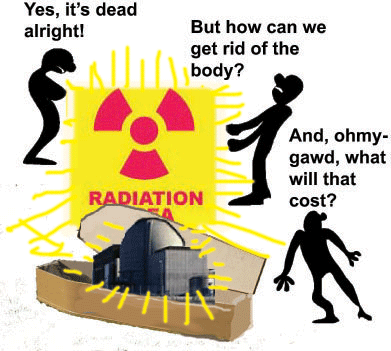 German utilities have ‘set aside too little’ for nuclear exit http://www.rechargenews.com/wind/1401381/german-utilities-have-set-aside-too-little-for-nuclear-exit Andrew Lee May 28 2015 Provisions set aside by German utilities for nuclear decommissioning aren’t sufficient and should be transferred into a public fund for safe keeping, says a study by the respected DIW Berlin economic think-tank.
Germany’s top four utilities E.ON, RWE, EnBW, Vattenfall have set aside €38bn ($41.4bn) to pay for the decommissioning of the country’s remaining nuclear power stations and the final storage of highly radioactive waste.But preliminary estimates assume the costs for the nuclear decommissioning and waste storage to cost at least €50-70bn, the DIW says.
Also, the provisions aren’t protected from insolvencies, and the utilities could also try to escape their responsibility by restructuring their businesses, claim the authors of the DIW study – energy experts Claudia Kemfert, Christian von Hirschhausen and Cornelia Ziehm.
It is also questionable what value the provisions will have in a couple of years given the declining profitability of large utilities.”Seen these great risks, the provisions of the nuclear corporations should be transferred into a publicly administered fund as soon as possible,” von Hirschhausen proposes.
German utilities have always said their provisions for the nuclear exit are sufficient. But Germany’s largest utility, E.ON, late last year announced its split into a company for renewables, grids and customer solutions that will keep its current brand name, and another one to be named Uniper that will bundle its current nuclear and fossil activities.
Although debt-free at its onset next year, there are doubts whether Uniper can stay profitable over the long run, while the remaining E.ON may be exempt from the nuclear responsibility.
The DIW study also said that Germany’s electricity supply will be safe also after the last nuclear plant has been switched off in 2022 as the country currently is producing far more power than it needs, a situation that isn’t expected to change even with the nuclear phase-out.
E.ON will switch off its 1.3GW Grafenrheinfeld nuclear power plant in Bavaria state in the second half of next month. The 10 terawatt hours it produces per year can be compensated by coal and gas-fired energy, the DIW says. Separately, Vattenfall and E.ON today said they have closed a cooperation agreement for the decommissioning and dismantling process of joint nuclear plants.
Germany becoming a super power, with the success of its renewable energy
Germany, the Green Superpower Thomas L. Friedman, NYT MAY 6, 2015 BERLIN — A week at the American Academy in Berlin leaves me with two contradictory feelings: one is that Germany today deserves a Nobel Peace Prize, and the other is that Germany tomorrow will have to overcome its deeply ingrained post-World War II pacifism and become a more serious, activist global power. And I say both as a compliment.
On the first point, what the Germans have done in converting almost 30 percent of their electric grid to solar and wind  energy from near zero in about 15 years has been a great contribution to the stability of our planet and its climate. The centerpiece of the German Energiewende, or energy transformation, was an extremely generous “feed-in tariff” that made it a no-brainer for Germans to install solar power (or wind) at home and receive a predictable high price for the energy generated off their own rooftops.
There is no denying that the early days of the feed-in tariff were expensive. The subsidies cost billions of euros, paid for through a surcharge on everyone’s electric bill. But the goal was not simply to buy more renewable energy: It was to create demand that would drive down the cost of solar and wind to make them mainstream, affordable options. And, in that, the energiewende has been an undiluted success. With price drops of more than 80 percent for solar, and 55 percent for wind, zero-carbon energy is now competitive with fossil fuels here.
In my view the greatest success of the German energy transition was giving a boost to the Chinese solar panel industry,” said Ralf Fücks, the president of the Heinrich-Böll-Stiftung, the German Green Party’s political foundation. “We created the mass market, and that led to the increased productivity and dramatic decrease in cost.” And all this in a country whose northern tip is the same latitude as the southern tip of Alaska!
This is a world-saving achievement. And, happily, as the price fell, the subsidies for new installations also dropped. The Germans who installed solar ended up making money, which is why the program remains popular, except in coal-producing regions. Today, more than 1.4 million German households and cooperatives are generating their own solar/wind electricity. “There are now a thousand energy cooperatives operated by private people,” said the energy economist Claudia Kemfert. Continue reading
Germany’s nuclear exit costly: other countries’ exit might be worse

Costs for Germany’s nuclear exit could rise to $75 billion http://www.reuters.com/article/2015/04/20/us-germany-utilities-nuclear-exit-idUSKBN0NB18S20150420 BERLIN Reuters) – The bill for shutting down Germany’s nuclear power plants and building a safe disposal site for nuclear waste could rise to 70 billion euros ($75 billion), the head of a government commission told daily Frankfurter Rundschau in an interview
E.ON, RWE, EnBW and Vattenfall [VATN.UL] are due to switch off their nuclear plants by a 2022 deadline set by Chancellor Angela Merkel’s government after the Fukushima disaster in Japan in 2011.
A decision by E.ON to restructure its business and spin off its conventional power plants raised additional fears that taxpayers may end up footing a portion of the bill for dismantling the nuclear plants and storing waste.
“There are significant financial risks coming up for the state,” said Michael Mueller, head of the government’s task force charged with finding a disposal site for nuclear waste.
The costs for the nuclear exit could rise to up to 70 billion euros over the next decades, meaning that the 36 billion euros ($38 billion) in provisions set aside by the four nuclear operators were not sufficient, he added.
Spokesmen from E.ON and EnBW said in separate statements that the companies’ provisions were sufficient and that they were certified on a regular basis by external auditors. conomy Minister Sigmar Gabriel has told lawmakers from his center-left Social Democrat (SPD) party that he wants to look into creating a public body to oversee the multibillion-euro risks associated with the nuclear switch-off.
The government is sounding out the option of subjecting the balance sheets of the four nuclear power plant operators to a stress test to ensure their provisions are adequate.
(Reporting by Michael Nienaber, Markus Wacket, Vera Eckert and Chris Steitz, editing by William Hardy)
Secret funding of Israel’s nuclear bomb, by West Germany
West Germany ‘secretly funded Israel’s nuclear bomb’, despite Israel denials, Telegraph UK
Former chancellor Konrad Adenauer has long been accused of secretly channelling hundreds of millions of dollars into Israel’s nuclear programme in the 1960s By Justin Huggler, Berlin 14 Apr 2015
Welt newspaper repeated long-standing allegations that the government of former chancellor Konrad Adenauer secretly channelled hundreds of millions of dollars into Israel’s nuclear programme in the 1960s.
The newspaper insisted the claims were true, despite a categorical denial earlier this month from Shimon Peres, the former Israeli president, who was in charge of the nuclear weapons project at the time.
In a detailed report, Welt claimed the funds were disguised as a $500 million (£338 million) loan for the development of the Negev desert.
The arrangement was agreed at a meeting between Mr Adenauer and David Ben-Gurion, the Israeli prime minister, in New York in 1960, the newspaper claimed.
The agreement was informal and was never scrutinised by the West German cabinet or parliament.
It was known as “Aktion Geschäftsfreund”, or “Operation Business Associate” by the West German foreign ministry.
The funds were channelled to Israel through the Kreditanstalt für Wiederaufbau, a government-owned development bank.
The bank has declined to release details of its payments to Israel under the programme………
Explicit details and photographs of its weapons project were leaked by Mordechai Vanunu, a former nuclear technician, in 1986.http://www.telegraph.co.uk/news/worldnews/europe/germany/11535629/West-Germany-secretly-funded-Israels-nuclear-bomb-despite-Israel-denials.html
Germany’s nuclear power companies have not set aside sufficient funds for nuclear decommissioning
 Nuclear plant closure money insufficient – German gov’t report http://www.reuters.com/article/2015/03/20/germany-utilities-nadal-idUSB4N0VR00V20150320
BERLIN, March 20 Fri Mar 20, 2015 (Reuters) – A report commissioned by the German government believes nuclear power firms have not set aside enough money to cover the long-term costs of decommissioning plants, according to a copy of the report seen by Reuters on Friday.
The report from the law firm Becker Buettner Held said the 36 billion euros already set aside by Germany’s four nuclear operators E.ON, RWE, EnBW and Sweden’s Vattenfall was insufficient and meant the costs could fall on the public purse.
The report added the government should consider legal measures which would force the parent companies of nuclear power plant operators to assume liability in the case ofbankruptcy. (Reporting by Markus Wacket; Writing by Caroline Copley; Editing by Stephen Brown)
Anti nuclear rallies in over 200 German towns
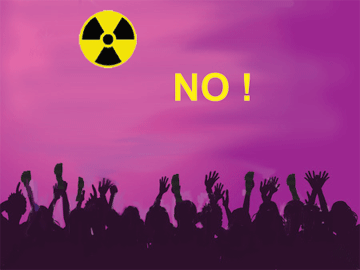 By Diet Simon, 17 Mar 15 About 12,000 anti-nuclear activists demonstrated in recent days in more than 200 German towns in commemoration of the Fukushima catastrophe four years ago and against the current nuclear situation in Germany.
There were pickets, and rallies in Neckarwestheim, Düsseldorf, Berlin und Dannenberg. The demos focused on the aging nuclear power station in Germany, waste issues and the evil methods energy companies are employing to dodge their responsibilities.
Obviously not as many people took to the streets as immediately following the Fukushima catastrophe, so the more than 200 events were all the more noteworthy. Countless local newspapers reported on them. It was a successful reminder of the nuclear dangers, pulling the issue back into public focus.
Tenacity is a special strength of the German anti-nuclear movement.
Staring Thursday this week (19 March) many selected German cinemas will show an antinuclear film, „Die Reise zum sichersten Ort der Erde“ (The journey to the safest place on earth) dealing with the unsolved problem of disposing nuclear waste.
Many activists have talked to their local cinemas to run it so as to reach the biggest possible public (schedule of showings). Most found that it needed just a phone call or a face-to-face conversation to persuade cinema operators to show it.
As part of special screenings experts discuss with audiences about the film and its pressing question, where to with our life-threatening waste.
The film will also screen at the Environmental Filmfestival in Washington DC, from 17 to 29 March.
Some media comment: “A film about insanity” (Grit Lemke, DOK Leipzig); “Unideological and with unshakeable belief in a public who can think for themselves” (Saiten Ostschweizer Kulturmagazin); “A magnificent documentary film” (Susan Boos, Die Wochenzeitung); “Most watchable” (Susanna Petrin, Aargauer Zeitung); “Excellent documentation” (Blick);
“Looking away is forbidden” (Hans Nüsseler, Swiss television).
Production: Mira Film GmbH | Weststrasse 182 | CH-8003 Zürich | Tel +41 (0) 43 960 3684 | info@mirafilm.ch| www.mirafilm.ch
World distribution: Autlook Weltvertrieb | Spittelberggasse 3/14 | A-1070 Wien I Tel +43 720 34 69 34 Iwelcome@autlookfilms.com | www.autlookfilms.com
The film’s website: http://www.diereisezumsicherstenortdererde.ch/de/
Thousands of Germans rally in anti-nuclear protest, remembering Fukushima
 VIDEO: German protesters call for end to nuclear power as they remember Fukushima http://www.euronews.com/2015/03/08/german-protesters-call-for-end-to-nuclear-power-as-they-remember-fukushima/Thousands of demonstrators have called for an end to nuclear energy during a rally in Neckarwestheim, in southern Germany.
They gathered in the town, home to a nuclear plant, to remember Japan’s Fukushima disaster four years ago.
Protesters chanted “switch off,” while holding banners reading “Fukushima out of control” and carrying mock coffins.
An earthquake and tsunami struck the Fukushima Daiichi plant, 220 kilometres northeast of Tokyo, in March 2011. It sparked nuclear meltdowns, forcing more than 160-thousand residents to flee from nearby towns and contaminating water, food and air.
German Chancellor Angela Merkel to Japan to discuss renewable energy co-operation
 Merkel to discuss Germany’s nuclear exit, cooperation on renewable energy during Japan trip, Fox Business, March 07, 2015 BERLIN – German Chancellor Angela Merkel says she plans to use her upcoming trip to Japan to discuss how Berlin and Tokyo can cooperate to expand the use of renewable energy.
Merkel will visit Japan on Monday and Tuesday as part of a series of bilateral meetings with G-7 leaders ahead of a June summit in Germany.
Germany sped up its exit from nuclear energy after Japan’s Fukushima nuclear disaster in March 2011.
Merkel said in a weekly online address Saturday that Germany was “now strongly emphasizing renewable energy. And I believe Japan should go down this road too — and it is.”….http://www.foxbusiness.com/markets/2015/03/07/merkel-to-discuss-germany-nuclear-exit-cooperation-on-renewable-energy-during/
Absolute NO to tax-payer funded nuclear power

 Germany says using tax money for nuclear power ‘out of the question’ BY BARBARA LEWIS AND TOM KOERKEMEIER BRUSSELS Thu Mar 5, 2015 (Reuters) – Using taxpayers’ money to fund nuclear power is “absolutely out of the question”, German Economy Minister Sigmar Gabriel said on Thursday, in an apparent swipe at British plans to finance new atomic generation.
Gabriel was arriving for talks in Brussels on the European Commission’s proposal for an energy union, which would deepen cross-border cooperation on energy across the 28-member EU…….
“There are countries in the EU that want to support nuclear power with tax money. We think that is absolutely out of the question,” Gabriel said.
“We will not agree by any means that nuclear energy be supported by public money. Nuclear energy is the most expensive kind of generation. It has now been around for 50 years, it is not new and it is dangerous.”
Gabriel did not directly mention Britain’s plans to finance new nuclear generation to be built by French utility EDF at Hinkley Point in southwest England.
The European Commission last year approved state aid for the 16 billion pound ($25 billion) plan, drawing fierce criticism and legal action from those who say the subsidy distorts competition.
On Wednesday, a German energy cooperative announced it would take legal action against Britain’s plan to pay a guaranteed price for power produced at Hinkley Point….. http://www.reuters.com/article/2015/03/05/us-eu-energy-nuclear-idUSKBN0M115Q20150305
Top legal adviser backs German government levy on nuclear fuel
 RWE, EON Fall as Court Aide Backs German Nuclear-Fuel Tax by Stephanie Bodoni Stefan Nicola
February 3, 2015 (Bloomberg) — EON SE fell the most in a month and RWE AG had its steepest plunge since mid-December after an adviser to the European Union’s top court backed a German levy on nuclear fuel that the country’s biggest utilities have been fighting as illegal.
EON declined 3.92 percent, to 13.375 euros a share at the close in Frankfurt, and RWE fell 4.55 percent to 23.905 euros a share after Advocate General Maciej Szpunar of the EU Court of Justice said in a non-binding opinion that the German nuclear-fuel tax doesn’t violate EU rules. The Luxembourg-based court follows such advice in most cases.
German’s unprecedented switch to renewables has forced traditional utilities to close nuclear reactors and seen power prices slide for a fourth year. Essen-based RWE hasn’t ruled out following EON’s lead in breaking itself up.
Germany’s so-called energy shift has forced utilities to close nuclear reactors and undermined power prices. The nuclear fuel tax also contributed to harming the companies’ profitability from 2011. EON’s plan to break itself up is the most radical response yet to the changes.
Nuclear exit is at the core of other pending litigation in Germany and the country’s top court is reviewing the constitutionality of the nuclear-exit laws and the fuel tax. http://www.bloomberg.com/news/articles/2015-02-03/german-nuclear-fuel-tax-in-line-with-eu-law-aide-says
Germany’s Constitutional Court will hear nuclear utilities’ complaints about early nuclear shutdowns
German court to decide on nuclear exit complaints this year Tuesday, January 27, 2015 CSTDUESSELDORF/FRANKFURT (Reuters) – Germany’s highest court aims to decide this year on complaints filed by the country’s biggest utilities against a decision to shut down its nuclear plants earlier than initially planned, a court spokesman said on Tuesday.
E.ON , RWE and Vattenfall [VATN.UL] filed complaints with the Constitutional Court after the government imposed a stricter closure timetable in 2011 as a result of the Fukushima nuclear disaster in Japan……..
The court will not decide on individual damages claims – estimated to total at least 15 billion euros ($17 billion) – but its decision could provide the legal basis for such motions should it rule the government’s decision is illegal.
The court spokesman said he could not be more precise about the timing of the ruling, adding it still needed to be decided whether a hearing would take place.
RWE, Germany’s second-biggest utility, said it expects a ruling in the second half of the year.
The complaints are part of a number of legal steps being pursued by RWE and its peers over Germany’s nuclear policy, including a nuclear fuel tax and the immediate three-month shutdown of all of its nuclear power stations following the Fukushima disaster.
($1 = 0.8787 euros)
(Reporting by Tom Kaeckenhoff and Christoph Steitz; Editing by Maria Sheahan and John Stonestreet) http://kfgo.com/news/articles/2015/jan/27/german-court-to-decide-on-nuclear-exit-complaints-in-2015/
Under France’s nuclear waste dump – a geothermal energy source!
 The Inconvenience of a Geothermic Energy Source Under France’s Nuke Waste Dump http://nf2045.blogspot.com.au/2015/01/the-inconvenience-of-geothermic-energy.html
The French weekly newspaper Le Canard enchaîné provides aggressive and biting coverage of the nuclear establishment in a way that mainstream media refrain from doing. Le Canard has been in print since 1915, except for a period during the German occupation when it was forced to close. The journal had a moment of international fame in September 2013 when it ran satirical cartoons about Tokyo being awarded the 2020 Olympics in spite of Japan’s troubles containing its nuclear catastrophe.
Unfortunately for readers who would like easy access to its reporting,Le Canard has stuck to its policy of being print-only……..
 Nuclear Waste on the Aquifer by Professor Canardeau translation of Des déchets (nucléaires) sur la nappeLe Canard enchaîné December 2014
A huge pocket of warm water exists beneath what is supposed to be France’s largest nuclear garbage pit, located near the town Bure. This site is destined to store, for at least 100,000 years, the most dangerous high-level waste that has accumulated since France built its first reactor. 125 meters tall, 30 kilometers wide and dozens of kilometers long, this reserve of warm water could sooner or later be used to produce heat or energy. The water is a comfortable 66 degrees, but it is found at a depth of 1,800 meters, while the nuclear waste is to be buried above it at a depth of 500 meters.
On January 5, 2015, the agency for the management of radioactive waste (ANDRA) will find itself on trial in high court in Nanterre for having divulged false information concerning the supposed absence of concern about significant underground water tables at the site in Bure. The citizen groups Sortir du nucléaireand Stop Bure 55, and Mirabel Lorraine Nature Environnement have brought the charges.
Some background: Continue reading
Subsidies to coal and nuclear power cost German electricity consumers €40bn a year
Fossils and nuclear ‘twice RE’s cost’ to German taxpayers http://www.rechargenews.com/wind/1388925/fossils-and-nuclear-twice-res-cost-to-german-taxpayers By Bernd Radowitz in Berlin , January 16 2015 Subsidies and hidden costs of fossil-fired and nuclear power in 2015 are slated to be about double the amount German consumers pay via a surcharge on their electricity bill to finance the expansion of renewable energies, claims a study by the forum for ecological and social market economy (FÖS) commissioned by Greenpeace Energy.
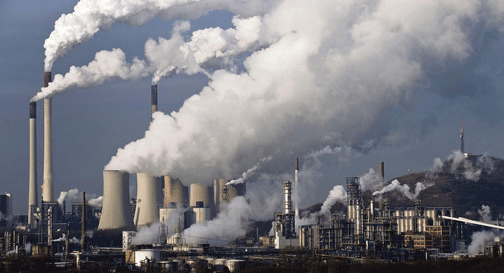
German electricity consumers via the EEG surcharge pay about €20bn ($23bn) per year to finance the build-up of solar, wind, biomass and other renewable energies, while the hidden costs of conventional power sources both in 2014 and 2015 reach some €40bn a year, the study says.
Included are direct subsidies and financial concessions, as well as external costs society has to come up with for environmental damage or the final storage of nuclear waste.
“Renewable energies aren’t just cleaner, but in the end also significantly cheaper than coal or nuclear,” says Marcel Keiffenheim, head of politics and communication atGreenpeace Energy, an independent power provider.
“But the problem is that the high costs of coal and nuclear are hidden from power clients and are being paid indirectly via taxes and other contributions.
The scientists behind the study emphasise that renewable energies aren’t driving up the cost of power supply as had been argued frequently in fierce discussions in Germany about power prices – but on the contrary replace more expensive energy sources that have higher costs to taxpayers and society.
“If utilities had to take into account those additional costs in their calculations, renewable energies already today to a great degree would be competitive,” said Swantje Küchler, who led the study for FÖS.
A kilowatt hour of wind power from newly-built machines now costs between €0.051 and €0.087, while nuclear power including the hidden costs would come at a price of €0.185-€0.498, lignite at a cost of €0.126-€0.141, and hard coal at a cost of €0.147-€0.167, the study says.
1 This Month
6 June – WEBINAR- Get Inspired by Protests Against Military Bases!


Cuba Is Not a Failed State – It Is a Besieged State
PETITION: “Global Appeal to Endorse Palestinian Right of Return of Refugees”


of the week– Nuclear Reactor Information Task Force
To see nuclear-related stories in greater depth and intensity – go to https://nuclearinformation.wordpress.com
-
Archives
- June 2026 (34)
- May 2026 (306)
- April 2026 (356)
- March 2026 (251)
- February 2026 (268)
- January 2026 (308)
- December 2025 (358)
- November 2025 (359)
- October 2025 (376)
- September 2025 (257)
- August 2025 (319)
- July 2025 (230)
-
Categories
- 1
- 1 NUCLEAR ISSUES
- business and costs
- climate change
- culture and arts
- ENERGY
- environment
- health
- history
- indigenous issues
- Legal
- marketing of nuclear
- media
- opposition to nuclear
- PERSONAL STORIES
- politics
- politics international
- Religion and ethics
- safety
- secrets,lies and civil liberties
- spinbuster
- technology
- Uranium
- wastes
- weapons and war
- Women
- 2 WORLD
- ACTION
- AFRICA
- Atrocities
- AUSTRALIA
- Christina's notes
- Christina's themes
- culture and arts
- Events
- Fuk 2022
- Fuk 2023
- Fukushima 2017
- Fukushima 2018
- fukushima 2019
- Fukushima 2020
- Fukushima 2021
- general
- global warming
- Humour (God we need it)
- Nuclear
- RARE EARTHS
- Reference
- resources – print
- Resources -audiovicual
- Weekly Newsletter
- World
- World Nuclear
- YouTube
-
RSS
Entries RSS
Comments RSS
 nuclear-news