Highly toxic nuclear waste being imported into Russia, from Germany
 Russia Is Importing Toxic Nuclear Waste From Germany, Greenpeace Warns, https://www.themoscowtimes.com/2019/10/23/russia-is-importing-toxic-nuclear-waste-from-germany-greenpeace-warns-a67873 A European uranium enrichment firm has resumed shipments of a highly toxic and radioactive waste product from Germany to Russia, Greenpeace Russia warned Wednesday. Russia Is Importing Toxic Nuclear Waste From Germany, Greenpeace Warns, https://www.themoscowtimes.com/2019/10/23/russia-is-importing-toxic-nuclear-waste-from-germany-greenpeace-warns-a67873 A European uranium enrichment firm has resumed shipments of a highly toxic and radioactive waste product from Germany to Russia, Greenpeace Russia warned Wednesday.
The enrichment firm Urenco and Russia’s state nuclear company Rosatom halted the radioactive waste imports from Germany in 2009 over revelations that the waste was stored in the open. German media reported Tuesday that Urenco had resumed exports of the toxic compound used to enrich uranium, sending up to 3,600 metric tons to central Russia in May-October 2019. “Russia should not become a radioactive burial ground for the rest of the world,” Greenpeace’s energy campaigner Rashid Alimov said, demanding the release of government documents and punishment of officials responsible for resumed shipments. Urenco plans to send 12,000 metric tons of uranium hexafluoride to Russia in 2019-2022, the Die Tageszeitung newspaper reported, citing officials’ communications. Greenpeace estimates that Russia has stored 1 million metric tons of the uranium hexafluoride, a waste product known as “tails.” Vyacheslav Alexandrov, the head of the state-run radioactive waste management operator’s Novouralsk branch where Urelco had reportedly sent the “tails,” said Russia prohibits nuclear-waste imports and expressed surprise over Greenpeace’s warning. In comments to the Znak.com news website, Alimov agreed with Alexandrov that “Russia formally observes the law” but contended that about 90% of the imported toxic “tails” remain in Russia after enrichment. |
|
Study: Germany needs clean energy surge to replace coal, nuclear
|
Study: Germany needs clean energy surge to replace coal, nuclear https://www.pv-tech.org/news/study-germany-needs-clean-energy-surge-to-replace-coal-nuclear, By José Rojo Martín, Sep 16, 2019
Germany must embrace renewables and energy storage at an unprecedented scale if it hopes to offset the void left behind by coal and nuclear phase-outs, a new study has said. A review sponsored by German solar association BSW found Germany will have to drive a structural shift in its energy system to satisfy future demand, set to rise even as the country’s existing generation fleet takes a “massive” hit from decommissioning. The analysis by energy consultancy EuPD says Berlin will require a surge of installed PV capacity between today (48GW), 2030 (162GW) and 2040 (252GW) to plug the energy shortfall, which could soar to 70TWh by 2030. The boom, the document claims, should not only cover the large-ground mounted PV segment (from 15.7GW capacity today to 126.7GW by 2040) but also extend to C&I (from 24GW to 91GW) and domestic (from 6.6GW to 35GW) PV installations. The transformation, the study notes, will fail to take hold unless Germany pairs renewable growth with that of energy storage. According to EuPD, a mix of cheaper technology and rising demand could see the nation-wide market boom from 1.9GWh today to 59GWh by 2040. Europe’s PV giant eyes subsidy-free transitionEuDP’s findings were used by German PV body BSW to renew its long-running campaign against the discontinuation of solar subsidies. Under current legislation, the 48GW industry will see state incentives frozen for new projects once capacity hits 52GW. n a statement released alongside the study, BSW’s managing director Carsten Körnig urged cabinet ministers to make the “appropriate decision” when they meet to discuss the issue on 20 September. The 52GW PV subsidy threshold will be breached next year unless it is scrapped now, Körnig warned. The industry efforts to retain government support come as more and more developers attempt subsidy-free ventures, a market Germany has been slower to embrace than Spain and other Southern counterparts. Initially smaller zero-subsidy deals – such as BayWa r.e.’s 8.8MW and Axpo’s 1.5MW – are slowly giving way to far larger moves, including a 500MW pipeline proposed by THEE and CEE. However, the country risks stifling further PPA activity if it does not de-risk these deals, experts have warned. The spotlight on storage as enabler of Germany’s energy shift comes as the sector teeters at the “edge of profitability”, as argued by analysts for a recent PV Tech Power article. Separate research has identified particularly strong economics for the country’s solar-plus-storage hybrids. Volume 20 of PV Tech Power, Solar Media’s downstream solar industry journal, includes a Special Report on energy storage and is out now, available for free download here. The prospects and challenges of European solar’s new era will take centre stage at Solar Media’s Large Scale Solar Europe 2020, to be held in Lisbon on 31 March and 1 April 2020 |
|
Germany shows how it can lead the world in neatly shutting down nuclear power
Spectacular Video Shows Nuclear Power Plant Demolition in Germany
Tower of German nuclear station demolished. The plant was on line for only 13 months
Short-lived German nuclear plant’s cooling tower demolished https://www.citynews1130.com/2019/08/09/short-lived-german-nuclear-plants-cooling-tower-demolished/, BY THE ASSOCIATED PRESS, Aug 9, 2019
Remote-controlled excavators on Friday removed pillars that supported the tower at the Muelheim-Kaerlich plant, near Koblenz. The tower, whose top half had already been removed by a specially designed robot, collapsed under its own weight in a cloud of dust a couple of hours later.
Muelheim-Kaerlich was switched off in September 1988 after 13 months in service when a federal court ruled the risk of earthquakes in the area hadn’t been taken into account sufficiently. After a lengthy legal battle, demolition started in 2004. Operator RWE says nearly all radioactive material had already been removed by then.
Germany’s Grohnde nuclear plant headed for shutdown, due to high temperatures
Nuclear power plant in Germany at verge of getting switched off due to heat wave – Nuclear phase-out, 26 Jul 2019, Benjamin Wehrmann https://www.cleanenergywire.org/news/nuclear-power-plant-germany-verge-getting-switched-due-heat-wave
A nuclear power plant in northern Germany has come to the verge of being taken off the grid on Friday, a Lower Saxony state environment ministry spokesperson told Clean Energy Wire. The ministry on Thursday had said the Grohnde nuclear plant near Hannover would likely be taken offline, as high temperatures were excessively warming a river used for the plant’s cooling system, and should be started up again once the heat wave that has hit Germany and other European countries with unprecedented temperatures has abated. On Friday, the plant’s operator, Preussen Elektra had informed the ministry that water temperatures were not rising as quickly as expected. However, precautions for a possible shutdown were taken nonetheless, the operator said. The river Weser, into which the plant’s cooling water is discharged, is suffering low water levels and has warmed to above 26 degrees Celsius. Additional heat from the nuclear reactor could damage the river’s ecosystem, the ministry said.
According to preliminary figures from meteorological service DWD, 25 June set another temperature record for Germany. Lingen in Lower Saxony recorded a high of 42.6 degrees, breaking the previous day’s all-time German high of 40.5 degrees.
Renewable energy providing more electricity than coal and nuclear power combined in Germany
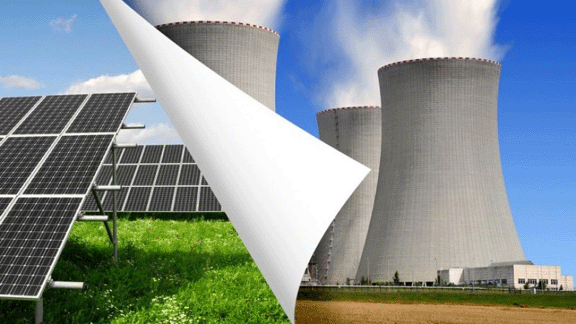 Renewable energy providing more electricity than coal and nuclear power combined in Germany Independent Solar, wind, biomass and hydroelectric power generates nearly half of country’s output. Emma Snaith, 25 Jul 19,
Renewable sources of energy produced more electricity than coal and nuclear power combined for the first time in Germany, according to new figures.
Solar, wind, biomass and hydroelectric power generation accounted for 47.3 per cent of the country’s electricity production in the first six months of 2019, while 43.4 per cent came from coal-fired and nuclearpower plants.
Around 15 per cent less carbon dioxide was produced than in the same period last year, according to figures published by the Fraunhofer Institute for Solar Energy Systems (ISE) in July.
However, some scientists have attributed the high renewable power output to favourable weather patterns and “market-driven events”.
Fabian Hein, from the think tank Agora Energiewende, told Deutsche Welle the 20 per cent increase in wind production was the result of particularly windy conditions in 2019……..
Renewables accounted for 40 per cent of Germany’s electricity consumption in 2018, according to government figures.
While in the UK, 29 per cent of electricity was sourced from renewables last year.
Germany is aiming to phase out its nuclear power plants by 2022. Its renewable energy has been rising steadily over the last two decades thanks in part to the Renewable Energy Act (EEG), which was reformed last year to cut costs for consumers.
But Germany still relies heavily on coal, gas and lignite for its energy needs.
Germany’s reluctance to end its dependence on coal saw hundreds of climate activists storm one of the country’s biggest open-pit coal mines in June to protest against fossil fuel use.
..electricity production from solar panels rose by six per cent, natural gas by 10 per cent, while the share of nuclear power in the country’s electricity production has remained virtually unchanged.
ACTIVISTS WALK “CEASE AND DESIST” ORDER INTO NUCLEAR WEAPONS BASE
BÜCHEL, Germany — Eleven international peace activists entered the Büchel Air Base southwest of Frankfurt early this morning to deliver what they called a “Treaty Enforcement Order” declaring that the sharing of US nuclear weapons at the base is a “criminal conspiracy to commit war crimes.”
Upon entering the base’s main gate with a printed “cease and desist order,” they insisted on seeing the base commander to deliver the order in person.
“We refuse to be complicit in this crime,” said Brian Terrell of Voices for Creative Nonviolence in Chicago, Illinois. “We call for the nuclear bombs to be returned to the US immediately. The Germans want these nuclear weapons out of Germany, and so do we.”
The group included people from Germany, The Netherlands, the United Kingdom, and the United States. All eleven were detained by military and civilian authorities and were released after providing identification. This is the third year in a row that a delegation of US peace activists has joined Europeans and others in protesting the US nuclear weapons at Büchel. The local group Nonviolent Action for Abolition of Nuclear Weapons (GAAA) convenes the International Action Week, demanding permanent ouster of the US nuclear weapons, cancellation of plans to replace today’s B61s with new hydrogen bombs, and Germany’s ratification of the 2017 Treaty on the Prohibition of Nuclear Weapons.
“Delivery of the ‘Cease and Desist Order’ is an act of crime prevention,” said John LaForge, of the US peace group Nukewatch and coordinator of the US delegation. “The authorities think the entry is a matter of trespass. But these nuclear bomb threats violate the UN Charter, the Treaty on Nonproliferation of Nuclear Weapons, and the 2017 Treaty on the Prohibition of Nuclear Weapons.” he said, adding, “Interrupting government criminality is a duty of responsible citizenship.”The activists included: (from the United States) Susan Crane, Richard Bishop, Andrew Lanier, Jr., Brian Terrell, Ralph Hutchison, and Dennis DuVall; (from the UK) Richard Barnard; (from The Netherlands) Margriet Bos, and Susan van der Hijden; and (from Germany) Dietrich Gerstner, and Birke Kleinwächter.
Susan van der Hijden of Amsterdam, who is just back from the US where she visited the Kansas City, Kansas site of a factory working on parts of the new replacement bomb, known as the B61-12. “The planning and training to use the US H-bombs that goes on at Büchel cannot be legal, because organizing mass destruction has been a criminal act since the Nuremberg Trials after WWII,” van der Hijden said.
In 2019, in Germany, renewables are providing more electricity than are coal and nuclear
 German renewables deliver more electricity than coal and nuclear power for the first time, DW,17July19
In Germany, sun, wind, water and biomass have so far produced more electricity in 2019 than coal and nuclear power combined. But it’s a snapshot of a special market situation and might not be a long-term trend.
In Lippendorf, Saxony, the energy supplier EnBW is temporarily taking part of a coal-fired power plant offline. Not because someone ordered it — it simply wasn’t paying off. Gas prices are low, CO2 prices are high, and with many hours of sunshine and wind, renewable methods are producing a great deal of electricity. And in the first half of the year there was plenty of sun and wind.
The result was a six-month period in which renewable energy sources produced more electricity than coal and nuclear power plants together. For the first time 47.3% of the electricity consumers used came from renewable sources, while 43.4% came from coal-fired and nuclear power plants.
In addition to solar and wind power, renewable sources also include hydropower and biomass. Gas supplied 9.3% while the remaining 0.4% came from other sources, such as oil, according to figures published by the Fraunhofer Institute for Solar Energy Systems in July.
A vision of the future
Fabian Hein from the think tank Agora Energiewende stresses that the situation is only a snapshot in time. For example, the first half of 2019 was particularly windy and wind power production rose by around 20% compared to the first half of 2018.
Electricity production from solar panels rose by 6%, natural gas by 10%, while the share of nuclear power in German electricity consumption has remained virtually unchanged.
Coal, on the other hand, declined. Black coal energy production fell by 30% compared to the first half of 2018, lignite fell by 20%. Some coal-fired power plants were even taken off the grid. It is difficult to say whether this was an effect of the current market situation or whether this is simply part of long-term planning, says Hein………
The increase in wind and solar power and the decline in nuclear power have also reduced CO2 emissions. In the first half of 2019, electricity generation emitted around 15% less CO2 than in the same period last year, reported BDEW. However, the association demands that the further expansion of renewable energies should not be hampered. The target of 65% renewable energy can only be achieved if the further expansion of renewable energy sources is accelerated. https://www.dw.com/en/german-renewables-deliver-more-electricity-than-coal-and-nuclear-power-for-the-first-time/a-49606644-0
German climate activists storm open cut coal mine
western Germany to campaign against fossil fuels. https://www.bbc.co.uk/news/world-europe-48734321
Germany’s energy plant operators as well as government are clear that nuclear station lifetimes will not be extended
|
Germany’s env min and plant operators dismiss call for nuclear lifetime extensions,Clean Energy Wire
Germany’s env min and plant operators dismiss call for nuclear lifetime extensions, Germany certainly does not need to return to nuclear energy and should push through with its energy transition instead, according to environment minister Svenja Schulze. Following isolated calls to extend the lifetime of the country’s nuclear plants, Schulze said the technology is very expensive, on closer inspection not CO₂-neutral, and always carries the risk of an accident. Germany’s remaining nuclear power plant operators RWE, E.ON and EnBW also rejected the idea to upend the country’s societal consensus to phase out nuclear power by the end of 2022. Germany’s environment minister Svenja Schulze has dismissed recent isolated calls for a postponement of the country’s nuclear exit to protect the climate. “We certainly don’t need a return to nuclear power. That would cause nothing but problems,” Schulze told energy managers at utility association BDEW’s annual conference. The technology is very expensive, on closer inspection not CO2-neutral, and always carries the risk of an accident, according to Schulze, whose ministry is also in charge of nuclear security…… Opposition to nuclear power has been particularly strong in Germany, and there is a broad societal consensus to phase it out as part of Germany’s landmark Energiewende (energy transition). While the country struggles with aspects of the phase out – such as what to do with the waste – one issue that isn’t a problem is public consent. The vast majority of Germans want to see nuclear power gone sooner rather than later. …… With reference to Germany’s unsolved challenges of dealing with nuclear waste, Schulze said the country had used nuclear power for only three generations, and now left radioactive waste for thousands of following generations to deal with. Schulze also said nuclear power stations would not fit into Germany’s future electricity system. “Nuclear power would only block the grid. We don’t need more inflexible large power stations in a decentralised flexible system.”…… Plant operators have repeatedly said nuclear power will come to an end by the end of 2022 as planned and utility association BDEW said that reaching climate targets in the energy sector does not require a longer operating life for nuclear power plants. “It doesn’t make sense at all to start a discussion about lifetime extensions shortly before reaching the finishing line,” BDEW head Stepan Kapferer said at the conference, adding the operators had already clearly rejected the idea anyway. Nuclear power in Germany “is finished”, plant operators E.ON, RWE and EnBW told Jakob Schlandt for an article in Tagesspiegel Background. “This chapter is over,” said a RWEspokesperson…… The BDEW expressed confidence that its companies can benefit hugely from the energy transition. The Energiewende offered “huge opportunities for growth”, said BDEW head Stefan Kapferer in his opening remarks with reference to renewables and the charging infrastructure for electric mobility. He repeated his association’s call for a CO2 price for heating and transport. “It’s a joke that electricity, as the greenest available form of energy, is also the most expensive,” Kapferer said. https://www.cleanenergywire.org/news/germanys-env-min-and-plant-operators-dismiss-call-nuclear-lifetime-extensions |
|
Germany launches public meetings, in search of nuclear waste repository solution
Public info event kicks off search for nuclear waste repository https://www.cleanenergywire.org/news/public-info-event-kicks-search-nuclear-waste-repository
Germany’s huge task in dismantling its nuclear power stations
Germany’s atomic phase-out: How to dismantle a nuclear power plant https://www.dw.com/en/germanys-atomic-phase-out-how-to-dismantle-a-nuclear-power-plant/a-47823766– 11 Mar 19, Germany now has just seven nuclear plants left in operation, but what becomes of those that are already decommissioned? Bits of them are recycled, and could ultimately end up in our kitchens.
When Egbert Bialk looks at the giant demolition robot perched on top of the cooling tower at the Mülheim-Kärlich nuclear power plant, it makes him happy.
“Happy that the eyesore is finally being dismantled,” he told DW. “Some said we should leave it standing as a memorial or piece of art. But for me the tower is like a symbol of humanity’s arrogance, of us playing with fire.”
Bialk began campaigning against the reactor when it was built near his home in the 1970s, and has since joined the local chapter of environmental group BUND to observe the 1 billion euros ($1.2 billion) decommissioning of the facility.
The dismantling of the western German plant, which will take two decades to complete, started in 2004, seven years before the Fukushima disaster that prompted Angela Merkel’s government to announce the nation’s complete withdrawal from nuclear power by 2022.
With just a couple of years to go before that deadline, seven plants are still in operation, and even after they’ve shut down for good, it will take many more years before all the country’s reactors have been safely dismantled, and contaminated sites cleared and deemed free of radiation
One of the most pressing questions during this lengthy process, is what to do with the radioactive waste?
Buried in mines
The first things to be removed are the heavily contaminated spent fuel rods, which contain the nuclear fuel that is converted into electrical power.
Because Germany doesn’t yet have a long-term depository for highly radioactive waste, the rods are currently stored in so-called Castor containers in several locations across the country.
By the time all the nation’s reactors have been decomissioned, there will be around 1,900 such containers in interim storage. And there they will remain until a suitable location for their permanent resting place has been found
Read more: Nuclear waste in disused German mine leaves a bitter legacy
“We expect the storage phase to take 50 years,” Monika Hotopp, spokeswoman of BGE told DW.
Exactly what it will all cost, is unknown. Much depends on the ultimate location, but the 4.2 billion euro preparations of a former iron ore mine known as pit Konrad to be used as the final depository for low- and intermediate-level radioactive waste could serve as some kind of indicator.
Once things like technical equipment and parts of buildings exposed to nuclear fission reaction for years, have been buried in the mine, it will be filled up with concrete and sealed.
“When sealed, it’s safe and there should be no danger of nuclear radiation for the environment,” Hotopp told DW.
Environmental groups however, warn that nuclear waste remains a threat even when buried deep under the ground.
“The depositories have to be able to contain radiation for up to 500,000 years,” local environmentalist Bialk told DW. “We are giving a time bomb to future generations.”
Building materials recycled into roads and pots
And what happens to the rest of the waste? The hundred of thousands of tons of metal, concrete, pipes and other building materials that accumulate during the dismantling process?
Because under German law, the entire plant, including offices and the canteen, are considered radioactive, no single item can be removed before operators can prove it is no longer contaminated. Once considered free of radiation or at least to be below the safety limit, the waste can be disposed of at regular landfills and recycling sites.
Environmental groups and locals criticize this practice, on the grounds that once materials have been recycled, nobody knows where they end up. Concrete from nuclear power plants could be used to pave our roads, while metals could be melted and turned into pots and pans.
“Melted metals could even be turned into braces for kids; they could be contaminated by radiation and no one would know,” he told DW. “I think it would be useful to track where the materials from nuclear sites end up.”
But experts don’t regard post-decommissioning monitoring as necessary.
“The risks are minimal,” Christian Küppers, who specializes in nuclear facility safety at the environmental research center Oeko-Institut, told DW. “The safety limits for radiation correspond to what we are naturally exposed to in the environment,”
All the material from nuclear power plants that expose radiation below 0.01 millisieverts per year can be recycled, Küppers continued.
By way of comparison, the Oeko- Institut says people are exposed to natural radiation of 2.1 millisieverts per year in Germany, and a one-way transatlantic flight exposes those on board to between 0.04 and 0.11 millisieverts of radiation.
From nuclear site to “greenfield”
Once the nuclear power plants have been completely dismantled, all the waste removed and when there is no longer any measurable trace of radiation, the premises can be returned to greenfield status.
At this point, the premises are considered to be regular industrial sites, and can be sold as such.
Likewise pit Konrad. Once the mine has been closed and sealed, which is expected to happens around the year 2100, the land on top of it will also be returned to greenfield space. Theoretically, houses could then be built on it.
Whether anybody would want to live there, is another question, says Monika Hotopp from BGE, the federal company in charge of the long-term storage sites.
Because ultimately, nuclear power has become synonymous with danger. And as Bialk puts it, even when all the plants have been dismantled and the waste stored, the problem won’t have gone away.
“First, the radioactive waste remains dangerous for hundreds of thousands of years. Second, other countries still rely on nuclear power,” he said. “There are more than 50 nuclear power plants in France alone, and if an accident were to happen there, it would affect us, too.”
Germany phasing out coal, but will not import nuclear power as replacement
“We want energy security to be provided at all times,” the minister told broadcaster ZDF, but added: “We do not want to import cheap nuclear power from other countries.”
Germany‘s coal commission on Jan. 26 said the country should shut down all of its coal-fired power plants by 2038 at the latest, proposing at least 40 billion euros ($45.7 billion) in aid to regions affected by the phase-out.
Germany urges Russia to destroy missile to save nuclear treaty
http://www.digitaljournal.com/news/world/germany-urges-russia-to-destroy-missile-to-save-nuclear-treaty/article/541215 German Foreign Minister Heiko Maas on Friday called on Russia to destroy a controversial missile system Washington says breaches a key arms control treaty.
“We believe Russia can save this treaty,” Maas said after talks with Russia’s top diplomat Sergei Lavrov, referring to the Intermediate-Range Nuclear Forces treaty (INF).
“It affects our security interests in a fundamental way.”
Tensions have raged between Russia and the United States over the fate of the INF agreement signed in 1987 by then US president Ronald Reagan and Soviet leader Mikhail Gorbachev.
US President Donald Trump has promised to walk away from the agreement and Russian leader Vladimir Putin threatened a new arms race, saying Europe would be its main victim.
Washington says Moscow’s 9M729 missile system violates the treaty and warned it would withdraw from the agreement if Russia does not get rid of it.
Russia denies the claim, accusing the United States of violating the treaty which forbids ground-launched short- and intermediate-range missiles.
“Like other NATO members, we believe that there is a missile violating this treaty and it should be destroyed in a verifiable manner to get back to the implementation of this agreement,” Germany’s Maas told reporters.
Maas commended Moscow for trying to salvage the agreement and expressed hope that talks between Russian and US negotiators would resume in the near future.
Last month Washington gave Russia a 60-day deadline to dismantle missiles that it claims breach the INF treaty or the US would begin the six-month process of formally withdrawing from the deal.
Lavrov for his part said Washington provided no evidence that Russia’s tests of the missile violated the INF treaty.
He said Washington’s demands to destroy the missiles and have regular access to Russian sites were just “a pretext to exit the treaty.”
“During official contacts on arms control and disarmament issues back in October the United States said the decision is definitive and their announcement of the withdrawal from the INF treaty is not an invitation to dialogue. This is a quote.”
Earlier this week, talks between US and Russian officials in Geneva to salvage the deal led nowhere. Moscow said Washington did not appear to be in the mood for more talks while a US official said Russia was just paying “lip service” to transparency.
Russian officials said US representatives had confirmed Washington’s intention to begin withdrawing from the treaty from February 2.
Renewables beating coal energy in Germany
The shift marks progress as Europe’s biggest economy aims for renewables to provide 65 percent of its energy by 2030 in a costly transition as it abandons nuclear power by 2022 and is devising plans for an orderly long-term exit from coal.
The research from the Fraunhofer organisation of applied science showed that output of solar, wind, biomass and hydroelectric generation units rose 4.3 percent last year to produce 219 terawatt hours (TWh) of electricity. That was out of a total national power production of 542 TWh derived from both green and fossil fuels, of which coal burning accounted for 38 percent.
Green energy’s share of Germany’s power production has risen from 38.2 percent in 2017 and just 19.1 percent in 2010.
Bruno Burger, author of the Fraunhofer study, said it was set to stay above 40 percent this year.
“We will not fall below the 40 percent in 2019 because more renewable installations are being built and weather patterns will not change that dramatically,” he said……….https://www.weforum.org/agenda/2019/01/renewables-overtake-coal-as-germanys-main-energy-source?utm_source=Facebook%20Videos&utm_medium=Facebook%20Video
1 This Month



Shut down the radiation-damaged Heysham nuclear reactors now
To see nuclear-related stories in greater depth and intensity – go to https://nuclearinformation.wordpress.com

Say No to NASA’s Reckless Nuclear Reactor on the Moon
Say No to NASA’s Reckless Nuclear Reactor on the Moon
-
Archives
- October 2026 (247)
- September 2026 (339)
- August 2026 (330)
- July 2026 (355)
- June 2026 (287)
- May 2026 (306)
- April 2026 (356)
- March 2026 (251)
- February 2026 (267)
- January 2026 (308)
- December 2025 (358)
- November 2025 (359)
-
Categories
- 1
- 1 NUCLEAR ISSUES
- business and costs
- climate change
- culture and arts
- ENERGY
- environment
- health
- history
- indigenous issues
- Legal
- marketing of nuclear
- media
- opposition to nuclear
- PERSONAL STORIES
- politics
- politics international
- Religion and ethics
- safety
- secrets,lies and civil liberties
- spinbuster
- technology
- Uranium
- wastes
- weapons and war
- Women
- 2 WORLD
- ACTION
- AFRICA
- Atrocities
- AUSTRALIA
- Christina's notes
- Christina's themes
- culture and arts
- Events
- Fuk 2022
- Fuk 2023
- Fukushima 2017
- Fukushima 2018
- fukushima 2019
- Fukushima 2020
- Fukushima 2021
- general
- global warming
- Humour (God we need it)
- Nuclear
- RARE EARTHS
- Reference
- resources – print
- Resources -audiovicual
- Weekly Newsletter
- World
- World Nuclear
- YouTube
-
RSS
Entries RSS
Comments RSS

