AREVA lost $5.6 billion in 2014, ( total market capitalization of $3.5 billion!)
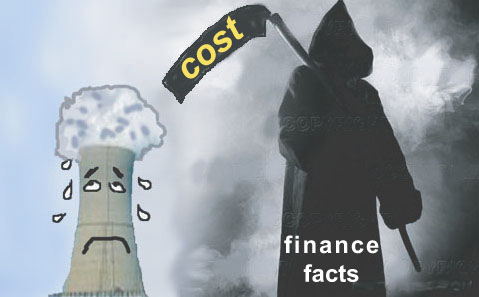 France’s Areva Lost $5.6 Billion In 2014 – Is This The End? http://oilprice.com/Alternative-Energy/Nuclear-Power/Frances-Areva-Lost-5.6-Billion-In-2014-Is-This-The-End.html By Nick Cunningham, 08 March 2015
Could France, a heavyweight in nuclear power, begin to see its position crumble?
Areva, France’s iconic nuclear power builder, reported a massive financial loss for 2014. The state-owned company revealed that it lost 4.9 billion euros ($5.6 billion) in 2014, an enormous decline from the 500 million euro loss it posted the previous year.
Weighing on the company is its much-heralded rector in Finland. The Olkiluoto 3 unit under construction in Finland was supposed to be completed in 2009, but it has since turned into a nightmare. Billed as the first Generation III+ pressurized water reactor – dubbed the Evolutionary Power Reactor (EPR) by Areva – the project was intended to demonstrate nuclear technology that had advanced well beyond the designs seen in today’s operational power plants, which were built in the 1970’s. Now expected to be completed in 2018, the decade of delay coulddouble the reactor’s eventual total cost.
Also, Areva is building another reactor in Normandy that has suffered a similar fate. The Flamanville 3 is several years behind schedule – it may not come into operation until 2016 or 2017 after an original start date of 2012. That reactor, which will be operated by fellow state-owned nuclear operator EDF, has also seen its costs skyrocket because of the delays.
While Areva’s $5.6 billion loss may be shocking at first glance, it looks even worse when compared to the company’s total market capitalization of $3.5 billion. In other words, Areva lost more money in 2014 than the company is worth in its entirety. Despite what appears to be an obvious need for injection of cash to keep the company afloat, France’s energy minister Segolene Royal said that it is “too early” to discuss such a measure, although she added that “all solutions are being looked at.”
The delays from multiple projects have one thing in common – they are using Areva’s EPR design, which has proven to be far more complex than anticipated. That raises serious questions about Areva’s future as a leading nuclear power company. “The EPR is a rotten design that they should have given up on a long time ago,” Steve Thomas, a professor at the University of Greenwich in Britain, told the New York Times last year. Areva’s share price has plummeted over the last year as it became clear the company was quickly burning through cash.
Compounding Areva’s problems is the fact that the west is no longer building nuclear reactors, aside from a few projects in the U.S. Even worse, France, which is the second largest generator of nuclear power in the world (and the leader in terms of percentage of total electricity from nuclear power), is considering a transition away from nuclear power.
French President Francois Hollande has pledge to cut France’s reliance on nuclear power by one-third by 2025. That is easier said than done for a nation that gets 75 percent of its electricity from nuclear. The French National Assembly approved a bill late last year that would slash nuclear’s share down to 50 percent over the next decade, but the Senate is trying to water down the bill. While the outcome is uncertain, what is clear is the fact that France – a global champion in nuclear power – is set to shrink its nuclear energy sector.
To make matters worse, a few safety issues have cropped up in recent weeks that could amount to a significant blow for nuclear power in Europe. A leak at the Fessenheim plant on the border with Germany and Switzerland was discovered in late February, forcing the plant’s temporary closure. This is the same plant that President Hollande specifically pledged to close during his 2012 presidential campaign.
And in neighboring Belgium, cracks have formed in the walls of the pressure vessels at several plants, raising alarm about their safety. The cracks at Belgium’s Doel 3 and Tihange 2 point to a potentially larger problem. Experts fear “material fatigue,” the possibility that radiation is wearing down the materials much quicker than expected. Such a development, if true, “could be a problem for the entire global nuclear industry,” said Jan Bens, general director of the Belgian Federal Agency for Nuclear Control (FANC), according to Deutsche Welle.
Aging European nuclear power plants, potentially presenting serious safety concerns, could well be slated for closure in the coming years. With France’s nuclear champion, Areva, unable to build suitable replacements, France is quickly seeing its position as a global leader in nuclear power slip.
Nuclear developments on hold, as Areva asks NRC to suspend nuclear reactor design review
 Areva asks NRC to suspend nuclear reactor design review http://www.power-eng.com/articles/2015/03/areva-asks-nrc-to-suspend-nuclear-reactor-design-review.html 03/06/2015 Areva Inc. has asked the U.S. Nuclear Regulatory Commission (NRC) to suspend its design certification review of Areva’s European Pressurized Reactor (EPR).
The announcement also puts on hold plans for the Calvert Cliffs 3 nuclear unit in Maryland, which was going to use the EPR reactor design. Unistar Nuclear Energy also asked the NRC to suspend review of its combined operating license application just days after Areva’s request.
The U.S. EPR is based on the EPR reactor currently under construction in France and Finland and planned for construction at Hinkley Point C in the UK, the article said.
Eiffel Tower embraces wind power
One of the world’s most iconic sites has become the latest high profile venue to embrace renewable energy, after the installation of two vertical axis wind turbines as part of the Eiffel tower’s high profile renovation project….
http://www.dailyclimate.org/t/7001469699682004860
Warning to France on drones- an easy way to destabilise nuclear reactors
 Most French Nuclear Plants ‘Should Be Shut Down’ Over Drone Threat,NewsWeek BY CATHERINE PHILLIPS AND CONOR GAFFEY / FEBRUARY 24, 2015 “You don’t need massive amounts of force to allow a nuclear plant to go into instability. The plant has enough energy to destroy itself. Drones can be used to tickle the plant into instability.”
With devastating simplicity, John Large explains how drones could be used to coordinate a terror attack on a nuclear power station. First, one drone hits the distribution grid serving the plant, depriving the facility of off-site power, making it dependent on its diesel generators to cool the reactor, which generates up to 1,000 megawatts of power – enough to light up half of Paris. Then the generators are easily taken out by an unmanned drone with a relatively small payload. Without power to cool the radioactive fuel, Large estimates it would take approximately 30 seconds before the fuel begins to melt, leading to potential leakages of nuclear waste.
It’s the same cause behind the meltdown at the Fukushima nuclear plant in Japan after it was hit by a tsunami in March 2011. But potential terrorists wouldn’t need to trigger an earthquake, just be able to accurately pilot a pair of readily-available commercial drones carrying small payloads of explosive. Last year, unmanned drones were spotted flying over at least 13 nuclear power stations in France. The last widely-reported sighting was on 3 January, when two aircraft were seen flying over a nuclear facility in Nogent-sur-Seine, in northern-central France.
Activists maintain that a government blackout has blocked information on any further sightings. Curiously, no pictures of drone sightings near power stations have surfaced, a fact that causes concern amongst experts.
“There’s not one single picture. That’s very troubling,” says Jean-Luc Fornier, whose company designs and operates drones for use in the media industry. “If we had some pictures, we could decide on who may be operating the machines.” Fornier suggests that the flyovers that have been noted have three possible explanations: innocent pranksters, anti-nuclear protestors, or trial runs by terrorists. French National Research Agency said the General Secretary for Defence is “providing €1m of funding for research projects into the detection, identification and neutralisation of small aerial drones”.
According to Large, of consulting engineers Large & Associates, based in London, who was commissioned by Greenpeace France to evaluate and report on the spate of flyovers, the “unacceptable” risk posed by a terrorist drone attack means that many of Europe’s nuclear power stations – including the majority of those in France – should be shut down……..
Rousselet says the government is downplaying the threat. He says Greenpeace became aware of a further flyover sighting on 28 January before a government blackout blocked further reports. For Large, the threat remains: “The problem is that these nuclear plants are very attractive targets as the public’s perception of all things nuclear is a fate worse than death. There’s a psychological attraction for these plants as targets as they can cause mass concern among the public.” http://www.newsweek.com/2015/03/06/most-french-nuclear-plants-should-be-shut-down-over-drone-threat-309019.html
Trouble in nuclear France: AREVA and EDF in financial distress
 France Warns of Nuclear Industry Shake-Up After Areva Loss NYT, By DAVID JOLLY and STANLEY REEDFEB. 23, 2015 PARIS — France’s energy minister said on Monday that an overhaul of the country’s state-controlled nuclear energy industry was imminent, after one of the country’s main builders of nuclear power plants warned of a loss that could hamper its ability to continue operating independently……
EDF has been facing its own problems, including lengthy delays and steep cost overruns on a flagship plant that it is building at Flamanville, in the northwest of the country. There are also uncertainties about whether a showcase project in Britain will proceed — one in which both EDF and Areva would participate.
The French nuclear industry’s travails underline the gloomy state of the nuclear industry since the Fukushima disaster in Japan in 2011. Moreover, the French industry, though long a world leader, has in recent years been threatened by its own mistakes……..
The loss that Areva warned of on Monday would be substantially larger than its stock-market value of about €3.7 billion, suggesting that the troubled company, plagued by cost overruns and write-downs, may need new funds to continue operating. Areva’s capabilities are vital to France’s ambitions to remain a world provider of nuclear plants and services like supplying fuel.
With few new nuclear plants being planned to replace the older ones that are being phased out in the West, “Europe will see a gradual decline in nuclear’s share of electricity supply,” said Antony Froggatt, an analyst at Chatham House, a London-based research organization…….
Areva shares closed down 2.1 percent in Paris trading on Monday.
The company, which is based in Paris, had previously warned that it was facing trouble; it said in November that it was suspending its financial guidance for 2015 and 2016. Standard & Poor’s cut the company’s debt rating to junk soon after that, citing the company’s “limited headroom.”http://www.nytimes.com/2015/02/24/business/international/areva-nuclear-results.html?_r=0
EDF’s financial problems delay decision on proposed new nuclear plant at Hinkley Point
 EDF Energy delays Hinkley Point nuclear decision French power firm’s plans to build first British atomic reactors in almost 30 years suffers further setback Guardian, Terry Macalister, 13 feb 15 The timetable surrounding the construction of Britain’s first new atomic reactors in almost 30 years has once again been blown off course, its developer, EDF Energy, has admitted. The setback came as the French-owned generator and supply company reported a 25% slump in operating profits for 2014 to £863m, which it blamed on challenging market conditions.
EDF had originally promised to tie up a new deal with financial backers and then take a final investment decision on the proposed new plant at Hinkley Point in Somerset by the middle of last year. This date was later revised to March 2015.
But in a new statement, the largely state-owned energy group said a final investment decision might only be possible in a matter of months, and it had still not finalised talks with Chinese financial backers……….
Meanwhile, there is growing speculation that Chinese investors are hardening the terms under which they would be willing to help underwrite some of the cost of the new plant. China National Nuclear Corporation and China General Nuclear Power Corporation are expected to be minority shareholders in the project, but are also pushing for commitments to build and operate their own plant at Bradwell in Essex.
EDF has declined to confirm that it too is trying to limit the financial damage through compensation from the UK government should there be a successful legal challenge in the European courts by Austria to the UK subsidy arrangement.
Critics of the £24.5bn nuclear programme in Somerset have highlighted the industry’s poor track record for constructing facilities on time and on budget. They have questioned whether Hinkley Point C reactors would able to meet their timetable of opening for operations in 2023.
EDF has already run into problems with a new project at Flamanville in Normandy, while another project in Finland, the European pressurised reactor, which uses the same design as Hinkley, is also massively behind its original timetable.
Financial problems at its French design partner, Areva, have not helped the sense of uncertainty surrounding EDF’s nuclear ambitions,……http://www.theguardian.com/business/2015/feb/12/edf-energy-delays-hinkley-point-nuclear-decision
France wants to beat USA in selling nuclear reactors to India
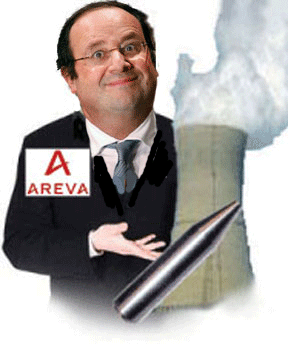 US nuclear ‘breakthrough’ cloud on France deal, Telegraph New Delhi, Feb. 5:France has indicated it may want to use elements of the nuclear liability “breakthrough” India and the US have claimed, in setting up its own reactors in this country, signalling potential for competitive bargaining over the terms New Delhi offers to different nations.
India last year offered France and Russia – the two nations other than the US that have committed to selling nuclear reactors – an insurance pool created by Indian public sector firms to fund any compensation following an accident from their reactors.
The US had so far appeared unconvinced by the insurance pool plan. Its apparent turnaround during President Barack Obama’s India visit last week has sparked speculation in the capital’s diplomatic enclave that New Delhi may have offered Washington a particularly sweet deal……….
France is pandering to Modi’s pet initiative of “Make in India” by promising to build “large parts of the Areva reactors” in India. And unlike the US, France had also never sought any change in the nuclear liability law despite its concerns that the law was draconian and out of line with global standards, the senior French official said…….
The Indian foreign office also pointed to France’s acceptance of India’s liability law.”Every country has a different approach to this matter,” Akbaruddin said, citing the example of uranium India already sources from France. “With France, the template of our engagement is already set.” http://www.telegraphindia.com/1150206/jsp/nation/story_1764.jsp#.VNUrReaUcnk
FREEDOM OF SPEECH THREATENED BY AREVA
 J
J
January 23, 2015
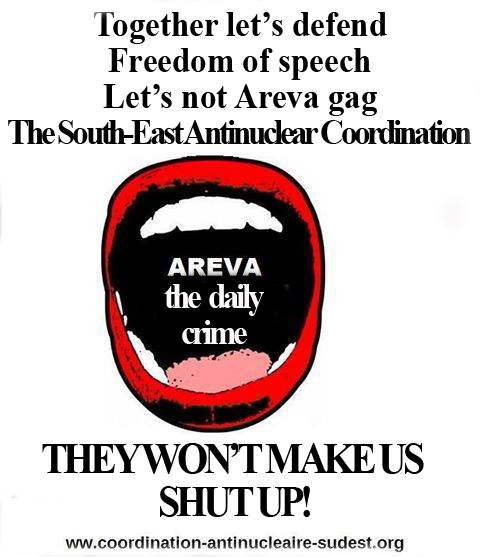
AREVA filed a complaint against the South-East Antinuclear Coordination.
We will not allow ourselves to be gagged !
The South-East Antinuclear Coordination has just been informed last Tuesday January 6, 2015 that a defamation suit has been filed by Areva against them for a report that they published on their website, denouncing the nuclear lobby’s penetration to the elected officials.
This attack on freedom of speech is taking place while the nuclear health crime continues here in the Rhône Valley of France, and in Fukushima, Japan.
By such attempt to gag opposition, the nuclear giant intends to silence dissent at a time when the Areva group is in financial and industrial decay (having lost 52% of its stock market value, failure of its EPR in Finland, risky investments, its Mox sales declining, especially in Japan, in question regarding its foreign budget financing etc), at a time when incidents are increasing at its ageing nuclear facilities in France and that thousands of Japanese children and adults will die slowly in Fukushima, Japan, and elsewhere as in Niger.
The South-East Antinuclear Coordination, apart from any political party, bringing together concerned citizens acting for the immediate and unconditional cessation of the nuclear crime for public health reasons, denounces :
The fanatical ideological war that proponents of atomic destruction are waging against free thought and against the people, the arrogance and the imperialism of the nuclear lobby and of its ruling caste,
The populations health and life damages and the contamination of areas by radioactive releases in the air and in the water from each of the 125 civil nuclear facilities plus the military nuclear facilities on secret military bases located throughout the french territory. Damages deliberatedly done, and repeated daily, such as the manufacturing of the radioactive «depleted uranium» by Areva, used in weapons of war,
Neo-colonialist exploitation of Niger’s workers and resources, as well as the radioactive contamination of the territories and of the Tuareg people and other people life in this country,
The infiltation of the State institutions, and of the elected assemblies by a private interests group and their ideological relay to impose a dominant order and a state of nuclear terror on the country and the plane.
The South-East Antinuclear Coordination calls to mind that there is no harmless dose of artificial radiation.
The South-East Antinuclear Coordination calls for solidarity :
All the persons freedom-loving, attached to the right of speech and criticism,
All the collectives, groups and organizations,
To oppose this attack on freedom of speech,
To send support emails to the South-East Antinuclear Coordination : sudest.antinucleaire@free.fr
To express their indignation to the authorities and to Areva by any way each person will define:
To sign the petitions:
http://www.cyberacteurs.org/cyberactions/presentation-ne-laisserons-pas-baillonner-878.html
https://www.lapetition.be/en-ligne/Lettre-Ouverte-15382.html
By mail to Areva :
Monsieur Philippe Varin Président du Conseil dAdministration d’Areva 1, place Jean-Millier 92084 Paris-La Défense cedex
By phone to Areva :
Tél : 01.34.96.00.0001.34.96.00.00
By fax to Areva :
Fax : 01.34.96.00.01
By mail, to the French Prime Minister :
Premier Ministre Manuel Vals : 57 Rue de Varenne, 75007 Paris
By email thru the French Prime Minister website :
http://www.gouvernement.fr/contact/ecrire-au-premier-ministre
By mail to the Minister of Social Affairs, Health :
Marisol Touraine, Ministre des Affaires sociales, de la Santé et des Droits des femmes 14, avenue Duquesne 75350 PARIS 07 SP
By phone to the Minister of Social Affairs, Health :
Tel : 01 40 56 60 00
To communicate and to make know to everyone and everywhere this blatant violation of freedom of speech in France.
To support the legal defense of the South-East Antinuclear Coordination,
Financial help (to be refunded if Areva withdraws its complaint and does not go to court)
To be sent to :
CAN 180 chemin de la Parisienne 84740 Velleron – France
Or thru the donation button on the CAN website :
http://www.coordination-antinucleaire-sudest.org/
Contact : sudest.antinucleaire@free.fr
Source: http://www.coordination-antinucleaire-sudest.org/

A Charlie Hedron review of A Stage Play about France’s Nuclear History
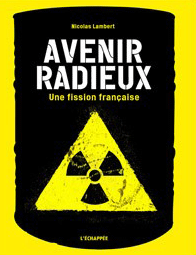 We must keep in mind that all the words chosen by Nicolas Lambert were actually spoken. This is an element of the play that gives the performance its considerable impact.
Nicolas Lambert prepared this play about nuclear for seven years, poring over heaps of articles and books, visiting nuclear power plants, attending public debates on the EPR reactor proposed for Penly, meeting union leaders, intermediaries, militants, corporate spokespersons for Areva and EDF—and then March 11, 2011: Fukushima.
A Radiant Future: A Stage Play about France’s Nuclear History Nuclear Free by 2045? By Dennis 15 Jan 15, (translation by Dennis) Two months before Charlie Hebdo became a famous name, I came across a youtube video of the French actor Nicolas Lambert performing his play Avenir Radieux (A Radiant Future). It was just a short clip, and it seems no other video recording was made of it, but I was intrigued. I ordered the book, read it, then contacted the publisher to ask if I could take it on as a translation project. The translation will be finished soon, so this is some advance publicity for the English edition. I’m not an agent for the publisher, but if someone out there in the publishing world is interested, they can contact me and I will put them in touch with the publisher (Editions L’Echappée, Paris) or the author. Part 1 is a review that appeared in Charlie Hebdo’s special nuclear edition in 2012, written by one of the persons injured in the January 7th shootings. Part 2 is the promotional blurb from the French edition.
Part 1
Review of A Radiant Future translated from French published in The Nuclear Swindle (L’Escroquerie Nucléaire), special edition of Charlie Hebdo, September 2012.
The Seditious Theater of Nicolas Lambert by Fabrice Nicolino
Nicolas Lambert invented a new genre that could be called investigative theater. In A Radiant Future: A French Fission he lights up the nuclear lobby while keeping the audience laughing……… Continue reading
France’s government on high alert due to UFO’s over nuclear facilities
UFOs spotted over nuclear plants in France and Belgium Open Minds Alejandro Rojas January 15, 2015
The French government is on high alert due to a large amount of UFO sightings over nuclear power plants since October, 2014. The latest sighting in France was just last week, and witnesses in Belgium spotted one in December. Most media outlets suspect that the objects are drones, but not all of the witnesses are convinced. If they are drones, the authorities say they do not know who they belong to. According to Austrian news site ORF.at, there were 18 separate occasions UFOs were seen flying over nuclear power plants in France between early October and early November. They say authorities suspect it is the coordinated effort of an unknown group.
ORF.at says the sightings have sparked a debate over nuclear power plant security. Greenpeace has accused the French government of downplaying the danger of these unknown over flights.
The latest incident was announced on January 3, 2015. The nuclear power plant in Nogent-sur-Seine, southeast of Paris, says two security guards saw “two flying objects.” In late December, an object flew over a nuclear power plant in Belgium. The power plant is in Doel, about 10 miles from Antwerp. The news site Spiegel Online, says that plant had been shut down four months ago reportedly due to sabotage. No further details have been released.
According to Speigel Online, Greenpeace again raised concerns that the plants “are not adequately protected from attacks by drones.”……….http://www.openminds.tv/ufos-spotted-nuclear-plants-france-belgium/31709
Anti nuclear allies: the terrorist victims cartoonists of Charlie Hebdo
Slain cartoonists at Charlie Hebdo were allies of anti-nuclear movement http://www.beyondnuclear.org/home/2015/1/8/slain-cartoonists-at-charlie-hebdo-were-allies-of-anti-nucle.html We pause today to remember those slain at the French satirical news magazine Charlie Hebdo. Several of the cartoonists at Charlie Hebdowere close allies of the French anti-nuclear movement, even providing cartoons to the French anti-nuclear network, “Sortir du nucléaire.”
Stéphane Charbonnier, its editor in chief, drew many cartoons lampooning the nuclear industry. (One 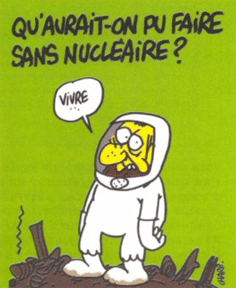
example is pictured at right. It reads: “What could one do without nuclear? Live.”) Charb, as he was known by his pen name, participated in opposition to both nuclear power and nuclear weapons. He was among the 12 killed.
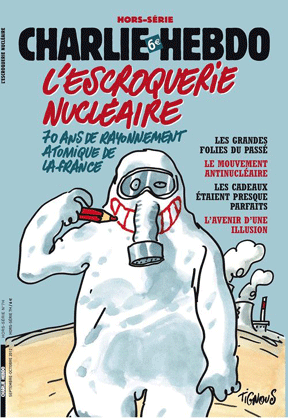 Another Hebdostaffer, Fabrice Nicolino, who was wounded but we are told will survive, was the author of the brilliant special edition of Charlie Hebdo focusing on nuclear power and called The Nuclear Swindle (cover pictured left). In it, Nicolino, an author and environmental journalist, pointed out that nuclear power is a hold-up, with democracy as the spoils. The assassination of the 12 people atCharlie Hebdo, and the injuring of others, was also an assault on democracy. Tens of thousands rallied the same night in Paris and elsewhere, holding vigil for the victims and for freedom
Call for new nuclear reactors, from France’s Energy Minister
 French energy minister wants new nuclear reactors http://www.reuters.com/article/2015/01/13/france-nuclear-idUSL6N0US1P320150113
First time minister clearly approved new nuclear plants
* Says some of EDF’s plants can operate more than 40 years
* EDF shares climb more than 5 percent (Adds shares, trader comment)
By Michel Rose PARIS, Jan 13 (Reuters) – France should build a new generation of nuclear reactors to replace the country’s ageing plants, Energy Minister Segolene Royal said on Tuesday, the first time a government member has clearly approved this option.
France, the country most reliant on nuclear power, must decide in the next few years whether to continue down the nuclear route as about half of its 58 reactors will reach their designed 40-year age limit in the 2020s.
Royal’s so-called energy transition bill, which is being reviewed by the Senate after parliament’s lower house passed a first version last year, aims to cut the share of nuclear energy in France’s electricity mix to 50 percent from 75 percent.
But that does not mean France wants to exit atomic energy, as it is part of the country’s history and expertise, Royal told L’Usine Nouvelle magazine in an interview, in contrast with Germany’s decision to phase out nuclear power.
“EDF’s board has adopted part of its big maintenance plan with my agreement,” Royal said.
“We must now also programme the construction of a new generation of reactors, which will replace old plants when these cannot be renovated anymore.”
Shares in EDF rose as much as 5.6 percent, the biggest gainer on France’s CAC 40 index of blue chip stocks. Clarinvest fund manager Ion-Marc Valahu, who owns EDF shares, said Royal’s comments had given the stock a boost.
Traders also mentioned that European utilities had been buoyed by a Morgan Stanleyupgrade to British energy company Centrica, as well as positive comments about the sector from Citigroup.
Mark Lewis, a senior analyst at Kepler Cheuvreux in Paris, said it was a big shift in Royal’s stance.
“The problem in my view is that new nuclear build is just not economic at prices below 100 euros per megawatt-hour, just look at the guarantee the UK government had to give EDF for Hinkley C,” he said.
Britain has guaranteed the price of power from the Hinkley Point C nuclear power station that is to be operated by French utility EDF.
State-owned EDF, which operates all of France’s nuclear reactors, faces a 55 billion euro ($65 billion) upgrade of its existing plants by 2025, including work decided in the light of the Fukushima nuclear meltdown in Japan.
To finance this investment, EDF has advocated an extension of reactor lifespan to 50 or 60 years, arguing that the power stations were modelled on similar reactors in the United States which have been granted 60-year licences.
“I didn’t include a 40-year age limit in the energy transition bill like ecologists wanted. Some nuclear plants can live longer,” Royal said in the interview.
This was also the first time the former partner of President Francois Hollande, and apowerful voice in the cabinet, had approved an extension beyond 40 years.
However, the ultimate decision for a lifespan extension will be for the country’s independent nuclear watchdog, the ASN, which is set to give a preliminary opinion on the question this year and make a final decision in 2018-2019.
($1 = 0.8473 euros) (Additional reporting by Sudip Kar-Gupta in London and Raoul Sachs; editing by Sybille de La Hamaide and David Clarke)
Nuclear Free by 2045? – pays tribute to Charlie Hebdo’s anti nuclear stand
http://nf2045.blogspot.jp/2015/01/charlie-hebdo-special-nuclear-swindle.html 12 Jan 15 As the French nation prepares for a massive rally in support of liberty and free speech in the wake of the January 7th murders, certain ironies cannot escape attention.
The entire political establishment will be out for this rally, yet they were all targets in the past of Charlie Hebdo’s pointed satire. Some of them voiced disgust and disdain when they were the targets, or they showed no interest in fixing the problems exposed in the journal. Good for them, I suppose, if they are now ready take criticism more seriously and pay free speech and democracy more regard.
Just in case anyone gets the impression that Charlie Hebdo did only crude satirical cartoons about religion, let’s remember that these jokers had the courage to take on all sacred cows, even the ones with Iodine 131 and Strontium 90 in their milk.
Below is the cover page of Charlie Hebdo’s special nuclear issue from 2012. The French original of the cover page and accompanying text is here. –(pictures are at sidebar on right of this Antinuclear page)
The full issue does not appear to be available in digital format.
The Nuclear Swindle: 70 Years of French Atomic Radiation
Charlie Hebdo Responds to Montebourg* Special Edition of Charlie Hebdo, September 2012
At least AREVA is selling some wind turbines, though not nuclear reactors
Iberdrola awards AREVA its largest renewable energy business to date January 6, 2015
Source: Iberdrola Iberdrola has signed with Areva its largest renewable energy contract to date, valued at approximately €620 million, for the supply of wind turbines to its Wikinger offshore project.
The French company will supply 70 M5000-135 5MW wind turbines, worth €550 million. For the first time, Iberdrola will be installing 5-MW turbines in a wind facility.
Under the terms of the contract, AREVA will also provide maintenance services, valued at €70 million, for a 5-year period which may be extended for another five years…..http://www.pennenergy.com/articles/pennenergy/2015/01/iberdrola-awards-areva-its-largest-renewable-energy-business-to-date.html
Nuclear company AREVA really in a state of bankruptcy, but tax-payers will bail it out
AREVA goes from bad to worse, nuclear giant headed for bankruptcy http://sansdrapeauxnibanderoles.wordpress.com/ Sortir du Nulcleaire , France January 4 15 , Translation by Noel Wauchope The French group AREVA, world No. 1 nuclear power is bankrupt. Its shares collapsed: they have lost 55% since the beginning of the year. Already over-indebted, AREVA’s losses for 2014 would exceed € 1 billion- Nuclear power has become too risky and too expensive, civil nuclear is no longer sold on the world market: AREVA has not delivered a reactor for 7 years.
- The sites of two EPR reactors in Finland and France drag on, their cost has tripled, now reaching 9 billion euro.But the Finns will not pay the additional costs and now require penalties. It’s a total financial fiasco.
- The delivery of nuclear fuel in Japan remains suspended because the reactors have remained closed there since the accident in Fukushima. This fuel export shortfall adds to the worsening finances of AREVA.
- After Fukushima, Siemens left AREVA to convert to renewable energy. They held a 20% stake in the group.
- The Uramin case in 2007: the acquisition of uranium mining in Niger, Central African Republic and Namibia, which soon proved unworkable. Between the purchase, retro-commissions and the unsuccessful operation, AREVA has accumulated € 3bn loss. The proposed remedies: the taxpayer on the front line
1 This Month



26 September – International Day for the Total Elimination of Nuclear Weapons


PLEASE OPPOSE HR 8255 AND S.3639 – bills would accelerate satellite deployment, with no environmental review or safeguards – https://ncstd5li.quorum.us/campaign/169331/
To see nuclear-related stories in greater depth and intensity – go to https://nuclearinformation.wordpress.com
-
Archives
- September 2026 (269)
- August 2026 (330)
- July 2026 (355)
- June 2026 (287)
- May 2026 (306)
- April 2026 (356)
- March 2026 (251)
- February 2026 (267)
- January 2026 (308)
- December 2025 (358)
- November 2025 (359)
- October 2025 (375)
-
Categories
- 1
- 1 NUCLEAR ISSUES
- business and costs
- climate change
- culture and arts
- ENERGY
- environment
- health
- history
- indigenous issues
- Legal
- marketing of nuclear
- media
- opposition to nuclear
- PERSONAL STORIES
- politics
- politics international
- Religion and ethics
- safety
- secrets,lies and civil liberties
- spinbuster
- technology
- Uranium
- wastes
- weapons and war
- Women
- 2 WORLD
- ACTION
- AFRICA
- Atrocities
- AUSTRALIA
- Christina's notes
- Christina's themes
- culture and arts
- Events
- Fuk 2022
- Fuk 2023
- Fukushima 2017
- Fukushima 2018
- fukushima 2019
- Fukushima 2020
- Fukushima 2021
- general
- global warming
- Humour (God we need it)
- Nuclear
- RARE EARTHS
- Reference
- resources – print
- Resources -audiovicual
- Weekly Newsletter
- World
- World Nuclear
- YouTube
-
RSS
Entries RSS
Comments RSS

