More worrying flights by drones, near France’s nuclear plant
 Catch me if you can: More drones break into France’s nuclear air space Rt January 04, 2015 Two aircraft – presumably drones – were spotted flying over a French nuclear power plant on Saturday. The incident happened amid the country’s efforts aimed at detecting and intercepting such flying objects above nuclear facilities.
Enormous risk in France’s plan for nuclear garbage tip near the town Bure.


 Nuclear Waste on the Aquifer Nuclear free by 2045? http://nf2045.blogspot.com.au/2015/01/the-inconvenience-of-geothermic-energy.html by Professor Canardeau translation of Des déchets (nucléaires) sur la nappe Le Canard enchaîné December 2014
A huge pocket of warm water exists beneath what is supposed to be France’s largest nuclear garbage pit, located near the town Bure. This site is destined to store, for at least 100,000 years, the most dangerous high-level waste that has accumulated since France built its first reactor. 125 meters tall, 30 kilometers wide and dozens of kilometers long, this reserve of warm water could sooner or later be used to produce heat or energy. The water is a comfortable 66 degrees, but it is found at a depth of 1,800 meters, while the nuclear waste is to be buried above it at a depth of 500 meters.
On January 5, 2015, the agency for the management of radioactive waste (ANDRA) will find itself on trial in high court in Nanterre for having divulged false information concerning the supposed absence of concern about significant underground water tables at the site in Bure. The citizen groups Sortir du nucléaireand Stop Bure 55, and Mirabel Lorraine Nature Environnement have brought the charges.
Some background: The fundamental rules related to deep geological disposal of nuclear waste, established in 1991 and still in force, clearly state that sites should not involve significant concerns about geothermal sources or build-up of heat. But in 2002, the geophysicist André Mourot (now deceased) was going through the archives at the Bureau of Geological and Mining Research in Nancy, Reims, and he discovered the existence of this aquifer, and he realized its significance as a source of energy. The geologist Antoine Godinot remembers that André Mourot wrote a report and distributed it to all interested groups. Next, they demanded that ANDRA conduct testing to learn fully about the aquifer.
ANDRA made no response until 2008. “What a disaster, this drilling and testing,” laughed the nuclear physicist Monique Sené. “The probe got stuck. They couldn’t even reach the aquifer.”
This fiasco didn’t stop ANDRA from declaring in 2009 that the geothermic source is negligible. Since then it has stuck to this position. To the malcontents it accuses of spreading this information about a geothermic potential, it responds, “The studies done by ANDRA concern whether there is an exceptional geothermic resource.” For ANDRA, as far as Bure is concerned, there is “no geothermic resource of exceptional interest.” Everything hinges on what is understood by “exceptional.”
Tada! At the end of 2013, at the request of the local information committee tracking the Bure laboratory (composed of representatives of the State, local collectives, and civil society groups), a Swiss group called Geowatt, specializing in geothermic energy resources, produced a report that stated, “We are of the opinion that the geothermic resources of the Bure region could at present be developed at an economical cost with the use of appropriate technology. The nail in the coffin was the additional comment stating, “The burial of nuclear waste prevents access to the geothermic resource.”
The physicist Bernard Laponche points out, “If we build this project at this site, we are going to impose enormous risks on future generations, and for sure one day people will want to exploit this geothermic energy, but they will stumble upon the nuclear waste that is blocking access to it. ”
Perhaps ANDRA will be able to leave their contact information for future generations to get in touch.
France’s nuclear maintenance inadequate, costly: EDF shares slump
 France failing to keep up with nuclear reactor maintenance http://enformable.com/2014/09/france-failing-keep-nuclear-reactor-maintenance/ Lucas W Hixson Website According to the head of the French Nuclear Safety Authority, Electricite de France SA (EDF) – the largest generator of nuclear power in the world, is unable to keep up with maintenance needs at aging nuclear reactors in its fleet. The state-controlled EDF operates 58 nuclear reactors at 20 nuclear facilities and nearly 85% of its electrical production comes from nuclear energy.
After the Fukushima Daiichi nuclear disaster, EDF was forced to conduct repairs and safety improvements at its nuclear power stations, but according to Pierre-Franck Chevet, head of the Nuclear Safety Authority in France, “There are delays and complications and some could affect safety.”
EDF has estimated that it will need to spend at least $71 billion to improve safety at its nuclear power plants before 2025.
EDF shares have fallen as much as 4.2% since June 19th.
Potential for drones to carry explosive devices over nuclear reactors
With concerns about terrorism ever-present, the fear that drones carrying explosive devices could potentially fly over such sites looms large.
Drones Flying Over Nuclear Power Stations in France Raise Concerns Global Voices, byAbdoulaye Bah Translated byDanielle Martineau 9 December 2014
With 58 nuclear reactors spread out over 19 plants, France is the highest user of nuclear energy in Europe, and the second highest in the world, after the United States.
In a blog post published on the website Géneration NT, Jérôme G. gives some insight into the matter:…….
Drones have successfully evaded all the power stations’ defenses. EDF also reports a number of drone overflights that differs from Greenpeace’s count. Pascal Riché, co-founder of rue89.nouvelobs.com, notes: Continue reading
France’s nuclear security problem: no way to detect small drones at low altitudes
France Backs Anti-Drone Research After Mystery Nuclear Flights, Bloomberg, By Tara Patel tpatel2@bloomberg.net Dec 9, 2014, Paris France is backing research on how to track and destroy drones as the mystery of who is behind a series of illegal flights over atomic sites remains unsolved.
The French National Research Agency will start a tender later this month for systems to “detect and even neutralize” drones, according to a statement from the Secretariat for Defense and National Security, which advises the president and prime minister.
Areva SA (AREVA), Electricite de France SA and Commissariat a l’Energie Atomique et aux Energies Alternatives confirmed some 20 incidents since the middle of September of remote-controlled drone-like objects violating protected zones around their nuclear installations. The government vowed to put an end to the flights, which haven’t inflicted damage. No one has publicly claimed responsibility.
“The use of drones is bringing progress but with it new risks,” the national security committee said in yesterday’s statement.
The flights exposed a security weakness described by speakers at a parliamentary hearing last month in Paris. Top military and police officials joined experts from the nuclear industry and research organizations to testify before lawmakers on the kinds of drone technology that may be at work and the risks they pose. French radar systems aren’t adapted to detect so-called mini-drones weighing a few kilograms and flying at low altitudes, Denis Mercier, Chief of Staff of the French Air Force, told the hearing.
Drone industry representatives gave evidence on the sector’s exponential growth and lack of adequate supervision……http://www.bloomberg.com/news/2014-12-09/france-backs-anti-drone-research-after-mystery-nuclear-flights.html
France keen to sell nuclear reactors to Czech Republic (or indeed, anybody)
 French Companies Interestedin Expanding Czech Nuclear Program Sputnik News 9 Dec 14 During his visit to Prague, French Prime Minister Manuel Valls said French state-controlled companies such as Electricite de France and Areva are interested in expdanding the Czech Republic’s nuclear program.
MOSCOW, December 9 (Sputnik) — French energy companies are interested in developing the Czech’s nuclear program, according to country’s Prime Minister Manuel Valls.
Dyring his visit to Prague on Tuesday, Valls told a Czech-French business forum that state-controlled companies such as utility Electricite de France and nuclear engineering giant Areva “are ready to react to the decision” to expand the country’s nuclear energy output, according to Associated Press……..http://sputniknews.com/business/20141209/1015660406.html
IAEA tells France to smarten up on nuclear power safety
IAEA recommends France raises funds, workforce for nuclear safety, Reuters, PARIS Fri Nov 28, 2014 “……..As the reactors age, approaching 40-years old in the next decade, French nuclear watchdog ASN will need more frequent safety checks requiring more staff and funds, both hard to obtain given government budget constraints……..The head of ASN, Pierre-Frank Chevet, has regularly warned officials of the need to increase the authority’s budget and workforce, but has so far obtained only a fraction of its estimates…….
Chevet also called for a new tax on nuclear operators that would be ringfenced for nuclear safety.
The IAEA mission, which did not disclose the draft report to reporters, also identified issues in need for improvement in the regulatory framework for the control of medical exposure to radiation and in “processes needed to deliver ASN’s mandate.”………
The final report will be given to the French government and made public in about three months. (Reporting by Michel Rose Editing by Jeremy Gaunt) http://www.reuters.com/article/2014/11/28/us-france-nuclear-safety-idUSKCN0JC1LF20141128
Security problems surround mysterious drone flights over France’s nuclear power plants
Drone flights were first reported over at least 13 nuclear facilities in October. The flights have taken place mostly at night, involving drones of different sizes and capability, from smaller models that would need to be operated within the immediate vicinity to larger ones around two meters in size, which could be controlled from kilometres away. Flights have been carried out both in isolation and concurrently, with drones flown simultaneously over nuclear facilities hundreds of miles apart.
Risk assessment
It is difficult to assess the risk posed by the recent drone flights as at this point it is unclear who is behind them and crucially what their intentions and capabilities are…….
worryingly, drones could be used to carry explosives for detonation close to the reactor or other sensitive parts of a nuclear site, although there have been no reports to date that these drones have been carrying a malicious cargo…….
Drones could also have other malicious uses. When mounted with small cameras, they could be used to conduct reconnaissance or to test security provisions before carrying out a follow-up attack by other means. Or they could be potentially used to drop equipment onsite to help out a malicious insider. A recent case in Belgium involving the sabotage of non-nuclear systems of a power station by an employee highlights that insiders can pose a real threat……..http://theconversation.com/mystery-drones-are-buzzing-around-french-nuclear-plants-should-we-be-worried-34447
In gloomy economic situation nuclear giant AREVA “suspends” its financial outlook for 2015 and 2016.
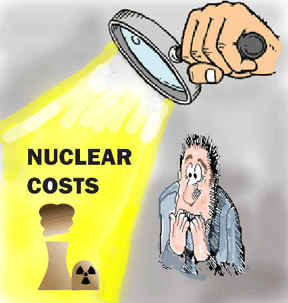 French Nuclear Giant Areva Says Future Is Uncertain, Prompting a Sell-Off NYT, By DAVID JOLLY and STANLEY REEDNOV. 19, 2014 PARIS — Areva, the French nuclear technology giant, has warned of an uncertain outlook for its business amid delays to important projects and sluggishness in the global atomic energy sector, sending its stock tumbling on Wednesday.
The company, which is about 87 percent state-owned, said late Tuesday that it was “suspending” its financial outlook for 2015 and 2016.
Areva cited cash flow problems related to its long-delayed nuclear plant project in Finland, on Olkiluoto Island, as well as Japan’s reluctance to restart reactors after the 2011 Fukushima disaster. The company noted “the still lackluster market” for providing services to existing nuclear plants, including in its crucial home market, which draws about three-quarters of its electricity from atomic power, the highest in the world………..
The company will burn through more than 400 million euros, or about $500 million, of cash this year, he said, and might need to raise as much as €2 billion in new capital to shore up its finances. Its share price fell about 16 percent on Wednesday. Compounding the shock was the fact that the company had reaffirmed its full-year profit and sales outlook on Oct. 31, even as it said revenue for the first nine months of 2014 fell more than 14 percent from a year earlier, to €5.6 billion………http://www.nytimes.com/2014/11/20/business/international/french-nuclear-giant-areva-says-future-is-uncertain-prompting-a-sell-off.html?_r=0
2015 the deadline for EDF to start closing nuclear reactors in France
 EDF must start French nuclear closure in 2015 despite delay on replacement http://www.reuters.com/article/2014/11/19/france-nuclear-idUSL6N0T93HX20141119 PARIS Wed Nov 19, 2014 Nov 19 (Reuters) – EDF will still need to start shutting down some nuclear capacity in 2015 despite a new delay in finishing a replacement in northern France, the official in charge of the closure of France’s oldest plant said on Wednesday.
The French utility announced on Tuesday that it expects 1,600-megawatt Areva-designed EPR nuclear reactor in Flamanville,France, to be connected to the grid in 2017, instead of 2016.
That pushed back the production of the first megawatt of electricity to the last year of President Francois Hollande’s mandate, which terminates in May 2017. Closing the Fessenheim plant on the German border was a campaign pledge of Hollande’s.
The delay gave rise to talk that EDF could avoid closing the Fessenheim nuclear plant altogether if anew centre-right government came to power in May 2017 and repealed the energy transition law that caps nuclear capacity at 63.2 gigawatts.
But Jean-Michel Malerba, who is in charge of closing the 1,600-MW reactor, told Reuters that EDF will still have to request a production permit for Flamanville some 18 months before start-up and will also have to request a production withdrawal permit for the equivalent capacity in 2015.
“EDF will have to ask for a production authorisation for Flamanville in 2015, even if the start-up date is a bit delayed, and on that occasion they will have to declare which reactors they want to shut to obtain that authorisation,” he said.
The official said Article 55 of the energy transition bill, which won approval from the lower house of parliament last month, requires EDF to request a production authorisation no later than 18 months before April 2017.
Energy Minister Segolene Royal suggested in September that keeping Fessenheim open, where half a billion euros ($630 million) of maintenance investment has been made in recent years, was a possibility. (Reporting by Michel Rose)
EDF’s nuclear power plants Flamanville and Olkiluoto delayed yet again
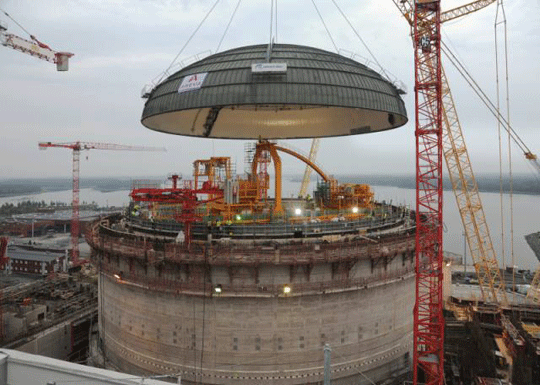 EDF says French nuclear reactor delayed another year to 2017 ,
* New one-year delay adds up to 10-year building period
* EDF says Areva unable to deliver key ingredients in time
* EDF still committed to EPR for UK Hinkley Point project (Adds EDF quote, background)
PARIS, Nov 18 (Reuters) – French utility EDF announced a new one-year delay for its Areva-designed EPR nuclear reactor in Flamanville, France, which it now expects to be connected to the grid in 2017, a decade after construction started.
EDF said the delay was due to Areva’s difficulties with ensuring a timely delivery of certain pieces of equipment, such as the lid and internal structure of the reactor vessel. It also said Areva had briefed it on a steam generator welding defect.
Construction on the Flamanville EPR reactor started in 2007 and it had initially been scheduled to be connected to the electricity grid in 2012, but it has been delayed repeatedly…….Four EPRs are under construction worldwide, one in France, one in Finland and two in China, but the Finnish and French projects have been plagued by billion euro cost overruns and multiyear delays.
Construction on the first EPR in Olkiluoto, Finland started in 2005 and it had originally been scheduled to go live in 2009, but it is now expected that will occurr in late 2018, almost a decade later than originally planned. Construction will have lasted 13 years, if it is not delayed again……..
Last month, European Union competition authorities gave the green light for state subsidies to EDF’s 16 billion pound project to build two EPR reactors in Hinkley Point C in southwest Britain, which are expected to start producing power from 2023……..http://in.reuters.com/article/2014/11/18/edf-nuclear-idINL6N0T85BN20141118
Drone flights still happening over France’s nuclear power plants
 French nuclear power plant drone flights continue, model plane fans freed Golfech nuclear plant on the edge of the Garonne river between Agen and Toulouse Reuters/Regis Duvignau By RFI 8 Nov 14
The mysterious drone flights over French nuclear power stations continued on Thursday night but the authorities were no closer finding who is responsible after the release of two model plane enthusiasts arrested on Wednesday…….
the public prosecutor announced on Friday that they were just modelling enthusiasts who wanted to film a boat they had made on the lake next to the plant.
As many as five flights have taken place on the same night, leading to speculation that they are part of an organised campaign but anti-nuclear groups have denied responsibility and no-one else has confessed.
Officials did not admit publicly the flights were taking place until 24 days after the first on 5 October and are anxious to calm public fears over security. http://www.english.rfi.fr/environment/20141107-french-nuclear-power-plant-drone-flights-continue-model-plane-fans-freed
Again, mystery drone aircraft fly over France’s nuclear power plants
France records at least 15 mystery drone flyovers of nuclear power plants, ABC News 3 Nov 2014, A drone has flown over a nuclear plant in central France for the second time in two days, a source close to the case says. The unmanned flying machine went over the plant in Dampierre-en-Burly on Sunday evening, said the source, who wished to remain anonymous.
The power station had already been flown over on Friday evening.
Authorities are scratching their heads over the number of unidentified drones spotted over nuclear plants across France over the past month, and a probe has been launched to try and find out exactly who is piloting the remote-controlled machines.
They have counted at least 15 flyovers, sparking questions over the security of nuclear plants in France, which relies heavily on atomic energy for electricity……..http://www.abc.net.au/news/2014-11-04/french-nuclear-plant-hit-by-another-mystery-drone-flyover/5864836
France and nuclear power: the end of the affair is coming?
Is France’s Love Affair with Nuclear Over? Oil Price, By Chris Dalby | Sun, 19 October 2014 French President Francois Hollande has promised to limit the growth of the country’s nuclear power, many older reactors have been targeted for decommissioning, and Greenpeace and other environmental groups have been relentless in their anti-nuclear campaigning. But until now, it seemed unlikely that France would ever truly rethink its love affair with nuclear power.
Last week, it did. On Oct. 10, France’s parliament voted to begin moving to undo decades of nuclear growth and to reduce its importance to the country’s energy mix. Over the next 11 years, France will reduce the amount of electricity coming from nuclear by one-quarter — from 75 percent to 50 percent. To do that, estimates are that as many as 20 of France’s 58 reactors would have to be closed.
The vote was part of a package of legal reforms in France’s long-awaited energy transition law, a main pillar of which was slowing nuclear power production and then maintaining it at the new lower level before progressively lowering it over the next 10 years.
The second pillar was removing bureaucratic hurdles that prevented renewable energy projects from getting off the ground. A trial period will see wind, solar, bio-gas and small hydro projects receive streamlined authorization in seven French regions.
A comparison of the contribution of renewables versus nuclear in France’s energy mix shows the massive disparity that the government is seeking to address. In June, France had 8,592MW of onshore wind installations and 5,095MW of PV, translating to 3.8 percent and 1 percent of the country’s energy needs. This compares to 63.2GWe of nuclear capacity.
The energy transition law aims to erase this imbalance. At 50 percent of national energy production, nuclear will remain the biggest source, but will be supported by a boosted renewables sector, with wind and solar levels similar to Germany’s…………
In March, around 60 Greenpeace protesters managed to spectacularly infiltrate Fessenheim in northeastern France, the country’s oldest nuclear power plant, which is set to be decommissioned in 2016. The activists deployed a huge banner on one of Fessenheim’s reactors, reading “Stop Risking Europe”, in support of their argument that France’s aging nuclear installations put all of Europe at risk, much like Chernobyl. Europe-Ecologie Les Verts (EELV), backed the protest at the time, widening a rift with Hollande’s Socialist Party that the energy transition law hopes to close……..
the pressure is on. Germany, Belgium and Switzerland are all abandoning nuclear power. Flagship nuclear firm Areva, which builds nuclear plants around the world, is not the profit-making juggernaut it once was. Nuclear is no longer as cost-competitive as it used to be compared to natural gas, wind and PV…….http://oilprice.com/Alternative-Energy/Nuclear-Power/Is-Frances-Love-Affair-with-Nuclear-Over.html
Cut back nuclear power, champion renewable energy – France’s parliament votes
French MPs back cut to nuclear energy reliance http://www.reuters.com/article/2014/10/10/us-france-energy-idUSKCN0HZ1LB20141010 (Reuters) – A law which fixes a target of reducing French nuclear power production from 75 percent of the country’s energy supplies to 50 percent by 2025 won approval from the lower house of parliament on Friday.
France, the world’s most nuclear-reliant country, has faced increasing costs because of the price of maintaining aging plants and tighter regulations after the Fukushima disaster inJapan.
It also wants to develop its own industrial champions in the renewable energy industry, which is still tiny compared to other European countries such as neighbors Germany or Spain.
Its much-delayed energy transition law, steered by energy minister Segolene Royal, is being reviewed by the national assembly under a fast-track procedure, to counter the thousands of amendments proposed by opposition MPs. Although the bill skirts the question of how the reduction in theshare of nuclear energy is supposed to happen — it does not single out any reactor for closure, for instance – it caps nuclear electricity capacity at the current 63.2 gigawatts.
That would force EDF, which operates all of France’s nuclear reactors, to close an equivalent capacity when it launches the 1.6 gigawatt next-generation Flamanville reactor, due in 2016.
Royal said earlier this week the utility could choose to close another plant than Fessenheim, France’s oldest and the one Hollande had promised to shut down.
The whole bill is expected to be approved next Tuesday before being sent to the country’s upper house early next year, with the view to final adoption in the spring, in time for a high-profile climate conference hosted in Paris in 2015.
The bill also introduced a goal to halve the country’s energy consumption between 2012 and 2050, with a midway target of a 20 percent cut by 2030, thanks to tax rebates on insulation work and bonuses for electric car buyers.
France’s energy deficit — the difference between the money it spends on energy imports such as oil and gas and the money it earns on exports such as electricity — amounted to 66 billion euros ($83 billion) in 2013.
That compares with a wider trade deficit of 62.2 billion euros.
(Reporting by Emile Picy; Writing by Michel Rose; editing by Keith Weir)
1 This Month



26 September – International Day for the Total Elimination of Nuclear Weapons


PLEASE OPPOSE HR 8255 AND S.3639 – bills would accelerate satellite deployment, with no environmental review or safeguards – https://ncstd5li.quorum.us/campaign/169331/
To see nuclear-related stories in greater depth and intensity – go to https://nuclearinformation.wordpress.com
-
Archives
- September 2026 (269)
- August 2026 (330)
- July 2026 (355)
- June 2026 (287)
- May 2026 (306)
- April 2026 (356)
- March 2026 (251)
- February 2026 (267)
- January 2026 (308)
- December 2025 (358)
- November 2025 (359)
- October 2025 (375)
-
Categories
- 1
- 1 NUCLEAR ISSUES
- business and costs
- climate change
- culture and arts
- ENERGY
- environment
- health
- history
- indigenous issues
- Legal
- marketing of nuclear
- media
- opposition to nuclear
- PERSONAL STORIES
- politics
- politics international
- Religion and ethics
- safety
- secrets,lies and civil liberties
- spinbuster
- technology
- Uranium
- wastes
- weapons and war
- Women
- 2 WORLD
- ACTION
- AFRICA
- Atrocities
- AUSTRALIA
- Christina's notes
- Christina's themes
- culture and arts
- Events
- Fuk 2022
- Fuk 2023
- Fukushima 2017
- Fukushima 2018
- fukushima 2019
- Fukushima 2020
- Fukushima 2021
- general
- global warming
- Humour (God we need it)
- Nuclear
- RARE EARTHS
- Reference
- resources – print
- Resources -audiovicual
- Weekly Newsletter
- World
- World Nuclear
- YouTube
-
RSS
Entries RSS
Comments RSS

