Defects in EDF’s nuclear reactors could close down many reactors: a warning to France
 Belgian Doel 4 nuclear reactor closed till year-end Major turbine damage forces closure till year-end By Geert De Clercq PARIS, Aug 14 (Reuters) “…In Britain, EDF Energy, owned by France‘s EDF, took three of its nuclear reactors offline for inspection on Monday after finding a defect in a reactor of a similar design.
The problems of the two French utilities with their reactors abroad may serve as a warning of possible generic flaws that could appear in EDF’s ageing nuclear park at home.
With 58 reactors in 19 nuclear plants, France is the world’s most nuclear-dependent country, relying on it for nearly three quarters of its power.
All of its plants are of the same basic Pressurised Water Reactor design, which means that a flaw discovered in one of EDF’s reactors could force the closure of others…..http://uk.reuters.com/article/2014/08/14/belgium-nuclear-doel-idUKL6N0QK43R20140814
Tough times for nuclear giant AREVA – shares plunge, sales wither
 Areva’s stock plunges on sales warning, solar exit PARIS, Aug 1 (Reuters) – Shares in French nuclear power group Areva closed 20 percent lower on Friday, the worst fall since the company was formed in 2001, as it posted a first-half loss, exited a thermal solar power business and cut sales targets.
The shares were down by as much as 23 percent earlier in the session with trading the busiest by volume since late February, when Areva posted a net loss of nearly half a billion euros.
Chief Executive Luc Oursel dropped a long-held target to sell 10 nuclear reactors by 2016, saying it would “take a few more years” and the firm warned that 2014 revenue would fall 10 percent, more than the 2-5 percent decline forecast in February.
 Areva, which has not sold a new nuclear reactor since 2007, hopes French utility EDF will get the green light from European Union competition authorities this year to build two Areva reactors in Britain, but its reactor sales are suffering badly from the aftermath of the 2011 Fukushima disaster.
Billions of cost overruns and multi-year delays in four projects involving its flagship EPR reactor have also hit the state-owned firm’s image, whileRussian, Korean and American reactor builders are winning orders at its expense……..
Revenue fell 12.4 percent to 3.89 billion euros and earnings before interest, tax, depreciation and amortisation (EBITDA) more than halved to 226 million euros from 487 million.
Oursel said the nuclear market environment had further deteriorated as constructionprojects for new reactors abroad as well as reactor overhaul operations in France had been delayed.
As a supplier to the utilities industry – which is suffering from overcapacity and slack power demand – Areva is feeling the impact of its customers’ efforts to cut costs and is trying to make savings itself to restore profitability.
The firm hiked its cost cut target to 1.2 billion euros from 1 billion and said it would cut 1,500 jobs in Germany by the end of 2015, as well as 200 jobs in the United States this year. It had earlier warned of 1,200 to 1,500 job losses in Germany. http://uk.reuters.com/article/2014/08/01/areva-results-idUKL6N0Q71IK20140801
Nuclear power to wind down in France, as renewable energy winds up
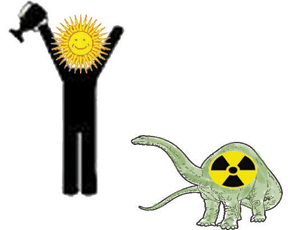
 France to Dim Its Reliance on Nuclear Power Government to Raise Profile of Renewables in National Energy Mix at Expense of the Atom By G, WSJ, ERALDINE AMIEL June 18, 2014 PARIS—France, one of the world’s biggest proponents and exporters of nuclear power, is losing its appetite for the atom at home.
French energy and environment minister Ségolène Royal on Wednesday presented a bill to boost renewable sources in the national energy mix and limit nuclear power production at current levels.
“We must diversify our energy sources and the share of nuclear will have to drop,” Ms. Royal told a news conference………
The new bill would cut nuclear’s share of France’s energy mix to 50% by 2025 from 75% now, while the share of renewables should increase to 40% from around 15% by 2030. The move confirms Mr. Hollande’s pledge during the presidential campaign of 2012.
France is the world’s second-largest generator of nuclear power, after the U.S., with 58 reactors dotted around the country. They are all owned and operated by state-controlled power giant Electricité de France SA, EDF.FR +0.11% which operates 15 more reactors in the U.K…….
The government is betting that this latest energy legislation that offers credit lines, subsidies and tax rebates will help create around 100,000 jobs over the next three years in the renewable and energy-saving industries, while cutting customers’ electricity bills and helping curb carbon emissions……..
According to energy experts, the increased use of renewable energy as proposed by the new bill would ultimately lead to the closure of 23-25 reactors out of 59 by 2025…….http://online.wsj.com/articles/france-to-dim-its-reliance-on-nuclear-power-1403113287
By 2020 France’s wind and solar power to be cheaper than its nuclear electricity
French nuclear more costly than renewables by 2020 – Greenpeace PARIS, June 12 Thu Jun 12, 2014 (Reuters) – Electricity produced by onshore wind and solar plants may become more competitive with power generated by upgraded nuclear plants in France by the end of this decade, a study by environmental group Greenpeace showed on Thursday.
The study comes a week before Energy Minister Segolene Royal presents the broad lines of a much-delayed framework energy law that aims to spell out how France will cut the share of atomic energy to 50 percent from the current 75 percent by 2025.
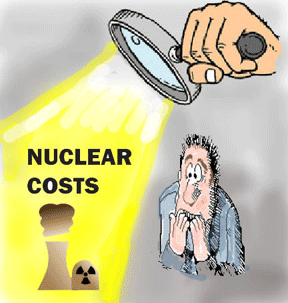 The rising cost of France’s nuclear energy is a concern and the government should set up independent expert institutions to help it plan long-term energy investments, a parliamentary committee said in a report published on Tuesday.
According to the Greenpeace study, the investment needed to upgrade French utility EDF’s 58 nuclear reactors to bring them close to the safety level of a new-generation EPR reactor would raise median production costs to 133 euros ($180) per megawatt-hour (MWh). That estimate, based on an extension of the lifespan of current reactors by 10 years to 50 years and 4.4 billion euros worth of work per reactor, would make nuclear energy less competitive than onshore wind power around 2015, the study said.
Greenpeace also sees the cost of photovoltaic power falling to less than 134 euros/MWh around 2019 from more than 250 euros/MWh today, making it competitive with the renovated French nuclear plants by that time……
French regulator ASN is expected to give a first opinion on whether reactors can be granted life extensions in 2015 and decide reactor by reactor in 2018-2019. ($1 = 0.7345 Euros) (Reporting by Michel Rose; Editing by James Macharia, Larry King) http://in.reuters.com/article/2014/06/12/france-nuclear-idINL5N0OT2LN20140612
France’s nuclear dilemma
France caught between nuclear cliff and investment wall BY MICHEL ROSEPARIS Wed Apr 30, 2014 (Reuters) – France must decide in the next few years whether it wants to continue its nuclear-driven energy policy at a cost of up to 300 billion euros (246.8 billion pounds) or if it wants to embark on an equally costly route towards using other fuels.
Most of the country’s 58 nuclear reactors were built during a short period in the 1980s, and about half will reach their designed age limits of 40 in the 2020s, pushing France towards what industry calls “the nuclear cliff.”
Public support in France for nuclear power has traditionally been strong but is looking shakier since the 2011 nuclear reactor meltdown at Japan‘s Fukushima facility following a massive earthquake and tsunami. And French President Francois Hollande has said he wanted to cut the share of atomic energy in France’s electricity mix to 50 percent from 75 percent by 2025, reduce oil and gas consumption and boost renewable energy.
A replacement of the nuclear plants run by state-controled utility EDF (EDF.PA), or a switch towards alternative sources would cost huge amounts of money.
“There’s a problem, which is decision-making. Are we going towards a new nuclear fleet or not? This needs preparation,” Jacques Repussard, the head of state-funded nuclear advising institute IRSN told Reuters in an interview. EDF has advocated an extension of the reactors’ lifespan to 50 or even 60 years, arguing that they were modelled on similar reactors in the United States which have been granted 60-year licences.
But French nuclear watchdog ASN, the only authority allowed to grant this extension, has so far repeated that the utility should not take this extension for granted and would only give a first opinion next year and a final one in 2018-2019………..
On the one hand, EDF wants to cash in on its nuclear know-how through exporting its technology and services, including to Britain’s nuclear investment power programme.
Yet EDF also faces a 55 billion euro upgrade of its existing reactors by 2025 and will have to decide on how to finance their ultimate replacement, at a potential cost of up to 240 billion euros, about six times EDF’s existing debt pile.
“If you close down all nuclear reactors when they reach 30 or 40 however, you will need to build a huge new fleet, that would be a massive challenge not only from a financial point of view but also from a project management point of view,” said Laszlo Lavro, head of the International Energy Agency’s Gas, Coal and Power division.
Within the government, ministers have voiced contradicting views on nuclear energy, even though the departure of the Green party from the government has made the pro-nuclear case stronger.
An energy transition bill now slated for July has been repeatedly delayed, with Paris naming its fourth energy minister in less than two years earlier this month.
Newly appointed energy minister Segolene Royal, a powerful voice in the new government, has skirted questions on nuclear policy at a news conference earlier this week……….
Decisions cannot be delayed indefinitely as building new energy infrastructure, especiallynuclear power plants, takes time.
Construction of France’s pilot new generation reactor in Flamanville, which started in 2007, has seen repeated delays and cost overruns and is currently expected to be finished in 2016……http://uk.reuters.com/article/2014/04/30/uk-france-nuclear-analysis-idUKKBN0DG0KC20140430
Vast majority of French people prefer renewable energy, would not invest in nuclear power
France moving away from Nuclear power http://www.enn.com/energy/article/47327 27 April 14 France may be the world’s most nuclear energy dependent country, but times are changing as the country looks to increase the amount of wind—sourced electricity in its power mix.
When French President François Hollande took the reins of power in 2012 he pledged to reduce the country’s nuclear dependency from 75% to 50% by 2025. Today, France has a goal of reaching 19 GW of wind energy by 2020, up from its current level of 8.2 GW, according to the European Wind Energy Association’s (EWEA) latest statistics. This will significantly raise the percentage of wind powered electricity in the country from the 3% wind covers today. And, according to a very recent survey, the French people are firmly behind the transition.
Some 64% of French people see wind energy as a solution, among others, in the context of the energy transition, says a CSA survey published in March 2014. Moreover, 80% of the 1010 respondents consider it necessary to invest in wind without waiting for the traditional power plants to reach the end of their lifecycle.
65% of those surveyed said that they would invest in renewable energy (wind and solar/photovoltaic) today if they had to personally invest in one energy source, while 15% chose nuclear, 7% chose gas and 1% chose coal. Meanwhile, 69% of French people would choose wind energy if they had to choose one energy type to be constructed in their region. 75% chose solar, 21% chose nuclear, 16% chose gas and 4% chose gas.
The results show that the French are aware that an energy transition must take place, they are confident enough in renewables to invest if they could, and they know that the time to act is now.
3 French nuclear plants fail safety test
 French nuclear watchdog singles out 3 plants for safety shortfall By Michel Rose PARIS, April 16 (Reuters) – France’s nuclear watchdog singled out three of EDF’s 19 nuclear power stations for having a below-average safety performance in its annual safety report, which also asked for more enforcement powers such as the ability to impose fines….. There were 127 level-1 incidents on the 7-level International Nuclear and Radiological Event Scale (INES) in France in 2013, ASN said, and two level-2 incidents.
Level-1 incidents are minor procedural infringements and level-2 incidents can refer to cases of minor exposure to radiation…….
The watchdog also mentioned shortfalls in terms of radiation protection at Cattenom near the German border and in terms of impact on the environment at Belleville in the Loire valley, Chooz near Belgium, and Chinon.
Chevet said the ASN needed a more graduated array of sanction powers on operators such as EDF.
The watchdog can at anytime stop operations at a nuclear plant if it considers it presents a danger for the public and can also issue public warnings, but Chevet said an ability to impose fines for each day of safety breaches would be useful.
“We clearly lack intermediary sanction tools, for when shortfalls last for one, two, three years, but don’t require a shutdown of the plant,” he said.
The presentation to parliament of a much-delayed energy transition bill planned in July could be the opportunity to introduce such powers, he added. (Reporting by Michel Rose. Editing by Jane Merriman) http://in.reuters.com/article/2014/04/16/france-nuclear-safety-idINL6N0N74K120140416
France’s prosecutor examining AREVA’s finances
French prosecutor probes Areva buy of Canadian miner https://au.finance.yahoo.com/news/french-prosecutor-probes-areva-buy-084747257.html France’s financial prosecutor has opened a preliminary probe into state-controlled nuclear giant Areva’s controversial 2007 purchase of a Canadian uranium miner, a judicial source said Thursday.
The probe focuses on the $2.5 billion (1.8 billion euro) purchase by Areva of UraMin at a height of demand for enriched uranium.
Areva was later forced to revalue its UraMin uranium mines to only 410 million euros.
Canadian media reports have suggested the sale was preceded by suspicious stock trades.
French newspaper Le Monde said France’s Cour des Comptes, which oversees state accounts, had referred the case to prosecutors. It said the Cour des Comptes is to release a report into Areva’s 2006-2012 finances later this month.
Areva’s chief from that period, Anne Lauvergeon, said in a statement Thursday that the deal was “strategic at the time”, noting that it was “submitted and approved by the group’s decision-making bodies”.
France’s government protects AREVA from criticism: goodbye to freedom of speech
 Adieu Free Speech in Nuclear France: Areva Rules 31 Mar 2014 miningawareness Almost two months ago, the French government condemned a French citizen-NGO for criticizing the almost completely French government owned nuclear company AREVA. (http://fr.wikipedia.org/wiki/Areva)
How can a government sue its own citizen for raising a question of possible corruption? Shouldn’t the government provide
 documents proving that there was no corruption instead?
Since when do citizens have no right to criticize their own government or question its actions? This shows that France has no free speech and is no democracy.
We find AREVA a very worrisome entity. It is a majority French government owned nuclear multinational, and by all appearances, the French government seems willing to put the weight of the French military, and now French courts, behind it. What is this other than a Nuclear Empire?
And, AREVA is more widely present throughout the world than realized. It has been present at Fukushima, having provided its MOX fuel, and operating a post-nuclear disaster water purification system, which apparently failed, and other projects. (1) It is involved in the WIPP nuclear waste dump (2), which has recently leaked radiation in the USA; it is involved in the Savannah River MOX plant, which ran over cost and is being moth-balled by the USA. AREVA mines for uranium in Africa, where, by all appearances, the French military is throwing its weight around to protect its mining interests. AREVA works closely with majority French government owned EDF, as well.
The outcome of the appeal in this case, appears yet to be announced. But, the fact that AREVA sued a French citizen, running a tiny NGO-blog site, for defamation, and that a judge ruled in AREVA’s favour, shows just how out of control AREVA and the French State really are. It is hence unsurprising that AREVA has almost two hundred entries in Wise Uranium’s “Hall of Infamy”:http://www.wise-uranium.org/uccoghi.html
Below is our translation of the February 7th statement by the NGO,Observatoire du nucléaire, dealing with this topic. (French original here:http://observ.nucleaire.free.fr/obs-fait-appel-don-areva.htm)
“Observatoire du nucléaire
Statement of 7 février 2014
Condemned at the demand of Areva,
l’Observatoire du nucléaire, appeals this judgement which
seriously endangers the right
to denounce the misdeeds of the nuclear lobby
Friday, 7 February 2014, despite damning evidence made public byl’Observatoire du nucléaire (see http://www.observatoire-du-nucleaire.org), the 17th Criminal Chamber of the Court of Paris saw fit to condemn (to several thousand euros in financial penalties, details shortly) for ‘defamation’ this association, at the urging of the radioactive multinational Areva.
t is edifying to remark that it is not only the justice system, but almost the entirety of French society, the main political parties, with the majority of the ‘big’ media, at the forefront, who conscientiously turn their eyes away, in order to profit from the plunder of Niger’s uranium. So, Areva was finally just executing this dirty work.
France is too happy to be able to fuel its nuclear reactors by grabbing Niger’s uranium at a derisory price: it’s probably hundreds of billions of euros, which should be reimbursed to Niger, especially if one takes into account the serious environmental damage (contamination, drying up of groundwater) and public health (multiple cancers, displacement of the local population, etc.)
The supposedly ‘environmentalist’ party EELV, through its two ministers, and by the complicit silence of its parliamentary groups, is directly the accomplice of Areva and of the nuclear lobby……..http://miningawareness.wordpress.com/2014/03/31/adieu-free-speech-in-nuclear-france-areva-rules/
Greenpeace Activists invade French nuclear power plant
 Activists breach French nuclear plant Sky News, , Tuesday March 18, 2014 Dozens of Greenpeace activists have snuck into a nuclear power plant in eastern France at dawn.
It’s the latest break-in by the environmental group to highlight alleged security weaknesses at atomic facilities.
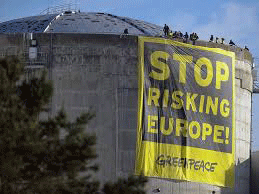
The activists broke into the Fessenheim plant and hung a banner reading ‘Stop risking Europe’ on the side of one of its reactors.
They did this ‘to denounce the risk of French nuclear power for the whole of Europe,’ the group said in a statement on Tuesday…….
Police detained 56 activists, he said, but 20 remained on top of the dome of one of the reactors as a police helicopter hovered above.
France, the world’s most nuclear-dependent country, operates 58 reactors and has been a leading international proponent of atomic energy.
But in a deal with the Greens before the 2012 parliamentary and presidential elections, President Francois Hollande’s Socialist party promised to cut reliance on nuclear energy from more than 75 per cent to 50 per cent by shutting 24 reactors by 2025.
Hollande has pledged to close Fessenheim, which was commissioned in 1977, by the end of 2016.
The plant, located on the banks of the Rhine, is close to the Swiss and German borders and is considered vulnerable to seismic activity and flooding.
The Greenpeace protest stunt comes ahead of a meeting by European leaders to discuss the future of the continent’s energy policy.
Greenpeace wants Hollande and German Chancellor Angela Merkel to push Europe towards a real energy transition, complaining that France relies too much on nuclear power, and Germany on coal, for electricity supplies. http://www.skynews.com.au/world/article.aspx?id=959316
France’s nuclear electricity costing industry 35% more does Germany’s electricity
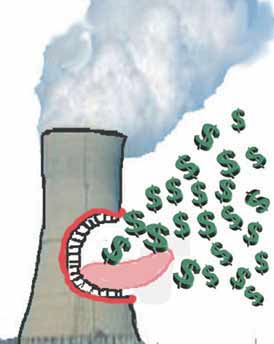 France’s Industrial Giants Call for Price Cap on Nuclear http://www.bloomberg.com/news/2014-03-17/france-s-industrial-giants-call-for-price-cap-on-nuclear.html by Tara Patel Mar 17, 2014 France’s biggest electricity users urged the government to cap Electricite de France SA (EDF)’s wholesale nuclear-power price at the current level to help industrial consumers compete with German rivals.
The competitiveness of large French power consumers has “dropped off in a way that is extremely worrying,” the Uniden lobby group said today in a statement. The regulated rate is set at 42 euros ($58.50) a megawatt-hour. Uniden has written a position paper in response to a state consultation on power prices. While the body’s 41 members, which include PSA Peugeot Citroen (UG) and Total SA (FP), strive to compete with foreign peers, EDF has embarked on a cost-cutting drive as spending increases to maintain and upgrade its 58 reactors.
France has said it will announce any revisions to the power rate or the way it’s calculated at the end of the month. The government already forces state-controlled EDF to sell about a quarter of its nuclear output to other French distributors to increase domestic competition. The country gets about three-quarters of its power production from EDF’s atomic fleet.
Large German industrial power users will pay 35 percent less for their electricity next year than those in France, Uniden said. “Even more preoccupying” is France’s inability to compete with North America, where the boom in shale gas has lowered the cost of energy supply, it said.
EDF, based in Paris, has said it can’t make ends meet unless it gets permission to raise the price of wholesale nuclear power. “One can’t demand of a company to sell a quarter of its output below cost in the long term,” Chief Executive Officer Henri Proglio said last month. The regulated rate helps EDF make “a step toward” meeting its costs of 50 euros a megawatt-hour, he said. Uniden called for tighter control of EDF’s costs and more “visibility” on the power price over the next five years.
France’s nuclear power program stalled at best, planned to decline
Even if President Hollande’s plan for the transition stalls, it seems clear at least that there will be no further expansion of nuclear in France.EDF is planning to build two new nuclear reactors at Hinkley in western England with Chinese help, but at Flamanville in Normandy a new reactor of the same EPR design is behind schedule and massively over budget. A second envisaged EPR reactor in France has been shelved indefinitely – and no other new nuclear power stations are planned.
France struggles to cut down on nuclear power By Rob Broom BBC News, 10 JAN 14 Paris “…….French President Francois Hollande also wants to cut nuclear output sharply – by a third in 20 years. It’s a big ask in a country that now relies on nuclear for 75% of its electricity.
If fully implemented, the pledge would force the closure of up to 20 of the country’s 58 reactors according to Professor Laurence Tubiana a former government adviser who the president asked to facilitate a national debate, paving the way for what they call le transition energetique.
This would be a huge step, but Tubiana describes it as a “logical evolution”.France realised that Japan had survived economically when all its atomic power stations were shut down because of its diverse energy mix. In Japan, before the disaster, nuclear power delivered about 30% of the country’s electricity, but France is hugely dependent not only on nuclear, but on a single generation of nuclear power stations.
It is vulnerable to a “generic risk”, according to Tubiana, where a problem with one reactor could force them all offline for the fault to be fixed. This would cause chaos.
She says the 20 reactors closed in the “transition” could be replaced by renewable energy, which she says would maintain French energy independence and be both “stable and secure”. Continue reading
Paris derailment of nuclear waste freight train
Freight wagon with nuclear waste derails at depot near Paris, no leak http://www.reuters.com/article/2013/12/23/us-france-nuclear-idUSBRE9BM0QH20131223 PARIS Mon Dec 23, 2013 (Reuters) – A rail freight wagon carrying nuclear waste derailed at a depot in Drancy, 3 km (2 miles) northeast of Paris on Monday, the mayor of the town said.
There was no leakage of nuclear waste, Jean-Christophe Lagarde said by telephone.
“Today at 1605 (1505 GMT), a freight car transporting radioactive material derailed in Drancy station,” said the mayor, who is also a member of parliament for the French centrist UDI party. About 4,000 freight wagons carrying radioactive or chemical waste pass through the station each year, Lagarde said, calling the incident “intolerable”.
France’s “Europe Ecologie Les Verts” (EELV) Green party called for an end to the transportation of radioactive waste through urban areas and busy stations following the incident.
“The slightest accident can have catastrophic effects,” the EELV party said in a statement. “All (nuclear waste) transport is risky and exposes populations to unnecessary danger.”
Taxpayer money for UK nuclear from French, as well as British?
 Areva may use French fund to help pay for UK nuclear plant –paper http://uk.reuters.com/article/2013/12/16/uk-areva-hinkleypoint-funds-idUKBRE9BF0KS20131216 (Reuters) – Areva is in talks with the French government to release some funds set aside for dismantling its nuclear installations in France to help the company finance a new British nuclear reactor, a newspaper reported.
 Britain signed a deal with France’s state-owned utility EDF in October to build a 16-billion pound nuclear power plant at Hinkley Point in southwest Britain, the first new plant in Europe since the Fukushima disaster.d to help pay for UK nuclear plant – paper
PARIS Mon Dec 16, 2013 State-owned Areva is taking a 10 percent stake in the consortium that will build the facility, which also includes EDF’s Chinese partners China General Nuclear Corporation (CGN) and China National Nuclear Corporation (CNNC).
Quest for uranium underlies France’s military intervention in Central African Republic
Paris is focusing on the uranium deposits in the Bakouma sub-prefecture of the Mbomou prefecture, in south-eastern CAR.
The primary sources of France’s uranium in southern Algeria and northern Mali and Niger are increasingly threatened ….
escalation of jihadist operations added a sense of urgency to the French quest for the uranium resources
 Behind France’s intervention in CAR: Uranium supply security WorldTribune.com By Yossef Bodansky, Senior Editor, Global Information System/Defense & Foreign Affairs 17 Dec 13 Operation Sangaris (a local exotic butterfly) — the French and MISCA (the French acronym for the International Support Mission to the Central African Republic) military intervention in the Central African Republic (CAR) — is escalating.
The French contingent will now be 1,600-troop strong, rather than the 1,200 agreed-upon at the United Nations Security Council (UNSC). The African Union’s (AU’s) MISCA force will grow to a total of 6,000 troops from Francophone African states, rather than the original estimate of 3,500 troops.
The hasty deployment of these forces only aggravates an already explosive situation in the country and region, and sparks new fighting where none existed before the international intervention had been announced. Most notably is the sudden resumption of fighting in Bangui, a city and region which had been completely quiet and secure literally until the day before the arrival of the new French forces.
The French-led Operation Sangaris had nothing to do with the oft-declared threat of “seeds of genocide” in the CAR. The French administration of President François Hollande is driven by the French desire for uranium ores. Continue reading
1 This Month
Chernobyl: The Lost Tapes – A good documentary on Chernobyl on SBS available On Demand for the next 3 weeks– https://www.sbs.com.au/ondemand/tv-program/chernobyl-the-lost-tapes/2352741955560

of the week–London Campaign for Nuclear Disarmament

Tell the Ukrainian Government to Drop Prosecution of Peace Activist Yurii Sheliazhenko
To see nuclear-related stories in greater depth and intensity – go to https://nuclearinformation.wordpress.com
-
Archives
- April 2026 (114)
- March 2026 (251)
- February 2026 (268)
- January 2026 (308)
- December 2025 (358)
- November 2025 (359)
- October 2025 (376)
- September 2025 (257)
- August 2025 (319)
- July 2025 (230)
- June 2025 (348)
- May 2025 (261)
-
Categories
- 1
- 1 NUCLEAR ISSUES
- business and costs
- climate change
- culture and arts
- ENERGY
- environment
- health
- history
- indigenous issues
- Legal
- marketing of nuclear
- media
- opposition to nuclear
- PERSONAL STORIES
- politics
- politics international
- Religion and ethics
- safety
- secrets,lies and civil liberties
- spinbuster
- technology
- Uranium
- wastes
- weapons and war
- Women
- 2 WORLD
- ACTION
- AFRICA
- Atrocities
- AUSTRALIA
- Christina's notes
- Christina's themes
- culture and arts
- Events
- Fuk 2022
- Fuk 2023
- Fukushima 2017
- Fukushima 2018
- fukushima 2019
- Fukushima 2020
- Fukushima 2021
- general
- global warming
- Humour (God we need it)
- Nuclear
- RARE EARTHS
- Reference
- resources – print
- Resources -audiovicual
- Weekly Newsletter
- World
- World Nuclear
- YouTube
-
RSS
Entries RSS
Comments RSS
 nuclear-news