Cut nuclear power, boost renewable energy- Bill passes France’s National Assembly
 French Bill Seeks to Boost Renewable Energy, Cut Nuclear Use http://abcnews.go.com/Technology/wireStory/french-bill-seeks-boost-renewable-energy-cut-nuclear-31308484
PARIS — May 26, 2015, France’s lower house of parliament has approved a bill aimed at boosting renewable energy and reducing the country’s reliance on nuclear power, among other environment-friendly measures.
The French government wants to be exemplary this year in environmental matters, since Paris is hosting a U.N.-backed conference in December where 196 countries aim to limit greenhouse gas emissions to fight global warming.
The bill pushed by Ecology Minister Segolene Royal was approved Tuesday by the National Assembly, the lower house of parliament, with 308 votes for and 217 against. It will then go to the Senate for further discussions. At the end of the process —probably over summer— the assembly will have the final say.
Among the more significant changes are the following measures: Continue reading
Nuclear fusion – expensive boondoogle – as far away as ever
 Star power: Troubled ITER nuclear fusion project seeks new path, Phys Org 23 May by Pascale Mollard “……Launched in 2006 after years of wrangling, the International Thermonuclear Experimental Reactor (ITER) project is saddled with a reputation as a money pit.
It has been bedevilled by technical delays, labyrinthine decision-making and cost estimates that have soared from five billion euros ($5.56 billion) to around 15 billion. It may be another four years before it carries out its first experiment………
ITER’s job is to build a testbed to see if fusion, so far achieved in a handful of labs at great cost, is a realistic power source for the energy-hungry 21st Century.
Fusion entails forcing together the nuclei of light atomic elements in a super-heated plasma, held by powerful magnetic forces in a doughnut-shaped chamber called a tokamak, so that they make heavier elements and in so doing release energy.
The principle behind it is the opposite of nuclear fission—the atom-splitting process behind nuclear bombs and power stations, which carries the risk of costly accidents, theft of radioactive material and dealing with dangerous long-term waste…….
The tokamak—a word derived from Russian—by itself is an extraordinary undertaking: a 23,000-tonne lab, three times heavier than the Eiffel Tower.
“This is a project of unprecedented complexity… a real challenge,” said Mario Merola, in charge of ITER’s internal components division.
Management tangle
Part of ITER’s problems lie in a diffuse managerial structure and decision-making among its partners: the 28-nation European Union, which has a 45-percent stake, the United States, Russia, Japan, China, India, South Korea and Switzerland. he partners are providing their contributions mostly in kind, which has been a cause of messy, protracted debate about who should provide what, when and how. It has been further complicated by the role of national agencies, which in turn deal with their own suppliers.
In some cases, said Bigot, discussions have dragged on for six whole years without resolution……..By November, there will be a new progress report, with the likelihood of a further increase in the price tag. The project has no reserve fund to deal with the unexpected…..So far around seven billion euros have been contractually committed to the thousand or so companies working on the scheme. Every year of delay adds 200 million euros to the bill……”clearly if we can’t manage this project correctly, if undertakings are not kept… (the project) could be in danger.” http://phys.org/news/2015-05-star-power-iter-nuclear-fusion.html
EDF makes an offer to AREVA
Nuclear: EDF made an offer to over 2 billion euros in the … – Les Echos 23 May 15 As he announced, the president of EDF Jean Bernard Levy has sent this Friday to Areva executives Philippe Varin and Philippe Knoche, its proposal for the resumption of the activity of reactors Nuclear Group (Areva NP, formerly Framatome). Reportedly, this offer values the activities concerned just over € 2 billion, net of liabilities of the company. Specifically, the valuation is calculated on the basis of a multiple of 7.5 times EBITDA (EBITDA) activities occasions, recalculated according to the area concerned and restructurings that have been completed. “ This is an indicative offer, which must be followed by a period of due diligence before being adjusted to become a firm offer, possibly with conditions precedent ,” said a source close to the folder. “ At this point, the offer of EDF covers about a third of the financing needs of Areva, estimated at around 7 billion euros ,” continues the source.
During his public this week, Jean-Bernard Levy was very explicit. If the proposal EDF responds to a request of the State, its majority shareholder…..wseconomymarket.blogspot.com.au
Australians the suckers as AREVA tries to sell its failed nuclear technology down under
A negative learning curve on steroids What to make of the EPR saga? Areva is backing the wrong horse − the outcome of current political debates will result in a declining role for nuclear power in France, coupled to the growth of renewables.
A new report by ADEME, a French government agency under the Ministries of Ecology and Research, concludes that a 100% renewable electricity supply scenario is feasible in France. The report estimates that the electricity production cost would be €119 per megawatt-hour in 2050 in the 100% renewables scenario, compared with a near-identical figure of €117/MWh with a mix of 50% nuclear, 40% renewables, and 10% fossil fuels.
 Areva has also backed the wrong-sized wrong horse: a giant reactor with a giant price-tag. That said, the backers of ‘small modular reactors‘ are having no more success than Areva. And Areva isn’t having much luck with its mid-sized ATMEA pressurised water reactor………
The EPR saga shows that developing modified versions of conventional reactors (in this case pressurised water reactors) can be complicated and protracted and can end in failure. How much more difficult will it be to develop radically new types of reactors? The French government’s Institute for Radiological Protection and Nuclear Safety has recently produced an important critique of Generation IV nuclear power concepts. It states that there “is still much R&D to be done to develop the Generation IV nuclear reactors” and it is sceptical about the safety claims made for Generation IV concepts.
Feeling the pressure: Bumbling nuclear’s negative learning curve Jim Green, 21 May 2015, Climate Spectator http://www.businessspectator.com.au/article/2015/5/21/energy-markets/feeling-pressure-bumbling-nuclears-negative-learning-curve
French state-owned nuclear giant Areva is offering to sell its ‘world leading’ nuclear technology to South Australia. The offer is being reported in the South Australian media without a hint of irony. A reality check is in order.
Areva has posted losses in each of the past four years including a €4.83 billion loss in 2014. Continue reading
Engie not willing to acquire troubled nuclear company AREVA
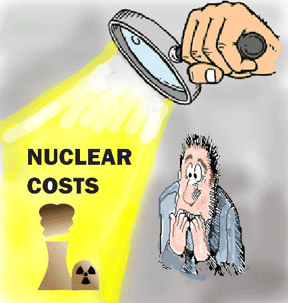 Engie will not acquire struggling French nuclear group Areva, Ft.com 21 May 15 Michael Stothard in Paris Engie would consider working with struggling French nuclear group Areva on some business lines but is not looking for any full-blown acquisitions to help rescue the company, according to the chief executive of the utility.
“If we consider something, it would be in co-operation with Areva, not simply an acquisition of some assets,” Gérard Mestrallet told the Financial Times on the sidelines of a business and climate change conference in Paris
The comments come as the French government looks to elicit the aid of French companies to help rescue Areva, which reported a €4.8bn loss last year.
Areva, which is 87 per cent government-owned, has fallen victim to a slump in global demand for new reactors that followed the 2011 Fukushima disaster in Japan, as well as crippling cost overruns at key projects…….
Any deal between Areva and Engie would be likely to come alongside a much larger agreement with EDF, which earlier this week outlined its preference for a broad rescue package to acquire Areva NP, the division that designs, manufactures and maintains nuclear reactors.
“The more ambitious proposal from EDF will preserve the technical expertise of Areva’s reactor business and create the possibility of partnerships with outside groups from France or elsewhere,” said Jean-Bernard Lévy, EDF’s chief executive.
The more ambitious proposal from EDF will preserve the technical expertise of Areva’s reactor business and create the possibility of partnerships with outside groups from France or elsewhere– Jean-Bernard Lévy, EDF’s chief executive
Another option on the table would see EDF, which is 85 per cent state-owned, simply recruit 1,200 Areva engineers who specialise in nuclear safety. This would require a greater injection of capital in the group from the government, however.
It is ultimately up to Paris to decide between these two options. A decision could come as early as June ……….3.http://www.ft.com/intl/cms/s/0/3d592a50-ffb8-11e4-8c46-00144feabdc0.html#axzz3aoqg2DDh
Finland pulls out of building Olkiluoto 4 nuclear reactor
Finland cancels – is the EPR finished?, The Ecologist, Dr Jim Green & Oliver Tickell 15 May 15
This week Finland cancelled its option for a second European Pressurised Reactor as the existing EPR project sinks into a abyss of cost over-runs, delays and litigation, writes Jim Green. It now looks like the EPR is a failed technology and its owner, French nuclear giant Areva, is fast running out of both money and orders as its ‘hot prospects’ evaporate.
There’s been plenty of bad news recently for the European Pressurised Reactor (EPR) nuclear power station design.
And now there’s more. The Finnish electricity company TVO announced this week that it had cancelled plans to build a second EPR at Olkiluoto in western Finland because of delays and problems with the first EPR on the site currently being built by Areva and Siemens.
That plant, Olkiluoto 3, is running severely over time and budget. Construction began in 2005 and it is not expected to commence operating until 2018, nine years late.
The estimated cost has risen from €3.2 billion (US$3.6b) to €8.5 billion (US$9.5b). Areva has already made provision for a €2.7 billion (US$3.0b) writedown on the project, with further losses expected. FTVO and Areva / Siemens are locked ina €10 billion legal battleover the cost overruns.
Finland’s government had given TVO a deadline of 30th June to request a building permit for its planned Olkiluoto 4 plant. TVO said it would not pursue the project due to “the delay of the start-up of Olkiluoto 3 plant unit.”
It added: “In this situation it is impossible to make significant Olkiluoto 4 related decisions necessary for the construction license application.” Continue reading
Gloomy financial situation for AREVA in so many ways
Despite the guaranteed increased purchase price for Hinkley Point C’s power, however, investors are not in a hurry to jump on board with a project where Areva will not just build the reactors but is also to bring in funding in the amount of 10% of the project’s total cost. The problem is that last fall, the company admitted it was having serious economic difficulties, which may cause it to fail to deliver on the financial commitments in the Hinkley Point C project.
Areva’s economic troubles have to do with another project the company is pursuing: the highly problematic reactor construction at a new site in Olkiluoto, Finland.
Survival of the fittest? World’s major nuclear builders are in for a long stretch in the red, Bellona, May 18, 2015 by Vladimir Slivyak, Translated by Maria Kaminskaya MOSCOW
“………..The project considered to be the flagship for the French nuclear industry in Europe is the nuclear power plant Hinkley Point C in Great Britain, estimated at €24 billion. The project envisions building two reactors of the EPR – for “European Pressurized Reactor” – design in Somerset, in England’s southwest. No new reactor construction was previously undertaken in Great Britain for a period of many years, and, on account of nuclear energy’s less than perfect reputation from the economic point of view, such a large-scale endeavor in a country with a market economy seemed quite unlikely.
Yet, the project received both the British government’s approval and state guarantees on a fixed purchase price for the power the future plant will be generating. A favorable determination on the project was eventually also handed down by the European Commission, which had been looking into the legality of the state guarantees provided to Hinkley Point C. What the grievances against the project boil down to is that purchase of power from Hinkley Point C at a guaranteed price – one that is substantially higher than today’s energy prices – has too close a semblance to state subsidies, and the latter is prohibited in the EU. This was the reason why far from all the European ministers voted in favor of the project, and litigation is still expected on the matter: Austria, which has voiced its disagreement with the European Commission’s decision, intends to challenge it in court.
Despite the guaranteed increased purchase price for Hinkley Point C’s power, however, investors are not in a hurry to jump on board with a project where Areva will not just build the reactors but is also to bring in funding in the amount of 10% of the project’s total cost. Continue reading
Safety problems may mean the end for AREVA’s EPR nuclear reactor
the International Energy Agency’s World Economic Outlook 2014 report:
- that nuclear growth will be “concentrated in markets where electricity is supplied at regulated prices, utilities have state backing or governments act to facilitate private investment”;
- and that “nuclear power faces major challenges in competitive markets where there are significant market and regulatory risks.”.
Finland cancels Olkiluoto 4 nuclear reactor – is the EPR finished?, The Ecologist, Dr Jim Green & Oliver Tickell 15 May 15 A negative learning curve on steroids
“……What to make of the EPR saga? First, Areva is backing the wrong horse – the outcome of current political debates will result in a declining role for nuclear power in France, coupled to the growth of renewables.
A new report by ADEME, a French government agency under the Ministries of Ecology and Research, concludes that a 100% renewable electricity supply scenario is feasible in France. The report estimates that the electricity production cost would be €119 per megawatt-hour in 2050 in the all-renewables scenario, compared with a near-identical figure of €117 / MWh with a mix of 50% nuclear, 40% renewables, and 10% fossil fuels.
Areva has also backed the wrong-sized wrong horse: a giant reactor with a giant price-tag. That said, the backers of ‘small modular reactors‘ are having no more success than Areva.
Areva has backed the wrong-sized wrong horse at the wrong time – the Global Financial Crisis and its aftermath, stagnant energy demand, the liberalization of energy markets, the political fallout from the Fukushima disaster and other factors have dampened demand for new reactors and made it more difficult to secure finance (or government subsidies) for huge projects.
The EPR saga undermines the rhetoric of standardised, simplified reactors designs ushering in a new era of nuclear growth. It also shows that developing modified versions of conventional reactors (in this case pressurised water reactors) can be complicated and protracted and can end in failure.
How much more difficult will it be to develop radically new types of reactors? The French government’s Institute for Radiological Protection and Nuclear Safety has recently produced an important critique of Generation IV nuclear power concepts.
It states that there “is still much R&D to be done to develop the Generation IV nuclear reactors” and it is sceptical about the safety claims made for Generation IV concepts.
The EPR saga shows that even countries with extensive nuclear expertise and experience can mess things up. The EPR might have demonstrated the potential for mass production to drive down costs – but in reality it is demonstrating the opposite.
Even before the EPR fiasco, the large-scale, standardised French nuclear power program was subject to a negative economic learning curve – costs were increasing over time. The EPR represents a negative learning curve on steroids.
That point is emphasised by construction cost estimates of £16-24.5 billion (US$24.3-37.2b; €21.7-33.2b) for two planned EPRs (with combined capacity of 3.2 gigawatts) at Hinkley Point in the UK. In the mid- to late-2000s, the estimated construction cost for an EPR was £2 billion; current estimates are 4-6 times higher.
Private companies have pulled out of EPR projects in several countries (Italy, the US, the UK, etc.). Thus the EPR fiasco reinforces points made in the International Energy Agency’s World Economic Outlook 2014 report:
- that nuclear growth will be “concentrated in markets where electricity is supplied at regulated prices, utilities have state backing or governments act to facilitate private investment”;
- and that “nuclear power faces major challenges in competitive markets where there are significant market and regulatory risks.”…..http://www.theecologist.org/News/news_analysis/2859924/finland_cancels_olkiluoto_4_nuclear_reactor_is_the_epr_finished.html
Crowdfunding and recuperation programs for Fukushima children
 Fukushima c’est eux Fukushima c’est nous
A group of parents who has been hosting children from Fukushima since summer 2012 are now organizing another round of crowd funding for summer 2015.
Details on their crown funding site.
http://fr.ulule.com/fukushima-nous/
Here is the information about the previous year’s achievement.
http://fr.ulule.com/fukushima/
JCSシドニーレインボープロジェクト JCS Sydney Rainbow Project
2015年夏、東北の震災孤児・遺児を10人、シドニーに保養に呼ぶ計画です
Summer camp 2015 for children who lost parents/family members
詳細はこちら For donation details https://readyfor.jp/projects/sydney
FUKUSHIMA KIDS DOLPHIN CAMP 2015 フクシマドルフィンキャンプ2015 御蔵島
“Dear eARThist family,
Oak to all relations Tokyo would like to present 2015 Fukushima Kids Dolphin Camp in Mikura Island this summer for children to release their stress from radiation fear caused by 2011 Tohoku earthquake and tsunami and give them an opportunity to play in the mother nature. And WE ARE COLLECTING DONATIONS!
See more at http://www.oak-to-all-relations.org/fukushima-kids-dolphin-camp2015/
Source: Save Children From Radiation
http://www.save-children-from-radiation.org/events/

France’s nuclear safety worries as fires break out close to 3 nuclear power plants
 French police investigate fires near three nuclear sites http://uk.reuters.com/article/2015/05/12/uk-france-nuclear-fires-idUKKBN0NX1HD20150512 PARIS French police are investigating fires that caused minor damage near three nuclear installations, state-owned utility EDF (EDF.PA) and atomic research agency CEA said on Tuesday.
Fires broke out on Monday morning at a weather station near EDF’s former Brennilis nuclear power station in Brittany and another near its Belleville nuclear plant on the Loire river, a spokeswoman said.
She said the fire had damaged equipment belonging to the IRSN nuclear research institute used to measure pollution and radioactivity at the weather stations, which are each about 1.5 kilometres away from the nuclear plants. “Police investigations are ongoing,” the EDF spokeswoman said.
Another fire was started on Monday evening at a weather station close to atomic research institute CEA’s Valduc site in Burgundy where nuclear weapons are manufactured and dismantled.
“There was the beginning of a fire, but it was quickly put out and there were no real consequences,” a CEA spokesman said, adding that a complaint had been filed with police.
The simultaneous incidents are reminiscent of drones that flew over French nuclear plants last year which raised safety concerns. [ID:nL5N0SR0DY] (Reporting by Michel Rose; editing by Jason Neely)
Canadian review board knocks back Areva’s planned uranium mine as uneconomic
Review board recommends against Areva Canada uranium mine http://ca.reuters.com/article/businessNews/idCAKBN0NW22H20150511 May 11, 201 By Rod Nickel WINNIPEG, Manitoba – A review board in the northern Canadian territory of Nunavut has recommended that Areva’s AREVA.PA planned uranium mine should not proceed, due to uncertainty about timing of the company’s plans to build the mine.
The Canadian Nuclear Safety Commission released the Nunavut Impact Review Board’s report on
Monday.The review board makes recommendations to Canadian federal ministers who are responsible for the decision.
Uranium prices have been weak since 2011’s Fukushima disaster in Japan, which caused that country to take its reactors off-line. The slump has led uranium producers to put some plans for new mines on hold.
The Nunavut review board considered the project’s social, economic and environmental impacts, but concluded that it could not adequately do this with no clear development schedule. The board said its recommendation, if adopted by Ottawa, does not mean that Areva could not apply again for approval.
Areva spokeswoman Veronique Loewen said the company was disappointed and is reviewing the report.The project involves two separate open-pit mine sites and a milling operation.
AREVA’s nuclear options narrow in attempt to save thecompany
Indebted French nuclear company Areva sacks workers, negotiates with Paris, Financial Review, 10 May 15 French nuclear group’s options narrow; Talks with EDF and state over costs of shake-up by Michael Stothard
French nuclear group Areva is to cut 6,000 jobs over three years – 14 per cent of its global workforce – as options for a government-backed rescue package begin to narrow.
Areva, which reported a €4.8bn loss last year, said it was also lowering wages for surviving staff in an attempt to deliver the bulk of a €1bn cost reduction target.
However, the state-controlled group, which has seen its equity capital fall to nearly zero after four years of losses, is continuing to negotiate a more radical restructuring plan with EDF and the French government.
People close to the discussions said that these talks now focus on just two remaining options, and a final decision will be made in the coming months.
This deal, which could be valued at as much as €3bn, would result in the break-up of Areva, a company once regarded as one of the crown jewels of France’s nuclear industry. But, at the same time, it would limit the amount of cash the state has to contribute to Areva in a capital raising, which is expected to accompany such a deal.
Under a second, simpler, option – which people close to the talks say is preferred by the managements of Areva and EDF – only the smaller engineering business of Areva would be sold to EDF.
This would keep Areva relatively intact. But with EDF paying only between €300m and €1bn, it would necessitate a much bigger capital contribution from the cash-strapped French government to Areva.
To help mitigate the cost to the state of any capital raising, Areva will consider approaching its existing Chinese partners, according to people familiar with the plans………http://www.afr.com/news/world/indebted-french-nuclear-company-areva-sacks-workers-negotiates-with-paris-20150510-ggy6b0
Areva’s nuclear fuel reprocessing plant in La Hague in crisis- shunned by clients
Crisis for Areva’s La Hague plant as clients shun nuclear, News Daily May 6, 2015 EMMANUEL JARRY FOR REUTERS BEAUMONT-HAGUE, France – Areva’s nuclear fuel reprocessing plant in La Hague needs to cut costs as its international customers disappear following the Fukushima disaster, and its sole remaining big customer, fellow state-owned French utility EDF, pressures it to cut prices.
Located at the westernmost tip of Normandy, La Hague reprocesses spent nuclear fuel for reuse in nuclear reactors and is a key part in Areva’s production chain, which spans uranium mining to fuel recycling.
Its valuation and outlook are crucial for the troubled French nuclear group, which is racing to find an equity parter after four years of losses have virtually wiped out its capital……….
One of the world’s biggest nuclear waste storage facilities, La Hague’s four pools hold the equivalent of about 50 reactor cores under four meters of water.
Protected by 1.5 meter thick anti-radiation concrete walls, employees in space suits cut up spent nuclear fuel rods, extract uranium and about one percent of plutonium, and melt the remaining waste into glass for eventual deep storage.
Areva says reprocessing reduces natural uranium needs by 25 percent but opponents say that separating plutonium from spent nuclear fuel increases the risk of nuclear proliferation.
The United States does not reprocess its nuclear fuel, but Britain has a large reprocessing plant in Sellafield. A planned recycling plant in Rokkasho, Japan – modeled on La Hague – has been plagued by problems and is years behind schedule.
Since the 2011 nuclear disaster in Fukushima, Areva’s reprocessing unit has lost nearly all of its international customers.
The company’s “back-end” sales – which include reprocessing, logistics and decommissioning – have fallen to 1.53 billion euros in 2014, 18 percent of Areva’s turnover, from 2 billion euros, 30 percent of nuclear revenue, in 2004.
EDF SQUEEZE
In the past decades, more than 32,000 tonnes of spent nuclear fuel has been reprocessed at La Hague, of which nearly 70 percent for EDF, 17 percent for German utilities, nine percent for Japanese utilities and the rest for Swiss, Belgian, Dutch and Italian clients.
This year, La Hague expects to treat 1,205 tonnes of spent fuel, of which just 25 tonnes will come from abroad. That leaves Areva with EDF virtually as its sole customer, and although both firms are state-owned – Areva 87 percent, EDF 85 percent – EDF has played hardball in contract negotiations.
La Hague extracts plutonium from used nuclear fuel, which it then sends to Areva’s Melox plant in southeast France, which produces MOX fuel – a mixture of plutonium and spent uranium – for 22 (soon 24) of EDF’s 58 reactors.
The arrival of new management at both companies since the start of the year has ended years of hostility between France’s two nuclear champions, but a 6.5 billion euro contract to treat and recycle 1,100 tonnes per year of EDF’s spent fuel for the 2013-2020 period has still not been signed…………http://newsdaily.com/2015/05/crisis-for-arevas-la-hague-plant-as-clients-shun-nuclear/
AREVA’s woes heralding a slippery global slope for the nuclear industry?
French Nuclear Dynamo Stalls, NYT, By DAVID JOLLY and STANLEY REEDMAY 7, 2015 PARIS — For decades, France has been a been a living laboratory for atomic energy, getting nearly three-quarters of its electricity from nuclear power — a higher proportion by far than in any other country.
But in the last few years, the French dynamo has started to stall. New plants that were meant to showcase the industry’s most advanced technology are years behind schedule and billions of euros over budget. Worse, recently discovered problems at one site have raised new doubts about when, or even if, they will be completed……..
Alarmed by the French industry’s problems, the Socialist government of President François Hollande is expected soon to announce an industry overhaul. As the majority owner of the country’s two main nuclear companies — the reactor maker Areva and the big utility operator Électricité de France — the government will aim not only to put the companies on a firmer financial footing but to reorganize them in hopes of restoring the French industry’s role-model luster.
On Thursday, Areva took the first of those steps by announcing big cost-cutting plans. The move is likely to trim as many as 6,000 jobs from the company’s global work force of 45,000 — as many of 4,000 of those coming in France……….
With the French companies struggling, some nuclear experts see a slippery geopolitical slope. Continue reading
6,000 employees of failing nuclear giant AREVA are to lose their jobs
French nuclear group Areva to cut up to 6,000 jobs worldwide, Yahoo 7 News May 8, 2015,
Paris (AFP) – French nuclear group Areva, which incurred massive losses last year, announced Thursday it would cut up to 6,000 jobs worldwide as it seeks to slash its costs by a billion euros by 2017. he number of job cuts will be between 5,000 and 6,000 worldwide, said the group’s human resources director Francois Nogue.Between 3,000 and 4,000 of the job losses will be in France.
Areva had earlier said it planned to reduce its labour costs by around 15 percent in France and 18 percent internationally.
The group’s labour costs currently come to between 3.5 billion and 4.0 billion euros — an unsustainable level given that revenues are only about twice that, said Nogue………….https://au.news.yahoo.com/a/27700325/french-nuclear-group-areva-to-cut-up-to-6-000-jobs-worldwide/
1 This Month



26 September – International Day for the Total Elimination of Nuclear Weapons


PLEASE OPPOSE HR 8255 AND S.3639 – bills would accelerate satellite deployment, with no environmental review or safeguards – https://ncstd5li.quorum.us/campaign/169331/
To see nuclear-related stories in greater depth and intensity – go to https://nuclearinformation.wordpress.com
-
Archives
- September 2026 (269)
- August 2026 (330)
- July 2026 (355)
- June 2026 (287)
- May 2026 (306)
- April 2026 (356)
- March 2026 (251)
- February 2026 (267)
- January 2026 (308)
- December 2025 (358)
- November 2025 (359)
- October 2025 (375)
-
Categories
- 1
- 1 NUCLEAR ISSUES
- business and costs
- climate change
- culture and arts
- ENERGY
- environment
- health
- history
- indigenous issues
- Legal
- marketing of nuclear
- media
- opposition to nuclear
- PERSONAL STORIES
- politics
- politics international
- Religion and ethics
- safety
- secrets,lies and civil liberties
- spinbuster
- technology
- Uranium
- wastes
- weapons and war
- Women
- 2 WORLD
- ACTION
- AFRICA
- Atrocities
- AUSTRALIA
- Christina's notes
- Christina's themes
- culture and arts
- Events
- Fuk 2022
- Fuk 2023
- Fukushima 2017
- Fukushima 2018
- fukushima 2019
- Fukushima 2020
- Fukushima 2021
- general
- global warming
- Humour (God we need it)
- Nuclear
- RARE EARTHS
- Reference
- resources – print
- Resources -audiovicual
- Weekly Newsletter
- World
- World Nuclear
- YouTube
-
RSS
Entries RSS
Comments RSS

