Global nuclear industry threatened as safety problems revealed at Flamanville reactor
Unfinished nuclear plants raise safety doubts. April 13, 2015 A new generation of giant reactors, meant to provide fresh hope for nuclear power in Europe, has been found to have a serious safety problem. By Paul Brown Climate News Network LONDON − The future of the world’s biggest nuclear reactor, under construction at Flamanville in northern France, is now in doubt after a serious flaw was found in its steel pressure vessel.
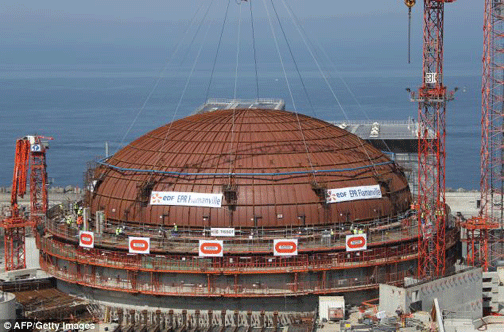
Examination has shown that the steel contains too much carbon, which can weaken the vessel’s structure and breaches safety rules. The Chinese, who have two similar 1,600 megawattEuropean Pressurised Reactors under construction, have been warned that they too may share the potentially catastrophic problem.
Investigations are continuing to check whether the problem can be rectified, but whatever happens it will add more delays and greater costs to the already troubled projects.
The problem also casts doubt on the much-heralded nuclear renaissance in Europe, where EPR reactors are being built not only in France but also in Finland.
Four more are planned for Britain, where they form a cornerstone of the UK government’s policy to fight climate change. A decision on whether to go ahead with the first two in the UK has already been postponed twice, and this revelation will cause further delays.
The French nuclear engineering firm Areva, involved in the EPR’s design and development, found the flawed steel and reported the problem to the country’s nuclear regulator, ASN, which has ordered an investigation. The French energy minister, Ségolène Royal, says the results of tests to check the extent of the problem will be released in October. Continue reading
100% renewable energy economically feasible for France: government report

 FRENCH FEDERAL GOVERNMENT REPORT: 100% RENEWABLE ELECTRICITY BY 2050 IN FRANCE WOULD NOT COST MORE THAN 50% NUCLEAR http://www.go100percent.org/cms/index.php?id=45&tx_ttnews%5Btt_news%5D=395&cHash=c49d899dffe50003b28e67bc8ffa6655The following is a brief summary of a piece that appeared in France’s center-left newspaper Le Monde, which reported on a piece published by Mediapart:
Ademe was reportedly to have shared the document with the public on April 14-15, but postponed it was not ready. However, a copy of the report was obtained by the French media and released to to the public, with the aim of raising the debate on French energy policy.
The 120 page report was written with the contribution of the General Direction of energy and climate, which functions under the French Minister of Ecology, and with “an objective of robustness and scientific solidity, the hypotheses and results were vetted by a scientific committee of national and international experts.”
Other highlights from the report, include:
– The potential for electricity generation by renewables in France by 2050 (1268 TWh a year) is triple the nation’s projected electricity demand for that time (422 TWh). Reaching this goal would require demand management that lowers consumption by 14%, despite a projected population increase of 6 million inhabitants.
– Achieving a 100% renewable electricity mix will require diversity of sources. The study projects a mix of 63% offshore and onshore wind, 17% solar, 13% hydro, and 7% thermal energy (including geothermal). The regions with the strongest renewable development potential are the Aquitane, Brittany, Midi-Pyrénées, the Pays de la Loire, Provence-Alpes-Côte d’Azur, and Rhône-Alpes.
– The report assumes that pre-tax consumer electricity costs will rise about 30% by mid century whether France opts for a 100% renewable power mix, or a combination of 50% nuclear power, 40% renewables, and 10% fossil fuel (primarily gas).
– Between 2019 and 2025, almost half of France’s 58 nuclear reactors will reach the 40 year lifespan for which they were designed. Even if they are granted a license extension, they must be replaced by newer technology that has continually been rising in price. Decommissioning of the reactors also adds to costs.
France’s nuclear corporation AREVA in deep financial trouble – needs tax-payer bailout
 Areva in Deep Financial Trouble, The Energy Collective, Dan YUrman 10 Mar 15 French government and investors ask whether it has hit bottom?
It is no secret that state-owned nuclear energy giant Areva has ten tons of financial debt on a five ton truck. After several years of smacking the bumper with a 2 x 4 to keep half of the IOUs in the air, the truck has hit a red light and all the weight of that debt has come down in one place and at one time. This week Areva’s senior leadership went public with the numbers and what they say is a path toward new earnings. Phillip Knoche, the new CEO of Areva, said, “We have to cut our costs and master difficult projects.”
Here’s the bad news
Areva is facing huge financial challenges with reported losses of {e}4.8 billion ($5.4 billion US) compared to a loss of just {e} 500 million last year. Sales were down in 2014 by 8% compared to 2013. The company wrote down assets by {e}1.5 billion, took a {e}1.1 billion charge on three nuclear projects, and wrote off another nearly {e}1billion in assets that it now believes are essentially worthless. They include a uranium mine bought by former CEO Anne Lauvergeon who’s expansionist strategy overextended the company in terms of its capital requirements.
The bad news isn’t over
This year the firm expects to see a further reduction in sales of at least 5% compared to 2014. The firm will sell off its unprofitable renewable energy business, and other assets, for {e}430 million. It will scale back other investments. Overall, debt has risen to {e}5.8 billion compared to a market cap of {e}3.6 billion. Essentially, the firm is underwater and needs a huge infusion of capital from the French government………
France struggles to save its financially strapped nuclear company AREVA
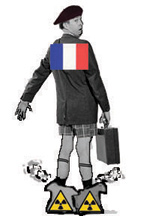 France Renews Push for Nuclear Shake Up Economy Minister Emmanuel Macron urges stronger cooperation between the state-controlled businesses. By INTI LANDAURO April 2, 2015 PARIS—The French government has turned up the heat on the country’s biggest nuclear-power companies to restructure the industry to help stem multibillion-euro losses at state-controlled equipment maker Areva SA.
Economy Minister Emmanuel Macron has asked Eléctricité de France SA–the operator of France’s fleet of nuclear power stations which provide most of the country’s electricity—to come to the rescue of Areva by deepening their industrial and possibly financial ties.
EDF and Areva, which are both majority-owned by the French state, have to cooperate better over the construction of  nuclear reactors and tendering for international business, Mr. Macron said on Thursday. He said that he has asked both companies to make proposals in the coming weeks………
Changing international attitudes to nuclear power, notably after the Fukushima disaster in Japan in 2011, have complicated the task for the French government by crimping demand for new business at Areva………
For now, Areva is working on a plan to sell assets, cut costs, reduce capital expenditure and start talks with unions over possible job cuts after posting a €4.8 billion ($5.4 billion) net loss in 2014, the fourth loss in as many years.
The company faces major hurdles with its contract to build a reactor in Finland, which has suffered a series of delays and cost overruns, and has also made a poor investment in uranium mining,……..http://www.wsj.com/articles/french-government-pushes-areva-edf-to-make-tie-up-proposal-1427961063
France’s nuclear industry now a liability, with AREVA’s down ward spiral
France’s Nuclear Decline Exposed as Areva Confronts Cash Crunch by Tara Patel, 27 Mar 15, (Bloomberg) — For decades France’s nuclear industry was seen as a source of economic strength, providing cheap power for factories, high-tech exports and tens of thousands of well-paid jobs. Today, it’s looking more like a liability.
Electricite de France SA, the world’s largest nuclear operator, must spend $63 billion over the next decade to keep the country’s aging fleet of 58 reactors running safely. More urgently, nuclear engineer Areva SA, touted as an export champion for a new atomic age, has lost billions from a project in Finland and investments in African uranium mines, raising the prospect of a state bailout…. The financial “sickness” at Areva could prove contagious to the whole nuclear industry, said Juan Camilo Rodriguez, an analyst at Alphavalue SAS…..
“The situation is difficult for Areva,” French Energy Minister Segolene Royal said Monday, just hours after the company shocked investors by saying losses for 2014 would be about 4.9 billion euros ($5.5 billion), more than its market capitalization……
Areva has been in a downward spiral since the meltdown at Fukushima’s atomic plant in Japan shook the global industry in 2011. The nuclear engineering company, which services existing reactors and supplies them with fuel, has lost about 75 percent of its value since as nations pulled back from atomic projects.
Last November, Areva’s credit rating was reduced to junk status by Standard & Poor’s after it abandoned financial targets. The company blamed its losses on construction of a new reactor on a Finnish island, delays in restarting Japanese plants and a worsening outlook for other export orders.
Before Fukushima, France’s atomic industry was readying for a nuclear energy renaissance. Former EDF Chief Executive Officer Pierre Gadonneix predicted France’s flagship reactor, the giant EPR model, would sell “like hotcakes” around the world.
Over Budget Fukushima ended the prospect of new reactors in many countries, including Italy and Switzerland, in addition to damping a number of potential export markets for Areva and EDF. Germany decided to shut all its nuclear reactors.
Not a single EPR has yet fired up as construction projects in France’s Normandy region as well as in Finland and China are behind schedule and mostly over budget…….
Against the backdrop of Areva’s financial uncertainty, a long-delayed law that would reduce France’s reliance on nuclear power is in the Senate. Prospects for Areva and EDF will be affected by the decision of lawmakers on whether to shut some reactors……http://www.bloomberg.com/news/articles/2015-02-27/france-s-nuclear-decline-exposed-as-areva-confronts-cash-crunch
Financially in trouble AREVA is nevertheless advising on marketing Small Modular Nuclear Reactors
 NuScale hires an energy giant to help get its nuclear plant certified Feb 17, 2015, Wendy Culverwell
Staff Reporter-Portland Business Journal Portland-based NuScale Power has entered an agreement with AREVA to support testing and design of its nuclear power system as it prepares to submit a Design Certification Application to the U.S. Nuclear Regulatory Agency….The agreement gives NuScale access to AREVA’s fuel technology as well as its nuclear testing capabilities…..
NuScale Power is developing a small, modular nuclear power system that is built under factory conditions and deployed to a client’s site….
It expects to submit the document by late 2016 and to secure approval in time for a 2020 commercial launch…..

Fluor Corp. (NYSE: FLR) is its majority investor.http://www.bizjournals.com/portland/blog/sbo/2015/02/nuscale-hires-an-energy-giant-to-help-get-its.htm
France’s law on green or solar roofs for new commercial buildings
FRENCH LAW TO REQUIRE GREEN ROOFS OR SOLAR PANELS ON NEW COMMERCIAL BUILDINGS, ecosalon, by Sara Novak on March 24, 2015 France just passed a new law that will require all new buildings in commercial zones to be covered with green roofs or solar panels.
Environmental groups hope to reduce the energy costs of commercial buildings while creating an urban jungle in the world’s most beloved city of progress…..The law will change the face of the urban landscape in France by promoting more urban greenery.

While solar panels have an obvious purpose, the benefits of green roofsare less well known. Not only do they beautify buildings and create space for community gardens, they have a number of other environmental benefits.
In the summer, green roofs retain 70 to 90 percent of precipitation and in the winter they retain 25 to 40 percent of precipitation. This reduces runoff and decreases the stress on sewer systems. The daily dew and evaporation cycle along with the light absorbed by vegetation, help to cool buildings down. Green roofs also reduce smog by slowing the distribution of dust and particulate matter……..
The combination of solar panels and green roofs create dual environmental tools. Both help reduce the power demands on the national grid, especially when temperatures peak in the summer time.
Green roofs are popular in Germany, Australia, and parts of Canada. Since 2009, Toronto has had a similar mandatory law for green roofs on commercial buildings. But they’re also gaining traction in the U.S. New York City leads the pack in green roofs and it’s home to the largest roof top garden in the country. James Farley Post Office is topped with a greening system that saves the massive post office $30,000 per year in energy costs. Chicago, Washington, D.C., and Portland are all home to a number of green roofs.http://ecosalon.com/french-law-to-require-green-roofs-or-solar-panels-on-new-commercial-buildings/
Wind turbines in tree shapes to be installed in Paris
TREE SHAPED WIND TURBINES TO BE INSTALLED IN PARIS A French company called New Wind is installing tree-shaped wind turbines at the Place de la Concorde in Paris, France. The company’s founder, Jérôme Michaud-Larivière came up with the idea while in a Paris square, when he “saw the leaves tremble when there was not a breath of air.” He hopes the trees can be used to exploit small air currents flowing along buildings and streets, and could eventually be installed in people’s yards and urban centres………http://www.alternative-energy-news.info/tree-shaped-wind-turbines-paris/
France brings in law ordering solar or plant rooftops for new commercial buildings
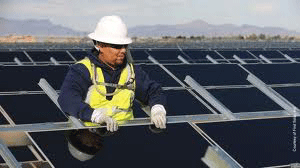 France Says New Roofs Must Be Covered In Plants Or Solar Panels http://thinkprogress.org/climate/2015/03/20/3636746/franch-rooftops-go-green/ BY ARI PHILLIPS MARCH 20, 2015
THE SKY’S THE LIMIT UNDER FRANCE’S NEW GREEN ROOFTOP LAW.According to a new French law approved on Thursday, rooftops on new buildings in commercial zones across France must either be partially covered in plants or solar panels.
Green roofs, which cover rooftop space with a layer of grasses, shrubs, flowers, and other forms of flora, offer a number of benefits. They create an insulating effect, reducing the amount of energy needed to heat or cool a building depending on the season. They increase local access to green space, which often comes at a premium in urban environments. They retain rainwater, thus decreasing runoff and any related drainage issues. They provide a space for urban wildlife, such as birds, to congregate and even nest, and they reduce air pollution by acting as natural filters.
Approved by French Parliament, the law was scaled back from initial proposals by environmental groups asking for green roofs to cover the entire rooftop surface of all new buildings. The compromise gave businesses a choice to install solar panels instead or to only cover part of the roof in foliage.
Even in a trimmed-down form, the law is trailblazing and will both change the urban landscape of cities across France as well as potentially inspire other countries to follow suit, especially with the United Nations’ climate summit coming to Paris at the end of the year.
France has lagged behind other major European countries like Germany, Italy and Spain in solar power development. As of last summer, France had just over five gigawatts of photovoltaic capacity, accounting for around one percent of total energy consumption. Germany has nearly 40 GWs installed. France is heavily reliable on nuclear power for its energy, and nuclear generation in 2012 made upabout 83 percent of the country’s total generation.
France’s nuclear company AREVA – too big to fail?
France’s nuclear love affair too strong to let Areva fail http://uk.reuters.com/article/2015/03/11/uk-france-nuclear-areva-idUKKBN0M71FF20150311 BY MICHEL ROSE AND GEERT DE CLERCQ PARIS (Reuters) – The future of France‘s nuclear industry has never looked bleaker, with a government pledging to wean the country off atomic power, cut-throat rivalry in world export markets and the debt of flagship nuclear group Areva in junk territory.
But even with a painful overhaul and lean years ahead for the nuclear sector, the fuel which after World War Two powered France’s rise to the Group of Seven nations remains the bedrock of its energy independence and is so strategically vital that Paris will not let Areva (AREVA.PA) fail.
That is the premise underpinning a new industrial strategy due to be announced by Areva and domestic utility EDF (EDF.PA) in coming months, while President Francois Hollande is softening his resolve to reduce the share of nuclear in France’s electricity mix.
“Neither the government nor EDF can afford to let Areva die,” said former Areva executive Bertrand Barre, who noted that U.S. nuclear giant Westinghouse suffered a 30-year order drought but survived – albeit as part of Japan‘s Toshiba. (6502.T)
Areva’s record 4.83 billion euro (3.4 billion pounds) 2014 loss underlined the troubles of a group which since its 2001 creation never managed to become a world leader in nuclear newbuild.
Over the last few years a series of shockwaves have jolted the case for nuclear: the 2011 Fukushima disaster; Germany‘s exit from nuclear; rising renewable energy output; and the U.S. shale gas revolution.
Already weakened by billions of euros lost on a fixed-price, turnkey reactor project in Finland and an African uranium mine, Areva had limited reserves to ride out the storm.
Hollande has charged Areva’s new management team, led by Philippe Varin, to work with EDF to come up with a new industrial and financial strategy by end July.
Details are scarce so far, but industry sources agree that one likely outcome is a deeper involvement of EDF, possibly a capital stake, in Areva’s reactor business and a possible sale of part of its uranium mines to Chinese investors.
Economy Minister Emmanuel Macron told Reuters on Monday the two firms could forge an industrial alliance and that EDF may consider a capital investment in Areva’s reactor business.
ROYAL “TURNAROUND”
At the same time, there has been a toning down of Hollande’s campaign promise to cut the share of nuclear power in France’s electricity generation from 75 percent to 50 percent by 2025.
“We never said we wanted to exit nuclear energy altogether. We want to exit the previous all-nuclear policy,” Energy Minister Segolene Royal said in January.
Despite repeated questions, including from Reuters, Royal has refused to commit to Hollande’s 2025 target, made during his election campaign, and has come out in support of building new nuclear plants to replace older ones, the first time for a member of this government.
It remains to be seen whether the target will survive Royal’s energy transition bill, which is currently going through parliament, but analysts notice a subtle shift.
Montpellier University professor Jacques Percebois said France realises that if it wants to sell reactors abroad, it needs to be careful about how it winds down nuclear at home.
“That is what is behind the turnaround that we are seeing now – including from Segolene Royal,” he said.
That turnaround would come at a political cost to Hollande, whom ecologists will accuse of breaking his promises. But with the Ukraine crisis pushing security of supply to the fore,France – which gets just 15 percent of its gas from Russia – suddenly feels quite comfortable about nuclear.
Even if it were to reach its 2025 target, France is so deep into nuclear that it is unlikely to want to spend much on German wind turbines or Chinese solar panels and will focus on saving the 220,000 jobs in its nuclear industry.
Half of EDF’s 58 reactors will reach their designed age limit of 40 years in the 2020s and the utility has estimated it will cost about 300 billion euros to modernise its fleet and replace it with new reactors from 2030 onwards.
AREVA’S FUTURE
This is a potential windfall for Areva, which will work on extending the lifespan of EDF’s nuclear fleet while it waits for France to start building new reactors again.
When it finishes the sole reactor it is building in France, Areva is expected to get a significant part of EDF’s 55 billion euro budget to extend the lifespan of its reactors.
It can also make money from countries getting out of nuclear altogether.
In Europe, where dozens of reactors will be dismantled in Germany, Britain, Belgium and other countries in the next decade, Areva is a top player in nuclear decommissioning, which already generates 500 million of its 8.3 billion euro revenue.
“Areva is well placed, as it is one of the few players with experience in decommissioning various types of nuclear installations, including reactors,” an Areva spokeswoman said.
The company has built nearly 100 reactors around the world, in France, Belgium, Germany, Switzerland, Spain and China and is servicing more than 250 of the 440 operating reactors worldwide.
More than half of these reactors are over 30 years old and 73 are more than 40 years old, IAEA data show.
“It’s a future engine of growth, even if it’s not revving up yet” said Jean-Marie Chevalier, a energy economics professor at Dauphine University in Paris.
(Editing by Mark John and Anna Willard)
AREVA lost $5.6 billion in 2014, ( total market capitalization of $3.5 billion!)
 France’s Areva Lost $5.6 Billion In 2014 – Is This The End? http://oilprice.com/Alternative-Energy/Nuclear-Power/Frances-Areva-Lost-5.6-Billion-In-2014-Is-This-The-End.html By Nick Cunningham, 08 March 2015
Could France, a heavyweight in nuclear power, begin to see its position crumble?
Areva, France’s iconic nuclear power builder, reported a massive financial loss for 2014. The state-owned company revealed that it lost 4.9 billion euros ($5.6 billion) in 2014, an enormous decline from the 500 million euro loss it posted the previous year.
Weighing on the company is its much-heralded rector in Finland. The Olkiluoto 3 unit under construction in Finland was supposed to be completed in 2009, but it has since turned into a nightmare. Billed as the first Generation III+ pressurized water reactor – dubbed the Evolutionary Power Reactor (EPR) by Areva – the project was intended to demonstrate nuclear technology that had advanced well beyond the designs seen in today’s operational power plants, which were built in the 1970’s. Now expected to be completed in 2018, the decade of delay coulddouble the reactor’s eventual total cost.
Also, Areva is building another reactor in Normandy that has suffered a similar fate. The Flamanville 3 is several years behind schedule – it may not come into operation until 2016 or 2017 after an original start date of 2012. That reactor, which will be operated by fellow state-owned nuclear operator EDF, has also seen its costs skyrocket because of the delays.
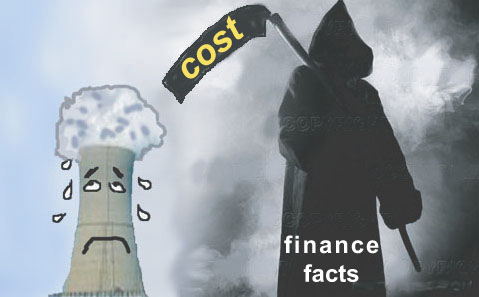
While Areva’s $5.6 billion loss may be shocking at first glance, it looks even worse when compared to the company’s total market capitalization of $3.5 billion. In other words, Areva lost more money in 2014 than the company is worth in its entirety. Despite what appears to be an obvious need for injection of cash to keep the company afloat, France’s energy minister Segolene Royal said that it is “too early” to discuss such a measure, although she added that “all solutions are being looked at.”
The delays from multiple projects have one thing in common – they are using Areva’s EPR design, which has proven to be far more complex than anticipated. That raises serious questions about Areva’s future as a leading nuclear power company. “The EPR is a rotten design that they should have given up on a long time ago,” Steve Thomas, a professor at the University of Greenwich in Britain, told the New York Times last year. Areva’s share price has plummeted over the last year as it became clear the company was quickly burning through cash.
Compounding Areva’s problems is the fact that the west is no longer building nuclear reactors, aside from a few projects in the U.S. Even worse, France, which is the second largest generator of nuclear power in the world (and the leader in terms of percentage of total electricity from nuclear power), is considering a transition away from nuclear power.
French President Francois Hollande has pledge to cut France’s reliance on nuclear power by one-third by 2025. That is easier said than done for a nation that gets 75 percent of its electricity from nuclear. The French National Assembly approved a bill late last year that would slash nuclear’s share down to 50 percent over the next decade, but the Senate is trying to water down the bill. While the outcome is uncertain, what is clear is the fact that France – a global champion in nuclear power – is set to shrink its nuclear energy sector.
To make matters worse, a few safety issues have cropped up in recent weeks that could amount to a significant blow for nuclear power in Europe. A leak at the Fessenheim plant on the border with Germany and Switzerland was discovered in late February, forcing the plant’s temporary closure. This is the same plant that President Hollande specifically pledged to close during his 2012 presidential campaign.
And in neighboring Belgium, cracks have formed in the walls of the pressure vessels at several plants, raising alarm about their safety. The cracks at Belgium’s Doel 3 and Tihange 2 point to a potentially larger problem. Experts fear “material fatigue,” the possibility that radiation is wearing down the materials much quicker than expected. Such a development, if true, “could be a problem for the entire global nuclear industry,” said Jan Bens, general director of the Belgian Federal Agency for Nuclear Control (FANC), according to Deutsche Welle.
Aging European nuclear power plants, potentially presenting serious safety concerns, could well be slated for closure in the coming years. With France’s nuclear champion, Areva, unable to build suitable replacements, France is quickly seeing its position as a global leader in nuclear power slip.
Nuclear developments on hold, as Areva asks NRC to suspend nuclear reactor design review
Areva asks NRC to suspend nuclear reactor design review http://www.power-eng.com/articles/2015/03/areva-asks-nrc-to-suspend-nuclear-reactor-design-review.html 03/06/2015 Areva Inc. has asked the U.S. Nuclear Regulatory Commission (NRC) to suspend its design certification review of Areva’s European Pressurized Reactor (EPR).
The announcement also puts on hold plans for the Calvert Cliffs 3 nuclear unit in Maryland, which was going to use the EPR reactor design. Unistar Nuclear Energy also asked the NRC to suspend review of its combined operating license application just days after Areva’s request.
The U.S. EPR is based on the EPR reactor currently under construction in France and Finland and planned for construction at Hinkley Point C in the UK, the article said.
Eiffel Tower embraces wind power
One of the world’s most iconic sites has become the latest high profile venue to embrace renewable energy, after the installation of two vertical axis wind turbines as part of the Eiffel tower’s high profile renovation project….
http://www.dailyclimate.org/t/7001469699682004860
Warning to France on drones- an easy way to destabilise nuclear reactors
 Most French Nuclear Plants ‘Should Be Shut Down’ Over Drone Threat,NewsWeek BY CATHERINE PHILLIPS AND CONOR GAFFEY / FEBRUARY 24, 2015 “You don’t need massive amounts of force to allow a nuclear plant to go into instability. The plant has enough energy to destroy itself. Drones can be used to tickle the plant into instability.”
With devastating simplicity, John Large explains how drones could be used to coordinate a terror attack on a nuclear power station. First, one drone hits the distribution grid serving the plant, depriving the facility of off-site power, making it dependent on its diesel generators to cool the reactor, which generates up to 1,000 megawatts of power – enough to light up half of Paris. Then the generators are easily taken out by an unmanned drone with a relatively small payload. Without power to cool the radioactive fuel, Large estimates it would take approximately 30 seconds before the fuel begins to melt, leading to potential leakages of nuclear waste.
It’s the same cause behind the meltdown at the Fukushima nuclear plant in Japan after it was hit by a tsunami in March 2011. But potential terrorists wouldn’t need to trigger an earthquake, just be able to accurately pilot a pair of readily-available commercial drones carrying small payloads of explosive. Last year, unmanned drones were spotted flying over at least 13 nuclear power stations in France. The last widely-reported sighting was on 3 January, when two aircraft were seen flying over a nuclear facility in Nogent-sur-Seine, in northern-central France.
Activists maintain that a government blackout has blocked information on any further sightings. Curiously, no pictures of drone sightings near power stations have surfaced, a fact that causes concern amongst experts.
“There’s not one single picture. That’s very troubling,” says Jean-Luc Fornier, whose company designs and operates drones for use in the media industry. “If we had some pictures, we could decide on who may be operating the machines.” Fornier suggests that the flyovers that have been noted have three possible explanations: innocent pranksters, anti-nuclear protestors, or trial runs by terrorists. French National Research Agency said the General Secretary for Defence is “providing €1m of funding for research projects into the detection, identification and neutralisation of small aerial drones”.
According to Large, of consulting engineers Large & Associates, based in London, who was commissioned by Greenpeace France to evaluate and report on the spate of flyovers, the “unacceptable” risk posed by a terrorist drone attack means that many of Europe’s nuclear power stations – including the majority of those in France – should be shut down……..
Rousselet says the government is downplaying the threat. He says Greenpeace became aware of a further flyover sighting on 28 January before a government blackout blocked further reports. For Large, the threat remains: “The problem is that these nuclear plants are very attractive targets as the public’s perception of all things nuclear is a fate worse than death. There’s a psychological attraction for these plants as targets as they can cause mass concern among the public.” http://www.newsweek.com/2015/03/06/most-french-nuclear-plants-should-be-shut-down-over-drone-threat-309019.html
Trouble in nuclear France: AREVA and EDF in financial distress
France Warns of Nuclear Industry Shake-Up After Areva Loss NYT, By DAVID JOLLY and STANLEY REEDFEB. 23, 2015 PARIS — France’s energy minister said on Monday that an overhaul of the country’s state-controlled nuclear energy industry was imminent, after one of the country’s main builders of nuclear power plants warned of a loss that could hamper its ability to continue operating independently……
EDF has been facing its own problems, including lengthy delays and steep cost overruns on a flagship plant that it is building at Flamanville, in the northwest of the country. There are also uncertainties about whether a showcase project in Britain will proceed — one in which both EDF and Areva would participate.
The French nuclear industry’s travails underline the gloomy state of the nuclear industry since the Fukushima disaster in Japan in 2011. Moreover, the French industry, though long a world leader, has in recent years been threatened by its own mistakes……..
The loss that Areva warned of on Monday would be substantially larger than its stock-market value of about €3.7 billion, suggesting that the troubled company, plagued by cost overruns and write-downs, may need new funds to continue operating. Areva’s capabilities are vital to France’s ambitions to remain a world provider of nuclear plants and services like supplying fuel.
With few new nuclear plants being planned to replace the older ones that are being phased out in the West, “Europe will see a gradual decline in nuclear’s share of electricity supply,” said Antony Froggatt, an analyst at Chatham House, a London-based research organization…….
Areva shares closed down 2.1 percent in Paris trading on Monday.
The company, which is based in Paris, had previously warned that it was facing trouble; it said in November that it was suspending its financial guidance for 2015 and 2016. Standard & Poor’s cut the company’s debt rating to junk soon after that, citing the company’s “limited headroom.”http://www.nytimes.com/2015/02/24/business/international/areva-nuclear-results.html?_r=0
1 This Month

of the week – Shut Down Drone Warfare!


Tell the Ukrainian Government to Drop Prosecution of Peace Activist Yurii Sheliazhenko

Petition to revoke the licensing of the Near Surface Nuclear Disposal Facility (NSDF) at Chalk River. https://www.ourcommons.ca/petitions/en/Petition/Details?Petition=e-7247
To see nuclear-related stories in greater depth and intensity – go to https://nuclearinformation.wordpress.com
-
Archives
- April 2026 (114)
- March 2026 (251)
- February 2026 (268)
- January 2026 (308)
- December 2025 (358)
- November 2025 (359)
- October 2025 (376)
- September 2025 (257)
- August 2025 (319)
- July 2025 (230)
- June 2025 (348)
- May 2025 (261)
-
Categories
- 1
- 1 NUCLEAR ISSUES
- business and costs
- climate change
- culture and arts
- ENERGY
- environment
- health
- history
- indigenous issues
- Legal
- marketing of nuclear
- media
- opposition to nuclear
- PERSONAL STORIES
- politics
- politics international
- Religion and ethics
- safety
- secrets,lies and civil liberties
- spinbuster
- technology
- Uranium
- wastes
- weapons and war
- Women
- 2 WORLD
- ACTION
- AFRICA
- Atrocities
- AUSTRALIA
- Christina's notes
- Christina's themes
- culture and arts
- Events
- Fuk 2022
- Fuk 2023
- Fukushima 2017
- Fukushima 2018
- fukushima 2019
- Fukushima 2020
- Fukushima 2021
- general
- global warming
- Humour (God we need it)
- Nuclear
- RARE EARTHS
- Reference
- resources – print
- Resources -audiovicual
- Weekly Newsletter
- World
- World Nuclear
- YouTube
-
RSS
Entries RSS
Comments RSS
 nuclear-news