IndependentWHO: The Hippocratic Vigil

The Hippocratic Vigil
The aim of the silent vigil is to remind the World Health Organisation of its duties. It was Hippocrates who formulated the ethical rules for health practitioners. The World Health Organisation ignores these rules, when it comes to protecting the health of the victims of the consequences of the nuclear industry.
Since the 26th April 2007, the Hippocratic Vigil has been held in front of the WHO headquarters in Geneva. It has been maintained, each working day between 8am and 6pm, to remind this United Nations body of its duties as they are defined in its Constitution.
Placards display the messages that the Vigil seeks to convey to WHO


Up to now, 300 people have participated in the Vigil in front of the WHO headquarters. They come from several European countries, as well as some from America. About 40 of them are either Swiss or French living within a radius of about 50km from Geneva. These are the people who relieve others for lunch breaks or for “anti-freeze” breaks in the middle of winter. We are able to call upon a group of “stalwarts” in unforeseen circumstances, such as health problems, last-minutes cancellations.
The vigil is maintained by individuals on their own or in groups up to a maximum of three. People sign up for half a day, a full day, a few days or the whole week. Those who come to do the Vigil are offered accommodation by a network of “hosts” (numbering 20). The people taking part in the vigil have to pay for their travel to Geneva and for their food themselves.
For additional information, or to sign up for the vigil, write to Paul Roullaud
paul.roullaud@independentwho.org
or telephone him on +33 (0)240 87 60 47
Source : Independent WHO
http://independentwho.org/en/hippocratic-vigil/
French govt uses amendment to impose nuclear waste dump without parliament vote
The CIGEO project, managed by l’Agence nationale pour la gestion des déchets radioactifs (ANDRA), aims to bury nuclear waste 500 meters under the village of Bure. The wastes consist of 80,000 cubic meters of high-level, long-lived waste produced by French nuclear facilities. The project was estimated to cost 16.5 billion euros in 2005, but an estimate done in 2009 set the figure at 36 billion euros. The final cost is unknowable. For several years, anti-nuclear activists and residents have opposed what they call a “nuclear garbage dump.”
So how did nuclear waste find its way into a bill with 400 articles related to economic growth?

 Executive Privilege Invoked for Approving French Nuclear Waste Site http://nf2045.blogspot.jp/2015/09/executive-privilege-invoked-for.html
For many years, the French nuclear establishment has been struggling to overcome public opposition and legislative obstacles to its plans to bury high-level, long-lived nuclear waste in the rural village of Bure. During the summer of 2015, the socialist government of Francois Hollande took the desperate measure of tacking the issue onto an omnibus bill called the loi Macron, which is supposed to be concerned only with growth, equality and economic opportunity.
Just about anything could be subjectively judged to promote economic growth, so the government took an expansive view and included whatever it wanted under a very flexible definition of matters which favor “growth, equality and economic opportunity.” Once the nuclear waste project was in the Macron Bill, the government then took advantage of an executive privilege called Article 49.3.
About Article 49.3 Continue reading
France heading towards a nuclear industry phaseout?
 France tilting toward nuclear phase-out, DW 10 Sep 15 As the traditionally strong French nuclear power industry continues to be plagued by technical and financial difficulties, the government has sought to cut nuclear power in favor of renewables. French Environment Minister Segolene Royal sparked rebuke Tuesday (08.09.2015) by tying shutdown of the country’s oldest nuclear plant to the opening of an EPR reactor that has been delayed for six years already………last year, Areva recorded a loss of 5 billion euros. The group hasn’t sold a single power plant in the last seven years, and the Fukushima disaster looks to have had further impacts on demand for new reactors.
Third-generation nuclear reactors – so-called European Pressurized Reactors (EPR) – were initially considered a secure technology for the future and the flagship of the French nuclear industry. But even they have been fraught with problems.
Despite Royal’s recent statement, recently passed legislation on renewable energy in France may be the most telling sign that the winds of change appear to be blowing – toward a nuclear phase-out.
Technology of the future turns sour
Operational start of the Olkiluoto 3 EPR in Finland has been delayed from 2009 to 2018, and the Flamanville 3 reactor in France from 2012 to 2018. Construction costs for Flamanville 3 have exploded, from 3.3 to more than 10 billion euros. Two EPR reactors at the Hinkley Point nuclear facility in England have also been the focus of controversy, as construction costs are much higher than initially projected. Financing for completing the project has still not been secured.
There is also the prospect of major safety issues. In mid-April it became known that there were weak points in the steel vessel that surrounds the reactor at the French Flamanville plant, which could lead to cracking under pressure.
The French Nuclear Safety Agency (ASN) called the situation “very serious,” and has demanded a comprehensive report by October.
If the regulating authority judges the vessel unsafe, it would be a disaster for Areva. Replacing it would take several years and result in additional costs in the hundreds of millions of euros, experts say.
Yannick Rousselet, a nuclear energy expert at Greenpeace, says further delays would deal a death blow to the EPR project. Aside from the two European reactors, no EPR installation has been successfully completed – there are just two projects in China.
“Only a few years ago, Areva told us that worldwide it would be finalizing two to three reactors per year,” Rousselet said. “The reality today is that the EPR as an industrial project is dead.”
EDF steps in to save AREVA. The French state owns 86.5 percent of Areva and 84.5 percent of EPR, which is the world’s second-largest electricity provider and a major nuclear power producer.
In an emergency meeting with President Francois Holland in June, it was agreed that EDF should buy in to Areva’s reactor business.
“Without these measures, Areva wouldn’t survive the year,” said Mycle Schneider, editor of the World Nuclear Industry status report.
And according to Schneider, help for Areva doesn’t spell an end French nuclear power’s problems.
EDF is considerably larger than Areva, and has an annual turnover of 70 billion euros. But Schneider points out its also has 37.5 billion euros of debt. Schneider sees this mountain of debt as a central problem.
According to the Paris audit office, the company faces an additional 50 billion euros in costs for dismantling and disposal of nuclear waste.
From nuclear to renewables?
As nuclear energy faces these problems, winds of change appear to be blowing through the French energy system.
Marc Bussieras, head of EDF’s economic strategy department, is open to energy production without nuclear. EDF’s priority is a cost-effective strategy, he told DW.
“Today in France, there are economic reasons in favor of installing renewable energy capacity,” Bussieras said.
Marc Bussieras, head of strategy at EDF, said at a DW panel renewables make economic sense
The French government is seeking to promote an energy transition through new legislation, which is also hoped to create jobs. The law, adopted in July 2015, states that the share of nuclear power in France’s energy mix should be reduced from 75 percent today to 50 percent by 2025. The shortfall in power supply should primarily be covered by wind and solar.
According to a study commissioned by the national environmental agency (ADEME), a complete phase-out of nuclear power and switch to 100 percent renewable energy should be possibly – and economically viable – by 2050…….
Schneider sees other opportunities for the nuclear industry. “The future lies in the huge market for demolition and nuclear waste management,” Schneider said. “New constructions will remain the exception.” http://www.dw.com/en/france-tilting-toward-nuclear-phase-out/a-18692209
European Pressurised nuclear Reactor (EPR) – litany of delays and cost overruns
French EPR reactor years behind schedule, billions over budget http://economictimes.indiatimes.com/news/international/business/french-epr-reactor-years-behind-schedule-billions-over-budget/articleshow/48785708.cms By Reuters | 3 Sep, 2015, PARIS: French state-controlled utility EDF on Thursday announced new delays and cost overruns for the Areva-designed 1650 megawatt European pressurised reactor (EPR) reactor it is building in Flamanville, Normandy.

The EPR is set to be the first of a new series of safer “next-generation” reactors to replace France’s ageing fleet of 58 nuclear reactors. The Flamanville reactor had been scheduled to start in 2012 and was scheduled to cost 3 billion euros.
A similar EPR reactor built by ArevaBSE 1.16 % in Finland, on which construction started in 2005 and was scheduled to start up in 2009, has suffered even longer delays. Two more EPRs are under construction in China and EDF plans to build two in Hinkley Point, Britain.
Below is a timeline of the Flamanville delays and cost overruns:
July 2005: EDF says it plans to build an EPR reactor at Flamanville, which is due to start operating in 2012. The cost is estimated at 3 billion euros.
In its 2005 annual report, EDF estimates the cost at 3.3 billion euros.
May 2006: EDF says construction should begin in 2007 and be completed in 2012.
December 2007: Work starts on the Flamanville ..
December 2008: EDF says EPR is due to cost 4 billion euros.
July 2010: EDF says start of Flamanville EPR is delayed until 2014. Construction costs now seen at 5 billion euros.
July 2011: EDF delays the completion of its Flamanville reactor by another two years to 2016. It expects costs to rise to 6 billion euros.
December 2012December 2012: EDF says stricter regulation in the wake of the Fukushima disaster will bring the total cost of the EPR to 8.5 billion euros. The start-up date is still expected for 2016.
July 2013: EDF installs the dome of Flamanville reactor.
November 2014: EDF said the Flamanville reactor will start up in 2017. It says the delay is due to Areva’s difficulties with ensuring a timely delivery of certain pieces of equipment.
April 2015: EDF says weak spots have been found in the steel of the Flamanville EPR. EDF starts a series of new tests on the EPR as construction work continues. Nuclear regulator says carbon concentrations have weakened the mechanical resilience of the steel and its ability to resist the spreading of cracks.September 3 2015: EDF said the Flamanville reactor will now start in 2018 and cost 10.5 billion euros.
France’s new nuclear power – not successful at home, so they might try to sell it off to Czech Republic
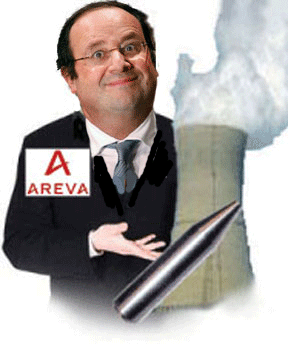 French foreign minister: EDF to consider participating in building new Czech nuclear reactors US News 23 Aug 15 PRAGUE (AP) — French Foreign Minister Laurent Fabius says his country’s company will consider participating in developing the Czech Republic’s nuclear program.
The Czech government has recently approved a long-term plan to increase the country’s nuclear power production. As part of the plan, the government wants to build one more reactor at the Temelin nuclear plant and another at the Dukovany plant, with an option to build yet another reactor at each plant…..Speaking to reporters after meeting Czech counterpart Lubomir Zaoralek on Sunday, Fabius said it will be state-controlled utility Electricite de France that will be part of a public tender to build the reactors. http://www.usnews.com/news/business/articles/2015/08/23/france-to-consider-helping-czech-nuclear-program
Local anxieties in Germany, over French nuclear waste plan
 French nuclear waste plan irks Germans near site, DW, 4 Aug 15 France wants to build a permanent nuclear waste storage facility not far from the German border. The plan has irked many in the region, but the government in Berlin sees no need for action.
Nuclear power plants produce radioactive waste, which emits radiation for thousands of years. Even Germany, which is set to phase out nuclear power, is looking for a final repository for its spent nuclear fuel, but has not yet decided on the location. Finding a geologically suitable site is not the problem, but rather, the protests over the location. Nobody wants to live with a nuclear waste dump at their doorstep.
For many decades, France has focused and relied on nuclear power, and now, plant operators are under pressure to find repositories for the radioactive waste.
The French government seems to have its sights set on Bure, a town in eastern France, around 120 kilometers (74 miles) from the German border. There, scientists have spent years investigating whether highly and moderately radioactive waste can be disposed of 500 meters underground. ANDRA, the French national agency for radioactive waste, believes that Bure offers what a repository requires: Nuclear waste can be stored there for 100 years; then, the site can be closed off and ultimately, the nuclear waste can decay there for 100,000 years until the radiation no longer poses a threat to humans.
‘Unbearable coup’
Opponents of the site feel less bothered by the repository itself then by the decision-making process that led to choosing it. In mid-July, the government added a last minute clause to a legislative package promoting business development but did not hold a debate or vote in parliament. And since no other potential nuclear waste sites have been explored in France, critics believe that the Bure location was practically predetermined. The Green party group in the French national assembly calls the procedure an “unbearable coup,” while the nation’s nuclear regulatory body and the French Institute for Radiological Protection and Reactor Safety (IRSN) have expressed “numerous reservations” about the plans………http://www.dw.com/en/french-nuclear-waste-plan-irks-germans-near-site/a-18627896
The end of the line for AREVA’s model of “birth to grave” nuclear processes
 As losses mounted, so did Areva’s debt, which reached six billion euros at the end of the first half of 2015.
The sale of the nuclear reactor unit to EDF marks the end of Areva’s formerly profitable full-service model, which offered clients all aspects of development ranging from conception and construction to fuel procurement and waste treatment.
France sells major nuclear stake http://www.iol.co.za/business/international/france-sells-major-nuclear-stake-1.1893029#.VbqVMvOqpHw July 30 2015 Paris – Atomic energy giant Areva on Thursday agreed to sell a majority stake of its nuclear reactor unit to electricity group EDF as part of a shake-up of the French sector. Continue reading
€7bn needed to keep loss-making nuclear company AREVA alive
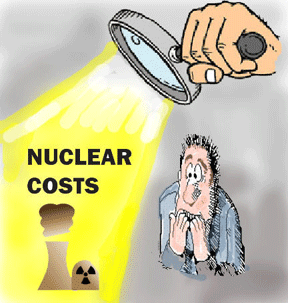 Lossmaking Areva needs €7bn capital injection, Ft.com Michael Stothard in Paris, 30 July 15 Struggling French nuclear group Areva on Thursday disclosed it needed a bigger than expected capital injection worth €7bn as the company also unveiled a far-reaching agreement with EDF on asset disposals and other projects.
The two companies — both state-controlled — agreed in principle that EDF will pay €2bn for a 75 per cent stake in Areva’s reactor unit, called Areva NP, in a radical reshaping of the French nuclear industry that has come after months of tense negotiations……..
Following the deal, Areva, which reported a €4.8bn net loss last year, will be reduced to a nuclear fuel company that mines, enriches and then disposes of uranium. The heart of the company — designing, building and servicing nuclear reactors — is being sold off.
Areva said that overall it would need €7bn in capital over the next two years, however, meaning that as much as €5bn will be required from sources other than EDF, the French utility group. Much of these additional funds are likely to come from a government-backed capital raising.
The French government may have to contribute between €4bn and €5bn, far more than the €2bn to €3bn that ministers had hoped for just a few months ago, according to people familiar with the situation, although the exact level of the capital raising was not announced on Thursday.
Areva said it could secure €0.4bn from selling some other assets including Canberra, its nuclear measurements subsidiary, and as much as €1.2bn from other sources of equity financing. This suggested a government-backed capital raising that might be closer to €4bn.
On Thursday the two companies also said they would set up a dedicated company to be 80 per cent owned by EDF and 20 per cent by Areva NP, aimed at improving the design and management of brand new reactors projects.
One of the problems that has weighed on Areva in recent years has been cost overruns at key projects, particularly the Olkiluoto 3 reactor in Finland, which is 10 years behind schedule and prompted the company to take €3.9bn in impairment charges………..http://www.ft.com/cms/s/0/110c0476-368c-11e5-b05b-b01debd57852.html#axzz3hPaCUU5g
France moves towards renewable energy, while government still shelling out $billions to save AREVA
France‘s decision to reduce dependence on nuclear power will not go down well with the already struggling nuclear industry, which includes French players like Areva, EDF and GDF Suez. Areva, the world’s largest nuclear company, reported a loss of $4.8 billion in 2014 after it started facing a dip in demand following the 2011 Fukushima disaster.
Areva is one of the most prominent companies in France, so the French government has been trying hard to save the company through a proposed deal with EDF, which involves selling off its reactor and fuel treatment business. According to recent reports, the French government could end up shelling out $5.5 billion to rescue Areva, far more than anticipated.
Is France Ready To Move Away From Nuclear Energy? http://oilprice.com/Alternative-Energy/Nuclear-Power/Is-France-Ready-To-Move-Away-From-Nuclear-Energy.html By Gaurav Agnihotri 30 July 2015 | 0
But unlike the U.S., nuclear energy represents France’s largest source of electricity generation, accounting for around 77 percent of the country’s energy generation in 2014. However, in the last few years, France has witnessed growing public support in favor of developing newer technologies that can reduce carbon emissions and replace nuclear power.
In the year 2012, France’s newly elected President Francois Hollande pledged to reduce his country’s dependence on nuclear power to 50 percent by 2025. This triggered a ‘national debate for energy transition’ in France which lasted for eight months. The National Assembly of France then passed an Energy Transition for Green Growth bill in 2014 which would put a cap on the country’s nuclear power capacity at the current level of 63.2 gigawatts.
Last week saw French Lawmakers finally pass this bill which seeks to cut the country’s growing dependence on nuclear power. With the move, France is following Germany, which decided to significantly reduce its dependence on nuclear energy after the infamous 2011- Fukushima nuclear disaster in Japan.
In order to meet this tough new target, Electricite De France or EDF (which is 85 percent government-owned) would have no other option but to close some of its nuclear power capacity in order to accommodate its new European Pressurized Reactor (EPR), which is currently under construction in Normandy.
The new law further requires France to increase the contribution of renewables in its total energy consumption to 32 percent by 2030. This is in addition to reducing the C02 emissions by 40 percent by 2030 when compared to 1990 levels and also reduce conventional fossil fuel consumption by 30 percent by 2030 from 2012 levels.
Although the law has made it quite clear that France now has to reduce its dependence on nuclear power, there are still several loopholes. as it hasn’t provided a clear manner in which the set target is supposed to be met and there is no specific implementation strategy put in place yet. “This law sets goals, which is interesting, but it doesn’t explain how to reach them, postponement of the detailed implementation plans is not a good sign,” said Yannick Rousselet of Greenpeace.
“I want France to become a nation of environmental excellence,” said French environmental minister Segolene Royal. She further said that recent steps taken by the French government could create close to 100,000 jobs in the renewable sector.
As the new law has also set a goal of increasing overall renewable energy consumption while also curtailing nuclear power, we can expect some major foreign investments in the French clean energy sector in the coming few years. French energy giant Total has in fact been investing a substantial amount in the solar sector. With its partnership with U.S. based Sunpower, Total might just ramp up its investments in the French solar sector.
It is interesting to note that wind energy also enjoys local public support in France as a 2014-CSA survey revealed that around 64 percent of local people see wind energy as a worthy replacement for nuclear power. According to the European Wind Energy Association, France increased its target for energy generation from wind to 19 gigawatts by 2020 from 8.2 gigawatts in 2014.
France is also the second largest producer of biofuels in Europe after Germany, mostly producing biodiesel. France has already set a goal of blending 10 percent of biofuels with its conventional fuels by 2020. So, with the current push towards renewables one can reasonably expect a surge in biofuel investments as well.
However, the same cannot be said for natural gas, as France is one of the four countries that have banned hydraulic fracturing or fracking. Experts predict that the French natural gas demand might even fall by the year 2020.
What does this mean for the suppliers of nuclear fuel and companies like AREVA?
France‘s decision to reduce dependence on nuclear power will not go down well with the already struggling nuclear industry, which includes French players like Areva, EDF and GDF Suez. Areva, the world’s largest nuclear company, reported a loss of $4.8 billion in 2014 after it started facing a dip in demand following the 2011 Fukushima disaster.
Areva is one of the most prominent companies in France, so the French government has been trying hard to save the company through a proposed deal with EDF, which involves selling off its reactor and fuel treatment business. According to recent reports, the French government could end up shelling out $5.5 billion to rescue Areva, far more than anticipated.
With its desire to shift away from nuclear energy, France is slowly and steadily preparing itself to adapt newer technologies and eventually move towards renewables. However, this transition requires a clear road map with a clear plan on the systematic closure of its nuclear capacity. Without these, it might take several years (beyond the target dates) for the Energy Transition law to get implemented.
By Gaurav Agnihotri for Oilprice.com
France quadruples carbon price, will move towards renewable energy
France Passes New Energy Law Quadruples Carbon Price, Bloomberg by Tara Patel 23 July 15, French lawmakers adopted a long-delayed energy law that will reduce the country’s reliance on nuclear reactors and raise carbon prices almost fourfold.
Lawmakers late Wednesday passed legislation that included a last-minute amendment initially rejected by the government to increase the target price of carbon to 56 euros ($61.48) a ton in 2020 and 100 euros a ton in 2030, according to the National Assemblywebsite. The rate, now 14.50 euros a ton, climbs to 22 euros a ton in 2016 and is integrated in a levy on fossil fuels.
The rise provides “visibility” to the business community on how carbon prices will evolve, Environment Minister Segolene Royal said. Higher taxes on fossil fuels will be offset by lower levies on other products, she also said.
France’s nuclear corporation AREVA going down the financial gurgler
As Areva Goes Belly Up, Modi’s French Nuclear Plans May Start Unravelling, DiaNuke.org, 24 July 15 “………..The signs of Areva’s irreparable decline if not imminent death have been on the horizon these past years. With its single product catalogue, Areva has struggled to complete two identical EPR reactors, the first at Olkiluoto for TVO in Finland (still not operational despite a nine-year delay and a trebling of costs) and the second in Flamanville, France, plagued by equally serious construction and security flaws, delays and outrageous cost over-runs. …….
Reactor woes continue
The estimated price of the reactor continues to go up and up – it has nearly trebled from 3.3 billion euros eight years ago to around 9 billion euros at current estimates and could go higher if the EPR’s technical problems persist. The company has run up a deficit estimated at 4.8 billion euros for a turnover of 8.3 billion. Its recapitalisation requirements stand at 7 billion euros. The French government has stepped in to impose draconian solutions on the company that will see its design, construction and operations arm hacked off and handed over to its arch enemy, EDF. When the negotiations with EDF are completed – the haggling over price is currently underway – Areva, a company that has built and operated some 64 nuclear reactors will be reduced to a dwarf.
The French nuclear security watchdog, ASN, has issued a number of severe warnings to Areva on major security issues and manufacturing and construction flaws in the reactor being built in Flamanville, France, one of four EPRs under construction in the world. One of the latest warnings concerns the weakness of the reinforced steel core at the heart of the reactor where nuclear fission takes place. French papers have described fissures in the reactor’s innermost core as measuring as much as 42 centimetres. If the ASN’s suspicions about the poor quality of the forging done by Areva are proved right (the final test results will be available in October), the reactor dome will have to be removed. This can only mean one thing: the total abandonment of the EPR in France. A decision is not expected until 2016.
Several reports published in France on the woes of the EPR describe it as a product of “French technological hubris”. It is a gigantic reactor that looks good on paper. But as the adage goes, the proof of the pudding lies in the eating and India did not wait long enough to see the reactor’s performance before rushing in to buy an untried product.
“The EPR reactor whose problems are at the heart of the current crisis is an expensive failure,” writes energy analyst Nick Butler. “It has to be written off and replaced by a new generation of smaller, less complex reactors that can be built on time and on budget. The EPR was designed at a time when it was believed that energy costs would rise inexorably. That is no longer the case.”…………There is also the question of Areva’s massive debt.
Uncertain future
The Finnish nuclear operator TVO is suing Areva for billions of dollars for the delays, cost over-runs (estimated at 7 billion euros instead of the 3.3 billion originally projected) and technical flaws related to the EPR in Olkiluoto. The failure of the Finnish EPR has contributed vastly to Areva’s troubles.
Once hailed as the harbinger of a nuclear renaissance, the EPR is fast becoming one of the world’s most criticised and by far the most expensive nuclear white elephants. In France work began in 2007 and the reactor was to have gone on stream in 2012. This date has now been pushed forward to 2017 at three times the initial cost.
Leaving aside the problems linked to cost, safety and technological know-how, it is at this stage totally unclear if EDF would like to pursue the EPR programme at all. Last year the European Commission gave the go ahead for building another EPR reactor at Hinkley Point in Britain. But British authorities, which were to have signed in March 2015, now appear reluctant to go ahead. The Financial Times reported that the project might be completely abandoned. In the US, plans to build the EPR have currently been suspended. as World Nuclear News reported in March, Areva “has asked the US Nuclear Regulatory Commission (NRC) to suspend work on the design certification of the US EPR until further notice, prompting Unistar Nuclear Energy to request the suspension of the review of its construction and operation licence (COL) application for Calvert Cliffs 3.” http://www.dianuke.org/why-is-india-bent-on-joining-the-sinking-french-nuclear-ship/
Reject Nunavut board’s recommendation against uranium project – AREVA urges Canadian govt
 Areva urges minister to reject Nunavut board’s disapproval of uranium project CBC News Jul 08, 2015 The company that wants to eventually open a uranium mine near Baker Lake, Nunavut, is asking the federal government to reject a territorial regulator’s recommendation that the project not be approved.
In May, following a multi-year environmental impact review, the Nunavut Impact Review Board (NIRB) said Areva Resources Canada’s Kiggavik project should not be approved because it doesn’t have a construction timeline attached to it.
But whether the project can proceed is ultimately up to Aboriginal Affairs and Northern Development Minister Bernard Valcourt. Areva has written Valcourt asking him to send the recommendation back to NIRB and direct NIRB to “consider the inclusion of appropriate terms and conditions to a project approval.”..http://www.cbc.ca/news/canada/north/areva-urges-minister-to-reject-nunavut-board-s-disapproval-of-uranium-project-1.3142869
Grim future for France’s nuclear companies AREVA and EDF
Burdened by losses, EDF’s foreign activities are currently unable to finance the increasing requirements at home, where the production costs of nuclear plants are rising by around 5% each year and investment needs are increasing.
The international trend is not for a nuclear renaissance but for a boom in renewable energy, and France will not be able to export significantly more reactors, or to develop new reprocessing contracts abroad under profitable conditions.
To understand just how far the French nuclear industry has fallen in recent years, look no further than the value of EDF and Areva. Since 2007, EDF’s stock price has fallen more than 70%; Areva’s by more than 85%. If Areva weren’t 83% government-owned, it almost certainly would have declared bankruptcy by now.
nuClear News July 15 http://www.no2nuclearpower.org.uk/nuclearnews/NuClearNewsNo75.pdf The deep crisis which the French nuclear industry is experiencing is not new, although it seems to have shocked some commentators. It actually represents the outcome of a strategy launched at the end of the 1990s which was always flawed. The project involved an aggressive export policy which it was hoped would disguise predictable difficulties at home, according to a report by WISE Paris for Greenpeace. (1)
When France shuts its nuclear reactors, it will be left with a monumental radioactive trash problem
 French nuclear waste will triple after decommissioning: agency http://www.reuters.com/article/2015/07/01/us-france-nuclear-waste-idUSKCN0PB4TM20150701
In a report released on Wednesday, Andra estimated that final nuclear waste volumes will eventually reach 4.3 million cubic meters, up from 1.46 million at the end of 2013 and an estimated 2.5 million in 2030.
That is based on an average lifespan of 50 years for utility EDF’s 58 nuclear reactors and including a new reactor under construction in Flamanville. Most of that waste will be only slightly radioactive, such as building rubble and clothing used during decommissioning, but because of its bulk, it requires increasing amounts of space.
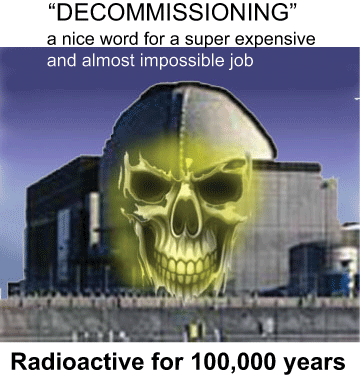
Andra, which publishes a nuclear waste inventory every three years, expects its low-level waste facility in Morvilliers, in the Aube region, would fill up between 2020 and 2025.
“We want to warn that the storage centers are filling up and that we need to optimize waste management because storage facilities are a rare resource,” Andra executive Michele Tallec told Reuters.
Volumes of highly radioactive, long-life waste – which represent just 0.2 percent of the volume but 98 percent of the radioactivity – should rise from 3,200 cubic meters at the end of 2013 to about 10,000 cubic meters when all France’s nuclear plants reach their end of life.
This waste is scheduled to be buried in the controversial deep-storage site in Bure, in eastern France, which already has a test facility but has not received any nuclear waste.
his year, Andra plans to present the French government and nuclear regulator ASN a technical dossier on Bure, which aims to bury nuclear waste 500 meters underground in thick layers of argillite rock, which Andra says will prevent most radioactive particles from traveling more than a few meters over hundreds of thousands of years.
Andra plans to put in a formal request to build the 35 billion euro facility – which faces resistance from environmental groups and local residents – in 2017 and hopes to start construction in 2020 with a view to open it for first testing in 2025.(Reporting by Benjamin Mallet and Michel Rose, writing by Geert De Clercq, editing by David Evans)
In France, nuclear power has lost its glow
 France Loses Enthusiasm for Nuclear Power, Scientific American, Nuclear’s share of electricty will drop from 75 percent to 50 percent by 2025 due to loss of know-how and requirements for more renewable sources By Umair Irfan and ClimateWire | June 29, 2015“……..
A ‘once formidable institution’ declines….nuclear plants, by their nature, are big bets and take years to build. Laponche explained that the French nuclear industry anticipated 1,000 TWh of demand, but domestic needs have yet to top 600 TWh, leaving an oversupply. With the economic downturn and increasing energy efficiency, French electricity demand has remained level or declined in some instances.
Now, some of France’s reactors are showing wrinkles—France’s oldest reactor, Fessenheim 1, started operations in 1977—and officials need to decide whether to invest in costly safety upgrades to keep them operating or to decommission them, another expensive prospect that leaves open the possibility that fossil fuels may rise to meet the shortfall.
New reactors also are struggling. Areva’s third-generation nuclear reactor, EPR, is now under construction at four sites: two in China, one in France and one in Finland. All four are behind schedule, and the French and Finnish reactors have seen their costs more than double, suffering from quality control and management problems.
“The cost of construction of new nuclear is extraordinarily expensive,” said Antony Frogatt, a senior research fellow at Chatham House, an international affairs think tank. He observed that there are ways to extend the lives of existing reactors, but upgrades get progressively more expensive, and certain components, like reactor pressure vessels, cannot be replaced, so renewed operating licenses are only prolonging the inevitable.
And while France has reduced nuclear waste, it hasn’t eliminated the need to dispose of it. No country with nuclear power has a viable underground repository for waste, and proposed sites in France face public opposition, despite more widespread support for nuclear power.
On the other hand, France is the second largest renewable energy producer and consumer in Europe. Wavering solar and wind power don’t play well with baseload nuclear plants that prefer to run at full blast, so the French must find a way to cope with this imbalance if they are to meet the European Union’s directive to generate 20 percent of their electricity from renewables by 2020…….
To sum up, it’s a shrinking client base [for nuclear power] and a competitive market,” said Mycle Schneider, an independent international energy consultant. “The financial and economic situation is devastatingly bad.”
The New York Times reported that Areva hasn’t been profitable since 2010, accrued €4.8 billion in losses in 2014 and may lay off up to 6,000 workers. EDF may take over parts of Areva’s business…….
1 This Month

of the week – Shut Down Drone Warfare!


Tell the Ukrainian Government to Drop Prosecution of Peace Activist Yurii Sheliazhenko

Petition to revoke the licensing of the Near Surface Nuclear Disposal Facility (NSDF) at Chalk River. https://www.ourcommons.ca/petitions/en/Petition/Details?Petition=e-7247
To see nuclear-related stories in greater depth and intensity – go to https://nuclearinformation.wordpress.com
-
Archives
- April 2026 (114)
- March 2026 (251)
- February 2026 (268)
- January 2026 (308)
- December 2025 (358)
- November 2025 (359)
- October 2025 (376)
- September 2025 (257)
- August 2025 (319)
- July 2025 (230)
- June 2025 (348)
- May 2025 (261)
-
Categories
- 1
- 1 NUCLEAR ISSUES
- business and costs
- climate change
- culture and arts
- ENERGY
- environment
- health
- history
- indigenous issues
- Legal
- marketing of nuclear
- media
- opposition to nuclear
- PERSONAL STORIES
- politics
- politics international
- Religion and ethics
- safety
- secrets,lies and civil liberties
- spinbuster
- technology
- Uranium
- wastes
- weapons and war
- Women
- 2 WORLD
- ACTION
- AFRICA
- Atrocities
- AUSTRALIA
- Christina's notes
- Christina's themes
- culture and arts
- Events
- Fuk 2022
- Fuk 2023
- Fukushima 2017
- Fukushima 2018
- fukushima 2019
- Fukushima 2020
- Fukushima 2021
- general
- global warming
- Humour (God we need it)
- Nuclear
- RARE EARTHS
- Reference
- resources – print
- Resources -audiovicual
- Weekly Newsletter
- World
- World Nuclear
- YouTube
-
RSS
Entries RSS
Comments RSS
 nuclear-news
