France’s nuclear company EDF increases security following the Paris attacks

 EDF boosts nuclear plant security after Paris attacks http://www.jpost.com/Breaking-News/EDF-boosts-nuclear-plant-security-after-Paris-attacks-435178 France’s EDF has increased security at its nuclear plants following the Paris attacks in which 130 people died last week, the head of the state-controlled utility said on Tuesday.
“We are in a state of extreme vigilance on all our sites,” Jean-Bernard Levy said on France 2 television.
EDF operates 58 reactors at 19 nuclear plants across France, which relies on atomic energy for about three quarters of its electricity.
Levy said EDF had been on “maximum alert” since the Charlie Hebdo attacks in Paris in January and that it made systematic background checks on all people who work in its nuclear installations, both its own staff and outside contractors.
Increasing risk of sabotage by extremists working in the nuclear industry
 Working in Nuclear while Muslim , Nuclear Free by 2045?, 24 Nov 15 Since the inception of nuclear energy, anti-nuclear critics have been warning about the vulnerability of nuclear power plants to deliberate sabotage. Recent events indicate that we are moving closer to a period of global instability in which state governments cannot protect against non-state actors who will deliberately or unintentionally create a nuclear disaster.
France still keen to market nukes to South Africa
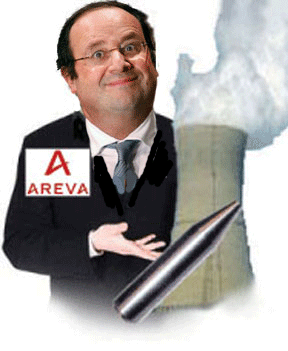 FRANCE STILL KEEN ON SA’S NUCLEAR POWER DEAL http://ewn.co.za/2015/11/22/France-still-keen-on-SAs-nuclear-power-deal French Foreign Minister says France named a special envoy to make the pitch to supply SA’s needs. Jean-Jacques Cornish | about 13 hours ago
PRETORIA – French Foreign Minister Laurent Fabius says his country is still willing to take part in South Africa’s nuclear power project despite reports of a deal being made with Russia.
He told President Jacob Zuma France has named a special envoy to make the pitch to supply South Africa’s needs. Fabius says the purpose of his talks with Zuma yesterday was to ensure South African participation in the climate change summit in Paris at the end of this month.
But he took the opportunity in their Pretoria meeting to assure the South African president that France has the competency to supply and install the nuclear power station it’s looking for.
Despite reports that Russia has already clinched the deal with South Africa, France does not regard this as a fair accomplishment. (Edited by Winnie Theletsane)
Employee-shareholders of EDF call for halt to too-costly British Hinkley Point nuclear project

 Hinkley Point nuclear plan puts survival of EDF at risk, say employee shareholders http://www.theguardian.com/environment/2015/nov/13/hinkley-point-nuclear-plan-puts-survival-edf-at-risk-say-employee-shareholders
French energy firm should halt expensive UK project in which it has has nothing to gain and everything to lose, says association of employee-shareholders EDF’s £18bn project to build two nuclear reactors in Hinkley Point, Britain, is so expensive and so risky that it puts the survival of the French utility at risk, an association of employee-shareholders said on Thursday.
EDF Actionnariat salarié (EAS) said in a statement that the interests of EDF are gravely threatened by the Hinkley Point project, which it calls “a financial catastrophy foretold” in which EDF has nothing to gain and everything to lose.
“EAS asks the management of EDF to stop this risky project, whose financial risks are to big for our company and which could put EDF’s very survival at risk,” the association said.
EDF staff own 1.72% of the utility’s capital, making employees the second-largest shareholder after the state, which hold 84.5%, according to ThomsonReuters data.
Last month, EDF announced a partnership with Chinese utility CGN to build Hinkley Point, but the two companies have not yet made the final investment decision to go ahead with the project, which EDF reluctantly agreed to finance on its already stretched balance sheet after other partners pulled out.
EDF, which already has to borrow money every year to pay its dividend, faces a €55bn (£39bn) upgrade of its nuclear fleet over the next decade, will spend some €5bn to install Linky smart meters in coming years and needs to invest billions in the reactor unit of Areva, which it plans to buy next year.
Standard & Poor’s last month warned that it might downgrade EDF’s debt if it goes ahead with Hinkley Point, because of the project’s high execution risks and substantial investment needs.
France’s effort to market nuclear technology to South Africa
 France seeks to win over SA on nuclear energy, Business Day, BY SISEKO NJOBENI, NOVEMBER 06 2015 AMID speculation about SA’s nuclear build programme, the French special envoy for the French-South African nuclear partnership Pascal Colombani is in the country punting his country for the highly anticipated programme.
During his two-day visit to the country, Mr Colombani is scheduled to have meetings “at the political level” as well with relevant public enterprises such as Eskom and the South African Nuclear Energy Co-operation (Necsa). However, he would not say who he was scheduled to meet in government.
“This is my first visit since I have been appointed by President (François) Hollande as his special envoy for the nuclear partnership with SA. Therefore, the overall purpose of my visit is to scale up our co-operation into a long-term strategic partnership in nuclear energy with SA,” Mr Colombani told Fin24.
He said France and SA shared ambitious goals for the development of nuclear energy, “which should become one key component of our strategic partnership”.
Mr Colombani said France was ready to scale up the co-operation between the two countries into a strategic long-term partnership, by supporting the development of SA’s new nuclear programme. Technology, training and safety were at the core of this partnership, he said……http://www.bdlive.co.za/business/energy/2015/11/06/france-seeks-to-win-over-sa-on-nuclear-energy
France invites China in, to save failed nuclear corporation AREVA
 France’s nuclear-reactor maker Areva open to Chinese funds, says French President Francois Hollande, South China Morning Post, Zhen Liuzhen.liu@scmp.com 3 Nov 15 It’s natural to involve China in Areva’s planned restructuring as the two nations cooperate to build nuclear plants, says French President French President Francois Hollande said on Tuesday that France welcomed Chinese investment in its state-owned nuclear-reactor maker Areva, as he wrapped up his two-day trip to China.
“We welcome foreign capital in the Areva restructuring. It would not affect our sovereignty,” Hollande said in Beijing.
On Monday, Areva and the China National Nuclear Corporation signed a memorandum of understanding for possible partnership on nuclear-waste recycling that could be worth €20 billion (HK$171 billion).
Hollande said that as China and France had become partners building nuclear plants together in Britain and China, it was natural to have the Chinese in the Areva recapitalisation. Last month, French utility company EDF came to an agreement with Chinese nuclear company CGN to jointly build the Hinkley Point nuclear plants in Britain.
Despite the continuous nuclear cooperation, Hollande said his two-day China trip focused more on climate change issues to ensure success in the upcoming UN round of climate talks to be held in Paris next month……..http://www.scmp.com/news/china/diplomacy-defence/article/1875477/frances-nuclear-reactor-maker-areva-open-chinese-funds
Sell EDF shares, because of Hinkley nuclear costs – says leading broker
 Broker tells investors to sell EDF shares because of Hinkley Point costs, http://www.theguardian.com/business/2015/oct/22/broker-tells-investors-sell-edf-shares-hinkley-point-costs Guardian, Terry Macalister, 22 Oct 15,
Investec Securities has ‘long-term concerns’ about financial strain the £18bn nuclear project will put the French energy group under.A leading City broker has called on investors to sell their shares in EDF, saying it has “long-term concerns” about the financial stresses on the French energy group from the £18bn Hinkley Point C nuclear project in Somerset.
The sell note from Investec Securities comes a day after EDF signed a deal with China General Nuclear Corporation and said it would start work within weeks on the UK’s first new nuclear plant for 20 years.
The government has finally admitted what had been denied for years – that the contract for difference aid mechanism for the power station is effectively a state subsidy.
The fine print of a formal document from the Department of Energy and Climate Change said: “The government confirms that it is not continuing the ‘no public subsidy policy’ of the previous administration.”
Coalition ministers always argued that any new nuclear plants would only be constructed if they could be done without subsidy.
“A long-dated project is the last thing that EDF needs, given the existing pressures on its balance sheet. Unless favourable disposals materialise, we fear the dividend will be a casualty,” said a research note from Harold Hutchison, utility analyst with Investec.
EDF, which is largely owned by the French state, has still not taken an irreversible investment decision or received the final documentation from the government on the controversial subsidy system.
But the state visit to Britain of the Chinese president, Xi Jinping, was used as a platform to effectively launch the Hinkley scheme that EDF now says will be funded by debt and not underwritten by UK government guarantees.
Investec believes this will be difficult for EDF at a time when a new French energy law means the company must close some of its power stations while being encouraged to bail out its troubled engineering partner, Areva, through a merger.
EDF is also under financial stress because a new nuclear plant at Flamanville in Normandy, north-west France, has run far over budget and been hit by delays.
Opinion is polarised about whether Hinkley will provide useful baseload low carbon power or is a white elephant project that is far too expensive and stands little chance of being constructed on time. The first of two reactors is scheduled to open in 2025 and in theory could provide 7% of the UK’s electricity 24 hours a day for 35 years.
Nuclear energy falls from France’s pride and joy, to its expensive source of woe
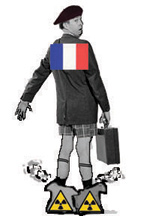 Tale of woe in French nuclear sector, Ft.com, October 13, 2015, Michael Stothard Broken government promises, multibillion-euro delays and a key national champion rescued from the brink of failure: it has been a torrid year for the proud French nuclear industry.
Problems came to a head in August when Areva, the designer and builder of nuclear reactors around the world, was forced to strike a multibillion-euro rescue package deal with rival group EDF and the French government. It had been hit by foreign competition, the downturn in global nuclear demand following the 2011 Fukushima disaster and cost overruns. It had not sold a new reactor since 2007. It urgently needed to be put back on a “sound footing” to keep nuclear a “strength for our country,” said Manuel Valls, French prime minister, before the deal to sell much of the company to EDF………
The country is also a torchbearer for nuclear power as part of the European energy mix when many countries have retrenched following Fukushima. “There’s no doubt the global nuclear industry, including in France, is challenged and it is asking itself some profound questions since Fukushima,” says Jean-Marc Ollagnier, chief executive of Accenture’s resources operating group.
But for French nuclear the past five years have been a tale of technical problems and cost overruns that brought Areva to its knees and called into question the country’s ability to deliver on next generation technology.
These construction problems highlight the complexity of the EPR projects, and have led some to question if there is demand for these larger reactors, given their cost and size. The questions come at the same time as internal political ones, as France attempts to reduce its reliance on nuclear power.
President François Hollande, due to a deal struck between the anti-nuclear Green party and his ruling pro-nuclear Socialist party, has promised to reduce nuclear in the French energy mix from 75 to 50 per cent by 2025…….. Even if no plants are shut down for political reasons in the lead-up to 2025 there are still decisions to be made, all of which are likely to be expensive.
The grand carénage, increasing the life expectancy of the 30-year-old plants from their current 40 years to 50 years, is expected to cost EDF around €55bn, should it ever win political approval. Closing one nuclear plant has already proved difficult. Decommissioning Fessenheim, France’s oldest reactor on the German border, was promised by the government to happen by 2016. This year it was delayed until Flamanville comes online in 2018, leaving the government accused of breaking its promises……..http://www.ft.com/intl/cms/s/0/58036178-68f8-11e5-a57f-21b88f7d973f.html#axzz3oU6siWHM
Rating agencies warn EDF of downgrade, if they continue with Hinkley nuclear station plan
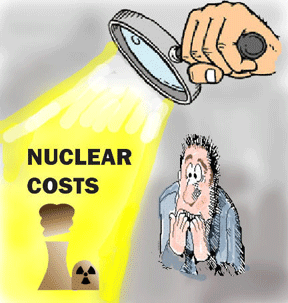 EDF faces threat of credit downgrade over Hinkley Point Two of the world’s biggest ratings agencies have warned that EDF and its Chinese partners face credit-rating downgrades if they press ahead with a £16 billion nuclear power station at Hinkley Point in Somerset.
Amid growing doubts about the deal, Moody’s said the project would have a “credit negative effect” on the companies because of the dangers of big cost overruns and delays to EDF’s untested EPR French reactor technology……. (subscribers only) .http://www.thetimes.co.uk/tto/business/industries/utilities/article4574734.ece
France’s nuclear corporation AREVA is still there – only just
 Areva still standing despite turbulent times News Advance October 3, 2015 Jason Ruiter Like an eroding plateau, the nuclear industry sloughed off a section of its market share – but it still stands.
Areva announced a loss of $5.3 billion in global income in 2014 from the year prior, resulting in a loss of roughly several hundred employees in the Lynchburg area and a need to consolidate, adopt austerity measures and sell a chunk of its business to Électricité de France, the largest utility in France which is also majority-owned by the French government. The power plant business segment of Areva – which employs most Areva Lynchburg employees and constructs, designs and services nuclear plants – will sell 75 percent of the company to EDF for an injection of equity into the business…….
survival came at a cost: Areva NA introduced an advanced severance package to qualified employees to retire early in addition to cutting 22 jobs in the area last fall. Last year, Areva, one of the biggest employers in the region, reported about 1,800 employees in the area. This year, they have about 1,500, a decrease of about 16 percent. For the North America continent, those numbers are steeper, decreasing roughly 20 percent from 5,000 full-time and part-time employees to “closer to 4,000,” Mignogna said……
“Debt is due now,” Mignogna said. “So the [French] government had to react now and try to work out a deal where we could get some cash inflow to the company and they chose to do that.” The result was the EDF purchase of Areva’s power plant operations, which will be consummated by the end of 2016.
Just how much Areva will be changed through the purchase by EDF is unclear. Mignogna said that due to anti-trust considerations, where Areva will be providing services to EDF’s competitors, the North American portion will be operated at “arm’s length.” But he wasn’t sure if Areva’s name will be changed to EDF as a result……..http://www.newsadvance.com/work_it_lynchburg/news/areva-still-standing-despite-turbulent-times/article_a2d991c0-4197-5c04-a163-e7ba145cfea1.html
France hoping to get Japan to help save failed nuclear company AREVA
Nuclear energy on agenda during French PM’s trip to Japan French Prime Minister Manuel Valls rounded off a three-day visit to Japan with bilateral talks on the nuclear sector.
It follows an announcement in September by Japan’s Mitsubishi Heavy Industries stating it was considering taking a stake in Areva NP, the reactor-making subsidiary of French nuclear company Areva. In July, French energy giant EDF agreed to buy between 51 and 75 percent of the subsidiary. At the time it announced it would be looking for partners to take a minority stake.
Valls formally asked his counterpart Shinzo Abe for Japan’s help in reorganising France’s nuclear sector……http://www.euronews.com/2015/10/06/nuclear-energy-on-agenda-during-french-pm-s-trip-to-japan/
France’s EDF does a policy U-turn – now investing in renewables
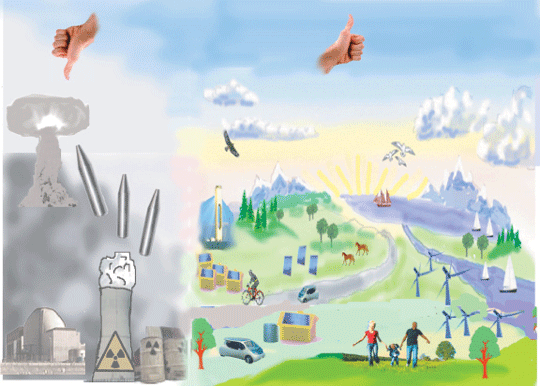 Shifting focus: Owner of world’s largest nuclear fleet looks to renewable energy, Fierce Energy September 24, 2015 By William Pentland EDF, the state-controlled electric utility company based in Paris, France, is pinning its hopes for growth on renewable energy investments, including investments in markets outside of Europe. “By 2030, we want to have a significant presence in three to five countries outside of Europe, notably in solar and wind,” said Jean-Bernard Levy, chief executive officer of Electricite de France SA (EDF), in an interview with the French financial daily newspaper,Les Echos.
EDF owns and operates the world’s largest fleet of nuclear reactors. Currently, 95 percent of the French utility’s generating assets are located in either France, Britain or Italy. Levy said EDF would ramp up investments in renewable energy in these markets.
“Our objective is to double our European and French renewables fleet by 2030 from 28 to more than 50 gigawatts,” Levy said.
This strategy departs markedly from the strategy articulated by Levy’s predecessor, Henri Proglio.
While speaking at the Eurelectric conference in June 2014, Poglio said that the European Union needed to assert greater “control” over the pace of renewable energy growth………http://www.fierceenergy.com/story/shifting-focus-owner-worlds-largest-nuclear-fleet-looks-renewable-energy/2015-09-24
Why we must expose the true ugly nature of the nuclear industry

As I stood against sensationalists and repeated hoaxers, mostly Youtubers, who are only harming the antinuclear cause and the Fukushima victims cause, lately those people have sent me insults and threats of violence, calling me a pro-nuke shill hiding behind my D’un Renard alias,, and not showing my face etc. I presently became the focus of those people hate and slurs for calling their repeated hoaxes what it is: B.S., mental pollution, sensationalism and disinformation. I did it not to look for trouble, but because I believe truth is important, primordial, crucial.
Only by sharing the true facts, we will win, as true facts stand, stay.
B.S. flies high first but stinks later when it is quickly debunked
Consequently, for the first time, i will share publicly my personal story, why and how I awoke and became antinuclear.
A little about myself, I am Hervé Courtois, 60 years old, Picardie, France.
For 4 years and half I used a nom de plume “D’un Renard”, which in french means “from a fox”, because around my place there are many forests and many foxes which I could hear at night while blogging. I did not want to used my true identity because I wanted to protect the identity of my daughter in Japan when I started to blog on internet about the Fukushima catastrophe by fear of getting her in troubles with the Japanese government, and also by fear that Japanese government could bar me to enter Japan to visit my daughter. Few months ago I decided finally to use my real name.
I lived very long time in Asia, 37 years, in Japan, Korea, Hong-Kong and the Philippines, I came back home to France 6 years ago.
My 33 years old daughter, French-Japanese, lives in Iwaki city, Fukushima prefecture, 50 kms South from the nuclear plant of Fukushima Daiichi. She was born in Paris in 1982, but grown up in Fukushima, she is 33 years old, unmarried, no children, does not want to give birth anymore by fear of possible tetragenic birth due to radioactive contamination thru her living environment and the contaminated food.
Three months after the start of the Fukushima catastrophe, I went to visit her there in Iwaki city, Fukushima for the full month of June 2011, to check how she was and how was the real situation there.
On location I was surprised how to find that the people on location who should be the most at risk were kept uninformed of the real situation and of the dangers for their health, for their life, by the Japanese government.
I became aware that there was then an imposed omerta on the media by the Japanese government. All media repeating the same tune, don’t worry be happy, there is no danger, the situation is under control. The reactors are now in cold shutdown.
I keep wondering how reactors having exploded could be in cold shutdown. Smelling a rat.
Most people I met were kept in dark of the real situation, informations were totally controlled, filtered, censored, twisted, the people lied to. Just as the french people in 1986 were lied to by their own government telling them that the Chernobyl plume was not coming towards France, that it would not reach France, that they were safe, most of the people not taking protection measures to regret it later with rampant thyroid cancer allover Eastern France.
When I came back from Japan to France, the most nuclearized nation in the world per square kilometer and per inhabitant, the nuclear industry Areva being owned by the State, the French government, of course the french media were also censored about Fukushima by the French government, telling to French people that the Fukushima disaster was over, that it had ended in March 2011, that it was nowall under control. I found at home the same omerta, that I had met in Japan.
I decided to search for informations on internet, search for knowledge, to learn about nuclear, so that I could better understand what was truly happening, what was hidden, unsaid, covered up, so that I could then inform my daughter and help her to know the facts, the dangers and how to protect herself.
My life changed and was never the same again, it became almost a full time occupation, many hours days and nights on internet to find informations and to share them to other people, discovering gradually the lies, what had been hidden about Fukushima, Chernobyl, Three Mile islands and other hidden nuclear catastrophes, so many. I lost my innocence about nuclear.
I became angry and quite involved as an activist both on the net but also in real life. I became a a member of Sortir du Nucléaire France and of Greenpeace France,
On March 2012 I was the one to organize in Paris the 1rst year Fukushima Anniversary, a rally in front of the Paris main cityhall, with french antinuclear activists combined to some Japanese members of the Paris Japanese community, a Japanese TV crew coming to film our event.
Since the end of June 2011 up to now I continue to blog on the net on various blogs and on some Facebook antinuclear groups and pages that I founded.
I have therefore been following the Fukushima catastrophe day and night from the right beginning, and I am very well aware of the real dangers of Fukushima and of nuclear, my own blood and flesh French-Japanese daughter being one of the victims of nuclear in Fukushima, l will therefore continue to fight nuclear until it ends or until my last breath.
I am opposed to all pro-nuclear and their paid shills, but I am also oppose to those irresponsable people who produce hoax after hoax about Fukushima to satisfy their attention-glory-narcissist craving and their donations milking. All those people in different ways are harming the truth, harming our antinuclear cause.
I never asked donations not wishing to become an activist for sale, I do it for the love of my daughter, and because it is right to do it, not for money nor glory.
Nuclear is more than bad, we will only win by exposing its its ugly real nature, the true real solid facts. We won’t win by spinning sensationalism or hoaxes, which only become ammunitions for the pro-nuke shills to discredit us and the true dangers of nuclear in the mind of the general public.
We need everybody to wake up and to get their hands on deck, to ban all kinds of nuclear, civil and military, allover the world, to free our planet from this evil criminal industry.
Say no to nuclear, say yes to renewable, clean, safe and getting cheaper everyday.
Best wishes to everyone.
Hervé Courtois, “D’un Renard”, from France
Source: Nuclear News
Why we must expose the true ugly nature of the nuclear industry
 In front of the gates of Fessenheim Nuclear plant at the end of the day, Naoto is standing at the center, all the others are solid Fukushima Watchers and Antinuclear activists, friends.
European No to Nuclear Rally at Fessenheim Nuclear plant on March 9, 2014
At Fessenheim, Alsace, France
First 9 bridges upon the Rhine River, between France and Germany, were occupied, then all the people from the bridges regrouped to the Fessenheim Nuclear Plant, 9500 people participating.
The largest groundwater in Europe is located right under the Fessenheim Nuclear plant: the Rhine aquifer, nearly 80 billion cubic meter of water between Basel and Mainz, which provides 80% of the drinking water and more than half of the industry in that area. What would happen in the event of a serious accident?
The Honored guest of that day was Naoto Matsumura, for his heart and spirit in caring for the abandoned animals within the 20kms radius No Man’s Zone of Fukushima. The next day Naoto was delivering his Fukushima testimony at the Europen Parliament in Strasbourg city in front of all the European MPs.
It was a terrific feeling, meet again some old friends and making some new friends.
 With Christian Roy, an antinuclear activist and my closest friend
that day occupying one of those night bridges on the Rhine river.

IndependentWHO: The Vigil for August 2015 – Geneva and Paris

«The World Health Organisation (WHO) is failing in its duty to protect those populations who are victims of radioactive contamination.»
The Vigil is held in front of the World Health Organisation (WHO) headquarters. It has been maintained every working day since the 26th April 2007 to remind this United Nations body of its duties as defined in its constitution.
The International Atomic Energy Agency, whose mandate is the promotion of everything nuclear, has – for the last 55 years – prevented the WHO from carrying out its public health mandate in a world ever more exposed to the lethal effects of ionizing radiation.
For 55 years, as of May 29, 2014, the World Health Organization (WHO) has been under the heel of the International Atomic Energy Agency (IAEA) in matters regarding ionizing radiation and health. The IAEA, whose mandate is the promotion of everything nuclear, has thus prevented the WHO from carrying out its public health mandate in a world more and more exposed to the lethal effects of ionizing radiation.
The Vigil for August 2015 – Geneva and Paris
Since April 26, 2007, the Hippocratic Vigil has been held outside the WHO headquarters in Geneva, which now makes a total of 436 weeks without interruption. The vigil consists of a silent presence that aims to remind the World Health Organization of its obligations as set out in its constitution. We have added the name of Hippocrates to our description because of the ethical rules he instituted for health practitioners. As far as the protection of the health of people affected by the consequences of the nuclear industry is concerned, the World Health Organization ignores these rules. The Vigil takes place outside the WHO headquarters in Geneva every working day from 8:00 am to 6:00 pm
Week 432 – Geneva – 03 to 07 August 2015
François Fresneau (Pruigné l’Eguillé – 72 – France) – Michel Monod (Geneva – Switzerland)
Martine Cuennet (Avully – Switzerland) – David Shipley (Geneva – Switzerland)
François Rittmeyer (Vevey – Switzerland)

Michel Monod (Geneva – Switzerland)
(not photographed)
François Fresneau (Pruigné l’Eguillé – 72 – France) – Robert Parsons (Geneva – Switzerland)
Martine Cuennet (Avully – Switzerland) – François Rittmeyer (Vevey – Switzerland)

Marcelin et Jocelyne Grousselas (St Cyr la Rosière – 61 -France)
Martine Cuennet (Avully – Switzerland) – Mireille Jubert (Grenoble – 38 – France)
(not photographed)
Guy Chatelan (Gex – 01 – France) – David Shipley (Geneva – Switzerland)
Alison Katz (Geneva – Switzerland) – Hannelore Schmid (Onex – Switzerland)
Michel Monod (Geneva – Switzerland) – Caroline Mercier (Geneva – Switzerland)
Véronique Marcot (Rochejean – 25 – France) – Roland Essayan (Fontaine les Dijon – 21 – France)
♦
Week 435 – Geneva – 24 to 28 August 2015
Monique Guittenit (Lusignan Petit – 47 – France) – Martine Cuennet (Avully – Switzerland)
Françoise Bloch (Geneva – Switzerland) – Annick Steiner (Geneva – Switzerland)
Alison Katz (Geneva – Switzerland)
♦
Week 436 – Geneva – 31 August 2015
Lamamo (Aix les Bains – 73 – France) – Isabelle Perrey (Aix les Bains – 73 – France)
~
We believe it is important to address ourselves to those who are partly responsible for deciding WHO policy. It is for this reason that, on 9th November 2012, we began a Vigil outside the Ministry of Health in Paris. The Ministers of Health are the representatives of the member countries of WHO, and they are involved in deciding the policies and actions that this institution pursues in the area of radioprotection. We will maintain this silent and peaceful vigil every Friday from 9am to 5pm outside the Ministry of Health in Paris, until France takes the necessary steps to ensure that WHO fulfils its mission to protect the population from radioactive pollution, and that a programme of independent research is put in place on a national and / or European level, on the theme of “Health and nuclear power”.

Taking part in the Vigil outside the Ministry of Health during July 2015 :
Midori Amo – Philippe Clavière – Hervé Courtois – Marie Magdeleine Fratoni – Etsuko Furukata – Martine Laroche – Dominique Maddaléna – Keiko Negtshi – Christian Roy – Nadine Ruelland – Ryota Sono – Yuki Takahata – Jean Pierre Triger
Source : IndependentWHO
http://independentwho.org/en/2015/08/31/vigil-august-2015/
IndependentWHO: Our demands to WHO

The IndependentWHO collective believes that, in the area of radioprotection, WHO should, as a matter of urgency, put in place the following 6 points :
1.To reinstate the Health and Radiation Department and recruit independent and internationally recognised experts to lead and coordinate responses to public health disasters such as Chernobyl and Fukushima and also to investigate the health consequences of nuclear-related activities in general .
2. To take immediate action, in collaboration with appropriately qualified partners including the Office for the Coordination of Humanitarian Affairs (OCHA), to ensure that medical care, treatment and adequate radioprotection are provided to populations in the affected areas.
3. As a priority, to coordinate with appropriately qualified partners, the importation of uncontaminated food to meet all the nutritional needs of the populations living in the affected areas and the implementation of medical interventions (such as the daily administration of apple pectin) which are known to facilitate the elimination of radionuclides and significantly reduce the radioactive dose delivered to sensitive cells and organs.
4. To establish a Commission on Radiation and Health made up of independent experts to undertake a scientific study of the health consequences of the accident at Chernobyl, including all studies undertaken by independent researchers, having no connections, financial or otherwise, to the nuclear industry or associated bodies, and to report their findings to the World Health Assembly organised by WHO.
5.Within the Commission, to establish working groups to examine and report on the available evidence, the gaps in research in relation to different aspects of radioprotection, and as a priority, establish a working group on the health consequences of chronic, low dose, internal radiation and a working group on damage to the human genome from both external and internal sources of radiation.
6. To publish and make available in full, the proceedings of the Geneva 1995 and Kiev 2001 conferences on the health consequences of Chernobyl.
Source : IndependentWHO
http://independentwho.org/en/our-demands-to-who/
1 This Month

of the week – Shut Down Drone Warfare!


Tell the Ukrainian Government to Drop Prosecution of Peace Activist Yurii Sheliazhenko

Petition to revoke the licensing of the Near Surface Nuclear Disposal Facility (NSDF) at Chalk River. https://www.ourcommons.ca/petitions/en/Petition/Details?Petition=e-7247
To see nuclear-related stories in greater depth and intensity – go to https://nuclearinformation.wordpress.com
-
Archives
- April 2026 (114)
- March 2026 (251)
- February 2026 (268)
- January 2026 (308)
- December 2025 (358)
- November 2025 (359)
- October 2025 (376)
- September 2025 (257)
- August 2025 (319)
- July 2025 (230)
- June 2025 (348)
- May 2025 (261)
-
Categories
- 1
- 1 NUCLEAR ISSUES
- business and costs
- climate change
- culture and arts
- ENERGY
- environment
- health
- history
- indigenous issues
- Legal
- marketing of nuclear
- media
- opposition to nuclear
- PERSONAL STORIES
- politics
- politics international
- Religion and ethics
- safety
- secrets,lies and civil liberties
- spinbuster
- technology
- Uranium
- wastes
- weapons and war
- Women
- 2 WORLD
- ACTION
- AFRICA
- Atrocities
- AUSTRALIA
- Christina's notes
- Christina's themes
- culture and arts
- Events
- Fuk 2022
- Fuk 2023
- Fukushima 2017
- Fukushima 2018
- fukushima 2019
- Fukushima 2020
- Fukushima 2021
- general
- global warming
- Humour (God we need it)
- Nuclear
- RARE EARTHS
- Reference
- resources – print
- Resources -audiovicual
- Weekly Newsletter
- World
- World Nuclear
- YouTube
-
RSS
Entries RSS
Comments RSS
 nuclear-news