Authorities withheld information on serious incident at Fessenheim nuclear facility in France
Reports: Fessenheim nuclear accident played down by authorities http://www.dw.com/en/reports-fessenheim-nuclear-accident-played-down-by-authorities/a-19093477
An incident at the Fessenheim nuclear facility in France in 2014 was more serious than previously known. German media reports claim the authorities withheld information detailing the gravity of the situation. Both the French nuclear authority, ASN, and the company operating the two Fessenheim nuclear reactors, French energy giant EDF, allegedly did not divulge the gravity of the incident on April 9, 2014, when one of the reactors had to be shut down after water was found leaking from several places.
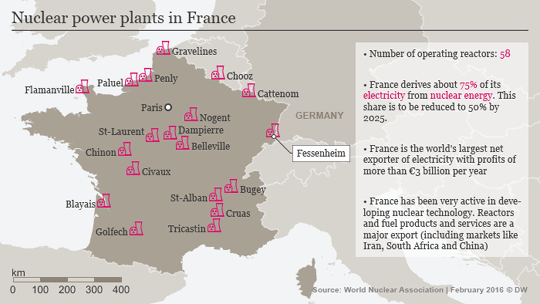
Researchers from German daily “Süddeutsche Zeitung” and public broadcaster WDR claim the incident at Fessenheim, which is in Alsace near the border with Germany, could turn out to be one of “most dramatic nuclear accidents ever in Western Europe.”
They are basing the claim on a document they say they have obtained, sent by ASN to the then-head of the facility on April 24, 2014.
The letter and subsequent reply reveal that the reactor could not be shut down in an ordinary fashion due to control rods being jammed. The reactor had to be shut down by adding boron to the pressure vessel, an unprecedented procedure in Western Europe, according to an expert.
“I don’t know of any reactor here in Western Europe that had to be shut down after an accident by adding boron,” Manfred Mertins, expert and government advisor on nuclear reactor safety, told WDR and Süddeutsche Zeitung.
The reports say the official report ASN released did not contain information on adding boron nor the jammed control rods. It was also not reported in that way to the International Atomic Energy Agency (IAEA).
The Fessenheim reactors went online in 1977 and 1978, making them France’s oldest. The government has repeatedly said it would shut down the facility after fierce criticism from politicians at home, as well as from neighboring Germany and Switzerland.
On Friday, Eveline Lemke, environment minister for the German state of Rhineland-Palatinate, which borders Alsace, called for Fessenheim to be shut down immediately. She said she was “dismayed to hear about yet another incident involving a French reactor,” adding that France’s nuclear watchdog was “evidently failing.”
Germany has also been at loggerheads with Belgium over the country’s Tihange nuclear reactor near their shared border. It was shut down in March 2014, but went back online in December last year, despite concerns over cracks in its pressure vessels.
Nuclear power still provides three-quarters of France’s energy needs, but the government passed legislation last summer to cut the country’s dependence on atomic energy.
France sued by Geneva over dangerous and polluting nuclear station


 Geneva sues France over ‘dangerous’ nuclear plant, The Local, 03 Mar 2016 Geneva is taking legal action over a French nuclear reactor for “endangering lives and polluting water”. Some 70 kilometres from Geneva as the crow flies, Bugey, in the Ain department, is one of France’s oldest nuclear power plants, having come into service in 1972.
The site creates about 4.5 percent of France’s electricity using pressurized water reactors that harness water from the nearby Rhône River.
It has been the subject of controversy before, notably in 2013 when Greenpeace activists broke in to the plant to highlight alleged security weaknesses at the facility.
The current Swiss legal action is a joint initiative by Geneva’s city and cantonal authorities, which have teamed up on an issue that has preoccupied the region for some time, reports Swiss daily 24 Heures.
Back in 2012, the canton placed an official objection to French energy company EDF’s authorization to create a nuclear waste depot at the Bugey site, but the complaint was rejected by the French government. In March 2015 the city council engaged Corinne Lepage, environmental law specialist and a former French minister, to devise a legal strategy calling for the plant to be shut down.
This fresh Swiss campaign against Bugey, led by Lepage, comes as Switzerland decides to shut down one of its own nuclear plants, at Mühleberg.
The reactor in the canton of Bern will be disconnected from the Swiss electricity grid in 2019 and will be finally put out of service by September 2020 at the latest, its owner BKW Energy announced to the press on Wednesday.
Like Bugey, Mühleberg also dates from 1972, making it one of the oldest nuclear plants in the world.
No age limits
However, despite the old age of some of Switzerland’s nuclear installations, their lifespan should not be limited by law, the federal government said on Wednesday.
On Wednesday the Swiss parliament voted against a motion to set an age limit for nuclear plants………
Worse than before Fukushima’
Quashing the proposal angered some on the political left, however, including president of the Greens, Adèle Thorens.
Speaking to Le Matin, she said: “Instead of moving away from nuclear power it’s been decided to prolong the life of nuclear plants instead.”
Worse, she said, was the fact that parliament “had refused the recommendations of our own monitoring organization!”
“We are now in a security situation worse than before Fukushima,” she added. “That’s the incredible paradox of our energy strategy.” http://www.thelocal.ch/20160303/geneva-sues-france-over-dangerous-nuclear-plant
The horrendous truth about just how big a mess nuclear corporation EDF is in
 EDF’s leaked Board Agenda: Zombie nuclear projects and ‘beyond the grave’ reactors http://www.theecologist.org/blogs_and_comments/Blogs/2987305/edfs_leaked_board_agenda_zombie_nuclear_projects_and_beyond_the_grave_reactors.html Jonathon Porritt 29th February 2016
French nuclear parastatal EDF is facing problem after problem – zombie nuclear projects in the UK, Finland, China and France, a fleet of ‘beyond the grave’ reactors, a dropping share price and its drooping credit rating. But is it really as bad as all that? Jonathon Porritt has exclusive access to the leaked Agenda of its latest board meeting. And the answer is – no. It’s even worse.
You seriously wouldn’t want to be a Director of EDF at the moment. The agenda for an average Board Meeting must be seriously gloomy on each and every occasion.
And thanks to an EDF mole (and to judge by the number of leaks to the French press and the UK’sFT there’s a lot of them) I can now state this as fact, not mere opinion.
An annotated copy of the Agenda items for their last meeting on 16th February mysterious showed up in my email today, helpfully summarised byAlexandre Perra, EDF’s Executive Committee Secretary.
Item 1: Existing EPR construction projects
1.1 Olkiluoto (Finland)
Continuing, horrendous cost overruns, leading to ongoing legal stand-off with Finnish partners. Already delayed by seven years, but (hopefully!) could be finished by 2018.
1.2 Flamanville (France)
Continuing, horrendous cost overruns. Already delayed by nine years, but (hopefully!) could be finished by 2018.
1.3 Taishan (China)
Serious problems with both reactors under construction, but, this being China, everything’s shrouded in secrecy. WARNING: This could be much worse than we currently understand.
1.4 Pressure vessels
Still waiting for final safety assessment from French regulators. WARNING: There could be really serious problems here, despite our best efforts to ‘work with’ the regulator.
1.5 Deadlines/UK Treasury
These deadlines are now CRITICAL – as in EXISTENTIAL.
UK Treasury’s loan guarantees are linked to Flamanville operating successfully. And if it is not working properly by 2020, loan guarantee will be completely withdrawn.
Item 2: New reactors at Hinkley Point, Somerset
2.1 Final investment decision
Postponed again – for the eighth time. Still unable to raise the €23.3bn (£18bn), despite our Chinese backers agreeing last year to provide one-third of the total sum, and despite the UK Government offering all but limitless subsidies.
CAUTIONARY NOTE: The true cost is of course much closer to €31 (£24.5bn) taking into account both the cost of construction and the costs of finance. This has been recognised by the EU Commission.
Have just released new announcement: construction will now not start until 2019. We should know by then whether the EPR will ever produce any electricity, with Olkiluoto and Flamanville both due to come on stream in 2018.
2.2 Media strategy
Must keep up a good front: have blamed the latest delay on the Chinese New Year. Crucial that CEO maintains the line: “We estimate the investment decision is very close.”
‘Stop Hinkley Point’ protesters occupied our offices in Bridgewater yesterday. Need to handle with care. Negative coverage increasing all the time, and people have started to talk about our ‘zombie reactors‘ at Hinkley Point.
Regrettably, our cohort of ‘green ambassadors’ (led by renowned UK environmentalist George Monbiot) has fallen silent. Very few advocates now for EPR. Even the FT has now joined the ranks of the critics stating “Politically painful it may be, but the case for halting Hinkley Point C is becoming hard to refute.”
Item 3: Extending the life of our UK reactors
3.1 Some good-ish news: we’ve negotiated extensions for four of our eight reactors in the UK: Heysham 1 and Hartlepool, through to 2024, and Heysham 2 and Torness through to 2030. There will be a significant financial outlay here, which has not yet been properly accounted for, but still relatively ‘small beer’ (as the English say) when looking at our overall finances.
3.2 The longer we keep these reactors ticking over, more or less safely, the better it will be. As soon as they come offstream, all the liabilities associated with decommissioning kick in. Reminder to the Board: managing our rising liabilities is now our most critical priority!
Item 4: Extending the life of our French reactors
Current operating fleet: 58 reactors. The Board has already signed off on a major life extension programme, with an estimate of €55bn of costs. Recent external assessments have put total costs at €100bn. Crucial to hold the line in the media at €55bn. In reality, we have no idea what the total outlay will be.
Item 5: Energy Transition Law (France)
5.1 This now represents A MAJOR RISK, with a direct mandate from our principal shareholder (the French Government) that the country must reduce its dependence on nuclear generation from 75% to 50% of total electricity demand by 2025.
5.2 The Cour des Comptes (state Audit Office) has just issued a new report challenging our long-held expectation that demand for electricity in France will continue to grow significantly through to 2025. If they are right, the energy transition law will mean:
- Worst-case scenario: 20 reactors (35% of the fleet) will need to close.
- Best-case scenario: 17 reactors (29% of the fleet) will need to close.
5.3 Lobbying relevant Ministers and Prime Minister to amend the Energy Transition Law now a TOP PRIORITY.
tem 6: Financial position
- Current share price: down 50% on January 2015 position.
- Current market cap: €22.5 (symbolically and very uncomfortably, less than the total projected costs of the Hinkley Point project).
- Our €37bn net debt load also dwarfs our €18.5bn market capitalisation.
- Current credit rating still at risk. Standard & Poors and Moody’s both looking wobbly.
- Growing concern about perceived splits on the Board, especially as regards increasingly forceful hostility from our Trade Union representatives to Hinkley Point.
Merde alors! And now the FT reports that they have two EDF sources telling them that the final investment decision will be delayed until 2017! Nous sommes trahis! It will be soon! Very very soon! Call security!
The Champagne has lost its fizz
See what I mean? Not exactly a cheery occasion, even with the best of French lunches, and it must be a bit like that Board meeting after Board meeting.
So now shift the focus to London, to the Department of Energy and Climate Change. Imagine for a moment the Permanent Secretary, metaphorically shitting himself as the single biggest element in the UK’s future electricity supply slides, slowly but ever more inexorably, down the pan. Wouldn’t he just love to get access to the (real) Minutes of EDF’s Board meetings!
The implications of all this for the UK couldn’t possibly be more severe. Initially, Hinkley Point was meant to be on stream by 2025, generating a whacking great 7% of total electricity supply. Earlier delays meant that this had already slipped to 2030. Now that the start date has slipped again, to 2019, at the earliest, that 2030 date looks insanely optimistic.
And that’s just the start. EDF’s meltdown at Hinkley Point is already having a significant knock-on impact on other would-be nuclear prospects in the UK – with Horizon, NuGen and even China General Nuclear Corporation beginning to get cold feet.
If Hinkley Point does go down the pan, a project that has been given every conceivable financial inducement by both the UK and the French Government, who the hell is going to invest in different but equally dodgy reactor designs?
If the Permanent Secretary isn’t shitting himself about such a state of affairs, one has to ask where he’s getting his metaphorical Imodium from.
Jonathon Porritt is Co-Founder of Forum for the Future, and a writer, broadcaster and commentator on sustainable development. He is also Trustee of the Ashden Awards for Sustainable Energy, and is involved in the work of many NGOs and charities as Patron, Chair or Special Adviser.
This blog was originally published on Jonathon’s website.
France’s nuclear giant AREVA in deep financial mess – again!
 Nuclear group Areva in the red again http://www.euronews.com/2016/02/26/nuclear-group-areva-in-the-red-again/ Nuclear power group Areva has reported a full-year net loss of 2.038 billion euros, its fifth consecutive annual loss.
The French state-controlled firm blamed extra costs at a reactor project in Finland for half of that.
The rest was due to restructuring expenses and other costs related to market conditions including reduced demand for uranium, nuclear fuel and services.
The group said it has enough funds for this year thanks to bank loans and will sell five billion euros worth of new shares by the first quarter of 2017 to stay afloat.
Areva is 87 percent state-owned and the French government has promised to subscribe to the new share issue.
EDF in its financial woes, extends the life of four nuclear reactors
 EDF extends life of four nuclear reactors Final decision on investment in Hinkley Point still pending, with analysts and activists casting doubt on the project, Guardian, Sean Farrell 16 Feb 16, EDF plans to extend the life of four nuclear power plants in the UK and has said it is close to announcing a decision on its investment in two new reactors at Hinkley Point.
The French energy company said the lives of the Heysham 1 and Hartlepool plants would be extended by five years until 2024, and the closure dates of Heysham 2 and Torness will be delayed by seven years to 2030………
EDF, which is 85% owned by the French government, announced the extensions as it reported a 68% plunge in profits last year and cut its annual dividend. The company, which has been hit by falling power prices, said net debt increased by €3.2bn (£2.5bn) to €37.4bn.
The fall in EDF’s annual net profit to €1.19bn was caused by a tripling of provisions, asset writedowns and other one-off items to €3.64bn. EDF surprised markets by cutting its dividend to €1.10 a share after paying €1.25 for the previous three years.
But the company restated the appeal of the £18bn Hinkley Point project in Somerset. EDF has delayed deciding on the plan due to funding problems, according to reports in France…….
Paul Dorfman of the UCL Energy Institute said EDF’s financial position cast doubt on the prospects for Hinkley Point. “Unfortunately, with the best will in the world, it may just not happen,” he told the BBC’s Today programme. “EDF shares have crashed to half their value a year ago; the budget for Hinkley alone is bigger than EDF’s entire market value.”
Greenpeace said EDF and the French government were in disarray over the cost and risk of the Hinkley project.
Doug Parr, Greenpeace UK’s policy director, said: “EDF’s accounts show growing debts and falling earnings. Hinkley is a bad investment and most people with an ounce of financial acumen have now come to realise this. George Osborne stands alone in defending Hinkley’s honour.” http://www.theguardian.com/business/2016/feb/16/edf-extends-life-of-four-nuclear-reactors-hinkley-point-decision
EDF’s financial woes increases delay on decision about Hinkley nuclear plant
 EDF funds shortfall adds to nuclear plant delay Michael Stothard in Paris and Kiran Stacey in London, Ft.com 14 Feb 16 High quality global journalism requires investment.
EDF has still not secured funding for a £18bn nuclear plant at Hinkley Point in Somerset, further delaying one of the UK’s biggest energy projects.
Board members at the French utility will meet on Monday to sign off on the company’s annual results. Some supporters of the Hinkley Point plant had hoped they would use the meeting to give the scheme their final approval, but two people close to the process told the Financial Times EDF has not secured the necessary funding.
The final investment decision is not on the formal agenda, those people said, with one person saying it could be several months before all the financing is lined up…….
The market turmoil this year has made discussions over the financing more difficult, one person close to the talks said. EDF is in discussions with the French government to help find financing.
EDF is also spending at least €1.25bn to buy a majority stake in Areva reactor unit, Areva NP, as part of a government-backed bailout. It also faces a €100bn bill to upgrade its ageing nuclear power stations by 2030.
EDF said in September last year that the plant it is building in Flamanville, Normandy — already years overdue — would be delayed another year until 2018 and would cost €10.5bn, up from an initial budget of €3bn.
The UK government and EDF executives had hoped a final investment decision would swiftly follow the company’s agreement in October with CGN, the Chinese state-owned nuclear group, on how much of the deal each would finance. http://www.ft.com/intl/cms/s/0/34a0fbee-d1a0-11e5-92a1-c5e23ef99c77.html#axzz40BFAOtmS
Defective pressure vessel could seal the tomb of the EPR nuclear reactor
 French Nuclear Safety Authority has discovered a serious fault in the construction of the pressure vessel http://www.bridgwatermercury.co.uk/news/14275656.LETTER__the_French_Nuclear_Safety_Authority_have_discovered_a_serious_fault_in_the_construction_of_the_pressure_vessel/ Allan Jeffery, Bridgwater 14 Feb 16 Before Hinkley C can be built, the EPR reactor of the same design being built at Flamanville in France must be completed and be established generating before 2020, or else the UK government’s guarantees and financial agreements fall apart.
So it is not surprising that EDF tried to go unnoticed as it drove a convoy carrying the steel lid and pressure vessel from Chalon, where it was produced across France to Flamanville, though this was documented and publicised by Greenpeace last week.
In April the French Nuclear Safety Authority, (the ASN) discovered a very serious default in the composition of the steel used in the pressure vessel. Tests showed excessive presence of carbon, which makes the steel more brittle and subject to breakage. The pressure vessel contains the huge amounts of atomic fission energy in the core.
EDF was quick to minimise the problem and promised other tests. If EDF was serious with the safety measures the company should await the validation of the ASN of the test results that might be released in late 2016 or early 2017.
As Yannick Rousselet from Greenpeace France quoted, “Once again, EDF is turning a blind eye to all the issues, continuing as though no one else would notice and going forward anyway until there is no turning back.”
The nuclear industry is desperate and that new failure in safety could have serious consequences, not only in France, but also in China (Taishan) and England at Hinkley Point, which are among the other vessels produced with the same steel.
If the tests confirm the safety problem, EDF would have to replace the whole vessel, and have to break open and remove the first pressure vessel at Flamanville, adding huge costs and further delays, which would bring the final blow to the industrial jewel already dying.
This defective lid could seal the tomb of the EPR reactor!
Corporate elites push their toxic nuclear products onto India
Perverted Logic of Powerful Corporate Interests drive the India-France Nuclear Connection Mainstream Weekly, VOL LIV No 8 New Delhi by Harsh Kapoor The French President was in India as the chief guest at the surreal nationalist military parade of January 26, 2016. As is the practice, he was accompanied by a high-powered delegation and many multilateral deals got signed between the two countries. There are big ones that have been in the news, have been in the making for many years and may still take time to fructify. These concern the sale by France of nuclear power plants and of flying war toys to India.
India’s proposed purchase of military weaponry and nuclear power plants from France constitute the big centrepiece—attention and money involved in the overall scheme of Franco-Indian ties of the moment. These involve the sale of the Rafale-Multi Role Fighter jets, made by Dassault, said to be the most expensive in the world, and the sales of EPR (European Pressurised Reactors) nuclear reactors, made by Areva, also in the league of the most expensive.

Both these, that is, the civilian nuclear programme and defence procurement, are holy cows that are tightly sealed off by a firewall insulating them from reasoned public scrutiny; all this is managed and scripted by bureaucrats, lobbyists and keepers of ‘national interest’ who hold the keys. The Indian establishment of recent times seems to have grown very big pockets and a big-time ‘folie de grandeur’ where the bigger, more expensive, noisier, higher, shinier are seen as better benchmarks. (A sign of times we are in, that India’s Prime Minister walks about in clothes with his name printed on it all over.) Undue influence of foreign vendors and big Indian and foreign firms and lobbyists is a new reality in the corridors of our decision-making circles. That a new corporate-military industrial complex is shaping India’s drive down this road is a matter which should be the subject of social and economic enquiry by the academia. That is the Indian side of the picture.
But what is driving the French establishment in this foray into India?
The French authorities and the corporate elites see India (and China) as the new market to push their wares. It’s as banal and straight as that. It’s mostly about shoring up economic ties and in the process principally to bailout two crises-ridden sections of the French economy, namely, the civilian nuclear sector and the sagging military-industrial sector. Both of these continue to exercise a considerable hold over the French elites……..
Let us look at the story of the crisis-ridden French civilian nuclear programme to under-stand why the sale of the French EPR reactors for the proposed Jaitapur nuclear park is important to the French……..
The European Pressurised Reactor or EPR was a new generation design and a big bet of the French reactor-maker, Areva NP. The initial optimism from the EPR and the orders for new plants—first in Finland in 2003 (Olkiluoto), then in France in 2006 (Flamanville) and thereafter in China in 2007 (Taishan)—has dissolved with both Olkiluoto and Flamanville now nearly three times over-the-budget and at least 10 years and five years late respectively. Even the Chinese plants under construction are running late. Not a single functioning nuclear plant running the EPR reactor exists so far. There have been huge problems with the reactor design and construction quality despite years of experience in nuclear plant engineering in France. The highly trusted and independent-minded French nuclear safety agency (ASN) has found problems with the pressure vessel forgings in the Flamanville plant……..
The initial cost of the French EPR reactor was to be 3 billion euros but current estimates say it would be close to 11.5 billion euros. [One billion euros come to Rs 7000 crores and one French reactor would cost more then Rs 70,000 crores whereas the annual plan outlay for Maharashtra is Rs 47,000 crores.] The very largely state-owned company, Areva, that made the EPR has been running huge losses. In 2014 the losses were close to 5 billion euros. In July 2015 Areva sold off its reactor business to the French state-run electricity utility, EDF, which is also the biggest operator of nuclear power plants. Now the EDF, which has been economically sound, will have to manage the many very economically risky foreign projects of the former Areva. Experts say the EPR’s design problems and costs have dragged down Areva economically and the EDF is unlikely to want a similar fate for itself. The EDF has been developing its own designs for smaller nuclear reactors. Given the construction and operation problems of the EPR there is a possibility that the EDF could shelve the EPR’s giant reactor programme and place it in long-term cold storage.
The in-principle sale of six EPR reactors to India is a bet for the rescue of the crisis-marked French nuclear sector — imagine an injection of 60 billion euros if the price is, say, 10 billion dollars a piece. There was a joint venture by Areva and L & T, the Indian engineering major, which is negotiating the price of building the Jaitapur reactors with the Nuclear Power Corporation of India (NPCIL). They say the will bring down the price by sourcing the parts under a ‘make an India’ bid. All this will need to be reworked with the EDF being the new French entity in charge……….http://www.mainstreamweekly.net/article6209.html
In France, Greenpeace activists blocked convoy to Flamanville nuclear project
Greenpeace activists block truck convoy from French nuclear plant, Euronews, 13 Feb 16 Greenpeace activists blocked a truck convoy from reaching a French nuclear plant early on Friday (February 12) to protest nuclear power in France.
The convoy was carrying the lid to the nuclear vat at the Flamanville EPR reactor (Evolutionary Power Reactor) in north-western France — the sole nuclear reactor under construction in France……..After the 2011 Fukushima disaster, the French government voted to cap nuclear capacity at current levels and to reduce its share in the power mix to 50 percent by 2025, but Greenpeace says they have done little to achieve that goal.
French President Francois Hollande would have to close four to five nuclear reactors by the end of his term in 2017 in order to stay on track, Greenpeace said in a statement. http://www.euronews.com/2016/02/12/greenpeace-activists-block-truck-convoy-from-french-nuclear-plant/
Electricite De France (EDF) faces €100bn bill for upgrading ageing nuclear power stations
EDF faces €100bn bill for upgrading ageing nuclear power stations, Ft.com Michael Stothard in Paris , 11 Feb 16 French utility EDF is facing a €100bn bill for upgrading its ageing nuclear power stations at the same time as a new law could force it to close a third of its reactors, according to the country’s state audit office.
The report by the Cour des Comptes comes at a bad time for the world’s largest nuclear power generator as it scrambles to secure financing for a contentious £18bn nuclear project in the UK.
Unions and analysts have already raised concerns that EDF might be biting off more than it can chew with the proposed nuclear plant at Hinkley Point in Somerset. The utility is grappling with a large debt load as well as increased competition in its domestic market.
Shares in EDF, which is 85 per cent owned by the French government, have fallen 55 per cent in the past year, reducing its market capitalisation to €21bn. The group has net debt of €37bn.
The audit office said on Wednesday that the cost of increasing the life expectancy of the 58 nuclear plants in France from their current 40 years would be €100bn during the 2014-2030 period.
This is well above EDF’s €55bn estimate for the 2014-2025 period. The difference is in part because the €100bn also includes EDF’s operating expenses over that period.
The audit office also said that a law passed last year to reduce the share of nuclear in French energy production from 75 per cent at the moment to 50 per cent by 2025 could lead to the closure of 17 to 20 EDF reactors.
The law was set to “jeopardise planned investments” by EDF and “force it to close a third of its plants,” with possible consequences for jobs, said the report. It suggested that EDF might have to turn to the state for compensation………
EDF has said it wants to keep all of its 58 reactors running. It said that it wants the reduction of the share of nuclear in the French energy mix from 75 per cent to 50 per cent in the law to come from growing demand.
But the Cour des Comptes said this kind of growth in demand was unlikely. “Only a very significant increase of electricity use or power exports could limit the number of closures, but experts do not expect this will happen,” it said. http://www.ft.com/intl/cms/s/0/581cb61a-d00d-11e5-92a1-c5e23ef99c77.html#axzz3ztplMhin
French waste group Veolia moving into nuclear clean-up business
Veolia expands in nuclear waste clean-up with Kurion acquisition http://www.reuters.com/article/us-kurion-m-a-veolia-idUSKCN0VC0V4, 4 Feb 16
French water and waste group Veolia (VIE.PA) said it bought U.S. nuclear waste clean-up company Kurion for $350 million as it chases a slice of a market seen worth $210 billion over the next 15 years.
Veolia said it expects the new business to contribute annual revenue of $350-400 million by 2020, including about $250 million from waste treatment and $100-150 from decommissioning nuclear installations.
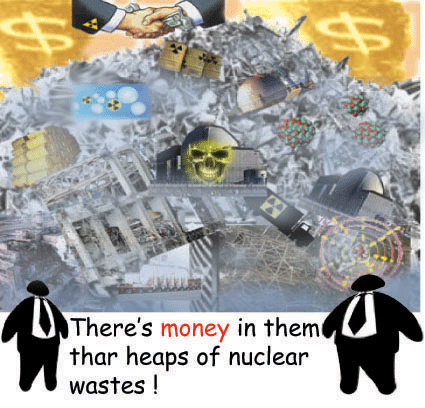
Kurion, which was one of few international firms involved in the early stages of the clean-up of the Fukushima nuclear disaster in Japan in 2011, currently has annual sales of about $100 million. Veolia generates about $20 million from cleaning up nuclear waste.
“Bringing Kurion and its employees into Veolia is going to enable us to develop a world-class integrated offer in nuclear facility clean-up and treatment of low-level radioactive waste around the world,” Veolia Chief Executive Antoine Frerot said.
Veolia plans to target the United States, Britain, France and Japan, which together amount to a market of $118 billion by 2030, and will focus on low-level radioactive waste, which represents 97 percent of the volume but just 0.1 percent of the radioactivity.
There are about 400 nuclear plants in operation worldwide, of which 100 to 150 will be decommissioned by 2030. Another 50 nuclear research centres will also have to be dismantled, Veolia said. Frerot said Veolia would focus on concentrating the waste to reduce its volume so that it can be stored safely, mostly in glass.
Kurion was founded in 2008 and and now employs over 200 people. Veolia had total revenue of 23.88 billion euros ($26.05 billion) in 2014. (Reporting by Geert De Clercq; Editing by James Regan)
France’s plan for 1,000 kilometers of road paved with solar panels
 France to pave 1,000 kilometers of road with solar panels http://inhabitat.com/france-to-pave-1000-kilometers-of-road-with-solar-panels/?newgallery=true by Lucy Wang In a major step forward for green energy, the French government has announced plans to installsolar photovoltaic panels on 1,000 kilometers (621 miles) of road over the next five years. The goal is to supply renewable power to 5 million people—or about 8 percent of the French population. The solar roadways will use Wattway panels, a photovoltaic technology unveiled last October by the major French civil engineering firm Colas. According to Ségolène Royal, France’s minister of ecology and energy, the “Positive Energy” project will be funded by raising taxes on fossil fuels, a decision Royal says is “natural” given the low prices of oil.
UK Hinkley Point nuclear plant project director quits
 EDF project director for UK Hinkley Point nuclear plant quits, 7 News, Reuters February 3, 2016 LONDON – An executive of French utility EDF in charge of Britain’s first new nuclear power station project for 20 years is leaving to join U.S. energy company Entergy Corp , the U.S. firm said on Tuesday.
As an executive director at EDF’s British unit, EDF Energy, Christopher Bakken had been project director since 2011 for the Hinkley Point C nuclear project in southwestern England.
He was responsible for the design, procurement, construction and commissioning of the planned new nuclear plant………
Intractable problems at two similar nuclear plants under construction in France and Finland threaten more delays to EDF’s British plans. https://au.news.yahoo.com/world/a/30718466/edf-project-director-for-uk-hinkley-point-nuclear-plant-quits/
Electricite De France : 6 union board members will oppose Hinkley Point nuclear project
EDF’s union board members to oppose Hinkley Point – sources, Yahoo 7 News, Reuters February 3, 2016 By Geert De Clercq PARIS – The six union members on EDF’s 18-seat board would vote against the French utility’s plans for two nuclear reactors in the UK, but other board members do not want to postpone the project, sources familiar with the situation said.
The unions want EDF to put off the 18 billion pound project to build two Areva-designed European Pressurised Reactors (EPR) at Hinkley Point in southwest England until it has strengthened its balance sheet and started up at least one of the four EPRs it has under construction elsewhere.
A united front of EDF’s unions opposing a major investment decision would be unprecedented, but the lack of support from other board members removes a major element of uncertainty for the plan.
“If the Hinkley Point project was put to the board today, the six union representatives would all vote against it,” one of the sources told Reuters on Tuesday.
EDF first announced Hinkley Point in 2013 and said in Oct. 2015 that Chinese utility CGN would take a 33.5 percent stake in the project, but it has not yet taken a final investment decision as it struggles to find financing.
On Monday, EDF’s dominant CGT union, which has three board members, called on the firm to postpone the project, saying EDF should prioritise upgrading its ageing nuclear fleet in France, start up the long-delayed EPR it is building in Flamanville, and design a new-model EPR reactor…….
A united front of EDF’s unions opposing a major investment decision would be unprecedented, but the lack of support from other board members removes a major element of uncertainty for the plan.
“If the Hinkley Point project was put to the board today, the six union representatives would all vote against it,” one of the sources told Reuters on Tuesday.
EDF first announced Hinkley Point in 2013 and said in Oct. 2015 that Chinese utility CGN would take a 33.5 percent stake in the project, but it has not yet taken a final investment decision as it struggles to find financing.
On Monday, EDF’s dominant CGT union, which has three board members, called on the firm to postpone the project, saying EDF should prioritise upgrading its ageing nuclear fleet in France, start up the long-delayed EPR it is building in Flamanville, and design a new-model EPR reactor……https://au.news.yahoo.com/world/a/30718719/edfs-union-board-members-could-vote-against-hinkley-point-sources/
Fatal rockfall at planned French repository site
World Nuclear News 26 January 2016 One person was killed and another injured today by a tunnel collapse within an underground laboratory operated by French waste management agency Andra. The laboratory, near Bure in the Meuse/Haute Marne area, is assessing the site for its suitability to house a national radioactive waste repository.
According to an Andra statement, the working face of the gallery within the laboratory collapsed at 12.20pm. Geophysical surveys were being carried out at the time and the rockfall is believed to have happened as drilling was taking place. The gallery has now been evacuated and its stability is being assessed……. http://www.world-nuclear-news.org/RS-Fatal-landslide-at-planned-French-repository-site-2601165.html
1 This Month

of the week – Shut Down Drone Warfare!


Tell the Ukrainian Government to Drop Prosecution of Peace Activist Yurii Sheliazhenko

Petition to revoke the licensing of the Near Surface Nuclear Disposal Facility (NSDF) at Chalk River. https://www.ourcommons.ca/petitions/en/Petition/Details?Petition=e-7247
To see nuclear-related stories in greater depth and intensity – go to https://nuclearinformation.wordpress.com
-
Archives
- April 2026 (114)
- March 2026 (251)
- February 2026 (268)
- January 2026 (308)
- December 2025 (358)
- November 2025 (359)
- October 2025 (376)
- September 2025 (257)
- August 2025 (319)
- July 2025 (230)
- June 2025 (348)
- May 2025 (261)
-
Categories
- 1
- 1 NUCLEAR ISSUES
- business and costs
- climate change
- culture and arts
- ENERGY
- environment
- health
- history
- indigenous issues
- Legal
- marketing of nuclear
- media
- opposition to nuclear
- PERSONAL STORIES
- politics
- politics international
- Religion and ethics
- safety
- secrets,lies and civil liberties
- spinbuster
- technology
- Uranium
- wastes
- weapons and war
- Women
- 2 WORLD
- ACTION
- AFRICA
- Atrocities
- AUSTRALIA
- Christina's notes
- Christina's themes
- culture and arts
- Events
- Fuk 2022
- Fuk 2023
- Fukushima 2017
- Fukushima 2018
- fukushima 2019
- Fukushima 2020
- Fukushima 2021
- general
- global warming
- Humour (God we need it)
- Nuclear
- RARE EARTHS
- Reference
- resources – print
- Resources -audiovicual
- Weekly Newsletter
- World
- World Nuclear
- YouTube
-
RSS
Entries RSS
Comments RSS
 nuclear-news