Safety fears over EDF bid to permit doubling of nuclear reactor cracks The Herald, 22 Jan 17 THE nuclear industry is secretly bidding to relax safety standards to allow the doubling of the number of cracks in the radioactive cores of Scotland’s ageing reactors
EDF Energy is asking for the safety rules to be rewritten so that it can keep running its nuclear power stations at Hunterston in North Ayrshire and Torness in East Lothian until they are at least 47 and 42 years old. They were originally designed to last 30 years.
Prolonged radiation bombardment causes the thousands of graphite bricks that make up reactor cores to crack, threatening a safe shutdown. But EDF is asking the UK government’s watchdog, the Office for Nuclear Regulation (ONR), to permit an increase in the proportion of cracked bricks from 10 to 20 per cent.
The revelation has sparked alarm from politicians and campaigners, who say that the industry is “gambling with public safety” and the public must be consulted. One leading expert argues that Hunterston should be immediately shut down
Hunterston started generating electricity in 1976. EDF currently plans to keep it operating until 2023, and the ONR is due to conclude a safety review of its future operation at the end of January
On January 13 EDF closed down one of Hunterston’s two reactors for planned maintenance, including inspections of cracking in the graphite core. The reactor is due to be restarted on February 10.
Torness was started up in 1988 and is currently planned to operate until 2030. The company, however, has said that it is hoping that the lives of both nuclear stations can be extended by a few more years.
EDF’s bid to relax safety standards at Hunterston and Torness is highlighted in a new report today for the Scottish Greens. It concludes that the risks from graphite cracking are serious and argues that an international convention demands that environmental risks must be assessed, alternative energy sources considered and the public consulted.
According to the report’s author, Edinburgh-based anti-nuclear campaigner and consultant, Peter Roche, Scotland doesn’t need nuclear electricity. “Despite the fact cracks are beginning in the graphite core of these reactors, increasing the risk for us all, the public has still not been asked for its opinion once,” he said……..
John Large, a consulting nuclear engineer, pointed out that the integrity of the graphite bricks was vital to nuclear safety. If they failed, they could block channels that enable control rods to be inserted to close down reactors and prevent them from overheating.
“Ageing problems like this serious cracking of the graphite bricks at the heart of each reactor are deeply worrying, so much so that these nuclear plants should now be permanently shut down,” he said.
Large accused EDF and the ONR of “false confidence” in believing they fully understood graphite cracking, which was difficult to predict. “The Hunterston B nuclear reactors now in their forty-first year of operation, should be immediately shut down,” he stated….
The company also argued that environmental impact assessments – and, by implication – public consultations were not required for life extensions at Hunterston and Torness..
ONR’s deputy chief inspector Mark Foy confirmed that EDF had asked for the proportion of graphite bricks allowed to be cracked to rise from 10 to 20 per cent. “That is provided to us in the form of a comprehensive justification, which we will assess to see whether we’re satisfied it’s safe to operate,” he said…….. http://www.heraldscotland.com/news/15039668.Safety_fears_over_EDF_bid_to_permit_doubling_of_nuclear_reactor_cracks/
January 23, 2017
Posted by Christina Macpherson |
France, safety |
Leave a comment
 EDF board prepares to defy Hollande on nuclear closure Power company’s bid to keep plant open shows president’s waning authority, Ft.com 19 Jan 17 by: Michael Stothard in Paris François Hollande risks falling short on another pledge as the board of state-controlled energy company EDF next week prepares to vote down his plans to close France’s oldest nuclear plant.
The French president promised in 2012 to shut down the Fessenheim power plant near the German and Swiss borders — long a target for anti-nuclear activists — in a bid to win over the Green party. But with just months left of his mandate ahead of the presidential election on April 23, some within EDF are attempting to drag their feet long enough for a change of government, according to three people with knowledge of the situation……..
Mr Hollande’s difficulties are partly down to a legal quirk with the vote. Six government-appointed representatives on the boardare not allowed to vote on the motion because of a conflict of interest, according to people close to the company. Six union representatives are set to vote against closure. The CGT and moderate CFDT unions have both said publicly that they will do so to protect the 850 workers at the site. This means it will take only one of the six remaining independent board members to vote against closure for the motion to be rejected. According to several people with knowledge of the situation, at least one is willing to vote no.
The Hollande government has put immense pressure on EDF to formalise the closure……..
The government does hold some cards. The state, as well as owning 85 per cent of the company’s equity, is participating in a €3bn capital raising. It must also sign off on an extension of the licence for a stopped second reactor at Paluel in northern France. A person close to the situation said the government could conceivably find a way around the board opposition or convince some board members to change their mind. …….
If EDF hangs on long enough, it might be able to resist the closure of Fessenheim completely. François Fillon, the centre-right presidential candidate who is the frontrunner to win the presidential election, has said he is against the closure of the plant.
https://www.ft.com/content/62551c48-de77-11e6-9d7c-be108f1c1dce
January 21, 2017
Posted by Christina Macpherson |
France, politics |
Leave a comment
France, which owns 87% of Areva, said it would offer €4.5 per Areva SA share to minority investors which include Kuwait’s investment fund and French energy group Total Paris: France will buy out minority shareholders in Areva and delist the troubled nuclear group, the government said on Wednesday as talks with potential investors in a new nuclear fuel company being spun out of Areva neared a conclusion.
The state, which owns 87% of Areva, said it would offer €4.5 per Areva SA share to minority investors which include Kuwait’s investment fund, French utility EDF and French energy group Total.
Areva’s shares have fallen by as much as 90% from their 2007 highs as the group chalked up repeated losses. The stock was suspended on Tuesday at €5.2.
European Union (EU) antitrust regulators approved the French government’s plan to inject €4.5 billion ($4.8 billion) into Areva on Tuesday, saying the rescue would not unduly distort competition.
The ruling will allow Areva, whose capital has been wiped out by years of losses, to restart as a smaller firm focused on uranium mining and nuclear fuel production and recycling.
Legacy Areva SA—the firm left over after this split and the sale of Areva’s reactor unit to state-controlled EDF—will get a €2 billion capital increase and will hold the liabilities related to the troubled Olkiluoto 3 project in Finland, which has been hit by delays.
Areva said negotiations with unspecified investors in the new company were being finalised. It said last month that two investors have made a €500 million ($526.40 million) offer for a combined 10% stake in the new entity.
Paris: France will buy out minority shareholders in Areva and delist the troubled nuclear group, the government said on Wednesday as talks with potential investors in a new nuclear fuel company being spun out of Areva neared a conclusion.
The state, which owns 87% of Areva, said it would offer €4.5 per Areva SA share to minority investors which include Kuwait’s investment fund, French utility EDF and French energy group Total.
Areva’s shares have fallen by as much as 90% from their 2007 highs as the group chalked up repeated losses. The stock was suspended on Tuesday at €5.2.
European Union (EU) antitrust regulators approved the French government’s plan to inject €4.5 billion ($4.8 billion) into Areva on Tuesday, saying the rescue would not unduly distort competition.
The ruling will allow Areva, whose capital has been wiped out by years of losses, to restart as a smaller firm focused on uranium mining and nuclear fuel production and recycling.
Legacy Areva SA—the firm left over after this split and the sale of Areva’s reactor unit to state-controlled EDF—will get a €2 billion capital increase and will hold the liabilities related to the troubled Olkiluoto 3 project in Finland, which has been hit by delays.
Areva said negotiations with unspecified investors in the new company were being finalised. It said last month that two investors have made a €500 million ($526.40 million) offer for a combined 10% stake in the new entity.
A person familiar with the situation said the two investors are Japan’s Mitsubishi Heavy Industries and JNFL. Talks are continuing with China’s National Nuclear Corporation about also taking a minority stake.
“These talks are continuing and focus on governance issues, and on the issue of the balance between the different third-party investor parties,” French industry minister Christophe Sirugue told Reuters in an interview.
Sirugue, who said he had discussed the governance issue with Chinese vice-premier Ma Kai during his visit to France in November, added that the make-up of the board of the new company is another important issue in the talks. Reuters
January 13, 2017
Posted by Christina Macpherson |
business and costs, France, politics |
Leave a comment
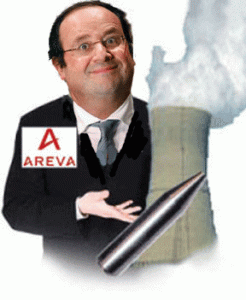 France ready to save nuclear group Areva, regardless of election outcome, Globe and Mail, GEERT DE CLERCQ, PARIS — Reuters, Jan. 04, 2017 A government-led rescue of French nuclear group Areva and the wider atomic-energy industry may cost the state as much as €10-billion ($13.94-billion Canadian), but political support is almost certain whoever wins the presidential election in May.
While taxpayers will ultimately pick up the huge bill, the main election contenders – from the Socialists and conservatives to the far-right National Front – broadly back the bailout, which involves splitting up Areva.
On top of its dire financial state, Areva is beset by technical, regulatory and legal problems. But given its importance to a nuclear industry that generates three quarters of France’s electricity and employs 220,000 people, the next government probably has little choice but to stand by the scheme hatched under outgoing Socialist President Francois Hollande.
France has a small but fierce anti-nuclear movement and some critics oppose investing billions in extending the life of aging reactors. Nevertheless, nuclear energy is broadly accepted, even though neighbouring Germany has decided to ditch it altogether following the 2011 disaster at Japan’s Fukushima plant…….
The nuclear industry rescue also involves a cash injection for power utility EDF, which operates France’s 58 nuclear reactors and will buy part of Areva’s business. But for all the domestic support, Brussels must also rule on whether the bailout complies with European Union rules on state aid………
Once the champion of France’s nuclear industry, 87-per-cent state-owned Areva has seen its equity wiped out by years of losses. Among its biggest problems is a nuclear plant it is building in Olkiluoto, Finland. Work is almost a decade behind schedule and huge cost overruns have led to Finnish utility TVO and Areva claiming billions from each other.
A similar project in Flamanville, France is also running years late, with costs spiralling. Areva has also had to take heavy writedowns on its African uranium mines while foreign orders have generally slumped since the Fukushima accident.
On top of this, U.S. and other regulators are investigating possible safety problems related to the suspected falsification of documents at Areva’s Le Creusot plant, which makes components for reactors worldwide.
In a restructuring that means an end to Areva as an integrated nuclear group, the firm will sell its reactor unit Areva NP to EDF. The French state will effectively nationalize the Olkiluoto liabilities and Areva will receive a mainly state-funded cash injection of €5-billion to refloat it as a uranium mining and nuclear fuel group.
The government is also seeking Japanese and Chinese investors to buy minority stakes in the fuel group, provisionally called NewCo, for £1-billion euros. http://www.theglobeandmail.com/report-on-business/international-business/european-business/france-ready-to-save-nuclear-group-areva-regardless-of-election-outcome/article33498170/
January 6, 2017
Posted by Christina Macpherson |
France, politics |
Leave a comment
 French watchdog deepens probes into Areva nuclear parts Concerns about quality and documentation could have knock-on effect on Hinkley Point Rt.com JANUARY 4, 2017 by: Michael Stothard in Paris
Investigators are widening probes into potentially faulty nuclear reactor components made at a factory operated by Areva, the struggling French manufacturer, after the problems contributed to multiple shutdowns of power plants last year.
Julien Collet, deputy director of the ASN, France’s nuclear regulator, said he wanted to “go much further” with investigations into Areva’s components, including one probe into the falsification of documents that certified the quality of certain parts.
Separately, the ASN is expected to issue a report this year about issues with components made by Areva for a new nuclear power plant at Flamanville in France. The report’s findings could have an impact on the proposed Hinkley Point C nuclear plant in the UK, which is due to use the same technology as Flamanville.
The ASN is leading investigations into two scandals relating to Areva’s supply of components for France’s existing nuclear power stations.
First, French investigators said in June that some steel components made at Areva’s Le Creusot factory — notably parts used in steam generators — had excessive carbon levels, which could make them vulnerable to cracking.
Second, Areva announced in May that it had found evidence suggesting employees had doctored quality-assurance documents relating to many different nuclear reactor components made at Le Creusot for up to 40 years.
Both affairs have contributed to French nuclear power plants run by EDF, the utility, being shut down last year………
Overseas regulators are monitoring events in France. David McIntyre of the US Nuclear Regulatory Commission said it was concerned by the revelations about doctored documents at Le Creusot, which has supplied some components to US nuclear power plants……..
Beyond Areva’s potentially faulty components in France’s existing nuclear power stations, there is another — potentially even larger — issue looming.
In 2014, the reactor vessel at the planned new nuclear power plant at Flamanville — which was made at Areva’s factory in Chalon/Saint-Marcel — was found to have potentially critical structural weaknesses as a result of excessive carbon levels……….
Any significant problems with the vessel could be catastrophic for EDF, as redoing this important piece of the plant would mean restarting much of the construction work, which is already billions of euros over budget and years late.
“If the reactor vessel is deemed faulty, it would be a disaster,” said Denis Florin, founder of Lavoisier Conseil, a consultancy.
Flamanville is a flagship project for EDF, using European Pressurised Reactor technology that is also earmarked for the Hinkley Point C power plant in the UK.
Any further delays at Flamanville could pose problems for Hinkley. This is partly because the financial support package the UK government has offered for Hinkley is premised on Flamanville being operational by 2020.
If Flamanville’s reactor vessel is found to be flawed, it could push back the completion date — currently scheduled for the end of 2018 — beyond 2020.
EDF has said it does not plan to use the UK financial support package, as it is financing the project from its own balance sheet, but this could still rob the company of room for manoeuvre should Hinkley face problems.
Additional reporting by Kana Inagaki in Tokyo https://www.ft.com/content/2baf6270-c36a-11e6-81c2-f57d90f6741a
January 6, 2017
Posted by Christina Macpherson |
France, secrets,lies and civil liberties |
Leave a comment

Ouch … the incredible Yannick Rousselet, the campaigner at Greenpeace against Nukes, Yannick Rousselet, whose ideas and actions of genius are no longer counted, is now a government target.
As everywhere, the state/establishment when under pressure resorts to authoritarianism and force. In France, Greenpeace anti-nuclear activist,Yannick Rousselet, has had his house raided in the early hours of the morning…with the police pulling up outside in their black vans and taking photos (including family photos), computers, USBs, files etc. on the basis that Yannick has been threatening state defence secrets.
It’s what happens when your campaigns are successful enough to threaten the state
By Yannick Rousselet:
“A few days ago, I informed you that I had been the victim of an act of “malevolence”. In fact, it was practiced by a state service, DGSI (Directorate General of Internal Security, the former DST).
Indeed, last Tuesday morning, these “good people” parked their black sedans in front of my home, donned their “police” armbands and came to search my family home.
They took all our digital media: phones, computers, internal and external hard drives, USB flash drives, SD cards. In this seizure, files related to our militant activities, but also all our photos and videos of families.
This is an investigation for “compromise of defense secrecy”, the initiative of which would come from the HFDS (Senior Defense and Security Official) and General Riac (National Nuclear Security Officer).
It is the Paris public prosecutor who is in charge of this investigation. They told me that I would be summoned for a police custody soon.”
December 19, 2016
Posted by dunrenard |
France | antinuclear, Greenpeace, State Repression |
1 Comment
 NuClear News No 91, Jan 2017 On 14th December some thirty Greenpeace activists blocked the EDF headquarters in Paris to denounce the financial scandal and technical bankruptcy of the Company. They hung a banner on the front of the HQ building which declared that EDF has a debt of 74 billion euros, but because of nuclear power, this figure will rise even higher. (1)
As we reported last month Greenpeace commissioned an audit by AlphaValue, the equity research company. The report indicated that EDF grossly underestimates the cost of nuclear electricity. If it disclosed the true cost of running its fleet of reactors in France while financing two new ones in the UK, it would be declared bankrupt. (2) (3)
France is set to have its usual nuclear power capacity almost completely restored by midJanuary, after a number of plants come back online following inspections. Only 4 out of 58 nuclear power plants will be offline by the middle of January, so worries about shortages have eased. EDF has confirmed that seven nuclear reactors shut down for safety checks would be up and running again by the end of December and there should be no problem with power supplies this winter.
Grid operator RTE said that three of the seven reactors offline – Gravelines 2, Dampierre 3 and Tricastin 3 – would resume production from December 20th and that four more would restart before December 31st. The seven reactors are among 12 that have been slated for inspections under orders from the nuclear regulator ASN following the discovery of high carbon concentrations, which could weaken their steel. (4)
EDF has asked ASN if it can postpone the outage of the 1.5-GW Civaux-1 and the 900-MW Tricastin-2 reactors to March and February respectively. The Civaux-1 and Tricastin-2 reactors are currently both due to go offline December 23 and return on January 15. (5)
While this particular crisis may appear to have an end in sight, the French industry’s problems are now moving overseas. Manufacturing problems and forged paperwork as identified at Le Creusot are rare in the nuclear industry, where strict adherence to production and operating rules are supposed to be a crucial buffer against nuclear accidents. Independent nuclear energy consultant Mycle Schneider says “Having worked for over 30 years in France, I did not think this was possible for this country, [but it is] likely we have seen only the tip of the iceberg.”
Inspectors from the U.S. China and four other countries are investigating the decades-long cover up of the manufacturing problems at Le Creusot to see whether flaws represent a safety threat to their reactors. After investigators discovered files suggesting Le Creusot employees had concealed for decades manufacturing problems involving hundreds of components sold to customers around the world, the French regulator, ASN, ordered Areva to check 6,000 manufacturing files by hand, covering every nuclear part made at Le Creusot since the 1960s. Finnish inspectors visiting Le Creusot said they learned of potential flaws in a component slated for the reactor at Olkiluoto. In the U.S., the NRC has identified at least nine nuclear plants that use large components from Le Creusot.
“I’m concerned that there keep being more and more problems unveiled,” said Kerri Kavanagh, who leads the U.S. Nuclear Regulatory Commission’s unit inspecting Le Creusot. Regulators are considering returning to Le Creusot or inspecting Areva’s Lynchburg, Va., offices to deepen their probe of the plant, a U.S. official said.http://www.no2nuclearpower.org.uk/nuclearnews/NuClearNewsNo91.pdf
December 17, 2016
Posted by Christina Macpherson |
business and costs, France |
Leave a comment
 Areva receives offer for 10% stake in spun-off nuclear unit , Ft.com, 15 Dec 16
Deal would help recapitalise troubled French group Areva, the struggling French nuclear group, received a firm €500m offer for a 10 per cent stake in a new nuclear fuel company that will be split off from its parent in a wider reshaping of the French nuclear industry.
Areva is preparing to split off its uranium mining and nuclear fuel activities into NewCo as part of a government-backed rescue after the group was forced to the brink of collapse under the weight of its own debt this year.
Earlier this year it was agreed that the other half of Areva, the troubled reactor business, would be taken over by EDF, the larger French nuclear group, in a deal that values that part of the business at about €2.5bn.
On Thursday evening the company said it had received a firm offer for 10 per cent of the new company.The deal, if it goes ahead, will go another step towards
recapitalising Areva. This will all come on top of a state-backed capital raising planned for early next year……..
EDF, the other major company in the sector, lost more than a tenth of its stock market value on Thursday after it warned of lower 2017 earnings becasue of an expected drop in power prices…….
Shares in EDF were down 12 per cent on Thursday. The stock has fallen 23 per cent over the past year after repeated warnings of weak profits. https://www.ft.com/content/4a1d5af6-c319-11e6-9bca-2b93a6856354
December 16, 2016
Posted by Christina Macpherson |
business and costs, France |
Leave a comment

 Coverup at French Nuclear Supplier Sparks Global Review Inspectors say Areva unit’s files suggest manufacturing flaws in critical parts were covered up for decades, WSJ, By MATTHEW DALTON and INTI LANDAURO in Paris and REBECCA SMITH in San Francisco, Dec. 13, 2016
Inspectors from the U.S. and other countries are investigating a decadeslong coverup of manufacturing problems at a key supplier to the nuclear power industry, probing whether flaws introduced in a French factory represent a safety threat to reactors world-wide.
Inspectors from the U.S., China and four other nations visited ArevaSA’s Le Creusot Forge in central France earlier this month to examine the plant’s quality controls and comb through its internal records.
A string of discoveries triggered the newly expanded review: First, French investigators said they found steel components made at Le Creusot and used in nuclear-power plants across France had excess carbon levels, making them more vulnerable to rupture. Then, the investigators discovered files suggesting Le Creusot employees for decades had concealed manufacturing problems involving hundreds of components sold to customers around the world.
The disclosure of flaws covered up by Le Creusot led to two reactor shutdowns this summer in France, and in September authorities ordered Areva to check 6,000 manufacturing files by hand, covering every nuclear part made at Le Creusot since the 1960s.
“I’m concerned that there keep being more and more problems unveiled,” said Kerri Kavanagh, who leads the U.S. Nuclear Regulatory Commission’s unit inspecting Le Creusot. Regulators are considering returning to Le Creusot or inspecting Areva’s Lynchburg, Va., offices to deepen their probe of the plant, a U.S. official said.
On Wednesday, Paris prosecutors opened a preliminary investigation into whether Le Creusot’s activities were fraudulent and dangerous, according to a spokeswoman for prosecutors.
“What we see now at Le Creusot is clearly unacceptable,” said Julien Collet, assistant general manager at France’s Nuclear Safety Authority.
Areva executives have acknowledged the records falsifications and blamed them on a breakdown of manufacturing controls spanning many decades at Le Creusot. Areva has since tightened its controls and is cooperating with the regulators’ reviews, company officials said…….
Beyond France, regulators are trying to determine whether other nuclear facilities that relied on components from Le Creusot are safe. Finnish inspectors visiting the forge last week said they learned of potential flaws in a component slated for a reactor in the southwestern island of Olkiluoto. In the U.S., the NRC has identified at least nine nuclear plants that use large components from Le Creusot……..
Last week’s inspection has turned up a concern with one of Areva’s next-generation reactors, the European Pressurized Reactor under construction in Finland, versions of which are also planned for plants in China, France and the U.K…….http://www.wsj.com/articles/problems-at-nuclear-components-supplier-spark-global-reviews-1481625005
December 14, 2016
Posted by Christina Macpherson |
France, safety, secrets,lies and civil liberties |
Leave a comment
 French Nuclear Plant Technician Continued Working While Under Investigation For Terrorism, BuzzFeed News, 14 Dec 16, Paris Rida E. was put under investigation for suspected ties to terrorist groups in Syria, but that didn’t prevent him from working for several months at a nuclear power plant.
A French radiation protection technician has been banned from working at nuclear power plants by a Paris court more than three years after he began posting in support of armed jihad on Facebook.
The 31-year-old technician, referred to in court proceedings as Rida E., was permitted to access nuclear plants for several months while he was being investigated by French authorities for suspected ties to terrorist groups in Syria. He was convicted on Dec. 7 of conspiring to commit acts of terrorism……https://www.buzzfeed.com/paulaveline/rida-e-employee-of-the-tricastin-and-devoted-def?utm_term=.xtWZDAWkLe#.fnNAdXYxOD
December 14, 2016
Posted by Christina Macpherson |
France, incidents |
Leave a comment
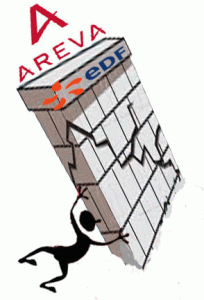 French taxpayers face huge nuclear bill as EDF financial crisis deepens, Ecologist, Paul Brown 8th December 2016
Nuclear giant EDF could be heading towards bankruptcy, writes Paul Brown, as it faces a perfect storm of under-estimated costs for decommissioning, waste disposal and Hinkley C. Meanwhile income from power sales is lagging behind costs, and 17 of its reactors are off-line for safety tests. Yet French and UK governments are turning a blind eye to the looming financial crisis.
The liabilities of Électricité de France (EDF) – the biggest electricity supplier in Europe, with 39 million customers – are increasing so fast that they will soon exceed its assets, according a report by an independent equity research company,
Bankruptcy for EDF seems inevitable – and if such a vast empire in any other line of business seemed to be in such serious financial trouble, there would be near-panic in the workforce and in governments at the subsequent political fall-out.
But it seems that the nuclear-dominated EDF group is considered too big to be allowed to fail. So, to keep the lights on in western Europe, the company will have to be bailed out by the taxpayers of France and the UK.
The French government, facing elections next spring, and the British, struggling with the implications of the Brexit vote to leave the European Union, are currently turning a blind eye to the report by AlphaValue that EDF has badly under-reported its potential liabilities.
Ageing nuclear reactors
While EDF is threatening to sue people who say it is technically bankrupt, the evidence is that the cost of producing electricity from its ageing nuclear reactors is greater than the market price.
Coupled with the impossibility of EDF paying the full decommissioning costs of its reactors, it is inevitable that it is the taxpayers in France and the UK who will eventually pick up the bill. However this will not be easy due to the EU’s ‘state aid’ rules, which limit governments’ ability to support ailing companies.
There is also the ongoing thorny problem of disposing of the nuclear waste and spent fuel rods, which are building up in cooling ponds and stores on both sides of the Channel, with no disposal route yet in sight.
A looming problem for EDF, which already admits is has €37 billion of debt, is that 17 of its ageing fleet of nuclear reactors, which provide 70% of France’s electricity, are being retired.
According to AlphaValue, EDF has underestimated the liabilities for decommissioning these reactors by €20 billion. Another €33.5 billion should be added to cost of handling nuclear waste, the report says. Juan Camilo Rodriguez, an equity analyst who is the author of the report, says that a correct adjustment of nuclear provisions would lead to the technical bankruptcy of the company.
In a statement, EDF said it “strongly contests the alleged accounting and financial analyses by the firm AlphaValue carried out at the request of Greenpeace and relating to the situation of EDF”.
It says that its accounts are audited and certified by its statutory auditors, and that the dismantling costs of EDF’s existing nuclear power fleet have also been subject to an audit mandated by the French Ministry of the Environment, Energy and the Sea.
Even with its huge debts, EDF’s problems could be surmounted if the company was making big profits on its electricity sales, but the cost of producing power from its nuclear fleet is frequently greater than the wholesale price.
That creates a second problem – that unless the wholesale price of electricity rises and stays high, the company will make a loss on every kilowatt of electricity it sells. The new rightwing French presidential candidate, François Fillon, promises not to retire French reactors and to keep them going for 60 years. But this cannot be done without more cost.
This is the third problem: vast sums of capital are needed to refurbish EDF’s old nuclear fleet for safety reasons following the 2011 Fukushima nuclear disaster in Japan. …….
Repeated life extensions
Since the sale of UK nuclear plants to EDF in 2008 at a cost £12.5 billion, the company has continued to operate them, and has repeatedly got life extensions to keep them running.
But this cannot go on forever, and they are expected to start closing in the next ten years. Once this happens, the asset value of each station would become a liability, and EDF’s mountain of debt would get bigger.
So far, the French and UK governments, and the company itself, seem to be in denial about this situation. Currently 17 French reactors are shut down for safety checks, following the discovery of faulty safety-critical compenents including large, difficult to replace steel forgings like steam generators.
The company has issued reassuring statements that they will be back to full power after Christmas, however in so doing EDF is assuming that the safety checks will give the reactors a clean bill of health. In fact, there are three other possible outcomes:
- additional potentially time-consuming tests are needed that will create further months of downtime.
- remedial engineering works are required to make the reactors safe. These would probably be costly and time-consuming.
- key components at the heart of the reactors, for example steam generators, need to be replaced altogether. However this would be so costly that, for a nuclear plant already reaching the end of its lifetime, premature closure would be the only viable option.
Perhaps the most likely outcome is that some of the 17 reactors will fall into each of these four categories, creating as yet unquantifiable unbudgeted costs for the company.
Meanwhile, to make up the shortfall from the closed reactors, electricity is being bought from neighbouring countries, including the UK, to keep the lights on in France. The power shortage is temporarily causing an increase in wholesale prices – but one that EDF is unable to fully exploit because so many of its reactors are not generating.
The future remains unpredictable – but as long as there are no actual power cuts, no action is expected from governments. Despite official denials, however, the calculations of many outside the industry suggest that it is only a matter of time before disaster strikes.
The cost of producing electricity from renewables is still falling, while nuclear gets ever more expensive, and massive liabilities loom. Ultimately, the bill will have to be passed on to the taxpayers. http://www.theecologist.org/News/news_analysis/2988433/french_taxpayers_face_huge_nuclear_bill_as_edf_financial_crisis_deepens.html
December 10, 2016
Posted by Christina Macpherson |
business and costs, France, politics |
Leave a comment
French taxpayers face huge nuclear bill as EDF financial crisis deepens, Ecologist, Paul Brown 8th December 2016 “………New nuclear stations Even more money is required to finish new nuclear stations EDF is already committed to building. The first, Flamanville in northern France, is five years late and billions over budget. Questions over the quality of the steel in its reactor are still not resolved, and it may never be fully operational.
Add to that the need for €12 billion (or potentially considerably more) capital to complete the two nuclear stations EDF is committed to building at Hinkley Point in southwest England, and it is hard to see where all the money will come from.
To help the cash-strapped company, its ultimate owner, the French state, has already provided €3 billion in extra capital this year, and decided to forego its shareholder dividend. But that is a drop in the ocean.
Mycle Schneider, a Paris-based independent international consultant on energy and nuclear policy, says: “The French company overvalues its nuclear assets, and underestimates how much it will cost to decommission them.
“However, EDF’s biggest problem is the cost of producing power from these ageing power stations. The cost is greater than the wholesale price, so everything they sell is at a loss. It is impossible to see how they can ever make a profit.”
He says that is not the company’s only problem: France has not dealt with the problem of nuclear waste, and has badly underestimated the cost of doing so: “With German electricity prices going down and production increasing in order to export cheap electricity to France, it is impossible to see how EDF can ever compete. It is really staggering that no one is paying any attention to this.”
Even former EDF director Gérard Magnin agrees. He resigned from the board in July as he thought the Hinkley Point project too risky for the company because of its already stretched finances. Now he says that, with the reactors closed for safety checks, the French nuclear industry faces “its worst situation ever”.
The company’s troubles do not stop in France, as EDF also owns the UK nuclear industry. Ironically, it took over 15 reactors in the UK after British Energy went bankrupt in 2002 because the cost of producing the electricity was greater than the wholesale price – exactly the situation being repeated now in France.http://www.theecologist.org/News/news_analysis/2988433/french_taxpayers_face_huge_nuclear_bill_as_edf_financial_crisis_deepens.html
December 9, 2016
Posted by Christina Macpherson |
business and costs, France, politics |
Leave a comment

 French court probes forged documents case at Areva nuclear foundry http://www.reuters.com/article/us-france-nuclear-areva-court-idUSKBN13X20C, 8 Dec 16 The Paris prosecutor’s office has opened an investigation into the suspected falsifying of documents at Areva’s Le Creusot foundry that manufactures parts for nuclear reactors, a judicial source said on Thursday.
The case, which alleges forgery, use of forged documents, endangerment of lives and aggravated deception, will be put in the hands of the police, the source said. French nuclear safety regulator ASN said in October that it had asked the courts to step in to investigate after nuclear group Areva sounded the alarm in May over documentation irregularities involving 6,000 nuclear component manufacturing files.
Thousands of such documents used in the French nuclear sector dating back to 1965 are being looked at
“We have not been informed (of the investigation) at this point,” a spokeswoman for Areva told Reuters, adding that the group would cooperate with the investigation and hand over all information at its disposal.
The discovery of weak spots in the reactor vessel of the EPR reactor under construction in Flamanville in 2014 led Areva to review manufacturing procedures at its Creusot steel forging plant.
ASN said in September that Areva had identified 87 irregularities related to reactors operated by state utility EDF, 20 concerning equipment for the Flamanville reactor, and one related to a steam generator for EDF’s 900 MW Gravelines 5 reactor on halt since April.
Gravelines 5’s restart has been pushed back to June 2017 after an executive told parliament in October that something suspicious had been discovered. (Reporting by Benjamin Mallet, Chine Labbé and Bate Felix; editing by Richard Balmforth/Mark Heinrich)
December 9, 2016
Posted by Christina Macpherson |
France, Legal |
Leave a comment
 Mitsubishi Heavy faces tough decisions in nuclear power business Orders dry up at home and abroad after Fukushima disaster, Nikkei Asian Review, 8 Dec 16, TOKYO –– Mitsubishi Heavy Industries and Japan Nuclear Fuel are putting the final touches on a plan to acquire a roughly 10% stake in the troubled French nuclear energy company Areva. But for Mitsubishi Heavy it is an agonizing decision.
The investment would involve spending 40-50 billion yen ($350-438 million), which is an extraordinary amount considering the uncertain future of the nuclear power business. Mitsubishi Heavy has made little headway with exports, highlighted by Vietnam’s recent decision to abandon plans for a pair of nuclear plants. The Japanese company finds itself in a tight spot, pulling with no progress on a rope it cannot release.
In Japan, the Sendai plant operated by
Kyushu Electric Power is one of the few domestic nuclear power plants now running. Restarting other plants and making them safer and more quake-resistant are the tasks at hand. But Mitsubishi Heavy has received few hard orders and it is rough going for the manufacturing aspect of its nuclear power business, admitted company President Shunichi Miyanaga.
Facing dim prospects for new domestic orders, both Mitsubishi Heavy and Japan Nuclear Fuel must find other ways to secure enough business to keep their equipment and workforces active.
Back in 2006, Mitsubishi Heavy partnered with Areva to develop a so-called Generation III+ pressurized-water reactor with state-of-the-art technologies. The team has been using the design to compete with the larger, older-generation pressurized-water systems promoted by two other groups: the team of Hitachi and General Electric, and the team of Toshiba and Westinghouse…….
The French government, which owns nearly 90% of Areva, is looking to cut its losses. Unprofitable businesses are being excised from Areva and a new company is being set up that will seek over 30% of its capital from Japan, China, and elsewhere. …
There are lingering worries inside Mitsubishi Heavy about this huge investment in Areva. To alleviate those concerns, Mitsubishi Heavy has voiced confidence that there will be another nuclear renaissance in 20 to 30 years……http://asia.nikkei.com/Business/Deals/Mitsubishi-Heavy-faces-tough-decisions-in-nuclear-power-business
December 9, 2016
Posted by Christina Macpherson |
business and costs, France, Japan, politics international |
Leave a comment
France investigating hazardous nuclear plant after Greenpeace call – report https://www.rt.com/news/369320-france-nuclear-plant-danger/ 6 Dec, 2016 France has reportedly opened an investigation into an activity of its oldest power plant, Fessenheim, after Greenpeace reported that the reactor has numerous abnormalities and is endangering people’s lives.
The investigation was launched by the Paris Prosecutor’s office, AFP reported on Monday evening, citing judicial sources.
The Fessenheim power plant is in the Haut-Rhin department in Alsace, eastern France, near the German and Swiss borders.
The plant’s activity is endangering the lives of people and it has equipment which doesn’t fulfill the requirements of safety, according to the AFP report.
READ MORE: France’s nuclear watchdog wants to shut down 5 reactors over failure risk
All these concerns were previously voiced by Greenpeace, which accused AREVA, a group specializing in nuclear power and renewable energy, and Électricité de France (EDF) of inaction.
In October this year, Greenpeace called upon the Paris prosecutor to investigate the abnormalities of both reactors of the plant.
“EDF and AREVA were aware of serious irregularities on Reactor 2 at Fessenheim,” the statement said. “The defective part is a steam generator, an essential component of nuclear reactors.”
The group also called for the immediate shutdown of Reactor 1 of the plant.
Greenpeace also accuses EDF and AREVA of falsifying safety certificates of the plant so that the authorities won’t shut it down.
“EDF, as the operator, has in fact decided to give priority to economic interests instead of protecting people and the environment.”
Fessenheim has recently been the topic of heated discussion, which even took place in the Elysee Palace. In April, President Francois Hollande promised to formally initiate the shutdown of France’s oldest nuclear reactors on the grounds of environmental and safety concerns.
READ MORE: Hollande vows to shut down France’s oldest nuclear power plant
Also in October, the Nuclear Safety Authority (ASN) asked EDF to shut down and inspect the plant. Fessenheim houses two 920 megawatt reactors and has been running since 1978, making it France’s oldest operating nuclear power plant. The German government and activists alike have long been calling for it to be permanently closed.
The plant is situated on a seismic fault line, making it vulnerable to earthquakes and flooding. The German government has repeatedly called on France to terminate the Fessenheim plant as soon as possible, after an April 2014 accident when one of the reactors had to be shut down as water was found leaking from several places.
France has 58 nuclear reactors with a total capacity of 63.2 Gigawatts. The country gets two thirds of its electricity from nuclear energy.
December 7, 2016
Posted by Christina Macpherson |
France, safety |
Leave a comment