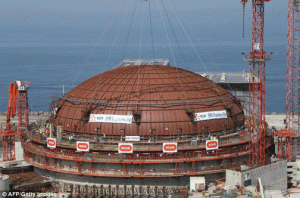
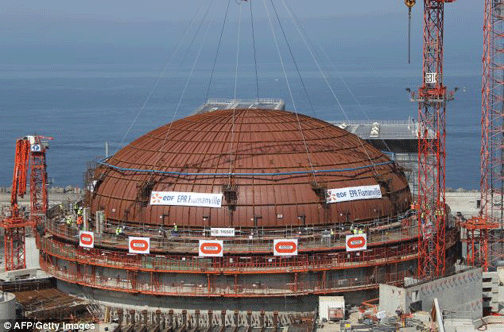
 FT 28th June 2017, A group of experts at the French nuclear safety authority have cleared
EDF’s Flamanville 3 nuclear reactor to start as planned next year – despite weak spots in its steel. The group’s non-binding recommendation will be used by the safety authority, the ASN, to formulate a final ruling on October.
But the decision makes it likely the reactor will get the final green light. Completion of the next-generation reactor had been thrown into doubt after the discovery in 2015 of weak spots in the steel prompted an
extensive safety review by the ASN.
The stakes are high for French nuclear groups EDF and Areva because it would cost billions of euros to fix if the
ASN had ruled that the steel was too brittle. The sign off by the ASN is also a European Commission pre condition for approving EDF’s planned takeover of Areva’s reactor business. The group of experts did recommend,
however, that EDF put in place a new reactor cover by 2024. https://www.ft.com/content/7b401283-e91c-3612-9e21-2d1c8c45ed8d
June 30, 2017
Posted by Christina Macpherson |
France, safety |
Leave a comment
 ASN 28th June 2017, On 28th June 2017, ASN presented its position regarding the Flamanville EPR
reactor pressure vessel anomaly. ASN relied on the analysis of the files
transmitted by Areva NP and EDF, carried out by its nuclear pressure
equipment department and its technical support organisation IRSN, and on
the opinion of its Advisory Committee for nuclear pressure equipment.
On the basis of the technical analyses carried out, ASN considers that the
mechanical characteristics of the pressure vessel bottom head and closure
head are adequate with regard to the loadings to which these parts are
subjected, including accident situations.
However, the anomaly in the chemical composition of the steel entails a reduction in the margins with
respect to the fast fracture risk. ASN therefore considers that EDF must
implement additional periodic inspections to ensure that no flaws appear
subsequently. ASN observes that such inspections can be performed on the
vessel bottom head and therefore considers that they must be implemented.
However, the technical feasibility of similar inspections on the pressure
vessel closure head is not established. ASN therefore considers that the
use of the closure head must be limited in time. It notes that it would
take about seven years to manufacture a new closure head, which could thus
be available by the end of 2024. In these conditions, ASN considers that
the current closure head shall not be operated beyond that date.
http://www.french-nuclear-safety.fr/Information/News-releases/ASN-presents-its-position-regarding-the-Flamanville-EPR-reactor-vessel-anomaly
June 30, 2017
Posted by Christina Macpherson |
France, safety |
Leave a comment
 Reuters 26th June 2017, The cover of the reactor vessel EDF is building in Flamanville, France, may not be able to function more than a few years unless the utility can do additional tests which so far it has not be able to, nuclear regulator ASN said in a report.
While the long-awaited report, a copy of which was obtained by Reuters, concludes the European Pressurized Reactor (EPR) is fit for service, EDF may have to replace its vessel cover soon after its
scheduled start-up in 2018. The requirement is a major blow for EDF, which
will have to start planning for a costly replacement of a key part before
the reactor even starts up.
The reputational damage could also add to concerns in Britain about its 18 billion pound ($23 billion) project to
build two similar EPR reactors in southwest England.
The French regulator had ordered a deep review of the Flamanville vessel following the discovery
in 2015 of carbon concentrations in the base and cover of the containment vessel, which make its steel more brittle. The report – led by the IRSN, the ASN’s technical arm – is being reviewed by a group of independent experts on Monday and Tuesday.
This autumn, ASN will partly base its final ruling on Flamanville on the experts’ recommendations. The ASN report
states that while the base of the vessel is fit for service despite the need for increased monitoring over its lifetime, manufacturer Areva NP has not been able to conduct sufficient tests on the cover as it is no longer accessible. These controls are indispensable in order to ensure the reactor’s safety over its 60-year lifetime, the report says.
http://uk.reuters.com/article/edf-flamanville-nuclear-idUKL8N1JN2OC
June 28, 2017
Posted by Christina Macpherson |
France, safety, UK |
Leave a comment
 Telegraph 25th June 2017,EDF is bracing for a multi-billion euro rise in costs at its Hinkley Point C nuclear site after a fresh evaluation of the project revealed yet another
likely delay. An internal review of the troubled project by senior
executives at EDF’s French headquarters is expected to confirm fears that
the state-backed energy giant will not be able to deliver Hinkley on time
or in line with its £18bn budget.
The French newspaper Le Monde reported over the weekend that sources close to the review have said no one believes
it can be delivered by 2025. Instead, the start-up date is likely to be
2027 and pile a further £870m on to the construction costs of the £18bn
project. The review is being led by Jean-Michel Quilichini, the group’s
audit director, and is expected to be made public later this summer. The
latest delay is likely to fuel concerns that Government has locked energy
bill payers into “a high cost and risky deal” that could fail to deliver on
its economic promises.
http://www.telegraph.co.uk/business/2017/06/25/hinkley-nuclear-costs-climb-deadlines-slip/
June 26, 2017
Posted by Christina Macpherson |
business and costs, France |
Leave a comment
 France Info 22nd June 2017 [Machine Translation] Defects on the pressure vessel of the EPR of Flamanville: “EDF and Areva were not transparent,” denounces Greenpeace. Greenpeace believes that EDF and Areva have not sufficiently communicated on the defects of the pressure vessel of the EPR of Flamanville.
“The origin of the anomalies and the history of the design” have not been made\ public, denounces the association in particular. The NGO is based on a report to which it has had access and which is due to be published onThursday by the High Committee for Transparency and Information on Nuclear Safety (HCTISN) on anomalies in the Flamanville EPR tank ( Handle). The HCTISN is an expert committee on nuclear safety. It decided in June 2015 totake the matter of the anomalies on the tank of the EPR of Flamanville.
According to Greenpeace, the report states that EDF and Areva “did not explain to the public the origin of the anomalies and the history of the design and manufacture of the EPR reactor vessel.” The report also notes that “no alternative technical scenario has been made public, in the event of the rejection of the tank and its lid by the Nuclear Safety Agency
(ASN)”.
“Since the beginning of the case, EDF and Areva have put the ASN before the fait accompli: they refuse to communicate a plan B to force it to accept that the EPR starts with pieces veined,” explains Yannick Rousselet, in charge of Campaign for Greenpeace France. “The rejection of the tank by the ASN would trigger a ‘domino effect’ by questioning the
feasibility of all EPR projects sold by EDF and AREVA in the UK, China and inland, says Yannick Rousselet. Industrialists put an intolerable pressure on the ASN, making the future of the nuclear sector on its shoulders.” http://www.francetvinfo.fr/sante/environnement-et-sante/defauts-sur-la-cuve-de-lepr-de-flamanville-edf-et-areva-nont-pas-ete-transparents-denonce-greenpeace_2248675.html
June 24, 2017
Posted by Christina Macpherson |
France, safety |
Leave a comment
Le Parisien 19th June 2017 A drone flew over a nuclear power plant located in the commune of Avoine, a
few kilometers from Chinon, Sunday evening in the early evening. An
investigation is underway. The Chinon nuclear power plant was overflown
by a drone on Sunday night. At around 8:20 pm, a small flying object was
observed by a station employee. Thirty minutes later, the specialized
gendarmes go to the scene, view the video surveillance images and confirm
the employee’s testimony. A research device was launched by the soldier. No
results so far. A complaint must be filed by the plant manager. The inquiry
is conducted by the Chinon Research Brigade. http://www.leparisien.fr/faits-divers/indre-et-loire-un-drone-survole-la-centrale-nucleaire-de-chinon-19-06-2017-7066137.php
June 21, 2017
Posted by Christina Macpherson |
France, incidents |
Leave a comment
Reuters 19th June 2017, A fire that broke out on the roof of a nuclear reactor at the Bugey plant
in central-eastern France has been extinguished, operator EDF said on
Monday, citing fire brigade officials. The fire began at the plant’s
nuclear reactor number 5, some 35 kilometers from the city of Lyon, nuclear
regulator ASN said earlier in a statement. EDF said in a separate statement
there were no injuries or fatalities, while safety body IRSN said on
Twitter that sensors had not picked up any increase in radiation. http://www.reuters.com/article/us-france-power-nuclearpower-idUSKBN19A2AH
June 21, 2017
Posted by Christina Macpherson |
France, incidents |
Leave a comment
Reporterre 17th June 2017 [Machine Translation] Here is an edifying and accessible book that reveals
the mysteries of the atomic industry in general and the operation of our nuclear power plants in particular.
On the occasion of its release, the Network Sortir du nucléaire has created its own publishing house, Yasnost’Editions. The author, Nozomi Shihiro, comes from the EDF seraglio and has endorsed the operator’s doctrine on transparency: “To tell the public everything he would not like to learn from others . He writes,however, under a pseudonym for fear of passing under the Caudines forks of his enterprise.
Throughout the book he endeavors to show that the transparency chanted by the national electrician is in reality only powder for the attention of the disinformed populations and the docile political world.
https://reporterre.net/Dans-les-arcanes-de-l-industrie-atomique
June 19, 2017
Posted by Christina Macpherson |
France, media |
Leave a comment

 Dave Toke’s Blog 15th June 2017, The French Government’s announcement that it will legislate for a carbon floor price of 30 euros per MWh marks a dramatic turn in EU energy markets which will now be shifted to favour nuclear power above renewables. This is because just over half of nuclear power generated in the EU come from reactors in France, whereas less than 10 per cent of EU renewable energy production comes from France.
The fact that nuclear power is being given special privileges undermines the policy credibility of the Green Energy
Minister Nichals Hulot who has just been appointed by President Macron.
Given that three-quarters of electricity in France comes from nuclear power, and very little from fossil fuels, this measure is a thinly disguised extra incentive for nuclear power, an incentive that the large bulk of renewable generation in the EU will not be able to receive.
Only the UK has a carbon floor price, which is around 17 per cent lower than the proposed French one. A case in point is Germany, which generates a third of the wind power in the EU. German electricity wholesale power prices are
relatively low – much lower than in the case of the UK for example, and there are fears that some windfarms will no longer be economic after their feed-in tariff contracts end after 2020. But they would be likely to stay online of they had access to the carbon floor price being set in France.
There is no carbon floor price in Germany. Macron seems, in energy at least, to be continuing ‘business as usual’ in letting EDF run the French state. The French Government has effectively ploughed several billions into bankrupt nuclear generators AREVA and also injected money to EDF through a ‘share flotation’ (EDF is 85 per cent owned by the French Government) that seems associated with building Hinkley C power station.
http://realfeed-intariffs.blogspot.co.uk/2017/06/france-to-tilt-eu-energy-market-towards.html
June 19, 2017
Posted by Christina Macpherson |
France, politics |
Leave a comment
Capital 15th June 2017, [Machine Translation] Documents from the Institute of Radiation Protection
and Nuclear Safety (IRSN) show that the EPR pressure vessel does not pass a strength test. It would therefore not be in compliance with the regulations, contrary to what is being said.
Areva and EDF play a major part of their economic future this month. First session today: As the Echos recall, the High Committee for Transparency and Information on Nuclear Safety meets to discuss the safety of the EPR nuclear reactor vessel built by Areva on behalf of a group of companies, EDF in Flamanville.
At the end of June, it will be up to the Permanent Expert Group on Nuclear Pressure Equipment (GPESPN) to assess its working. It will examine the findings of another body: the Institute of Radiation Protection and Nuclear Safety (IRSN), the
technical expert of the Nuclear Safety Authority (ASN).
A technical note published by IRSN last April, but until now completely unnoticed, shows that the pressure vessel does not comply with the regulation of nuclear equipment under pressure. And poses a major safety problem. Hidden in the
middle of a mass of documents put online, it is dated September 2015 and signed by Gérard Gary, a nuclear physicist, research director emeritus ex-CNRS attached to the laboratory of solid mechanics of the Ecole
http://www.capital.fr/entreprises-marches/epr-de-flamanville-cette-note-d-expert-qui-pointe-le-danger-de-la-cuve-1232494
June 19, 2017
Posted by Christina Macpherson |
France, safety |
Leave a comment
 Major Changes on Whistleblowing in France, Lexology
Blog The Anticorruption Blog Squire Patton Boggs France June 16 2017
From January 1, 2018, there will be an obligation on almost all employers to implement reporting/whistleblowing schemes.
France has historically been very reluctant to support workplace whistleblowing, especially anonymously. Whistleblowing schemes were effectively only authorized in 2005 to permit US companies to comply with their SOX obligations. Those regulations were very restrictive, limited to employees and only in relation to certain legal breaches.
However, since December 2016, we now have a law relating to “transparency, the fight against corruption and modernization of business life,” also known as “Sapin 2.” This has introduced a number of changes, including the obligation to implement whistleblowing schemes and anti-corruption compliance programs.
Definition of Whistleblower
Sapin 2 Law defines a whistleblower (in French “lanceur d’alerte”) as:
- Any individual (i.e., not limited to employees)
- Acting in good faith
- Reporting or revealing a crime, a serious and manifest breach to an international treaty, a serious breach of a law or regulation, or a serious threat or harm to the public interest
- Of which he or she has personal knowledge……….
Principles Governing Reporting Schemes
- Reporting schemes must protect the identity of the whistleblower, the identity of any person incriminated and the information collected. The disclosure of any of these details carries up to two years’ imprisonment and a €30,000 fine (€150,000 for corporations)……….
Breach of Secrecy by the Whistleblower
A whistleblower will not be liable for breaching a secrecy obligation by law provided that:
- The disclosure is necessary and proportionate for the protection of the interests at stake, and
- The reporting procedures provided by law are complied with
However, Sapin 2 does not allow a whistleblower to disclose information covered by doctor/patient or client/lawyer professional secrecy or national security.
No Retaliation
Whistleblowers are protected from retaliation in the hiring process, in terms of access to an internship or professional courses or in salary or otherwise. However, where the report is made in bad faith, the employee can:
June 19, 2017
Posted by Christina Macpherson |
civil liberties, France |
Leave a comment
France to close some nuclear reactors, says ecology minister Hulot, Reuters, 13 June 17, French environment and energy minister Nicolas Hulot said on Monday that the government plans to close some nuclear reactors of state-controlled utility EDF (
EDF.PA) to reduce nuclear’s share of the country’s power mix.
He gave no indication of timing.
Hulot told reporters at the G7 environment summit in the Italian city of Bologna that it was too early to give numbers about France’s aim to reduce the share of nuclear in its power generation to 50 percent from the current 75 percent.
“We are going to close some nuclear reactors and it won’t be just a symbolic move,” he said.
EDF shares, which were down 0.8 percent before Hulot’s comments, immediately fell further to stand 2.2 percent lower.
Asked about the possibility of introducing a carbon tax, Hulot said “France already has a carbon tax which we increase every year. At an EU level we want to increase the threshold,” he said……https://www.reuters.com/article/us-edf-nuclear-idUSKBN1931AD
June 14, 2017
Posted by Christina Macpherson |
France, politics |
Leave a comment
 11 June 17, Alternatives Economiques, [Machine Translation] Who decides on the energy policy of France,especially for electricity? The president of EDF, the minister of ecological and solidarity transition, in charge of energy, or the tenant of Bercy? Perpetual question that sends a lot of ink and weakens EDF, torn between conflicting interests.
It is time for the government to address the problems ofthe 83% -owned state, which is currently heavily indebted and whose financial situation is worrying.
On 6 April, EDF presented a strategic plan for its future investments as part of its Board of Directors’ plan of multiannual energy programming (PPE) 1 published at the end of October. On April 21, Ségolène Royal wrote to Jean-Bernard Levy, CEO of the EDF group, asking him to review his copy because “the actions foreseen by EDF do not make it possible to respect the objectives of diversification of electricity production set in the PPE “.
Among the points raised by the former minister, the absence of measures or means to prepare the closure of nuclear power plants, such as Fessenheim or coal.
Stopping a power station is not very complicated. Nuclear power stations are shut down regularly in France for maintenance or incidents. On the other hand, preparing the retraining of employees, developing new activities at the level of employment areas, organizing training courses for new trades … all this takes time.
EDF’s strategic plan, silent on these aspects, reveals the company’s will: to drag things out as much as possible. Moreover, it is rumored that EDF would have established a plan to reduce the share of nuclear energy to 50% in the energy mix by 2050 and not 2025 as foreseen in the energy transition law. EDF, but is not in any case in a hurry to revise its
strategic plan transmitted to the State. Why can not the state, which guarantees the implementation of the objectives of the Energy Transition Act, be heard?
For that, it would have to speak with one voice. And that is far from the case. For the shareholder state also has its interests in the matter. According to the Court of Auditors, it received a total of 11.3 billion euros of dividends between 2011 and 2016, an amount that the sages of the rue Cambon consider as exorbitant compared to the usual practices.
This financial interest has up to now pushed the State to support the nuclear sector and to defend the prolongation of the lifetime of power stations already depreciated, according to a short-term vision, which hampers investment in renewable energy energy savings.
But now, things are complicated for EDF, with a drop in its turnover and its production of electricity of nuclear origin. Moreover, very heavy investments are emerging: 55 billion euros in 10 years for the large fairing (upgrading of nuclear reactors), 15 to 20 billion euros for the two British EPRs of Hinkley Point, etc. https://www.alternatives-economiques.fr/anne-bringault/energie-edf-va-t-reviser-plan-strategique/00079236
June 12, 2017
Posted by Christina Macpherson |
business and costs, France, politics |
Leave a comment
Dave Toke’s Blog 27th May 2017 It’s now the middle of 2017 and still, after 12 years of trying to build the French European Pressurised Reactor, there is still no model in operation. Even in China, which has, according to some of its domestic critics, let us say a more relaxed attitude to safety requirements compared to western agencies, the EPR at Taishan is still not generating electricity.
It was 16 months ago that the constructors announced that ‘cold start’ tests had been successful and that the whole of the plant (including two sets) would be fully functional this year (2017). Now they say that this will not happen, although one set ‘will’ be running sometime in the second half of this year. But then the plant, which begun construction in 2009, was supposed to be finished in 2013. This failure does present the question of how it is that other nuclear plant built in
China have not been subject to this much delay.
How can we explain this? The obvious reason is that the EPR is a turkey that is widely regarded as bordering on, if not actually, ‘unconstructable’. The difference with other nuclear plant built in China may simply be that the EPR was designed to suit western safety standards.
It’s an easy guess to say what this means for Chinese plans to build nuclear power plant in the UK! In France
construction at the EPR at Flamanville began in 2007 and completion by 2019 seems possible but uncertain. The other EPR at Olkiluoto started in 2005 and is about, so they say. to undergo ‘cold tests’. On the basis of what has happened in Taishan this doesn’t mean that it is about the generate electricity, though. http://realfeed-intariffs.blogspot.co.uk/2017/05/more-delays-in-epr-signals-more.html
May 31, 2017
Posted by Christina Macpherson |
business and costs, China, France |
Leave a comment
French nuclear regulator delays Flamanville ruling to autumn
ASN again delays ruling on safety of Flamanville reactor
* Postpones ruling to “autumn” from “end of summer”
* Will issue provisional ruling in July, then seek input (Adds new ASN statement)
Reuters, By Geert De Clercq PARIS, May 30 French nuclear regulator ASN said on Tuesday it will “probably” issue a final ruling in the autumn on whether the reactor that utility EDF is building in Flamanville is safe for use, in the latest delay in the process.
The ASN said in 2015 it had discovered excessive carbon concentrations in the cover and bottom of the Flamanville reactor vessel, which can weaken the mechanical resilience of the steel and its ability to resist the spreading of cracks.
Since then, Areva, which designed the EPR reactor, EDF and the ASN have been testing whether weak spots could jeopardise the safety of the reactor.
The regulator’s green light about the reactor vessel is crucial for EDF and Areva, as European Union antitrust authorities have made it a precondition for their approval of EDF’s planned takeover of Areva’s reactor unit.
The ASN has repeatedly postponed deadlines for ruling on the safety of reactor vessel.
And in what will be another delay, an ASN spokesman said in an email that the regulator now expected a “firm position probably in (the) autumn”……
Earlier on Tuesday, the ASN said it expected to receive technical reports about the reactor vessel by the end of next month. It will analyse these and then draft a provisional ruling on Flamanville, which will be made public in early to mid-July. It will then invite feedback on this ruling from the public, civil society, local authorities and the companies involved.
With the Flamanville reactor vessel welded in place in 2013 and covered by thousands of tonnes of concrete since then, taking out the vessel would delay the reactor startup by several years and cost billions of euros.
EDF has repeatedly said it is confident the ASN will find the vessel fit for operation……
The Flamanville reactor is years behind schedule and billions over budget, but EDF CEO Jean-Bernard Levy said this month EDF plans to load fuel in the reactor before end-2018. Construction in Flamanville started in 2007 and the plant was supposed to go online in 2012, but EDF has announced new delays and cost overruns every few years. The company said in 2015 the reactor would cost 10.5 billion euros ($12 billion), up from an initial budget of 3 billion. ($1 = 0.8948 euros) (Editing by Mark Potter/Alexander Smith) http://www.reuters.com/article/edf-flamanville-asn-idUSL8N1IW4N6
May 31, 2017
Posted by Christina Macpherson |
France, safety |
1 Comment








 nuclear-news