Drop in output of France’s nuclear reactors, due to delays and outages
French nuclear output drops to 52 GW on maintenance, outage, delays, S and P Global,
Andreas Franke , EditorJonathan Dart , 14 Jan 19 London — French nuclear output peaked at 52 GW Monday as an unplanned outage, delays to scheduled returns and planned maintenance kept availability below expectations, data from grid operator RTE and nuclear operator EDF show.
The 910-MW Blayais 2 reactor suffered an outage Sunday afternoon due to turbine failure in the non-nuclear part of the plant, EDF said. The reactor is due to return Monday at 8:00 pm local time (1900 GMT).
The 1.3-GW Penly 1 reactor is also scheduled to return Monday night following a three-month maintenance break.
The 1.3-GW Flamanville 1 unit is scheduled to return late Wednesday following a 10-year overhaul that began in April 2018 and extended for four months more than expected.
Flamanville 2 started its own 10-year-overhaul last week.
EDF has warned of a “particularly dense and complex maintenance schedule” this year, with seven reactors undergoing 10-year-overhauls.
Another two reactors are scheduled to go offline this weekend for annual maintenance. ……–Andreas Franke, andreas.franke@spglobal.com
–Edited by Jonathan Dart, newsdesk@spglobal.com https://www.spglobal.com/platts/en/market-insights/latest-news/electric-power/011419-french-nuclear-output-drops-to-52-gw-on-maintenance-outage-delays
Five of France’s EDF nuclear reactors shut down, awaiting regulatory approval
Creusot: 5 EDF reactors still without ASN green light. Five nuclear
reactors are still waiting for an operating license from the Nuclear Safety
Authority (ASN) as part of the investigation of the manufacturing records
of the Creusot plant, while the other 53 have already received fire green,
Creusot’s spokesperson said .
“We are still waiting for elements of answers from EDF,” she said to explain the delay of the
investigation which was to end on December 31, 2018. The five reactors
concerned are Cattenom 4 (1,300 MW ), Fessenheim 1 (880 MW), Flamanville 2
(1,330 MW), Golfech 1 (1,310 MW) and Tricastin 2 (915 MW). All five
reactors will be shut down for maintenance in the coming weeks, as follows:
Cattenom 4 (January 19th to April 11th), Fessenheim 1 (January 19th to
March 20th), Flamanville 2 (January 10th to July 10), Golfech 1 (February
16 to March 23) and Tricastin 2 (January 26 to April 1). The reactors will
not be able to restart without prior approval from ASN.
Communities call on France’s government to stop EDF from setting up nuclear facilities on agricultural land.
|
Le Quotidien 20th Dec 2018 In a letter addressed to the highest authorities of the French state,
associations denounce the massive purchase of land by EDF around nuclear power plants, including that of Cattenom. They suspect the company of planning the construction of EPR and call for the respect of the right of neighboring countries, including Luxembourg, to live in a preserved environment. Following the acquisition by EDF of agricultural land around
nuclear sites, including Cattenom, defense associations are concerned about the vagueness of these purchases and the uncertainties that weigh on their future use. The Daily publishes below all of their letter addressed to the President of the Republic, the Prime Minister, the Minister of Ecological Transition and local elected representatives: “No to the extension of nuclear, yes to the protection of agricultural land http://www.lequotidien.lu/grande-region/extension-de-cattenom-vers-la-construction-dun-epr/ |
|
AREVA – ORANO? -Framatome? – corruption in the air yet again for France’s nuclear corporation?
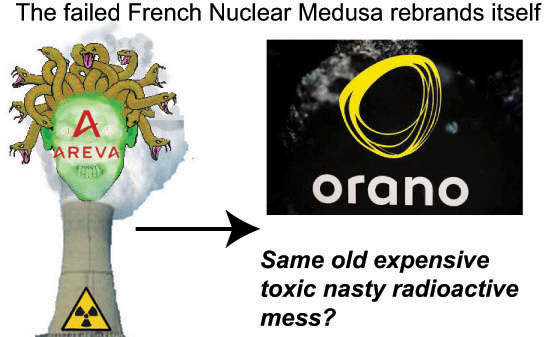
Orano’s activities in Mongolia under judicial investigation for suspicion of corruption https://www.lemonde.fr/energies/article/2018/12/19/les-activites-d-orano-en-mongolie-visees-par-une-enquete-judiciaire-pour-des-soupcons-de-corruption_5399983_1653054.html 19th Dec 2018 These suspicions of “bribery of a foreign public official” involve one of the service providers of Orano, the consulting firm Eurotradia International.
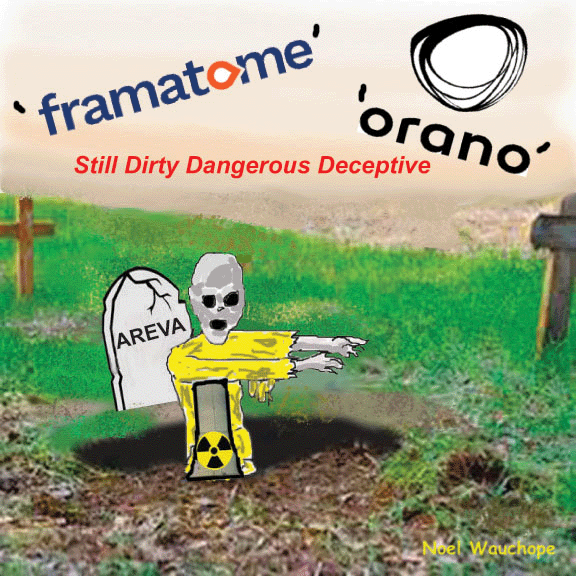 The French nuclear group Orano, [or is it Framatome?] formerly Areva, is in
  the sights of the national prosecutor’s office that investigates suspicions of corruption in Mongolia, it was learned, Wednesday, December 19,from sources close to the case. These suspicions of “bribery of a foreign public official” involve one of the service providers of Orano, the consulting firm Eurotradia International.
Anti-corruption campaign in Mongolia
In October 2013, under the chairmanship of Luc Oursel, Areva entered into a strategic partnership to exploit two uranium deposits in the Gobi Desert (southeast) with Mongolian Mon-Atom and Japan’s Mitsubishi. The agreement came after more than ten years of exploration of the French group in Mongolia, but it remained uncertain until the last moment. The project had sparked strong environmental opposition in this huge country of three million inhabitants, whose subsoil is rich in ores (uranium, copper, gold, coal).
The case is part of an anti-corruption campaign in Mongolia where, in another case, two former prime ministers were jailed in April for controversial deals with the mining giant, Anglo-Australian Rio Tinto.
In addition, the French nuclear group has already been targeted since 2015 by a preliminary survey of the PNF. This case, dubbed “uraniumgate”, is about the controversial sale in the fall of 2011, a large amount of Nigerian uranium for $ 320 million. https://www.lemonde.fr/energies/article/2018/12/19/les-activites-d-orano-en-mongolie-visees-par-une-enquete-judiciaire-pour-des-soupcons-de-corruption_5399983_1653054.html
How France multiplies hazardous nuclear waste.
 Reporterre 11th Dec 2018 Claiming to ” recycle ” used nuclear fuel, the reprocessing industry complicates the management of waste by increasing the amount of plutonium and hazardous materials.
According to the official communication, the reprocessing does not generate
contamination, only ” authorized discharges ” . They are spit by the
chimneys, dumped at the end of a pipe buried in the Channel.
authorized to reject 20,000 times more radioactive rare gases and more than
500 times the amount of liquid tritium that only one of the Flamanville
reactors located 15 km away. ” . It contributes ” almost half to the
radiological impact of all civilian nuclear installations in Europe ” .
https://reporterre.net/Comment-la-France-multiplie-les-dechets-nucleaires-dangereux
REPLACING NUCLEAR WITH RENEWABLES WOULD SAVE FRANCE $44.5 BILLION
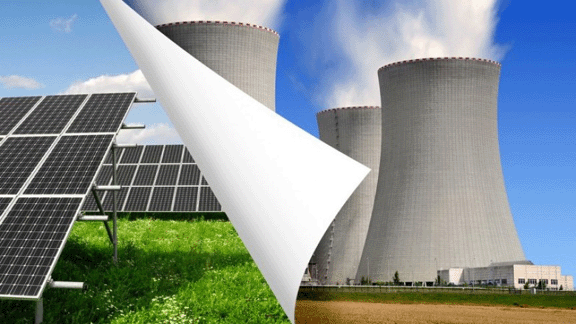
 Futurism, 13 Dec 18 The French government just announced a plan to power 95 percent of the country with solar and wind energy by 2060. And by doing so, the government would spend about $44.5 billion (39 billion euros) less than it would if it maintained its current energy infrastructure.
To get there, the government would need to cancel plans to construct 15 new nuclear power plants, and instead replace its aging nuclear reactors with renewable infrastructure over the next several decades, according to a new report published Monday by the French environmental agency.
The report details how France could increase its dependence on solar and wind energy over time, gradually shutting down nuclear power plants to make room for renewables.
But doing so will still be costly: the report suggests that developing these new power plants as well as the necessary infrastructure to support them will cost the government $1.45 trillion (1.28 trillion euros) over the next 42 years. That’s a huge investment, but it’s still much cheaper than maintaining the status quo and replacing the country’s aging nuclear power plants with more modernized reactors…….. https://futurism.com/the-byte/nuclear-plants-renewable-energy-france
Despite President Macron, France’s government report calls new nuclear power uneconomical
 Building new nuclear plants in France uneconomical -environment agency https://af.reuters.com/article/commoditiesNews/idAFL8N1YF5HCGeert De Clercq, DECEMBER 11, 2018
State environment agency contradicts Macron on new nuclear
* New nuclear reactors would be structurally loss-making
* Renewables could account for 85 pct of power mix by 2050.
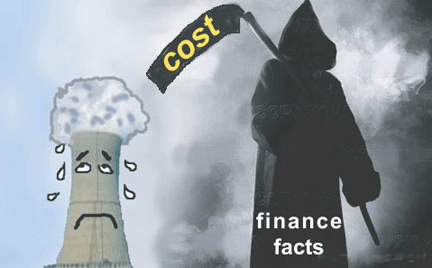
Building new nuclear reactors in France would not be economical, state environment agency ADEME said in a study on Monday, contradicting the government’s long-term energy strategy as well as state-owned utility EDF’s investment plans.
In a speech last month, President Emmanuel Macron said nuclear energy would remain a promising technology for producing low-cost, low-carbon energy and that EDF’s EPR reactor model should be part of future energy options.
Macron has also asked EDF to draw up a plan for building new reactors with a view to making a decision about nuclear in 2021
Two EPR reactors under construction in France and Finland are years behind schedule and billions of euros over budget.
“The development of an EPR-based nuclear industry would not be competitive,” ADEME said, adding that new nuclear plants would be structurally loss-making. bit.ly/2GlEbcT
Building a single EPR in 2030 would require 4 to 6 billion euros of subsidies, while building a fleet of 15 with a total capacity of 24 gigawatt-hour by 2060 would cost the state 39 billion euros, despite economies of scale that could bring down the EPR costs to 70 euros per megawatt-hour (MWh), ADEME said.
Renewables costs could fall to between 32 and 80 euros/MWh, depending on the technology, by 2060.
But extending the existing fleet too long, while also building new EPRs, would lead to overcapacity, compromising returns on all generation assets, including renewables.
EDF – which generates about 75 percent of French electricity with 58 nuclear reactors – declined to comment.
The ADEME report, which studied energy mix scenarios for 2020-2060, said renewables could account for 85 percent of power generation by 2050 and more than 95 percent by 2060, except if the government pushes through the EPR option anyway.
The gradual increase of renewables capacity could reduce the pre-tax electricity cost for consumers – including generation, grids and storage – to about 90 euros per MWh, compared to nearly 100 euros today, ADEME said.
ADEME director Arnaud Leroy, appointed in February, helped write the energy chapter of Macron’s election programme and was a spokesman for his campaign, but the agency is independent and earlier studies have also contradicted government energy policy.
In 2015, a ADEME study suggesting that France could switch to 100 percent renewable energy by 2050 at a cost similar to sticking with nuclear was barred from publication for months by the government. reut.rs/2RLGKG8 (Reporting by Geert De Clercq; editing by David Evans)
Why France must shut down many nuclear reactors
Backstory: Macron To Close Multiple Nuclear Reactors, But Why Now? https://cleantechnica.com/2018/11/30/backstory-macron-to-close-multiple-nuclear-reactors-but-why-now/?fbclid=IwAR0tO9BXT4FaNEuhnwexaC6cf4V6jj6cJLnQeiZPdA91t7SrrmL5n7xtRHg November 30th, 2018 by Michael Barnard
President Emmanuel Macron of France depressed nuclear executives globally in late November 2018, announcing the planned retirement of 14 of 58 reactors by 2035. This was still less than was promised in his election campaign, but represents a major internal political battle, as well as a major change of France’s circumstances.
This has been an emerging story for several years.
 France did a better job than most of building nuclear plants. They picked a single design and built a bunch of them over a relatively concentrated 20 years from about 1978 onward. It was a massive, state-funded, state-managed energy infrastructure initiative at a scale rarely seen. They dodged a bunch of the mistakes of other geographies somewhat by accident. They aren’t subject to earthquakes or tsunamis. They kept the technology highly standard. They developed a skilled workforce for building them and rewarded them well.
But the last nuclear reactor went live almost 20 years ago, the oldest ones are at end-of-life, and the skilled workforce only knows how to maintain and operate existing reactors now, not build new ones. The current President of France, Macron, used to be the Minister of Industry. He’s stated publicly that even he couldn’t find out how much the build-out actually cost, with the clear assertion that a bunch of actual costs were hidden.
“Nobody knows the total cost for nuclear energy,” he said. “I was minister for industry and I could not tell you.”
And France had to build nuclear to be load-following due to its over-reliance on a more usually inflexible form of generation. Nuclear is good for baseload up to 30–40%, but when it has to be turned on and off it gets a lot more expensive very quickly. France has the good fortune to have been able to export a lot of electricity to the rest of the EU for several years, but the energy mix on the continent is strongly favoring more flexible forms of generation.
And now, a few things have changed in the decades since France made its huge bet on nuclear generation in the Messmer Plan in 1974.
Renewables are dirt cheap, with Lazard’s latest figures bringing them in at 3–6 times cheaper than new nuclear. (Amusingly, Lazard still labels wind and solar as ‘alternative energy‘.) Europe is a leading geography for wind and solar, so skilled trades and supply chains all exist. Europe’s grid has strengthened and expanded over the past 30 years, so the need for a country to go it alone has diminished substantially.
The EU was founded in 1993 and France is an integral part of it, and that has two impacts. The first is that France’s energy independence policy that was part of the impetus for a massive nuclear fleet looks archaic in context of modern politics and economics. The second is that EU regulations forbid destabilizingly large governmental subsidies for energy, something which the Hinkley plant in the EU had to fight through. As Macron’s experience shows, it’s actually impossible for anyone to figure out how much any nuclear plant actually cost due to budget fudging. This last is true globally, by the way.
French attempts to build next-generation reactors are failing in multiple locations in France and elsewhere. The cost and budget overruns and construction failures are staggering.
And Chernobyl and Fukushima both happened since the French nuclear build-out began. Public support diminished substantially after those events, one on the same continent and one a world away.
France receives a greater percentage of its electricity from nuclear than any country in the world, at 72% close to 50% more than its nearest ‘competitor’, Slovakia. And it will diminish over the coming decades. Its last-built reactor will reach end-of-life in 2040 or so. It’s unlikely that it will be replaced. And it’s unlikely that more than a fraction of the aging reactors will be refurbished at all.
Wind, solar, a continent-scale grid, and open economic borders all contributed to the death of the French nuclear dream. It’s time for France to wake up and join the future, and it has. It voted in Macron, a politician who promised to reduce France’s nuclear fleet. He fought the entrenched bureaucracy and EDF, and while the new plans are slower than the promised ones, they are the right plans on a pragmatic timeline.
Report shows how unprepared France is, in the event of a nuclear accident
 ACRO 15th Nov 2018 In the event of a serious nuclear accident, France is not ready. This is
the conclusion of a study of ACRO carried out for the ANCCLI (National
Association of Committees and Local Information Commissions). Indeed, the
lessons of the Chernobyl disaster were ignored, because it was an accident
described as “Soviet”, so impossible in France. Those of the Fukushima
disaster are slow to be taken into account.
https://www.acro.eu.org/plans-durgence-nucleaire-en-france-forces-et-faiblesses/
Appeal lodged to stop commissioning of Flamanville EPR nuclear reactor vessel.
|
Greenpeace France 28th Nov 2018 The “Sortir du nucléaire” network, Greenpeace France, the CRILAN and Stop
EPR-Ni in Penly and elsewhere are now filing an appeal before the Council of State to cancel the authorization given by the Nuclear Safety Authority (ASN). ) to commission the Flamanville EPR reactor vessel. An authorization that should never have been granted. In 2005, ASN alerted Areva NP (now
Framatome) and EDF to bad practices at the Creusot Forges plant. Ignoring these warnings, Areva NP has still made important elements of the tank for the EPR Flamanville. As shown by the correspondence between Areva and the ASN, the manufacturer has ignored the remarks of the latter on the manufacturing processes of this equipment. However, once the tank irreversibly installed in the reactor, Areva warned the ASN that it contained a defect calling into question its strength! After having described this anomaly as “very serious”, ASN nevertheless proposed to
Areva to introduce a request for a derogation. Despite the protests of many citizens , the Safety Authority finally gave a favorable opinion on the use of this tank. Then, on October 10, 2018, she issued an authorization subject to the change of the lid in 2024 and additional surveillance measures. Given the problems encountered in Flamanville, it is absurd that the government continues to open the door to new reactors, with a possible decision on new projects in 2021.
The future is for the energy transition towards energy savings and renewable energies, not to keep at arm’s length
an outdated technology that threatens the whole of Europe! https://www.greenpeace.fr/espace-presse/epr-quatre-associations-deposent-recours-devant-conseil-detat/ |
France abandons plans for the Astrid (Advanced Sodium Technological Reactor for Industrial Demonstration)
Reuters 29th Nov 2018 , The French government has informed Japan that it plans to freeze a next
generation fast-breeder nuclear reactor project, the Nikkei business daily
reported on Thursday. Japan, which has been cooperating with Paris on the
fast-breeder development in France, has invested about 20 billion yen
($176.27 million) in the project, the report added. The French government
will halt research into the Astrid (Advanced Sodium Technological Reactor
for Industrial Demonstration) project in 2019, with no plans to allocate a
budget from 2020 onwards, the report said, without citing sources.
https://www.reuters.com/article/france-nuclearpower-astrid/update-1-france-to-freeze-fast-breeder-nuclear-reactor-project-nikkei-idUSL4N1Y41OU?rpc=401&
Manipulations suggested to keep up tax-payer funding for EDF’s nuclear business
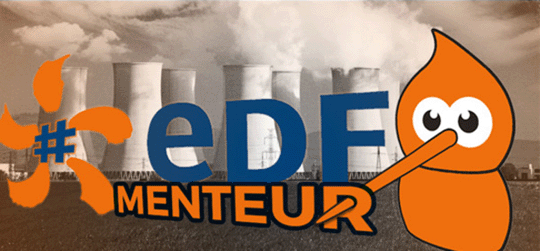 L’usine Nouvelle 28th Nov 2018 Ongoing reflection on EDF’s structure could lead to the creation of a
public holding company at the head of two major subsidiaries, with the
group’s nuclear fleet on one side and the sale of its production on the
other a group of activities that are most concerned by the energy
transition.
EDF could be reorganized into three blocks, with a central
public holding company controlling two major subsidiaries, one dedicated to
nuclear power and the other to energy transition. The aim would be to
secure the financing and operation of the group’s power stations by
protecting them from the vagaries of the market, which would amount to
making nuclear power an “essential asset” for France, in particular to
justify the operation. to the European Commission.
France will face a massive task when, inevitably, it must close and clean up its old nuclear reactors
reactors, spare a thought for France. The world champion of atomic energy
is approaching a cliff edge in its electricity production.
construction in the 1980s and 1990s. France has not brought on stream a new
reactor for 20 years. Even if the lives of its plants were extended from 40
to 60 years, in itself an expensive proposition, 75 per cent of its nuclear
generating capacity would be gone by 2050.
to set a clear framework allowing EDF, the monopoly nuclear operator, to modernise its fleet and for renewables to take a bigger slice of electricity production.
plants should be taken offline sooner rather than later, to avoid leaving EDF with the monumental task of decommissioning scores of them at the same time.
https://www.ft.com/content/c7421fbe-f326-11e8-9623-d7f9881e729f
New allegations of corruption in AREVA (now called ORANO)
 L’express 29th Nov 2018 , Areva: new suspicions of corruption. Anne Lauvergeon’s former right hand
man is suspected of having received money on a contract signed by the
group. After ” atomic Anne ” – the nickname of Anne Lauvergeon, when she
was the powerful boss of the French nuclear group – “radioactive Seb”?
, and who was long the darling of Lauvergeon, is shipped as its former
president in the gigantic case Uramin – the purchase by the company of
paid uranium deposits a fortune, whereas they concealed essentially sand
and wind.
https://www.lexpress.fr/actualite/societe/justice/areva-nouveaux-soupcons-de-corruption_2049586.html
France halts plan with Japan, for developing advanced nuclear reactors
Nikkei Asian Review 30th Nov 2018 The French government has informed Japan it will halt joint development of
advanced nuclear reactors, Nikkei has learned, dealing a blow to the fuel
cycle policy underpinning much of the East Asian country’s energy plans.
https://asia.nikkei.com/Economy/France-halts-joint-nuclear-project-in-blow-to-Japan-s-fuel-cycle
1 This Month

of the week – Shut Down Drone Warfare!


Tell the Ukrainian Government to Drop Prosecution of Peace Activist Yurii Sheliazhenko

Petition to revoke the licensing of the Near Surface Nuclear Disposal Facility (NSDF) at Chalk River. https://www.ourcommons.ca/petitions/en/Petition/Details?Petition=e-7247
To see nuclear-related stories in greater depth and intensity – go to https://nuclearinformation.wordpress.com
-
Archives
- April 2026 (44)
- March 2026 (251)
- February 2026 (268)
- January 2026 (308)
- December 2025 (358)
- November 2025 (359)
- October 2025 (376)
- September 2025 (257)
- August 2025 (319)
- July 2025 (230)
- June 2025 (348)
- May 2025 (261)
-
Categories
- 1
- 1 NUCLEAR ISSUES
- business and costs
- climate change
- culture and arts
- ENERGY
- environment
- health
- history
- indigenous issues
- Legal
- marketing of nuclear
- media
- opposition to nuclear
- PERSONAL STORIES
- politics
- politics international
- Religion and ethics
- safety
- secrets,lies and civil liberties
- spinbuster
- technology
- Uranium
- wastes
- weapons and war
- Women
- 2 WORLD
- ACTION
- AFRICA
- Atrocities
- AUSTRALIA
- Christina's notes
- Christina's themes
- culture and arts
- Events
- Fuk 2022
- Fuk 2023
- Fukushima 2017
- Fukushima 2018
- fukushima 2019
- Fukushima 2020
- Fukushima 2021
- general
- global warming
- Humour (God we need it)
- Nuclear
- RARE EARTHS
- Reference
- resources – print
- Resources -audiovicual
- Weekly Newsletter
- World
- World Nuclear
- YouTube
-
RSS
Entries RSS
Comments RSS
 nuclear-news