In France, over the next decade renewable energy is ‘on track to overtake nuclear’
 Renewables ‘on track to overtake nuclear’ in France https://www.powerengineeringint.com/2019/12/16/renewables-on-track-to-overtake-nuclear-in-france/ Kelvin Ross A new study claims that renewables are on track to overtake nuclear power as the dominant energy source in France in the next decade.The share of renewables in France will hit 42.9 per cent of the country’s power mix by 2023, up from 19.9 per cent in 2018, according to analytics company GlobalData. Renewables ‘on track to overtake nuclear’ in France https://www.powerengineeringint.com/2019/12/16/renewables-on-track-to-overtake-nuclear-in-france/ Kelvin Ross A new study claims that renewables are on track to overtake nuclear power as the dominant energy source in France in the next decade.The share of renewables in France will hit 42.9 per cent of the country’s power mix by 2023, up from 19.9 per cent in 2018, according to analytics company GlobalData.
And the research suggests that renewables will continue to rise as nuclear reactors come offline. The report examining France’s power outlook to 2030 reveals that in 2018 nuclear power dominated the capacity mix by 47.2 per cent, followed by renewables, hydropower and thermal power. In the non-hydro renewable energy mix, wind contributed 56.7 per cent followed by solar PV with 35.6. GlobalData analyst Piyali Das said that France “is aiming to boost the renewable energy sources through tender mechanism. Renewable power sources are expected to increase at a compound annual growth rate of 8.9 per cent between 2019 and 2030 with a net capacity addition of around 50 GW. “Installed capacity for onshore wind will double from its current levels of 15.1 GW by 2026, and to support the expansion the government has announced doubling of the renewable energy budget. Solar PV is not behind by much in terms of growth and will witness an addition of more than 24 GW during the same period.” Das said that in the long-term, the French government has decided to cut down its fossil fuel dependency and is replacing coal and oil power stations with gas-fired plants. The government also has wants to reduce nuclear generation to 50 per cent of net generation by 2035, with a plan to decommission around 14 reactors by 2035 and fill the gap with renewable sources. “To date the development of renewable energy is largely supported by public support mechanisms,” explained Das. “These mechanisms finance the difference between the remuneration of their production on the wholesale market and the purchasing price guaranteed by the state to the renewable producer. |
|
Legal action regarding defective welds in EPR nuclear reactor
Crilan 16th Dec 2019, On July 20, 2018 and following the “Sortir du nuclear” network and Greenpeace France, CRILAN filed a complaint with the Cherbourg Public Prosecutor concerning defective welds, particularly those relating to
crossings of the containment. This December 16, 2019, following ASN
inspections and in connection with the complaint by Réseau “Sortir du
nuclear” and Greenpeace France, CRILAN files a complaint with the Public
Prosecutor of Paris for serious breaches relating to the qualification of
some equipment installed on the EPR.
These are materials participating in
the safety demonstration: mechanical (pumps, valves) or electrical (relays,
circuit breakers, etc.). This qualification is based in particular on
studies and tests. It must be the subject of documentation and traceability
of reservations and “open” points, which has not always been the case.
As EDF is subject to regulations on basic nuclear installations, violations
committed may be penalized.
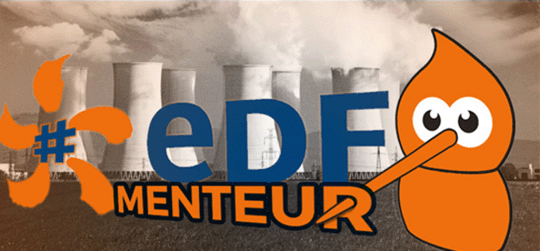
France’s EDF company is trying to ‘restore trust’ in the nuclear industry
France’s nuclear industry in dire straits
 The French nuclear revolution is rusting away, December 6, 2019, THE AUSTRALIAN, Henry Ergas “……..France’s nuclear power industry faces a future that is more uncertain than ever. The problems gripping the industry were highlighted late last month in an official report prepared by the former president and chief executive of PSA Peugeot Citroen, Jean Martin Folz.
While the report’s focus is on the difficulties that have plagued the construction of a new reactor at Flamanville in northwestern France, its implications reach much further.
With nuclear power plants accounting for more than 70 per cent of its overall electricity generation, no country is as dependent on nuclear energy as is France.
The decision to rely so massively on nuclear energy was taken in 1974, after the oil shock of the previous year had underlined France’s vulnerability to Middle Eastern oil. Prime minister Pierre Messmer launched a crash program that led to the construction of 56 reactors in just 15 years.
…….. however, most of France’s generators are approaching the final decade of their useful life. Planning for their replacement has been a stop-start affair, with the Greens’ increasingly strident opposition to nuclear power deterring successive governments from taking action.
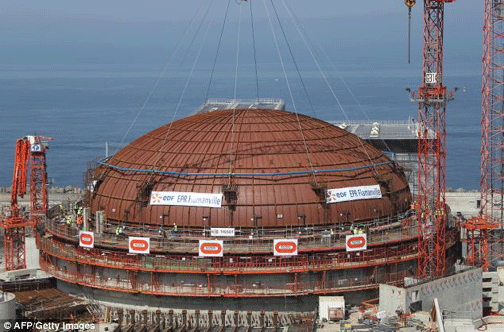 As a result, only the Flamanville plant received the go-ahead, with construction beginning in 2007 for an expected entry into service in 2012. Virtually from the outset, the project was beset by woes. At this stage, the total costs of construction are four times greater than initially estimated, while the plant will not enter service before the end of 2022.
The problems stem partly from the sheer complexity of the new reactor, which is the first of its kind to be built in France.
Additionally, the catastrophe at Fukushima in 2011 led to regulatory changes that necessitated costly redesigns. And the project has suffered more than its fair share of mismanagement, aggravated by a byzantine allocation of responsibilities between EDF, the main French electricity utility, which oversaw the project, and many layers of subcontractors.
However, as the Folz report shows, the primary cause of the difficulties lies in the erosion of the industry’s skill base during the long hiatus from the end of the crash program in 1990 to the initiation of Flamanville………
There is, at this point, no prospect of France scaling up its nuclear program  ………The cost blowout at Olkiluoto drove Areva, the “national champion” of France’s nuclear industry, into bankruptcy.
Even with an injection of $7.3bn in public funds EDF, which acquired Areva, lacks the balance sheet strength to underwrite new projects, while the French government’s borrowing ability is hampered by its already too high levels of debt.
To make matters worse, the regulated prices at which EDF has to sell the power it generates mean that it cannot charge its European clients the full value of the baseload it supplies.
 As for global investors, who might provide the debt financing EDF would require, they are wary of projects that are risky in themselves ….
Given those constraints, the government has announced a modest plan to eventually build six additional reactors. So far, however, there are no actionable decisions beyond the completion of Flamanville. And work on the next generation of reactors….. has been quietly downgraded, making it likely that there will no fourth generation reactor of French design.
The consequences for France itself are far-reaching. Beginning in the late 1950s, French firms succeeded in one high-technology market after the other by developing or acquiring a rather basic design (including the Westinghouse Pressurised Water Reactor, the Mirage jet fighter and the TGV high-speed train) that they upgraded while producing it on a large scale.
That era is over, and there is every sign France is struggling with almost all the major projects it has in train.
The Folz report should therefore come as an ominous warning for Australia’s submarine project, as it identifies French industry’s serious managerial and technological weaknesses in a range of areas, such as precision welding, that are crucial to that project’s success……. https://www.theaustralian.com.au/commentary/the-french-nuclear-revolution-is-rusting-away/news-story/afe4546ed799939cf117d71f05035c5e
Another shutdown at French nuclear power station Golfech
France Bleu 2nd Dec 2019. A nuclear reactor again shut down at the Golfech power station after a leak. The production unit number 2 of the Tarn-et-Garonne power plant was stopped this Monday, December 2 in the morning, after the discovery of a steam leak in a non-nuclear part. This reactor had just been restarted just four days ago.
France wants to label nuclear as “green”. Germany will have none of it
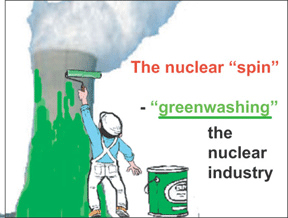 Paris, Berlin divided over nuclear’s recognition as green energy https://www.euractiv.com/section/energy-environment/news/france-and-germany-divided-over-nuclears-inclusion-in-eus-green-investment-label/ By Cécile Barbière | EURACTIV.fr | translated by Daniel Eck 27 Nov 19, Disagreement on the inclusion of nuclear power in the EU’s upcoming green finance taxonomy has revived long-standing divisions between France and Germany over the energy transition. EURACTIV France reports.
Franco-German relations have already been strained by French President Emmanuel Macron’s radical comments on NATO’s “brain death,” which attracted strong rebukes in Berlin.
Now, the European Commission’s proposed taxonomy for sustainable finance has emerged as a new bone of contention.
Tabled in 2018, the EU taxonomy aims to determine which economic activities can benefit from a sustainable finance label at European level. The objective is to give clear indications to investors so they can redirect their financing towards environmentally-friendly sectors.
Six pre-defined environmental objectives must be met in order to obtain the label. If any technology seriously undermines one of those goals, it is automatically disqualified.
It is because of this double level of control that nuclear energy failed to win the green label in the European Parliament, until the Council representing EU member states voted to reinstate it in September.
Although nuclear energy largely meets the low-carbon emissions objective, “it was not possible to include nuclear power because there is no scientific evidence for waste treatment. This means that the sector does not meet both requirements,” explained Jochen Krimphoff, WWF’s deputy director for green finance.
Since the beginning of the negotiations on the EU’s taxonomy, France has been pushing to reintroduce nuclear power, much to Germany’s dismay.
“France will advocate that nuclear energy should be part of this eco-label,” said French Finance Minister Bruno Le Maire at the conference to replenish the Green Fund at the end of October.
“We cannot succeed in the ecological transition, and we cannot achieve our goal in terms of combating global warming without nuclear energy,” the French minister said.
Although nuclear energy largely meets the low-carbon emissions objective, “it was not possible to include nuclear power because there is no scientific evidence for waste treatment. This means that the sector does not meet both requirements,” explained Jochen Krimphoff, WWF’s deputy director for green finance.
Since the beginning of the negotiations on the EU’s taxonomy, France has been pushing to reintroduce nuclear power, much to Germany’s dismay.
“France will advocate that nuclear energy should be part of this eco-label,” said French Finance Minister Bruno Le Maire at the conference to replenish the Green Fund at the end of October.
“We cannot succeed in the ecological transition, and we cannot achieve our goal in terms of combating global warming without nuclear energy,” the French minister said.
The move is all the more surprising given France’s rather progressive positions on the taxonomy. For example, Paris has, like the Commission and Parliament, been calling for the taxonomy to enter into force as early as 2020, while the Council has advocated for implementation in 2023.
For its part, Germany would not be opposed to labeling gas as green. This could be at the risk of a deal that would see both gas and nuclear power re-entering the scheme.
France’s Flamanville nuclear financial catastrophe gets worse
Le Monde 22nd Nov 2019, Jean-Martin Folz’s report on the construction of the Flamanville EPR, handed out on October 28 , is without appeal for the French nuclear power industry. The financial catastrophe continues to worsen. The project is currently 10 years late and 9 billion euros over budget. He helped engulf Areva, flagship of the French nuclear industry, declared bankrupt in 2016, which owed its salvation to a bailout on public funds of 4.5 billion euros.
It now weighs on the accounts of EDF, a new prime contractor since the
wreck of Areva, which no longer hopes to connect the reactor to the network
before 2022.
France’s government is giving mixed messages on future of nuclear energy
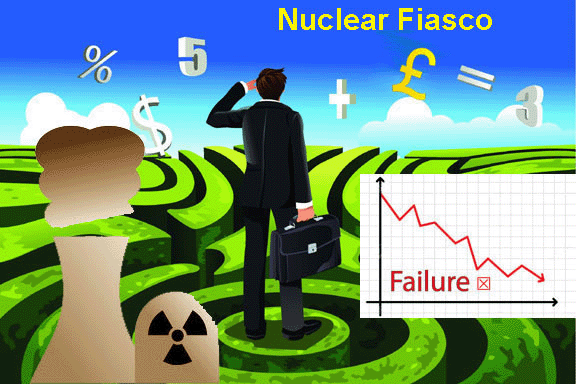 EDF gives Macron little reason to come clean on
 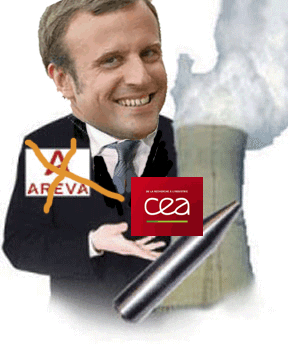 nuclear https://www.ft.com/content/adbe9da6-0ab8-11ea-bb52-34c8d9dc6d84 Problems at a flagship nuclear reactor means French government can take time over future of EDF, BEN HALL , Europe editor NOVEMBER 20 2019
The earthquake that shook the Rhone valley in south-east France last week could have been another financial disaster for energy giant EDF in what has been a bruising year. Its share price has taken a battering over concerns that it will struggle to pay for the upkeep of its ageing fleet of reactors, find money to build new ones and service its €37bn of net debt. The worries have been amplified by further delays and cost overruns at the mammoth nuclear plant it is building on the Normandy coast. The Rhone valley is home to four of the country’s 19 atomic power stations and a nuclear fuel processing facility, all operated by EDF. The tremor was the worst to hit France in 16 years. Three reactors at Cruas had to be shut down until mid-December for mandatory safety checks.
The French government, which owns 83.7 per cent of the company, is giving mixed messages about the way forward. It will not decide whether to build more EPRs until Flamanville is up and running — conveniently after the 2022 presidential election, allowing Emmanuel Macron to avoid the wrath of France’s increasingly powerful environmental movement. But according to Le Monde newspaper, the government has also secretly ordered EDF to draw up a feasibility study for six new EPRs built in pairs.
France’s company EDF selling out of USA nuclear plants, Exelon to buy.
EDF Will Bail on Three Nuclear Plants, Exelon Holds the Bag, Power Mag 11/21/2019 | Aaron Larson Exelon Generation said EDF Group—a French integrated electricity company—is exercising a put option to sell its 49.99% interest in the R.E. Ginna, Nine Mile Point, and Calvert Cliffs nuclear energy facilities. The two companies will now begin negotiations for Exelon to acquire full ownership of the plants.
EDF’s involvement in the facilities was through the Constellation Energy Nuclear Group (CENG), a joint venture between it and Constellation Energy, which was negotiated in 2009. Exelon acquired its majority stake in the plants as part of a merger with Constellation Energy, a deal that closed in March 2012.
EDF said the disposal of CENG shares is part of a previously announced non-core-asset disposal plan. The put option could have been exercised by EDF anytime between Jan. 1, 2016, and June 30, 2022. A transaction price will follow from the determination of the fair market value of CENG shares pursuant to the contractual provisions of the put option agreement, EDF said.
…….. The facilities consist of the single-unit 576-MW R.E. Ginna Nuclear Power Plant (Figure 1) and the dual-unit 1,907-MW Nine Mile Point Nuclear Station, which are both in upstate New York, and the dual-unit 1,756-MW Calvert Cliffs Nuclear Power Plant in Maryland. The upstate New York plants were under economic pressure and faced possible closure a few years ago, but subsidies approved by the state have kept the units financially viable.
France’s nuclear company EDF – report – a litany of failures
EDF gives Macron little reason to come clean on nuclear, Problems at a flagship nuclear reactor means French government can take time over future of EDF. BEN HALL 20 Nov 19
The earthquake that shook the Rhone valley in south-east France last week could have been another financial disaster for energy giant EDF in what has been a bruising year. Its share price has taken a battering over concerns that it will struggle to pay for the upkeep of its ageing fleet of reactors, find money to build new ones and service its €37bn of net debt. The worries have been amplified by further delays and cost overruns at the mammoth nuclear plant it is building on the Normandy coast. The Rhone valley is home to four of the country’s 19 atomic power stations and a nuclear fuel processing facility, all operated by EDF. The tremor was the worst to hit France in 16 years. Three reactors at Cruas had to be shut down until mid-December for mandatory safety checks. ……..
…………The failures at Flamanville have given Paris reason to withhold the clarity EDF needs — even if Mr Macron’s regards the nuclear industry as a strategic asset for France and Europe. The risks of nuclear power to health and safety and the costs of decommissioning and waste storage may be overblown, as Jonathan Ford has argued in this column. But if the more basic challenge of building vaguely on time or on budget cannot be met, nuclear energy soon loses its appeal. ben.hall@ft.com https://www.ft.com/content/adbe9da6-0ab8-11ea-bb52-34c8d9dc6d84
Irish wind power for France, as France’s EDF nuclear electricity is in a financial mess

 Interconnector gives Ireland a stake in France’s fraught nuclear debate https://www.irishtimes.com/opinion/interconnector-gives-ireland-a-stake-in-france-s-fraught-nuclear-debate-1.4086989
The bill for modernising 54 ageing reactors is currently estimated at €100bn, Nov 19, 2019, Tony Kinsella In October 2nd, 2018, the European Commission agreed to provide €530 million (56 per cent of the total cost) for an Ireland-France 700MW Celtic electricity interconnector. France can export cheap base-load nuclear electricity surpluses along this interconnector, while Irish wind-generated power can flow in the opposite direction.
However, French nuclear policy is a mess. The bill for modernising its ageing reactors is currently estimated at €100 billion, a figure that can only rise.
France’s first commercial nuclear plants were commissioned in the 1960s. Construction was boosted following the 1974 oil shock, with 54 pressurised water reactors (PWR) commissioned between 1978-1991, with a programmed life span of 40 years.
The ageing reactors are due to be replaced by EPR reactors jointly developed by France’s Areva and Siemens of Germany. EPR is third-generation pressurised water reactor technology.
The first EPR project was the 2005 Olkiluoto 3 plant in Finland, followed by the 2007 Flamanville plant in Normandy, France. They will both take four times as long to build and cost between three and four times their original estimates – Olkiluoto is due to start operating from 2020 having cost nearly €9 billion and Flamanville in 2023 for €12.4 billion.
The world’s first two operational EPR reactors opened in Taishan, China, last year. These two 1,750MW plants cost €3.5 billion each, and took nine years to build.
On October 28th, the French government received a damning 34-page report on the Flamanville nuclear project. Jean-Martin Folz, former head of carmaker Peugeot, was, at the behest of the government, tasked by Électricité de France (EDF) with producing a “no-holds barred” review of the Flamanville project in July 2019. He submitted a chillingly realistic report.
Some key elements of the Flamanville plant are defective. Repairing or replacing them will involve partial demolition of the plant. It might now prove cheaper to simply abandon it.
Wasted away
At the heart of the problem is that Europe’s once highly-skilled nuclear industry has wasted away since the 1990s. We no longer have enough experienced nuclear contractors, engineers, welders and technicians. This problem also bedevils the €22 billion Hinkley Point project in the UK.
Despite this EDF remains committed to new plants. Le Monde published an internal EDF note on November 9th on the company’s plans to build a further six EPR plants for €7 billion apiece.
The French minister for energy, Élisabeth Borne, moved quickly to publicly distanced herself from this position. She told the Political Questions show on national television that it was “not a view I share”.
Borne, an engineer and former head of the Paris RATP transit authority, went on to underline that the “option of 100 per cent renewable electricity had not been sufficiently studied”.
Borne is a respected technocrat. When she calls on EDF to “reflect on its role in a 100 per cent renewable situation” she means business.
She confirmed that no decisions on nuclear plants would be taken before mid-2021, and that “no new nuclear plants will be approved until Flamanville is operational”.
France has fallen behind in the installation of renewable power. Successive governments have chopped and changed in their approaches, denying renewable developers clear long-term perspectives. Less than 40 per cent of projects approved under a national tendering system since 2010 have actually been built.
President Giscard d’Estaing argued in 1974 that ‘France does not have oil but it has ideas’. Macron now needs to embrace ‘ideas’
Planning approval systems where every project is processed separately on a narrow basis create an additional obstacle. The fact that certain project technology has been approved in, say, Normandy offers no guarantee that an identical project will get the go-ahead in Burgundy.
Full planning approval on a very restricted technical basis takes over five years. Minor changes in processes and equipment can mean that planning approval is no longer valid, and the developer has to either begin again or abandon the project. This has been fatal for many renewable projects where available technologies evolve between the planning application and construction.
Cumbersome and therefore expensive procedures act as barriers to local projects and the involvement of regional and local authorities or co-operatives.
Administrative culture
Realisation of significant renewable energy projects in France will require a shift in French administrative culture. The financial costs may be relatively low, but more than one reform has foundered on the rocks of French administrative immobility.
If France is to expand its renewable sector from its current 18 per cent it needs to achieve two things – boost the European transmission grid and simplify procedures for renewable energies in France.
The French government needs to decide just what kind of electricity mix it wants, what France needs, and what the French electorate will accept by mid-2021, with the debate closed by the May 2022 presidential elections.
Paris could decide on a number of new EPR plants for around €10 billion apiece, invest to extend the working life of its current reactors, or significantly facilitate renewable energies and storage capacity.
President Giscard d’Estaing argued in 1974 that “France does not have oil but it has ideas”. Macron now needs to embrace “ideas”.
One 700MW connector can almost replace one nuclear reactor. A second Franco-Irish interconnector could now be on the cards.
Tony Kinsella is an entrepreneur and commentator. He divides his time between Ireland and southwest France
France extends nuclear reactors outage after earthquake
France extends nuclear reactors outage after earthquake, France 24 13 Nov 19, French utility EDF on Tuesday extended outages at three nuclear reactors at its Cruas plant until Nov. 15 following a 5.1 magnitude earthquake in southeast France that forced it to temporarily suspend electricity generation at the site.A sensor at the plant was activated during the earthquake in the region on Monday, requiring the state-controlled utility to carry out further checks for potential damage.
A spokesman for EDF said the outage extension would allow enough time for thorough visual and advanced checks across the plant, including in the nuclear buildings to ascertain that the units could function properly when they restarted.
France’s ASN nuclear safety agency on Monday said it was monitoring the situation and would decide when the reactors could restart.
The outage at the three reactors reduced French power generation by 2,700 megawatts (MW)……https://www.france24.com/en/20191112-france-extends-nuclear-reactors-outage-after-earthquake
France considering building 6 new EDF nuclear reactors at a cost of at least 46 billion euros ($51 billion)
 France’s EDF expects six new nuclear reactors to cost 46 billion euros: Le Monde, PARIS (Reuters) 11 Nov 19 – French power utility EDF estimates it would cost at least 46 billion euros ($51 billion) to build six of its latest generation EPR nuclear reactors if the government decides to build them, French newspaper Le Monde reported on Saturday.The estimate was in a confidential document presented to the board of state-controlled EDF at the end of July, it said.
However, the Flamanville EPR reactor under construction in northern France has been plagued by cost overruns and a series of technical problems resulting in years of delays.
EDF, in which the state has an 84% stake, said in October the project which began in 2006 would cost 1.5 billion euros more than previously expected, raising the total cost to 12.4 billion euros.
Reporting by Leigh Thomas; Editing by Edmund Blair full story https://www.reuters.com/article/us-edf-nuclear-epr/frances-edf-expects-six-new-nuclear-reactors-to-cost-46-billion-euros-le-monde-idUSKBN1XJ074
EDF – a nuclear business financial meltdown
On the shores of the English channel in Normandy, engineers are struggling to fix eight faulty welds at a plant that’s supposed to showcase France’s savoir faire in nuclear power.As they consider sending in robots to access hard-to-get-to areas between two containment walls, for Electricite de France it’s just the latest setback in a project that’s running a decade late and almost four times over budget.
“We hear every year that there’s a new problem,” Finance Minister Bruno Le Maire said on Monday. It is not acceptable that one of the most prestigious and strategic sectors for our country is facing so many difficulties.”
The Flamanville plant is now slated to be completed in 2022 at a price tag of 12.4 billion euros ($13.8 billion), with the latest glitch costing a whopping 1.5 billion euros. Bemoaning the loss of France’s edge in the sector because of a 15-year gap between the start of construction at the plant and that of the previous reactor, Le Maire has given EDF a month to come up with an action plan to restore the industry’s know-how before the country can determine whether it will build any new atomic plants.
For the world’s largest producer of nuclear power producer, Flamanville is just one of many challenges. Across the channel, delays at two U.K. reactors have upped the cost to as much as 22.5 billion pounds ($28.9 billion), 2.9 billion pounds more than previously estimated. EDF also faces mounting costs of maintaining 58 domestic nuclear plants that provide more than 70% of France’s power.
Add to the mix the fact that the former electricity monopoly is losing market share among French corporate and residential clients as rivals buy a part of the electricity it generates at below-market prices, and it’s easy to see why investors are bearish about the company. EDF’s stock has lost 34% this year, making it the second worst-performing utility in the Stoxx 600 Utilities Index of European companies.
A year ago, EDF was Europe’s biggest utility by market value. Now, its market capitalization stands at 28 billion euros, less than half that of Italy’s Enel SpA, which has swelled to 69 billion euros on the success of its renewable business. RWE AG, the German utility planning to shut down its nuclear plants and progressively phase out coal-fired plants, is up 43% this year and Orsted A/S, the Danish champion in offshore wind, whose revenue is about a sixth of EDF’s, has surpassed the French giant.
“Investors are staying away because of current uncertainties following the strongly negative news flow on the reputation of the nuclear industry,” said Auguste Deryckx, an analyst at AlphaValue. “The CEO’s stubbornness in pursuing nuclear, which is limiting potential growth in renewables that are better valued by the market, remains a black spot.”
EDF is struggling to cover the 15 billion euros it needs annually to maintain its aging nuclear reactors, build new atomic and renewable projects, upgrade its electricity network and roll out smart meters, even after cutting 1.1 billion euros in cost cuts in the past four years. Profits have been hit not only by falling power prices, but by safety issues that have forced reactors to be shut for several months in France and the U.K. Other clouds on the horizon—the decommissioning of two of its oldest reactors next year and a dozen more by 2035, and the treatment of nuclear waste.
The one-time monopoly—now about 83% owned by the state—needs some drastic measures, says Chief Executive Officer Jean-Bernard Levy, who’s pushing the state for an increase in the regulated prices at which rivals buy the company’s nuclear power……..https://www.msn.com/en-au/news/world/the-worlds-largest-nuclear-power-producer-is-melting-down/ar-AAJEHRZ?li=AAgfYrC&fbclid=IwAR2c-xzdRQS6grHOpiPYl5e7lEPRCPkPIQCGEWCP3vT5mxgDkH4sfc9alJo
French activists broke into nuclear plant, demonstrating the risk of terrorism
 Greenpeace 28th Oct 2019, In the early hours of 12 October 2017, eight people sneaked inside the grounds of the Cattenom nuclear plant in northern France. Without much difficulty, they reached the foot of a spent fuel pool – where the still highly radioactive fuel rods are stored after use.
It was a scenario Greenpeace France had been warning about since 2001 through numerous reports, letters and speeches. France’s aging fleet of reactors is poorly protected, and not designed to withstand big impacts, such as an explosion set off by terrorists.
A loss of water from the spent fuel pools – protected by walls only 30cm thick – could lead to a massive release of radioactivity. Fortunately, the eight intruders turned out to be peaceful activists from Greenpeace France; they set off some fireworks to demonstrate their presence and then allowed themselves to be led away.
The ease with which they had penetrated alarmed the government of Luxembourg, which lies just north of Cattenom. It also finally spurred the French authorities into action; a parliamentary investigation into nuclear safety
was announced the following month. It’s a textbook example of the role of
non-violent direct action (NVDA) in a democracy, much like the recent
climate strikes.
When the authorities are sleeping at the wheel, and not
responding to polite arguments, citizen action is needed to wake them up.
In this case, it did. A happy end? Unfortunately not.
In a classic case of shooting the messenger, prosecutors have pressed for stiff penalties. In February 2018, a court in Thionville sentenced the ‘Cattenom nine’ – the eight activists and a Greenpeace France employee. It imposed a 2-month jail sentence on two of the individuals, and suspended sentences on the
rest. It also ordered Greenpeace France to pay €50,000 to the power
company, EDF as ‘moral damages’.
1 This Month



26 September – International Day for the Total Elimination of Nuclear Weapons


PLEASE OPPOSE HR 8255 AND S.3639 – bills would accelerate satellite deployment, with no environmental review or safeguards – https://ncstd5li.quorum.us/campaign/169331/
To see nuclear-related stories in greater depth and intensity – go to https://nuclearinformation.wordpress.com
-
Archives
- September 2026 (245)
- August 2026 (330)
- July 2026 (355)
- June 2026 (287)
- May 2026 (306)
- April 2026 (356)
- March 2026 (251)
- February 2026 (267)
- January 2026 (308)
- December 2025 (358)
- November 2025 (359)
- October 2025 (375)
-
Categories
- 1
- 1 NUCLEAR ISSUES
- business and costs
- climate change
- culture and arts
- ENERGY
- environment
- health
- history
- indigenous issues
- Legal
- marketing of nuclear
- media
- opposition to nuclear
- PERSONAL STORIES
- politics
- politics international
- Religion and ethics
- safety
- secrets,lies and civil liberties
- spinbuster
- technology
- Uranium
- wastes
- weapons and war
- Women
- 2 WORLD
- ACTION
- AFRICA
- Atrocities
- AUSTRALIA
- Christina's notes
- Christina's themes
- culture and arts
- Events
- Fuk 2022
- Fuk 2023
- Fukushima 2017
- Fukushima 2018
- fukushima 2019
- Fukushima 2020
- Fukushima 2021
- general
- global warming
- Humour (God we need it)
- Nuclear
- RARE EARTHS
- Reference
- resources – print
- Resources -audiovicual
- Weekly Newsletter
- World
- World Nuclear
- YouTube
-
RSS
Entries RSS
Comments RSS
 nuclear-news