 Latest hot spell set to deepen drought pain in France, Saudi Gazette, July 17, 2019
Hot weather in France next week is expected to prolong drought conditions that have impacted several sectors including nuclear power generation and farming, and led to restrictions on water use in 61 administrative regions.French meteorological services expect very hot and dry weather next week, with a slight risk of a heatwave in the southeastern part of the country. This comes after a hot spell set record temperatures at the end of June.
The hot weather and lack of rainfall throughout the year have led to very low levels of groundwater, which contributes to the volume and flow of rivers, said Violaine Bault, hydrologist at French Geological Survey BRGM.
When groundwater decreases and there is no rainfall, rivers dry up.
The situation was more critical in the Loire, Auvergne-Rhone-Alpes and Burgundy regions in central and eastern France. The Rhone River has been severely impacted. There has been very little rainfall in the region over the past three winters, Bault said.
French state-controlled utility EDF said on Tuesday that due to flow forecasts for the Rhone river, electricity generation could be restricted at its Bugey, St-Alban and Tricastin nuclear power plants from Saturday, July 20.
The nuclear plants, with a combined capacity of around 10,800 megawatts, use water from the river as coolant.
EDF’s use of water is regulated by law to protect plant and animal life. It is obliged to reduce output during hot weather when water temperatures rise, or when river levels and the flow rate are low.
The company said two nuclear reactors at the St. Alban plant and one at Bugey could be impacted over the weekend, but production losses are expected to be lower from Monday……… http://saudigazette.com.sa/article/572195
July 18, 2019
Posted by Christina Macpherson |
climate change, France |
Leave a comment

Marchers in Tahiti ‘mourn’ French nuclear weapons test legacy https://asiapacificreport.nz/2019/07/05/marches-in-tahiti-mourn-french-nuclear-weapons-test-legacy/, By PMC Editor -July 5, 2019 , By RNZ Pacific
An estimated 2000 people have joined a march in French Polynesia this week to mark the 53rd anniversary of France’s first atomic weapons test in the Pacific.
The first test was on July 2, 1966, after nuclear testing was moved from Algeria to the Tuamotus.
Organisers of the Association 193 described it as a “sad date that plunged the Polynesia people into mourning forever”. The test on Moruroa atoll was the first of 193 which were carried out over three decades until 1996.
The march was to the Place Pouvanaa a Oopa honouring a Tahitian leader.
The march and rally were called by test veterans’ groups and the Maohi Protestant church to also highlight the test victims’ difficulties in getting compensation for ill health.
After changes to the French compensation law, the nuclear-free organisation Moruroa e Tatou wants it to be scrapped as it now compensates no-one. The Association 193 said it was withdrawing from the project of the French state and the French Polynesian government to build a memorial site in Papeete, saying it will only serve as propaganda.
Apart from reparations for the victims, the organisation wants studies to be carried out into the genetic impact of radiation exposure.
July 15, 2019
Posted by Christina Macpherson |
France, Legal, OCEANIA, opposition to nuclear, weapons and war |
Leave a comment
French President Emmanuel Macron unveils France’s nuclear-powered ‘Barracuda’ submarine By Euronews with Reuters 12/07/2019 French President Emmanuel Macron unveiled France’s latest nuclear-powered ‘Barracuda’ class submarine on Friday, a €9 billion stealth vessel programme Paris says is key to maintaining its naval presence for decades to come…….
July 13, 2019
Posted by Christina Macpherson |
France, weapons and war |
Leave a comment
Reuters 5th July 2019 The French government has requested an independent audit of EDF’s
(
EDF.PA) Flamanville nuclear plant, which faces new cost overruns and
delays of up to three years after a regulator ordered repairs last month.
ASN, the French nuclear watchdog, said that state-owned EDF would have to
repair eight faulty weldings in the reactor’s containment building,
adding that it had rejected a request to delay repairs until 2024.
July 8, 2019
Posted by Christina Macpherson |
Arclight's Vision, business and costs, France, politics |
1 Comment
France Bleu 1st July 2019 Tricastin power plant: are the defects of the tank dangerous? The reactor vessel of the Tricastin NPP was delivered with defects 40 years ago.
Anti-nuclearists point to this problem to demand the shutdown of the
reactor. https://www.francebleu.fr/infos/economie-social/centrale-de-tricastin-les-malfacons-de-la-cuve-sont-elles-dangereuses-1561481499
July 4, 2019
Posted by Christina Macpherson |
France, safety |
Leave a comment

Heatwave may force nuclear power shutdown in France as cooling water runs out, https://www.telegraph.co.uk/news/2019/06/30/heatwave-may-force-nuclear-power-shutdown-france-cooling-water/ David Chazan, Paris 30 JUNE 2019
Drought and overheating of river water may force some of the nuclear power plants that supply two-thirds of France’s electricity to shut down temporarily in the wake of the European heatwave.
The extreme temperatures are beginning to abate, but shortages and excessive temperatures of river water needed to cool reactors are worrying EDF, the largely state-owned electricity company.
If the hot weather continues, households, offices and factories will require large quantities of electricity for air conditioning and ventilation.
River levels have fallen in eastern, central and southern France, the Journal du Dimanche newspaper reported on Sunday.
The Civaux nuclear plant is cooled by water from the River Vienne, now close to a historic low following the heatwave.
EDF uses two dams to augment the river water, but the local authority has complained that the company uses the river almost exclusively for its power station, jeopardising farming, drinking water supplies, leisure activities and tourism.
Residents of areas near the River Loire have made similar criticisms.
The Loire has four nuclear plants on its banks, but the local authority has reported water levels close to the historic lows registered during France’s terrible 2003 heatwave, blamed for 15,000 deaths, mostly elderly people affected by dehydration.
Last year, hot weather forced EDF to temporarily shut down three reactors in eastern France, at the Bugey power plant near the Swiss border, at its Saint-Alban plant on the Rhône, and at the Fessenheim plant near the German border.
The heatwave has revealed that France is ill-prepared to face extreme temperatures, according to green party leaders. The government is to unveil new measures to manage water resources this week.
A record high of 45.9 degrees Celsius was reached in the southern village of Gallargues-le-Montueux, near Montpellier, on Friday.
Three swimmers died of “thermic shock” from plunging into cool water, and a cyclist died after collapsing in the heat in the southern Vaucluse département.
In Spain, a British mountaineer was airlifted to hospital after suffering heatstroke.
The unnamed 48-year-old collapsed in the Western Pyrenees’ Baztan Valley and was taken to hospital in a serious condition.
July 1, 2019
Posted by Christina Macpherson |
climate change, France |
1 Comment
 EDF to curb Bugey nuclear reactor output as Rhone river flow slows https://www.reuters.com/article/us-france-weather-nuclearpower/edf-to-curb-bugey-nuclear-reactor-output-as-rhone-river-flow-slows-id Reporting by Bate Felix; Editing by Geert De Clercq, PARIS (Reuters) 29 June 19 – French utility EDF said on Friday that power generation at its 3,600 megawatt (MW) Bugey nuclear power plant in eastern France could be curbed from Tuesday July 2 due to a lower flow rate of the Rhone river.The plant near the Swiss border has four 900 MW reactors and uses water from the river for cooling.
EDF’s use of water from rivers as coolant is regulated by law to protect plant and animal life. It is obliged to reduce output during hot weather when water temperatures rise, or when river levels and the flow rate are low.
France saw new all-time record temperatures about 45 degrees Celsius in the south of the country on Friday afternoon as a sweltering heatwave engulfed much of southern and central Europe.
June 29, 2019
Posted by Christina Macpherson |
climate change, France |
Leave a comment
France wants EDF to sell more nuclear power to rivals, price could increase, Bate Felix, PARIS (Reuters) 24 19,- The French government plans to increase the amount of nuclear energy utility EDF is forced to sell to its competitors by 50 percent to 150 terawatt hours and is in talks with the European Commission to potentially raise the fixed price.The government aims to have both measures ready before the November auction window of the so-called ARENH market mechanism, under which EDF’s rivals bid for wholesale nuclear electricity for the year ahead, the energy ministry said.
“If we want power prices to be contained in 2020, we need to increase the ceiling and it is the wish of the government to move quickly on those two measure before the November auction window,” an official of the energy ministry told journalists.
“There would likely be a slight increase in the fixed price”, the official added.
The EU’s executive arm, which regulates market competition in the bloc would have to approve any change in the fixed wholesale nuclear price……..https://www.reuters.com/article/us-france-electricity/france-wants-edf-to-sell-more-nuclear-power-to-rivals-price-could-increase-idUSK
June 25, 2019
Posted by Christina Macpherson |
business and costs, France, politics |
Leave a comment
Le Point 18th June 2019 “France could switch to 100% renewable energy” INTERVIEW. According to Rana
Adib, head of the network of experts REN21, the effort in favor of
renewable energies must be relaunched to comply with the Paris agreement.
https://www.lepoint.fr/economie/la-france-pourrait-passer-a-100-d-energies-renouvelables-18-06-2019-2319433_28.php
June 24, 2019
Posted by Christina Macpherson |
climate change, France, renewable |
Leave a comment

French energy group EDF reviews costs of delayed nuclear project https://www.ft.com/content/c6bc1884-9343-11e9-b7ea-60e35ef678d2 Flamanville plant’s faulty weldings must be fixed, says watchdog David Keohane in Paris JUNE 20, 2019
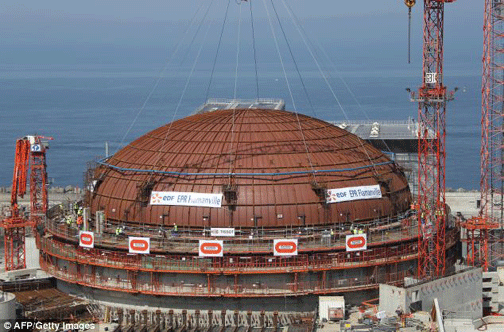
French energy group EDF says it is reviewing the start-up schedule and costs of its flagship Flamanville nuclear project after the regulator said it would have to fix faulty weldings, which have already delayed the project.
ASN, the nuclear watchdog, said on Wednesday that nuclear-focused EDF needs to repair eight of the joins at Flamanville in northern France.
“EDF is currently analysing the impact of this decision on the Flamanville EPR [nuclear reactor] schedule and cost, and, in the upcoming weeks, it will give a detailed update on the next steps in the project,” said the company in a statement on Thursday.
“This is negative news but it does not come as a surprise,” said analysts at Société Générale, since EDF had already flagged the likelihood of a delay. EDF’s shares fell 1.8 per cent by midday in Paris.
The ASN said in October that the weldings were being reviewed. While, in July, EDF said there would be further delays and cost overruns due to problems with the connections. It pushed back the loading of nuclear fuel and the target construction costs at the late and over-budget plant.
EDF had said the loading of nuclear fuel was scheduled for the end of 2019 with commercial activity starting in 2020 and costs revised up again from €10.5bn to €10.9bn. Initially, Flamanville was expected to cost €3.3bn and start operations in 2012. ASN suggested in its communication to EDF that the plant would not be operational before 2022.
The Flamanville plant in France is one of three being built in Europe using the next-generation European Pressurised Reactor technology. The other two projects are the Olkiluoto project in Finland, which is more than a decade late, and the UK’s Hinkley Point, which is mired in controversy over the high cost of the project.
More broadly, EDF is expected to brief trade unions on Thursday about plans to reorganise the company. The plan, codenamed Hercules, say people familiar with the matter, would involve a holding company 100 per cent-owned by the state and two subsidiaries sitting beneath it. EDF Bleu, or EDF Blue, would house all nuclear and hydroelectric assets and EDF Vert, or EDF Green, would hold the renewables, services and network assets.
EDF Vert would then be floated to raise funds.
The company will also propose a regulated pricing mechanism for 100 per cent of France’s nuclear production to replace the current mechanism, said analysts at Bernstein. The plan to split the company stems from this move since, as Bernstein add, a “100 per cent regulated price for nuclear production in France would likely be considered state aid by the EU”.
The plan thus still has to clear the European Commission as well as probable public pushback to higher regulated prices and heavy union opposition. French trade unions remain particularly powerful within EDF and has used threats of power cuts in the past.
In a joint statement this week, the unions said they “oppose a strictly financial reorganisation that would lose sight of the industrial project, the social ambition and the general interest” of the group.
June 22, 2019
Posted by Christina Macpherson |
business and costs, France, safety |
Leave a comment
French ASN orders EDF to fix weldings on Flamanville nuclear reactor https://www.euronews.com/2019/06/19/french-asn-orders-edf-to-fix-weldings-on-flamanville-nuclear-reactor
19/06/2019 PARIS (Reuters) – French nuclear regulator ASN said in a statement on Wednesday that utility EDF will have to repair eight faulty weldings that traverse the containment vessel at the nuclear reactor EDF is building in Flamanville, northern France.
In April, IRSN – ASN’s technical arm – had already recommended that EDF repair the eight weldings, which are hard to reach and hard to repair. EDF had hoped to convince ASN that the flaws in the weldings were not a threat to the reactor’s safety and wanted to leave them in place.
The ASN was due to rule on the recommendation this month. Its statement gave no further details.
EDFCEO Jean-Bernard Levy said on Tuesday that repairing the weldings would cause further delays to the reactor, which is already years behind schedule and billions of euros over budget.
Following the discovery of the problems with the weldings, EDF in July 2018 delayed the scheduled loading of nuclear fuel by a year to the fourth quarter of 2019.
(Reporting by Geert De Clercq; Editing by Leigh Thomas)
|
|
|
June 20, 2019
Posted by Christina Macpherson |
France, safety |
Leave a comment
|
 French Nuclear Power Producer EDF Plans a Turnaround, CFO Xavier Girre is selling assets and trailing new financing tools ahead of a potential reorganization of the company. WSJ By Nina Trentmann June 14, 2019 French Nuclear Power Producer EDF Plans a Turnaround, CFO Xavier Girre is selling assets and trailing new financing tools ahead of a potential reorganization of the company. WSJ By Nina Trentmann June 14, 2019
Aging nuclear reactors, soaring debt and large capital-spending commitments that generate are just some of the problems facing Xavier Girre, the chief financial officer of French electricity supplier Electricité de France SA .
The room to maneuver is limited: Key operating decisions must be taken in conjunction with the French government, EDF’s largest shareholder.
“We are not the decision makers,” Mr. Girre told CFO Journal. “With regards to regulation, the state is.”……..
France’s largest energy producer has also sold assets worth €10 billion ($11.24 billion), and assets worth a further €2 billion to €3 billion are to be divested by 2021. The government recently allowed EDF to give shareholders new shares instead of a cash dividend
A planned restructuring of the company’s assets and a new pricing structure for the French energy market could help Mr. Girre make further improvements, said Claire Mauduit-Le Clercq, analyst at S&P Global Inc.
The plan could allow EDF to separate its nuclear plants—it currently operates 58—from the rest of the business, a move that would enable the company to focus on investments in renewable energy. A large part of the company’s energy production comes from nuclear reactors…….
Analysts say the challenge for EDF will be to fund the turnaround given its hefty debt load. EDF’s net debt—a measure of total loans and financial liabilities less cash and liquid assets—was €33.38 billion at the end of 2018, up from €33.01 billion at the end of 2017.
Further complicating the picture is EDF’s large capital spending program. The company committed in 2014 to spending up to €45 billion by 2025 to extend the lifespan of its nuclear reactors fleet from around 40 to 50 years. The average age of an EDF nuclear power plant currently stands at 33 years.
New plants under construction, for example in Britain’s Hinkley Point, are adding to that cost burden. Total capital expenditures were about €14 billion in 2018. “EDF would not have to sell business after business to fund new investments if this was a viable business model,” AB Bernstein’s Ms. Becker said.
Meanwhile, the company’s net income slumped to €1.17 billion in 2018 from €3.17 billion a year earlier. Fluctuating energy prices, mean “the company lacks visibility into its future earnings,” said Ms. Mauduit-Le Clercq.
“You have a company that faces major investment needs, that has a negative cash flow equation and that has high debt levels—this creates tension in the balance sheet,” she said.
But the company’s financial standing is more vulnerable when other obligations, such as pension liabilities, future obligations to retire certain assets and costs for managing nuclear waste, are factored in. Adjusted net debt was €70 billion at the end of 2018, S&P Global said. https://www.wsj.com/articles/french-nuclear-power-producer-edf-plans-a-turnaround-11560526991
|
|
June 17, 2019
Posted by Christina Macpherson |
business and costs, France, politics, renewable |
Leave a comment
|
Renews Biz 14th June 2019 , French environment minister Francois de Rugy has outlined today how France
intends to meet its new 10GW offshore wind target by 2028. A 1GW
fixed-bottom project to be built off Normandy will soon be open to public
consultation, he said. Tenders will also be launched in the near future for
three 250MW floating offshore wind farms and an up to 1GW fixed-bottom
development off the island of Oleron. One 250MW floating project,
comprising about 20 turbines, will be allocated to the south of Brittany in
2021, with the other two will be located in the Mediterranean in the
Occitanie and PACA regions, De Rugy said.
https://renews.biz/53745/france-maps-offshore-future/
|
|
June 17, 2019
Posted by Christina Macpherson |
France, renewable |
Leave a comment
|
Together Against Sizewell C accuse EDF Boss of Schoolboy Errors in his Defence of Nuclear Power, http://www.tasizewellc.org.uk/index.php/news/271-together-against-sizewell-c-accuse-edf-boss-of-schoolboy-errors-in-his-defence-of-nuclear-power 30th May 2019
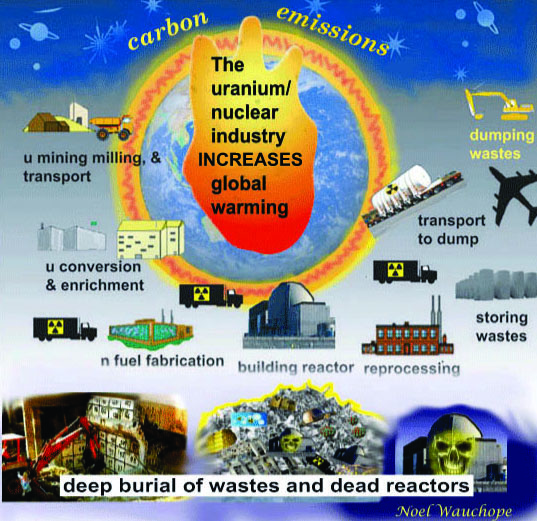
Together Against Sizewell C chairman, Pete Wilkinson, claims that EDF CEO Jean-Bernard Lévy makes some schoolboy errors in his fatuous defence of nuclear power in his IEA February 25th speech, this having been recently reported by World Nuclear News, 20 May 2019. Pete Wilkinson says “M. Lévy is careful to use the word ‘direct’ when claiming that nuclear power produces electricity without emissions; by this, he presumably means that the only part of the nuclear fuel cycle that can even come close to being ‘low carbon’ is that which ‘burns’ uranium in the reactor. Of course, he knows, as do we all, that across the entire fuel cycle, nuclear requires an acceptance of a carbon footprint from uranium mining, milling, enrichment, fuel production, transport, nuclear plant construction, storage and the still-unknown CO2 burdens created by final spent fuel and waste management conundrums. To claim otherwise is disingenuous, especially from someone in such a position of responsibility.
It is true that the fight against climate change is challenging, but to conclude that nuclear power is essential to winning that fight is wrong and designed to defend a technology which is antiquated, costly, polluting and presents us with a wealth of unresolved health issues related to childhood leukaemia. Sixty studies, including the seminal German government-sponsored KiKK Report indicate elevated rates of leukaemia and other cancers as a result of exposure to ionising radiation.
The Oxford Research Group produced a report some years ago which clearly demonstrated that, given the global nature of the problem of climate change, it would require the building of at least 3000 nuclear plants to have a noticeable impact on the problem – that’s one new plant a week for 60 years. Impossible, yes, but wholly undesirable as well since the nuclear waste legacy that scale of programme would create is unthinkable: we can’t even deal with the 500,000 cubic metres of legacy waste in the UK after 60 years of merrily creating it without a thought about how to manage it safely. Even after ten years of the Nuclear Decommissioning Authority, the UK is still no closer to a universally safe and secure means of dealing with the legacy waste, let alone the hotter and more radioactive waste which M. Levy’s reactors will leave us over the next few decades in return for huge amounts of UK tax payers’ cash should the plant at Hinkley ever be finished and should Sizewell become more than an EdF aspiration.
A further reason why nuclear power cannot hope to have more than a minor role to play in the fight against the climate emergency, is the fact that the plants take so long to build. The ‘nuclear renaissance’ in the UK was mooted on the back of energy security and low carbon. The lights in the UK were, at the time of Blair’s announcement in 2005, predicted to go out in 2017. It is now 2019, the lights didn’t go out and no new nuclear is contributing electricity to the national grid in the UK and is unlikely to be doing so for at least another six or seven years – probably longer, given the historic over-runs of time and budget which accompany nuclear plant. Nuclear is an option for the future, not an imperative: that much has been shown time and again with analyses from highly reputable and responsible green and academic groups. Nuclear just can’t contribute fast enough and even if and when it does, its contribution will be only marginal at best, negative at worst.
By definition, renewables are potentially endless. They rely on the Sun, the wind, the tides and ambient energy. Moreover, the source of the energy arrives free-of-charge, without mining for rare, unstable and potentially lethal metals or digging for fossil fuels to burn, releasing their carbon back into the atmosphere. Combined with efficiency measures, decentralised electricity generation, smart grids and conservation measures which have already seen electricity demand fall in the UK by some 16% in the last decade, we can meet all our climate change, cost and demand targets without nuclear. This has been demonstrated time and time again: nuclear is an option, not an imperative, and it is an option we should refuse.
 Quite apart from the fact that EdF’s flagship EPR Flamanville plant is facing a further two year delay as a result of ASN’s likely demands that reactor core welds are repaired, it is appropriate to remind M. Lévy that EdF is hugely in debt, that its board of Directors are not united in their view of the company’s new build programme and that the victim communities around the proposed sites for new build are fearful of the wholesale disruption to their lives, the environment and the tranquility they currently enjoy in these largely remote and isolated sites”. Quite apart from the fact that EdF’s flagship EPR Flamanville plant is facing a further two year delay as a result of ASN’s likely demands that reactor core welds are repaired, it is appropriate to remind M. Lévy that EdF is hugely in debt, that its board of Directors are not united in their view of the company’s new build programme and that the victim communities around the proposed sites for new build are fearful of the wholesale disruption to their lives, the environment and the tranquility they currently enjoy in these largely remote and isolated sites”.
|
|
June 3, 2019
Posted by Christina Macpherson |
France, spinbuster |
Leave a comment
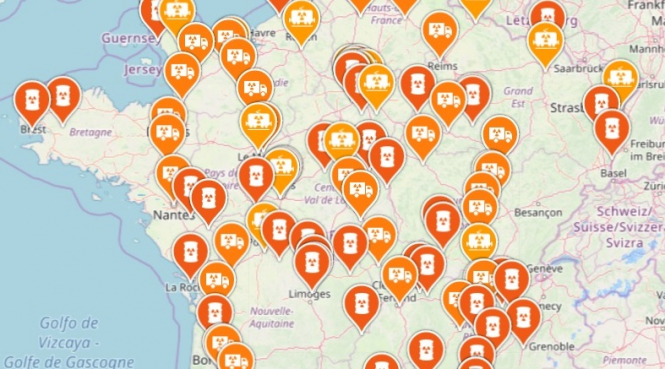
Nuclear waste map of France published by Greenpeace, https://www.connexionfrance.com/French-news/Nuclear-waste-map-of-France-published-by-environmental-activists-Greenpeace-on-issue 29 May, 19, Nuclear waste is becoming a hot topic of discussion, as Greenpeace publishes a map of waste across France
A new interactive map showing the locations of nuclear waste across France has been published by environmental group Greenpeace, as part of its forthcoming campaign on the issue.
The map was published online this week, with the NGO aiming to “compile in a single place” all of the information it has on the location of radioactive material, to let people know how close they may be living to the waste.
The map categories include storage centres (at which the waste will be stored for 300 years minimum); nuclear centres that generate all forms of nuclear waste; more than 200 old uranium mines, operational up to 2001; factories and other plants; and radioactive waste from more than 70 military sites.
The data was collected from records of radioactive waste agency l’Agence Nationale pour la Gestion des Déchets Radioactifs (Andra).
The map does not include waste from medical use or research.
The map allows you to search by post code (Greenpeace.fr / Screenshot)Greenpeace is hoping to raise awareness and prompt debate over the extent of nuclear waste, and ask questions on the potential impact it may have. This also includes the impact of transporting nuclear waste by road or rail.
The group is also seeking to gather signatures and support for its national campaign on the issue, which it will later address to French ecology minister François de Rugy.
The map features a button saying “Agir! (Act!)”, allowing members of the public to add their support.
A public debate is set to be held on September 25 on this exact question – the issue of nuclear waste in France. It will be held on a platform via which the public will be able to ask for further information and have their say.
Nuclear waste disposal is also expected to be on the agenda at the G20 summit being held in Japan next month.
May 30, 2019
Posted by Christina Macpherson |
France, wastes |
Leave a comment








 nuclear-news