Framatome’s sub-standard nuclear fuel is threatening the survival of France’s nuclear company EDF
It is not only in China, in the world’s first operational EPR nuclearreactor, that the fuel produced by EDF’s subsidiary, Framatome, is a problem. In France, in the Ardennes, an unprecedented incident on the nuclear fleet has just occurred in a reactor and potentially concerns ten reactors, to varying degrees of severity.
This nuclear fuel that poisons the life of EDF
by Martin Leers, Le Journal de l’energie 2nd Aug 2021
Metal guards that enclose the reactor fuel, called cladding, deteriorate too quickly. A problem far from trivial: fuel cladding plays a key role in the safety of nuclear reactors. This “accelerated” corrosion appeared between 2020 and 2021 in one of the two reactors at the Chooz power plant. A fault which currently forces EDF to extend its shutdown since March 2021 and has therefore already cost it more than a hundred million euros.
But the stakes for EDF are much more important than a shutdown of a reactor. The “M5” alloy sheaths, which wear out prematurely in Chooz reactor n ° 2, are fitted to all EPR reactors in France, Finland and China, as well as dozens of other reactors in France and abroad.
Is there a link between this incident in France and that of the leaking ducts of the first EPR reactor in service in the world in Taishan (China)?
Why do these latest generation sheaths wear out prematurely?
A burning question for EDF, which is trying to convince the Nuclear Safety Authority (ASN) and the Institute for Radiation Protection and Nuclear Safety (IRSN) to reuse cladding with questionable reliability in reactors.
How did the problem come to be at the Chooz nuclear power plant?
When the Chooz reactor n ° 2 was shut down in February 2021 to reload the fuel, particles were discovered on the fuel assemblies and in the water of the primary circuit [1] . “Numerous white migrant bodies of a few millimeters were either collected by the anti-debris devices or remained on the assemblies”, explained EDF in an internal letter to ASN, dated July 7, 2021. An abnormal phenomenon . These particles are zirconium oxide which originates from the surface of the fuel cladding. [2] Their presence indicates that the sheaths are degrading. “The consequence of an abnormally high corrosion rate”, clarified EDF in the letter to ASN.
These particles are very friable and cannot cause a loss of tightness in the nuclear fuel, explained Karine Herviou, deputy director general of IRSN, to the Journal de l’énergie .
The fuel claddings are tubes more than 4 meters long and less than 1 centimeter in diameter, very thin (0.6 mm thick) in which the uranium pellets are stacked. These sheaths, commonly called rods, are brought together in assemblies, each made up of 264 sheaths. The core of Chooz nuclear reactor No. 2 contains 205 assemblies. In Chooz reactor n ° 2, the abnormal wear is only in the upper part of certain assemblies.
What consequences for the safety of the nuclear reactor could have the accelerated wear of the fuel rods?
The cladding plays an important role for reactor safety: they form the first barrier between nuclear fuel, containing very dangerous radioactive substances, and the environment. They must prevent radioactivity from spreading in the water circulating in the nuclear core. However, “damage to the surface of certain fuel cladding calls into question the demonstration of the integrity of the fuel in service”, considers ASN. This means that this incident calls into question the parameters which guarantee, in the eyes of ASN, the safety of the reactor in normal operation and during accident scenarios.
“Accelerated corrosion is likely to weaken the cladding and increase the risk of loss of integrity of the rods concerned during accidental transients and therefore lead to rupture of the first barrier”, explains EDF in the internal letter to ASN from July 7, 2021. But EDF does not consider this scenario plausible.
What are the causes of abnormal wear of the fuel rods?
EDF estimated on July 7 that “at this stage of the investigations, no single cause appears at the origin of the phenomenon of accelerated corrosion (…) which rather finds its explanation in a combination of several unfavorable factors”. But the M5 alloy from which the sheaths are made “seems to be the trigger,” notes EDF.
The iron content of the sheaths singled out
It is the low iron content of the cladding alloy which is partly responsible for their degradation. Two production batches for low iron content sheaths have been identified by EDF. The most damaged sheaths come from these lots, which EDF calls “hyper sensitive castings”. But until the February 2021 incident on Chooz reactor no.2, slight variations in iron in the cladding alloy were not considered to be a factor in the degradation of the fuel rods. The variable iron content of fuel cladding does not appear to have been perceived as a problem in France by the fuel assembly manufacturer, Framatome, or by the operator EDF, or by ASN and IRSN.
The sheaths which deteriorate are “in conformity” with the specifications
“The iron content of these batches is within the standards”, explains IRSN. “The products supplied by Framatome comply” with the specifications, “iron was not considered as a characteristic parameter for the behavior of the rods in the core. », Adds ASN.
Following the incident, EDF informed ASN that the iron content will be increased in the cladding which will be used in reactor No. 2 at Chooz from “cycle 20”. Not the next time the reactor is reloaded, but the next.
A “multifactorial” phenomenon
The iron content of pencils is not the only culprit. EDF puts forward other causes to explain the degradation of the fuel cladding. The temperature is higher at the top of the nuclear core in the most powerful reactors, those of 1450 MW, than in the less powerful reactors, those of 1300 MW. It is in this area that the cladding deteriorated in two 1,450 MWe reactors in France. What would happen if low iron cladding was introduced into EPR reactors, even more powerful than the 1450 MW reactors?
Another unfavorable element: the positioning of the fuel assemblies in the reactor vessel. “The corrosion rate depends on the place of an assembly in the reactor core during the first cycle”, particularly in the four most powerful reactors in the French fleet, explains EDF in an internal document. [3]
An unprecedented incident in France but not abroad
If this wear had never been observed in France, it had already occurred on three nuclear reactors in Brazil and Germany, two of which used the same M5 alloy. [4] As at the Chooz power station, the most worn cladding was the one with the lowest iron content. “The phenomenon of accelerated corrosion observed at the end of cycle 18 of Chooz B2 is comparable to other events in Konvoi reactors abroad”, notes EDF in the internal letter to ASN. Therefore, why was this incident not anticipated in France when the nuclear operators and institutions say they maintain a permanent dialogue on safety at the global level?
The nuclear safety experts from the German GRS institute have not been able to fully identify the causes of the corrosion of the cladding on German reactors, adds Karine Herviou of IRSN.
M5 alloy sheaths are fitted to all EPR reactors in France, Finland and China, as well as dozens of other reactors.
Designed to be more corrosion resistant than previous alloys and to improve nuclear fuel efficiency, the M5, manufactured by Framatome, is widely used in nuclear power worldwide.
“A large majority of reactors in France use assemblies with M5 cladding,” explains Karine Herviou of IRSN. Framatome claims its M5 sheaths are used in 96 nuclear reactors around the world, in a 2018 brochure .
The same cladding is used in the EPR reactors at Flamanville (Manche), Olkiluoto in Finland and Taishan in China. M5 alloy sheaths had many leakage problems in the 2000s, says a 2008 IRSN report:
“Between 2001 and 2008, around thirty fuel assembly leaks with M5 alloy cladding were detected. To date, EDF has identified three types of faults causing leaks in fuel rods with M5 alloy cladding. »Defects now corrected……………
10 nuclear reactors in France affected by the cladding defect discovered at the Chooz power plant
For the moment, ten nuclear reactors in France are directly or indirectly affected by the defect in the cladding discovered on the reactor n ° 2 at Chooz.
“To date, seven 1,300 MWe reactors and three 1,450 MWe reactors have at least one rod with a low iron content, in the core or in the management reserve,” ASN told the Journal de l’énergie .
But the inventory of potentially defective rods is still in progress, “even if it should not change”, added ASN. In addition to the two production batches for low iron content sheaths, EDF identified other batches of concern and informed ASN of them in an internal letter. How many ? Mystery.
“An inventory of the iron content of each of the rods of each of the assemblies present in the reactor or in reserve is being drawn up”, specifies ASN…………..
Is EDF’s priority to save fuel even if it means playing stunts with nuclear safety?
EDF is therefore forced to adapt the operation of the two reactors to the defective ducts with “compensatory” measures. EDF proposes that Chooz reactor no. 2 only operate at 92% of its power during its next cycle. For Chooz reactor n ° 1, the operator proposes to reduce load monitoring. [6] “Depending on the elements, EDF could be required, on reactors 1 of Chooz, 1 and 2 of Civaux and 3 of Cattenom to take compensatory measures (either to limit maneuverability or to operate at a drop in power)” , announces the operator in the internal letter of July 7, 2021 to ASN.
Measures that would have a financial impact. The aim, explains ASN, is “not to allow a reactor operating mode where this corrosion acceleration is possible”.
IRSN must deliver its opinion on EDF’s proposals in a few weeks, then ASN will decide.
Why does EDF not give up using potentially defective cladding in reactors? Is it about saving fuel even if it means doing acrobatics with nuclear safety?
Neither EDF nor Framatome answered questions from the Journal de l’énergie . https://journaldelenergie.com/nucleaire/combustible-nucleaire-empoisonne-edf/
The incident that caused the shutdown of the Taishan nuclear power plant occurs regularly in France
The incident that caused the shutdown of the Taishan nuclear power plant
occurs regularly in France. An expert will have to determine whether the
responsibility of the French fuel manufacturer, Framatome, is engaged in
the incident at the Chinese plant.
France TV info 3rd Aug 2021
French President acknowledges France’s debt to Polynesia, but no apology.
French President Emmanuel Macron said Tuesday that Paris owed “a debt” to
French Polynesia over nuclear tests conducted in the South Pacific
territory between 1966 and 1996, but stopped short of apologising.
Daily Mail 28th July 2021
Despite the rain, France’s nuclear reactors are still threatened by global heating.

Rhône production still threatened despite the rains. A heatwave and drought could still cause shutdowns of nuclear reactors along the Rhone by the fall, despite unprecedented rainfall in Western Europe in recent weeks which has replenished the flow of the river, said analysts Wednesday.
Montel 21st July 2021
https://www.montelnews.com/fr/news/1240314/-la-production-du-rhne-toujours-menace-malgr-les-pluies
A new problem for France’s nuclear company EDF threatens to further delay its plans for new model European Pressurised Reactor (EPR2)
EPR2**
In a discreetly published notice in March, the Institute for Radiation Protection and Nuclear Safety (IRSN) – the technical office of the Nuclear Safety Authority (ASN) – asks the State-owned company EDF to identify the origin of the vibrations affecting the circuit primary water from EPRs, already built or under construction.
And to find a solution to this problem, so that it does not reproduce on its new model of reactor, called EPR 2.
Passed under the radar, the news is yet another hard blow in a story with twists and turns. Indeed, EDF has to date no idea how to solve it.
Consequently, we can already anticipate new years of additional delay inthe development of a technology, supposedly easier to produce and therefore more competitive, on which the group led by Jean-Bernard Levy plays very heavily.
Blast 17th July 2021
Costly dismantling of France’s Brennilis nuclear power plant continues, 35 years after shutdown.
The dismantling of the Brennilis nuclear power plant, in the Monts
d’Arrée (Finistère) will be completed by 2040 and will have cost 850
million euros, the departmental council of Finistère said on Thursday.
These operations began over 35 years ago.
France Bleu 15th July 2021
French nuclear company EDF struggles with increasing debt and poor prospects for its nuclear fleet.
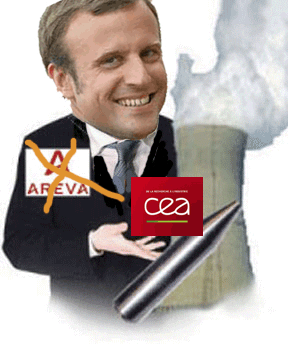
Telegraph 11th July 2021, Macron’s battle to rewire EDF. French President Emmanuel Macron wants to restructure EDF and separate the costly nuclear power arm from the rest of the business. Jean-Bernard Lévy has developed a remarkable level of patience in his role leading utilities giant EDF. The French state-controlled company oversees some of the longest-running infrastructure projects in the world, operating 73 reactors globally.
But even Lévy is bound to have grown frustrated by the lack of progress in the French government’s effort to improve the company’s prospects. In what has been code-named Project Hercules, France wants to overhaul competition rules and separate EDF’s costly nuclear power arm from other areas of its business.
It is hoped the move could allow EDF to double its growth target in renewable energy to 100 gigawatts (GW) by 2030 and help it manage its debts. Brussels must first give approval for EDF’s reorganisation, but talks appear to have stalled and time is running out before France’s general election in April.
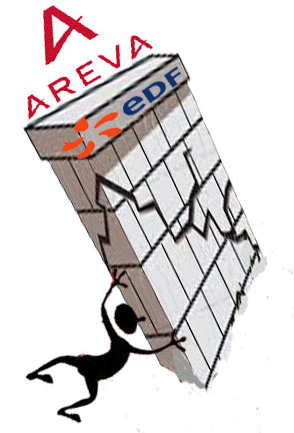
Its expensive nuclear fleet is one reason for its heavy net debt of €42bn. Multi-billion euro investment is needed in coming years to decommission, maintain and build new plants. S&P Global says nuclear projects “represent the highest risk to the group’s credit quality”.
It expects net debt to rise to €50bn-€52bn by the end of 2023. EDF argues it is disadvantaged by rules in France allowing competitors to buy a quarter of the electricity generated by its nuclear fleet at a fixed price of €42 per MwH, to make up for its monopoly in themarket. The price is too low and inflexible, EDF argues.
Meanwhile, EDF’s spending grows. The company is building several large assets without yet getting paid, including the £22bn-23bn nuclear power plant Hinkley Point C Somerset. For its next planned nuclear power station in the UK, Sizewell C in Suffolk, a different funding mechanism is being discussed with the
Government that would allow EDF to recoup costs from household bills during construction, rather than having to wait until the plant is generating.Ministers are believed to be preparing to introduce legislation this
autumn.
https://www.telegraph.co.uk/business/2021/07/11/macrons-battle-rewire-edf/
France’s government helps settle the debts of bankrupt nuclear company AREVA (which is now resuscitated as ORANO)
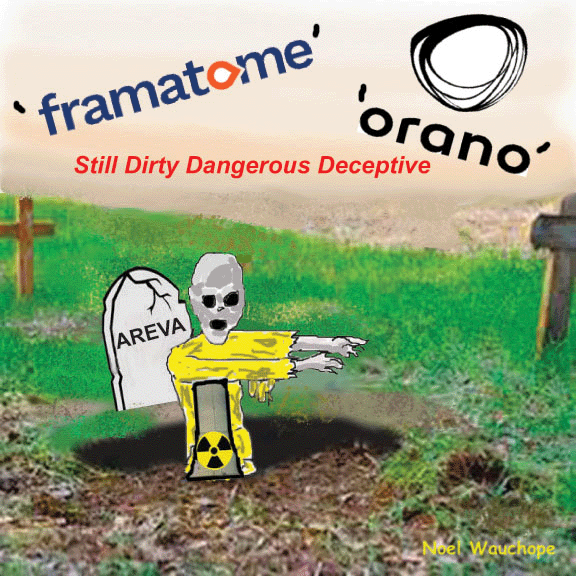
French state helps Areva settle Finnish EPR liabilities. To settle a new additional cost of 600 million euros, the State will buy back from the company, for 994.1 million euros, part of the shares it holds in the capital of Orano, the group responsible for managing the fuel cycle.
Le Monde 8th July 2021
“EDF’s Chinese dream seems well and truly over”- a minor nuclear incident becomes a major industrial disaster for the French nuclear firm.
Le Monde 6th July 2021 “EDF’s Chinese dream seems well and truly over”. The minor incident at a Chinese nuclear power plant could have repercussions … on French industrial cooperation with China, explains Frédéric Lemaître, correspondent for “Le Monde” in Beijing, in his column.
Since June 14, Fabrice Fourcade, the head of EDF in China, and the economic service of the French Embassy in Beijing have been absent subscribers. Within hours, an apparently minor technical incident at a Chinese nuclear power plant turned into a perfect crisis for the French electrician.
The cluster bomb came from the United States. Monday June 14, while the American President, Joe Biden, is in Europe, the American channel CNN announces that the French Framatome, a few days earlier, informed the White House of an “imminent radiological threat” to the nuclear power station of Taishan, in the far south of China.
Why Framatome? Because this plant, in which EDF is a 30% shareholder, was built on the model of the French EPR and because Framatome is one of its main architects. “The largest commercial contract signed by the French nuclear industry and, more generally, in the history of civil nuclear power, this project strengthens Framatome’s presence in China, one of the most promising markets in the world,” explains the group on its site.
Why the United States? The answer is complicated. According to Le Figaro, the French engineer in charge of monitoring the file – in fact, a leak of fuel rods supplied by Framatome – warned a colleague across the Atlantic because it is the American subsidiary which manages the database of all incidents in the group.
Problem: Taishan’s majority shareholder, Chinese CGN, is on the US government’s blacklist. In order to work on the
case and possibly come to Taishan’s aid, an American must therefore obtain the approval of the White House. EDF communicators may try to put out the fire by explaining, from Paris, that the incident is minor, while the industrial disaster is major.
The episode proves that EDF, a 30% shareholder in Taishan, has no say in the matter, is not informed of technical problems and cannot get a board meeting. In Xi Jinping’s China, where any situation is the result of a balance of power, a minority has – by definition – no rights.
France refuses to hand over maps of nuclear tests in Algeria
France refuses to hand over maps of nuclear tests in Algeria, https://en.mehrnews.com/news/175726/France-refuses-to-hand-over-maps-of-nuclear-tests-in-Algeria 7 Jul 21, France conducted several nuclear tests in the Algerian desert between 1960 and 1966, four of which were conducted on the ground and 13 underground.
Tayeb Zitouni, minister of Mujahideen and Right Holders of Algeria made the remarks on the occasion of the 59th anniversary of the country’s independence from France (July 5, 1962).
According to Al-Quds Al-Arabi newspaper, Zitouni said that the French side refuses to provide a map showing the exact location of the tests and the disposal of nuclear and chemical waste.
He said France had so far taken no action to clear the area of the contaminated areas or pay compensation to the victims of the nuclear tests.
The case of the atomic explosions is one of the most important unresolved cases between Algeria and France, which has reached a stalemate in negotiations, and on any occasion, the Algerian authorities ask Paris to accept responsibility for this sensitive case.
EDF launches the “EPR2” After the Flamanville and Finland fiascoes, what could go wrong?

After the Flamanville and Finland fiascoes, what could go wrong?
EDF launches the “EPR2” — Beyond Nuclear International The politics of “fait accompli” will ensure a new industrial and financial disaster
Editor’s note: Despite the latest safety failures at the Taishan EPR in China; the endless delays and cost over-runs at the EPR projects in France and Finland; the technical fiascos and do-overs at the EPR construction sites in France, Finland and the UK; and the ongoing reckless plans for 6 EPRs in India, the French nuclear sector has far from abandoned its hubris. Instead, incredibly, and as Stéphane Lhomme tells us in a recent new blog on the topic, here translated into English, EDF has announced plans to begin construction of the “EPR2”. What could possibly go wrong?
By Stéphane Lhomme. 4 July 21,
Despite the fact that it has proven incapable of properly carrying out the construction of the EPR reactor at the never-ending Flamanville site underway since 2008, EDF leadership has nevertheless decided — according to the media outlet, Contexte — to allocate hundreds of millions of Euros to launch a construction program for new reactors, called “EPR2”.
Despite being fiercely pro-nuclear, President Macron has declared on several occasions that the EPR at Flamanville would need to be operational before any decision to build other reactors could be made.
However, it’s very likely that Mr. Macron is perfectly well aware of — and complicit in — this decision by EDF management to move forward with a new project.
Just as it has often done in the past, in its contempt for democracy and the interests of the French public, the leadership of EDF intends to use the politics of fait accompli: it proposes to spend hundreds of billions to start one or several “EPR2” reactor construction projects in order to then proclaim that the ship has sailed so the program cannot be stopped…. under threat of wasting hundreds of billions.
But it’s precisely by building nuclear reactors that EDF is already wasting astronomic sums, just as Areva did before that, going bankrupt due to the disastrous EPR construction project in Finland (which began in 2005, was supposed to come on line in 2009….but is still not complete)!
EDF claimed to have EPR construction under control despite Areva’s setbacks in Finland, but the construction at Flamanville is also a total catastrophe. So how can we possibly believe that, miraculously, EDF would be capable of building new EPR reactors, and moreover modified ones (hence the concept “EPR2”)?
For sure, from the anti-nuclear point of view, it is reassuring to be able to count on the incompetence and manifest inability of EDF to build nuclear reactors. But there is no justification for wasting incredible sums of money that are so needed for energy efficiency and renewable energy development.
On the contrary, EDF is guaranteeing failure with these delusional nuclear projects, and, as is the case for Areva (renamed Orano), it is the public who will pay for the steep losses. If this “EPR2” program is not stopped as quickly as possible, it will end in a new industrial and financial disaster.
The least that the President of the Republic can do, assuming that he has a good grasp on democracy, is to prohibit EDF (which is 85% state-owned) from launching this new nuclear program before the startup of the Flamanville EPR.
But obviously the best decision would be to cancel all the new reactor projects and immediately to begin a rapid closure of the 56 reactors that pose a daily threat to the lives of French citizens and a majority of Europeans; reactors that produce radioactive waste for which there is no existing solution and that serve as a pretext for the totalitarian repression of citizens who oppose waste burial at the Cigéo at Bure in the Meuse.
Stéphane Lhomme is a longtime French anti-nuclear campaigner and runs the anti-nuclear network, Nuclear Observatory (Observatoire Du Nucléaire).
Headline photo of EPR protest in Colmar, France, by Linda Pentz Gunter.
Under cover of the nation’s preoccupation with the pandemic, France changes the rules, to permit nuclear installations in urbanised areas.
A government decree authorizes the construction of nuclear installations in urbanized or urbanizable areas. While the media, health and political institutions are grinding the brains of citizens with a virus, the government continues to issue decrees spiraling out of control.
This time, on June 29, 2021, a decree dispensing with the town planning code will allow the establishment of nuclear installations in urbanized areas, including where people reside! The ministers of ecology and housing signed this crap. The whole territory is now at the mercy of nuclear predation. It’s radioactivity in your garden or on the balcony.
Insanity presides over autocratic political power and lobbying.
Co-ordination Antinucleaire 2nd July 2021
European Court of Justice condemns France for preventing anti-nuclear group from access to legal justice.
Le Figaro 1st July 2021

Bure: France condemned for having rejected the legal action of an
 antinuclear association. The European Court of Human Rights (ECHR) on
 Thursday condemned France for having "disproportionately" restricted access
to justice to an association opposed to the nuclear waste burial project in
 Bure (Meuse).

The seven judges of the judicial body of the Council of Europe which sits in Strasbourg considered that France had violated article 6.1 of the European Convention on Human Rights which guarantees "the right of access to a court »Regarding the Mirabel-LNE association.......


The Cigéo project, on the border of the Meuse and Haute-Marne, aims to eventually store some 85,000 m3 of nuclear waste at a depth of nearly 500 meters.
 Le Figaro 1st July 2021

 https://www.lefigaro.fr/flash-eco/bure-la-france-condamnee-pour-avoir-rejete-le-recours-en-justice-d-une-association-antinucleaire-20210701
Buried in the sand of Southern Algeria – the radioactive pollution from French nuclear tests

Algérie: sous le sable, les déchets nucléaires français, translation by
Hervé CourtoisC.A.N. Coalition Against Nukes, 2 July 21
This is one of the major issues in the reconciliation of memories between France and Algeria. A subject that has long remained buried in the sands of the Sahara: the pollution of southern Algeria by French nuclear tests.
More than fifty years after the last test in 1966, Algiers has just created an agency for the rehabilitation of former nuc;ea test sites.
The Propaganda
From 1960 to 1966, the French army conducted 17 nuclear tests in southern Algeria, on the sites of Reggane and In Ekker. At the time, Albdekrim Touhami, a native of Tamanrasset, was a teenager. In Ekker is 150 kilometers north. He remembers the installation of the French military base, seen then as a welcome source of employment.”For us, it was a godsend. Everyone came running to get a job as a laborer or simple worker on the site. We didn’t think that this bomb was going to be a disaster for the region. We were told, “Here it is, the bomb will go off at such and such a time. You may feel some shaking, like an earthquake. But don’t worry, there will be no problem.” “
Fifteen years after Hiroshima and Nagasaki, the danger of nuclear weapons is known. Southern Algeria is chosen to conduct these tests, because the area is considered quite deserted compared to the Southern Alps or Corsica, while being close to the French mainland.
France wanted to quickly demonstrate its capacity to use the bomb in the context of the Cold War and the race for nuclear deterrence.”France wanted to catch up with the other nuclear powers, the United States, Russia and the United Kingdom, to remain in what was called at the time “the big league”. This partly explains why the priority was the result, not the concern about the environmental impact or the collateral damage to the population. The priority was to explode the bomb,” recalls Patrice Bouveret, co-founder of the Observatoire de l’armement, an independent center of expertise.A highly polluted area .
In1962, Algeria became independent. The tests continued. Most of them, eleven, were carried out between 1962 and 1966 and therefore with the agreement of the new Algerian authorities. Systematically, the waste generated by these tests was buried, explains Jean-Marie Collin, spokesperson for Ican-France (International Campaign for the Abolition of Nuclear Weapons) who published a study with Patrice Bouveret, “Under the sand, the radioactivity! “.
Very clearly, France has a desire to bury,” emphasizes Jean-Marie Collin. It considers the desert as an ocean, an ocean of sand, and it buries everything that is likely to be contaminated. Algerian independence and the fact that France left Algeria under rather complicated conditions did not play in favor of depollution. On the contrary, even more waste was left behind. “Waste that goes from the simple screwdriver to the tank exposed to test the resistance of military equipment to the atomic bomb. Another pollution linked to nuclear tests, the accidental one during the Berryl underground test in 1962.
The reason for the tests was that the nuclear technology was not fully mastered and therefore there were accidents that released radioactive lava,” continues the Ican-France spokesman. The test concerned was in 1962. We were there in 2007. The scientists measured the radioactivity, which was extremely high, and they told us: “You should not stay more than twenty minutes on the spot, if you do not want to absorb radioactivity that is dangerous for your body. “
Only one victim compensated.
Contaminated rocks left in the open air, in areas of passage. Contaminated sand disseminated by the winds beyond the Algerian borders, particularly in neighboring Niger. For about fifteen years, in the area of Tamanrasset and with very few means, Abdelkrim Touhami and his association Taourirt tries to draw up a sanitary assessment.We learned that many people died of suspicious deaths,” he confides. People were dying little by little. Babies were being born with deformities. Cancers were occurring through this disaster. “
To date, no official census of the people exposed, whether French or Algerian. Only one Algerian victim has been compensated under the Morin Law (2010). The decree of May 31 creating an agency for the rehabilitation of test sites in Algeria is an important step for Jean-Marie Collin of Ican-France.
Until now,” he explains, “the Algerian state created a certain surveillance zone on these sites, but there had never been any action to protect these zones in order to avoid any real access. This decree opens up the possibility that international organizations such as States could come and help rehabilitate these nuclear test sites. What we have at the same time are discussions between France and Algeria, officially revealed in April, whereas until then, these discussions did not officially exist.
“These discussions took place within the framework of the Franco-Algerian working group on nuclear tests, created in 2008 under the presidency of Nicolas Sarkozy. This issue of rehabilitation was also included in the report by Benjamin Stora on the reconciliation of memories between France and Algeria. Algiers must ratify the Tian, the Treaty for the Prohibition of Nuclear Weapons, to which France is not a signatory, before mid-October.
.Supporters of the rehabilitation of former nuclear test sites want a joint Franco-Algerian mission to be sent to map the polluted sites in order to circumscribe them, and eventually treat them so that the inhabitants are no longer exposed to radioactivity. . https://www.rfi.fr/fr/afrique/20210629-alg%C3%A9rie-sous-le-sable-les-d%C3%A9chets-nucl%C3%A9aires-fran%C3%A7ais?fbclid=IwAR2Gn0qmn8xngwhyIaCBN1ut9lU9w_YwziHLSr9S2SkwmBGc9oaWL0f18As
Protests against France’s Tricastin nuclear station, Greenpeace activists face gaol.
Despite the lawsuits, we, Greenpeace, will continue to warn of nuclear
danger. Thirty-four Greenpeace activists will appear on June 29 in court in
Valencia. They had entered the Tricastin nuclear site to denounce the
danger. Greenpeace reaffirms in this forum its commitment and calls for the
dismantling of the plant.
Reporterre 26th June 2021
“40 years is enough”: 300 people gathered in Montélimar to demand the
shutdown of the Tricastin power plant.
France Bleu 26th June 2021
1 This Month



26 September – International Day for the Total Elimination of Nuclear Weapons


PLEASE OPPOSE HR 8255 AND S.3639 – bills would accelerate satellite deployment, with no environmental review or safeguards – https://ncstd5li.quorum.us/campaign/169331/
To see nuclear-related stories in greater depth and intensity – go to https://nuclearinformation.wordpress.com
-
Archives
- September 2026 (233)
- August 2026 (330)
- July 2026 (355)
- June 2026 (287)
- May 2026 (306)
- April 2026 (356)
- March 2026 (251)
- February 2026 (267)
- January 2026 (308)
- December 2025 (358)
- November 2025 (359)
- October 2025 (375)
-
Categories
- 1
- 1 NUCLEAR ISSUES
- business and costs
- climate change
- culture and arts
- ENERGY
- environment
- health
- history
- indigenous issues
- Legal
- marketing of nuclear
- media
- opposition to nuclear
- PERSONAL STORIES
- politics
- politics international
- Religion and ethics
- safety
- secrets,lies and civil liberties
- spinbuster
- technology
- Uranium
- wastes
- weapons and war
- Women
- 2 WORLD
- ACTION
- AFRICA
- Atrocities
- AUSTRALIA
- Christina's notes
- Christina's themes
- culture and arts
- Events
- Fuk 2022
- Fuk 2023
- Fukushima 2017
- Fukushima 2018
- fukushima 2019
- Fukushima 2020
- Fukushima 2021
- general
- global warming
- Humour (God we need it)
- Nuclear
- RARE EARTHS
- Reference
- resources – print
- Resources -audiovicual
- Weekly Newsletter
- World
- World Nuclear
- YouTube
-
RSS
Entries RSS
Comments RSS
 nuclear-news