Emmanuel Macron won French election on a wide margin, running on a pro nuclear policy
| Incumbent French president Emmanuel Macron, who ran on a ticket to boost nuclear and renewable energy, was re-elected on Sunday by a wider margin than expected. Macron, from centre-right party La Republique en Marche, won the election with 58.55% of the vote against 41.45% for Marine Le Pen, representing Rassemblement National, though she nevertheless secured the far-right’s highest ever share of the vote. The president planned to build six European pressurised reactors (EPRs) by 2050, with an option foreight more pending further assessment, he stated in his election manifesto. The construction of the first reactor would start in 2028 and come into service in 2035, though the plan was deemed “unrealistic” by some experts. Macron also scrapped a plan to close 12 reactors by 2035 in a U-turn to his 2017 campaign pledge to cut reliance on nuclear energy to 50%, down from 70% currently. Montel 25th April 2022 https://www.montelnews.com/news/1315204/macron-wins-election-vows-to-boost-nuclear-renewables |
French election: Macron and Le Pen’s nuclear plans torn apart: ‘Waste of time AND money’
FRENCH presidential hopefuls Emmanuel Macron and Marine Le Pen have unveiled ambitious plans to boost France’s nuclear power capacity – already at 70 percent of its domestic electricity generation – but experts have questioned the feasibility.
By IAN RANDALL, , Apr 24, 2022
The recent emphasis on large-scale nuclear reactors is, at least superficially, seemingly at odds with President Macron’s announcement late last year that France would be investing in so-called small modular reactor designs as part of his “France 2020” roadmap.
……………… Of the strategy’s allocated €30billion (£25.2billion) budget, €8billion (£6.7 billion) is to be apportioned towards the development of hydrogen power, compared with just €1billion (£0.8billion) towards small-scale reactor concepts.
Despite this funding disparity, however, Mr Macron asserted that the realisation of the small modular reactors was in fact “goal number one”……………………………. https://www.express.co.uk/news/science/1600032/french-election-energy-macron-le-pen-grand-nuclear-plans
Investigations continue into possible stress corrosion in several of EDF’s nuclear reactors in France.
EDF has said it found indications of possible stress corrosion on the
auxiliary circuits of four French nuclear power reactors totalling 4.8 GW
in capacity, namely Chinon 3, Cattenom 3, Flamanville 2 and Golfech 1. The
signs of possible corrosion were detected during ultrasonic inspections of
parts of the piping at its Chinon 3 (905 MW), Cattenom 3 and Flamanville 2
(1.3 GW each) reactors, the French state-owned utility said in a statement
at the end of last week.
The units are among six reactors that EDF
considers as “priority” for these checks, with the other three being
Flamanville 1 (1.3 GW) and Bugey units 3 and 4 (880 MW each). Meanwhile,
inspections carried out on the safety injection system circuit at Golfech 1
(1.3 GW) during planned maintenance also detected indications of possible
corrosion, EDF added. A spokeswoman told Montel on Tuesday that the utility
was carrying out further investigations to find out whether it was
corrosion or not.
Montel 19th April 2022
https://www.montelnews.com/news/1313964/edf-finds-indications-of-possible-corrosion-on-4-reactors-
France’s nuclear energy output falling, as signs of corrosion halt several nuclear reactors

Electricite de France SA has found corrosion on key piping on four nuclear
reactors during recent checks, taking the number of affected units at its
French fleet of atomic generators to nine.
Corrosion issues have forced the French energy giant to halt some of its 56 reactors for lengthy checks and repairs, just as Europe faces its worst energy crisis in half a century.
The state-controlled utility previously said its nuclear output will fall
to the lowest in more than three decades this year and hardly rebound next
year due to the reactor works.
Signs of corrosion were found in pipings of
the Chinon-3, Cattenom-3 and Flamanville-2 reactors, three of the six units
that EDF had decided to check in February, EDF said in a statement posted
on its website last week. Indications of corrosion have also been found at
the Golfech-1 unit during a planned maintenance halt, and deeper checks
will be carried out, the utility said.
Bloomberg 19th April 2022
French presidential election – Macron and LePen have differing pro-nuclear policies – but in both cases, very costly.
 | |||
French presidential election: Future of nuclear power and EDF down to voters, Euractiv By Nelly Moussu | EURACTIV.fr | translated by Anne-Sophie Gayet, 13 Apr 2022
Both Emmanuel Macron and Marine Le Pen, the candidates that qualified for the second round of the French presidential election, support the revival of nuclear energy. However, they differ in their ambitions, strategies and modus operandi. EURACTIV France reports.
EDF, the French multinational electric utility company, is looking to diversify its energy sources – in particular, focusing its core business on nuclear power. This progress has so far been hampered, however, by a number of difficulties that have challenged the energy giant’s finances: the shutdown of reactors for maintenance and the obligation to lower its prices, as mandated by the state.
With Macron and Le Pen’s pro-nuclear energy programmes, the company is likely to face increased financial pressure, presented with high investment costs for maintenance and the building of reactors.
Two pro-nuclear politicians
Presenting his electoral programme in Belfort on February 10, Macron outlined his plan to build six new nuclear reactors of the EPR 2 type, examine eight other projects, and extend existing plants. “I am asking EDF to study the conditions of extension beyond 50 years, in conjunction with the nuclear safety authority”, Macron said.
An “inter-ministerial programme directorate dedicated to new nuclear power” would be set up to “ensure the management, coordinate administrative procedures, and ensure that the costs and deadlines of the projects are respected”, he continued.
Macron also announced a new regulation for nuclear electricity, replacing the Regulated Access to Historic Nuclear Electricity (Accès Régulé à l’Electricité Nucléaire Historique, ARENH). This system, which allows all energy suppliers to purchase electricity from EDF under conditions set by the State, will expire in 2025.
………. Le Pen has broad nuclear ambitions too. In her plan, named ‘Marie Curie’, the candidate announced that she wanted to extend the life of existing power plants to 60 years, reopen the Fessenheim plant (which was closed in 2020), build five pairs of EPRs by 2031 and five pairs of EPR 2s by 2036.
However, these forecasts are not necessarily credible, said Nicolas Goldberg, an energy expert at Terra Nova. In a note published by the Terra Nova think tank on Monday (April 11), he emphasised that Le Pen’s announcements “are contradictory to what the nuclear industry advocates: according to independent audits carried out on behalf of the State, deciding today on a nuclear revival would mean that at best a first pair of EPRs could be available between 2035 and 2037 […]. It should also be remembered that the industry itself has expressed some doubts about its ability to build more than 14 EPRs by 2050.”
Towards a nationalisation of EDF?
To implement their nuclear projects, Macron and Le Pen would rely on EDF, 84% of which is currently owned by the state.
………………..“The state will take its responsibilities to secure EDF’s financial situation and its financing capacity in the short and medium-term, as much as to allow it to pursue its strategy of profitable development within the framework of the energy transition”, Macron announced in February during his speech in Belfort.
Some have interpreted this statement as an open door to nationalisation. “Emmanuel Macron knows very well that in order to have a cheap nuclear power, public funding is required”, Goldberg said. By nationalising, EDF’s borrowing rates would not be the same; nor would the sharing of risks……………..
“For Emmanuel Macron, I feel that it is complicated,” Goldberg said. “There is, at the same time, the will to keep an integrated group, to give public financing for nuclear power, and to remain in the European markets”. Nationalisation is uncertain on Macron’s side, and it could be only partial.
Nationalisation is less of an uncertainty for Le Pen, Goldberg said. “It’s a nationalisation no matter what it costs,” the expert says. However, the candidate has not given any details on this issue in her programme. Contacted by EURACTIV on this for more details, her campaign team did not respond…….. https://www.euractiv.com/section/energy/news/french-presidential-election-future-of-nuclear-power-and-edf-down-to-voters/
France working out how to save debt-laden nuclear company EDF
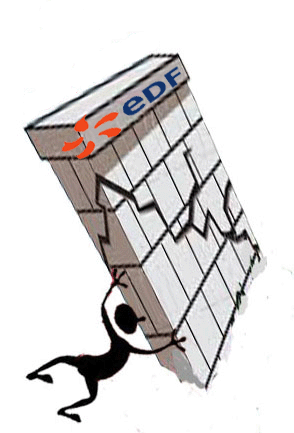
France is considering restructuring plans for debt-laden power firm EDF
(EDF.PA) that include full nationalisation followed by the sale of its
renewables business to focus on nuclear energy, BFM Business reported,
citing unidentified sources.
The website said the government was working
with investment bank Goldman Sachs on several restructuring scenarios. The
sale of the renewables business could fetch 15 billion euros ($16 billion),
it cited unidentified bankers as saying, adding that could help finance the
building of six next-generation EPR nuclear reactors.
Reuters 13th April 2022
Emmanuel Macron Gets Nuclear Energy All Wrong

The price of nuclear generation today is inordinate: a rip-off in terms of value, to put it bluntly. Indeed, while safety concerns drive up the cost of nuclear plant insurance, the price of renewables is predicted to sink further, by as much as 50 percent or more by 2030. ……No nuclear reactors anywhere are built without enormous government support, and France will be no different: The bill for the French taxpayers will start at $57 billion, according to the New York Times.
The single greatest barrier to the so-called nuclear renaissance is nuclear power itself and its inability to deliver affordable power on time and on budget.
Nuclear power won’t help France meet its climate goals on budget or on time.
https://foreignpolicy.com/2022/03/22/macron-france-nuclear-energy-climate-renewables/ By Paul Hockenos, a Berlin-based journalist. 22 Mar 22, At year’s end, Germany will shutter its last three nuclear plants; Belgium will follow suit by 2025. France, on the other hand, is committed to remaining Europe’s last stronghold of nuclear energy. At the center of French President Emmanuel Macron’s re-election platform is his plan to construct as many as 14 new-generation reactors and a fleet of smaller nuclear plants, supposedly to bolster the country’s climate protection strategy.
France’s bet on nuclear energy, however, is an egregious miscalculation that will severely inhibit its decarbonization efforts. At a critical juncture in the battle against climate change, diverting any finances and losing time with nuclear power, which has been in decline worldwide for decades, will only set back the country’s climate efforts, perhaps dooming its chances to go carbon neutral by 2050. Indeed, this Hail Mary pass, taken out of desperation as France has fallen woefully behind on its climate targets, will most probably come to naught anyway as the era of nuclear power wanes further no matter France’s declarations.
The simple explanation: Fully fledged renewables are faster, cheaper, and lower risk than nuclear power.
Despite the flurry of media hype around new nuclear energy and loose talk of a “nuclear renaissance,” in recent years, the arguments against nuclear power have grown demonstrably stronger.
Critics’ original concern with nuclear power, namely its safety, remains levelheaded and paramount. The two most catastrophic meltdowns—namely in 1986 at Ukraine’s Chernobyl nuclear power plant and in 2011 at Japan’s Fukushima site—are well known and had horrific repercussions that haunt those regions today. But these mega disasters are only the blockbusters.
According to the International Atomic Energy Agency, there have been 33 serious incidents at nuclear power stations worldwide since 1952—two in France, and six of them in the United States. Currently, a fifth of France’s geriatric nuclear generation is shut down because of safety issues—the older reactors get, the higher the risk of an accident—exacerbating an acute energy crunch there. So much for the 24/7 reliability of nuclear power.

And then there’s the now 80-year-old conundrum of how and where to dispose of radioactive waste. To date, no secure repositories are in operation anywhere in the world for the spent fuel, which remains toxic for hundreds of thousands of years. Experts estimate that more than 250,000 metric tons of radioactive waste—over 14,000 metric tons in France and 90,000 metric tons in the United States—is currently in temporary storage near nuclear power plants and military production facilities worldwide.
In France and elsewhere, there’s broad agreement that for security and health reasons, highly radioactive material can’t simply be lodged interminably at interim sites. But France’s wish to one day entomb its toxic refuse 500 meters below the Earth’s surface and 186 miles east of Paris is still on hold as locals refuse to accept the presence of a long-term nuclear repository near their homes. The story is the same just about everywhere: No one wants to raise families near a nuclear waste dump.
But these days, there are other arguments against nuclear energy that are arguably even more averse to a nuclear revival than the issues of safety and nuclear waste.
Nuclear power plants have actually pulled off one of the most remarkable feats of recent technological history: Where virtually all other technologies have gotten cheaper over time as they have developed and matured, nuclear power has actually become more expensive. Indeed, it has grown dauntingly costly compared with renewables: at least four times as costly as utility-scale solar and onshore wind power. While the cost of solar and wind energy generation, as well as battery storage, plummets by the year—in 2020 alone, onshore wind costs declined by 13 percent and those of utility-scale solar photovoltaics by 7 percent—the bill for new nuclear sites climbs upward.
The price of nuclear generation today is inordinate: a rip-off in terms of value, to put it bluntly. Indeed, while safety concerns drive up the cost of nuclear plant insurance, the price of renewables is predicted to sink further, by as much as 50 percent or more by 2030. This price trend is one reason why in 2020 total investment in new renewable electricity surpassed $300 billion, 17 times global investment in nuclear power, according to the World Nuclear Industry Status Report. No nuclear reactors anywhere are built without enormous government support, and France will be no different: The bill for the French taxpayers will start at $57 billion, according to the New York Times.
This yawning price differential means renewables generate many more times the electricity per dollar invested than does nuclear—and thus decreases emissions by a greater factor.
The single greatest barrier to the so-called nuclear renaissance is nuclear power itself and its inability to deliver affordable power on time and on budget. If Europe’s current headline nuclear projects are a measure—marred for decades now by massive cost overruns and protracted delays—France’s hopes to have its first new reactor up and running by 2035 are illusory. In Flamanville in northwest France, the French energy firm EDF is struggling to finish a reactor that is a full decade behind schedule and now roughly four times above cost projections. The Olkiluoto 3 reactors in Finland, also many times over budget, have been delayed again and again since the early 2000s.
Indeed, not one reactor conceived since 2000 in the European Union has generated even a kilowatt of energy. The Olkiluoto 3 plant may begin commercial activities this year. As for the new, smaller, presumably cheaper nuclear reactors envisioned by billionaire Bill Gates among others, not one is in operation anywhere in the world.
In a widely circulated Jan. 25 letter penned by four former top nuclear energy regulators in France, the United States, Germany, and the United Kingdom, the authors excoriated the viability of relying on nuclear energy to beat climate change: Nuclear energy, they argue, “is just not part of any feasible strategy that could counter climate change. To make a relevant contribution to global power generation, up to more than ten thousand new reactors would be required, depending on reactor design.”
The fact is that nuclear power is simply too cumbersome to really play a meaningful role in tackling climate change—in France or elsewhere. We don’t have that kind of time. Indeed, there is no way countries can meet their 2030 decarbonization goals agreed to at the Paris Agreement by embarking now on nuclear power programs.
In stark contrast, renewable energy is a sprinter: Farms can be licensed, financed, and deployed much faster because they’re smaller, less capital intensive, more quickly approved, and easier to build. Depending on the country, vast utility-scale solar fields and onshore wind farms can materialize in just a handful of years. Last year, China brought to life about 50 gigawatts of solar capacity—that’s as much electricity generation as 10 nuclear reactors. Even the average nine-year schedule of offshore wind parks is still much, much shorter than nuclear’s erratic, extended timelines.
In Europe and elsewhere, building out nuclear power will greatly hamper the effort to curb climate change, not help it. “The more urgent climate change is, the more we must invest judiciously, not indiscriminately,” writes sustainability expert Amory Lovins, “to buy cheap, fast, sure options instead of costly, slow, speculative ones.”
In the end, the evidence speaks conclusively for ramping down fossil fuels and nuclear energy as fast as possible while embarking on an all-out expansion of sustainable renewables: wind, solar, biomass, geothermal, hydroelectric, and tidal/wave energy. Modern gas works will back up this clean energy model until green hydrogen can take over. Ever better energy storage, smart grids, energy conservation, and digital management will make this model of the future work.
Germany and Belgium—like Austria, Italy, and nine other EU countries—are looking the facts straight in the eye. By swearing off nuclear energy and fossil fuels at the same time, these countries will have the best chance at making a net-zero energy system functional by 2050, at the latest. https://foreignpolicy.com/2022/03/22/macron-france-nuclear-energy-climate-renewables/
Paul Hockenos is a Berlin-based journalist. His recent book is Berlin Calling: A Story of Anarchy, Music, the Wall and the Birth of the New Berlin (The New Press).
Macron under Putin’s thumb as Russia could CRIPPLE France’s nuclear industry, as it controls uranium supply.

Macron under Putin’s thumb as Russia could CRIPPLE France’s nuclear
industry. The recent reports of atrocities committed by Russian forces in
Bucha have finally pushed the EU into considering a ban on Russian fossil
fuels.
Oil and gas exports make up a large portion of Russia’s economy
and EU is heavily dependent on gas supplies from Moscow, making up 40
percent of its imports. The EU imported a staggering €48.5billion
(£38billion) of crude oil in 2021, and €22.5billion (£19billion) of
petroleum oils other than crude.
But even as EU leaders meet to discuss an immediate ban on Russian coal, experts have warned that aside from fossil fuels, Russia could also manipulate the EU’s energy through its control
of the global uranium supplies.
Speaking to Express.co.uk, Dr Paul Dorfman,
an associate fellow at the University of Sussex’s Science Policy Research
Unit (SPRU) and chair of the Nuclear Consulting Group said: “In terms of
energy security, Russian controlled uranium – basically reactors run on
uranium, includes both Russia and corporations in Kazakhstan, which are
Russian controlled.
Express 9th April 2022
In France, the nuclear waste keeps piling up: new reactors will add to the dilemma

France inches towards nuclear waste solution as more reactors planned
President Macron’s ‘French Nuclear Renaissance’ aims to provide energy independence and greener electricity for France – but the nuclear waste keeps piling up Connexion, By George Kazolias, 8 Apr 22,
Emmanuel Macron has announced plans to launch construction of six new nuclear reactors by 2050, along with studies for a possible eight further ones.
He also wants to prolong the life of existing reactors beyond 50 years in what he is calling the “French Nuclear Renaissance”.
Mr Macron’s vision to “take back control of [France’s] energy and industrial destiny” might be a winner with his electorate, but it clashes with the proposals of most of the left-wing presidential candidates, who want to reduce reliance on nuclear power.
New reactors will add to waste dilemma
Solutions for dealing with the waste already produced by existing power stations, however, are still struggling to get out of the starting blocks – and there is no plan for what would be done with waste from a potential 14 additional ones…………..At present, however, none of France’s nuclear reactor waste has been dealt with in a long-term way. All waste considered radioactive, almost two million cubic tonnes of it, is stored at surface level, in treatment centres and pools, or shallow repositories.
Some 60% of this comes from reactors and the rest is from medical, research, military and other sources.
The other waste, which includes items such as tools, clothing, mops and medical tubes, is not highly radioactive,
……… More problematic is what to do with France’s intermediate and high-level nuclear waste.
In 1998, a site near the village of Bure in the Meuse in north east France was chosen as the final storage place for most of it. It will be stored half a kilometre below ground in a vast network of tunnels and galleries known as a Deep Geological Repository (DGR).
The facility will be big enough for all the nuclear waste accumulated so far, but on-site studies, administrative procedures and opposition to the programme, including court cases and civil disobedience, have slowed its opening.
Deep underground storage could be three years away
The Bure DGR will store the waste in galleries carved out of 160-million-year-old compacted clay rocks. Known by its French acronym, Cigéo, the project currently holds 84% of the 665 hectares required to build the facility. The prefecture of the Meuse gave it a declaration of public utility (DUP) in December – a formal recognition that a proposed project has public benefits that must be obtained for most large construction and infrastructure projects before work can begin.
Once the Conseil d’Etat gives its consent, the prime minister can sign his own DUP. Andra will then have the power to get the rest of the property it needs.
In the meantime, work has continued with digging of wells and galleries to test reversible techniques of stocking waste for up to 100,000 years.
The prime minister is expected to sign off only after the presidential elections, but the final green light might be three years away as the rigorous and independent Nuclear Security Agency studies the permit request to move and store the spent nuclear fuel and other radioactive matter.
Plans are for existing not future waste
Activity at the Cigéo remains high, nevertheless. This year, a 1,700m² building, called The Eclipse, is being built to house companies working on underground trials.
A 100m-long cavity will also be dug to test technologies and conduct experiments. This is the length each cavity will have to be for intermediate-level waste, which is often solidified into concrete.
The nuclear authority is hoping to start storing this type of waste in 2025.
It is impossible to bury the high-level radioactive waste. This is turned into a glass-like substance, but then requires a cooling period of at least 50 years.
The clay storage facilities cannot handle temperatures above 90C.
Senator Sido said: “It is true that the most recent batches cannot be stocked in their present state. They are too hot and need a cooling-off period of several decades. But the first batches can be stocked now.”
The remaining high-level waste might not arrive before 2060. By then, France will have produced at least as much nuclear waste again. For that, it might have to create a new underground facility.
“As far as I know, there is no project in the pipeline for high-level and long-lived waste which will be produced in the future,” Mr Sido said. https://www.connexionfrance.com/article/Practical/Environment/France-inches-towards-nuclear-waste-solution-as-more-reactors-planned
France pays the steep cost of inflexible and ageing nuclear as electricity prices soar

French baseload and peak prices soar due to a combination of massive outages of French nuclear power plants, cold weather and inefficient heating
France pays the steep cost of inflexible and ageing nuclear as electricity prices soar — RenewEconomy 3 Apr 22,
The common refrain among critics of wind and solar is to blame their “variability” or “intermittency” for soaring electricity prices as Europe wrestles with gas shortages worsened by the war in Ukraine. But France, the nuclear “pin-up” country for the anti-renewables brigade, is not faring so well either.
Over the weekend, the key “day ahead” prices of electricity in France surged to unprecedented levels. On Friday, the futures price for “baseload” for wholesale French electricity price hit the eye-watering level of €714 a megawatt hour ($A1050/MWh).
It didn’t get much better by Sunday, when the day-ahead price for Monday settled at €515/MWh ($A758/MWh), which is the predicted average price over a 24-hour period. The price for peak electricity between 8am and 9am was €2,987/MWh ($A4,400/MWh).
The prices for both baseload and peak prices in the rest of the European market were significantly cheaper, and in Germany it was dramatically so.
The main reasons? Both supply and demand. Less than half (30GW) of France’s 64GW of nuclear capacity was available, thanks to planned and unplanned outages, and extended repairs due to corrosion issues in their ageing plants.
The forecast is for cold weather, and many French homes are fired with inefficient, energy hungry electric resistance heating, largely as a result that the French believed they had no reason to be energy efficient because of the their massive investment in nuclear.
“Massive outages of French nuclear power plants, in combination with cold weather and electric (often resistance) heating, are causing a critical situation for electricity supply there tomorrow,” energy analyst Kewes van der Leun tweeted over the weekend.
The French authority called on consumers to reduce their power consumption.
The situation in Europe is similar to the growing “north-side” divide in electricity prices in Australia, identified by the Australian Energy Market Operator, which has noted that since early 2021 average prices in the most heavily coal dependent states of Queensland and NSW are considering higher than elsewhere.
Partly that is due to a lack of transmission (France has similar problems), but also to the inflexibility of baseload, and the desperation of baseload owners to bid up prices when they can to recoup their costs.
Sure, states with high amounts of renewables do experience price spikes, but they tend to be short lived and the average price is significantly lower than so-called “cheap” coal.
The situation in France is not likely to get better any time soon. President Emmanuel Macron has pledge to invest significantly more in nuclear and his far-right opponent, Marine Le Pen (who is given an outside chance of unseating him) has pledge to stop all new wind and solar development.
But new nuclear won’t help. At the very best, a new reactor could be online by 2035, although France’s recent experience with massive cost over-runs and delays would put a major question mark over that being achieved.
French baseload and peak prices soar due to a combination of massive outages of French nuclear power plants, cold weather and inefficient heating
France pays the steep cost of inflexible and ageing nuclear as electricity prices soar — RenewEconomy
The common refrain among critics of wind and solar is to blame their “variability” or “intermittency” for soaring electricity prices as Europe wrestles with gas shortages worsened by the war in Ukraine. But France, the nuclear “pin-up” country for the anti-renewables brigade, is not faring so well either.
Over the weekend, the key “day ahead” prices of electricity in France surged to unprecedented levels. On Friday, the futures price for “baseload” for wholesale French electricity price hit the eye-watering level of €714 a megawatt hour ($A1050/MWh).
It didn’t get much better by Sunday, when the day-ahead price for Monday settled at €515/MWh ($A758/MWh), which is the predicted average price over a 24-hour period. The price for peak electricity between 8am and 9am was €2,987/MWh ($A4,400/MWh).
The prices for both baseload and peak prices in the rest of the European market were significantly cheaper, and in Germany it was dramatically so.
The main reasons? Both supply and demand. Less than half (30GW) of France’s 64GW of nuclear capacity was available, thanks to planned and unplanned outages, and extended repairs due to corrosion issues in their ageing plants.
The forecast is for cold weather, and many French homes are fired with inefficient, energy hungry electric resistance heating, largely as a result that the French believed they had no reason to be energy efficient because of the their massive investment in nuclear.
“Massive outages of French nuclear power plants, in combination with cold weather and electric (often resistance) heating, are causing a critical situation for electricity supply there tomorrow,” energy analyst Kewes van der Leun tweeted over the weekend.
The French authority called on consumers to reduce their power consumption.
The situation in Europe is similar to the growing “north-side” divide in electricity prices in Australia, identified by the Australian Energy Market Operator, which has noted that since early 2021 average prices in the most heavily coal dependent states of Queensland and NSW are considering higher than elsewhere.
Partly that is due to a lack of transmission (France has similar problems), but also to the inflexibility of baseload, and the desperation of baseload owners to bid up prices when they can to recoup their costs.
Sure, states with high amounts of renewables do experience price spikes, but they tend to be short lived and the average price is significantly lower than so-called “cheap” coal.
The situation in France is not likely to get better any time soon. President Emmanuel Macron has pledge to invest significantly more in nuclear and his far-right opponent, Marine Le Pen (who is given an outside chance of unseating him) has pledge to stop all new wind and solar development.
But new nuclear won’t help. At the very best, a new reactor could be online by 2035, although France’s recent experience with massive cost over-runs and delays would put a major question mark over that being achieved.
Macron rubbing hands with glee as UK energy crisis means EDF poised for ‘£30bn payday’

Macron rubbing hands with glee as UK energy crisis means EDF poised ‘£30bn payday’. EMMANUEL MACRON could win big from the UK energy crisis, with EDF being tipped to secure contracts worth nearly £30 billion.
Dr Paul Dorfman, an associate fellow at the University of Sussex said: “The UK has a very strong relationship with EDF, they own and run the substance of UK reactors and are helping to build Hinckley point and the rest of it.
“However, EDF are in debt. Moodys, the financial organisation has recently downgraded EDF’s credit rating. A quarter of all of France’s reactors are currently offline due to safety and security problems, that’s
largely because they have an ageing nuclear fleet, like us.
“In order to kind of try to prolong their lifespan, the French government has big upgrade of their nuclear. “The cost estimates are around £70-80 billion just to upgrade, just to keep them tottering on.”
EDF is currently constructing the Hinckley Point C nuclear power station and is also adding new reactors to Sizewell C in Suffolk and Bradwell B in Essex. Dr Dorfman has warned that these new reactors constructed by EDF are the same type of EPR reactors that were built in France, which the French court of Auditors estimated cost an extra €19billion (almost £16 billion). He continued: “EDF is clear about the need for Government investment in order to proceed with Sizewell C.”
Express 1st April 2022
Greenpeace activists storm French nuclear plant
Greenpeace activists break into the construction site of the Flamanville
EPR nuclear reactor to protest against pro-nuclear candidates in the French
presidential elections.
Launched at the end of 2007, the Normandy project
is 11 years overdue and its cost has risen to 12.7 billion euros according
to EDF, compared with the 3.3 billion announced in 2006. Greenpeace France
has called for an independent assessment of the viability of EPR nuclear
reactors.
Euronews 31st March 2022
https://www.euronews.com/2022/03/31/greenpeace-activists-storm-french-nuclear-power-plant
France’s nuclear energy output continues to slump

Falling nuclear output in France has spurred gas demand in the country and
is hampering EU moves to cut dependence on Russian supplies, according to
some analysts. “The underperformance of French nuclear power in the
Ukraine crisis is completely underestimated. The orders of magnitude are
dizzying” one analyst, who wished to remain anonymous, told Montel.
France, with 56 reactors – the world’s second-biggest nuclear
production capacity – has long been viewed as Europe’s powerhouse,
exporting output across the bloc. Now, that picture has changed with the
country’s nuclear availability plunging in recent months to its lowest
level in over 30 years.
Since 2015 France’s annual nuclear output has
slumped by around 100 TWh, TSO figures showed. In 2015, French reactors
generated 417 TWh. This year atomic output is forecast to drop to 295-330
TWh.
Montel 25th March 2022
https://www.montelnews.com/news/1308826/french-nuclear-slump-hinders-russian-gas-exit–analysts
Macron government considering nationalising France’s debt-laden nuclear company EDF
| |||
France looking to nationalise debt-laden power company EDF https://www.power-technology.com/news/france-power-company-edf/ 13 Mar 22
The French Government, which holds an 84% stake in the $30bn energy giant, could retain domestic business but review overseas operations. The Government of France is reportedly weighing options to nationalise multinational electric utility company Electricite de France (EDF), reported Bloomberg.
Citing people familiar with this, the report said that the French Government is considering the option to reorganise the debt-laden business with a focus on nuclear energy production.
French officials have been carrying out talks with advisers on the option to acquire all the stake from EDF’s small stakeholders and delist the company from the stock exchange, people aware of the development said.
The French Government, which owns 84% of EDF, could retain the ownership of the company’s domestic business but review EDF’s overseas operations, the sources added.
If the idea to nationalise EDF is approved, then the move is expected to take place after the French Presidential election, which is slated to take place later this year.
The Government of France is reportedly weighing options to nationalise multinational electric utility company Electricite de France (EDF), reported Bloomberg.
Citing people familiar with this, the report said that the French Government is considering the option to reorganise the debt-laden business with a focus on nuclear energy production.
French officials have been carrying out talks with advisers on the option to acquire all the stake from EDF’s small stakeholders and delist the company from the stock exchange, people aware of the development said.
The French Government, which owns 84% of EDF, could retain the ownership of the company’s domestic business but review EDF’s overseas operations, the sources added.
If the idea to nationalise EDF is approved, then the move is expected to take place after the French Presidential election, which is slated to take place later this year.
However, a spokesperson for the French finance ministry said that the information is ‘false’ and the government isn’t working on such a project.
Last month, French Government announced it will offer $2.4bn to support EDF, as the group sees a hit to profits due to outages at several of its nuclear plants and the impacts of a government power-price cap.
”Infinite war” – NATO and U.S. weapons industry found the perfect sales opportunity in Yemen
Arms Industry Sees Ukraine Conflict as an Opportunity, Not a Crisis, Jonathan Ng, Truthout , 2 Mar 22,

In the United States, the industry employs around 700 lobbyists. Nearly three-fourths previously worked for the federal government — the highest percentage for any industry. The lobby spent $108 million in 2020 alone, and its ranks continue to swell. Over the past 30 years, about 530 congressional staffers on military-related committees left office for defense contractors. Industry veterans dominate the Biden administration, including Secretary of Defense Lloyd Austin from Raytheon.
”’………………….Yemen Burning
Arms makers found the perfect sales opportunity in Yemen. In 2011, a popular revolution toppled Ali Abdullah Saleh, who had monopolized power for two decades. His crony, Abdu Rabbu Mansour Hadi, became president the next year after easily winning the election: He was the only candidate. Thwarted by elite intrigue, another uprising ejected Mansour Hadi in 2015.
That year, Prince Salman became king of Saudi Arabia, but power concentrated into the hands of his son, Mohammed bin Salman, who feared that the uprising threatened to snatch Yemen from Saudi Arabia’s sphere of influence.
Months later, a Saudi-led coalition invaded, leaving a massive trail of carnage. “There was no plan,” a U.S. intelligence official emphasized. “They just bombed anything and everything that looked like it might be a target.”
The war immediately attracted NATO contractors, which backed the aggressors. They exploit the conflict to sustain industrial capacity, fund weapons development and achieve economies of scale. In essence, the Saudi-led coalition subsidizes the NATO military buildup, while the West inflames the war in Yemen.
Western statesmen pursue sales with perverse enthusiasm. In May 2017, Donald Trump visited Saudi Arabia for his first trip abroad as president, in order to flesh out the details of a $110 billion arms bundle. His son-in-law, Jared Kushner, arrived beforehand to discuss the package. When Saudi officials complained about the price of a radar system, Kushner immediately called the CEO of Lockheed Martin to ask for a discount. The following year, Mohammed bin Salman visited company headquarters during a whirlwind tour of the United States. Defense contractors, Hollywood moguls and even Oprah Winfrey welcomed the young prince Yet the Americans were not alone. The Saudi-led coalition is also the largest arms market for France and other NATO members. And as the French Ministry of the Armed Forces explains, exports are “necessary for the preservation and development of the French defense technological and industrial base.” In other words, NATO members such as France export war in order to retain their capacity to wage it.
President Macron denies that the coalition — an imposing alliance that includes Saudi Arabia, Egypt, Jordan, the United Arab Emirates, Kuwait, Bahrain, Qatar, Sudan and Senegal — uses French weapons. But the statistics are suggestive. Between 2015 and 2019, France awarded €14 billion in arms export licenses to Saudi Arabia and €20 billion in licenses to the United Arab Emirates. CEO Stéphane Mayer of Nexter Systems praised the performance of Leclerc tanks in Yemen, boasting that they “have highly impressed the military leaders of the region.” In short, while Macron denies that the coalition wields French hardware in Yemen, local industrialists cite their use as a selling point. Indeed, Amnesty International reports that his administration has systematically lied about its export policy. Privately, officials have compiled a “very precise list of French materiél deployed in the context of the conflict, including ammunition.”
Recently, Macron became one of the first heads of state to meet Mohammed bin Salman following the assassination of journalist Jamal Khashoggi. Like Trump’s trip, Macron’s diplomatic junket was a sales mission. Eventually, Macron clinched a deal with the United Arab Emirates for 80 Rafale fighters. The CEO of Dassault Aviation called the contract “the most important ever obtained by French military aerospace,” guaranteeing six years of work for a pillar of its industrial base.
French policy is typical of NATO involvement in Yemen. While denouncing the war, every Western producer has outfitted those carrying it out. Spanish authorities massage official documents to conceal the export of lethal hardware. Great Britain has repeatedly violated its own arms embargo. And the United States has not respected export freezes with any consistency.
Even NATO countries in Eastern Europe exploit the war. While these alliance members absorb Western arms, they dump some of their old Soviet hardware into the Middle East. Between 2012 and July 2016 Eastern Europe awarded at least €1.2 billion in military equipment to the region.
Ironically, a leading Eastern European arms exporter is Ukraine. While the West rushes to arm Kyiv, its ruling class has sold weapons on the black market. A parliamentary inquiry concluded that between 1992 and 1998 alone, Ukraine lost a staggering $32 billion in military assets, as oligarchs pillaged their own army. Over the past three decades, they have outfitted Iraq, the Taliban and extremist groups across the Middle East. Even former President Leonid Kuchma, who has led peace talks in the Donbas region, illegally sold weapons while in office. More recently, French authorities investigated Dmytro Peregudov, the former director of the state defense conglomerate, for pocketing $24 million in sales commissions. Peregudov resided in a château with rolling wine fields, while managing the extensive properties that he acquired after his years in public service.
The Warlords
Kuchma and Peregudov are hardly exceptional. Corruption is endemic in an industry that relies on the proverbial revolving door. The revolving door is not simply a metaphor but an institution, converting private profit into public policy. Its perpetual motion signifies the social reproduction of an elite that resides at the commanding heights of a global military-industrial complex. Leading power brokers ranging from the Mitterrands and Chiracs in France, to the Thatchers and Blairs in Britain, and the Gonzálezes and Bourbons in Spain have personally profited from the arms trade.
In the United States, the industry employs around 700 lobbyists. Nearly three-fourths previously worked for the federal government — the highest percentage for any industry. The lobby spent $108 million in 2020 alone, and its ranks continue to swell. Over the past 30 years, about 530 congressional staffers on military-related committees left office for defense contractors. Industry veterans dominate the Biden administration, including Secretary of Defense Lloyd Austin from Raytheon.
The revolving door reinforces the class composition of the state, while undermining its moral legitimacy. As an elite rotates office, members insulate policymaking from democratic input, taint the government with corruption and mistake corporate profit with national interest. By 2005, 80 percent of army generals with three stars or more retired to arms makers despite existing regulations. (The National Defense Authorization Act prohibits top officers from lobbying the government for two years after leaving office or leveraging personal contacts to secure contracts. But compliance is notoriously poor.) More recently, the U.S. Navy initiated investigations against dozens of officers for corrupt ties to the defense contractor Leonard Francis, who clinched contracts with massive bribes, lavish meals and sex parties.
Steeped in this corrosive culture, NATO intellectuals now openly talk about the prospect of “infinite war.” Gen. Mike Holmes insists that it is “not losing. It’s staying in the game and getting a new plan and keeping pursuing your objectives.” Yet those immersed in its brutal reality surely disagree. The United Nations reports that at least 14,000 people have died in the Russo-Ukrainian War since 2014, and over 377,000 have perished in Yemen.
In truth, the doctrine of infinite war is not so much a strategy as it is a confession — acknowledging the violent metabolism of a system that requires conflict. As a self-selecting elite propounds NATO expansion, military buildup and imperialism, we must embrace what the warlords most fear: the threat of peace.The author would like to thank Sarah Priscilla Lee of the Learning Sciences Program at Northwestern University for reviewing this article. https://truthout.org/articles/arms-industry-sees-ukraine-conflict-as-an-opportunity-not-a-crisis/?eType=EmailBlastContent&eId=734c56bc-48da-4e66-bea1-f2bedb7d1431
1 This Month

of the week – Shut Down Drone Warfare!


Tell the Ukrainian Government to Drop Prosecution of Peace Activist Yurii Sheliazhenko

Petition to revoke the licensing of the Near Surface Nuclear Disposal Facility (NSDF) at Chalk River. https://www.ourcommons.ca/petitions/en/Petition/Details?Petition=e-7247
To see nuclear-related stories in greater depth and intensity – go to https://nuclearinformation.wordpress.com
-
Archives
- March 2026 (251)
- February 2026 (268)
- January 2026 (308)
- December 2025 (358)
- November 2025 (359)
- October 2025 (376)
- September 2025 (257)
- August 2025 (319)
- July 2025 (230)
- June 2025 (348)
- May 2025 (261)
- April 2025 (305)
-
Categories
- 1
- 1 NUCLEAR ISSUES
- business and costs
- climate change
- culture and arts
- ENERGY
- environment
- health
- history
- indigenous issues
- Legal
- marketing of nuclear
- media
- opposition to nuclear
- PERSONAL STORIES
- politics
- politics international
- Religion and ethics
- safety
- secrets,lies and civil liberties
- spinbuster
- technology
- Uranium
- wastes
- weapons and war
- Women
- 2 WORLD
- ACTION
- AFRICA
- Atrocities
- AUSTRALIA
- Christina's notes
- Christina's themes
- culture and arts
- Events
- Fuk 2022
- Fuk 2023
- Fukushima 2017
- Fukushima 2018
- fukushima 2019
- Fukushima 2020
- Fukushima 2021
- general
- global warming
- Humour (God we need it)
- Nuclear
- RARE EARTHS
- Reference
- resources – print
- Resources -audiovicual
- Weekly Newsletter
- World
- World Nuclear
- YouTube
-
RSS
Entries RSS
Comments RSS
 nuclear-news