France sends reprocessed nuclear fuel to Japan, despite environmental and safety dangers

https://japantoday.com/category/national/france-sends-latest-nuclear-shipment-to-japan CHERBOURG, France 18 Sept 22
Two ships carrying reprocessed nuclear fuel destined for Japan set sail Saturday morning from northern France, an AFP photographer said, despite criticism from environmental campaigners.
The fuel was due to leave the northern French port city of Cherbourg earlier this month but was delayed by the breakdown of loading equipment.
Environmental activists have denounced the practice of transporting such highly radioactive materials, calling it irresponsible.
The previous transport of MOX fuel to Japan in September 2021 drew protests from environmental group Greenpeace.
MOX fuel is a mixture of reprocessed plutonium and uranium.
“The Pacific Heron and Pacific Egret, the specialised ships belonging to British company PNTL, left Cherbourg harbor on September 17. They will ensure the shipment of MOX nuclear fuel to Japan,” French nuclear technology group Orano said in a statement Saturday.
They are bound for Japan for use in a power plant and Orano said it expected the shipment to arrive in November.
Japan lacks facilities to process waste from its own nuclear reactors and sends most of it overseas, particularly to France.
The operation was carried out “successfully”, Orano said, and it is the second shipment that arrived in Cherbourg from a plant in La Hague, located 20 kilometers away, after the first came on September 7.
Yannick Rousselet of Greenpeace France previously denounced the shipment.
“Transporting such dangerous materials from a nuclear proliferation point of view is completely irresponsible,” he said last month.
MOX is composed of 92 percent uranium oxide and eight percent plutonium oxide, according to Orano.
The plutonium “is not the same as that used by the military,” it said.
EDF contractors relax radiation exposure limits to speed up reactor repairs
By Benjamin Mallet – Friday 16 Sept 22, PARIS (Reuters) https://www.msn.com/en-gb/news/world/exclusive-edf-contractors-relax-radiation-exposure-limits-to-speed-up-reactor-repairs/ar-AA11UdIE?ocid=st– Some contractors helping French power giant EDF to inspect and repair its corrosion-hit nuclear reactors are planning to relax their rules on radiation exposure limits so that their workers can spend more time on the job, EDF told Reuters.
The company, which is rushing to get its fleet of nuclear powerstations ready for the winter, said the new threshold was in line with its own standards and remained well below French legal limits.
“We have been informed by some of our partners that they expect to increase the radiation exposure limit for some of their staff,” EDF said in emailed comments on Friday, responding to a Reuters query.
“The activities currently underway at our plants lead to a higher number of hours worked in the nuclear part of our sites. This additional activity had not been foreseen by our partners when they set their radiation limits,” the company said.
Two sources with direct knowledge of the repair works told Reuters that at least one EDF contractor, French company Monteiro, had already increased the maximum exposure its workers could be subject to, adding this posed no health risk.
A Monteiro spokeswoman had no immediate comment.
The sources said the changes to the safety guidance illustrated how EDF was racing against the clock to restart 15 reactors taken offline last winter after the emergence of stress corrosion at some plants.
Continue reading
A new window into France’s nuclear history
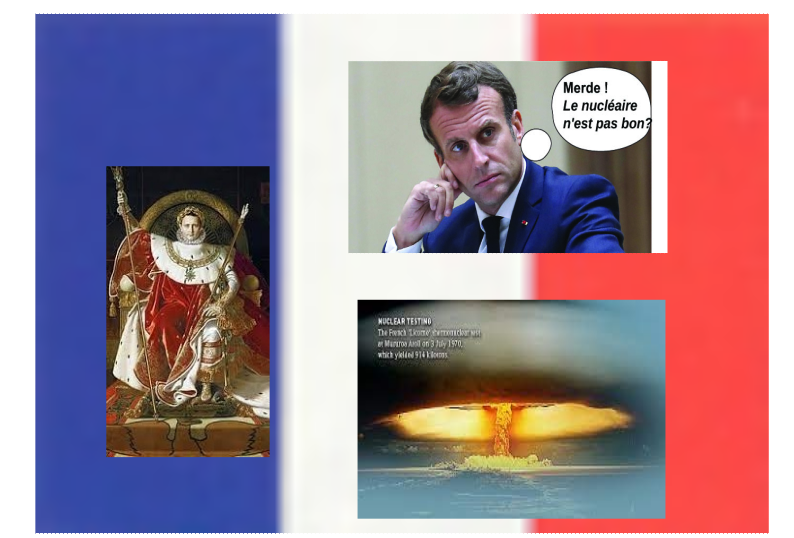
Bulletin of the Atomic Scientists By Austin R. Cooper | September 16, 2022, Access to French nuclear archives has increased dramatically during the past year. Since October 2021, French officials have declassified thousands of documents about the development of French nuclear weapons, an arsenal of roughly 300 warheads today.
This work marks a sea change in France, for decades one of the most difficult nuclear-armed democracies to study. Unlike the United States and the United Kingdom, France does not have Freedom of Information laws, which allow the public to file declassification requests. French archives do consider special access requests (dérogations), but these requests cannot compel a declassification review, which limits their utility in making nuclear weapons documents available for research.
French President Emmanuel Macron, in the wake of prize-nominated journalism and scholarship on the development of French nuclear weapons, launched a significant declassification initiative last year. This process has focused on Polynesia, the semi-autonomous French territory where French forces conducted nearly 200 atmospheric and underground explosions from 1966 to 1996. The scope does not include Algeria, the former French colony where French authorities built and operated their first nuclear test sites between 1960 and 1966, during the Algerian War for Independence (1954–62) and the construction of the postcolonial Algerian state.
New French transparency could help settle debates about environmental contamination and health effects from radiation exposure, especially in Polynesia. French law has promised to compensate victims of French nuclear weapons development who become sick or die from radiation-linked illness but has made only slow progress since 2010. Other nuclear-armed democracies, including the United States and the United Kingdom, have established similar compensation programs.
…………………………. Yet crucial gaps remain in access to French nuclear archives, especially records from the earliest years of the weapons testing program—when it took place in Algeria—and records concerning foreign affairs.
………………………. A report in February 2022 indicated that Macron’s declassification review had withdrawn only 59 documents out of nearly 35,000.
The global stakes. French nuclear history does not only concern France. France became the world’s fourth nuclear weapon state by building test sites and conducting atmospheric and underground explosions in two former French colonies: Algeria and then Polynesia. These blasts drew criticism from Algerian and Polynesian leaders, and from many neighboring countries in Africa and the Pacific.
Before becoming one of the world’s top nonproliferation cops, France served as a global nuclear supplier. During the Cold War arms race, the French government was among those that provided Israel, India, South Africa, Iran, and Iraq with nuclear technologies. Except for possibly Iran, all these states endeavored to build nuclear weapons; so far, only Iraq has failed to do so.
……………………. President Richard Nixon and his National Security Advisor Henry Kissinger secretly reversed US policy and launched unprecedented Franco-American cooperation on weapons design and safety procedures.
………………………………… . The publication in March 2021 of the French-language book Toxique, by the physicist Sébastien Philippe and investigative journalist Tomas Statius, created a media firestorm surrounding French nuclear history.
Toxique showed that French authorities underestimated and overlooked the extent of radioactive contamination—and the health risks—from the atmospheric explosions conducted in Polynesia until 1974. This finding relied on dozens of French documents declassified in 2012–13, following a decade of court battles fought by associations of nuclear test victims and anti-nuclear organizations.
……………………………………………….. Limits to French nuclear transparency. Recent French declassifications indicate real progress, but three shortcomings have become clear.
First, archival documentation of France’s first nuclear explosions in the Algerian Sahara (1960–66) falls outside the Declassification Commission’s mandate. This recent work, as well as the CEA-DAM process, have incidentally declassified a few documents about the two test sites in the Algerian desert. But most of these records remain unavailable for research.
This split in French nuclear history—between Algeria and Polynesia—is artificial. Similar French entities, and often the same French officials, directed the Algerian and Polynesian sites.
The reason for French transparency about the Polynesian sites, but not the Algerian ones, stems from French politics. Polynesia, and its semi-autonomous government, are part of France. Algeria won its independence in a bloody war of decolonization that coincided with the first French nuclear explosions. Algeria remains a touchy subject in France……………………………………………………….
Insights from the archives. French President Macron’s shift in declassification policy opens a new window into the development of French nuclear weapons. Researchers can now look to France for resources to understand the nuclear dimensions of European security during a moment when these dimensions have become all too obvious.
What makes France so important? Now the only nuclear weapon state in the European Union, France’s nuclear history has key quirks. It also has global reach.
In contrast to their British neighbors, French officials endeavored to build their nuclear weapons program as independently of the United States as possible. Franco-American technological cooperation improved during the Cold War, but Paris remained committed to charting its own strategic course. France provides a case study of trying to go it alone.
The French case also demonstrates deep entanglement with French colonial policies in Africa and the Pacific. A similar point holds true for the US use of the Marshall Islands as a nuclear test site and tribal lands for uranium mining, or for UK nuclear testing in Australia. As the only country not merely to plan but actually to conduct nuclear explosions on the African continent, and given the longevity of its nuclear presence in the Pacific, France offers a unique vantage point on broader intersections between the Cold War arms race and decolonization struggles.
French nuclear archives have as much to do with today’s politics as with 20th-century history. Macron’s policy shift demonstrates the impact of executive action and the power of civil society to shape nuclear weapons governance when researchers, journalists, activists, and other stakeholders work together. The French case has unique features—namely the legal status of Polynesia—but it holds broad lessons for nuclear-armed democracies.
Building on recent strides, the French declassification effort can expand in ways that do not threaten nonproliferation goals. Two places to start: documentation of the Algerian test sites and the rich nuclear collections in the Diplomatic Archives. https://thebulletin.org/2022/09/a-new-window-into-frances-nuclear-history/
Continued drop in France’s nuclear power energy production

Nuclear power generation at EDF’s (EDF.PA) French reactors in August fell
by 37.6% year on year to 18.1 terawatt hours (TWh), mainly due to the
impact of the discovery of stress corrosion, the utility said on Tuesday.
EDF said on its website that total nuclear generation in France since the
start of the year was 191 TWh, down 20.2% compared with January-August
2021.
Reuters 13th Sept 2022
Drying up of Europe’s great rivers – the death knell for France’s nuclear fleet?
From the Danube to the Loire, Europe’s prime rivers — lifelines for the continent’s economy — are running low after a brutal five-month drought. After years of dry weather, scientists are warning that low-water conditions could become the norm in Europe as the climate changes.
Could the Drying Up of Europe’s Great Rivers Be the New Normal Yale Environment 369 BY PAUL HOCKENOS • SEPTEMBER 6, 2022 “………………………………. “At towns up and down the Danube, drought and climate change take on an existential meaning,” explains Nick Thorpe, author of The Danube: A Journey Upriver from the Black Sea to the Black Forest. “In contrast to city dwellers, they’re having this disaster unfold before their eyes.”
…………………………. In France, the warmed waters of the Rhône and Garonne can no longer cool the systems of nuclear power plants, forcing numerous plants to shut down. And hundreds of tributaries to the larger rivers are in even worse shape: bone dry.
…………………………. In early August, France’s prime minister, Élisabeth Borne, said that France is in the midst of the “most severe drought” the country has ever experienced, which has so sapped rivers — including the Loire, the Doubs, the Dordogne, and the Garonne — that hundreds of municipalities now require that drinking water be delivered by truck………………………… https://e360.yale.edu/features/europe-rivers-drought
France braces for uncertain winter as nuclear power shortage looms
“Sky-high electricity prices are an economic threat, with France’s nuclear issues seemingly turning into a greater challenge than Russian gas flows,”
https://www.reuters.com/world/france-braces-uncertain-winter-nuclear-power-shortage-looms-2022-08-30/ By Forrest Crellin, Silvia Aloisi and Nina Chestney
PARIS, Aug 30 (Reuters) – France, once Europe’s top power exporter, may not produce enough nuclear energy this winter to help European neighbours seeking alternatives to Russian gas, and may even have to ration electricity to meet its own needs.
France has for years helped to underpin Europe’s electricity supply, providing about 15% of the region’s total power generation.
But this year, for the first time since French records began in 2012, France has become a net power importer as its own production of nuclear energy hit a 30-year low, based on data from consultancy EnAppSys
The supply squeeze, caused by a wave of repairs at the country’s nuclear power stations, couldn’t have come at a worse time. Europe is in the grip of an energy crisis as Russian gas supplies plummet in the wake of the Ukraine conflict and France, which derives 70% of its electricity from nuclear energy, has lost its edge.
French power prices have hit a string of all-time highs – topping 1,000 euros ($1,004.10) per megawatt hour earlier this month – on expectations the country will not have enough electricity to meet domestic demand. That surge, from prices of around 70 euros a year ago, has added to a cost-of-living crisis.
“Sky-high electricity prices are an economic threat, with France’s nuclear issues seemingly turning into a greater challenge than Russian gas flows,” said Norbert Rücker, head of economics and next generation research at Julius Baer.
It is really urgent” to “get out of this dependence on the nuclear fleet – French energy expert.
EDF: “It is really urgent” to “get out of this dependence on the nuclear
fleet which is weakening us more and more”, warns an expert. Yves Marignac
pleads among other things for a diversification of our electrical system
and a control of our electricity consumption, but also the development of
renewable energies.
France Info 25th Aug 2022
Nuclear: EDF extends the shutdown of four reactors for several weeks. (Translation)
The energy company announced on Thursday that reactors 1, 3 and 4 of the Cattenom power plant, as well as reactor 1 of Penly, will only be reconnected to the electricity network between November and January. An announcement related to the stress corrosion problem detected since last fall on several units.
By Les Echos
Posted on August 25, 2022 at 5:55 PMUpdated on August 25, 2022 at 6:04 p.m.
France will have to do without at least four nuclear reactors until the beginning of winter. This Thursday, EDF announced the extension, for several weeks, of the shutdown of units affected by the problem of stress corrosion detected for the first time in the fall of 2021.
According to the new provisional timetable published by the energy company, reactors 1 and 4 of the Cattenom power plant, in Moselle, will be reconnected to the electricity network on November 1 and 14 respectively . Reactor number 3 will resume service on December 11, while unit number 1 of the Penly power plant (Seine-Maritime) will not be reconnected until January 23……… (subscribers only) https://www.lesechos.fr/industrie-services/energie-environnement/nucleaire-edf-prolonge-pour-plusieurs-semaines-larret-de-quatre-reacteurs-1783781#utm_source=newsletter&utm_medium=email&utm_campaign=nl_lec_18h&utm_content=20220825&xtor=EPR-5020-%5B20220825
French nuclear woes stoke Europe’s power prices
Forrest Crellin Reuters, Vera Eckert Reuters, 24 Aug 22, PARIS/FRANKFURT, Aug 24 (Reuters) – European power prices are surging to fresh records as France grapples with lower nuclear output, adding further pressure to wholesale energy markets already struggling with vastly lower Russian gas supply.
Technical problems have hampered French nuclear reactors along with summer maintenance and drought has curbed hydroelectric production, another of its key sources of electricity generation.
Power from neighbouring countries is needed to help France handle its nuclear shortage. With gas making up the majority of the deficit, the extra demand is driving prices higher again.
“In France, only half the reactors are running,” said German state secretary in the economy ministry, Patrick Graichen…………………. more https://www.nasdaq.com/articles/french-nuclear-woes-stoke-europes-power-prices—
Counting the cost of cracking at EDF’s nuclear reactors in France

Nuclear Engineering, 11 Aug, 22,
The full extent of stress corrosion cracking at EDF’s reactors in France has still to be determined. Nonetheless, lower production as plants are re-examined has come at the worst possible time for the company.
On 15 December 2021 EDF announced that it would temporarily shut down two reactors at the Civaux site. The move came after inspections undertaken as part of as Civaux 1’s 10-yearly in-service inspection revealed defect indications close to welds in pipes that formed part of the of the safety injection system (SIS). This back-up circuit allows borated water to be injected into the reactor core in order to stop the nuclear reaction and to maintain the volume of water in the primary circuit in the event of a loss of primary coolant accident.
The discovery illustrated the mixed blessings of a ‘series’ approach to nuclear build, as EDF decided that it should also investigate and, if needed, address the same problem at other reactors in the N4 series, notably at Chooz, where there are four similar reactors. It began an outage at Chooz 2 on 16 December and at Chooz 1 on 18 December.
At that time EDF said the extended outage at Civaux and the closure at Chooz would cost it about 1TWh in lost generation to the end of 2021. But since then the company has found the problem to be more widespread.
ASN (Autorite´ de Su^rete´ Nucle´aire), France’s nuclear safety authority, said analysis on parts of the pipes removed from Civaux 1 had revealed the presence of cracking resulting from an unexpected stress corrosion phenomenon on the inner face of the piping, close to the weld bead. There was worse news for EDF. The ultrasonic inspection, which had been carried out during the plants’ regular 10-yearly outages, is mainly used to detect cracking caused by thermal fatigue. It is less effective at detecting stress corrosion cracking (SCC). That raised the fear that SCC had been present in reactors that had previously been examined by ultrasound and indications of SCC had wrongly been classified as spurious. The re-examination of Chooz B1 and B2 indicated this was indeed the case and there was SCC that needed to be addressed.
All five of the reactors in the initial group have had to undergo additional checks to determine which areas and systems are affected by the stress corrosion phenomenon.
To make matters worse still, checks at Penly 1, during its third 10-yearly outage, revealed indications on the same pipes, which laboratory analysis showed to be SCC, albeit at a smaller scale than at Civaux 1. Unlike the Chooz and Civaux reactors, Penly is not one of the 1450MWe N4 series but a 1300MWe reactor in an earlier French series.
As a result, EDF has returned to the checks previously conducted on all of its reactors to re-examine the results, searching for indications then thought to be spurious but now seen as potential indications of stress corrosion.
May update
In early May, speaking at an investor meeting after the company published results for the three months to the end of March, Regis Clement, EDF’s Deputy Head of Nuclear Generation, provided an update to investors.
He said inspections and examinations had confirmed stress corrosion in sections of piping at Civaux 1, Chooz 1 and Penly 1, where the affected parts will be removed and replaced. EDF had already begun investigations at Civaux 2 and Chooz 2 and now that has been extended to seven more units – Chinon 3, Cattenom 3, Bugey 3 and 4, Flamanville 1 and 2, and Golfech 1. Of these units, Clement said: “Indications have been found during ultrasound inspection process but we are not yet able to establish whether these are minor flaws in the composition of the steel, traces of thermal fatigue or stress corrosion.” Laboratory tests are under way.
In the end, EDF will inspect all its reactors. It expects that process to be completed by the end of 2023 and largely to be carried out during scheduled maintenance outages. Clement said, “At this time more or less 20% of the fleet is undergoing examination” and EDF expected to have a “high level of requirements” in controlling or remedying the problem.
The overall cost of assessing and remedying the problem cannot yet be fully assessed, ……………………….https://www.neimagazine.com/features/featurecounting-the-cost-of-cracking-9919744/
France’s government determined to expand nuclear power, oblivious to environmental, safety, and cost ill-effects

the plant’s cooling processes have increased the water’s temperature by 6 degrees C, which has triggered ripple effects throughout the food chain.
that will have a disastrous impact on the ecosystem,”
French nuclear plants break a sweat over heat wave, DW 15 Aug 22, Successive heat waves are putting French nuclear reactors under strain. But that is not pushing them into an existential crisis, as Lisa Louis reports from Paris.
Like other European countries, France has been baking in temperatures of up to 40 degrees Celsius (104 degrees Fahrenheit) for several weeks. Although that is putting French nuclear reactors under strain, this does not seem to be calling the country’s nuclear-heavy energy strategy into question.
Nuclear power plants normally generate roughly 70% of electricity in France — making nuclear’s share of the energy mix there higher than in any other country.
But more than half of the country’s 56 reactors have been closed for several months due to planned or extraordinary maintenance.
And about a fifth of them would normally need to interrupt their activity or at least reduce it to a bare minimum, as the water temperature of the rivers into which plants discharge their cooling water exceeds a certain limit.
But the government has suspended that rule until at least September 11.
‘Ripple effects throughout the food chain’
For Jean-Pierre Delfau, an environmental activist at local group FNE86, that is an exasperating decision.
“I just can’t understand how they can keep the reactors running although that will have a disastrous impact on the ecosystem,” he told DW, as he and two other environmentalists made their way through high grass on the bank of the Garonne river to take a water sample on a recent afternoon.
The Garonne supplies cooling water for the Golfech nuclear plant in southwestern France. One of the power station’s two reactors has been standing still for months, after authorities found corrosion and small cracks on pipes relevant for the plant’s safety. The second reactor is still functioning.
“Due to the heat, the Garonne’s water throughput is already down to 50 cubic meters per second, from several thousand in normal times,” Delfau said. “The Golfech plant makes that worse, as it uses 8 cubic meters for its cooling system but only discharges 6 cubic meters back, as some of the water evaporates during the process,” he pointed out.
He added that the plant’s cooling processes have increased the water’s temperature by 6 degrees C, which has triggered ripple effects throughout the food chain.
“The warmer water destroys microalgae that are food for certain small fish, which bigger fish feed on,” explained the 79-year-old, who has been an anti-nuclear protester for more than 50 years.
“Plus, warmer water contains more bacteria. In order to make it potable, we have to add a lot of chemicals, which people then drink.”
Not an existential crisis for French nuclear power
Power company EDF, which runs all of France’s nuclear power plants, declined an interview request with DW. A spokeswoman replied by email that the situation was “extraordinary” and that so far, environmental probes had not revealed any negative impact on the flora and fauna around the respective reactors.
Despite environmental concerns, current issues are not throwing French nuclear power into an existential crisis. The government is planning to soon nationalize EDF and construct additional nuclear plants.
That has Anna Creti, climate economy director at Paris University Dauphine, scratching her head.
“It’s not quite clear how this strategy is supposed to work on a technology level, especially in the short run,” she told DW.
Technology not ready

“France is banking on so-called small modular reactors (SMRs), for which there exist roughly 40 different technologies, all of them in a pilot phase,” Creti said. “Getting them ready for deployment could take up to 10 years,” she added.
“The government also plans to construct more pressurized-water, so-called EPR reactors — a model that has encountered numerous problems,” she continued.
According to current predictions, the country’s first EPR plant is to go live next year in Flamanville in the north of the country. According to developer EDF, building costs have so far at least tripled, to roughly €13 billion ($13.3 billion).
The European Court of Auditors puts that figure at €19 billion — with construction taking more than 10 years longer than planned. Other EPRs in Britain, China and Finland are reported to experience construction, conceptual or production problems.
“The government has nevertheless earmarked €150 billion for refurbishing existing nuclear plants and constructing new ones,” Creti said, adding that no such funding boon was announced for renewables, although Paris is working on new rules to cut red tape for development of renewables.
“Putting more money intorenewables would make sense, as theyhave become ever cheaper over the past few years, and their technology is sufficiently advanced for them to be deployed immediately across the country,” she emphasized.
France is the only European country not to have reached its 2020 EU renewables targets. Renewable energies make up only roughly 19% of energy production, instead of the planned 23%……………………………………..
Energy shortages expected in winter
Philippe Mante is strongly hoping for that [shift to renewables]. He’s in charge of climate affairs at EELV, France’s green party, which is opposed to constructing new nuclear plants. For the sake of energy security, the party is not in favor of immediately dismantling existing nuclear energy plants.
Neighboring countries will be watching closely. Until now, France has been Europe’s biggest net energy exporter. This year, however, the country will have to import more electricity than it’s exporting.
That’s likely to add even more pressure to energy prices, which are already skyrocketing, due among other things to Moscow’s invasion of Ukraine and reduced delivery of Russian gas. https://www.dw.com/en/french-nuclear-plants-break-a-sweat-over-heat-wave/a-
With its failing nuclear industry, France now an importer of power, no longer an exporter.
Sweden was the biggest net exporter of power in Europe during the first
half of 2022, overtaking France, according to a new report from EnAppSys.
France has long been a major exporter of power in the European market, with
a fleet of nuclear power stations generating a stable surplus of
electricity. However, that’s beginning to change, with France shifting from
a net exporter earlier in the year to a net importer.
This fall from grace
for France has, ironically, been blamed on its nuclear power station fleet,
which is beginning to show signs of age and unreliability. In fact, the
country has found several structural problems at its nuclear power
stations, which means it’s had to plug a significant gap in its electricity
supply with power generated elsewhere.
With France unlikely to be able to
fix its nuclear fleet anytime soon, it’s also unlikely to make it to the
top of the net power exporter list anytime soon either. Instead, the top
honour goes to Sweden, which exported a total of 16 TWh during the first
half of 2022. Most of that power, 7 TWh and 4 TWh, went to neighbours
Finland and Denmark, respectively.
However, the real story for the European
power export market is that Germany – a country commonly criticised for its
energy policies due to an overreliance on Russian gas – was Europe’s second
largest exporter in the first half of 2022. It exported 15.4 TWh, with
France taking the lion’s share. The UK also noticeably saw a change in its
fortunes in the first half of 2022, with the country going from a reliable
importer of electricity to a net exporter position, with power largely
flowing back to France. However, the UK still ended the six month period as
having imported 1.5% more power than exported.
Electrical Review 12th Aug 2022
Electricite de France (EDF) nuclear corporation is headed for bankruptcy – that’s why France’s government is nationalising it.
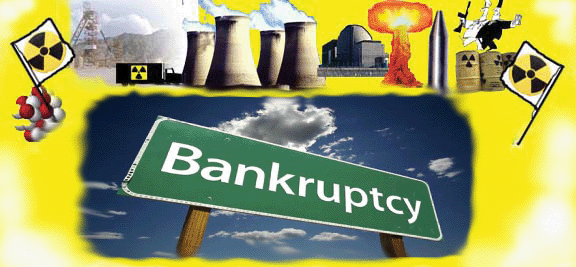
Is EDF running out of money? The French government is to spend £20
billion buying back the final 16% of Electricité de France (EDF) shares
still privately owned, bringing the company back under public ownership.
Why are they renationalising this company? The answer is simple. It is to
avoid EDF going bankrupt. Right now, over half (29 out of 56) of EDF’s
French nuclear reactors are currently offline. The company is already
hugely indebted and faces a massive bill of up to 100 billion euros (£85
billion) to keep its ageing nuclear fleet going.
And EDF’s flagship EPR reactor is over-cost and over-time everywhere it is being attempted to be
built. Aside from its debts, EDF has faced issues with ageing reactors,
after experts warned President Macron of significant corrosion safety
problems in EDF nuclear power plants in France as cracks were detected in
the cooling systems of some nuclear reactors.
Meanwhile there is delay after delay in bringing online every one of the EDF flagship nuclear
reactors, in Finland, in France, even here in Somerset. In desperation to
help fund its latest lossmaker at Sizewell, Suffolk, EDF is reaching out to
fellow utility giant Centrica for help. Could this be the same Centrica,
which in 2016 abandoned plans to invest in EDF’s Hinkley C partly because
of ‘the lengthening time frame for a return on the capital invested in a
project of this scale’?
Electrical Review 9th Aug 2022
EDF sues French government for €8.4bn after Macron forces it to sell energy at a loss
EDF is suing the French government for €8.3bn (£7bn) after Emmanuel
Macron forced the nuclear giant to sell energy at a loss.
The company has filed a compensation claim with the Conseil d’Etat, the French
administrative supreme court, over “losses incurred” as a result of a
price cap extended in January. Paris ordered EDF, which is currently 84pc
state owned, to sell more of its power to French rivals at below market
prices in an attempt to support households and businesses as energy costs
soared.
EDF, which is in the process of being fully nationalised by the
French state, said the €8.3bn figure reflected losses “estimated to
date”, suggesting the price cap could cost it €15bn over the full year.
EDF estimated the changes would cost it between €7.7bn and €8.4bn when
they were first announced and said it would consider “any measure to
protect its interests”. Before the measure was enacted, competitors were
allowed to buy 100TWh of EDF’s electricity at a heavy discount to balance
its monopoly position. In January, the Elysée ordered that cap to be
increased by a fifth.
Telegraph 9th Aug 2022
French Nuclear Giant Sues Government For $8 Billion
https://oilprice.com/Latest-Energy-News/World-News/French-Nuclear-Giant-Sues-Government-For-8-Billion.html— By Charles Hugh Smith – Aug 10, 2022,
French nuclear giant EDF, forced to sell power to competitors below market value, is now suing the French government for over $8 billion in compensation.
EDF says it has lost 8.3 billion euros (nearly $8.6 billion at today’s exchange rate) as of the date of filing the claim against the government, and anticipates losing more than 15 billion euros for the full year.
The French power company, which is already 84% owned by the government and is in the process of being fully nationalized, is forced to sell electricity it produces to rival power plants to increase competition as EDF holds a monopoly.
The initial government decree states that suppliers can purchase up to 25% of EDF’s annual nuclear output between July 2011 and December 2025 at a fixed, discounted price of about $47 per MWh. However, in January this year, the government implemented a larger cap at one-fifth in order to reduce consumer energy bills for this year. Then, in March, the government issued additional decrees, further increasing the volume and reducing the price for EDF.
The losses cited by EDF stem from this time period.
In June, EDF reported earnings showing its largest ever half-year loss. EDF lost 5.3 billion euros in the first half of this year, compared to 4.2 billion euros in profit for the same period of 2021.
EDF’s power stations account for 70-75% of France’s power consumption, and the government is keen on nationalizing the giant in order to ensure energy supplies amid a looming crisis that began when Russia invaded Ukraine.
Losses are mounting for EDF in other areas, as well.
Last week, EDF was forced to slash output at nuclear power stations on two rivers as a heatwave spreading across Europe has rendered the rivers too hot to cool the units.
1 This Month



Shut down the radiation-damaged Heysham nuclear reactors now
To see nuclear-related stories in greater depth and intensity – go to https://nuclearinformation.wordpress.com

Say No to NASA’s Reckless Nuclear Reactor on the Moon
Say No to NASA’s Reckless Nuclear Reactor on the Moon
-
Archives
- October 2026 (256)
- September 2026 (339)
- August 2026 (330)
- July 2026 (355)
- June 2026 (287)
- May 2026 (306)
- April 2026 (356)
- March 2026 (251)
- February 2026 (267)
- January 2026 (308)
- December 2025 (358)
- November 2025 (359)
-
Categories
- 1
- 1 NUCLEAR ISSUES
- business and costs
- climate change
- culture and arts
- ENERGY
- environment
- health
- history
- indigenous issues
- Legal
- marketing of nuclear
- media
- opposition to nuclear
- PERSONAL STORIES
- politics
- politics international
- Religion and ethics
- safety
- secrets,lies and civil liberties
- spinbuster
- technology
- Uranium
- wastes
- weapons and war
- Women
- 2 WORLD
- ACTION
- AFRICA
- Atrocities
- AUSTRALIA
- Christina's notes
- Christina's themes
- culture and arts
- Events
- Fuk 2022
- Fuk 2023
- Fukushima 2017
- Fukushima 2018
- fukushima 2019
- Fukushima 2020
- Fukushima 2021
- general
- global warming
- Humour (God we need it)
- Nuclear
- RARE EARTHS
- Reference
- resources – print
- Resources -audiovicual
- Weekly Newsletter
- World
- World Nuclear
- YouTube
-
RSS
Entries RSS
Comments RSS

