French nuclear power group EDF to have a bigger loss than previously expected
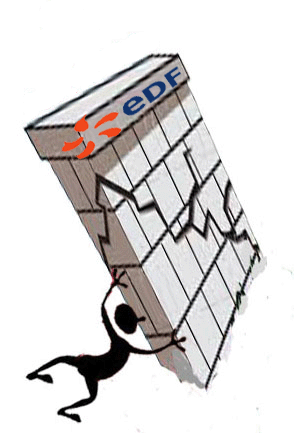
French nuclear power group EDF is expecting a hit of around 32 billion
euro ($32.18 billion) to its full-year core earnings from lower nuclear
production, a bigger loss than previously forecast and its sixth profit
warning this year.
The French government, which already owns 84% of EDF, is
in the process of fully re-nationalising the company, the debt-laden
operator of Europe’s largest fleet of nuclear power plants.
Reuters 27th Oct 2022
https://www.reuters.com/business/energy/french-utility-giant-edfs-history-2022-07-08/
FRANCE DISCOVERS OMINOUS CRACKS IN DOZENS OF NUCLEAR REACTORS
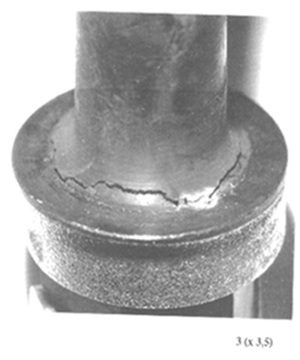
AND THE TIMING COULDN’T BE WORSE.
https://futurism.com/the-byte/france-cracks-dozens-reactors by MAGGIE HARRISON, 27 Oct 22,
Bad Reaction
Europe’s energy crisis may have just gotten worse.
The Wall Street Journal reports that dozens of France’s nuclear reactors — which, amid Russia’s devastating stranglehold on the continent’s natural gas supply, are essential to the nation’s energy security — remain offline following a series of troubling outages believed to be caused by stress-induced pipe corrosion. Fixes are reportedly taking longer than anticipated, but for a struggling continent on the brink of winter, those fixes can’t come quickly enough.
“It’s important that this work restarts as soon as possible,” Emmanuelle Wargon, head of France’s energy regulator, told the WSJ. “If not, the risk of not having electricity rises.”
High Pressure
The nuclear fleet in question, owned by the energy provider EDF, is comprised of 56 reactors, of which 26 are currently out for the count.
According to the WSJ, the pipe problems trace back to late last year, when a crack was discovered in a high-pressure pipe close to the reactor’s core at the nation’s youngest nuclear plant. Other plants, which then launched their own investigations, discovered their own stress corrosion issues shortly thereafter.
“It is only possible to identify [stress corrosion’s] presence once cracking has begun,” read a note from France’s Institute for Radioprotection and Nuclear Safety, the WSJ reports. “Regular inspections of the pipes can only identify the phenomenon once a fault is present.”
Importantly, these aren’t simple fixes. Because the majority of the cracks are so close to the reactor core, radioactivity is a very real threat for technicians, whose exposure has to be limited.
And given how complicated the repairs are, French power experts are reportedly quite pessimistic about the EDF’s ability to get their reactors back online for the winter, especially given that, per the WSJ’s sources, the timelines for several reactor fixes have already been pushed back by at least six weeks.
Beyond the Border
These outages are clearly terrible for France, but they’re just as bad for the rest of Europe, too.
Natural gas prices have skyrocketed as a result of the Russian invasion of Ukraine, which sparred a barrage of Western sanctions and Russia’s subsequent retaliation by way of natural gas restriction. Nations are asking a lot of their citizens, and the continent needs any ounce of energy that it can scavenge to at least somewhat comfortably — let alone safely — get through the winter.
READ MORE: France’s Nuclear Reactors Malfunction as Energy Crisis Bites [The Wall Street Journal]
More on Europe’s energy crisis: Europe’s Energy Crisis Is so Bad It May Have to Idle Cern’s Large Hadron Collider
Nuclear power – a ‘religion’ in France. now turning out to be a curse.
Paris dims the lights as blackouts threaten disaster for Macron. Years of
underinvestment in its aging nuclear fleet risk causing chaos in France
this winter. Xavier Barbaro, chief executive of France’s leading
independent renewables producer Neoen, is concerned about the growing risk
of shortages.
“It’s a possibility and no one would have thought that a
few years or even a few months ago,” he says. “Blackouts were something in
the past. and it can happen again. “We have heard literally for decades
that having nuclear was a chance for the country and in the end, it might
actually be a curse.”
France put all of its eggs in the nuclear basket,
but technical problems are now frequently cutting capacity at its aging
plants. While President Emmanuel Macron has ordered new reactors as part of
a nuclear “renaissance”, decades of inaction are coming back to haunt
the country. Like Liz Truss, Macron’s government has staked its
reputation on his country avoiding blackouts that would undoubtedly have
severe political consequences this winter.
However, industry bosses are
less certain than the President. “We’ve been told for ages that nuclear
power is safe, secure and so constant,” says Adrien Jeantet, director of
energy services at Enercoop, a French utility company using only renewable
energy.
“Now we see that it’s not dependable. We really need it now that
we have gas shortages and all of a sudden it’s not there. Half of the
reactors are shut down.” Barbara Pompili, Macron’s minister in charge
of the energy transition for two years, says nuclear power is almost like a
religion in France.
However, she adds that a widespread belief in its
“magic” has caused underinvestment in renewables that will be needed
for the future. “What I’m worried about is the strategic thinking in the
long run,” she says. “Maybe we were too confident on nuclear power and
we underestimated the importance of renewables. The reason is that too many
people considered that investing in renewables was bad for nuclear power.
“It’s totally crazy. We lost so much time thinking in this way… it’s
very difficult to have a serious rational debate in France on the energy
issue.”
Telegraph 24th Oct 2022
EU ‘dancing on edge of volcano’ with Ukraine – French ex-president
https://www.rt.com/news/565187-eu-ukraine-peace-sarkozy/ 24 Oct 22, Nicolas Sarkozy says the bloc’s policy is driven by “miscalculation, exaltation, anger, superficial reactions”
It’s high time for the EU to abandon its emotionally driven policies on Ukraine and start talking about achieving peace, former French president Nicolas Sarkozy has suggested.
In an interview with Le Journal du Dimanche on Saturday, Sarkozy criticized Brussels for its involvement in the conflict between Russia and Ukraine, which has included sweeping sanctions on Moscow, weapons deliveries to Kiev, and calls for a military solution to the crisis.
“The European Commission is primarily an administrative body. Moreover, I still haven’t understood under which article of the European treaties [the body’s president Ursula] von der Leyen justifies her competence in the field of arms purchases and foreign policy,” he said.
“The only thing the Europeans are hearing now is more and more billions of euros being spent on the purchase of weapons. More weapons, more deaths, more war,” the 67-year-old politician added.
The EU’s policy regarding the conflict in Ukraine is driven by “miscalculation, exaltation, anger, superficial reactions,” and because of this “we’re dancing at the edge of a volcano,” said Sarkozy, who was the president of France between 2007 and 2012.
The bloc was right to condemn Russia and show solidarity with Ukraine, but it also needs to exercise “composure” and work to prevent the escalation of the conflict, he added. “It’s high time for serious initiatives to be taken to start talking about the future and peace.”
Sarkozy also criticized Ukrainian President Vladimir Zelensky for signing a decree earlier this month, which officially made it “impossible” for him to hold talks with his Russian counterpart Vladimir Putin.
Such a stance amounted to “demanding a regime change in Moscow,” the veteran politician pointed out. “I consider this to be a dangerous leap into the unknown, although it’s understandable that it’s difficult for the Ukrainian president to talk to Putin,” he said.
Moscow, which has repeatedly invited Kiev to come to the negotiating table in recent months, has blamed the Ukrainian side for undermining any potential for a peaceful settlement of the crisis. It has also repeatedly condemned the deliveries of weapons to Zelensky’s government by the US, EU, UK and some other countries, arguing that they won’t change the outcome of the conflict, but will prolong the fighting and increase the risk of a direct confrontation between Russia and NATO.
France’s Nuclear Reactors Malfunction as Energy Crisis Bites
B1 The linchpin of France’s energy security faces maintenance and pipe-corrosion problems plus labor unrest
WSJ, By Matthew Dalton Oct. 23, 2022
PARIS—France is falling behind in its plans to return the country’s fleet of nuclear reactors to full power this winter after a rash of outages, raising fears that one of Europe’s key sources of electricity won’t be ramped up to counter Russia’s squeeze on the continent’s energy supplies.
The nuclear fleet was designed to act as the front line of France’s energy security. Since Moscow cut the flow of natural gas to Europe—plunging the continent into its biggest energy crisis since the 1970s oil shock—France’s vaunted nuclear fleet has been about as effective as the Maginot Line, the French fortifications that did little to stop the German invasion during World War II…………….. (subscribers only) more https://www.wsj.com/articles/frances-nuclear-reactors-malfunction-as-energy-crisis-bites-11666517581
The Generational Divide Over Nuclear Power
The scientists at the Cigéo lab in France are not including the risk of deliberate attacks in their research. All of this – the security risks, the enormous uncertainty around waste, the potential for nuclear proliferation – concerns the activists at the House of Resistance.
https://www.forbes.com/sites/christinero/2022/10/21/the-generational-divide-over-nuclear-power/?sh=5d8d990a6b13 Christine Ro 21 Oct 22
Maud Simon is one of the younger residents of the House of Resistance, a home in the bucolic French commune of Bure. The setting is peaceful, with fewer than 100 residents amidst the fields and cottages.
But Simon and her housemates want disruption. The activists, part of the anti-nuclear network Sortir du nucléaire, purchased this house back in 2006 to mobilize against the nearby Cigéo research laboratory, where scientists are testing deep geological disposal for eventually storing nuclear waste. The activists say there hasn’t been enough information about the risks of this research, and are opposed more generally to the legitimation of nuclear energy given its risks.
The House of Resistance is now home to a fluctuating population of about 5 to 40 people, though this can swell to as many as 400 during a special event.
Simon has been living here for two years. She believes that many young French people favor nuclear energy because of propaganda disseminated by the pro-nuclear lobby, which has spread for instance to YouTube. She’s somewhat unusual, as she grew up in an anti-nuclear family.
A short drive away is the reason that Simon and her fellow protestors chose this site.
To get to the heart of the Cigéo nuclear research laboratory, I’m squeezed with nine other people into an elevator descending 490 meters.
Lasting five minutes, it’s the longest lift ride of my life.
In this peaceful corner of northeast France, scientists are working on a problem that no one, in any country, has solved: what to do permanently with the waste produced by nuclear power generation. In France the total inventory of such waste amounted to 1.7 million m3 at the end of 2020, according to the French National Agency for Radioactive Waste Management (Andra), which operates the Cigéo site.
Our guide’s name at the Cigéo facility is, appropriately enough, Jacques Delay. Dealing with the waste problem involves a high degree of uncertainty and epic timescales (Switzerland, for instance, requires planning for up to 1 million years of containment for any deep geological repository there).
Geologist Delay says that the scientists are expecting technology to continue progressing at its current rate. So certain decisions will be left to future scientists.
Andra hopes to begin operating long-term disposal by 2050, and to have reversible storage until about 2150, in case future scientists come up with a better solution. Then the deep geological disposal would be sealed off completely.
Every 25 metres or so in the Cigéo facility, the construction of the drifts (passageways) changes, to allow for years-long experiments on factors like corrosion and swelling. Walls are lined with concrete of different quality and rigidity levels, for instance. The shape of the drifts fluctuates as well. Scientists here run tests with waste after it’s waited on the surface for 70 years, and cooled to below 90°C.
The scientists at the Cigéo lab in France are not including the risk of deliberate attacks in their research. All of this – the security risks, the enormous uncertainty around waste, the potential for nuclear proliferation – concerns the activists at the House of Resistance.
Nuclear science like that on display at Cigéo is clearly a point of pride in France, which is a permanent member of the UN Security Council and has embraced nuclear energy much more than its neighboring countries. Yves Marignac, who leads the Nuclear and Fossil Energy Unit at the négaWatt Association, notes, “There’s no equivalent worldwide of a country that has developed so much nuclear industry relative to its size.”
The French nuclear fleet is large but not always reliable. Currently, half of France’s currently 56 nuclear reactors are currently out of operation due to corrosion and maintenance issues.
Rainer Baake, the managing director of the Climate Neutrality Foundation in Germany, believes that young people are more pro-nuclear because “they never experienced nuclear fallout.” The former politician says that Germans were very enthusiastic about nuclear energy until the Chernobyl disaster, which led to radioactivity contaminating German gardens. He’s helped shape Germany’s subsequent transition away from nuclear energy, which was meant to have been completed in 2022 but has now been postponed due to the energy supply crisis.
Nuclear is increasingly popular among young people – for instance in Finland, home to the world’s first deep geological repository for nuclear waste – not only because they have less memory of the risks, but also because of widespread concern about climate change. Unlike fossil fuels, nuclear energy is mostly emissions-free; unlike solar and wind energy, it can operate 24/7. And climate anxiety is more pressing than radiophobia for many people who grew up after the Cold War.
The world’s most famous youth climate activist, Greta Thunberg, declared on October 12 that it would be a mistake for Germany to phase out nuclear energy altogether. This set her apart from political units like Germany’s Green Party – which was one of the parties that negotiated for the closure of nuclear plants by the end of 2022 – and long-established environmental organizations like Greenpeace.
Thunberg’s support for nuclear power appears somewhat ambivalent, as she was arguing that nuclear should not be eased off in favor of coal plants, which are set to continue operating in Germany until 2030. After all, Nobel Prize-winning physicist Steven Chu has argued, air pollution from fossil fuels kills more people than the harms from nuclear energy.
Some young people are all in on nuclear. In North America, “nuclear bros” show that nuclear energy’s popularity is picking up steam among young men.
Nuclear energy is one of the most contentious topics within the environmental movement. To ensure its relevance going forward, the anti-nuclear camp will need to make its core issues – including safety, costs, nuclear proliferation, and the pesky problem of nuclear waste – resonate with more young people like Simon.
Strikes at French nuclear plants – what’s at stake?
Forrest Crellin, 19 Oct 22, PARIS, (Reuters) – Strikes at France’s nuclear power plants have affected about a third of its reactors, in many cases delaying maintenance work and complicating operator EDF’s (EDF.PA) efforts to boost production ahead of winter.
Currently 20 out of 56 reactors have been impacted, a union official said on Wednesday. Of these, maintenance plans of 17 have been disrupted, with some seeing their restart schedule delayed by a few days and some by up to three weeks.
THE EFFECT ON SUPPLY
France’s nuclear output was already expected to hit a 30-year low in 2022 due to a record number of reactor outages for corrosion issues and planned maintenance, at a time when Europe is facing an energy crisis because of the war in Ukraine.
Rolling strikes over wages by the FNME-CGT union at some plants have added to the problem.
Maintenance delays at nine reactors have caused the loss of 4.4 terawatt hours (TWh) of nuclear power generation – nearly a quarter of the power produced in September – compared to the maintenance schedule before the strikes began, data from consultancy Energy Aspects showed.
France is a net importer of electricity and the strikes will further boost power imports, particularly from Britain, the consultancy said.
Power grid operator RTE warned on Tuesday that prolonged strikes further delaying the restart of reactors could have “heavy consequences” for electricity supply over the winter.
Britain’s National Grid has also cited maintenance issues at French nuclear reactors as a factor that could affect UK energy supplies this winter……………..
the strikes raise a question mark over power availability for November………………….
WHAT’S THE COST?
FNME-CGT secretary general Sébastien Menesplier said a one day outage at an EDF reactor usually cost about 1 million euros ($976,600) but that at current electricity prices that could be “5 to 10 times more”.
With the baseload November power price around 587 euros ($573) per megawatt-hour (MWh), the cost of a reactor not running is probably not far from 10 million euros per day, said Emeric de Vigan, vice president of power at data and analytics firm Kpler.
However, French forward baseload contracts have fallen from highs over 1,000 euros in late August, as maintenance delays at EDF have been mostly be priced in.
“With that being said, events like this come at the worst possible time, when French nuclear is needed the most, and even more so for the coming months,” Rystad analyst Fabian Ronningen said.
WHAT’S THE LEGAL POSITION?
Workers are legally obligated to ensure the continuity of the public electricity service, requiring them to raise production or resume operations to return reactors to the grid to avoid power cuts………………………………. more https://www.reuters.com/business/energy/strikes-french-nuclear-plants-whats-stake-2022-10-19/
France’s national embarrassment: half of its nuclear reactors to remain out of action for months
France’s nuclear reactors will not work as normal any time soon. The
trouble will persist well into next year. when edf, the French energy giant,
warned in May that nuclear-electricity production this year would be lower
than previously forecast because half its reactors were out of action, the
timing could not have been worse.
Thanks to its nuclear industry, France is
usually Europe’s biggest net exporter of electricity. The closures turned
the country into a net power importer for the first time, just as the
continent faced an energy crunch. When in September edf then announced that
even by 2024 output would still be well below normal levels, the problem
became a national embarrassment.
France’s current nuclear troubles are
partly due to routine maintenance of the country’s 56 reactors, half of
which are about 40 years old. Each ageing reactor needs periodically to be
shut down, on a rotating basis, for inspection. During the pandemic,
scheduled maintenance was interrupted by lockdowns. The real crunch,
though, came after corrosion issues were detected in late 2021 at one
pressurised-water reactor. By this September no fewer than 25 reactors were
out of action: ten for routine maintenance, the rest for corrosion analysis
or repairs.
Economist 13th Oct 2022
France’s Finance Minister : Priority is to restart nuclear reactors a soon as possible
https://www.reuters.com/business/energy/frances-le-maire-priority-is-restart-nuclear-reactors-soon-possible-2022-10-11/—PARIS, Oct 11 (Reuters) – French Finance Minister Bruno Le Maire said on Tuesday the government’s priority was to restart EDF’s (EDF.PA) nuclear reactors – with more than half of them currently offline – as soon as possible.
During a press conference at the headquarters of grid operator RTE, Le Maire also said the goal was still to go back to 50GW of nuclear production capacity for the network at the start of 2023.
French nuclear power output is at a 30-year low for the year, owing to an unprecedented number of outages at EDF’s fleet of 56 reactors, with more than half offline because of corrosion issues and scheduled maintenance.
France won’t retaliate with nuclear weapons if Russia uses them in Ukraine
French President Emmanuel Macron says he intends to avoid ‘global war’
https://www.thenationalnews.com/world/europe/2022/10/13/france-wont-retaliate-with-nuclear-weapons-if-russia-uses-them-in-ukraine/ Soraya Ebrahimi, Oct 13, 2022,
France will not respond with nuclear weapons should Russia use them against Ukraine, French President Emmanuel Macron has said.
“Our doctrine rests on the fundamental interests of the nation,” Mr Macron told public broadcaster France 2 on Wednesday.
“They are defined clearly and wouldn’t be directly affected at all if, for example, there was a ballistic nuclear attack in Ukraine, in the region.”
It was the first time he has discussed France’s nuclear deterrence doctrine regarding Ukraine in detail.
Mr Macron said it was not good to talk about it too much.
So far, despite his threats, there is no sense that Russian President Vladimir Putin is moving nuclear assets.
Mr Macron said Mr Putin must “return to the table” to discuss peace in Ukraine and that he thought Kyiv would have to negotiate with him at some point.
“Today, first of all, Vladimir Putin must stop this war, respect Ukraine’s territorial integrity and come back to the table for talks,” he said.
Asked if he would back a Ukrainian offensive to recapture Crimea, which was annexed by Russia in 2014 in a move not recognised internationally, Mr Macron said that “at some point as the conflict develops”, Russia and Ukraine “will have to come back to the table”.
“The question is whether the objectives of the war will only be reached by military means,” he said, although “it’s up to the Ukrainians to decide” what those aims should be.
When reminded that Ukraine no longer wanted to negotiate with Mr Putin, Mr Macron replied: “I tell you that at some point … it will be necessary. That’s why I have always refused maximalist positions.”
He said France would supply air defence systems to Ukraine after Russia’s wave of air strikes this week, which was aimed at “breaking Ukrainian resistance”.
“We’re going to deliver … radars, systems and missiles to protect them from these attacks,” Mr Macron said.
He said France was also negotiating to send another six Caesar mobile artillery units.
Putin vows continued ‘tough’ attacks against Ukraine – video
He said the war had entered “an unprecedented stage” since the weekend because “for the first time all over Ukraine civilians have been killed … and electricity and heating facilities have been destroyed”.
“The aim of the Russians these last few days has been to break, to shatter Ukrainian resistance,” Mr Macron said.
He acknowledged that France was “unable to deliver as much as the Ukrainians ask for. I’m obliged to keep some for us to protect ourselves and our eastern flank (of Nato)”. The extra Caesar guns were made for Denmark, but talks are under way to redirect them to Ukraine.
Maintenance on eight French nuclear reactors delayed by strike
https://www.reuters.com/markets/europe/maintenance-five-french-nuclear-reactors-delayed-over-strike-2022-10-12/ By Forrest Crellin, 12 Oct 22,
PARIS, (Reuters) – France’s FNME trade union said on Wednesday that some workers at EDF’s (EDF.PA) nuclear plants resumed their strike over salaries, delaying maintenance work on eight reactors as the union sent a message of support to striking refinery workers.
Reporting by Forrest Crellin; Editing by Tomasz Janowski and Elaine Hardcastle
Three of the Cruas nuclear plant’s reactors are affected by the strike, while two reactors at the Cattenom and Tricastin plants and one Bugey reactor have had their maintenance delayed by the strike, FNME said.
EDF nears cut-price deal for GE nuclear turbine unit with Russian contracts
French energy group renegotiates terms for business that also supplies Rosatom
Sarah White in Paris YESTERDAY 6 Print this page French power operator EDF has renegotiated a deal to buy a nuclear turbine maker from General Electric, cutting its offer price for a business seen as strategic for France’s atomic industry but that is exposed to the risk of sanctions because of orders from Russia’s Rosatom. State-controlled EDF, which is on the cusp of being fully renationalised, was encouraged into making a move on the turbine company by the French government in a deal announced by President Emmanuel Macron at the start of the year.
The acquisition was touted as a way of recovering French control of the technology as EDF gears up to build new reactors, while also securing the future of a large factory in eastern France at a time when GE was exploring asset sales and looking to cut jobs. But the business has since been caught up in the fallout from Russia’s invasion of Ukraine, even though its dealings with state-owned Rosatom, one of the world’s biggest nuclear plant developers, have not faced sanctions so far………………………. more https://www.ft.com/content/4e3f8a9e-e89c-47c9-9caa-b84825db1e70—
As France’s nuclear power production is failing, the government aims to cut the nation’s electricity consumption

France launched a national energy savings plan on Thursday, banking on a
push to turn off lights and lower thermostats to avoid power and gas cuts
over the winter. Although the country is less dependent on Russian gas than
eastern neighbours like Germany, French nuclear power production has
slumped as the sector struggles to bring more of its aging reactors online
out of forced maintenance. The government has set a target of cutting
France’s energy consumption 10% by 2024 from 2019 levels, a first step in a
longer-term plan to become carbon neutral by reducing energy use 40% by
2050.
Reuters 6th Oct 2022
France’s nuclear energy strategy — once its pride and joy — faces big problems this winter
CNBC Sam Meredith, @SMEREDITH19 5 Oct 22,
- Deep-rooted problems with France’s nuclear-heavy energy strategy are raising serious questions about its winter preparedness.
- A long-standing source of national pride, France generates roughly 70% of its electricity from a nuclear fleet of 56 reactors, all operated by state-owned utility EDF.
- In recent months, however, more than half of EDF’s nuclear reactors have been shut down for corrosion problems, maintenance and technical issues.
…………………….. more than half of EDF’s nuclear reactors have been shut down for corrosion problems, maintenance and technical issues in recent months, thanks in part to extreme heat waves and repair delays from the Covid pandemic. The outages have resulted in French power output falling to a near 30-year low just as the European Union faces its worst energy crisis in decades.
“I find the France nuclear relationship really interesting because it just bluntly shows you all of the pros and cons of nuclear,” Norbert Ruecker, head of economics and next generation research at Julius Baer, told CNBC via telephone.
“Yes, it’s low carbon but it’s not economic. You need to nationalize EDF to make it happen. Yes, it offers baseload but wait a second, sometimes a whole plant disappears for weeks and months, so that baseload promise is not really there,” Ruecker said.
……………………………………………… A ‘winter of discontent’?
French power prices climbed to a string of all-time highs this summer, peaking at an eyewatering level of around 1,100 euros ($1,073) per megawatt hour in late August. Analysts fear the country may struggle to produce enough nuclear energy to support both its own needs and those of its neighbors in the coming months.
Underlining the structural problems in the country’s nuclear fleet, France not only lost its position as Europe’s biggest exporter of electricity this year but also, remarkably, actually imported more power than it exported.
Data from energy analysts at EnAppSys that was published in July found that Sweden clinched the top spot as Europe’s largest net power exporter during the first six months of 2022. Prolonged outages in France’s nuclear fleet saw the country’s exports halve from the same period last year, and analysts at EnAppSys warned the situation showed “no signs of improving any time soon.”
To compensate, France imported expensive electricity from U.K., Germany, Spain and elsewhere.
“Thanks to the market, thanks to the power lines that we have, Europe saved France from a big blackout” this summer, Julius Baer’s Ruecker said.
“It was the U.K., Germany, Spain and to some extent Switzerland that all stepped in. So, for me, the past month really has just uncovered some of the political talk which was not always objective,” he added, referring to talk of nuclear energy as a climate solution among politicians…………………………………………………….
What does it mean for Europe?
France’s ailing power output has renewed criticism of its nuclear-heavy energy strategy at a time when many others in Europe are turning to atomic power as a replacement for a shortfall in Russian gas.
Germany, which initially planned to shutter its three remaining reactors by the end of the year, decided to delay its nuclear phaseout to shore up energy supplies this winter. The U.K., meanwhile, is seeking to ramp up its nuclear power generation, and the EU has listed nuclear energy among its list of “green” investments.
“It is important to say that if France has a nuclear problem, Europe has a problem as well in terms of electricity,” Alexandre Danthine, senior associate for the French power market at Aurora Energy Research, told CNBC via telephone.
“They are, in general, a big exporter, but in winter they need energy from neighboring countries in order to satisfy demands — whatever the situation,” Danthine said.
In France, Eurasia Group’s Rahman noted, Macron reacted angrily last month to suggestions, including from outgoing EDF boss Jean-Bernard Levy, that his “stop-start approach” to nuclear power in the last five years was partly responsible for the crisis.
In what was widely seen as a policy U-turn, Macron announced in February his intention for France to build at least six new nuclear reactors in the decades to come, with the option for another eight. At the start of his presidency, Macron had committed to reducing the share of nuclear power in the country’s energy mix.
The reversal controversially placed atomic power at the center of France’s bid to achieve carbon neutrality by the middle of the century.
Advocates of nuclear power argue it has the potential to play a major role in helping countries generate electricity while slashing carbon emissions and reducing their reliance on fossil fuels.
To critics of the energy source, however, nuclear power is an expensive distraction to faster, cheaper and cleaner alternatives. Instead, environmental campaign groups argue technologies such as wind and solar should be prioritized in the planned shift to renewable energy sources. https://www.cnbc.com/2022/10/05/frances-nuclear-heavy-energy-strategy-faces-big-problems-this-winter.html
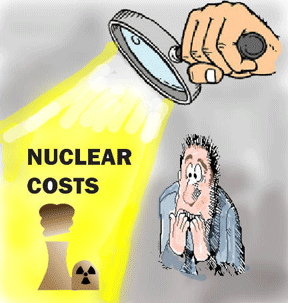
Will Sizewell C nuclear really go ahead? EDF’s €60bn debt, and €52bn costs for French nuclear build.
When EDF board members joined a video call in late August to discuss a landmark UK nuclear project, they were instead treated to a stand-off between the utility’s outgoing boss and the French state. Rather than signing off the Sizewell C plant in Suffolk as Jean-Bernard Lévy had pushed for, the biggest French power producer’s controlling shareholder demanded more time to finish new audit reports and the meeting descended into acrimony, according to people familiar with the discussions.
“Some people didn’t understand what they were doing there and why there wasn’t going to be a decision on anything,” one of the people said. “It was messy.” The episode, one of several clashes at the company to have spilled into the open in recent months, will provide little comfort to Lévy’s successor, Luc Rémont, who is due to take over as chief executive and chair just as Paris executes a plan to buy out the 16 per cent of EDF it does not already own.
While the nationalisation clarifies the ownership structure, the company could still be subject to demands from the French state that have not always been in its immediate interest, including that it shield consumers from soaring energy prices. Big strategic questions on everything from Sizewell to renewable energy investments, meanwhile, still loom large.
Rémont, currently a senior executive at industrial conglomerate Schneider Electric, will need to solve
the group’s short-term problems while also preparing EDF to take on some of France’s biggest nuclear construction projects in two decades — a period when it has struggled to complete any on time or on budget.
The company’s electricity output is on course to reach all-time lows this year, after corrosion problems at the company’s nuclear plants added to maintenance stoppages and led to the outage at one point of more than half the French fleet of 56 reactors. That has strained supplies across Europe just as the region pivots away from Russian gas, while also turning France into a net power importer for the first time.
French officials have so far insisted that the Sizewell C plant in Britain will go ahead, adding that the state had commissioned extra audits simply to calculate the financial consequences of removing a Chinese state-backed company from the project.
But the government may eventually want to revisit some of its choices, bankers and union representatives close to EDF said, particularly as the group grapples with costly investments. By the end of this year, EDF’s
net debt is already forecast to swell to about €60bn, while its French construction programme alone could cost another €52bn.
FT 5th Oct 2022
https://www.ft.com/content/559ce578-fa0d-4bbe-9860-9d512b1510e1
1 This Month

of the week – Shut Down Drone Warfare!


Tell the Ukrainian Government to Drop Prosecution of Peace Activist Yurii Sheliazhenko

Petition to revoke the licensing of the Near Surface Nuclear Disposal Facility (NSDF) at Chalk River. https://www.ourcommons.ca/petitions/en/Petition/Details?Petition=e-7247
To see nuclear-related stories in greater depth and intensity – go to https://nuclearinformation.wordpress.com
-
Archives
- March 2026 (251)
- February 2026 (268)
- January 2026 (308)
- December 2025 (358)
- November 2025 (359)
- October 2025 (376)
- September 2025 (257)
- August 2025 (319)
- July 2025 (230)
- June 2025 (348)
- May 2025 (261)
- April 2025 (305)
-
Categories
- 1
- 1 NUCLEAR ISSUES
- business and costs
- climate change
- culture and arts
- ENERGY
- environment
- health
- history
- indigenous issues
- Legal
- marketing of nuclear
- media
- opposition to nuclear
- PERSONAL STORIES
- politics
- politics international
- Religion and ethics
- safety
- secrets,lies and civil liberties
- spinbuster
- technology
- Uranium
- wastes
- weapons and war
- Women
- 2 WORLD
- ACTION
- AFRICA
- Atrocities
- AUSTRALIA
- Christina's notes
- Christina's themes
- culture and arts
- Events
- Fuk 2022
- Fuk 2023
- Fukushima 2017
- Fukushima 2018
- fukushima 2019
- Fukushima 2020
- Fukushima 2021
- general
- global warming
- Humour (God we need it)
- Nuclear
- RARE EARTHS
- Reference
- resources – print
- Resources -audiovicual
- Weekly Newsletter
- World
- World Nuclear
- YouTube
-
RSS
Entries RSS
Comments RSS
 nuclear-news