Nuclear reactor: a deep crack discovered at Penly 1 risks destabilizing EDF
Nuclear reactor: a deep crack discovered at Penly 1 risks destabilizing
EDF. A new “stress corrosion” problem found by the the company on a
shutdown reactor in Seine-Maritime could have significant repercussions,
due to its size and location.
The discovery could have serious consequences
for EDF. The company detected a major crack on a weld of an emergency
circuit of a shutdown reactor, Penly 1, in Seine-Maritime, a new problem
for the energy giant whose nuclear fleet is heavily disturbed since 2021 by
these phenomena.
In a note, which went unnoticed until its media coverage
on Tuesday by the Context site , EDF mentioned having detected a
“significant stress corrosion defect” on an emergency pipe used to cool
the reactor in an emergency. For Yves Marignac, ” the fact that larger
cracks are possible raises the question of keeping the 6 reactors of the
same type P’4″ in operation while awaiting their preventive repair” ,
announced in December by EDF for the current year 2023.
Liberation 8th March 2023
Crack in piping of Penly nuclear reactor further complicates EDF’s situation.
Unlike the microcracks detected on other reactors (such as those of Chooz,
in the Ardennes, and Civaux, in Vienne, 1,450 MW, the most powerful and
most recent), the defect observed at Penly is described as particularly
important:
the ASN describes a crack extending over 155 millimeters (mm),
“that is approximately a quarter of the circumference of the piping”.
The nuclear policeman adds that its maximum depth is 23 mm, for a pipe
thickness of 27 mm.
Although the Penly 1 reactor had already been
identified as being among the most sensitive to the phenomenon of stress
corrosion, this portion of the circuit in particular was considered
“non-sensitive” by EDF, due to its geometry. The licensee, like ASN,
considers that the presence of corrosion could be explained by the double
repair to which the piping was subjected during the construction of the
reactor.
Time News 8th March 2023
French MPs pave way to dropping legal limit on nuclear in energy mix
By Théo Bourgery-Gonse | EURACTIV.fr 5 Mar 23,
The decision still needs to go through some legislative hoops before it is finalised – but it signals a stronger-than-ever willingness by the government to revamp nuclear power across the country. The Senate voted in favour of getting rid of the limit altogether in January.
A 2015 law to promote green growth limited the proportion of energy France could get from nuclear to 50% of its energy mix by 2035. With 69% of the country’s energy coming from nuclear, according to official data, the measure was thought to encourage investment in renewables and paved the way at the time of the closing of France’s iconic and then oldest Fessenheim plant in June 2020.
Mar 3, 2023
Lawmakers voted in favour of doing away with the 50% legal limit on nuclear in the country’s total energy mix on Thursday as part of France’s larger efforts to build newer, more modern nuclear plants.
The vote took place in the Committee for Economic Affairs on Thursday as part of a broader legislative package that would see the building of six new nuclear European Pressurised Reactors 2 (EPR2). The first one of those, EPR2 is expected to be operational in 2035………………………
France Sees ‘No Problem’ Funding Macron’s New Nuclear Reactors
By Ania Nussbaum https://www.bloomberg.com/news/articles/2023-03-01/france-sees-no-problem-funding-macron-s-new-nuclear-reactors#xj4y7vzkg
French President Emmanuel Macron’s government sees “no problem” funding the six new nuclear reactors he has proposed building, a project that by one estimate could cost at least €51 billion ($54 billion).
We trust the nuclear industry, there’s no difficulty ahead to fund nuclear reactors announced by the president,” government spokesman Olivier Veran said after a cabinet meeting on Wednesday. “The funding framework will be introduced, believe me, there’s no problem.”
Macron last year made a U-turn on a previous pledge to cut back France’s reliance on nuclear energy by promising to build at least six new nuclear reactors slated to enter into service from 2035, and up to 14 reactors in total. France gets about 70% of its electricity from nuclear power.
Luc Remont, the chief executive of electricity utility Electricite de France SA, which operates the country’s nuclear reactors, told lawmakers during a hearing on Tuesday that the construction of the six reactors would cost at least €51 billion, cautioning that that was just a “rough estimate.”
EDF is being nationalized by the government, and Remont said the company can’t bear the cost of the new reactors by itself, suggesting the state would have to step in.
Earlier this week, Macron called for the European Investment Bank to invest in low-carbon energy, including nuclear power. On Wednesday, his minister for energy transition, Agnes Pannier-Runacher, who is trying to build an alliance of pro-nuclear countries to weigh in on European Union negotiations, said the funding of future nuclear reactors would be presented by the end of the year. She ruled out higher taxes.
France mounts battle for nuclear energy in Europe

Paris persuades 10 EU countries to join a ‘nuclear alliance’
Sarah White and Leila Abboud in Paris, Alice Hancock in Brussels and Guy Chazan in Berlin, https://www.ft.com/content/f7a79b52-ff1a-4336-82c1-ed359df60173 1 March 23,
France is making an aggressive push to promote nuclear power in the EU, seeking to rally allies for battles to come in a stand-off with Germany over the bloc’s energy policy. Paris on Tuesday persuaded 10 countries, including Hungary and Bulgaria, to join a “nuclear alliance” calling on Brussels to do more to back atomic energy, a move they argued would help meet climate goals while protecting the EU’s energy independence.
The establishment of the pro-nuclear group at a meeting in Stockholm, comes as France lobbies for concessions from the EU’s ambitious renewable power goals to obtain what would effectively be carve-outs for its nuclear industry, the mainstay of its electricity production. That has opened a rift with Germany and left other member states wondering if they will be forced to pick sides.
The disagreements are bleeding into a host of EU energy reforms, from a planned overhaul of electricity markets to how to promote hydrogen energy and renewables. It also reflects how Germany and France have had trouble forging consensus on a range of issues since Russia’s invasion of Ukraine rattled the EU’s economic and political order.
French energy minister Agnès Pannier-Runacher said she had a “productive discussion” with her German counterpart at the meeting of EU energy ministers in Stockholm on Tuesday, but the pair did not resolve their differences. “We do not want nuclear to be discriminated against,” she said.
Some EU countries are questioning why French president Emmanuel Macron’s government is pushing its agenda so hard given it risks reopening legislative battles on energy issues that had already been resolved. “
It is total war from everywhere [on the nuclear issue],” said one senior EU diplomat outside of the Franco-German nucleus, as several described French efforts to get “low carbon” — a byword for atomic power — into a number of draft regulations in recent months.
Another said the issue had “become a spoiler in every discussion”, when France had agreed last year to a broad outline of a renewable energy agenda without insisting on nuclear carve-outs.
The meeting hastily arranged by Paris was met with a degree of bewilderment by other EU states. Belgium, which recently extended the life of two reactors, was not invited, while Sweden, which has a modest atomic energy sector, declined to join. The Netherlands only signed up on condition that a paragraph in the joint statement linking nuclear power to renewables targets was deleted, people close to the talks said.
France pushing hard to make the European Union a pro-nuclear organisation

France seeks ‘nuclear alliance’ at EU energy meeting
EU Observer, By WESTER VAN GAAL BRUSSELS, 27. FEB, 23
France is building an alliance of pro-nuclear states to advocate for expanding nuclear power in the bloc.
EU energy ministers are meeting on Monday and Tuesday (27 and 28 February) to discuss issues ranging from security of supply to the upcoming electricity market reform.
But on the sidelines, French energy minister Agnes Pannier-Runache has invited 12 other countries on Tuesday to discuss a “nuclear alliance.”
“I would like to remind you that nuclear power represents 25 percent of European electricity production”, said Pannier-Runache. “It will be one of the important low-carbon energy sources next to wind and solar power that will help us achieve carbon neutrality.”
She later explained that the meeting would be an occasion to discuss “research, supply chain and nuclear waste issues.”
Countries in attendance include traditionally pro-nuclear members Romania, Bulgaria, Slovakia, Czech Republic, Hungary, Poland, Slovenia and Finland. Newly-joined Croatia, plus the Netherlands, Italy and Sweden will also attend.
It is the latest move in an ongoing spat with Germany which is phasing out nuclear power and whose negotiators have stressed nuclear electricity should not be equated to electricity derived from solar and wind.
Other countries not attending the meeting include Belgium and Luxembourg, whose energy minister Claude Turmes said nuclear power “is very slow.”
“It takes 12 to 15 years to build a new nuclear facility,” he said. “If we want to win the race against climate change, we need to be fast.”
The French meeting follows intense French lobbying to include nuclear power in a recent EU Commission rules for green hydrogen, which is made with electricity derived from wind and solar but now also allows nuclear power as energy source…………. https://euobserver.com/green-economy/156759
France mounts ‘aggressive’ nuclear push with eye on EU industrial plan

“They’re trying to get nuclear everywhere where it doesn’t fit … to have policy lock-in,” said one EU diplomat who spoke on condition of anonymity, adding: “Everybody is a little annoyed at the French — it’s very aggressive.”
Paris looks out for its atomic industry as the sector faces a crossroads.
BY VICTOR JACK, 17 Feb 23, https://www.politico.eu/article/france-aggressive-nuclear-energy-push-eu-industrial-plan-renewables/
With its atomic industry at a crossroads, France is mounting a lobbying blitz to put nuclear energy on par with renewables in EU climate legislation — and unlock benefits from the bloc’s upcoming plans to boost green industries.
Paris argues that if the ultimate goal of the EU’s climate targets is to decarbonize the bloc, that should mean nuclear plants, with their negligible CO2 emissions, have a key role to play alongside renewables.
But that push — and attempt to reposition nuclear as a green technology — is also a strategy to strengthen Paris’ hand down the line in accessing cash from the bloc’s upcoming mammoth industrial strategy, six diplomats told POLITICO.
“They’re trying to get nuclear everywhere where it doesn’t fit … to have policy lock-in,” said one EU diplomat who spoke on condition of anonymity, adding: “Everybody is a little annoyed at the French — it’s very aggressive.”
The move is designed to “build leverage for other arguments” down the line, a second EU diplomat said.
Asked whether France expects nuclear to be counted as a “clean technology” in the upcoming industrial plan and therefore benefit from it, a senior French energy ministry official told POLITICO that “the [EU sustainable investment rules] recognize the fact that nuclear … is a technology that contributes to the transition.”
“So in absolute terms, it seems to us that this question already has an answer.”
Small victory, bigger problem
Paris notched a first victory last week on the EU’s long-awaited rules governing what counts as “renewable hydrogen.”
Unlike most other countries, hydrogen producers in France will be able to count the electricity taken from the grid as renewable as long as they also sign a long-term power contract with an existing renewables provider. The exception was made because 70 percent of France’s electricity comes from low-emissions nuclear.
But this promotion of nuclear-powered hydrogen — also known as “pink” or “low-carbon” hydrogen — is only one part of France’s broader push to inject atomic energy into EU green policy files, in which it has so far been less successful.
In late January, Paris attempted to insert low-carbon hydrogen into a renewables cooperation partnership with Ukraine, but was ultimately overruled.
It also led a push alongside eight other EU countries this month for pink hydrogen to be included in the EU’s Renewable Energy Directive, arguing that it should contribute toward 2030 targets for greening transport and industry.
When it didn’t get its way, France accused Spain and Germany of reneging on promises to recognize the role of low-carbon hydrogen.
“It would not be understandable for Spain and Germany to take different positions in Brussels and not keep their commitments,” French Energy Minister Agnès Pannier-Runacher told reporters last week.
Atomic needs
The push comes as experts predict France’s electricity demand will rise sharply as the country electrifies to meet its climate goals, and its ageing nuclear fleet declines.
Historically an exporter of electricity to its EU neighbors, France last year was forced to import power to meet its consumption needs as half its nuclear fleet was forced into maintenance due to corrosion and other technical problems.
And with the country’s largest utility EDF announcing a nine-month halt to another nuclear reactor earlier this month, that leaves two-fifths of its reactors still out of action.
“A lot of these nuclear reactors are ageing,” said Carlos Torres Diaz, senior vice president and head of power at Rystad Energy, a consultancy, who predicts some will be decommissioned already “in the next decade.”
Add to that French electricity demand is set to rise from 417 to 715 terawatt-hours by 2030, Torres Diaz said, meaning “there will need to be some investments.”
Paris is clearly aware of the challenge. In a sharp U-turn from his previous policy, President Emmanuel Macron announced plans to build six new reactors last February, with an eye on building eight more.
But that won’t come cheap, with new nuclear plants typically costing “billions,” Torres Diaz said. “If they need to renew all this ageing capacity then they will need to get the funding … If it’s not a green source of energy they will struggle to get some financing.”
That’s where the EU’s Green Industrial Plan comes in.
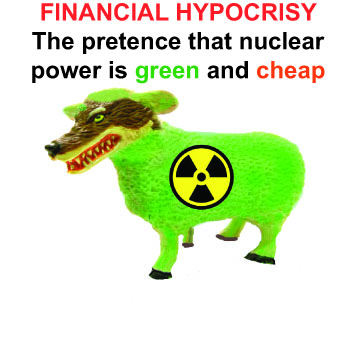
Announced last month, the upcoming plan is Brussels’ attempt to help the bloc go toe-to-toe with the United States’ $369 billion Inflation Reduction Act with a range of tax relaxations and new industrial benchmarks for 2030.
From the proposed European Sovereignty Fund, to more state aid allowances and potentially a competitive auction for a 10-year fixed-rate renewable hydrogen contract, there’s ample opportunity for France to cash in.
With the discussion still in its early days and specific language on policy not yet nailed down, that gives France an opening to stake out its position.
In the planned Net-Zero Industrial Act, for example, which aims to slash red tape on “net-zero” technologies, the “precise product scope [of the technologies] remains to be defined,” according to the European Commission.
Marion Labatut, EDF’s deputy director of EU affairs, agreed “it would be good” if nuclear were included in the upcoming strategy. She added that the utility would be interested in accessing the Commission’s hydrogen auction, for example.
And while France is likely to face resistance from nuclear-skeptic countries including Germany and Luxembourg, recent diplomatic efforts indicate Paris is not likely to give up easily.
In fact, pink hydrogen was on the agenda during the first official meeting between Commission President Ursula von der Leyen and French Prime Minister Élisabeth Borne on Thursday.
Overall, this push “is very unsurprising,” a third EU diplomat said. “The French are very skilled at using crises to push their own strategic policies ahead.”
Alexandre Léchenet and Giorgio Leali contributed reporting.
France’s government may switch funds from social housing to the cause of propping up the nuclear industry.
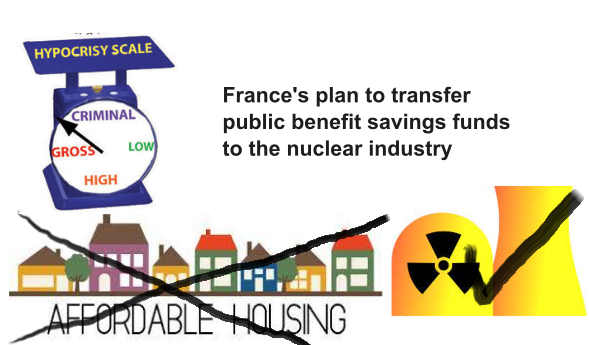
Will we be forced to choose between heating and housing one day? This
question may appear absurd at an individual level but much less so at the
level of the French state which constantly has to make trade-offs on
subjects as uncomfortable as this one.
According to French business daily
Les Echos, the government is contemplating the possibility of setting aside
a portion of the Livret A [savings account proposed by French banks] –
whose €375 billion is mainly devoted to social housing funding – and
investing a portion of the money in nuclear power.
Le Monde 12th Feb 2023
Financial disaster looms for France’s nuclear corporation EDF
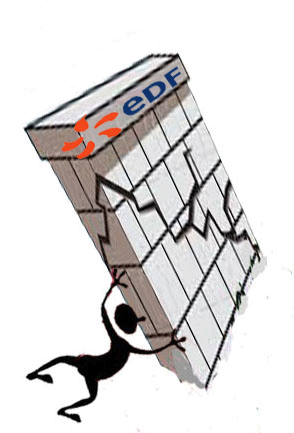
EDF reported one of the biggest losses in French corporate history on
Friday, February 17, as fallout from the Ukraine war and idling nuclear
reactors spelled financial disaster for the state-controlled utility.
EDF struggled with a drop in electricity output last year as it had to close
several of France’s 56 nuclear reactors to fix corrosion problems while a
heatwave led to a diminution of hydro-power production.
While 2022 revenue rose 70% to €143.5 billion, EDF reported a record loss of €17.9 billion
which compared with a net profit of €5.1 billion in 2021. After Russia’s
invasion of Ukraine sent energy prices skyrocketing, the government
required EDF to sell energy under cost to consumers to help them afford
their bills.
Le Monde 17th Feb 2023
Despite massive losses of nuclear company EDF, and reactor corrosions, France plans to build a new fleet of EPR reactors.
Despite corrosion leaving nearly half of French atomic power fleet idle
last year and huge cost overruns at new construction, state-backed power
comapny insists on building even more reactors.
A plunge in nuclear power
output related mostly to inspections and repairs for stress corrosion that
left nearly half of France’s atomic generation fleet idled for much of last
year has cost EDF €29.1bn ($30.99bn), pushing the embattled state-owned
utility into a massive loss.
Forty-three of the company’s 56 reactors are
currently operational again, up from only 30 at the beginning of November
2022. But last year’s decline in nuclear output – which the company had to
compensate for with power purchases at a time when market prices were very
high – linked to the impact of price caps for French consumers last year,
triggered a loss in generation and supply segment earnings before interest,
taxes, depreciation and amortisation (Ebitda) of €23.14bn.
Gains in other
areas, such as regulated activities or renewables were not able to
compensate for the nuclear drain on finances. That was the main cause of a
€17.94bn net loss for the entire group, compared to a €5.11bn net
profit in 2021.
Despite the massive losses at EDF, as well as dozens of
billions in cost overruns and decade-long delays at the construction of a
new EPR (European Pressurised Reactor) at Flamanville, French President
Emmanuel Macron last year launched a programme to build six further EPRs in
France, with the option for eight more at later stage.
Recharge 17th Feb 2023
EDF’s historic $13.5 billion loss in 2022 – as France became an importer of electricity
Electricite de France SA reported a historic loss for 2022 after repairs
choked its nuclear output, but the utility predicted a significant rebound
in earnings this year as production recovers. The state-controlled
generator swung to a net loss, excluding non-recurring items, of €12.7
billion ($13.5 billion) last year after a profit of €4.7 billion in 2021,
according to a statement on Friday.
The company’s woes exacerbated the
region’s energy crisis by turning France — traditionally a powerhouse
producer — into a net importer of electricity. President Emmanuel
Macron’s government, which is trying to regain full ownership of the
nuclear giant to reassure creditors, wants new Chief Executive Officer Luc
Remont to restore production and prepare the company to start building new
reactors in France and the UK.
Bloomberg 17th Feb 2023
https://www.bnnbloomberg.ca/edf-reports-record-loss-after-nuclear-output-choked-by-repairs-1.1885186
EDF posts record net loss after nuclear fleet hit by repairs
French energy company EDF has reported a significant downturn in its 2022 results after repairs choked its nuclear power output and government measures tightened, but it saw UK profits soar due to high electricity prices.
Annabel Cossins-Smith 17 Feb 23, https://www.power-technology.com/news/edf-posts-record-losses-after-nuclear-troubles/
rench energy giant EDF on Friday posted a record loss for 2022 after necessary repairs to its nuclear power reactors saw a serious decline in electricity output.
A company spokesperson said in a press release that in November last year just 30 of 56 reactors were operational but that this number has now risen to 43. It cited stress corrosion on 16 of its reactors as a key reason for its output decline, stating that 10 of these have been or are currently being treated.
The state-controlled gas and electricity supplier saw a net loss, excluding non-recurring items, of $13.5bn (€12.7bn) last year, a significant decline from its profits of $5bn (€4.7bn) in 2021. Its raw earnings (EBITDA) stood at -$5.3bn (-€5bn), compared with a positive EBITDA of $19bn (€18bn) in 2021.
“The target for 2023 is to improve operational performance,” EDF CEO Luc Rémont said on a call, Bloomberg reports. “The aim is to achieve an EBITDA that will be significantly higher than in 2021.”
The company also posted a net financial debt of $68.6bn (€64.5bn), up 50% from 2021. An EDF statement cited issues with cash flow from operations, hybrid bonds and a $3.7bn (€3.5bn) capital increase as reasons behind this.
However, EDF’s UK profits soared, largely due to electricity price rises in the country. This took its underlying profits to $1.4bn (£1.2bn), up from a loss of $25m (£21m) in 2021.
The company has said that its losses in France in particular come in part due to government price caps. The French government set these to protect consumers from soaring energy prices, shortly before taking majority control of the company last year.
“The French government’s exceptional regulatory measures to limit the increase in sales prices to consumers in 2022 had an adverse estimated effect of -€8.2 billion (-$8.7bn) in EBITDA”, a company press release stated. It added that “before these measures, EBITDA benefited from market price rises passed on to customers for an estimated amount of €8.7 billion ($9.2bn)”.
EDF began legal proceedings against the French government in August last year, claiming $8.8bn (€8.3bn) in damages after the company was forced to sell more of its power to rivals at prices below market rates as a way to counter its monopoly position in France.
The government is also continuing efforts to nationalise the company. Power stations operated by EDF provide almost 70% of France’s electricity, mainly through its nuclear fleet.
France’s nuclear output plummeted in 2022
France’s nuclear output plummeted by 22.6% year on year in 2022, down 81.7
TWh to 279 TW, EDF said on Friday, citing lower nuclear fleet availability
amid inspections and reactor repairs.
Last November, EDF cut its full-year
French nuclear output estimate to 275-285 TWh, down from 280-300 TWh
previously, due to 10-year maintenance schedules and strikes, as well as
extended outages at four nuclear reactors. The French utility’s nuclear
generation slumped to a 33-year low in 2022 as the country became a net
power importer for the first time since 2001, according to data previously
released from TSO RTE.
EDF posted an operating loss of EUR 19.36bn for 2022
due to the record low nuclear output and government caps on energy bills,
it said this morning.
Montel 17th Feb 2023
https://www.montelnews.com/news/1444244/frances-nuclear-output-plunges-23-in-2022–edf
TODAY. The evil of the nuclear industry – France to transfer public interest savings funds to the nuclear industry?
Just when I think that the nuclear industry can’t sink any further into hypocrisy and depravity – it comes up with a new trick against the poor and against the public good.
France – such a leader in many good things – philosophy, cheese, etc – has also been a leader in nuclear evil – nuclear colonialism. And now the nuke-obsessed French government comes up with an evil trick against its own population – to transfer Livre A social benefit savings to the nuclear industry.
France’s Livret A savings accounts are a unique system that enable any adult or child in the country to have a simple tax-free savings account . The system has been going for 200 years, and is used to provide funds for social benefit measures, especially social housing.
What’s a Livret A in France? Livret A is a simple savings account with instant withdrawal access that’s historically been very popular in France, a kind of on demand tax free savers account. In May 2022, there were 55 million accounts holding a total amount of 358,8 billion euros between them. French families felt confident in these government backed accounts that are easy to open while making a difference for the country. They are a great idea for kids and grand kids; for the first car or a deposit on a house later.
France’s Latest Nuclear Halt Is a Reminder of Long-Lasting Nature of Problem
By Carolynn Look and Josefine Fokuhl, February 7, 2023 https://www.bloomberg.com/graphics/2023-europe-energy-crisis-updates-fra
Despite France’s efforts to overcome a months-long maintenance crisis of its troubled nuclear fleet, another reactor has been taken offline for most of the rest of this year.
The nine-month planned halt of Electricite de France SA’s Chinon-1 nuclear reactor raises questions about whether the state-backed nuclear operator will be a millstone around Europe’s neck next winter, too. France’s nuclear plants form a backbone of Europe’s integrated power system, and an outbreak of safety-related incidents and repair delays over the past year could not have hit at a worse time.
As a result, French nuclear generation slumped to the lowest in more than three decades in 2022, just as the region struggled with throttled gas shipments from Russia and soaring fuel and power prices. The hope was that EDF would get its fleet in order by the time the next winter comes around, with Europe likely to source even fewer gas supplies from Russia this year, and Germany putting its last remaining nuclear plants to rest in April.
However, Chinon-1 will only return to the grid by Oct. 30, after being halted early on Tuesday, according to the French utility. The lengthy outage is because the reactor needs extra heavy checks and upgrades for EDF to get permission to extend its life from 40 to 50 years, it said.
Maintenance is Weighing on French Power Production
Total amount of power generated by nuclear power plants in France [graph on original]
The risk is that recent improvements in generation will be short-lived, especially if further disruptions pop up over the course of the year. Fresh maintenance this month is likely to curb output to historically low levels, with eight other reactors due to be taken off the system.
At the moment, the world’s biggest nuclear-plant operator has only 44 reactors available out of 56. Normally, those units could generate more than two-thirds of France’s electricity needs.
About a quarter of Europe’s electricity is produced by nuclear reactors in thirteen countries. But with France typically contributing more than half of the total, getting its reactors back up to speed will form a key part of how Europe guarantees its energy security for years to come.
1 This Month



Shut down the radiation-damaged Heysham nuclear reactors now
To see nuclear-related stories in greater depth and intensity – go to https://nuclearinformation.wordpress.com

Say No to NASA’s Reckless Nuclear Reactor on the Moon
Say No to NASA’s Reckless Nuclear Reactor on the Moon
-
Archives
- October 2026 (256)
- September 2026 (339)
- August 2026 (330)
- July 2026 (355)
- June 2026 (287)
- May 2026 (306)
- April 2026 (356)
- March 2026 (251)
- February 2026 (267)
- January 2026 (308)
- December 2025 (358)
- November 2025 (359)
-
Categories
- 1
- 1 NUCLEAR ISSUES
- business and costs
- climate change
- culture and arts
- ENERGY
- environment
- health
- history
- indigenous issues
- Legal
- marketing of nuclear
- media
- opposition to nuclear
- PERSONAL STORIES
- politics
- politics international
- Religion and ethics
- safety
- secrets,lies and civil liberties
- spinbuster
- technology
- Uranium
- wastes
- weapons and war
- Women
- 2 WORLD
- ACTION
- AFRICA
- Atrocities
- AUSTRALIA
- Christina's notes
- Christina's themes
- culture and arts
- Events
- Fuk 2022
- Fuk 2023
- Fukushima 2017
- Fukushima 2018
- fukushima 2019
- Fukushima 2020
- Fukushima 2021
- general
- global warming
- Humour (God we need it)
- Nuclear
- RARE EARTHS
- Reference
- resources – print
- Resources -audiovicual
- Weekly Newsletter
- World
- World Nuclear
- YouTube
-
RSS
Entries RSS
Comments RSS

