A continuing danger – at best, Chernobyl is merely dormant
 Tourism, Construction and an Ongoing Nuclear Crisis at Chernobyl NewsWeek, By Alexander Nazaryan / April 17, 2014 “……..For the most part, the defunct station of reactors (the first went live in 1977; the last, the one that blew, in 1983) looks like a tidy industrial park in central Ohio: shorn green lawns, a smattering of abstract art, half-empty parking lots, a canal rife with fish. Nothing indicates that this is the site of the worst nuclear disaster in human history.
Yet as tourists Instagram away at Pripyat’s ruins, Chernobyl is undergoing one of the most challenging engineering feats in the world, as a French consortium called Novarka tries to replace the aging sarcophagus that contains the reactor, a concrete shell hastily and heroically built in the direct aftermath of the meltdown. The place remains a half-opened tinderbox of potential nuclear horrors, and just because much of the world has forgotten about Chernobyl doesn’t mean catastrophe won’t visit here again……..
“It wouldn’t take much of a seismic event to knock it down,” a civil engineer recently explained to Scientific American. The Federation of American Scientists says, “If the sarcophagus were to collapse due to decay or geologic disturbance, the resulting radioactive dust storm would cause an international catastrophe on par with or worse than the 1986 accident……
Nor is the land surrounding the reactor quite the pristine preserve that some have celebrated in nature-has-triumphed-over-our-thoughtlessness-and-incompetence fashion. Earlier this year, a study by University of South Carolina biologist Timothy Mousseau and others indicated that fallen trees weren’t decomposing because, in Mousseau’s words, “the radiation inhibited microbial decomposition of the leaf litter on the top layer of the soil,” turning the ground into a vast firetrap at whose center sits the aged sarcophagus.
So, at best, Chernobyl is merely dormant. To extend that dormancy for a lot longer, Novarka was contracted in 2007 to build the New Safe Confinement. Though sometimes described as a gigantic hangar, having seen the NSC, I see it as something more elegant, its hopeful parabolic curves recalling the smooth grace of the Gateway Arch in St. Louis. In cross section, it is two layers of steel with a 39-foot layer of latticework in between. Its combined shapes and angles are so fluid and simple, you want to put them on a ninth grade geometry quiz.
Currently being built in two pieces, it will rise 30 stories and weigh 30,000 tons-and cost perhaps as much as $2 billion. When completed, the steel contraption will slide along Teflon rails on top of Reactor No. 4 (a process that will take several days). It is believed to be the largest movable structure on Earth. The NSC will be so enormous that, according to the British technology journal The Engineer, it “is one of a handful of buildings that will enclose a volume of air large enough to create its own weather.”……http://www.newsweek.com/2014/04/25/tourism-construction-and-ongoing-nuclear-crisis-chernobyl-248163.htmlNewsWeek,
The dangerous myth of “Chernobyl wild paradise”
 Decay takes a holiday: the wickedness beneath the “Chernobyl wild paradise” myth and the rotten implications for ecosystems and radiation science http://www.beyondnuclear.org/russia-ussr/2014/4/18/decay-takes-a-holiday-the-wickedness-beneath-the-chernobyl-w.html 21 April 14
Zombie forest?
April 26, 2014 will mark 28 years since the Chernobyl nuclear reactor exploded causing an unprecedented nuclear catastrophe. In a creepy revelation, the forests around Chernobyl are having difficulty decomposing. A recently published study indicates that forest matter in the contaminated areas around Chernobyl is taking years or even decades longer to decay than it should. In the areas with low radiation, 70 to 90 percent of the leaves were gone after a year. Where radiation levels were higher, “leaves retained around 60 percent of their original weight…”(Smithsonian.com) This indicates a fundamental disruption to the natural cycle of death feeding life, and calls into question the forest’s longer-term viability. Creatures responsible for decay such as microbes, fungi and some types of insects, are essential components of any ecosystem because they recycle organic material back into the soil. Unfortunately, they do not function properly in the areas around Chernobyl, leaving a forest full of “petrified-looking pine trees that no longer seem capable of rotting.” GIZMODO
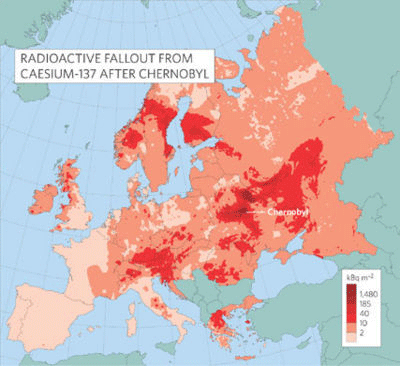
Radiation’s effect on decay processes should be expected, considering how it impacts microbes in food; or considering the results of a bizarre, cavalier and extremely ill-advised series of experiments performed using a “naked reactor” in the late 1950’s and early 1960’s. These experiments intentionally irradiated a number of varying materials and forest land 40 miles north of Atlanta, GA. Wood subjected to this radiation was produced in small-scale and called “Lockwood”, for Lockheed Aircraft Corporation who operated the Georgia Nuclear Laboratory. The building and land is still contaminated with radionuclides.
The lack of decomposer activity has researchers worried that nutrients which trees require for grow are not being recycled, causing trees in the area to grow more slowly. Improper plant decay has potential implications for animal decay as well, although there do not appear to be any Chernobyl studies investigating this yet.
Actual in-the-field examinations of regions contaminated by radioactivity from Chernobyl also reveal evidence for increased mutation rates, abnormal sperm with reduced swimming ability, developmental abnormalities, cataracts, tumors, smaller brains in both birds and mammals, and decreased tree growth rates, a finding of fundamental importance for ecosystem functioning that likely relates to effects on the microbial community. Fewer spiders and insects including bees, butterflies and grasshoppers—live there. Animals and plants show other impacts of radiation after the Three Mile Island nuclear disaster in the US and the Fukushima nuclear disaster in Japan.
Timothy Mousseau, a biologist at the University of South Carolina, Columbia, who collaborated on many of these studies, contends that, fundamentally, this evidence indicates low-dose rate exposures cause significant measurable impacts for the biota inhabiting contaminated regions of Chernobyl. Further, this evidence supports a hypothesis that suggests effects down to very low levels. Further implications for Fukushima should not be ignored.
Humans and animals alike: healthy looking on the outside, disintegrating on the inside
Referencing studies summarized in his book, Chernobyl: Consequences of the Catastrophe for People and the Environment, Alexey Yablokov states:
“Wildlife in the heavily contaminated Chernobyl zone sometimes appears to flourish, but the appearance is deceptive,” says Yablokov. “Levels of incorporated radionuclides remain dangerously high for mammals, birds, amphibians, and fish. Long-term observations of both wild and experimental animal populations in the heavily contaminated areas show significant increases in morbidity and mortality that bear a striking resemblance to changes in the health of humans – increased occurrence of tumours and immunodeficiencies, decreased life expectancy, early aging, changes in blood and the circulatory system, malformations, and other factors that compromise health.
“All of the populations of plants, fishes, amphibians and mammals studied there are in poor condition,” he continues. “This zone is analogous to a ‘black hole’, in which there is accelerated genetic degeneration of large animals – some species may only persist there via immigration from uncontaminated areas. The Chernobyl zone is a micro-evolutionary ‘boiler’, where gene pools of living creatures are actively transforming, with unpredictable consequences. We ignore these findings at our peril.”
Dr. Yablokov’s statement deftly presents the dichotomy between what is observed by a dilettante’s eye – such as lots of members in a wild animal population — versus what is actually happening to these members over time. What is happening to this wildlife has parallel implications for human health.
So where did this “paradise for wildlife” and “biodiversity sanctuary” myth come from? In 2006 the International Atomic Energy Agency, a nuclear power promoter and a member body of the United Nations, released a report entitled Environmental Consequences of the Chernobyl Accident and their Remediation: Twenty Years of Experience. This report references the creation of a nature preserve within the Chernobyl Exclusion Zone and remarks “Without a permanent residence of humans for 20 years, the ecosystems around the Chernobyl site are now flourishing. The CEZ has become a wildlife sanctuary…, and it looks like the nature park it has become.” From another report: “Indeed, the Exclusion Zone has paradoxically become a unique sanctuary for biodiversity.”
The Chernobyl Forum coalition makes this statement in support of “unique biodiversity” in spite of their recognition that “Genetic effects of radiation, in both somatic and germ cells, have been observed in plants and animals of the Exclusion Zone during the first few years after the Chernobyl accident. Both in the Exclusion Zone, and beyond, different cytogenetic anomalies attributable to radiation continue to be reported from experimental studies performed on plants and animals.” They conclude, however, “[w]hether the observed cytogenetic anomalies in somatic cells have any detrimental biological significance is not known.” In order to know this, one has to actually look.
The study summaries compiled by Alexey Yablokov, et al. (studies which had been mostly unavailable in the west until 2009) and the published examinations of researchers Mousseau, et al., indicate rather strongly that there is significant biological detriment to wildlife in the contaminated areas surrounding Chernobyl. And unlike these studies, the Chernobyl Forum documents provide very few references (under ten total) for any claims they make regarding the flourishing of wildlife.
Building of Chernobyl’s nuclear reactor tomb delayed again
Chernobyl Sarcophagus Jeapordised by Crisis in Ukraine, Sourceable, 15 April 14, The political crisis in Ukraine is severely hampering efforts to build a new radioactive containment structure over the site of the Chernobyl nuclear meltdown. Efforts to build an immense steel mausoleum to house the Chernobyl nuclear meltdown site are being stymied by the Ukrainian crisis, as channels of funding dry up amidst the country’s political upheaval.

Work on the New Safe Confinement arch (NSC) project first commenced in 2010, with the goal of containing the radioactive contamination produced by Chernobyl for at least a century into the future.
While the project was originally scheduled for completion by 2015, Ukrainian officials now concede that it will be impossible to meet the original timeline as a result of political turmoil, while others question whether or not construction will ever be completed.
The Ukrainian government and the European Bank for Reconstruction and Development are footing the hefty $2.1 billion bill for the project. The political crisis in Ukraine has left the country starved of cash, however, while also scaring off donor nations and foreign investors.
“In our financial analysis we are of course making the working assumption that it will not receive any money from Ukraine in the near term,” said Vince Novak, director of nuclear safety at the EBRD to trade publication NuclearEngineering……….http://sourceable.net/chernobyl-sarcophagus-jeapordised-by-crisis-in-ukraine/
Continuing sickness in children from irradiated food in Belarus
 Children Radiation Maps, Blog by Jan Hemmer April 14, 2012 by Mikkai“………“for 15 years new children were born who, thanks to God, did not experience the first radioactive shock. For 15 years, they have eaten contaminated food. Children receive the highest doses, because the dose coefficients, in a 3 year old child, are 5 times higher than in adults. Contaminate food spreads like locusts In the whole Republic. It is not surprising to find in Minsk, children with a dose load of 700-900 Bq/kg.
I want to draw your attention on the research of Prof. Bandazhevsky. We worked with him. He came to the conclusion that 50 Bq/kg bodyweight in children, represent a threshold where pathologies appear in vital organs like kidneys, liver, heart and others. I want to say that today the health of children is such that if we do not take urgent measures, I cannot see good prospects for our children.” Continue reading
Radiation Maps of Children of Belarus
Children Radiation Maps, Blog by Jan Hemmer April 14, 2012 by Mikkai
http://www.scribd.com/doc/15770206/NesterenkoBelrad Continue reading
Environmentalists from several European countries against Belarus – Russia nuclear power deal
Belarus and Russia sign off on Ostrovets nuclear plant in dubious contract Bellona Charles Digges, 13/10-2011 Russian and Belarusian environmentalists are concerned over a contract agreement signed by the Belarusian president, Alexander Lukashenko, for construction of the first two nuclear reactors in the Stalinist country, which was signed earlier this week.
Belarus’s state-owned Directorate for Construction of Nuclear Power Plants signed the contract with Atomstoriexport, the foreign construction wing of the Russia’s state nuclear corporation, Rosatom, for the construction of a 2400 megawatt plant of the untested AES 2006 (NPP -2006) design.
The site for the plant is in Ostrovets in the Grodno region, close to Lithuania – which has vociferously protested the building of the nuclear power plan. Continue reading
Legal action against Belarus President over planned nuclear power plant
 Presidential Decree No. 418 “On the location of a nuclear power station in Belarus” contradicts Article 18 of the country’s constitution, which proclaims Belarus “a neutral country with a nuclear-free territory.”
Activist Sues Belarusian President Over Nuclear Power Plant, Radio Free Europe, October 07, 2011, ASTRAVETS, Belarus — An antinuclear activist in western Belarus is suing President Alyaksandr Lukashenka over plans to build a contentious nuclear power station there, RFE/RL’s Belarus Service reports. Continue reading
Belarus freezes plan to give upits enriched uranium
Belarus hangs on to enriched uranium cache, Detroit Free Press |Aug 20, 2011, Belarus has frozen a plan aimed at getting the country to give up its Soviet-era stockpile of highly enriched uranium with U.S. assistance in response to new U.S. sanctions, the government said Friday.
The U.S. conducted a longtime effort to secure nuclear materials in former Soviet nations to prevent them from falling into the wrong hands.
The U.S. and the European Union introduced sanctions against President Alexander Lukashenko’s government for its crackdown on a political opposition group…… Belarus hangs on to enriched uranium cache | Detroit Free Press | freep.com
Murky background to plan for nuclear plant in Belarus
Rep. Dan Burton: 25 Years After Chernobyl, Russia and Belarus Still Don’t Get It, HUFFINGTON POST, 13 June 11“…..a new nuclear power plant set for construction this fall on former Soviet territory raises alarm at how little has been learned.What set Chernobyl apart from Fukushima more than anything else was the way the closed Soviet regime responded to the disaster, remaining in denial for weeks that a catastrophe was unfolding. The same could occur in Belarus, which is currently ruled by an autocratic leader who falsified his own reelection last December. Belarus and Russia’s mishandling of the proposal to build a reactor near Astraviec, a town in western Belarus, is a warning sign the West should not ignore. Again, we see the potential lack of transparency, international coordination, and communication……..
Rep. Dan Burton: 25 Years After Chernobyl, Russia and Belarus Still Don’t Get It
Russia building Belarus nuclear plants without consulting neighbouring countries
Lithuanian president criticizes Russia over new nuclear plants | World | RIA Novosti, 15 June 2010, The sites for two new nuclear power plants, in Russia’s Kaliningrad exclave and in Belarus, were selected with no environmental assessment and without consulting neighboring countries, Lithuania’s president said on Monday. Continue reading
Belarus will not send its enriched uranium to the Russia or USA stores
Minsk to hold on to its arms-grade uranium – Lukashenko , ‘RIA Novosti’ newswire, 20 April 2010, Belarus has no plans to build a “dirty” nuclear bomb but no one can take its enriched uranium stockpiles away from it, President Alexander Lukashenko said on Tuesday.”Russia and the United States are telling us – give us your enriched uranium. We will not give anything away. Everything here is under IAEA control. Russia tells America: Calm down, we will take it from there [Belarus]. No one will take anything without our consent. We will not allow that,” he said in a state-of-the-nation address.
Lukashenko added that his strained relations with Russia and the United States were due, among other things, to its reluctance to give away enriched uranium.
Misleading report on Belarus nuclear power plant
Environmental activist slams report on Belarusian nuclear power plant’s impact as sloppy, misleading
Belarus News 21 Sept 09 The Belarusian government’s report on the possible environmental impact of its future nuclear power plant does not address key issues, Russian environmental activist Andrei Ozharovsky said in an interview with BelaPAN. Continue reading
Belarusian Nuclear Power costly and dangerous
Belarusian Nuclear Power Project: Dangerous and Expensive
BIELAR.US 8 Sept 09 “…………a nuclear plant built by Russia on a Russian loan, serviced by Russian technicians and fed with Russian fuel might be a very good deal for Russia, but will hardly make Belarus more independent. Continue reading
Belarussian kids receive care
Belarussian kids receive careBy John Henderson Rocky Mount Telegram July 06, 2009 Children from Belarus who continue to be exposed to radiation from the 1986 Chernobyl nuclear power plant incident have once again traveled to Rocky Mount from the former Soviet Union to receive free medical care.But fewer local “host families” in this down economy have been able pay for the flights and take the children into their homes for six weeks. The host families also take the children to local offices for medical, eye and dental care treatment………………………….
On April 26, 1986, the Chernobyl nuclear power plant reactor exploded, releasing dangerous amounts of radiation into the air. The wind on that day carried it toward Belarus, contaminating the region’s air, soil and water.
“The problem is there is so much unknown radiation material (in Belarus), and it will probably be there for 3,000 or 4,000 years,” Patrone said. “Some of the food is not safe.”………………………………….
“Medically, they are small in size,” Patrone said. “Some have thyroid problems and an occasional immune-deficiency problem. They are still suffering, because basically, radiation is still in the dirt.”
If a child is diagnosed with a major problem here such as thyroid cancer, they are sent back to Belarus for treatment, he said.
“(The trip to Rocky Mount) is a way to get out of the radiation zone and to give kids a second (doctor’s) opinion,” he said.
Riot policemen against participants of “Chernobyl Way” in Minsk (Photo, video) – Charter’97 :: News from Belarus – Belarusian News – Republic of Belarus – Minsk
Riot policemen against participants of “Chernobyl Way” in Minsk
Charter 97 27 April 09 The spot near the Academy of Sciences was a sanctioned assembly point for participants. At the noon about a thousand and a half protesters gathered there. Protesters raised white-red-white flags, unfurled streamers “We oppose nuclear power station construction in Belarus”, “No to new Chernobyl”, “Return us our welfare benefits”, “No to chemical Chernobyl”, “No to toxic chemicals plant near Minsk”, “We are against nuclear reactor”. Dozens of white-red-white flags and flags of the European Union were fluttering………………..
………….an associate of the Academy of Sciences Ivan Nikitchanka called upon the regime not to hush up the aftermaths of the Chernobyl catastrophe at the state level, to return welfare benefits to people affected by the disaster and cleanup veterans, and not to construct the atomic power station in Belarus…………….
…………Viktar Ivashkevich called upon demonstrators remain unprovoked by secret services: “You see that authorities have sent riot policemen against a peaceful rally,” he addressed the participants. “I call upon you not to be drawn and walk along the official route Surhanau- Khmelnitski- Karastayanava- the Chernobyl Chapel.”
1 This Month

of the week – Shut Down Drone Warfare!


Tell the Ukrainian Government to Drop Prosecution of Peace Activist Yurii Sheliazhenko

Petition to revoke the licensing of the Near Surface Nuclear Disposal Facility (NSDF) at Chalk River. https://www.ourcommons.ca/petitions/en/Petition/Details?Petition=e-7247
To see nuclear-related stories in greater depth and intensity – go to https://nuclearinformation.wordpress.com
-
Archives
- April 2026 (103)
- March 2026 (251)
- February 2026 (268)
- January 2026 (308)
- December 2025 (358)
- November 2025 (359)
- October 2025 (376)
- September 2025 (257)
- August 2025 (319)
- July 2025 (230)
- June 2025 (348)
- May 2025 (261)
-
Categories
- 1
- 1 NUCLEAR ISSUES
- business and costs
- climate change
- culture and arts
- ENERGY
- environment
- health
- history
- indigenous issues
- Legal
- marketing of nuclear
- media
- opposition to nuclear
- PERSONAL STORIES
- politics
- politics international
- Religion and ethics
- safety
- secrets,lies and civil liberties
- spinbuster
- technology
- Uranium
- wastes
- weapons and war
- Women
- 2 WORLD
- ACTION
- AFRICA
- Atrocities
- AUSTRALIA
- Christina's notes
- Christina's themes
- culture and arts
- Events
- Fuk 2022
- Fuk 2023
- Fukushima 2017
- Fukushima 2018
- fukushima 2019
- Fukushima 2020
- Fukushima 2021
- general
- global warming
- Humour (God we need it)
- Nuclear
- RARE EARTHS
- Reference
- resources – print
- Resources -audiovicual
- Weekly Newsletter
- World
- World Nuclear
- YouTube
-
RSS
Entries RSS
Comments RSS
 nuclear-news