The pitfalls of Direct Democracy- Taiwan’s referendum and the vote on nuclear power

 How Direct Democracy Went Nuclear in Taiwan, A contentious vote on Taiwan’s nuclear future showed how the country’s public referendums went haywire. The Diplomat , By Nick Aspinwall, January 18, 2019 It only took one month for Huang Shih-hsiu, a 31-year-old nuclear energy advocate, to upend a core energy policy of Taiwan President Tsai Ing-wen. The policy, prior to its downfall, stated that Taiwan would decommission its three active nuclear power plants by 2025.
Covert nuclear development in Taiwan was stopped, because a senior scientist feared danger
Colby Cosh: How Canada almost left the door to the nuclear club ajar … again, National Post, 14 Jan 19,
Covert nuclear development in Taiwan was finally stopped cold because a senior scientist became convinced nukes were dangerous
In November, historians David Albright and Andrea Stricker published a new book called Taiwan’s Former Nuclear Weapons Program: Nuclear Weapons On-Demand. The book pulls together the previously sketchy story of Nationalist China’s covert nuclear research, which had its roots in the postwar exodus of Chiang Kai-shek and the Kuomintang party (KMT). Albright and Stricker describe decades of effort by the offshore Republic of China on Taiwan to play a double game with nuclear weapons. ………
The key to the story is the 40-megawatt uranium-fuelled Taiwan Research Reactor (TRR), supplied, like CIRUS, by Canada. TRR was very similar to CIRUS in design and capability. The pile went critical in January 1973, giving Taiwan an indigenous source of plutonium. Under the sales agreement, the reactor was to be “safeguarded” by the International Atomic Energy Agency (IAEA), answering to its inspectors and accounting for the whereabouts of its fuel. But Taiwanese nuclear agencies immediately began to behave suspiciously, talking to some of the slimier European industrial concerns about buying reprocessing equipment that would allow weapons manufacture
……….Covert nuclear development in Taiwan was finally stopped cold because one of the Republic’s senior scientists, Chang Hsien-yi, became convinced that nukes were dangerous to the existence of the Republic………. Email: ccosh@postmedia.com | Twitter: https://nationalpost.com/opinion/colby-cosh-how-canada-almost-left-the-door-to-the-nuclear-club-ajar-again
Taiwan Food Imports from Fukushima-Affected Areas Become Wedge Issue with Japan

Comprehensive and Progressive Agreement for Trans-Pacific Partnership (CFTPP) held over Taiwan , because of its referendum rejecting food from Fukushima
 FOOD IMPORTS FROM FUKUSHIMA-AFFECTED AREAS BECOME WEDGE ISSUE WITH JAPAN https://newbloommag.net/2018/12/17/fukushima-food-cftpp/18DECEMBER 2018 by Brian Hioe
I T IS UNSURPRISING that Taiwan will not be admitted to the Comprehensive and Progressive Agreement for Trans-Pacific Partnership (CFTPP) because of the referendum vote against food imports from Fukushima-affected areas held in late November concurrent with nine-in-one elections. Namely, the issue of food imports is one upon which Taiwan has long been pushed around by larger, more powerful countries, who dangle the threat of being denied admittance to international free trade agreements if Taiwan does not allow food imports.
The Abe administration has in the past made allowing food imports from Fukushima-affected areas a condition for stronger diplomatic relations with Japan. This would be part of a more general effort by the Abe administration to promote the prefecture of Fukushima as safe, with concerns that lingering radiation may still cause harmful effects in the region after the 2011 Fukushima disaster. The Abe administration has thus attempted to promote food exports from the area, as well as to encourage tourism to the area.
Concerns over whether food from Fukushima is safe are valid, seeing as this is an issue of contention in Japan itself. Abe’s Liberal Democratic Party (LDP) is deeply wedded to the Japanese nuclear industry, with an unusual willingness to push for nuclear energy in spite of outbreaks of large-scale public protest. Concerns have also been longstanding that the LDP has been unwilling to provide accurate nuclear assessments for the Fukushima area, or sought to mislead through official statistics.
After the results of the referendum in late November, in which 7,791,856 voted against allowing food imports from Fukushima, the Japanese government initially expressed understanding regarding the results of the referendum, suggesting that not allowing food imports from Fukushima would not be an obstacle for Japan-Taiwan relations going forward. However, this appears to have not entirely been the truth.
Indeed, as the KMT was a powerful force behind the push for the referendum, it is likely that the KMT sought to use the issue of food imports from Fukushima-affected areas as a means to not only to attack the DPP with the accusation that it was endangering public safety but also sabotage closer relations between Japan and Taiwan. Apart from that the KMT’s Chinese nationalism has a strong anti-Japanese element, the KMT is pro-unification and so opposes closer ties between Japan and Taiwan, seeing as Japan could be a powerful regional ally that interceded on behalf of Taiwan against Chinese incursion.
The CFTPP is a regional free trade agreement that is the form that the Trans-Pacific Partnership (TPP) took on after America withdrew from the trade agreement under Donald Trump. Despite the fact that the TPP was orchestrated under American auspices as a means to counter growing Chinese influence in the Asia-Pacific region, the Trump administration favored protectionism instead of free trade, seeing free trade as overextending American resources rather than expanding its economic reach.
This would not be the first time that food imports have been used as a condition of Taiwan’s admittance to or denial from the TPP framework. America previously made allowing American beef imports into Taiwan to be a condition of Taiwan’s possibly entering into the TPP, seeing as there were in concerns in Taiwan that the use of the hormone ractopamine—banned in most of the world’s countries but not in America—was unsafe. This, too, was a valid concern regarding food safety, but the KMT was interested in the issue because it hoped to use this as a wedge issue to sabotage relations between Taiwan and the US.
Now that Japan is the primary driving force behind the CFTPP, as the renewed version of the TPP, food imports from Fukushima-affected areas have taken priority as the issue which would determine Taiwan’s admittance or non-admittance to the CFTPP. As free trade agreements are more generally a way for large, powerful countries to coerce smaller, weaker countries into relations of economic subordination, this would be nothing surprising.
More generally, free trade agreements have also long been held over the heads of Taiwanese voters in order to influence how they vote, as observed in the examples of the Economic Cooperation Framework Agreement or the Cross-Strait Services Trade Agreement under the Ma administration. But in light of the issue of food imports from Fukushima-affected areas being a contested issue in Taiwan, it remains to be seen whether the CFTPP will become a significant wedge issue in Taiwanese politics going forward.
Taiwan Votes to Maintain Import Ban on Fukushima Food Imports
|
While Fukushima suffered a blow, trade ties between Japan and Taiwan avoided any major impact. The Diplomat , By Thisanka Siripala, December 03, 2018 On Friday, Japan and Taiwan signed off on five bilateral trade pacts just days after Taiwan voted in a referendum to uphold an import ban on agricultural products from areas surrounding the Fukushima nuclear fallout.
|
|
Taiwan doesn’t know what to do with radioactive trash, so decommissioning of 1st nuclear power plant is delayed
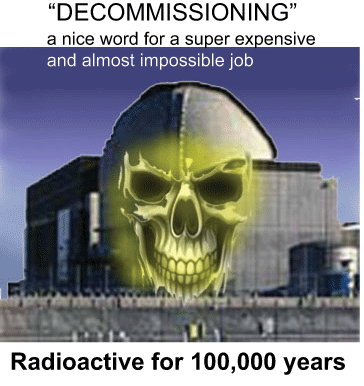 Decommissioning of 1st nuclear power plant facing major delay Focus Taiwan 2018/12/03 Taipei, Dec. 3 (CNA) By Elizabeth Hsu Taiwan is scheduled to begin decommissioning the first reactor of its oldest nuclear power plant in New Taipei on Dec. 5 after 40 years of service, but the deadline will not be met because of questions over how to deal with the plant’s nuclear waste.
The plan to decommission the two reactors in the Jinshan Nuclear Power Plant included the construction of an outdoor storage yard at the plant site for the dry storage of spent nuclear fuel.
The facility was built in 2013 but has yet to pass a New Taipei government inspection needed to obtain an operating permit, leaving the decommissioning process in limbo.
Hsu Tsao-hua (徐造華), a spokesman for Taiwan Power Company (Taipower), which runs Taiwan’s three nuclear power plants, said that if the storage facility cannot be used, the 816 fuel rods still in the Jinshan plant’s first reactor will have to stay where they are, and the plant’s safety equipment will have to be kept running.
Though the company has planned an indoor storage facility, it will take at least 10 years to build, which could delay the decommissioning process by at least a decade, Hsu warned………..
New Taipei Mayor Eric Chu (朱立倫) of the opposition Kuomintang (KMT) has declared that his city “can never be the permanent storage place for nuclear waste.”
His position has been at odds with the general stance of his party, which advocates the use of nuclear power as the country moves toward its ultimate goal of becoming a nuclear-free homeland. ……
“Nuclear waste represents pain in the heart of New Taipei (citizens),” said Hou, after the city has co-existed with two nuclear power plants for nearly four decades.
He also argued that nuclear waste should never be stored in a heavily populated city, and he urged the central government and Taipower to find a permanent storage location as soon as possible, a mission the utility has struggled with for years.
New Taipei is the most populous city in Taiwan with a population of 3.99 million as of November, government statistics show.
Even if the decommissioning of the Jinshan power plant were to start on time, it would still be a long process.
Under Taipower’s plan, it would involve eight years to shut the plant down, 12 years to dismantle it, three years to inspect its final condition and two years to restore the land. http://focustaiwan.tw/news/aeco/201812030020.aspx
Taiwan still on track to become nuclear-free, despite pro-nuclear referendum
Anti-nuclear group undeterred by passing of pro-nuclear referendum http://m.focustaiwan.tw/news/aipl/201811250029.aspx By Wu Hsin-yun, Ku Chuan and Evelyn Kao Taipei, Nov. 25 (CNA) Taiwanese on Saturday voted against the government’s policy of phasing-out nuclear power by 2025, prompting an environmental group opposed to nuclear power to reaffirm its support for the phasing out of all nuclear power plants.
The anti-nuclear group National Nuclear Abolition Action Platform said in a statement issued Sunday that it is wrong to return to nuclear power and promised to continue to campaign for an end to the use of nuclear power in Taiwan.
The statement came after Taiwanese voted in 10 referendums alongside Saturday’s local government elections, including one that asked: “Do you agree with abolishing the first paragraph of Article 95 of the Electricity Act, which means abolishing the provision that ‘all nuclear-energy-based power-generating facilities shall cease to operate by 2025’?”
As a result, 5,895,560 votes were cast in favor of repealing the nuclear phase-out, and 4,014,215 against the initiative, according to the Central Election Commission.
For a referendum to pass, the number of voters in favor of a proposition must exceed the number who vote against it, and reach a minimum of 4,939,267 votes, or one quarter of the 19,757,067 voters eligible to cast votes in the referendums.
Commenting on the referendum result, the anti-nuclear group said that not all those who voted in favor of stopping the nuclear phase-out are unconditional supporters of nuclear power, but rather some lack confidence in Taiwan’s energy transformation.
The result does not mean those who voted in favor of repealing the nuclear phase-out do not support the government’s nuclear-free, carbon reduction and renewable energy policy, the group said.
Currently, the decommissioning of the No. 1 and No. 2 nuclear power plants in New Taipei is underway and cannot be reversed according to the law, the group said.
However, as the No. 3 nuclear plant is near the active Hengchun fault line, the group said the geological environment is not suitable for extending the operational life of the nuclear plant to be or installing new units at the plant.
Taiwan can not withstand a nuclear disaster and the passage of the referendum does nothing to guarantee safety, the group noted.
The group stressed Taiwan is on the path to a nuclear-free homeland and carbon reduction and should not return to nuclear power and coal-fired plants.
Under the Referendum Act, a law repealed in a referendum has to be rescinded three days after the result is officially announced by the Central Election Commission, Cabinet spokeswoman Kolas Yotaka said Sunday.
This means the first paragraph of Article 95 of the Electricity Act will be removed.
However, “the government’s goal of making Taiwan a nuclear-free homeland by 2025 remains unchanged,” Kolas said, adding that in practice it may not be possible to postpone the phase-out of the No. 1, No. 2 and No. 3 nuclear plants.
According to the law, applications for postponement are required to be submitted 5-10 years before the scheduled retirement dates of nuclear plants, Kolas said, adding that any such applications cannot be made within the statutory time period.
As to whether the currently-mothballed No. 4 nuclear power plant will start commercial operations, Kolas said it is estimated any such reversal would take 6-7 years and cost NT$68.8 billion (US$2.22 billion).
Even if the nuclear plant is activated in 2019, it would not be ready to begin commercial operations in 2025, when the government’s goal of a nuclear-free homeland will be achieved, at which point Taiwan will have no need for nuclear power, she noted.
Taiwan votes to maintain ban on food from Fukushima disaster areas
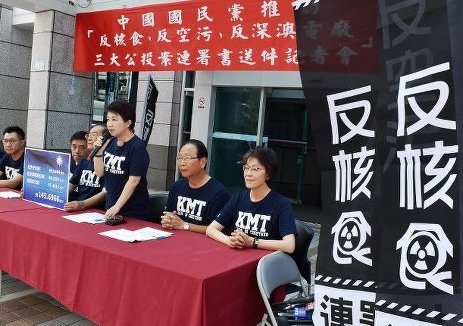 In this file photo dated Aug. 27, 2018, senior officials of the Kuomintang, Taiwan’s major political party, hold a press conference in Taipei to state their opposition to lifting a ban on food imports from Fukushima and four other Japanese prefectures. The banners read “oppose nuclear food.” (Mainichi/Shizuya Fukuoka)
TAIPEI (Kyodo) — A referendum on maintaining a ban on food products from five Japanese prefectures, imposed after the 2011 Fukushima nuclear disaster, saw the restrictions kept in place on Saturday, dealing a major blow to the government of President Tsai Ing-wen and the island’s relations with Japan.
For a referendum to deliver a decisive result in Taiwan, the “yes” vote must account for more than 25 percent of the electorate, or about 4.95 million voters.
The Central Election Commission website showed that more than 15 million of the 19.76 million eligible voters cast their ballots. More than 6 million voters approved the initiative, well over the 25 percent required.
The referendum is legally binding and government agencies must take necessary action.
The result dealt a significant blow to the Democratic Progressive Party government which proposed easing the ban after coming to power in May 2016, but backed away when the main opposition Nationalist Party (KMT) questioned the new government’s ability to ensure the safety of the imported products.
Government officials responsible for the policy declined to comment on Sunday, only saying it is a matter for President Tsai to decide.
Tsai announced her resignation as DPP leader on Saturday following her party’s disastrous defeat in key mayoral elections that day, races viewed as indicators of voter sentiment ahead of the next presidential and island-wide legislative elections in 2020.
Some worry that the result of the referendum on Japanese food imports will have a negative impact on the island’s relations with Japan. Taiwan’s representative to Japan, Frank Hsieh, said the initiative was a KMT scheme aimed at undermining bilateral relations between Taiwan and Japan at a time when the two are seeking closer ties as a way of protecting themselves from an increasingly belligerent China.
He also warned that if the referendum is successful, Taiwan would pay “a grave price” that will affect all its people.
China is the only other country still restricting comprehensive imports from Fukushima Prefecture and nearby Ibaraki, Gunma, Tochigi, and Chiba prefectures.
The referendum, initiated by the KMT, was one of 10 initiatives put to a vote in conjunction with Saturday’s island-wide local elections.
Voters approved two other referendums initiated by the KMT. One sought to stop the construction of new coal-fired power plants or the expansion of existing ones, and the other asked voters if they wanted to phase out thermal power plants.
Beijing will be happy about the result of a referendum on the name the island uses when competing at international sports events. It had sought to change the name used to participate in future international events, including the 2020 Tokyo Olympics, from “Chinese Taipei” to “Taiwan.”
The CEC website showed that more than 8.9 million cast their ballots. About 3 million of the eligible voters approved the initiative, less the 25 percent needed for the referendum to count.
The referendum was highly unpopular among athletes, who were worried that a successful outcome would hamper their right to compete, as the International Olympic Committee resolved in May that it would stand by a 1981 agreement that Taiwanese athletes must compete as “Chinese Taipei.”
The IOC had also warned that Taiwan would risk having its recognition suspended or cancelled if the referendum was successful.
China was annoyed by the proposal and pressured the East Asian Olympic Committee to revoke Taichung’s plan to host the 2019 East Asian Youth Games.
Beijing said that if the referendum was successful, it would not sit idly by and would “definitely respond,” without elaborating.
There were also five referendums relating to same-sex marriage — three initiated by opponents of same-sex marriage and two by supporters.
The CEC website showed that all three of the anti-same sex marriage initiatives passed, while both the pro-same sex marriage referenda failed.
The result also puts the Tsai government in an awkward position as Taiwan’s highest court, the Council of Grand Justices, ruled 18 months ago that the government must, within two years, amend the Civil Code or enact a special law legalizing gay marriage.
https://mainichi.jp/english/articles/20181125/p2g/00m/0in/010000c?fbclid=IwAR0ZlvV-JO_PHes83Gn8mutF6jKkFBzyx6iAYPJPw_2FA-tSqx3W71k9y2c
Taiwan to host Asian anti-nuclear forum in 2019
http://focustaiwan.tw/news/asoc/201811200015.aspx Taipei, Nov. 20 (CNA) Taiwan is set to host the annual No Nuke Asia Forum (NNAF) next year, the Taiwan Environmental Protection Union (TEPU) said Tuesday.
Founded in 1993, the NNAF is an annual gathering that brings together experts and academics from various anti-nuclear groups across Asia to discuss and share their visions on how to counter nuclear energy.
Taiwan’s upcoming referendum on the government’s policy of phasing out nuclear power in Taiwan by 2025 has been a topic of popular discussion at this year’s NNAF, which was held in the Philippines Nov. 11-15, the TEPU said.
During the forum, the union also came to share Taiwan’s past experiences, including a referendum that helped stop the ongoing construction of the country’s fourth nuclear plant in 2014, Liu said.
According to the TEPU, the 26th Asian anti-nuclear forum is scheduled to be held toward the end of 2019.
(By Wu Hsin-yun and Ko Lin)
Enditem/J
Hundreds of Taiwanese academics urge public to vote for nuclear power shut-down
Taiwan’s academics urge public to vote for nuclear power shut-down, Nature, 9 Nov 18
Open letter encourages voters to support the phase out of nuclear power plants in an upcoming referendum. Hundreds of researchers in Taiwan have signed an open letter urging the public to vote to continue the phase out of nuclear power in an upcoming referendum.
Last year, Taiwanese legislators added a clause to the island’s electricity act to shut down all nuclear power plants by 2025……
In October, proponents of nuclear power gathered enough signatures — more than 1.5% of the electorate in Taiwan — to force a referendum that will ask the public to agree to removing the phase-out clause from the act. ……Fifty academics, including environmental sociologist Chiu Hua-Mei at National Sun Yat-sen University in Kaohsiung, released the letter on 3 November, asking the public to vote to keep the clause. More than 400 others have now signed the letter.
Risky business
Chiu says that earthquakes and tsunamis, events that can damage nuclear power stations with devastating effects, are major threats to Taiwan, and there is no feasible long-term solution yet for dealing with the radioactive waste. It is currently stored at the power stations or on Orchid Island off the east coast. “It’s too risky for Taiwan to use nuclear power,” she says.
The academics who signed the letter felt compelled to advise the public about the risks of continuing to use nuclear power in Taiwan, Chiu says. “We think that scholars should say something for us, for Taiwan.”
Even if the phase-out clause ends up being removed from the act, it is not clear what president Tsai will do in response.
Fifty academics, including environmental sociologist Chiu Hua-Mei at National Sun Yat-sen University in Kaohsiung, released the letter on 3 November, asking the public to vote to keep the clause. More than 400 others have now signed the letter.
Taiwan’s phaseout of nuclear power
Taiwan on right rack to phase out nuclear power: German envoy, Focus Taiwan, 2018/10/28 Taipei, Oct. 28 (CNA) By Joseph Yeh Taiwan’s government is on the right track to install more capacity for renewable energy as it moves toward phasing out nuclear power by 2025, Germany’s new top envoy to Taiwan told CNA during a recent interview.
During an interview conducted on Wednesday, Thomas Prinz, the new director general of German Institute Taipei, told CNA that based on his understanding, the Taiwan government’s plan to substitute nuclear energy is “very realistic and can be achieved.”
The German government decided to close down all the country’s nuclear power stations in the wake of the Fukushima accident in Japan on March 11, 2011, when the Fukushima No. 1 nuclear plant was hit by a tsunami after a magnitude 9 earthquake knocked out power to its cooling systems sending its reactors into meltdown.
“However, it is not only the decommissioning which is interesting, when you shut down nuke plants you have to find other sources of energy. That is where your government is so far on the right track to install more capacity for renewable energy,” he added.
President Tsai Ing-wen’s (蔡英文) administration has set itself the goal of phasing out nuclear energy in Taiwan by 2025. An amendment to the Electricity Act was approved by the Legislative Yuan on Jan. 11, 2017 requiring all nuclear power operations to end by 2025.
Taiwan to hold referendum on lifting Fukushima food ban in November


Taiwan Premier encorages renewable energy, repeats commitment to phase out nuclear power
Infrastructure Journal 23rd Aug 2018 , Premier Lai Ching-te has underscored Taiwan government’s commitment to
retiring nuclear power by 2025, lending greater confidence to the national
renewable energy agenda.
https://ijglobal.com/articles/134907/taiwan-cements-support-for-renewables
Taiwan’s energy transition from nuclear to wind and solar power
Nuclear Ghost Town Reveals Power Risk for Taiwan’s Energy Shift, Bloomberg, By Dan Murtaugh, Miaojung Lin, and Samson Ellis August 7, 2018,
- Plan to shut reactors sparks race to develop wind, solar power
- Goal is 70% of electricity from gas, renewable sources by 2025
A map at the guard-house of the Lungmen Nuclear Power Plant in Taiwan shows what might have been: Classrooms, dormitories, a grocery store, a police station. It was supposed to be a self-contained city on the island’s northeast coast designed to meet growing demand for electricity in Asia’s seventh-largest economy.
Instead, the complex stands empty — unfinished and never used — a $10 billion casualty of growing public opposition to nuclear power. Since a disastrous 2011 reactor meltdown in Japan, more than 1,400 miles (2,250 kilometers) away, Taiwan has rewritten its energy plans. President Tsai Ing-wen ordered all of the country’s nuclear reactors to shut by 2025.
Taiwan’s Transition
Taichung gears up for wind power as Lungmen’s reactors are mothballed
That’s set off a high-risk gamble to find alternatives to nuclear, which supplies 12 percent of the island’s electricity, while limiting an increase in carbon emissions. The island’s sprint reflects a drive across the region toward cleaner energy sources such as sunlight, wind and natural gas. Nations from Australia to South Korea and mainland Chinato India are seeking to meet rising demand without belching more emissions blamed for climate change and smog.
Taiwan’s solution: Wind turbines are planned in the blustery Taiwan Strait, solar panels are popping up on coastal salt flats, and terminals are being planned to import more liquefied natural gas. But new sources could take years to develop, making power rationing and blackouts a possibility as the gap narrows between demand and generating capacity.
“There are going to be concerns over the next few years about reserve margins and power supply reliability,” said Zhouwei Diao, an IHS Markit analyst in Beijing.
The government’s plan has several parts. First, all nuclear and most oil-fueled generators will be shut. Together, they supplied 16 percent of Taiwan’s electricity in 2016. The country will still have about the same amount of coal capacity by 2025 as now, but its share of total power generation will drop to 30 percent from about half as sources of alternative energy expand. Natural gas will see the biggest usage gain, accounting for half of supply by 2025, while renewables like wind and solar will more than triple to 20 percent.
As electricity demand grows over the next seven years, the government says it will boost generating capacity while limiting carbon emissions and ridding itself of a political headache.
Taiwan’s state-run nuclear industry already was unpopular after it built a controversial waste-storage site on Orchid Island, home to one of the country’s indigenous peoples. But sentiment turned even more negative after the disaster in Japan, which occurred after a giant earthquake and tsunami. The disaster prompted countries including Germany and South Korea to ditch their nuclear programs.
Taiwan Power Co. operates three nuclear plants and was building the fourth in Lungmen when the Fukushima meltdown occurred. In 2014, the government halted construction that was nearly complete, with uranium-fuel rods in place. In 2016, the Democratic Progressive Party won election on an anti-nuclear platform. Last month, workers removed the unused fuel rods and sold them to a buyer in the U.S.
…….. The government has held firm to its plan. Part of the optimism comes from the plunging cost of building wind and solar projects around the world. There’s also expanding supplies of cheap liquefied natural gas available from the Middle East, Australia and the U.S…….. https://www.bloomberg.com/news/articles/2018-08-05/nuclear-ghost-town-reveals-power-risk-for-taiwan-s-energy-shift
Taiwan closing nuclear power stations, investing heavily in wind energy
Offshore Wind Journal 10th May 2018 , Taiwan’s Government is making good on longstanding plans to close nuclear power plants and invest heavily in offshore wind energy. Late April 2018
saw the authorities in Taiwan announce the results of the first large-scale
auction for offshore wind in the country, a process that will eventually
see around 3.8 GW of capacity being built there.
This demonstrates theTaiwanese Government’s determination to follow-through and execute plans
announced earlier for the sector. Taiwanese President Tsai Ing-wen has
proposed to end the country’s dependence on nuclear power by 2025 while
sourcing 20% of Taiwan’s electricity from renewable sources – that is,
five times the level in 2015. That plan depends heavily on offshore wind,
for which the Taiwan Strait is seen as particularly well-suited.
Data provided by law firm Jones Day showed that in 2016, electricity generated
from renewable energy accounted for 4.8% of the aggregate produced
electricity and 9.4% of the aggregate installed capacity in Taiwan, so the
government’s strategy is certainly an ambitious one. In due course the
Taiwanese Government would like to have an energy mix of 50% natural gas,
30% coal and 20% renewable energy.
http://www.owjonline.com/news/view,taiwan-makes-good-on-plan-to-replace-nuclear-power-with-wind_51748.htm
1 This Month

of the week – Shut Down Drone Warfare!


Tell the Ukrainian Government to Drop Prosecution of Peace Activist Yurii Sheliazhenko

Petition to revoke the licensing of the Near Surface Nuclear Disposal Facility (NSDF) at Chalk River. https://www.ourcommons.ca/petitions/en/Petition/Details?Petition=e-7247
To see nuclear-related stories in greater depth and intensity – go to https://nuclearinformation.wordpress.com
-
Archives
- March 2026 (237)
- February 2026 (268)
- January 2026 (308)
- December 2025 (358)
- November 2025 (359)
- October 2025 (376)
- September 2025 (257)
- August 2025 (319)
- July 2025 (230)
- June 2025 (348)
- May 2025 (261)
- April 2025 (305)
-
Categories
- 1
- 1 NUCLEAR ISSUES
- business and costs
- climate change
- culture and arts
- ENERGY
- environment
- health
- history
- indigenous issues
- Legal
- marketing of nuclear
- media
- opposition to nuclear
- PERSONAL STORIES
- politics
- politics international
- Religion and ethics
- safety
- secrets,lies and civil liberties
- spinbuster
- technology
- Uranium
- wastes
- weapons and war
- Women
- 2 WORLD
- ACTION
- AFRICA
- Atrocities
- AUSTRALIA
- Christina's notes
- Christina's themes
- culture and arts
- Events
- Fuk 2022
- Fuk 2023
- Fukushima 2017
- Fukushima 2018
- fukushima 2019
- Fukushima 2020
- Fukushima 2021
- general
- global warming
- Humour (God we need it)
- Nuclear
- RARE EARTHS
- Reference
- resources – print
- Resources -audiovicual
- Weekly Newsletter
- World
- World Nuclear
- YouTube
-
RSS
Entries RSS
Comments RSS
 nuclear-news