Politicians and decision-makers in South Korea are torn about a plan to
continue construction of two nuclear power plants, following a major
earthquake. The magnitude 5.4 earthquake in early November reignited public
concern about whether the country can still be considered a seismic safe
zone. Now a 500-strong panel of experts is due to report. http://www.aljazeera.com/news/2017/12/south-korea-concerns-raised-safety-nuclear-plants-171226071506379.html
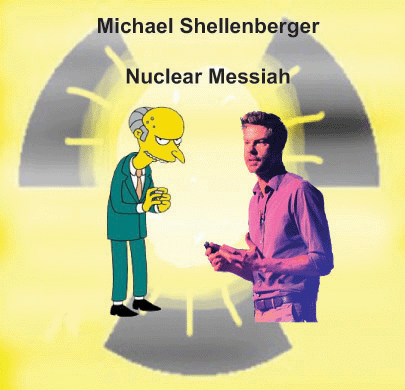
Exposing the misinformation of Michael Shellenberger and ‘Environmental Progress’, Nuclear Monitor Issue: #853 4689 30/10/2017, Jim Green ‒ Nuclear Monitor editor, and national nuclear campaigner with Friends of the Earth Australia
Michael Shellenberger’s pro-nuclear lobby group ‘Environmental Progress’ (EP) is celebrating the decision to proceed with two partially-built reactors in South Korea. A citizens jury appointed by the government voted almost 60% in favor of completing the reactors. President Moon Jae-in said the government would allow construction of the reactors to proceed but “we will completely stop all plans for the construction of new nuclear reactors.”1
It’s doubtful that Shellenberger’s California-based organization could have significantly swayed the citizens jury in South Korea, but EP was very active in the debate and presumably had some effect in shifting opinions. Here is a summary of the work EP carried out in South Korea this year:2
EP published a 62-page pro-nuclear report ‒ ‘The High Cost of Fear: Understanding the Costs and Causes of South Korea’s Proposed Nuclear Energy Phase-Out’.3
Shellenberger visited South Korea four times between April and October 2017, giving speeches, holding press conferences on collaborating with nuclear advocates. He claims that dozens of media outlets reported on EP’s visits, that a press conference in Seoul was “packed”4, and that he enjoyed “a crush of media attention”.5
EP sent a sign-on letter to South Korean President Moon Jae-in in July 2017 and another in August 2017.
In October, EP wrote to the citizens jury tasked with deciding the fate of the two partially-built reactors (Shin Kori 5 and 6).6
EP produced a video promoting nuclear power in South Korea.
Shellenberger has been talking and writing about his bizarre plan to bring peace to the Korean Peninsula by supporting the development of nuclear power in North Korea.
And, according to Shellenberger, EP countered the “lies” of Friends of the Earth (FOE) and Greenpeace in “two investigative pieces and three separate open letters to President Moon and the citizens jury that were signed by climate scientists and environmentalists from around the world.”6
EP’s campaign has involved a blizzard of misinformation and relentless, dishonest attacks against environment groups, particularly Friends of the Earth (FOE) and Greenpeace. Shellenberger claims4 that the “greatest coup” of the two groups was the “Hollywood-style anti-nuclear disaster movie” called Pandora7 which was released last year and has been watched by millions, mostly on Netflix. But FOE and Greenpeace had nothing to do with the production of the Pandora film!……..
The funding of the Pandora film isn’t an important issue but it neatly illustrates Shellenberger’s M.O. of relentless repetition of falsehoods in the hope that some mud sticks…..
Shellenberger himself featured in the dishonest and wildly inaccurate ‘Pandora’s Promise’ film a few years ago………
Nuclear power and weapons proliferation
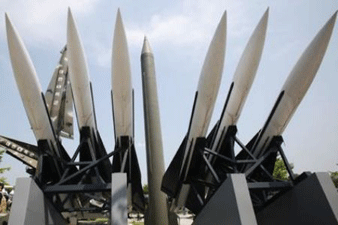
Shellenberger states: “One of FOE-Greenpeace’s biggest lies about nuclear energy is that it leads to weapons. Korea demonstrates that the opposite is true: North Korea has a nuclear bomb and no nuclear energy, while South Korea has nuclear energy and no bomb.”4
In fact, the connections between nuclear power (and associated industries such as enrichment and reprocessing) and weapons proliferation are well understood and there are countless real-world examples demonstrating the risks.26
Prominent nuclear lobbyists are now openly talking about the connections between nuclear power (and related industries) and weapons production in order to boost the case for further subsidies to support the ‘civil’ nuclear industry, particularly in the US.27 It seems Shellenberger didn’t get the memo.
As for Shellenberger’s claims about proliferation on the Korean peninsula, he ignores the fact that North Korea uses what is calls an ‘experimental power reactor’ (based on the UK Magnox power reactor design) to produce plutonium for weapons.28 He ignores the fact that North Korea acquired enrichment technology from Pakistan’s A.Q. Khan network, who stole the blueprints from URENCO, the consortium that provides enrichment services for the nuclear power industry.28 He ignores the fact that North Korea’s reprocessing plant is based on the design of the Eurochemic plant in Belgium, which provided reprocessing services for the nuclear power industry.28
North Korea is in ‘final stages of nuclear weaponisation’, says South Korea, The Independent16 Dec 2017, South Korea’s vice foreign minister issued an urgent plea about the threat from Pyongyang, warning the United Nations Security Council that North Korea was “in the final stages of nuclear weaponization”.
“It will fundamentally alter the security landscape in the region and beyond” if the North is able to equip a missile with a nuclear warhead, Cho Hyun warned.
In the past few months, North Korea has rattled the world with a series of weapons tests. It detonated a hydrogen bomb and has launched multiple ballistic missiles, saying after the latest firing that it now has the capability to attack the US mainland and had devised a missile capable of carrying “super-large heavy nuclear warhead”.
The late-November launch soared higher than any previous test, US Secretary of Defence James Mattis said, and illustrated North Korea’s determination to build missiles that can “threaten everywhere in the world”.
Continuing to defy international warnings, a top North Korean official said escalating pressure from the global community shows America is “terrified” by North Korea‘s nuclear capabilities.
The nation’s ambassador to the United Nations, Ja Song Nam, called a meeting of the UN Security Council a “desperate measure plotted by the US” in response to North Korea’s displays of military might.
The latest joint training operation practised infiltrating North Korea and removing nuclear weapons in the event of war.
According to South Korea news agency Yonhap the “Warrior Strike” exercise held at Camp Stanley involved hundreds of troops from both sides and ran from Tuesday to Friday.
Camp Stanley is an army camp located north of Seoul and has around 5000 soldiers.
The display comes as North Korea’s neighbours China and Russia also carried out an antimissile drill in Beijing last week. The joint five-day drill, which finished on Saturday, included servicemen from both militaries and was headed by top brass in the Russian and Chinese air force, Newsweek reported.
The latest joint exercise between Washington and Seoul follow joint aerial drills Vigilant Ace in South Korea earlier this month.
The five-day drill was meant to improve the allies’ wartime capabilities and preparedness, according to South Korea’s defence ministry said.
The Vigilant Ace exercises, which lasted five days, involved more than 230 warplanes and 12,000 soldiers from both sides.
United States troops also used the hi-tech F-35 Lightning IIs and F-22 Raptors.
South Korea is a key US ally in the region and relies on US military assistance for security against the North.
Troops from the two countries routinely train together, each time prompting outbursts from Pyongyang.
Meanwhile Russia warned against fresh preconditions for any potential US and North Korea talks. Deputy foreign minister Sergei Ryabkov on Saturday warned of a risk of escalation after Washington toughened its stance on North Korea nuclear talks and US President Donald Trump accused Moscow of failing to help.
“It’s sad that this powerful element of demands for further pressure on Pyongyang has once again appeared in the American position,” he told RIA Novosti news agency.
“It’s high time to stop this race of threats, pressure, blackmail and presentation of preconditions and shift to a real search for a political solution.”
Mr Ryabkov said that both Pyongyang and Washington are now putting forward preconditions for talks and there is a “risk of uncontrolled escalation”.
His comments came one day after US Secretary of State Rex Tillerson backed away from an earlier offer of unconditional talks to end the stand-off with Pyongyang following White House pressure.
Moon calls for ‘overwhelming’ military capability against North Korea, Korea Herald, jasonyeo@heraldcorp.com By Yeo Jun-suk : Dec 8, 2017 -President Moon Jae-in urged the military to secure “overwhelming” capability to fend off North Korea’s growing military threat on Friday as South Korea’s Defense Ministry warned against another strategic provocations following its latest missile launch.
The president also called for an “early and swift” transfer of wartime operational control from the United States to South Korea, suggesting the military should secure capability to lead combined operations in the event of contingency on the Korean Peninsula.
“Based on a robust South Korea-US alliance, we have to work swiftly to meet the conditions for wartime operational control,” said the president during a lunch meeting with some 150 military commanders at the presidential office of Cheong Wa Dae in Seoul.
“Given that North Korea’s missile and nuclear threat has been accelerating at a faster pace than before, the military’s role is more important than ever. You are our last line of defense against North Korea’s nuclear weapons and missile threats,” he added. ……http://www.koreaherald.com/view.php?ud=20171208050060
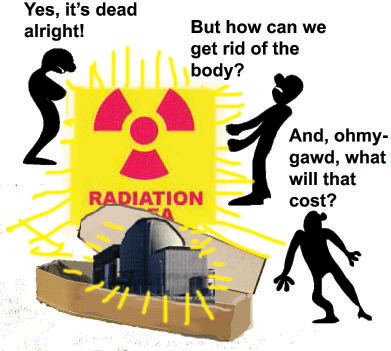
S. Korea strives to build up nuclear decommissioning industry, By Kim Eun-jung SEOUL, Dec. 8 (Yonhap) —South Korea will ramp up efforts to develop technologies related to nuclear decommissioning as the country’s oldest reactor is undergoing the lengthy, costly process of being dismantled, the energy ministry said Friday.
The Ministry of Trade, Industry and Energy launched a consultative body composed of state-run utilities, construction companies and research institutes to put concerted efforts toward developing the nation’s nuclear decommissioning industry,
The ministry said it aims to develop technologies needed to dismantle nuclear reactors by 2021 that will make such sites free of radioactive hazards and establish a research institute to pave the way for entering the global market by 2030…….
A total of 11 reactors will be retired one by one by 2030 as their operational life cycles expire as the government said it won’t extend their operation.
As part of the nuclear phase-out plan, the government is also pushing for an early closure of Wolsong-1, now the nation’s oldest operating reactor, as soon as possible.
Bomb shelter boss ‘wants North Korea to launch nuclear attack’ to help sell new ‘high street bunkers’Mirror UK, 30 Nov 17 British bunker experts have been working alongside a Korean company on making the world’s toughest shelters to prepare for nuclear war A bomb shelter boss ‘wants North Korea to launch a nuclear attack’ to help sell ‘high street bunkers’.
The bunkers have been built to withstand a nuclear attack, by Kim Jong-un are now being sold on Seoul’s high street.
British bunker experts Castellex have been working alongside the Korean company Chumdan Bunker System on making the world’s toughest shelters to prepare for nuclear war.
A ‘bunker showroom’ has now been opened in downtown Seoul, in the same shopping area where people are buying clothes and cosmetics. CBS owner Go Wan Hyeok says that demand from ‘petrified’ locals for affordable bunkers led him to set up in the busy retail district of Jangan-Dong – and wants to branch out to Europe and the UK within five years.
He said: “I’m wishing that he presses the button and shoots the bomb!
Carlisle News and Star 30th Nov 2017,The British and Korean governments have agreed to greater collaboration onnuclear developments, fuelling speculation that a Korean company is about
to invest in West Cumbria’s Moorside power station.
Greg Clark, the secretary of state for business, energy and industrial strategy, and Paik
Un-gyu, South Korean minister of trade, industry and energy, signed a
Memorandum of Understanding on Monday in London. It promises greater
collaboration in both the construction and decommissioning of nuclear power
stations.
The signing appears to have only been reported by World Nuclear
News and Business Korea websites. State-run Korea Electric Power
Corporation (Kepco) has revealed it is in “working-level” talks to buy
a stake in NuGen – which plans to build three new reactions in West
Cumbria to provide seven per cent of the UK’s electricity needs.
Continuing Conflict S. Korean Gov’t Stops Virtually Construction of New Nuclear Power Plants Seoul, Korea, Business Korea, 17 November 2017 , Choi Mun-hee
Korea Hydro & Nuclear Power (KHNP) held a board meeting on November 16 and decided to stop the construction of the third and fourth units of the Shin Hanul Nuclear Power Plant and the first and second units of the Cheonji Nuclear Power Plant. Controversies are likely to continue with hundreds of billions of won already invested in the construction projects and the government having yet to prepare a plan for compensation.
Those in favor of the construction of the nuclear power plants are claiming that nuclear power plants are safe tools for power generation as seen in the case of those that endured the magnitude 5.4 earthquake in Pohang on November 15. Those opposed to the construction are claiming that South Korea is not an earthquake-free zone and, as such, no more nuclear power plant should be allowed.
The Joint Action for a Nuclear Free Society, which is a local environmental group, held a press conference in Seoul on November 16. “Both the earthquake in Gyeongju last year and the recent earthquake in Pohang occurred in the Yangsan fault zone in the southeastern region of the Korean Peninsula and the latter’s epicenter was shallower and the latter caused more damage although the former had a larger magnitude,” it said, adding, “At present, a total of 18 nuclear power plants are in operation and five are under construction in the southeastern region of the peninsula including Gyeongju, Busan, and Ulsan, where big earthquakes have occurred one after another, and the operation of the power plants should be stopped and safety measures should be prepared immediately.”…… http://www.businesskorea.co.kr/english/news/national/19848-continuing-conflict-s-korean-gov%E2%80%99t-stops-virtually-construction-new-nuclear
Environmental groups that support the current administration’s nuclear energy phaseout policy have based their arguments on the potential dangers posed by natural disasters like earthquakes.
In a statement made yesterday, the Korean Federation for Environmental Movement reiterated the need to scale back nuclear energy operations in southeastern Korea, saying, “On the heels of the Gyeongju earthquake last year, there has been a quake on the Yansan fault line.”
Last September’s 5.8-magnitude earthquake in Gyeongju was the most powerful recorded in South Korean history. With the November 15 earthquake in nearby Pohang, only about 20 km away, the Yeongnam region has seen record-setting natural disasters in successive years.
North Korea nuclear crisis: Japan bracing itself for influx of evacuees if war erupts
Coast Guard readies plans to escort boats from peninsula to designated ports as brinkmanship continues between Pyongyang and Washington The Independent, 16 Nov 17 Japan is studying plans to cope with an influx of perhaps tens of thousands of North Korean evacuees if a military or other crisis breaks out on the peninsula, including ways to weed out spies and terrorists, a domestic newspaper said.
The Japan Coast Guard would escort boats fleeing North Korea to designated ports, where police would screen them by checking their identity and possible criminal records and expel those deemed a threat, The Yomiuri newspaper said on Thursday.
It did not say where those people would be sent, however.
Evacuees granted temporary entrance would be transferred to emergency detention centres, probably in southern Japan, after completing quarantine and other procedures.
Officials would then decide whether they were eligible to remain in Japan, The Yomiuri said.
Regional tension over Pyongyang’s missile and nuclear arms programmes remain high.
North Korea nuclear arsenal too developed to destroy quickly, says Moon, Christine Kim, 14 Nov 17, SEOUL (Reuters) – South Korean President Moon Jae-in said on Tuesday it would not be easy for reclusive North Korea to destroy its nuclear arsenal quickly, even if wanted to, given its weapons programs were so developed. North Korea is under heavy international pressure to end its weapons programs, pursued in defiance of U.N. Security Council resolutions. But it has vowed never to give up its nuclear arsenal.
Speaking to reporters in the Philippines, Moon said that if North Korea agreed to hold talks, negotiations could be held with all options open.
“If talks begin to resolve the North Korea nuclear issue, I feel it will be realistically difficult for North Korea to completely destroy its nuclear capabilities when their nuclear and missile arsenal are at a developed stage,” Moon said in a briefing.
“If so, North Korea’s nuclear program should be suspended, and negotiations could go on to pursue complete denuclearization.”…….
The North defends the programs as a necessary defense against U.S. plans to invade. The United States, which has 28,500 troops in South Korea, a legacy of the 1950-53 Korean war, denies any such intention.
U.S. President Donald Trump has traded insults and threats with North Korean leader Kim Jong Un as North Korea races toward its goal of developing a nuclear-tipped missile capable of reaching the United States.
Trump threatened in his maiden U.N. address to “totally destroy” North Korea if the United States was threatened and has said the time for talking, the policy of previous U.S. administrations, is over.
Moon reiterated his stance that now was the time to increase pressure on North Korea so that it would come to talks……..
He said differences in understanding between South Korea and China, North Korea’s lone major ally, regarding the deployment of the U.S. Terminal High Altitude Area Defense (THAAD) system on South Koran soil had not been resolved.
Trump vows to ‘figure out’ North Korea nuclear crisis with Moon SBS News, 7 Nov 17, US President Donald Trump arrived in Seoul on Tuesday vowing to ‘figure it all out’ with his South Korean counterpart Moon Jae-In, despite the two allies’ differences on how to deal with the nuclear-armed North.
As tensions over Pyongyang’s weapons programme have soared, the US president has traded personal insults and threats of war with North Korean leader Kim Jong-Un, but the South’s capital and its 10 million inhabitants would be on the front line of any conflict.
On Twitter Trump described Moon as “a fine gentleman”, adding: “We will figure it all out!”
The tone was in marked contrast to a previous Trump tweet in which he accused Moon — who has backed engagement with the North to bring it to the negotiating table — of “appeasement”.
Trump arrived from Japan, where he secured Tokyo’s full support for Washington’s stance that “all options are on the table” regarding Pyongyang, and declaring its nuclear ambitions “a threat to the civilised world and international peace and stability”……..
Introduction: Nuclear Energy in Asia, by Mel Gurtov
The Fukushima nuclear disaster of March 2011 has raised serious questions about nuclear power.
In our work since Fukushima, we have tried to answer two questions: What is the current status of nuclear energy in Asia? Does nuclear power have a future in East Asia? By answering those questions, we hope to contribute to the global debate about nuclear energy. To be sure, questions of such magnitude can rarely be answered with a simple ‘yes’ or ‘no’. Decisions on energy are made at the national level, on the basis of both objective factors such as cost-effectiveness and notions of the national interest, and less objective ones, such as influence peddled by power plant operators, corruption, and bureaucratic self-interest. Nevertheless, by closely examining the status and probable future of nuclear power plants in specific countries, the authors of this volume come up with answers, albeit mostly of a negative nature.
At the start of 2017, 450 nuclear power reactors were operating in 30 countries, with 60 more under construction in 15 countries. Thirty-four reactors are under construction in Asia, including 21 in China. The “Fukushima effect” has clearly had an impact in Asia, however. In China, no new construction took place between 2011 and 2014, although since then there has been a slow increase of licenses. Nevertheless, the full story of China’s embrace of nuclear power, as told in this volume by M. V. Ramana and Amy King, is that the onset of a ‘new normal’ in economic growth objectives and structural changes in the economy have led to a declining demand for electricity and the likelihood of far less interest in nuclear power than had once been predicted.
On the other hand, in South Korea, which relies on nuclear power for about 31 per cent of its electricity, Lauren Richardson’s chapter which is presented here, shows that the Fukushima disaster and strong civil society opposition have not deflected official support of nuclear power, not only for electricity but also for export.
Meanwhile, the 10 countries that comprise the Association of Southeast Asian Nations (ASEAN) are divided about pursuing the nuclear-energy option, with Vietnam deciding to opt out in 2016, and Cambodia, Indonesia, Malaysia, and the Philippines at various stages of evaluation. Even so, the chapter by Mely Caballero-Anthony and Julius Cesar I. Trajano shows that only about 1 per cent of ASEAN’s electricity will derive from nuclear power in 2035, whereas renewables will account for 22 per cent.
How viable nuclear power is finally judged to be will depend primarily on the decisions of governments, but increasingly also on civil society. ASEAN has established a normative framework that emphasises safety, waste disposal, and non-proliferation; and civil society everywhere is increasingly alert to the dangers and costs, above-board and hidden, of nuclear power plants.
As Doug Koplow’s chapter shows, for example, the nuclear industry, like fossil fuels, benefits from many kinds of government subsidies that distort the energy market against renewable energy sources. Costs are politically as well as environmentally consequential: even if construction begins on a nuclear power plant, it will be cancelled and construction abandoned in 12 per cent of all cases. It is important to note that of the 754 reactors constructed since 1951, 90 have been abandoned and 143 plants permanently shut down.
When construction does proceed, it takes between five to 10 years on average for completion (338 of 609), with some 15 per cent taking more than 10 years. And, in the end, old and abandoned reactors will have to be decommissioned, as Kalman A. Robertson discusses, with costs that may double over the next 15–20 years.
As Robertson points out, the problem of safe disposal of radioactive waste and the health risk posed by radiation released during decommissioning should be factored into the total price that cleanup crews and taxpayers will eventually pay. On top of all that, there isn’t much experience worldwide in decommissioning.
Then there is the issue of trust in those who make decisions. Tatsujiro Suzuki’s chapter shows that in Japan, the chief legacy of Fukushima is public loss of trust in Japanese decision-makers and in the nuclear industry itself. Several years after the accident, costs continue to mount, a fact that pro-nuclear advocates elsewhere in Asia might want to consider. They also need to consider the issue of transparency for, as Suzuki shows, the nuclear industry has consistently dodged the fairly obvious lessons of Fukushima with regard to costs, nuclear energy’s future, and communication with the public. Similarly, in Taiwan, as Gloria Kuang-Jung Hsu’s study shows, transparency about safety issues has been notoriously lacking, and a history of efforts to obfuscate nuclear weapon ambitions means that constant vigilance over nuclear regulators is necessary.
Of course, if public opinion does not count in a country—say, in China and Vietnam—the issue of trust is muted. But we know that, even there, people are uneasy about having a nuclear power plant in their backyard. Issues of hidden cost and public trust are also embedded in the biological and health threat posed by nuclear energy. Tilman A. Ruff, a long-time student of radiation effects on human health, demonstrates how these effects have been underestimated. He offers a detailed explanation of what exposure to different doses of radiation, such as from the Fukushima accident, means for cancer rates and effects on DNA. Timothy A. Mousseau and Anders P. Møller, who have undertaken field research for many years on the genetic effects of the Chernobyl accident, look at how nuclear plant accidents affect the health of humans and other species. Combined, these two chapters offer a potent, often overlooked, argument against the nuclear option.
This introduction by Mel Gurtov and the following article by Lauren Richardson are adapted from Peter Van Ness and Mel Gurtov, eds., Learning From Fukushima. Nuclear Power in East Asia. Australian University Press.
Protesting Policy and Practice in South Korea’s Nuclear Energy Industry , by Lauren Richardson
Japan’s March 2011 (3/11) crisis spurred a revival in anti-nuclear activism around the globe. This was certainly the case in South Korea, Japan’s nearest neighbour, which was subject to some of the nuclear fallout from Fukushima. This chapter examines the puzzle of why the South Korean anti-nuclear movement was apparently powerless in the face of its government’s decision to ratchet up nuclear energy production post-3/11. It argues that its limitations stem from the highly insulated nature of energy policymaking in South Korea; the enmeshing of nuclear power in the government’s ‘Green Growth Strategy’; and certain tactical insufficiencies within the movement itself. Notwithstanding these limitations, the movement has successfully capitalised upon more recent domestic shocks to the nuclear power industry, resulting in a slight, yet significant, curtailing of the South Korean government’s nuclear energy capacity targets.
Introduction….. The evolution of South Korea’s nuclear energy policy…… The bottom-up movement against nuclear energy…….. Phase 1: Pre-Fukushima…….. Phase 2: Post-Fukushima….. Explaining the limited policy change…… The insularity of nuclear power policymaking…… Nuclear power as ‘green’ energy……. Tactical insufficiencies in the anti-nuclear movement……..
New challenges to South Korea’s nuclear energy industry…… Corruption scandals…….. Cyber-attacks on nuclear power plants….
Report: North Korea runs hospital to treat nuclear radiation patients, By Elizabeth Shim | Nov. 1, 2017 (UPI)—North Korea operates a hospital that treats soldiers exposed to radiation at its nuclear test site in Punggye-ri, according to a Japanese press report.
The Asahi Shimbun reported Wednesday the hospital is located near Pyongyang, in North Hwanghae Province. Patients include soldiers who work at Punggye-ri and their families. The North Korea source who spoke to the Asahi on the condition of anonymity did not disclose the number of North Korea radiation patients at the hospital.
But according to the report, the Kim Jong Un regime retains “hundreds of thousands” of North Korean soldiers who are responsible for digging underground tunnels at Punggye-ri or guarding the site.
North Korea has conducted nuclear tests at the site for more than a decade, starting in October 2006, and most recently in September, when it announced its sixth nuclear test.
The test and recent missile launches earned North Korea universal condemnation and heavy economic sanctions.
The Asahi previously reported rumors were circulating among North Koreans residing near the site a “phantom disease” could be spreading “because of the nuclear tests.”