Japan town mayor OKs restarting nuclear reactor over 40 years old
February 16, 2021 (Mainichi Japan) TSURUGA, Fukui— The mayor of a central Japan town hosting a nuclear power plant operated by Kansai Electric Power Co. informed the speaker of the municipal assembly on Feb. 15 that he would approve the restart of a reactor at the plant that is more than 40 years old.
Mayor Hideki Toshima of the Fukui Prefecture town of Mihama told Mihama Municipal Assembly Speaker Yoshihiro Takenaka that he would approve the restart of the No. 3 reactor at Mihama Nuclear Power Station, which began operating in the 1970s. The assembly had already approved the reactivation of the aging reactor.
Meanwhile, Mayor Yutaka Nose of the prefectural town of Takahama, home to Kansai Electric’s Takahama Nuclear Power Station, whose No. 1 and 2 reactors are also over 40 years old, has given the green light for resuming the operations of the two rectors, while the Takahama Municipal Assembly has also approved of the move.
Now that local consent has been secured, the focus has shifted to the decisions expected from Gov. Tatsuji Sugimoto and the prefectural assembly……….
As a general rule, a nuclear power plant operator is expected to obtain consent for restarting a rector from the local governments around the plant as well as local assemblies. As a condition for approving the restart, the Fukui Prefectural Government said Kansai Electric would need to present candidate sites outside the prefecture for interim spent nuclear fuel storage facilities. The prefectural government maintained that until that condition was achieved, the parties were “not even at the starting line of discussion.”
However, after Kansai Electric proposed on Feb. 12 that it would finalize a planned site for the storage facilities by the end of 2023, the prefectural government demonstrated a positive attitude toward reactivation. Discussion on restarting the aging reactor may develop further at the prefectural assembly session convening on Feb. 16.
As World War 2 neared its end, with 20 million Russian soldiers killed, fighting with the Allies against Hitler, America’s government was already planning its military superiority over Russia.
What they needed was to demonstrate a weapon of huge mass destruction, that would frighten the Russians. Germany surrendered on 7 May 1945. Too late to try one out on Germany , but Japan was still in the war, (though near to giving up). So they had to hurry. Japan would be the test case – selecting the city of Hiroshima , both to test the effects of atomic bombing, and to show the Russians, on August 6th. To emphasise the USA’s military superiority, they plutonium bombed Nagasaki 3 days later.
After the war, how to get Japan ”on side” against Russia , and equally important, to show the Japanese that nuclear is really quite good.? USA helped Japan to now get an ‘economic miracle’, and better still, give Japan the benefit of ‘good nukes’.
To these crowded, seismically dangerous Japanese islands, USA promoted clusters of nuclear power stations. The nuclear industry’s image was miraculously enhanced – to Japan, and to the world.
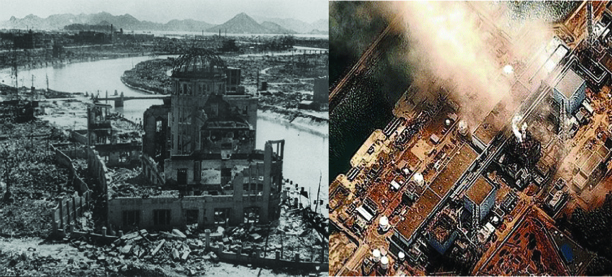
BUT, 66 years later, Japan suffered another disastous nuclear blow, with the meltdown at the Fukushima nuclear power station. With the 10 year anniversary of this disaster, on March 11, the real cleanup is nowhere in sight, vast amounts of contaminated water are still accumulating, areas are uninahitable, and most evacuees don’t want to return. Radioactive pollution in forests is still a problem.
Sad to reflect that this one country, Japan, has suffered two great nuclear horrors – 75 years apart, with the tragic effects of both continuing. The world needs, not a celebratory, cosmetic, Olympic Games, but real international help for the people of Fukushima, and for the environmental remediation. Japan needs help to shut down the toxic nuclear industry and move to clean energy
Strong Earthquake in Japan 10 years after the devastating tsunami in 2011
7.3 strong, the earthquake reports little damage
A leak in a nuclear plant and widespread power outage are initial concerns
The 7.3 magnitude quake which hit near Fukushima on Saturday night 11.04 pm local time hit off of Fukushima just weeks before the 10th anniversary of a quake on March 11, 2011 that devastated northeast Japan…………
, most concerning are reports of a leak at Fukushima Daini Nuclear Power plant, according to public broadcaster NHK – though this has been denied by the facility owners.
Pool water used for storing spent nuclear fuel may have leaked and contaminated the surrounding area, the outlet said.
An earthquake of 7.1 degrees on the Ritcher scale shook eastern Japan that Saturday (02/13/2021) and was strongly felt in Tokyo, without the Japanese authorities activating the tsunami warning for the moment.
Highest seismic activity before an earthquake occurs, are zero. The radioactivity contained in the pools of water that accumulate is a minor problem within this frame. We also remember that Japan’s nuclear program is a consequence of the unconditional surrender imposed by the U.S. after the Second War, to have control in the fissile material zone and lay its largest base on the island of Okinawa.
It was not an accident.
It’s not an earthquake fault.
It was the deliberate action of a conquest strategy, which made Japan a time bomb for all humanity.
Powerful magnitude 7.3 earthquake jolts Fukushima area, Japan Times 14 Feb 21, A powerful magnitude 7.3 earthquake struck late Saturday off the coast of Tohoku, leaving at least 50 people injured and knocking multiple power plants offline.
The quake, which measured a strong 6 on the Japanese seismic intensity scale — the second-highest level — jolted Miyagi and Fukushima prefectures in the Tohoku region. No tsunami warning was issued.
The injuries were reported in Miyagi and Fukushima prefectures, but it was not immediately clear if anyone was seriously hurt.
Nationwide, at least 950,000 homes were without power as of midnight, top government spokesman Katsunobu Kato said at a news conference. Kato later said that multiple power plants in the nation were offline.
A government source said the power outage situation was expected to improve through the early hours of Sunday but that more time would be needed in the Tohoku region.
The quake, which was also felt in Tokyo, where it registered a 4 on the Japanese scale, struck at around 11:07 p.m., according to the Meteorological Agency. The epicenter was off the coast of Fukushima, about 220 kilometers (135 miles) north of Tokyo. Its focus was estimated to be at a depth of about 55 kilometers.
At a news conference early Sunday morning, a Meteorological Agency official said aftershocks of up to a strong 6 on the Japanese scale could occur for at least a week. The official said Saturday’s quake was believed to be an aftershock of the Great East Japan Earthquake that struck the same region on March 11, 2011.
“Because (the 2011 quake) was an enormous one with a magnitude of 9.0, it’s not surprising to have an aftershock of this scale 10 years later,” said Kenji Satake, a professor at the University of Tokyo’s Earthquake Research Institute.
The quake registered a strong 6 in the southern part of Miyagi, and in the Nakadori central and Hamadori coastal regions of Fukushima, the agency said…….
No abnormalities have been found at the Fukushima Nos. 1 and 2 nuclear power plants, according to Tokyo Electric Power. The same was true for Japan Atomic Power Co.’s inactive Tokai No. 2 nuclear power plant in the village of Tokai in Ibaraki Prefecture and Tohoku Electric Power Co.’s Onagawa nuclear plant in Miyagi Prefecture, according to their operators……….
Prime Minister Yoshihide Suga immediately directed government agencies to assess damage, rescue any potential victims, work with municipalities and provide necessary information about any evacuation plans and damage as soon as possible. The government was setting up a task force to examine the quake.
Defense Minister Nobuo Kishi directed the Self-Defense Forces to gather information on the scope of the damage and be prepared to respond immediately.
The quake, which comes less than a month before the 10th anniversary of the Great East Japan Earthquake, registered a 4 on the Japanese scale as far north as Aomori Prefecture and as far west as Shizuoka Prefecture. It was the strongest quake in the region since April 7 that year, the meteorology agency said.
North Korea has relied on cyberattacks to fund an upgrade to its nuclear weapons and ballistic missiles arsenal, with help with materials and technology from other rogue states such as Iran, according to findings by experts examining the impact of sanctions on the country.
A panel of experts at the United Nations, tasked with monitoring the impact and enforcement of sanctions against the country, reported their findings to members of the Security Council this week, suggesting that a “total theft of virtual assets from 2019 to November 2020…valued at approximately $316.4 million.”
North Korea is subject to international sanctions designed to prevent the funding of its nuclear and ballistic weapons programs. The UN findings show the role cybercrime has played in funding the illegal development of weapons in North Korea, as well as the risks posed to digital currency users holding their money on cryptocurrency exchanges.
Military, Nuclear Entities Under Target By Novel Android Malware, Threat Post, Lindsey O’Donnell, February 11, 2021 The two malware families have sophisticated capabilities to exfiltrate SMS messages, WhatsApp messaging content and geolocation.
Researchers have uncovered two novel Android surveillanceware families being used by an advanced persistent threat (APT) group to target military, nuclear and election entities in Pakistan and Kashmir.
The two malware families, which researchers call “Hornbill” and “SunBird,” have sophisticated capabilities to exfiltrate SMS messages, encrypted messaging app content and geolocation, as well as other types of sensitive information.
Researchers first saw Hornbill as early as May 2018, with newer samples of the malware emerging on December 2020. They said the first Sunbird sample dates back to 2017 and was last seen active on December 2019.
“Hornbill and SunBird have both similarities and differences in the way they operate on an infected device,” said Apurva Kumar, staff security intelligence engineer, and Kristin Del Rosso, senior security intelligence researcher, with Lookout, on Thursday. “While SunBird features remote access trojan (RAT) functionality – a malware that can execute commands on an infected device as directed by an attacker – Hornbill is a discreet surveillance tool used to extract a selected set of data of interest to its operator.”
The malware strains were seen in attacks targeting personnel linked to Pakistan’s military and various nuclear authorities, and Indian election officials in Kashmir. Kashmiris are a Dardic ethnic group native to the disputed Kashmir Valley (and a previous target for other Android malware threat actors).
While the exact number of victims is not known across all campaigns for SunBird and Hornbill, at least 156 victims were identified in a single campaign for Sunbird in 2019 and included phone numbers from India, Pakistan, and Kazakhstan,” Kumar told Threatpost. “According to the publicly exposed exfiltrated data we were able to find, individuals in at least 14 different countries were targeted ………
SunBird has been disguised as applications such as security services (including a fictional “Google Security Framework”), apps tied to specific locations (like “Kashmir News”) or activities (“including “Falconry Connect” or “Mania Soccer”). Researchers said the majority of these applications appear to target Muslim individuals. Meanwhile, Hornbill applications impersonate various chat (such as Fruit Chat, Cucu Chat and Kako Chat) and system applications.
“Considering many of these malware samples are trojanized – as in they contain complete user functionality – social engineering may also play a part in convincing targets to install the malware,” said Kumar and Del Rosso. “No use of exploits was observed directly by Lookout researchers.”
Malware Cybersecurity Surveillance Capabilities
Both malware families have a wide range of data exfiltration capabilities. They are able to collect call logs, contacts, device metadata (such as phone numbers, models, manufacturers and Android operating system version), geolocation, images stored on external storage and WhatsApp voice notes.
In addition, both families can request device administrator privileges, take screenshots of whatever victims are currently viewing on their devices, take photos with the device camera, record environment and call audio and scrape WhatsApp message and contacts and WhatsApp notifications (via the Android accessibility service feature).
SunBird has a more extensive set of malicious functionalities than Hornbill, with the ability to upload all data at regular intervals to its C2 servers. For instance, SunBird can also collect a list of installed applications on the victims’ devices, browser history, calendar information, WhatsApp Audio files, documents, databases and images and more. And, it can run arbitrary commands as root or download attacker-specified content from FTP shares.
“In contrast, Hornbill is more of a passive reconnaissance tool than SunBird,” said Kumar and Del Rosso. “Not only does it target a limited set of data, the malware only uploads data when it initially runs and not at regular intervals like SunBird. After that, it only uploads changes in data to keep mobile data and battery usage low.”……..
State-Sponsored APT Behind The Cyberattack
The malware families have been linked “with high confidence” to the APT Confucius. This APT has been on the cybercrime scene since 2013 as a state-sponsored, pro-India actor. The APT has previously targeted victims in Pakistan and South Asia.
By: Xavier Vavasseur, February 10, 2021 A French Navy Rubis-class nuclear-powered submarine (SSN) patrolled the South China Sea, the French minister of armed forces announced in a series of tweets.
French armed forces minister Florence Parly called the patrol “a striking proof of the capacity of our French Navy to deploy far and for a long time in connection with our Australian, American and Japanese strategic partners.”
On Monday night, Parly shed some light on the current deployment of Rubis-class SSN FS Emeraude (S604) to the Pacific region. In a series of messages on Twitter, she said:
“Since September, a nuclear attack submarine (SSN Émeraude) and a support vessel (BSAM Seine) have sailed up to 15,000 km from the coasts of mainland France in the Indian Ocean and the Pacific. This extraordinary patrol has just completed a passage in the South China Sea. A striking proof of the capacity of our French Navy to deploy far and for a long time in connection with our Australian, American and Japanese strategic partners. Why such a mission? To enrich our knowledge of this area and to affirm that international law is the only rule that is valid, whatever the sea in which we sail. Nation of the Indo-Pacific (~ 2 million inhabitants), France has the 2nd largest exclusive economic zone in the world (11 million km2 of which 9 are in the Indo-Pacific). We intend to protect our sovereignty and our interests.”
Naval News first reported about Emeraude’s mission to the Pacific when it stopped over in Australia. The submarine then visited the U.S. naval base in Guam and participated in an anti-submarine warfare (ASW) exercise with the U.S. Navy and JMSDF. Following an exercise with the Indonesian Navy Emeraude will likely be joining the French carrier strike group which is set to depart this week for the Indian Ocean and Persian Gulf region.
Japan Times 10th Feb 2021, A court has ordered Tokyo Electric Power Company Holdings Inc. to pay a total of some ¥600 million to 271 plaintiffs over an evacuation caused by
the 2011 nuclear disaster. The Iwaki branch of Fukushima District Court
reached its conclusion Tuesday in a lawsuit filed by 297 plaintiffs —
which included residents of the heavily affected Yamakiya district in the
town of Kawamata who were ordered to evacuate — seeking ¥14.7 billion in
damages from Tepco.
The plaintiff side expressed its intention to appeal to
a higher court. The suit is the second in a series filed by evacuees who
left their homes due to the triple meltdown at Tepco’s Fukushima No. 1
nuclear power plant triggered by the March 2011 earthquake and tsunami. The
plaintiffs excluded the state from the suit as it hoped to achieve an early
resolution.
CHAMOLI: While experts are yet to pinpoint the cause of Chamoli flash floods and many are warning about climate change, the floods brought back fears of old tales related to a lost radioactive material in the Nanda Devi glaciers.
As per local residents in and around village Raini, a ‘machine’ was installed on Nanda Devi mountains in 1965 which had a nuclear device within.
Kartik Singh (92), a resident of Raini village claims that he was part of the 1965 expedition to install the ‘machine’, says, “I used to work as a porter then. Some people asked me to carry a packed, concealed load. I agreed. We went to a place called ‘Camp IV’. Later, a blizzard hit us and we decided to leave the device and return to safety.”
A mix of myths and rumours have filled Raini and adjacent villages after the flash floods. Many believe that the nuclear device caused the flash floods which wreaked havoc washing away two hydropower projects and killing many. Total 32 bodies have been found to date while 174 are missing.
“The device is dangerous and may be the cause of these floods meting the snow,” added Singh.
In the year 2010, responding to an RTI query of an activist Gurvinder Singh Chadha which had total 7 questions related to the radioactive device in question, the Bhabha Atomic Research Center had replied, “This center has no information on the above. Hence, we are unable to provide any information under the RTI Act 2005.”
Interestingly, one of the questions by Chadha included if American senator Richard Autier warned India about the nuclear device in 1965 and famous Russian scientist Arthur Compeleene also warned India saying that lakhs of people may be affected due to the radiation.
Chadha died last year. Dushyant Mainali, a practicing advocate in Uttarakhand Hugh Court and friend of the activist recalls, “He had filed RTI queries related to the device two times. He used to talk about this story often and had logical reasons to make us believe.”
Many books have been written on the issue including one by Stephen Alter. The Mussoorie-based author has written about a secret operation in which a device was to be installed to monitor China which had conducted a nuclear test in 1962 in Xinjiang province.
Weighing around 56kg, including an 8-10ft-high antenna, two transceiver sets system, the remote sensing device which was supposed to keep track of any further nuclear tests by China after 1964 is believed to be installed by the Central Intelligence Agency of the United States of America and Intelligence Bureau of India to spy on China.
In the year 2018, state cabinet minister of Uttarakhand Satpal Maharaj had said that he had urged the Prime Minister to take action in this regard.
The radioactive material is said to be an alloy of Pu-238 with 18 percent Pu-239 which is considered the most effective combination to prolong the life span of the material and generate maximum energy.
After the team which went on the expedition returned to the spot in the year 1966, they could not find the device. The device is said to have a life of around 100 years out of which 45 are still left. However, many believe the story is too far from reality and even a myth.
Mohan Singh, another resident of Raini village who has In the year 2018, state cabinet minister of Uttarakhand Satpal Maharaj had said that he had urged the Prime Minister to take action in this regard.
The radioactive material is said to be an alloy of Pu-238 with 18 percent Pu-239 which is considered the most effective combination to prolong the life span of the material and generate maximum energy.
After the team which went on the expedition returned to the spot in the year 1966, they could not find the device. The device is said to have a life of around 100 years out of which 45 are still left. However, many believe the story is too far from reality and even a myth.
Mohan Singh, another resident of Raini village who has taken part in many expeditions in Nanda Devi glaciers said, “I don’t think this flash flood is a result of any device. I don’t believe in this story. To me these are just rumours which started at some point in time and became a myth eventually.”
By Henry Bienen, Jeremiah Ostriker | February 3, 2021 The Biden administration has said that it will conduct a full review of trade and economic relations with China. It needs, actually, to conduct a review of all aspects of Sino-American relations: trade; technology; cultural, student, and scientific exchanges; and above all, security. There is room for vast improvement in all these realms, but the most pressing (and potentially dangerous) area involves security.
Relations between China and the United States have degenerated so far that some foreign policy experts now believe that war between the countries is possible. While this is a minority view, it is a dangerous one.
In the past, a US-China war was often considered unlikely for reasons of mutual economic interdependence and nuclear deterrence, not to mention the huge costs of war. Moreover, it has been said, ideological conflict and regional and international striving for advantage are not reasons enough for war. But now more pessimistic voices are also being heard. Citing pre-World War I analogies, in which it was (quite inaccurately) said that economic interdependence among European powers made war impossible, and noting what Harvard University’s Graham Allison has called the “Thucydides Trap,” in which there is a drift towards war when an emerging power threatens to displace an existing leading power, some believe war between China and the United States is becoming more conceivable and even probable.
We are concerned with the current direction of US-China’s policies, but we believe that the pessimists both overstate the possibility of a US-China war and understate the consequences of possible armed conflict. The production of so-called “small” nuclear weapons is given as a reason for the possibility of war without massive destruction. Nuclear war among nuclear powers has not occurred since the spread of nuclear weapons precisely because destruction would be huge and ghastly. But even lower-yield nuclear weapons nonetheless are quite deadly; each has the destructive potential of thousands of WWII airplane bombs. We cannot tell how limited the use of such weapons would be in advance of armed conflict, and, since Chinese missiles can reach our shores, we do not know if such a conflict could be contained.
There are other reasons for thinking war between China and the United States not only should be but will be avoided. We have past experience to warn us. The United States and China fought in the Korean War when US forces pushed to the Yalu River on China’s border. We know how that turned out. We also note that the United States did not send a land army to North Vietnam after China warned that the first US troops in North Vietnam would be met by Chinese “volunteers.” Lesson learned.
What points of conflict does the United States have with China that could actually lead to war? We can find only one, and it has nothing to do with trade, economic competition, ideology, human rights violations by China, or struggle for relative power in Asia or elsewhere. Taiwan is the critical point of conflict. China asserts its historical right to Taiwan as an integral part of China. The United States is committed to the principle that Taiwan’s relationship with China cannot be changed by force. Thus, how much military assistance to give to Taiwan, if China uses blockades or applies military force, is a critical issue for US policy. How and in what way to defend Taiwan loom as large questions. To do nothing in the face of Chinese military threats would not only call into question US commitments everywhere but might well lead to nuclear proliferation in Asia. What lessons would Japan, the Republic of Korea, Australia, perhaps Vietnam and Indonesia take? Taiwan itself has the capacity to build nuclear weapons and could do so, if the United States made clear that it would not respond to threats against Taiwan.
We do not minimize the difficulty of the Taiwan issue. There needs to be both clarity and ambiguity in how the United States deals with Taiwan. The United States needs to make clear that if China uses force against Taiwan there will be severe consequences. But we cannot in advance specify the consequences. We do not think war with China is probable over Taiwan. But we admit to the difficulties of finding the right policies in this area. We propose the following: As Joseph Nye noted recently in the Wall Street Journal, in consultation with China, the Biden administration should review policies for accident avoidance, crisis management, and high-level communications. Military-to-military relations already exist, and we do not know the details of them. But we suspect that the Trump administration let lapse, or weakened, constant communications and accident-avoidance protocols. These must be maintained and strengthened.
Arms sales to Taiwan are sensitive. Our aim is to avoid an invasion of Taiwan, and thus sales of missiles and technologies for defensive purposes seem right. We must make clear that we would work to circumvent a blockade of Taiwan. But obviously, Taiwan is not Berlin during the Cold War, and airlifts would have limited utility. Thus, it is the avoidance of a blockade that must be worked toward. And here, we need allies and friends in Asia and beyond to support the position that such a blockade would be disastrous for China’s economy and trade worldwide.
We can find no other issues where war could plausibly arise between China and the United States. And we reassert that any armed conflict could lead to a global catastrophe. In a more positive vein, the United States should be finding new paths to both cooperate and compete with China. The demonization of China—as per Donald Trump’s “China virus” and Secretary of State Pompeo’s bellicose language—are misguided and counterproductive. The two countries need to cooperate on climate and environmental issues and on the pandemic and other health matters.
Decoupling the economies of the United States and China would be very difficult, very expensive, and very foolish, as the Trump administration found out. It continued to want to export agricultural goods to China, and where it imposed tariffs, they raised costs to US consumers and manufacturers. We need to challenge China over its trade policies, but the best way to do that is to strengthen the US domestic economy and invest in education and technology innovation and research. So much of our vaunted technological progress has come from government investment. We should renew our government support for advanced research and technology, rather than faulting the Chinese for imitating our past actions. For but one example, consider how the internet was developed in the 1970s.
The United States has benefitted from an infusion of Chinese undergraduates, graduate students, and faculty. Undergraduates pay tuition; graduate students and post-grad medical and science researchers have strengthened the quality of universities and research centers. Most universities do not host classified research on their main campuses. Of course, there are dual-use technologies that can be copied or stolen. But the United States has gained from having Chinese scholars and students and researchers come to our shores. Many stay as productive and important citizens. As was the case with students and researchers from other countries in the past, many who return home see themselves as friends of the United States and hope for a more positive turn in Sino-American relations.
We now should join the Trans-Pacific Partnership. And we should form alliances and cooperative endeavors with China’s neighbors on trade, climate, health and regional conflict issues. And here we include Vietnam, Thailand, Indonesia, as well as India, Australia, New Zealand, Japan, and Korea. China’s push into Asia and Africa via its Road and Belt Initiative has not been a huge success. But here too the US could be more active and constructive with its own health and development policies abroad. The most useful thing that we could do to combat climate change would be to help the underdeveloped world move from coal and oil to renewable energy.
Above all, a strong and confident United States can compete and cooperate with China without conjuring up new enemies, or creating a new Cold War.
Fukushima to Triple Wind Power Generation https://www.nippon.com/en/news/yjj2021020801101/ Feb 8, 2021 Tokyo, (Jiji Press)–Japan’s industry ministry announced a plan on Monday to triple wind power generation in Fukushima Prefecture to 360 megawatts in fiscal 2024 from four years before.The plan highlighted the use of renewable energy as a pillar of efforts to accelerate the recovery of the northeastern prefecture from the March 2011 nuclear accident.
Under the plan, the Fukushima and national governments aim to construct an industrial complex running solely on renewable energy sourced within the prefecture, by fiscal 2030.
The national government will provide financing to build some 30 kilometers out of the over 80 kilometers of a grid that will supply electricity in the prefecture from renewable sources.
All 10 nuclear reactors in the prefecture are set to be decommissioned, following the triple meltdown at Tokyo Electric Power Company Holdings Inc.’s <9501> disaster-hit Fukushima No. 1 nuclear plant.
Times 8th Feb 2021, It took a letter from Tom Tugendhat, chairman of the Commons foreign
affairs committee, to alert Manchester University to the fact that a
Chinese company with which it was collaborating was implicated in
Beijing’s persecution of the Uighurs.
The university, which cut off ties with China Electronics Technology Corporation (CETC) last week, said that the letter was the first credible information that it had received about
its partner’s role in providing surveillance technology used to spy on
China’s Muslim minority.
That is surprising given that two Australian
universities cut off links with CETC in 2019 after similar warnings. But
what is more troubling is that Manchester appears to be far from alone in
partnering with Chinese companies with defence links on cutting-edge
scientific research. Indeed the Foreign Office is investigating more than a
dozen universities for possible breaches of national security rules.
Nuclear numbers: Assessing China’s threshold of ‘unacceptable damage’, TSG Sunday Guardian Live , Manpreet Sethi, February 6, 2021
Contemporary China appears to have a far lower threshold for taking damage than it once projected.
Nuclear deterrence works on the principle of causing unacceptable damage in response to nuclear use. But what kind of damage do nations find unacceptable? How does one calculate what would be unacceptable to another? Answers to these questions are difficult, but important because a fair assessment of what the adversary would find unacceptable can help to right-size one’s own nuclear arsenal.
Different countries, like different individuals, have disparate thresholds of damage absorption. For instance, during the Cold War, the US concluded that the USSR would be deterred if 50% of Soviet industry and 25% of its population were to be destroyed. Meanwhile, President Kennedy’s hesitation to lose even one American city during the Cuban missile crisis revealed America’s low damage threshold.
Interestingly, in the case of Communist China, Premier Mao had created the image that his country had a high damage-taking capacity. Dismissing nuclear weapons as a “paper tiger”, he suggested that American nuclear use could not deter China because even if 50 million Chinese died, an equal number would survive to carry the country forward. But is this assumption true even today? How does modern China perceive damage? ………
Amongst the many factors that can help assess damage tolerance thresholds, five are particularly relevant. The first is to understand the historical experiences since a country that has been through more wars and experienced losses is expected to have a higher damage tolerance threshold. ……..
Secondly, damage acceptability depends on the nature of the political system, with the assumption being that a closed, authoritarian system would be able to take more damage than a democracy…………damage acceptability depends on the nature of the political system, with the assumption being that a closed, authoritarian system would be able to take more damage than a democracy. While China is authoritarian, the Chinese Communist Party is extremely careful to sustain an image of legitimacy based on popular support. This, however, is not as easy to maintain today as it once was owing to society having become better educated, expressive and digitally connected. Therefore, the Party decision-making cannot afford to be insulated and ignore the mood of the masses.
The third factor is the level of economic development, since an economically well-off and materially aspirational society is believed to have a low stomach for damage. ………..
Fourthly, the damage threshold varies depending on the value a country places on the objective it seeks. The more a country is politically, economically and emotionally invested in the objective, the greater its willingness to bear damage. For instance, in case of a conflict over Taiwan, which China considers an existential threat, its threshold of damage is likely to be higher than in case of conflict in high Himalayas or over areas disputed with India.
Lastly, the nature of the leadership can push the threshold up or down, such that highly nationalist leaders, willing to take risks, have a higher damage absorption capacity. President Xi Jinping does appear to be more risk-loving than others……..any act that results in damage to his people can be perceived as his inability to control the situation and dent his image.
Contemporary China, therefore, appears to have a far lower threshold for taking damage than it once projected. …….
No matter how you feel about nuclear energy, nuclear waste is generally something you want to stay as far away from as possible—unless you’re two villages on the Hokkaido, Japan’s second-largest island. The two small fishing towns, Suttsu and Kamoenai, are competing to become the site for a high-level radioactive waste storage site as a means to stay afloat economically. But not everyone is so thrilled about the prospect.
According to national data, Japan has generated more than 19,000 tons of highly toxic atomic waste since it began using nuclear power in 1966. To keep it away from people, back in 2000, the country passed the Designated Radioactive Waste Final Disposal Act to open a call for an underground waste repository for some of it.
At the time, unsurprisingly, no municipalities to sign up to host the toxic stuff. The trepidation only grew when in 2011, an earthquake and tsunami triggered an explosion at Japan’s Fukushima Daiichi Nuclear Power Plant, releasing an unprecedented amount of radioactive contamination into the ocean. It was the most severe nuclear accident since Chernobyl.
But now, times are desperate in Japan’s small villages. Fishing, once a booming industry, is in decline. Many young people are moving into cities where economic prospects are better. As a result, populations are shrinking. Suttsu currently has a population of 2,885, down from nearly 5,000 in 1980, and Kamoenai is home to just more than 800. As Bloomberg noted, both towns were also hit hard by the economic downturn of the covid-19 pandemic last year.
Agreeing to host the nuclear storage facility would be a major boost for either town. By agreeing to preliminary research into hosting the nuclear storage facility, municipalities can rake in up to $19 million in government subsidies over two years. If that first stage goes well, another $66 million becomes available in exchange for a four-year field survey and preliminary drilling. If that goes smoothly, the town would go through a 14-year evaluation period, unlocking even more funding. In total, the potential prize for agreeing to host the facility could be up to $37 billion in investments. So in October, both towns’ officials came forward as potential candidates.
But of course, the prospect of living near an atomic waste dump has sparked opposition from concerned residents of both towns. Nuclear waste can contain toxic elements like uranium and plutonium. Anti-nuclear advocates in Suttsu even pushed for a referendum on the village’s application, but the municipal assembly voted it down. Japanese government officials said their review process is airtight and would protect locals, but in an interview with the magazine Aera, Yugo Ono, a geology professor at Hokkaido University, said the earthquake risk is high and could lead to the stored waste leaking.
It’s sad that small Japanese towns are being forced to these lengths to protect their economic stability. But at some point, Japan will need to put its nuclear waste somewhere. Let’s just hope when it does, it does so safely.




 nuclear-news