Australia risks bringing on a nuclear war with China. Urgent need to change foreign policy.
Nuclear’: Grim prediction for what war with China would look like, Yahoo News. Brooke Rolfe· News Reporter, Sat, 8 May 2021
Australia’s escalating rift with China could see the hypothetical prospect of war swiftly become a reality if the government doesn’t urgently rethink its approach, according to Hugh White, a leading expert on Australia’s strategic defence………..
Now our government has begun, with disconcerting nonchalance, to talk of war,” he wrote in The Saturday Paper.
“And yet our government seems to have no idea how serious, and dangerous, our situation has become, and has no viable plan to fix it. This must count as one of the biggest failures of statecraft in Australia’s history.”………..
“It would be a war the US and its allies would have no clear chance of winning. Indeed, it is not even clear what winning a war with a country such as China means. And it would very likely become a nuclear war,” he wrote.
Recent reports from the government saying Australia’s troops should be ready for a military conflict suggest Prime Minister Scott Morrison and Defence Minister Peter Dutton are prepared to go to war with China, Prof White noted.
He urged against any notion of heated conflict and implored the Federal Government to rethink its relationship with China from the ground up.
China’s inevitable rise needs to be accepted, combined with “a new order in Asia” which includes the rise of India and Indonesia.
“Australia must conceive a new relationship with China, one that takes account of this reality and works to balance and protect the full range of our interests … this would require hard work, deep thought and subtle execution. It would mean a revolution in our foreign policy.”…….
He urged against any notion of heated conflict and implored the Federal Government to rethink its relationship with China from the ground up.
China’s inevitable rise needs to be accepted, combined with “a new order in Asia” which includes the rise of India and Indonesia.
“Australia must conceive a new relationship with China, one that takes account of this reality and works to balance and protect the full range of our interests … this would require hard work, deep thought and subtle execution. It would mean a revolution in our foreign policy.” https://au.news.yahoo.com/nuclear-grim-prediction-for-what-war-with-china-would-look-like-051637841.html
A number of cases of unauthorized access have occurred at the Kashiwazaki-Kariwa plant since January 2018
Another security breach at Tepco nuclear plant uncovered, https://www.japantimes.co.jp/news/2021/05/09/national/tepco-nuclear-power-plant-security-breach/ A further case of unauthorized access at a nuclear power plant on the Sea of Japan coast run by Tokyo Electric Power Company Holdings Inc. occurred in 2015, it was revealed Sunday.
The operator of the Kashiwazaki-Kariwa plant has admitted to Kyodo News that a worker mistakenly used the identification card of his father, who was working at the same facility, in the morning of Aug. 21 of that year and was about to enter a protected area near its Nos. 6 and 7 reactors.
The utility, also known as Tepco, called local police after an alarm was set off at the reactor building’s gate, but the operator did not disclose the incident saying it was handled in accordance with nuclear safety rules.
A number of cases of unauthorized access have occurred at the plant since January 2018, with the country’s nuclear regulator last month effectively banning Tepco from restarting the plant until corrective actions are taken.
The cases included an incident in which an employee used a colleague’s ID last September to enter the central control room without authorization.
The 2015 incident indicates that Tepco’s security preparedness at the Kashiwazaki-Kariwa plant was inadequate for many years.
The card used by the worker had a sticker only stating the surname and security checks at one of the gates, where identification is required before approaching the protected area, were insufficient, according to Tepco, also the operator of the crippled Fukushima No. 1 nuclear plant.
China sets out to control the world nuclear industry, – Pakistan, UK, and beyond
Nikkei Asian Review 9th May 2021, Nick Butler: On Mar. 11, Pakistan inaugurated its most recent and largest civil nuclear power project with the opening of the 1.1-gigawatt plant in Karachi, doubling the capacity of Pakistan’s four existing nuclear facilities. A second similar unit is due to come online in the coming months. The event marked a significant step for Pakistan which needs additional capacity from all sources to bolster its existing inadequate power supplies. But even more important was the fact that the plant was built and will be operated by the state-owned China National Nuclear Corp. (CNNC), one of the companies leading Beijing’s drive to join the very short list of countries with the capability to build and operate civil nuclear power projects around the world. The development of China’s nuclear industry over the last decade has been remarkable. With over 30 new reactors commissioned and another 16 under construction, China is now the main source of growth for nuclear power across the world. China’s objective is to create a closed cycle, self-reliant nuclear industry within China from the processing of uranium to produce fuel for the reactors through to construction and management of the operating plants. This is being achieved through the adaptation of international technology, in particular from Westinghouse into new Chinese designed reactors. In the process, the Chinese nuclear industry will reduce or eliminate the role of the foreign companies whose capabilities established the first wave of development. The other part of the Chinese strategy is to create an export industry, with the plan focused on a range of countries lacking resources of their own and, in most cases, also lacking the technical skills to develop their own indigenous nuclear skills. The leading Chinese nuclear company, the China General Nuclear Power Group (CGN), formerly the China Guangdong Nuclear Power Group, joined the French state company Electricite de France (EDF) in the U.K. in funding a third of the Hinkley Point project. Their aim was to secure the opportunity to go on to build, own and operate a Chinese reactor in Britain, beginning with a new plant at Bradwell in Essex. China, by pursuing its industrial aspirations, is creating a set of relationships and alliances, making full use of the fact that power supplies are crucial for the day-to-day operations of economic life. In the modern world, this is the way in which empires are built. https://asia.nikkei.com/Opinion/What-China-s-rapidly-expanding-nuclear-industry-means-for-the-West |
Radioactive water release – Fukushima nuclear disaster continues to haunt the world

Radioactive water: Japan’s Fukushima nuclear disaster haunts the world a decade later, Geo News, 7 May 21, ”…. In a recent development, Japan decided to dump radioactive water stored at the disaster-hit Fukushima Daiichi nuclear power plant into the Pacific Ocean.
Scores of Pakistani fishermen recently protested this decision of Japan outside the Gawadar Press Club……….
Radioactive water could contaminate fish exports from Pacific ocean
Geo News got in touch with renowned Pakistani physicist Dr AH Nayyar to talk about Japan’s decision.
Dr Nayyar recalled the 1986 Chernobyl nuclear disaster while discussing the Fukushima disaster.
“They could not stop Chernobyl and radioactive clouds once they hovered over Europe from Soviet Union. Radioactivity found its way inside human skin and the world paid the price,” he said, adding that as far as Fukushima is concerned, it will be a first experiment of its own kind.
Dr Nayyar pointed out releasing radioactive water into the ocean could mean that if radioactive elements sit in marine life, it will soar chances of it infiltrating into humans via catchments and exports. “When radioactive particles decay, they cause cancer in the human body,” he said.
“People were skeptical in buying fresh milk and powder imported from Europe post 1986 Chernobyl disaster. It could be the same with fish coming from the Pacific ocean. They will have to be carefully examined if they carry radioactive particles. However, waters from the Pacific Ocean will not intrude into the Arabian Sea,” Dr Nayyar concluded……….
Currently, it is stored in gigantic water tanks, but the plant’s operator, Tepco, appraised that these tanks are expected to fill up by 2022.
The water is contaminated as it comes in contact with fuel before leaking into damaged basements and tunnels, where it mixes with groundwater that flows through the site from hills above. The combination results in excess contaminated water that is pumped out and treated before being stored in huge tanks crowding the site.
About 1.3 million tonnes of radioactive water – or enough to fill 500 Olympic-sized swimming pools – are currently stored in these tanks, In 2018, Tepco admitted it had not filtered all dangerous materials out of the water, despite saying for years they had been removed, according to a Reuters report.
Unacceptable and irresponsible, say China, South Korea to Japan
In a statement, China’s foreign ministry called the move “extremely irresponsible” and said it reserved the right to take further action.
South Korea’s government said the plan was “totally unacceptable” and that it would lodge a formal complaint with Japan.
Voices are rising within Japan as well. Greenpeace Japan said it “strongly condemned” the decision.
“The Japanese government has once again failed the people of Fukushima,” Kazue Suzuki, a climate change and energy campaigner at Greenpeace Japan, said in a statement. “The government has taken the wholly unjustified decision to deliberately contaminate the Pacific Ocean with radioactive wastes. Rather than using the best available technology to minimize radiation hazards by storing and processing the water over the longer term, they have opted for the cheapest option.” https://www.geo.tv/latest/349126-radioactive-water-japans-fukushima-nuclear-disaster-haunts-the-world-a-decade-later
The toll on marine life of radioactive water poured into the Pacific Ocean.
Beyond Nuclear 2nd May 2021, Tepco and the Japanese government are once more preparing to “dispose” of 1.25 million tonnes — translating to hundred of millions of gallons — of radioactive water accumulating at the Fukushima Daiichi nuclear power plant site by pouring it into the Pacific Ocean. I say “accumulating” because this water, needed to constantly cool the stricken reactors that exploded and melted down during and after March 11, 2011 — and that also runs down neighboring hillsides and across the site, picking up radioactive contamination — will continue to accumulate.
This is not a one-stop-toss. Citizens groups and fishing unions have been up in arms about this ever since it was first mooted. The actual dumping of the water always seems to be about two years away, and is always threatened as
the only “solution,” which it is not. It is almost certainly the cheapest solution, but not the only choice.
Even if we never ate the fish that comes out of the Pacific; and even if the fish and higher marine mammal predators never ate each other; contaminating sea life with radioactive toxins is wrong. We made it. Why dump it on creatures who had nothing whatever to do with its production and never needed to turn on a light?
This is not the only instance of total disregard for marine life when it comes to nuclear power. Just by using what is known as the “once-through” cooling intake system at coastal nuclear power plants, the toll on sea life is immense.
Billions of fish, fingerlings and spawn are drawn into the plant with the cooling water (the water rate can be as high as a million gallons a minute) and duly pulverized. Their “remains” are discharged at the other end as sediment. No fishing license required. New nuclear power plants promise to be even bigger marine predators.
Fission folly
France desperate to sell its flawed nuclear technology to India, Time for India to cancel Jaitapur nuclear power project.
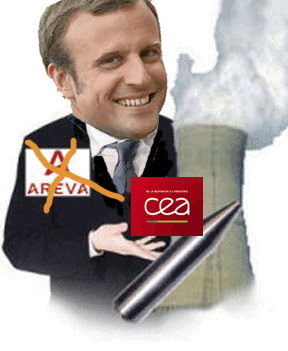
Time for India to cancel Jaitapur nuclear power project, France keen on flogging its ‘messy’ tech to India Business May 2, 2021 By Ranvir Nayar Media India Group France remains desperate to sell its severely troubled EPR nuclear reactors to India, even though its own project at home and at both the sites outside of France have had severe cost and time overruns and continue to face safety issues.
On March 3, 2021, Electricité de France, EDF, the sole operator of nuclear power plants in France, informed the country’s nuclear safety body, Autorité de Sûreté Nucléaire (ASN), of a design anomaly on three nozzles of the main primary system of the European Pressurised Reactor that it has been building at Flamanville in north-west France.
The design flaw is serious as the main primary system contains water used to cool the reactor core and transfer energy from the nuclear reaction to the steam generators. The design dates back to 2006 and the nozzles were manufactured in 2011.
https://mediaindia.eu/business/jaitapur-nuclear-france/
Serious concerns about China’s role in Hinkley Point nuclear power station
Independent 3rd May 2021. Chinese investors have amassed nearly £134bn of assets in key UK industries ranging from energy companies and transport hubs to breweries and schools. Nearly 200 British companies are either controlled by groups or individuals based in China and Hong Kong or count them as minority shareholders, according to an analysis of business data. The list of investments drawn up by the Sunday Times includes Hinkley Point C nuclear power station, Heathrow Airport, Northumbrian Water, pub retailer Greene King and Superdrug.
Serious concerns have been raised about the security implications of China’s investment in UK assets, most notably in relation to Hinkley Point nuclear power station which is owned by French energy firm EDF. In 2016 Theresa May’s government briefly put the project on hold before attaching new conditions to the £18bn deal. Nick Timothy, one of
the Ms May’s chief advisers, had warned that China “could use their role to build weaknesses into computer systems which will allow them to shut down Britain’s energy production at will”. China General Nuclear Power holds a 33.5 per cent stake in the plant, which is owned by the French state-owned energy firm EDF.
Malaysia needs to speak out on releasing nuclear waste into the sea
Malaysia needs to speak out on releasing nuclear waste into the sea https://www.theedgemarkets.com/article/malaysia-needs-speak-out-releasing-nuclear-waste-seaBernama/Bernama
May 02, 2021 KUALA LUMPUR : Malaysia needs to play its role as a member of the United Nations Environment Programme (UNEP) by speaking out on the long-term effect of releasing treated water from nuclear power plants into the ocean.
Co-founder of Project Ocean Hope, Mogesh Sababathy said actions need to be taken to ensure environmental sustainability, especially for marine life, is not threatened.
“Even though the nuclear waste will be diluted in water, its radioactive concentration should also be considered. And even when diluted, toxic is still toxic and it can still affect everyone.
“Hence, Malaysia needs to play its role and speak out on this issue at an international level, as this involves people’s security and health, as well as marine life in the region,” he told Bernama.
The Japanese government has recently approved a plan to release more than one million tonnes of treated water from the ruined Fukushima nuclear plant into the sea.
The plan also has the support of the International Atomic Energy Agency (IAEA), which says the release is comparable to the disposal of waste water from other nuclear plants globally.
Mogesh argued that this method will affect the world’s food chain security. “Nuclear radioactive is capable of affecting marine life and killing organisms, thus threatening the economic source of those who rely on it.
“It’s undeniable that Malaysia is far removed from Fukushima but we still share the same ocean. It is not impossible for the waste to drift to our country,” he said.
He hopes the relevant international bodies will study and develop safer alternative to dispose radioactive nuclear waste without harming the environment.
China’s big stake in UK’s new nuclear projects
Times 2nd May 2021 , How Beijing bought up Britain. China has quietly spent £134bn hoovering up
UK assets, from nuclear power to private schools and pizza chains. Research
reveals that almost 200 British companies are either controlled by Chinese
investors or count them as minority shareholders. The value of Chinese
investments totals £134 billion.
Some of the biggest sums have been spent
in the energy sector, notably nuclear power. Chinese state-owned China
General Nuclear (CGN) bought a 33.5 per cent stake in Hinkley Point C power
station in Somerset, the first new nuclear facility to be built in the UK
in more than 20 years.
The main investor is France’s EDF. CGN, which has
been blacklisted in America for allegedly helping to acquire US tech for
military use in China, has also joined with EDF on the proposed nuclear
plant at Sizewell C in Suffolk. CGN will take a 20 per cent stake during
the plant’s development. Plans for a third plant, at Bradwell in Essex,
have China hawks up in arms, because CGN intends to take a majority 66.5
per cent stake during development and will use its own reactor technology.
https://www.thetimes.co.uk/article/how-beijing-bought-up-britain-hqll9tjtx
Radioactive leakage from nuclear waste containers near Fukushima Daiichi nuclear plant
ECNS 30th April 2021, Tokyo Electric Power Company Holdings Inc. (TEPCO), the operator of the Fukushima Daiichi nuclear plant in Japan’s northeast said last week a container holding radioactive waste at the site of the plant may have leaked, Japan’s Asahi Shimbun reported Friday last week. The TEPCO said some gel-like blocks with large amount of radiation were found last month at the site where the containers were kept, and the situation is under investigation, according to the newspaper. The containers have been stacked in three layers, and the top container has become rusted and corroded, causing liquid accumulation, said the company. The sides of the two lower containers have been contaminated with radioactive materials, and it is believed that the liquid leaking from the top container may have made its way to the ground through the containers below, according to the company. The relevant containers have been moved to an indoor storage facility. The concentration of radioactive materials that emit beta rays in the gel-like blocks was 230,000 becquerels per gram, according to the report. http://www.ecns.cn/m/news/society/2021-04-30/detail-ihakynqm6148318.shtml |
In India’s pandemic nightmare, India and Pakistan need to invest in health, not nuclear weapons.

Oxygen is more important than uranium, DW, 1 May 21, India and Pakistan can afford to buy weapons and test ballistic missiles, but they can’t cope with the COVID crisis. DW’s Shamil Shams says it is time for both to invest in public health and focus less on warmongering.
Dr. Mubarak Ali, a progressive Pakistani historian, recently wrote on social media that the mishandling of the coronavirus pandemic in India and Pakistan proves that “oxygen is more important than uranium.”
Both India and Pakistan are grappling with an acute public health crisis brought on by coronavirus. India lacks oxygen for COVID patients, and Pakistan can’t afford to buy vaccines.
However, both nuclear-armed states continue to devote a large chunk of their national budgets to military spending.
The pandemic situation in India is nightmarish. During the week following April 18, India reported 2.24 million new cases, the highest number recorded by any country in a seven-day period since the pandemic began.
India also logged 16,257 deaths, almost double the 8,588 deaths recorded the previous week, according to Health Ministry data. Since the start of the pandemic last year, India has registered over 17.6 million COVID cases and almost 200,000 related deaths.
This “second wave” is particularly lethal and has exposed the fragility of India’s health infrastructure. Hospitals are overwhelmed with COVID patients, and there aren’t enough places to cremate or bury the dead.
The situation is Pakistan is getting worse by the day. Infections and deaths are surging.
As of Tuesday, April 27, Pakistan has recorded almost 805,000 COVID cases and 17,329 deaths. Experts say the actual numbers are likely much higher.
The vaccine rollout has been quite slow in Pakistan because the government doesn’t have the funding to purchase doses. China and other countries have donated a few million vaccine doses, but it is not enough to vaccinate a country of 220 million people.
Stubborn arrogance
Yet, the ruling classes in India and Pakistan are not ready to reevaluate their public spending policies.
For over 70 years since both countries gained independence from British rule, India and Pakistan have invested more in defense than in the wellbeing of their people.
Their militaries have thrived, even as a large segment of their populations have fallen below the poverty line.
This is what happens when a developing county prioritizes security-based national spending. India and Pakistan have the latest tanks and fighter jets, yet their hospitals lack ICU beds and ventilators………
Misplaced priorities
Even the world’s most developed health care systems have been pushed to the edge by the coronavirus pandemic. And for developing countries, the pandemic has demonstrated the necessity of a functional health care system for prosperity.
Powerful militaries and massive defense budgets cannot fight a virus.
Therefore, India and Pakistan can no longer justify supporting a nuclear arsenal while their populations suffer due to a lack of medicines, oxygen cylinders and hospitals.
The rulers of the two nations must put an end to their warmongering and resolve their disputes politically and diplomatically. The best way to deal with COVID – and potential pandemics in the future – is through regional cooperation.
The way many Pakistanis have offered support to Indians during their health crisis is proof that the two nations can overcome many challenges if they help each other.
The pandemic has demonstrated that if the arch-rival south Asian neighbors don’t move toward reconciliation and peace, their economies are bound to collapse in the long run, and even their mighty armies will not be able to stop it. https://www.dw.com/en/opinion-oxygen-is-more-important-than-uranium/a-57350243?fbclid=IwAR3Cwkkmbw2jocuXnqY6MpWWHOnWzy182c0WUa1XIkWRvAntNSlZS2t4CVY
South Korean fishermen protest against the dumping of Fukushima wastewater into the Pacific Ocean
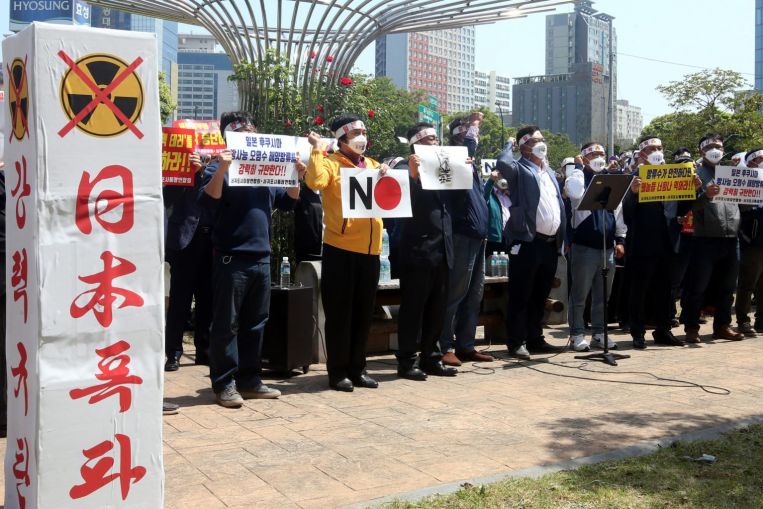
S.Korean fishermen hold boat protests against Japan nuclear plans, Reuters 30 Apr 21, Hundreds of South Korean fishermen across the country held protests on Friday calling on Japan to reverse its decision to release contaminated water from its crippled Fukushima nuclear plant into the sea.
About 800 fishermen participated in rallies at ports in nine cities, according to South Korea’s National Federation of Fisheries Cooperatives.
At one port, at Gungpyeong on the west coast, fishermen held anti-Japan banners and chanted slogans such as “Withdraw Japan’s decision” and “Condemn irresponsible nuclear attack”. Twenty fishing boats with banners denouncing Japan’s decision sailed near the port.
“My father bequeathed this sea to me and I’m going to pass it on to my son, who is also fishing,” said Park Re-seung, chief of Yongdu-ri fishing village, who has worked in the fishing industry for 38 years. “Why is Japan doing this? How could they do such a bad thing against the sea? Don’t they eat fish?”…….
“For us, this issue is about making our living,” Park added. “If the customers continue to see the news of the water release, they wouldn’t be even buying fishes that we caught here.” https://www.reuters.com/business/environment/skorean-fishermen-hold-boat-protests-against-japan-nuclear-plans-2021-04-30/
Even with water release to the Pacific, Fukushima nuclear plant needs more storage tanks
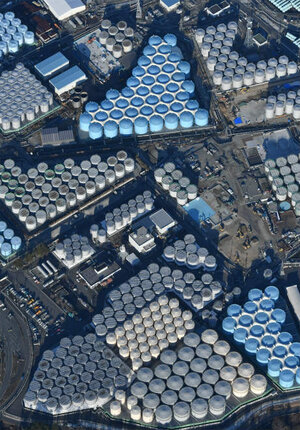
Even with water release, nuclear plant needs more storage tanks, Asahi Shimbun, By KEITARO FUKUCHI/ Staff Writer, May 1, 2021 The plan to release treated radioactive water from the crippled Fukushima No. 1 nuclear plant into the sea will likely not resolve the chronic problem of contaminated water accumulating there, Asahi Shimbun calculations show.
The maximum rate of water discharge allowed under the government’s basic plan would be less than the inflow of rainwater and groundwater at the nuclear power plant, meaning that additional water storage tanks would inevitably be needed at the site.
The government on April 13 approved the basic plan to release more than 1 million tons of treated water into the sea. The government and plant operator Tokyo Electric Power Co. hope to start discharging the water two years from now. Existing storage tanks at the site are expected to reach full capacity around the same time.
The Asahi Shimbun studied this plan based on documents and materials published by the government and TEPCO……… http://www.asahi.com/ajw/articles/14332645
Governor of Fukui Prefecture to approve restart of aging nuclear reactors, but local community is opposed.
Governor to approve restart of 40-plus-year-old nuclear reactors in Japan first
April 28, 2021 (Mainichi Japan) FUKUI — The governor of central Japan’s Fukui Prefecture announced on April 28 his intention to approve the reactivation of 40-plus-year-old nuclear reactors following an online meeting with the economy minister. If the move goes ahead, it would be the first time in Japan for such aging reactors to be restarted.
Fukui Gov. Tatsuji Sugimoto spoke with Economy, Trade and Industry Minister Hiroshi Kajiyama online on April 27 and confirmed the central government’s nuclear power policy, including plans to reboot the No. 3 reactor at Kansai Electric Power Co.’s Mihama Nuclear Power Station in the prefectural town of Mihama and the No. 1 and 2 reactors at the Takahama station in the prefectural town of Takahama — both of which are over 40 years old since they were put online.
Following the March 2011 disaster at the Fukushima Daiichi Nuclear Power Station, Japan decided to set the operating period of a nuclear rector at 40 years as a general rule. That period can be extended for up to 20 years as a one-time only exception if the Nuclear Regulation Authority approves…….
As a rule, consensus from host municipalities and prefectures is needed to restart a reactor. The Mihama and Takahama municipal governments, as well as their respective town assemblies have already agreed to restart the aging reactors. The Fukui prefectural nuclear safety commission tasked with checking the safety of nuclear plants has compiled a report on the assessment of Kansai Electric’s safety measures and submitted it to Gov. Sugimoto on April 22………..
The prefectural government had indicated that, as a condition for approving the restart of aging reactors, Kansai Electric present candidate locations outside Fukui Prefecture for interim storage sites for spent nuclear fuel. In February this year, Gov. Sugimoto expressed his appreciation over the utility’s proposal to secure a location “by the end of 2023,” including the shared use of a storage site in the Aomori Prefecture city of Mutsu in northern Japan.
The governor then practically shelved resolving the issue of interim storage sites and requested that the prefectural assembly debate the potential restart of the aging reactors. The central government had presented additional aid programs on April 6, including the provision of up to 2.5 billion yen (about $23 million) per nuclear station which is older than 40 years — in the cases of Mihama and Takahama stations, the subsidy will total 5 billion yen (roughly $46 million). With this, Fukui Prefecture entered the final stage of building local consensus for rebooting the idled reactors.
Meanwhile, local residents have voiced concerns over the safety of long-running reactors and evacuation routes in the event of an accident, among other issues……..
Kansai Electric will begin full-fledged preparations as soon as local consensus is built. However, as the construction of a specialized anti-terrorism facility, which became mandatory to reboot reactors under the new safety regulations, has been delayed, the timing of actually restarting the reactors remains undecided.
The Japan Atomic Power Co.’s Tokai No. 2 Power Station in the Ibaraki Prefecture village of Tokai in east Japan, which is also more than 40 years old, has been given the green light by the national government for an extension, but the utility has not been able to get consensus from the local community.
(Japanese original by Riki Iwama, Fukui Bureau) https://mainichi.jp/english/articles/20210428/p2a/00m/0na/022000c
Thyroid cancer increased 20-fold in Fukushima children

IPPNW 26th April 2021, Dr Alex Rosen: Thyroid cancer increased 20-fold in Fukushima children. In 2011, people in Japan were exposed to radioactive fallout in many places. Some still live in irradiated regions where they are confronted with increased amounts of radiation every day: radioactive hot spots on the roadside, in rice fields or in sandboxes, contaminated fungi or algae, irradiated groundwater and recontamination from forest fires or floods.
One of the most dreaded long-term effects of radioactive exposure is the development of cancers through mutation of the DNA. Thyroid cancer in children is certainly not the most dangerous, but it is the easiest to detect form of radiation-related cancer. On the one hand, the latency periods until the development of a cancerous ulcer are relatively short,only a few years; on the other hand, thyroid cancer in children is anextremely rare disease, so that even a slight increase can be statistically significant. In 2011, the pressure on the Japanese authorities to investigate the development of thyroid cancer in children and adolescents in Fukushima was correspondingly great.
https://www.ippnw.de/atomenergie/gesundheit/artikel/de/schilddruesenkrebs-bei-fukushima-kind.html
1 This Month



26 September – International Day for the Total Elimination of Nuclear Weapons


PLEASE OPPOSE HR 8255 AND S.3639 – bills would accelerate satellite deployment, with no environmental review or safeguards – https://ncstd5li.quorum.us/campaign/169331/
To see nuclear-related stories in greater depth and intensity – go to https://nuclearinformation.wordpress.com
-
Archives
- September 2026 (257)
- August 2026 (330)
- July 2026 (355)
- June 2026 (287)
- May 2026 (306)
- April 2026 (356)
- March 2026 (251)
- February 2026 (267)
- January 2026 (308)
- December 2025 (358)
- November 2025 (359)
- October 2025 (375)
-
Categories
- 1
- 1 NUCLEAR ISSUES
- business and costs
- climate change
- culture and arts
- ENERGY
- environment
- health
- history
- indigenous issues
- Legal
- marketing of nuclear
- media
- opposition to nuclear
- PERSONAL STORIES
- politics
- politics international
- Religion and ethics
- safety
- secrets,lies and civil liberties
- spinbuster
- technology
- Uranium
- wastes
- weapons and war
- Women
- 2 WORLD
- ACTION
- AFRICA
- Atrocities
- AUSTRALIA
- Christina's notes
- Christina's themes
- culture and arts
- Events
- Fuk 2022
- Fuk 2023
- Fukushima 2017
- Fukushima 2018
- fukushima 2019
- Fukushima 2020
- Fukushima 2021
- general
- global warming
- Humour (God we need it)
- Nuclear
- RARE EARTHS
- Reference
- resources – print
- Resources -audiovicual
- Weekly Newsletter
- World
- World Nuclear
- YouTube
-
RSS
Entries RSS
Comments RSS
 nuclear-news