Even with water release to the Pacific, Fukushima nuclear plant needs more storage tanks
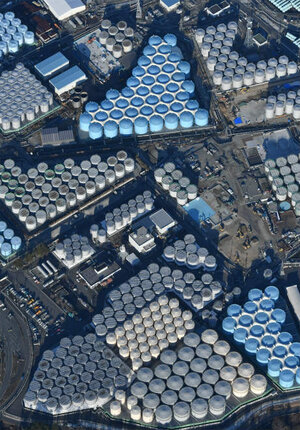
Even with water release, nuclear plant needs more storage tanks, Asahi Shimbun, By KEITARO FUKUCHI/ Staff Writer, May 1, 2021 The plan to release treated radioactive water from the crippled Fukushima No. 1 nuclear plant into the sea will likely not resolve the chronic problem of contaminated water accumulating there, Asahi Shimbun calculations show.
The maximum rate of water discharge allowed under the government’s basic plan would be less than the inflow of rainwater and groundwater at the nuclear power plant, meaning that additional water storage tanks would inevitably be needed at the site.
The government on April 13 approved the basic plan to release more than 1 million tons of treated water into the sea. The government and plant operator Tokyo Electric Power Co. hope to start discharging the water two years from now. Existing storage tanks at the site are expected to reach full capacity around the same time.
The Asahi Shimbun studied this plan based on documents and materials published by the government and TEPCO……… http://www.asahi.com/ajw/articles/14332645
Governor of Fukui Prefecture to approve restart of aging nuclear reactors, but local community is opposed.
Governor to approve restart of 40-plus-year-old nuclear reactors in Japan first
April 28, 2021 (Mainichi Japan) FUKUI — The governor of central Japan’s Fukui Prefecture announced on April 28 his intention to approve the reactivation of 40-plus-year-old nuclear reactors following an online meeting with the economy minister. If the move goes ahead, it would be the first time in Japan for such aging reactors to be restarted.
Fukui Gov. Tatsuji Sugimoto spoke with Economy, Trade and Industry Minister Hiroshi Kajiyama online on April 27 and confirmed the central government’s nuclear power policy, including plans to reboot the No. 3 reactor at Kansai Electric Power Co.’s Mihama Nuclear Power Station in the prefectural town of Mihama and the No. 1 and 2 reactors at the Takahama station in the prefectural town of Takahama — both of which are over 40 years old since they were put online.
Following the March 2011 disaster at the Fukushima Daiichi Nuclear Power Station, Japan decided to set the operating period of a nuclear rector at 40 years as a general rule. That period can be extended for up to 20 years as a one-time only exception if the Nuclear Regulation Authority approves…….
As a rule, consensus from host municipalities and prefectures is needed to restart a reactor. The Mihama and Takahama municipal governments, as well as their respective town assemblies have already agreed to restart the aging reactors. The Fukui prefectural nuclear safety commission tasked with checking the safety of nuclear plants has compiled a report on the assessment of Kansai Electric’s safety measures and submitted it to Gov. Sugimoto on April 22………..
The prefectural government had indicated that, as a condition for approving the restart of aging reactors, Kansai Electric present candidate locations outside Fukui Prefecture for interim storage sites for spent nuclear fuel. In February this year, Gov. Sugimoto expressed his appreciation over the utility’s proposal to secure a location “by the end of 2023,” including the shared use of a storage site in the Aomori Prefecture city of Mutsu in northern Japan.
The governor then practically shelved resolving the issue of interim storage sites and requested that the prefectural assembly debate the potential restart of the aging reactors. The central government had presented additional aid programs on April 6, including the provision of up to 2.5 billion yen (about $23 million) per nuclear station which is older than 40 years — in the cases of Mihama and Takahama stations, the subsidy will total 5 billion yen (roughly $46 million). With this, Fukui Prefecture entered the final stage of building local consensus for rebooting the idled reactors.
Meanwhile, local residents have voiced concerns over the safety of long-running reactors and evacuation routes in the event of an accident, among other issues……..
Kansai Electric will begin full-fledged preparations as soon as local consensus is built. However, as the construction of a specialized anti-terrorism facility, which became mandatory to reboot reactors under the new safety regulations, has been delayed, the timing of actually restarting the reactors remains undecided.
The Japan Atomic Power Co.’s Tokai No. 2 Power Station in the Ibaraki Prefecture village of Tokai in east Japan, which is also more than 40 years old, has been given the green light by the national government for an extension, but the utility has not been able to get consensus from the local community.
(Japanese original by Riki Iwama, Fukui Bureau) https://mainichi.jp/english/articles/20210428/p2a/00m/0na/022000c
Thyroid cancer increased 20-fold in Fukushima children

IPPNW 26th April 2021, Dr Alex Rosen: Thyroid cancer increased 20-fold in Fukushima children. In 2011, people in Japan were exposed to radioactive fallout in many places. Some still live in irradiated regions where they are confronted with increased amounts of radiation every day: radioactive hot spots on the roadside, in rice fields or in sandboxes, contaminated fungi or algae, irradiated groundwater and recontamination from forest fires or floods.
One of the most dreaded long-term effects of radioactive exposure is the development of cancers through mutation of the DNA. Thyroid cancer in children is certainly not the most dangerous, but it is the easiest to detect form of radiation-related cancer. On the one hand, the latency periods until the development of a cancerous ulcer are relatively short,only a few years; on the other hand, thyroid cancer in children is anextremely rare disease, so that even a slight increase can be statistically significant. In 2011, the pressure on the Japanese authorities to investigate the development of thyroid cancer in children and adolescents in Fukushima was correspondingly great.
https://www.ippnw.de/atomenergie/gesundheit/artikel/de/schilddruesenkrebs-bei-fukushima-kind.html
France’s EDF imposes conditions on India, re massive nuclear station planned for Jaitapur. EDF will be “Neither investor in the project nor responsible for construction”.
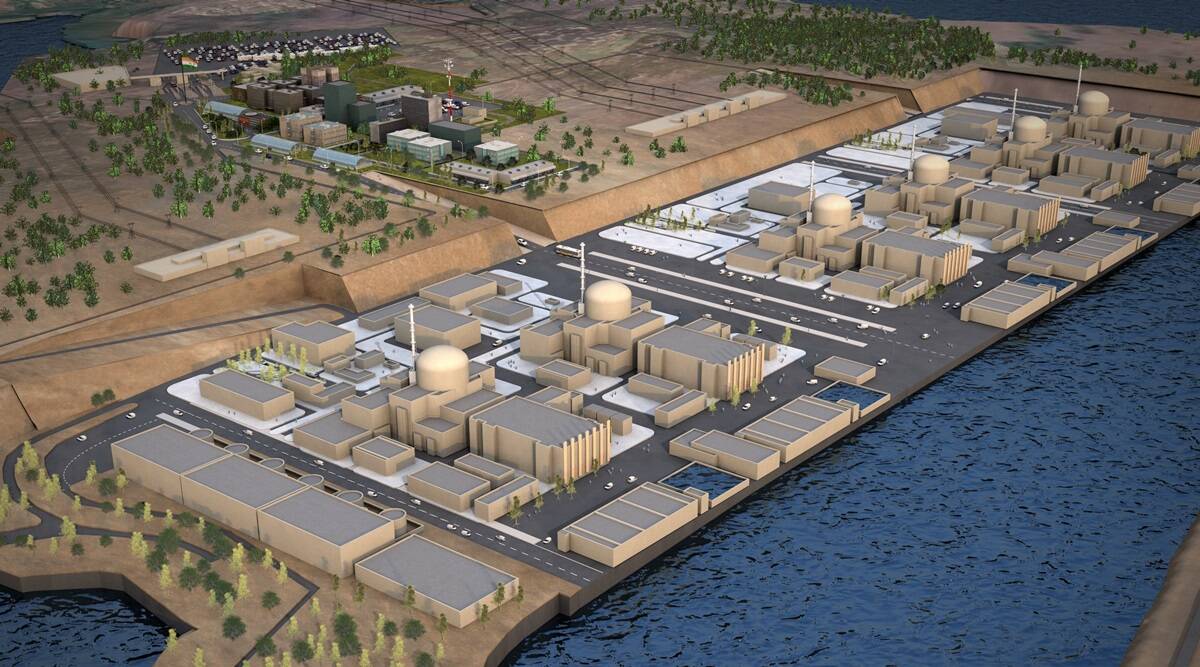
World Nuclear News 23rd April 2021, French company EDF has submitted to Nuclear Power Corporation of India Ltd (NPCIL) its binding techno-commercial offer to build six EPRs at Jaitapur in Maharashtra. The offer is the culmination of work that began with the 2018signature of an agreement between the two companies and paves the way for discussions towards a binding framework agreement.
https://world-nuclear-news.org/Articles/EDF-submits-offer-for-Jaitapur-project
Le Monde 23rd Aprilo 2021, It is believed to be the largest civilian atomic infrastructure in the world, with an installed capacity of 9,600 megawatts. This offer should initially have been submitted at the end of 2018 to the Nuclear Power Corporation of India Limited (NPCIL) group, the future operator of the plant.
But the approach of India’s spring 2019 general elections had made it untimely in the eyes of nationalist Prime Minister Narendra Modi, who is a candidate for his return to power. If the drafting of the document, more than 7,000 pages, finally took much longer than expected, it is also because of the sensitivity of its central subject: the distribution of responsibilities between the French corporation and the public operator. Indian.
In this case, EDF intends to impose its conditions. While the company chaired by Jean-Bernard Lévy originally said that it would build the entire Jaitapur plant, it now proposes to provide only “engineering studies and equipment”,
without being “Neither investor in the project nor responsible for construction”.
Not necessary to increase USA’s nuclear arsenal – China’s goal is defence – a stronger-second strike arsenal.
We Don’t Need a Better Nuclear Arsenal to Take on China
The military’s arguments for a nuclear overhaul are unconvincing. Slate, BY FRED KAPLAN, APRIL 23, 2021
This week, top military officers launched their big push on Capitol Hill for a total overhaul of the U.S. nuclear arsenal, at an estimated cost of $1.3 trillion over the next 30 years, and their top rationale—the go-to rationale for just about every large federal program these days—was the threat from China.
Their case was less than compelling
Yes, China is displaying some bellicose behavior these days, economically, politically, and militarily. But a new generation of U.S. intercontinental ballistic missiles, bombers, cruise missiles, and submarines would do nothing to deal with the problem.
Adm. Charles Richard, the head of U.S. Strategic Command, which runs plans and operations for the nuclear arsenal, laid out his case in hearings before House and subcommittees on strategic forces. He noted that China is expanding its nuclear arsenal at an “unprecedented” pace, on course to double in size by the end of the decade. It’s building more solid-fuel missiles, which can be launched right away (older liquid-fuel missiles require hours to load). It’s also building better early-warning radar, putting some of its ICBMs on trucks and moving them around. It might have adopted a launch-on-warning policy.
But all of this adds up to something less alarming than Richard’s rhetoric suggested—namely that the People’s Liberation Army is improving its ability to detect, and respond to, a nuclear attack on the Chinese homeland. Even if the Chinese doubled the size of their arsenal, which would give them about 600 nuclear weapons instead of the current 300, it would be well under half the size of the U.S. arsenal, so they would have no ability to launch a first strike against us.
In other words, China seems to be building a more potent second-strike arsenal—what we in the West would call a deterrent—perhaps in the face of Russia’s build-up of medium-range missiles and America’s development of a missile-defense force. This is troubling only to the extent it means that the United States would have a hard time launching a nuclear first-strike against China.
This is a bit troubling, but for reasons that seem less so, the more deeply the problem is analyzed. China’s military strategy is to establish hegemony in the region—especially in the Taiwan Straits and the South China Sea—and to prevent U.S. air and naval forces from intervening in this area. Beijing has made progress toward this goal by declaring some small islands, which are clearly in international waters, to be Chinese territory and converting them into military bases. It has also built and deployed hundreds of missiles that can attack ships, even large ones, with steadily improving accuracy and steadily longer range. China has also improved its ability to hit satellites and sensors in outer space (through cyber and more conventional means). Again, the goal is to keep the U.S. from intervening in Chinese military ventures. The American trump card in any such conflict has long been its nuclear arsenal (whether any president actually would use nukes to protect, say, Taiwan is another matter), but if China has its own potent nuclear deterrent, this card’s value is reduced: if we attack them, they can attack us……..
But all of this adds up to something less alarming than Richard’s rhetoric suggested—namely that the People’s Liberation Army is improving its ability to detect, and respond to, a nuclear attack on the Chinese homeland. Even if the Chinese doubled the size of their arsenal, which would give them about 600 nuclear weapons instead of the current 300, it would be well under half the size of the U.S. arsenal, so they would have no ability to launch a first strike against us.
n other words, China seems to be building a more potent second-strike arsenal—what we in the West would call a deterrent—perhaps in the face of Russia’s build-up of medium-range missiles and America’s development of a missile-defense force. This is troubling only to the extent it means that the United States would have a hard time launching a nuclear first-strike against China.
This is a bit troubling, but for reasons that seem less so, the more deeply the problem is analyzed. China’s military strategy is to establish hegemony in the region—especially in the Taiwan Straits and the South China Sea—and to prevent U.S. air and naval forces from intervening in this area. Beijing has made progress toward this goal by declaring some small islands, which are clearly in international waters, to be Chinese territory and converting them into military bases. It has also built and deployed hundreds of missiles that can attack ships, even large ones, with steadily improving accuracy and steadily longer range. China has also improved its ability to hit satellites and sensors in outer space (through cyber and more conventional means). Again, the goal is to keep the U.S. from intervening in Chinese military ventures. The American trump card in any such conflict has long been its nuclear arsenal (whether any president actually would use nukes to protect, say, Taiwan is another matter), but if China has its own potent nuclear deterrent, this card’s value is reduced: if we attack them, they can attack us.
……. the main point is this: We would gain no leverage in this scenario by building new ICBMs, bombers, cruise missiles, or submarines. To the extent these sorts of weapons loom as the ultimate deterrent, as a sort of overlord to any military competition, we already have plenty.
………. There will be fierce resistance to any slowdown of the strategic juggernaut. Most members of the congressional armed services committees regard the Nuclear Triad with the same veneration that Catholics bestow to the Holy Trinity. When they ask a witness if he believes in the Triad, they do so with a quivering tone, as if they were priests asking a supplicant if he believes in God.
At the same time, budget pressures are rousing some lawmakers to mull, a bit more deeply than before, whether so many nukes are necessary, whether they all have to be 100 percent reliable to deter adversaries from aggression, whether the recondite scenarios and theories of the nuclear game are quite real. It’s long past time to demystify the nuclear enterprise, to strip away the fear and trembling, and ask how many weapons are needed to do what. https://slate.com/news-and-politics/2021/04/nuclear-triad-overhaul-china.html
Fukushima waste water plan won’t win public confidence, no matter how hard Japan tries
Fukushima waste water plan won’t win public confidence, no matter how hard Japan tries, Peter Wynn Kirby https://www.scmp.com/comment/opinion/article/3130239/fukushima-waste-water-plan-wont-win-public-confidence-no-matter-how
- The nuclear industry’s history of secrecy and cover-ups is only one reason
- Tepco’s incompetent and at times dishonest handling so far of the 2011 disaster and its aftermath has shattered what’s left of people’s trust.
To exasperated observers, this recalled the nuclear industry’s notorious 1990s mobilisation of Pluto-kun, a puckish cartoon character who drinks plutonium – arguably the world’s most dangerous substance – to demonstrate its harmlessness.

While other nations in the region have registered vociferous opposition to the water release plan, the domestic resistance is telling. A majority of Japanese oppose the plan. For a decade, the fishing industry has laboured, successfully, to show that the seafood it brings to market is safe, giving a wide berth to the plume of radioactive effluent haemorrhaging out of the Fukushima nuclear plant. All these efforts may soon appear to have been made in vain.
As indicated above, the choice of last Tuesday for the announcement seems to have been dictated by politics alone. Did Japan see the Olympics as a feel-good spectacle that could provide cover for the decision? Did US President Joe Biden’s recent pressure on Japan and South Korea to work together on regional security make the timing more palatable?
Whatever the calculus involved, one thing is for sure: the more Japan tries to make Fukushima Daiichi seem perfectly safe, the more people distrust the message – and the messenger.
As the Japanese proverb goes, “Let the past drift away like water.” Yet with radiation, letting go is not so simple. Even as the Japanese government tries to rid itself of the catastrophic after-effects of the Fukushima nuclear crisis, radioactive traces stubbornly remain.
Japan announced last week its intention to release about 1.25 million tonnes of waste water collected from the bowels of the crippled Fukushima Daiichi nuclear power station. The water to be released into the Pacific Ocean contains tritium, a radioactive hydrogen isotope with a half-life of over 12 years. The unwelcome news has provoked uproar both within Japan and among neighbouring countries.
For over a decade, authorities have been engaged in a messy, difficult, frustrating, even Sisyphean task, flushing the ruined footprint of the power station with water to keep the slumped nuclear fuel there from triggering a chain reaction.The meltdowns left parlous uranium fuel in desultory clumps amid the wreckage below. The only way to cool the escaped uranium is to flood the most dangerous areas of the Fukushima Daiichi complex with circulating seawater. Radioactive groundwater and waste water have been stored on-site to avoid contact with humans and the environment.
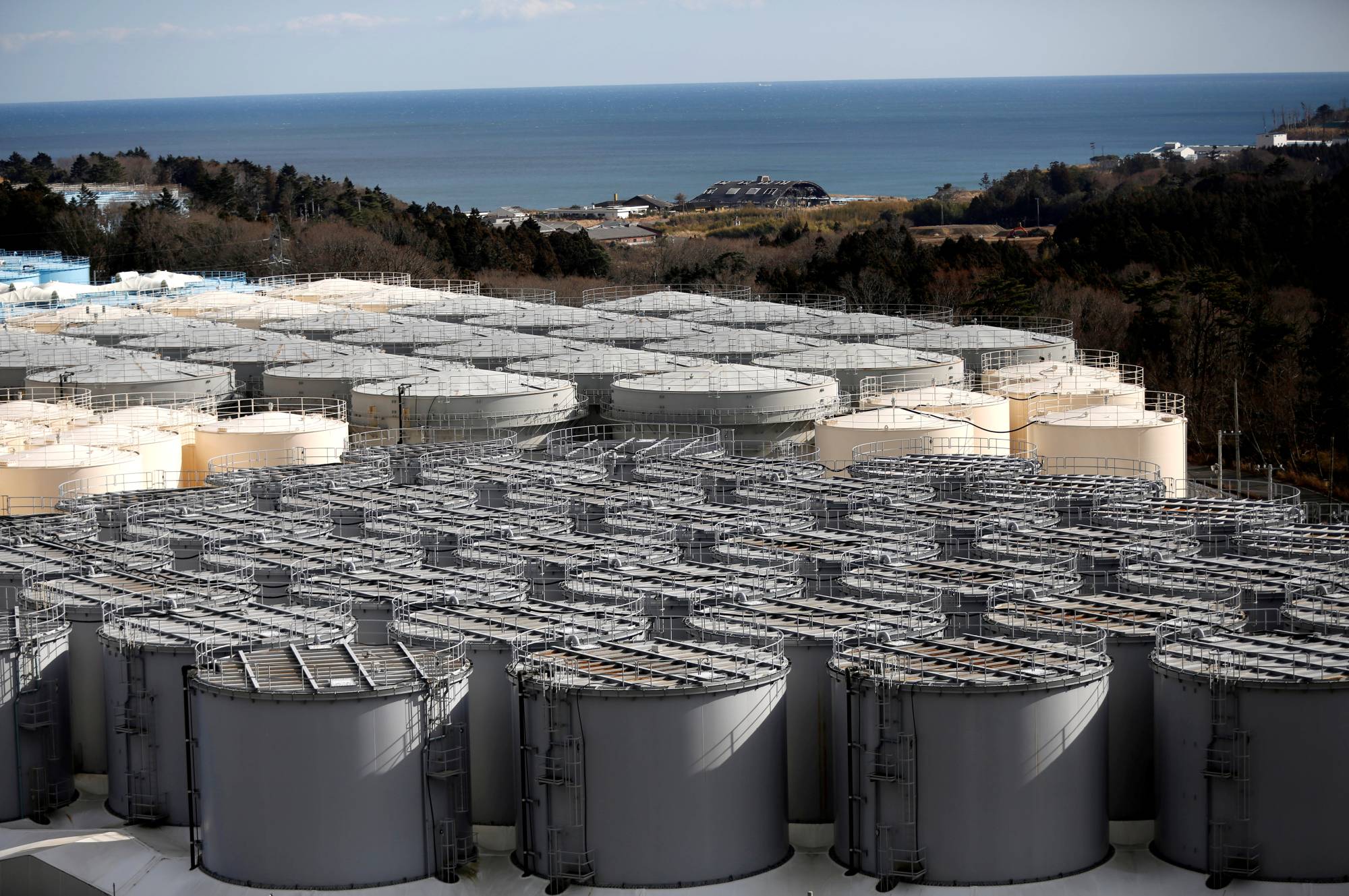
Ever since, huge water tanks filled with contaminated water have been springing up around the Fukushima Daiichi site like poisonous mushrooms. Now, there are over 1,000 of them. Most rival the size of small Japanese apartment buildings.
You didn’t have to be a genius to realise that the situation at Fukushima Daiichi was unsustainable. Any child who could do basic maths, or maybe a bit of Minecraft, would have been able to see that, day by day, month by month, the water would increase and the 350-hectare site would have less and less available space.Whatever else you might say about Japanese bureaucrats with regard to nuclear policy, they have very good maths skills. As a result, we can surmise that Prime Minister Yoshihide Suga’s announcement last week was, at root, a question of politics and calculated timing
Not that Japan didn’t attempt to resolve the situation otherwise. Authorities tried a range of strategies, including plugging leaks and creating a gigantic US$300 million ice wall around the site, underground, to stem water flow.
In the end, filtering the waste water was the only workable solution. But Japan had mixed results with this strategy. In June 2011, the first filtration system set up by reviled Tepco – Tokyo Electric Power Co, the company that owned the nuclear power station – broke down after only a few hours. The amount of radioactive Caesium in the water overwhelmed the filters.
More recently, before a parliamentary commission, Tepco was forced to admit that it had falsely claimed to have treated most of the waste water from the plant. In actual fact, Tepco had properly dealt with only about one-fifth of the waste water.
Astonishingly, this disappointing result stemmed from it not having bothered to change the filters often enough. Even such basic elements of quality control seem to be beyond the capabilities of the Tepco team, which already lives in infamy after having presided over the world’s second most damaging civil nuclear disaster, after Chernobyl.
Predictably, scientists, officials and industry stakeholders argue that this degree of tritium discharge happens all the time in the nuclear industry – this is more or less true, however perturbing – and suggest that the announced controlled release should therefore present no problem whatsoever.
But the history of the nuclear industry globally is one of military synergies, secrecy, cover-ups, Machiavellian information management, and propaganda-style communication with the public. Indeed, it was striking that on the very same day as Suga’s announcement, Japan’s reconstruction agency released a video depicting tritium in the form of Tritium-kun, a harmless-seeming fishlike creature with blushing cheeks who says tritium release is safe.
Legal and other problems for Japan, with growing opposition to its plan for dumping Fukushima waste-water in the ocean
Toxic reaction to Japan’s
Fukushima water dump, https://www.lowyinstitute.org/the-interpreter/toxic-reaction-japan-s-fukushima-water-dump ARISTYO RIZKA DARMAWAN, 21 Apr 21,
Experts insist the release of treated radioactive water is not dangerous.
Legal challenges might find otherwise.
The Netflix documentary “Seaspiracy” caused a stir following its release last month, both for highlighting the serious damage human activities are causing the world’s oceans – whether from marine debris or whale hunting – and also for claims that the program features misleading statements and statistics.
But the controversy pales against the announcement last week by the Japanese government that it plans in two years to release treated radioactive water into the Pacific Ocean.
The contaminated water has been held in tanks since an earthquake and subsequent tsunami damaged the Fukushima nuclear reactor in 2011. With storage capacity predicted to run out late next year, Japan has decided to press ahead with long-speculated plans to dump treated wastewater into the sea.
Even though the Japanese government, International Atomic Energy Agency and some experts have argued that the release of the water is not dangerous and will do no harm to the ocean, there are good reasons to be concerned about the potential for environmental damage. Local Japanese, South Korean and Taiwanese fishing industries have protested the move, as have communities in the Pacific Islands. China has been scathing, with one recent op-ed in the state-run China Daily declaring “Japan cannot use the Pacific as its sewer”. The United States has been more understanding in its comments, with Secretary of State Antony Blinken praising Japan for “transparent efforts” in its decision.
But Japan may also be challenged under international law, and South Korea has already threatened legal action under international dispute settlement mechanisms.
There are at least two international treaties that regulate or ban the dumping of waste at sea: the United Nations Convention on the law of the Sea (UNCLOS) and the 1996 Protocol to the Convention on the Prevention of Marine Pollution by Dumping of Wastes and Other Matter, 1972, generally referred to as the London Convention and Protocol.
UNCLOS stipulates that all parties shall cooperate in protecting the marine environment and under Article 210 explicitly requires “laws, regulations and measures shall ensure that pollution by dumping is not carried out without the permission of the competent authorities of States”.
That terminology will be debated, whether it be over the notion of “competent authorities” or indeed whether Japan’s plan amounts to “dumping”. UNCLOS defines the terminology of dumping as “any deliberate disposal at sea of wastes or other matter from vessels, aircraft, platforms or other man-made structures at sea”. Given that the proposal is to release water held on land, this may not be covered by the convention.
It may even be argued that dumping at sea is allowable under Article 8 of the London Convention and Protocol. The article stipulates that dumping is allowed during an emergency, with the provision that a party “shall consult any other country or countries that are likely to be affected”. That may explain the “transparency” of Japan providing two years notice of its intended action. Yet in this case, it is questionable whether running out of storage capacity can be considered an emergency, given the article also stipulates such action is permissible only “in emergencies posing an unacceptable threat to human health, safety, or the marine environment and admitting of no other feasible solution”.
Regardless of how such disputes play out, however, it is also notable that neither UNCLOS nor the London Convention and Protocol have strong sanction mechanisms. Enforcement relies on either coastal states or flag states.
Neighbouring countries have reacted strongly, as have international environmental NGOs, including Greenpeace. Boycotts and bans on Japanese fisheries products have already been mooted. Unless another solution is found, Japan’s plan will continue to face a mounting tide of opposition.
Decision on Fukushima waste water should be in consultation with international agencies, not just a decision by Japan alone.
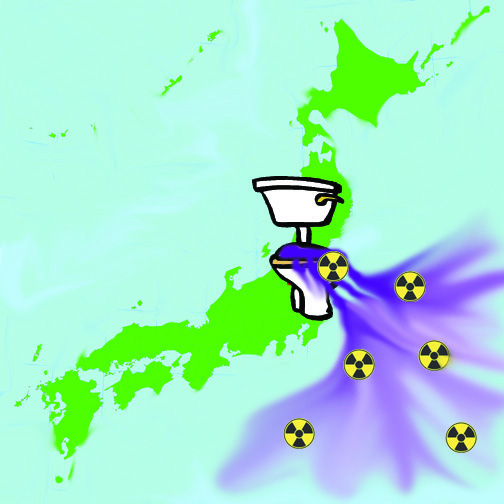
Disposal of Fukushima nuclear wastewater should be assessed under framework of intl agencies, not let world pay: FM, By Global Times, 21 Apr 21, China’s Foreign Ministry said on Wednesday the disposal of Fukushima nuclear wastewater should be assessed and discussed under the framework of international agencies including the UN, the WHO, and the IAEA, urging the Japanese government to correct its irresponsible decision to dump of the wastewater to the ocean and avoid involving people all around the world in paying for its wrongdoings.
The remarks came after South Korean Foreign Minister Chung Eui-yong expressed opposition to the move, and said on Tuesday that Seoul will work closely with international agencies to deal with Japan.
At a routine press conference, China’s Foreign Ministry spokesperson Wang Wenbin stressed that before dumping nuclear-contaminated water, there should be a discussion with neighboring countries and an evaluation within the framework of international agencies including the United Nations, the World Health Organization, and the International Atomic Energy Agency.
Wang added that Japan’s decision to dump the nuclear-contaminated water is not only opaque, unscientific, unlawful, irresponsible and unethical, but also at risk of being condemned by the world.
“A ban has been placed on black scorpionfish caught off Fukushima waters from entering markets due to the detection of excessive radioactive materials. And this is the second time that fish have been found with excessive radioactive materials in Fukushima waters since February,” said Wang.
All of these signs point to the fact that disposal of radionuclides is complicated and difficult, noted Wang, adding that the Fukushima nuclear power plant accident has been bringing harm to its surroundings for the past decade since it happened. ……..
Wang said that the methods of the wastewater disposal concern the safety of the Asia-Pacific region, the global ecological environment, and the lives and the health of people in all countries. The data should be evaluated and consultations held with all parties whose interests are bound to it.
“We noticed that Japan’s Tokyo Electric Power Company intends to submit a progress plan for wastewater disposal in May. We express strong opposition and serious concern to the matter as Japan unilaterally pushes forward the plan without consultation with the international community especially neighboring countries,” Wang said.
“Please don’t let people all over the world pay for Japan’s wrongdoings,” he added. https://www.globaltimes.cn/page/202104/1221712.shtml
Japan’s government bans shipments of black rockfish from Fukushima, due to highlevels of radioactive cesium
Fish radioactive report prompts Fukushima ban, http://global.chinadaily.com.cn/a/202104/21/WS607f7f4ea31024ad0bab93e5.html
By WANG XU in Tokyo China Daily 2021-04-21 The Japanese government banned shipments of black rockfish from Fukushima on Monday, after a radioactive substance was found to be more than five times higher than acceptable levels in the fish caught off the prefecture.
The Fukushima prefectural government said 270 becquerels of radioactive cesium were detected per kilogram of the black rockfish, which had been caught at a depth of 37 meters near the city of Minamisoma, Fukushima, on April 1.
The amount of radioactive cesium is five times more than the limit set by a local fisheries cooperative of 50 becquerels per kg. It is also sharply higher than Japan’snational standard in general foods of 100 becquerels per kg.
In response, Japan’s national nuclear emergency response headquarters on Monday ordered a ban on the shipment of the fish caught off the waters of Fukushima.
Early in February, radioactive cesium 10 times above permitted levels in Japan were detected in the same area.
Scientific research showed the amount of cesium in foods and drinks depends upon the emission of radioactive cesium through the nuclear power plant, mainly through accidents. High levels of radioactive cesium in or near one’s body can cause nausea, vomiting, diarrhea, bleeding, coma, and even death.
Monday’s restrictions came a week after Japan’s government decided to release radioactive water from the crippled Fukushima Daiichi nuclear plant into the sea despite fierce opposition from fishing crews at home and concern from the international community.
“The (Japanese) government’s decision is outrageous,” said Takeshi Komatsu, an oyster farmer in Miyagi prefecture, north of Tokyo. “I feel more helpless than angry when I think that all the efforts I’ve made to rebuild my life over the past decade have come to nothing.”
South Korea strongly criticized the decision to release the contaminated water, with its Foreign Ministry summoning the Japanese ambassador. President Moon Jae-in ordered officials to explore petitioning an international court over the issue.
S.Korean students shave heads in protest over Japan’s nuclear waste water plan
S.Korean students shave heads in protest over Japan’s nuclear waste water plan, Reuters, Hyun Yi 21 Apr 21, More than 30 South Korean college students shaved their heads in front of the Japanese embassy in Seoul on Tuesday to protest Japan’s decision to release water from its crippled Fukushima nuclear plant into the sea.
Police periodically dispersed crowds, who chanted and held placards, but did not stop the event from taking place, though there is an anti-pandemic ban on gatherings larger than 10 people.
The protesters who were shaved were draped in protective sheets emblazoned with messages condemning the Japanese plan and calling for it to be ditched.
One read: “The Japanese government should immediately cancel the plan to release the contaminated water.”…….. https://www.reuters.com/business/environment/skorean-students-shave-heads-protest-over-japans-nuclear-waste-water-plan-2021-04-20/
Sri Lanka expels ship carrying nuclear material for China
Sri Lanka expels ship carrying nuclear material for China, Channel News Asia, 22 Apr 21, COLOMBO: Sri Lankan authorities on Wednesday (Apr 21) expelled an Antigua-registered ship that entered the island’s territory without declaring a radioactive cargo bound for China.
The country’s Atomic Energy Regulatory Council said the MV BBC Naples was asked to leave after it was found to be in the Chinese-run port of Hambantota on Tuesday night carrying uranium hexafluoride.
“The ship failed to declare its dangerous cargo – uranium hexafluoride – and we decided to order it to leave our waters immediately,” council director general Anil Ranjith told AFP.
The ship had come from Rotterdam but authorities did not say where in China it was headed.
Ranjith said it was an offence to enter a port without declaring the material, which is used to enrich uranium, the fuel for nuclear power stations and weapons.
Sri Lanka’s opposition leader Sajith Premadasa demanded an investigation into the incident, describing it as a serious safety threat……
The entry of two Chinese submarines into Colombo in 2014 angered neighbouring India, the traditional regional power which is competing with Beijing for influence in the Indian Ocean.
Since then, Sri Lanka has not allowed Chinese submarine visits. https://www.channelnewsasia.com/news/asia/sri-lanka-expels-ship-carrying-nuclear-material-for-china-14666510
U.N. experts concerned at Japan’s decision to dump Fukushima nuclear waste-water into the Paific.

UN Experts Decry Japan’s Plan to Dump Radioactive Fukushima Wastewater Into Ocean, https://www.commondreams.org/news/2021/04/16/un-experts-decry-japans-plan-dump-radioactive-fukushima-wastewater-ocean?utm_campaign=shareaholic&utm_medium=Social&utm_source=facebook&fbclid=IwAR2W9TNN5pZWTgQjFhnnd_99e_F3cH4y7uPJggM1row-iqAzbRtoZvj2tvM
The decision is particularly disappointing as experts believe alternative solutions to the problem are available,” said the three special rapporteurs.by Brett Wilkins, staff writer 18 Apr 21, A trio of United Nations experts on Thursday added their voices to the chorus of concern over the Japanese government’s decision to dump hundreds of millions of gallons of radioactive wastewater from the Fukushima Daiichi Nuclear Power Plant into the Pacific Ocean, saying the move threatens not only the environment but also the human rights of people in and beyond Japan.
Japanese officials announced earlier this week that 1.25 million tonnes of treated radioactive water from the deactivated nuclear plant—which in March 2011 suffered major damage from a magnitude 9.0 earthquake and subsequent tsunami—would be discharged into the sea starting in about two years. Prime Minister Suga Yoshihide called the planned release “a realistic solution.”
However, anti-nuclear campaigners joined Japan’s neighbors China and South Korea in condemning the decision, with Greenpeace saying that it “completely disregards the human rights and interests of the people in Fukushima, wider Japan, and the Asia-Pacific region.”
Marcos Orellana, Michael Fakhri, and David Boyd—respectively the U.N.’s special rapporteurs on toxics and human rights, the right to food, and human rights and the environment—weighed in on the issue Thursday with a joint statement calling Tokyo’s decision “very concerning.”
“The release of one million tonnes of contaminated water into the marine environment imposes considerable risks to the full enjoyment of human rights of concerned populations in and beyond the borders of Japan,” they said, adding that “the decision is particularly disappointing as experts believe alternative solutions to the problem are available.”
Critics say other options for disposing of the the water, including evaporating and then releasing it into the air, were not fully considered, although nuclear experts stress that evaporation would not isolate radioactivity.
Japanese officials claim that levels of radioactive tritium are low enough to pose no threat to human health. However, scientists and other experts warn that the isotope bonds with other molecules in water and can make their way up the food chain to humans.
Cindy Folkers, radiation and health hazards specialist at the advocacy group Beyond Nuclear, said in a statement Wednesday that Fukushima Daiichi operator Tokyo Electric Power Company (TEPCO) “wants us to believe that the radioactive contamination in this water will be diluted in the ocean waters, but some of the radioactive isotopes will concentrate up the food chain in ocean life.”
“Some of the contamination may not travel out to sea and can double back on itself,” said Folkers. “Dilution doesn’t work for radioactive isotopes, particularly tritium, which research shows can travel upstream.”
“TEPCO data show that even twice-through filtration leaves the water 13.7 times more concentrated with hazardous tritium—radioactive hydrogen—than Japan’s allowable standard for ocean dumping, and about one million times higher than the concentration of natural tritium in Earth’s surface waters,” she added.
Japanese officials did reverse one highly controversial policy related to the wastewater dump this week. Amid intense public backlash, the government hastily retired Little Mr. Tritium, an animated radioactive mascot meant to promote and popularize the discharge.

“Some of the contamination may not travel out to sea and can double back on itself,” said Folkers. “Dilution doesn’t work for radioactive isotopes, particularly tritium, which research shows can travel upstream.”
“TEPCO data show that even twice-through filtration leaves the water 13.7 times more concentrated with hazardous tritium—radioactive hydrogen—than Japan’s allowable standard for ocean dumping, and about one million times higher than the concentration of natural tritium in Earth’s surface waters,” she added.
Japanese officials did reverse one highly controversial policy related to the wastewater dump this week. Amid intense public backlash, the government hastily retired Little Mr. Tritium, an animated radioactive mascot meant to promote and popularize the discharge.
“It seems the government’s desire to release the water into the sea takes priority over everything,” Katsuo Watanabe, an 82-year-old fisher from Fukushima, told Kyodo News. “We fisherman can’t understand it.”
South Korea raises with USA its worries about Fukushima water to be dumped into the Pacific Ocean

South Korea raises Fukushima concerns with U.S,
Yahoo News, April 18, 2021 As U.S. climate envoy John Kerry appeared in Seoul over the weekend to discuss global warming,
South Korea’s foreign ministry says it raised concerns to him over Japan’s plans to dump contaminated water from its defunct Fukushima nuclear plant into the sea…….
Under the plan, more than 1 million tonnes of water will be discharged from the plant, the site of the world’s worst nuclear disaster since Chernobyl.
Seoul has strongly rebuked the decision……
Kerry’s visit to Seoul precedes U.S. President Joe Biden’s virtual summit with world leaders on climate change, set for two days starting April 22. https://news.yahoo.com/south-korea-raises-fukushima-concerns-080908571.html
US backs Japan’s Fukushima plans despite S Korea’s concerns
US backs Japan’s Fukushima plans despite S Korea’s concerns
Seoul fails to gain US support against Japan’s decision to release contaminated water from Fukushima nuclear plant. Aljazeera, 18 Apr 2021
US climate envoy John Kerry has reaffirmed Washington’s confidence in Japan’s decision to release contaminated water from its crippled Fukushima nuclear plant into the sea despite concerns raised by South Korea.
Kerry arrived in Seoul on Saturday to discuss international efforts to tackle global warming, on a trip that included a stop in China ahead of President Joe Biden’s virtual summit with world leaders on climate change this month.
South Korean Foreign Minister Chung Eui-yong sought to rally support behind the country’s protest against the Fukushima plan at a dinner meeting with Kerry.
Under the plan, more than one million tonnes of water will be discharged from the plant wrecked by an earthquake and tsunami in 2011 into the nearby sea off Japan’s east coast.
Seoul strongly rebuked the decision, with the foreign ministry summoning the Japanese ambassador and President Moon Jae-in ordering officials to explore petitioning an international court.
“Minister Chung conveyed our government and people’s serious concerns about Japan’s decision, and asked the US side to take interest and cooperate so that Japan will provide information in a more transparent and speedy manner,” the ministry said in a statement.
But Kerry, at a media roundtable on Sunday, said Tokyo had made the decision in a transparent manner and will continue following due procedures.
“The US is confident that the government of Japan is in very full consultations with the IAEA,” he said, referring to the International Atomic Energy Agency…….. The former US secretary of state added that Washington would closely monitor Japan’s implementation “like every country, to make certain there is no public health threat”…….. https://www.aljazeera.com/news/2021/4/18/s-korea-us-show-differences-over-japans-fukushima-plans
Fukushima nuclear wastewater ‘fundamentally different’ from normal plants: Chinese ministry,
Fukushima nuclear wastewater ‘fundamentally different’ from normal plants: Chinese ministry, https://www.globaltimes.cn/page/202104/1221363.shtml
By Global Times , 18 Apr 21, Amid international pushback against Japan’s decision to dump nuclear-contaminated wastewater from the Fukushima nuclear power plant into the sea, China’s Ministry of Ecology and Environment has urged Japan to consider all safe ways of disposal to deal with the issue, as the nuclear-contaminated water is fundamentally different from discharges from other normal nuclear plants.
Regardless of domestic opposition and doubts from the international community, Japan made a unilateral decision to dump the contaminated water into the sea before exhausting all safe ways of disposal or fully consulting with neighboring countries and the international community, the ministry said.
China, as Japan’s close neighbor and one of the stakeholders in this issue, has expressed grave concerns.
The Chinese environment ministry urged Japan, which has a responsibility to the international community, to conduct further research on all safe ways of disposal and release related information in a timely and transparent way.
A cautious decision should be made after a careful consideration of all other safe ways of disposal and full consultation with all stakeholders, it said.
The ministry stressed that the nuclear-contaminated water has fundamental differences from the discharge of a normally operated nuclear plant, either in terms of the original source, category of radionuclides, or disposal treatment imparity.
The Fukushima contaminated wastewater came from the cooling water injected into the melted reactor core after the nuclear accident, as well as groundwater and rainwater that permeated the reactor. It contains a variety of radionuclides in the melted reactor core, which are difficult to treat, it said.
Discharges from a normally operated plant are mainly from the technology and land drainage, which contain few fission nuclides. After being treated and strictly monitored under international standards, such discharges are much less harmful than the international standards require, the ministry noted.
The ministry also said that China will evaluate the possible impact of nuclear-contaminated wastewater on the marine environment and strengthen monitoring of the radiation in that environment.
1 This Month



26 September – International Day for the Total Elimination of Nuclear Weapons


PLEASE OPPOSE HR 8255 AND S.3639 – bills would accelerate satellite deployment, with no environmental review or safeguards – https://ncstd5li.quorum.us/campaign/169331/
To see nuclear-related stories in greater depth and intensity – go to https://nuclearinformation.wordpress.com
-
Archives
- September 2026 (269)
- August 2026 (330)
- July 2026 (355)
- June 2026 (287)
- May 2026 (306)
- April 2026 (356)
- March 2026 (251)
- February 2026 (267)
- January 2026 (308)
- December 2025 (358)
- November 2025 (359)
- October 2025 (375)
-
Categories
- 1
- 1 NUCLEAR ISSUES
- business and costs
- climate change
- culture and arts
- ENERGY
- environment
- health
- history
- indigenous issues
- Legal
- marketing of nuclear
- media
- opposition to nuclear
- PERSONAL STORIES
- politics
- politics international
- Religion and ethics
- safety
- secrets,lies and civil liberties
- spinbuster
- technology
- Uranium
- wastes
- weapons and war
- Women
- 2 WORLD
- ACTION
- AFRICA
- Atrocities
- AUSTRALIA
- Christina's notes
- Christina's themes
- culture and arts
- Events
- Fuk 2022
- Fuk 2023
- Fukushima 2017
- Fukushima 2018
- fukushima 2019
- Fukushima 2020
- Fukushima 2021
- general
- global warming
- Humour (God we need it)
- Nuclear
- RARE EARTHS
- Reference
- resources – print
- Resources -audiovicual
- Weekly Newsletter
- World
- World Nuclear
- YouTube
-
RSS
Entries RSS
Comments RSS

