Japan has the ability to become both coal-free and nuclear-free
Can Japan Be Both Carbon-Free and Nuclear-Free?
Japan can – and should – pursue an energy mix that is both carbon-neutral and avoids reliance on nuclear energy. The Diplomat, By Daisuke Akimoto 7 Apr 21, Japanese Prime Minister Suga Yoshihide, scheduled to have summit talks with U.S. President Joe Biden on April 16, has been pursuing a carbon-neutral society. On October 26, 2020, Suga delivered a policy speech to the Japanese parliament and declared that “by 2050 Japan will aim to reduce greenhouse gas emissions to net-zero.” Internationally, the Paris Agreement entered in to effect in 2016, and Japan as a signatory to the treaty is obliged to reduce greenhouse gas emissions to limit global warming.
Japan has been under international fire on climate issues, as it is the world’s fifth largest emitter of carbon dioxide. In an interview with Mainichi Shimbun on May 20, 2019, Swedish environment activist Greta Thunberg criticized the fact that Japan had relied on coal-fired energy for more than 30 percent of its total amount of electricity, and planned to build and export new coal-fired plants. For this reason, Suga’s pledge to pursue a carbon-zero society was welcomed by U.N. Secretary General Antonio Guterres.
According to a poll reported by Reuters on December 9, 2020 however, many Japanese companies were pessimistic about the feasibility of the government’s carbon-free goal. n its policy proposal of March 2021, the powerful Japan Business Federation (Keidanren) suggested that the government should rely on efficient coal-fired power generation and nuclear energy as well. Before the 2011 nuclear accident in the Fukushima Daiichi Nuclear Power Plant, Japan operated as many as 54 nuclear power plants, but currently, only nine nuclear power plants are in operation. Keidanren proposed that about 30 nuclear power plants should be brought back online by 2030.
Japan has been under international fire on climate issues, as it is the world’s fifth largest emitter of carbon dioxide. In an interview with Mainichi Shimbun on May 20, 2019, Swedish environment activist Greta Thunberg criticized the fact that Japan had relied on coal-fired energy for more than 30 percent of its total amount of electricity, and planned to build and export new coal-fired plants. For this reason, Suga’s pledge to pursue a carbon-zero society was welcomed by U.N. Secretary General Antonio Guterres.
According to a poll reported by Reuters on December 9, 2020 however, many Japanese companies were pessimistic about the feasibility of the government’s carbon-free goal. n its policy proposal of March 2021, the powerful Japan Business Federation (Keidanren) suggested that the government should rely on efficient coal-fired power generation and nuclear energy as well. Before the 2011 nuclear accident in the Fukushima Daiichi Nuclear Power Plant, Japan operated as many as 54 nuclear power plants, but currently, only nine nuclear power plants are in operation. Keidanren proposed that about 30 nuclear power plants should be brought back online by 2030.
Does Japan really need to continue its reliance on nuclear energy as a means of achieving a carbon-neutral society? In exploring answers to this energy conundrum, it is important to look to the changes in nuclear power’s share of electricity generation in Japan. In 2010, the 54 nuclear power plants generated nearly 25 percent of the total amount of electricity produced in Japan. Presently however, the nine nuclear reactors in operation produce a mere 6 percent of the total electricity generated in Japan, indicating that Japan has successfully managed to deal with its electricity shortage without too much dependence on nuclear power in the past 10 years.
Likewise, public opinion about Japan’s nuclear energy policy needs to be taken into consideration. According to a survey by the Japan Atomic Energy Relations Organization, 87 percent of respondents in 2010 agreed that nuclear power was necessary, but that the percentage plummeted to 24 percent in 2013, after the Fukushima nuclear disaster. In a 2019 survey, only 12 percent of respondents stated that nuclear power generation should be maintained or increased, whereas 60 percent replied that nuclear power should be phased out or abolished immediately. Clearly, a majority of the Japanese people do not support the reactivation of the existing nuclear power plants, much less construction of new ones.
From a different viewpoint, Japan’s reliance on nuclear energy has military implications. U.S. Senator Edward Markey has pointed out the possibility of nuclear proliferation in Northeast Asia, warning that Japan’s stockpile of plutonium amounted to 48 tons as of 2017, which was nearly equal to the U.S. military’s stores and sufficient to create more than 6,000 nuclear warheads. Some experts, such as Professor Arima Tetsuo at Waseda University, have argued that the possession of a vast amount of plutonium – more than necessary for commercial use – symbolizes Japan is keeping opening the option to possess nuclear weapons. Paradoxically however, Tomas Kaberger, chair of the Executive Board of the Renewable Energy Institute, contended that nuclear reactors and reprocessing plants could be targeted in the event of armed attack, increasing Japan’s military vulnerability.
lthough the Suga administration does not plan to build new nuclear reactors, the government would depend on nuclear energy to achieve the carbon-neutral goal. This is because most lawmakers of the ruling Liberal Democratic Party (LDP) insist on the necessity of nuclear energy, which is regarded as a rich source of political support. However, an increasing number of LDP politicians have been supportive of the gradual decommissioning of the nuclear power plants.
Akimoto Masatoshi, former parliamentary vice minister of land, infrastructure, transport and tourism, is the most conspicuous LDP legislator advocating for decommissioning nuclear reactors in Japan. Akimoto, a key ally of Suga, has argued that it is possible to create a carbon-free society without nuclear reactors. Likewise, Kono Taro who has prime ministerial ambitions and serves as minister for administrative reform and regulatory reform, has been convinced that it is desirable for Japan to reduce its reliance on fossil fuels and nuclear energy by facilitating the further introduction of renewable energy……….
Without doubt, the landscape of international politics has been transforming in response to the global climate change and energy transformation, which will eventually change Japanese politics. On March 11, five former prime ministers – Hosokawa Morihiro, Murayama Tomiichi, Koizumi Junichiro, Hatoyama Yukio, and Kan Naoto – expressed a joint declaration calling for the Suga government’s policy shift toward a nuclear-free Japan. Learning from the lessons of Fukushima, Suga and candidates for future Japanese prime minister who share nuclear-free ideals, such as Kono Taro and Environment Minister Koizumi Shinjiro, are expected to take bold actions to transform Japan’s energy policy toward a carbon-free and nuclear-free Japan. https://thediplomat.com/2021/04/can-japan-be-both-carbon-free-and-nuclear-free/
Crookedness, fraud, in 10 years of Fukushima nuclear clean-up

How the Cleanup of the Fukushima Nuclear Accident Got So Expensive, The Asia Pacific Journal Philip Brasor and Masako Tsubuku, April 2921,
Abstract: Drawing on Japanese press and TV reports, the authors explain the extraordinary costs of the decade long cleanup of the 3.11 earthquake, tsunami, and nuclear meltdown, with no end to the process in sight.
………………………. According to a documentary special that aired on public broadcaster NHK in February, ¥5.6 trillion has so far been spent on decontaminating the areas surrounding the Fukushima Daiichi nuclear power plant, but not all of this money has been spent directly on cleanup activities, the goal of which was to bring the affected area back to “normal” as soon as possible so that evacuees could return to their homes. But ten years later that hasn’t happened, or, at least, not to the degree originally envisioned. After 90% of the work was finished, an estimated 60% of the radiation had been reduced, and the cleanup had become a self-generating public works project with its own profit motives for contractors and sub-contractors.
The central problem was the way the work was allocated. Ideally, the trade or education ministry should have been in charge, since both have experience in the nuclear energy field; or the construction ministry, which has extensive experience in large public works projects. However, the government chose the environment ministry, which has never carried out any large-scale public works. The other ministries, apparently, were loath to take on a job involving “waste.”
Usually, when a government entity orders work to be done, they set up a bidding process. In this case, there were multiple distinct areas targeted for cleanup, as well as various stages in the cleanup process. Under such circumstances, general contractors try to get all the work in a given area in order to maximize profits, and ideally, they will have no competition for bids, which means they can essentially charge whatever they want. When NHK examined the bid documents for the areas targeted for cleanup and related work, they found that 68 percent of the work orders only had one bidder. These sorts of public works normally generate a profit margin of 5%, but in this case, it was about 10%. As one environment ministry official admitted to NHK, they had no real idea about the competitive situation and didn’t know how to oversee the work.
As a result, there was a lot of misuse of funds. NHK looked at one subcontractor headquartered in the city of Iwaki, Fukushima Prefecture, that was investigated by the tax authorities. The company’s president was described by others as being a big-hearted individual who had once worked at the nuclear power station himself and wanted to help his neighbors move back into the area. That’s why he started the company, with the intention of reconstructing the area. The company grew quickly. After only two years, its profits exceeded ¥10 billion, at which point, according to one employee, “the original motivation” for starting the company “disappeared.” The company was freely padding receipts and spending money to entertain contractors who controlled work orders so that they could get even more lucrative jobs.
The president started giving away new cars to valued employees. After six years, one of the contractors discovered that the Iwaki subcontractor had bribed several of its employees and dropped the subcontractor. Subsequently, the subcontractor started laying off people as profits decreased sharply, and they weren’t the only ones. Two employees of another large general contractor were arrested for fraud for having reported fake costs and pocketing the difference. As one subcontractor explained, it was easy to do. The manager of a particular job asks the subcontractor to forge receipts saying that twice as many people worked on the job or asks a company that supplies lodging for workers to inflate the room charge on the receipts. At least 15 employees of one general contractor were accused of fraud or failure to report income. The total amount of money swindled in these cases was about ¥4 billion.
One contractor told NHK that he knew the environment ministry was understaffed so he didn’t worry about getting audited. The ministry asked for more personnel and the government always refused, saying the cleanup was only a short-term project. As initially planned, it would be finished in three years and cost a little over ¥1 trillion, but after 10 years it’s still not finished and actual costs have soared past ¥3 trillion, not counting the money spent for processing waste and constructing storage facilities. The ministry planned to build only two incinerators for waste disposal, but the local governments said they would only allow waste collected within their borders to be burned, so the ministry ended up building 16 incinerators in Fukushima Prefecture alone. And while they were built to last 20 years, half of them have since been demolished in order to alleviate local anxieties, so in many areas the work was not completed, though the cost of waste incineration ended up being more 5 times the original estimate.
Public funds paid for all of this, but direct tax money was used mainly for mid-term storage of irradiated materials. Everything else related to the cleanup is supposed to be paid for by capital gains made from the government selling Tokyo Electric Power Co. (Tepco) stock. NHK says that the government bought ¥1 trillion worth of Tepco stock at ¥300 per share and estimates that in order to pay off the cleanup costs they would need to sell that stock at ¥1,500 per share. Unfortunately, the stock hasn’t gone up in price since the government bought it. As of February 20, it was about one-fourth what it needed to be, so they have simply put off sale of the shares. One expert NHK talked to, a scholar who has done extensive research into nuclear accidents, said that if the stock doesn’t go up in price, then the government will end up using tax money anyway to pay for the cleanup; either that, or Tepco is going to have to cover more of the cost, which means utility bills will go up again. So, the public—more specifically, future generations—pays for it either way.
This pay structure was built into the law quite recently. Originally, Tepco was legally responsible for cleaning up any situations caused by an accident at their facilities, and thus were expected to pay for the Fukushima disaster, but since the job was so huge the government borrowed money and paid for the operations on behalf of Tepco. In turn, all of Japan’s electric power companies were supposed to reimburse the government. But in March 2013, Tepco talked the government into changing the pay structure, convincing it to shoulder more of the burden by saying that making utilities pay for everything is unfair to their shareholders, since nuclear power is a “national policy.”
A letter that NHK uncovered from Tepco to the trade ministry said that Tepco would not be able to “revive” itself if the government didn’t take more responsibility for the cleanup. Nine months later, the Cabinet decided on the capital gains strategy. According to various officials interviewed by NHK, the government knew that the capital gains plan wouldn’t be able to cover the costs of the cleanup, even before it ballooned out of proportion, but that they had to come up with something quickly “on paper.” As one trade ministry official said, the plan puts the government in a double bind, since in order for the stock to go up appreciably, it has to guarantee not only Tepco’s survival, but its success as a private corporation in the short run. And that, presumably, means getting nuclear power plants back online as soon as possible, a task that has run up against a wall of public opposition in the wake of the Fukushima disaster. ………..https://apjjf.org/2021/7/Brasor.html
Niigata governor wants Japan’s Nuclear Regulator to reassess Tepco, following security lapses
| Governor asks nuclear regulator to reassess TEPCO, https://www3.nhk.or.jp/nhkworld/en/news/20210405_31/ 5 Apr 21, The prefectural governor of Niigata has asked Japan’s Nuclear Regulation Authority, NRA, to reassess the capability of a local nuclear power plant’s operator after a series of security lapses.Governor Hanazumi Hideyo requested on Monday that the regulator re-examine Tokyo Electric Power Company. His move followed the revelation that multiple sensors at the Kashiwazaki-Kariwa plant had been broken for months and alternative measures were insufficient, leaving the facility vulnerable to intruders. A TEPCO employee also improperly entered the plant’s central control room using another employee’s ID card. Four years ago, the NRA endorsed the operator’s safety measures and gave the green light to restart two of the plant’s reactors. In response to the governor’s request, NRA Secretary-General Ogino Toru said the authority will scrutinize the operator’s ability. The NRA has instructed TEPCO to compile a report on its probe into the security breaches by September. The authority plans to conduct additional inspections after the report is submitted to see whether the company is technically capable of running the plant. As a penalty for the security lapse, the NRA is expected to ban the utility from transferring nuclear fuel, which would make it impossible to restart the plant. |
North Korea’s new tactical nuclear weapons means new dangers, new U.S. strategy needed
| North Korea’s tactical nuclear weapons expand deterrence, risk Experts say sanctions relief would get North Korea’s attention to return to negotiations as the country faces economic downfall. Aljazeera, By Frank Smith3 Apr 2021 Seoul, South Korea – North Korea appears to be well on its way to becoming a mature nuclear state despite longstanding United Nations sanctions, after Pyongyang’s tests in late March of cruise and ballistic missiles capable of carrying tactical nuclear warheads. North Korea’s nuclear development increased dramatically under leader Kim Jong Un, who took power in 2010 following the death of his father, Kim Jong Il. Kim Il Sung, the founder of North Korea and Kim Jong Un’s grandfather, conducted 15 ballistic missile tests between 1983 and 1993, according to the database of the Nuclear Threat Initiative, a Washington think-tank.Kim Jong Il oversaw two nuclear tests and 16 missile tests. Kim Jong Un has presided over four nuclear tests and 91 ballistic missile tests, as well as the launches of cruise missiles and the firing of rocket-propelled artillery. “They clearly see this type of weapons development as a key to their survival, and they will not stop,” Eric Gomez, director of defence policy studies at the Cato Institute, told Al Jazeera, while at the same time suggesting there was a window through which the US could at least reduce the threat with greater efforts and compromise. North Korean missile development has continued even as the North has been subject to strict UN Security Council sanctions and through on-and-off talks on denuclearisation.Negotiations have now been stalled for about two years and North Korea has rebuffed offers to resume discussions from the new US administration under Joe Biden. Predictable patternThe development of nuclear and missile programmes has followed a somewhat predictable pattern……….. ……Kim’s wish listTactical nuclear weapons are one of the items on Kim’s wish list that elicit concern, because, despite Kim Jong Un’s assumed preference to maintain personal “assertive control” over any launch of North Korea’s nuclear weapons, with tactical nuclear weapons that expectation changes.“Tactical nuclear weapons are a big headache when it comes to command and control … as they lend themselves to pre-delegation to officers in the field,” explained Panda. That means tactical nuclear weapons could be more widely distributed throughout the country, to more officials capable of launching them in the case of a perceived attack, which raises additional concerns, according to analysts………… ………..the US will have to give more concessions than it has been willing to in the past. Experts said sanctions relief would get North Korea’s attention, particularly with the deterioration of the country’s economy as a result of the COVID-19 pandemic and the closure of borders with China, its key trading partner.It’s an “important source of leverage … a door the North Koreans would be looking to crack open,” said the Carnegie Endowment’s Panda, advocating talks aimed at risk reduction. The Biden administration has said it will soon conclude its policy review on North Korea, which will provide some clarity concerning the new US president’s strategy towards Pyongyang……. https://www.aljazeera.com/news/2021/4/3/north-korea-expanding-and-enhancing-its-weaponry |
Japan’s nuclear regulator bans Tepco from restarting Kashiwazaki-Kariwa plant due to safety flaws.
Japan Times 24th March 2021 ,Japan’s nuclear regulatory body decided Wednesday to effectively ban Tokyo
Electric Power Company Holdings Inc. (Tepco) from restarting a nuclear plant on the Sea of Japan coast after the complex was found to have serious safety flaws.
The Nuclear Regulation Authority decided at its meeting to ban Tepco from transporting nuclear fuel to the Kashiwazaki-Kariwa plant in Niigata Prefecture or loading it into the reactors. A final decision will be made after the operator is given an opportunity to provide an explanation. The punitive measure will be effective until Tepco’s response to the incident is “in a situation where self-sustained improvement is expected,” according to the regulator.
Infamous Fukushima town sign praising nuclear energy to become permanent museum display

全町避難が続く福島県双葉町で、原発推進看板の撤去工事を見守る標語考案者の大沼勇治さん=21日
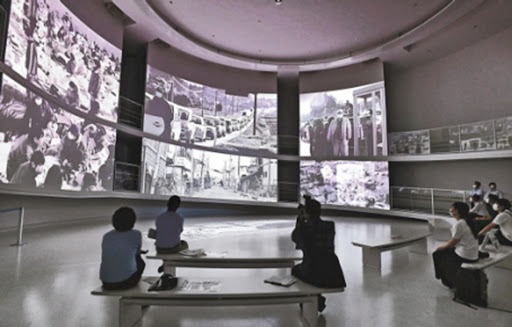 Infamous Fukushima town sign praising nuclear energy to become permanent museum display https://mainichi.jp/english/articles/20210320/p2a/00m/0na/006000c, March 20, 2021 (Mainichi Japan) FUKUSHIMA — A sign hailing nuclear energy and formerly located on the main street of Fukushima Prefecture town Futaba, which was rendered inaccessible following the nuclear meltdowns triggered by the March 2011 Great East Japan Earthquake, will go on display at the Great East Japan Earthquake and Nuclear Disaster Memorial Museum in the town from March 24. Infamous Fukushima town sign praising nuclear energy to become permanent museum display https://mainichi.jp/english/articles/20210320/p2a/00m/0na/006000c, March 20, 2021 (Mainichi Japan) FUKUSHIMA — A sign hailing nuclear energy and formerly located on the main street of Fukushima Prefecture town Futaba, which was rendered inaccessible following the nuclear meltdowns triggered by the March 2011 Great East Japan Earthquake, will go on display at the Great East Japan Earthquake and Nuclear Disaster Memorial Museum in the town from March 24.
The sign measures 2 meters by 16 meters, and reads “Nuclear Power: Energy for a Bright Future.” After the 2011 nuclear disaster at the Tokyo Electric Power Co. Fukushima Daiichi Nuclear Power Station, the sign became iconic nationally as a symbol of the northeastern Japan town that pushed for nuclear power and still remains entirely subject to evacuation orders. The sign was removed in March 2016 because its deterioration posed dangers, and photos of the sign were displayed at the museum. It is too large to be placed indoors, so authorities delayed its display when opening the museum in September 2020; in the meantime, discussions on how to exhibit it were held with the Fukushima Prefectural Government. Then, on March 19, the prefectural government announced the sign will go on permanent display at the museum’s outdoor terrace from March 24. Yuji Onuma, 45, who came up with the sign’s slogan when he was in elementary school, said, “I believe exhibiting the sign will symbolize a resolve to never have another nuclear accident, and to aim for a bright future this time around. It took a long time after its removal for display plans to be finalized, but I hope coming face to face with the real thing will give visitors a chance to think about the nuclear disaster.” (Japanese original by Ryusuke Takahashi, Fukushima Bureau) |
|
US Nuclear Corp signs agreements with Chinese nuclear corporation
US Nuclear Completes $256,626 Shipment to China, Signs New Agreement With CNNC Subsidiary, Intrado, March 22, 2021 LOS ANGELES, CA, (GLOBE NEWSWIRE) — via NewMediaWire – US Nuclear Corp. (OTCQB: UCLE) recently completed a shipment to China of USN’S popular tritium and carbon-14 air samplers as well as portable tritium monitors worth a total of $256,626.
Furthermore, as part of US Nuclear’s expansion into the Chinese market, US Nuclear signed a new “Cooperation Agreement” on March 1, 2021 with Dalian Zhonghe Scientific and Technological Development Co., a subsidiary of China National Nuclear Corporation (CNNC). Together, the companies will work to design the perfect instrumentation to outfit Chinese nuclear power plants. The instruments are planned to be built at a local factory in China to be cost-competitive and will be optimized for Chinese operators based on the local regulations and procedures. This can be a game changer since currently 80% of nuclear instruments purchased are imported into China at a high cost, and the functionality often does not fit local procedures, regulations, and language.
US Nuclear already has a local sales office in Beijing, China, and this new cooperation agreement with Dalian Zhonghe will help US Nuclear capture even more of the burgeoning market for nuclear power and radiation detection equipment in China.
The China National Nuclear Corporation (CNNC) controls most nuclear sector business including R&D, engineering design, uranium exploration and mining, enrichment, fuel fabrication, reprocessing, and waste disposal. It is also said to be the major investor in all nuclear plants in China.
China’s Nuclear Power Measurement Market
China is by far the world’s most active builder of nuclear power with plans to surpass the U.S. as the world’s top producer of nuclear energy by as early as 2030…………
China National Nuclear Corporation (CNNC) designs and builds nuclear power plants and oversees all aspects of China’s civilian and military nuclear programs. ……… China National Nuclear Corporation (CNNC) designs and builds nuclear power plants and oversees all aspects of China’s civilian and military nuclear programs. https://currently.att.yahoo.com/att/us-nuclear-completes-256-626-123000822.html
Kim Jong-un wants ”arms control talks” with USA, not denuclearisation in the short term
|
North Korea’s new nuclear gambit and the fate of denuclearisation, East Asia Forum, 22 March 2021 Author: Evans JR Revere, BrookingsIn March 2012, North Korean Foreign Minister Ri Yong-ho told a group of US experts and former officials that North Korea would not denuclearise until the United States removed its ‘threat’. He defined this as the US–South Korea alliance, the presence of US troops in South Korea, and the US nuclear umbrella defending South Korea and Japan.
‘If you remove the threat’, Ri said, ‘we will feel more secure, and in 10 or 20 years we will be able to consider denuclearisation’. ‘In the meantime,’ he declared, ‘we can sit down and engage in arms control talks as one nuclear power with another’. Ri’s remarks provided valuable insight into North Korea’s strategy and goals at the time. Today, his words shed light on why North Korean leader Kim Jong-un has doubled down on nuclear and ballistic missile programs. Faced with a new US president whose North Korea policy remains unclear, Kim Jong-un has decided to pre-empt the outcome of the ongoing US policy review by ending all prospects of denuclearisation and expanding his nuclear and missile capabilities instead. In doing so, Kim hopes to compel Washington to engage in ‘arms control talks’ if it hopes to slow the North’s nuclear program. Kim’s gambit to change the main topic of US–North Korea dialogue from denuclearisation to arms control was hiding in plain sight in his January 2021 address to the Korean Workers Party Congress. He described North Korea’s nuclear weapons development as the nation’s ‘strategic and predominant goal’ and an ‘exploit of greatest significance in the history of the Korean nation’. Declaring North Korea a ‘responsible nuclear weapons state’, Kim’s message was that the regime is now a permanent nuclear power and Washington must deal with it as such. No less important was Kim’s announcement of a plan to enhance his nuclear and missile arsenals by developing ‘ultramodern tactical nuclear weapons’, multiple-warhead missiles and solid-fuel intercontinental ballistic missiles. Kim’s remarks signalled his determination to make a dangerous threat even more potent. Much has been said about the Biden administration’s ongoing North Korea policy review. But Kim Jong-un’s remarks to the Party Congress suggest Pyongyang has conducted its own review, the result of which will be a major challenge for a new US administration still finding its feet…………… https://www.eastasiaforum.org/2021/03/22/north-koreas-new-nuclear-gambit-and-the-fate-of-denuclearisation/ |
|
Fukushima disaster 10 years on: How long will it take to clean up the nuclear waste?
Decontamination and living with ‘black bags’
Piles of black bags were generated by the vast, painstaking clean-up and then transported from other storage places. Those black bags have occupied more than 90 blocks ranging from 180 sq m to 6,500 sq m in the northern part of Tomioka since 2015.
According to a 2018 report from Japan’s Ministry of the Environment, the estimated total quantity of decontaminated soil will be somewhere between 16 and 22 million cubic metres after volume reduction. This is 13 to 18 times larger than the volume of the Tokyo Dome.
The Ministry says the total will likely be at the lower end of the provided range, in a latest reply to The Straits Times’ query.
Limits of decontamination
The “decontamination” only involves soil removal in flatland areas – the government has said that it is impossible to clear the soil in mountainous areas, but more than 70 per cent of the hardest-hit areas are mountainous.
Mr Nobuyoshi Ito is one of those who live in the mountainous areas where vast decontamination is hard to carry out.
Mr Ito first moved to Iitate village in Fukushima prefecture in 2010 after he retired as an IT engineer, to work as an “apprentice farmer”.
He had no ties with the village before that, but the self-professed “guinea pig” ended up staying on there, in open defiance of government orders to evacuate, and against his children’s wishes for him to live with them in Niigata prefecture on the west coast.
“When the government asked us to evacuate… I asked if there would be criminal charges if I continued to live here,” he told The Straits Times in 2016. “They said no.”
He carries a dosimeter around with him all the time, measuring anything he can lay his hands on from soil, plants to animal carcasses. He also owns a laboratory-grade radiation measuring machine at his cabin, deep in the mountains in the village.
He thinks the government’s decision to not decontaminate forested mountainous areas will backfire due to factors such as rain that may spread radioactive material, and in a study last year found that 43 out of 69 locations along the Olympic torch relay route had radiation levels above the government limits.
He told The Straits Times that he fears that Tokyo is overly eager to portray that everything was “under control”, given that this could give the impression that it is “case closed”.
Non-profit Greenpeace notes that such standards in towns neighbouring the nuclear plant would not pass in other parts of the world.
The indefinite future: Where to permanently store 16 million bags of nuclear waste
The law requires that the final disposal site of high-level nuclear waste should be outside of Fukushima by March 2045.
Two fishing villages in Hokkaido are vying to host the final storage facility of Japanese nuclear waste for half a century, splitting communities between those seeking investment to stop the towns from dying, and those haunted by the 2011 Fukushima disaster who are determined to stop the project.
I cannot give a deadline at this moment. We will consider the entire schedule based on the progress at the two new potential sites, along with nationwide public relations activities.
MS MASARU KASHIMA
Tokai nuclear plant ordered to halt for lack of evacuation plans
|
Tokai nuclear plant ordered to halt for lack of evacuation plans https://english.kyodonews.net/news/2021/03/a1683cef5f2a-breaking-news-japan-court-orders-suspension-of-tokai-nuclear-plant.html KYODO NEWS A Japanese court ordered Thursday the suspension of the Tokai No. 2 nuclear power plant, located northeast of Tokyo, citing a lack of evacuation plans despite persisting safety concerns over nuclear power generation 10 years after the Fukushima Daiichi accident.he Mito District Court’s ruling became the second case to order the suspension of a nuclear reactor in Japan after the Fukushima crisis, following a 2014 Fukui District Court decision to halt operations of the Nos. 3 to 4 units of the Oi nuclear plant.
The Tokai No. 2 plant in Ibaraki Prefecture, which started commercial operation in 1978, has remained idle as its operator Japan Atomic Power Co. is working to meet stricter regulations set after the 2011 disaster. The electricity wholesaler is seeking to restart the Tokai plant, after gaining approval for the extension of its operations beyond the preliminary 40-year limit in November 2018. Nuclear reactors are allowed to run for 40 years in Japan but can extend their operations for an additional 20-year period with approval from the nuclear watchdog. In handing down the landmark ruling, Presiding Judge Eiko Maeda said the situation is such one cannot say that “attainable evacuation plans and a disaster risk reduction system are in place.” Plaintiffs who live in Ibaraki and surrounding prefectures have expressed concerns about that point, as around 940,000 people are living within a 30-kilometer radius of the plant, the most among nuclear facilities nationwide. Maeda pointed out only five of the 14 municipalities within the radius have formulated regional evacuation plans in the event of a disaster, and such plans lack safety and need improvement. The current situation “poses a concrete danger that could infringe on personal rights” of local residents, the judge said. At the same time, however, the court did not find problems in the plant’s temblor and tsunami estimates as well as quake resistance of its building. |
|
Japanese regulator decides against restarting Kashiwazaki-Kariwa No. 7 nuclear reactor
Daily Mail 17th March 2021, Japanese nuclear regulators said Wednesday that the world’s largest nuclear
power plant, owned by the utility behind the Fukushima nuclear crisis, will
not restart anytime soon due to serious holes in the anti-terrorism
measures found at the facility.
The Nuclear Regulation Authority at its
weekly meeting decided to suspend further safety inspection and other
processes for a restart of the No. 7 reactor at the Kashiwazaki-Kariwa
nuclear power plant on the northern Japanese coast in Niigata prefecture.
The plant is owned by the Tokyo Electric Power Co.
Plutonium used at Japanese reactor will be glassed, stored at Savannah River Site
Plutonium used at Japanese reactor will be glassed, stored at Savannah River Site, Aiken Standard, By Colin Demarest cdemarest@aikenstandard.com, Mar 17, 2021
The National Nuclear Security Administration has decided a cache of plutonium sent from Japan years ago will be processed and disposed of for the foreseeable future at the Savannah River Site, a change of plans with local ramifications.
Up to 350 kilograms of stainless steel-clad plutonium from a Japanese reactor will be rid of using a slew of Savannah River Site facilities, tech and staff, recent federal documents show.
The Fast Critical Assembly fuel – already at the Savannah River Site – will be processed and dissolved at H-Canyon, a one-of-a-kind separations facility built in the 1950s. The material will then go to the tank farms, where millions of gallons of waste is stored.
After that, it will move to the Defense Waste Processing Facility, a mammoth plant that encases nuclear sludge in glass, making it safer to handle and stow long-term. The glass cylinders will ultimately go to an on-site storage building, where they will stay pending the availability of a dedicated depot, like Yucca Mountain in Nevada.
The entire endeavor will take years. And Japan is helping defray the cost.
The plutonium was previously slated to be handled and treated at the Savannah River Site and entombed at the Waste Isolation Pilot Plant in New Mexico, a repository resembling a salt mine. “Direct disposal of the FCA materials” at the Savannah River Site is a “sound option,” said SRS Watch Director Tom Clements, but it drums up some other questions……….. https://www.postandcourier.com/aikenstandard/news/savannah-river-site/plutonium-used-at-japanese-reactor-will-be-glassed-stored-at-savannah-river-site/article_b7b08e4c-8667-11eb-b8cd-8f0fb9c35316.html?fbclid=IwAR1s_w6jcU21h64HZ6z-tzb7uaWt4x-51ECsKd8E3bw6tvGacJn9_9gGmA8
New type of large and highly radioactive particles found in Japan
|
Recent studies have revealed that the fall-out from reactor unit 1 also included larger caesium-bearing particles, each greater than 300 micron in diameter, which have higher levels of activity in the order of 105 Bq per particle. These particles were found to have been deposited in a narrow zone stretching around 8 km north-northwest from the reactor site.
Surface soil samplesIn their study, chemist and environmental scientist Satoshi Utsunomiya of Japan’s Kyushu University and colleagues have analyzed 31 of these particles, which were collected from surface soil taken from roadsides in radiation hotspots. “[We] discovered a new type of radioactive particle 3.9 km north northwest of the Fukushima Daiichi Nuclear Power Plant, which has the highest caesium-134 and caesium-137 activity yet documented in Fukushima, 105–106 Bq per particle,” Utsunomiya says. Alongside the record-breaking radioactivity seen in two of the particles (6.1×10⁵ and 2.5×10⁶ Bq, after correction to the date of the accident) the team also found that they had characteristic compositions and textures that differed from those previously seen in the reactor unit 1 fall-out. Reactor building materialsA combination of techniques including synchrotron-based nano-focus X-ray analysis and transmission electron microscopy indicated that one of the particles was found to be an aggregate of smaller silicate nanoparticles each with a glass-like structure. This is thought to be the remnants of reactor building materials that were first damaged in the explosion and then picked up caesium that had been volatized from the reactor fuel. The other particle had a glassy carbon core and a surface peppered with other microparticles of various compositions, which are thought to reflect a forensic snapshot of the particles that were airborne within the reactor unit 1 building at the moment of the hydrogen explosion and the physio-chemical phenomena they were subjected to. “Owing to their large size, the health effects of the new particles are likely limited to external radiation hazards during static contact with skin,” explained Utsunomiya — with the two record-breaking particles thought too large to be inhaled into the respiratory tract. Impact on wildlifeHowever, the researchers note that further work is needed to determine the impact on the wildlife living around the Fukushima Daiichi facility — such as, for example, filter feeding marine molluscs which have previously been found susceptible to DNA damage and necrosis on exposure to radioactive particles. “The half-life of caesium-137 is around 30 years,” Utsunomiya continued, adding: “So, the activity in the newly found highly radioactive particles has not yet decayed significantly. As such, they will remain [radioactive] in the environment for many decades to come, and this type of particle could occasionally still be found in radiation hot spots.” Nuclear material corrosion expert Claire Corkhill of the University of Sheffield – who was not involved in the study – says that the team have offered new insights into the events that unfurled during the accident. “Although the two particles selected [for analysis] were small, a mighty amount of chemical information was yielded,” she said, noting that some of the boron isotopes the researchers identified could only have come from the nuclear control rods damaged in the accident……… The study is described in Science of the Total Environment. https://physicsworld.com/a/new-type-of-fallout-from-fukushima-daiichi-found-a-decade-after-nuclear-disaster/ |
|

Serious security lapse at a Japanese nuclear plant
|
Serious security lapse at nuclear plant in Niigata https://www3.nhk.or.jp/nhkworld/en/news/20210316_26/
Japanese nuclear regulators have assessed a security lapse at the Kashiwazaki-Kariwa nuclear plant in Niigata Prefecture as being at the most serious level in terms of anti-terror measures. The Nuclear Regulation Authority was notified by the plant’s operator, Tokyo Electric Power Company, in January that a worker accidentally damaged sensor equipment for detecting intruders. On Tuesday, the result of an investigation of the plant was reported at an NRA closed-door meeting. The probe found that other sensor equipment may have remained broken since March of last year, making the plant vulnerable to intruders for months. The NRA revealed that TEPCO employees in charge of security did nothing despite knowing that alternative measures taken were ineffective. The NRA’s provisional assessment of the security lapse was that it was the most serious on a four-level scale of risks in safeguarding nuclear material. The authority members plan to consider punishment for the utility as soon as the assessment is finalized. Last September, another problem took place at the plant. An employee entered the plant’s central control room illegally, using another employee’s ID card. |
|
Tokyo’s ”Recovery Olympics”? But Japan has not recovered from the Fukushima meltdown
Japan Hasn’t Recovered 10 Years After Fukushima Meltdown, https://truthout.org/articles/japan-hasnt-recovered-10-years-after-fukushima-meltdown/, Arnie Gundersen, -March 11, 2021
On March 11, 2011, a devastating offshore earthquake and ensuing tsunami rocked Japan and resulted in nuclear meltdowns in three nuclear reactors at the Fukushima Daiichi nuclear site. Until the 2020 Tokyo Olympics were placed on a one-year hiatus because of concerns over  COVID-19, the Japanese government had portrayed these events as the “Recovery Olympics.” It had hoped to use the Olympics to showcase a claimed restoration of Japan since it was devastated in 2011. But has Japan really “recovered?”
1. Existing radiation maps ignore significant sources of radiological exposure.
Most of the radiation maps of northern Japan are based on external radiation detected in handheld instrument measurements by citizens and scientists, who then link the measurements to GPS coordinates while downloading that data into a massive database. This information about direct, external radiation is certainly important, but it has become the de facto criteria for decision makers in Japan to decide which cities and towns should be repopulated.
We found that this approach only provides limited policy alternatives and serves to minimize potential population exposure for two reasons. First, the Geiger counter data is for external radiation that was deposited on the ground external to human bodies and ignores radiation imbibed or inhaled as “hot particles” into the human body.
Secondly, the external radiation data frequently displayed for northern Japan is based on radiation emitted from only a single radioactive isotope, Cesium-137 (Cs-137), as measured externally. On the other hand, our papers show a wide variety of isotopes that are not detected by handheld Geiger counters or absorbed externally. We show that there is an extensive brew of various isotopes present in radioactive dust that is inhaled or imbibed. Our papers indicate that the radioactive concentration in these dust particles varies widely, by a factor of 1 million, with 5 percent (3 sigma) of these “hot particles” 10,000 times more radioactive than the mean. Our most radioactive dust particle was collected 300 miles from the site of the meltdown.
Furthermore, the data show that alpha, beta and gamma-emitting contaminants in radioactive fallout from the Daiichi meltdowns have not traveled together in lockstep. This means that measuring only beta-emitters like Cesium-137 or only total gamma (as you would with a Geiger counter) is not enough to map the full impact of the fallout. Alpha-emitters must also be measured to protect the public health. This is especially important because of the serious health impacts that can come from exposure to alpha radiation.
2. Northern Japan remains radiologically contaminated.
When a nuclear chain reaction stops, the hazardous remnants of the previously split uranium atoms, euphemistically called “fission products,” are left behind and remain radioactive for centuries. The triple meltdowns and explosions at Fukushima Daiichi Units 1, 2 and 3 in March 2011 released an enormous amount of these fission products into the environment. Wind currents pushed as much as 80 percent of this radiation over the Pacific Ocean, while 20 percent fell on northern Japan, forcing the evacuation of approximately 160,000 Japanese citizens from ancestral lands.
Absent any human intervention, short-lived fission products that originally accounted for more than half of this contamination have already decayed away during the last nine years, while even more has washed into the Pacific from storms and typhoons. Limited cleanup efforts by the Japanese government have further reduced the contamination in a fraction of the populated portion of the devastated Fukushima prefecture. Greater than 10 million tons of radioactive material have been collected and stored in 10 million individual large black bags at hundreds of locations. However, due to mountainous terrain, more than 70 percent of Fukushima prefecture will never be decontaminated.
Absent any human intervention, short-lived fission products that originally accounted for more than half of this contamination have already decayed away during the last nine years, while even more has washed into the Pacific from storms and typhoons. Limited cleanup efforts by the Japanese government have further reduced the contamination in a fraction of the populated portion of the devastated Fukushima prefecture. Greater than 10 million tons of radioactive material have been collected and stored in 10 million individual large black bags at hundreds of locations. However, due to mountainous terrain, more than 70 percent of Fukushima prefecture will never be decontaminated.
As the cost and effort to completely decontaminate the entire land mass of Fukushima prefecture would be prohibitive, the Japanese government has focused on cleaning only populated areas. It also increased the “allowable” radiation limit 20-fold, after an initial partial decontamination, from 1 milli-Sievert to 20 milli-Sieverts per year (100 millirem to 2 rem) to facilitate repopulation of abandoned villages. A 20-fold increase in radiation will create a 20-fold increase in radiation-induced cancers. A significant fraction of residents chose not to return, recognizing the increased risk that these higher approved limits present.
3. Previously “cleaned” areas are becoming radiologically contaminated yet again.
The city of Minamisoma was contaminated and evacuated at the height of the Fukushima disaster. After a period of several years, radiation in the city was remediated and citizens were allowed to return. Minamisoma City Hall was decontaminated, with a new epoxy roof applied after the meltdowns in 2011. The authors collected samples from this previously “clean” fourth-story roof in 2016 and again in 2017, finding high levels of alpha radiation in the relative absence of the normally ubiquitous Cesium isotopes. This can only imply that wind-borne contamination from uncleaned areas is recontaminating those areas determined habitable.
4. Olympic venues in Fukushima prefecture are more contaminated than in Tokyo Olympic venues.
Suburbs of Tokyo are approximately 120 miles from the reactors at Fukushima Daiichi. We found particulate radiation at Olympic venues in Tokyo to be normal compared to other cities worldwide. We found that areas in Japan beyond the Olympic venues were seven times more contaminated than the venues themselves. Contamination at the Olympic venues in Fukushima prefecture, planned to showcase the region’s recovery, were also more contaminated than the Tokyo venues. We found that on average, these northern Olympic venues were two to three times more contaminated with “hot particles” than venues in Tokyo.
We also detected small but statistically significant levels of plutonium at the J-Village national soccer camp in Fukushima prefecture. Even though the Japanese government claims to have thoroughly decontaminated these Fukushima locations, it is not surprising that these Olympic venues remain contaminated. As discussed previously, since the entirety of the prefecture’s area will never be decontaminated, these areas will continue to have wind-borne contamination for centuries.
Science on a Shoestring
As Fukushima was melting down, nuclear advocates in the U.S. were testifying to the Washington State legislature, saying that Japan’s nuclear plants would not be a problem, and that working in a nuclear plant is “safer than working in Toys R Us.” Not surprisingly, those same zealots are now claiming that there will be no increase in cancer fatalities as a result of the three Fukushima meltdowns. However, not including the hot particle contamination my colleagues and I have identified, the UN estimates that thousands of fatalities will occur. Others, including myself, believe the actual cancer increase could result in upwards of 100,000 increased deaths as a result of the radioactive microparticles strewn into the environment.
There is no doubt that radiological conditions in Japan have improved in the decade since the triple meltdowns at Fukushima Daiichi. However, our data show that Japan has not “recovered,” nor can it ever return to pre-meltdown norms. Public relations campaigns by interested parties cannot obscure the recontamination of populated areas in northern Japan that will continue to occur.
Hasegawa, the former head of Maeda Ward in Fukushima prefecture at the time of the Fukushima disaster, sums up the sentiment of most of Japanese citizens in northern Japan: “The nuclear plant took everything.… We are just in the way of the Olympics. In the end, the radiation-affected places like us are just in the way. They are going ahead just wanting to get rid of these places from Japan, to forget.”
There is an old laboratory adage that says, “The best way to clean up a spill is not to have a spill,” and this applies on a much larger scale to the entirety of northern Japan, where cleanup will remain economically unfeasible. Our future plans to further support our hypothesis that Japan remains contaminated will involve testing the shoestrings of Olympic athletes and visitors to northern Japan. Shoestrings are useful, as their woven fabric traps dust which may assist in determining the extent of contamination into populated areas in northern Japan compared to that in Tokyo.
1 This Month
Chernobyl: The Lost Tapes – A good documentary on Chernobyl on SBS available On Demand for the next 3 weeks– https://www.sbs.com.au/ondemand/tv-program/chernobyl-the-lost-tapes/2352741955560

of the week–London Campaign for Nuclear Disarmament

Tell the Ukrainian Government to Drop Prosecution of Peace Activist Yurii Sheliazhenko
To see nuclear-related stories in greater depth and intensity – go to https://nuclearinformation.wordpress.com
-
Archives
- April 2026 (139)
- March 2026 (251)
- February 2026 (268)
- January 2026 (308)
- December 2025 (358)
- November 2025 (359)
- October 2025 (376)
- September 2025 (257)
- August 2025 (319)
- July 2025 (230)
- June 2025 (348)
- May 2025 (261)
-
Categories
- 1
- 1 NUCLEAR ISSUES
- business and costs
- climate change
- culture and arts
- ENERGY
- environment
- health
- history
- indigenous issues
- Legal
- marketing of nuclear
- media
- opposition to nuclear
- PERSONAL STORIES
- politics
- politics international
- Religion and ethics
- safety
- secrets,lies and civil liberties
- spinbuster
- technology
- Uranium
- wastes
- weapons and war
- Women
- 2 WORLD
- ACTION
- AFRICA
- Atrocities
- AUSTRALIA
- Christina's notes
- Christina's themes
- culture and arts
- Events
- Fuk 2022
- Fuk 2023
- Fukushima 2017
- Fukushima 2018
- fukushima 2019
- Fukushima 2020
- Fukushima 2021
- general
- global warming
- Humour (God we need it)
- Nuclear
- RARE EARTHS
- Reference
- resources – print
- Resources -audiovicual
- Weekly Newsletter
- World
- World Nuclear
- YouTube
-
RSS
Entries RSS
Comments RSS
 nuclear-news