How Taishan almost became China’s Chernobyl.
How Taishan almost became China’s Chernobyl. https://www.spectator.co.uk/article/how-taishan-almost-became-china-s-chernobyl Ian Williams, 4 July 21,
Days after a nuclear power plant began spewing deadly radiation, the ruling Communist party pushed ahead with a huge and self-indulgent celebration of the sort that had become a hallmark of its rule. This was no time for bad news, and the party delayed, dithered and hid the truth about the deadly events that were unfolding.
That was the Chernobyl disaster in 1986. Soviet leaders allowed Kiev’s International Workers’ Day celebrations to go ahead. The participants, meanwhile, were oblivious to events at the stricken reactor just 60 miles away. The images of those May Day celebrations have come to symbolise the party’s criminal dishonesty, and they were nearly echoed after a technical glitch hit the Taishan nuclear power plant in Guangdong province early last month, just weeks before the Chinese Communist party’s centenary.
Thankfully it did not turn into another Chernobyl, but the response of the authorities in China was chillingly reminiscent of those dark days in Ukraine.
On 16 June, the Chinese government said that there had been an incident with the fuel rods at a nuclear plant, but this information took over a week to get out: a close reminder that authoritarian states repel uncomfortable truths. On 8 June, US authorities were reportedly informed that there was an ‘imminent radiological event’ at the Taishan Nuclear Power Plant in Guangdong Province, just 80 miles from Hong Kong. The Chinese safety authorities were reportedly raising the acceptable limits for radiation detection outside the plant in order to avoid having to shut it down. The French company who part-owned the plant, Framatome, needed to obtain a US waiver to obtain the technical information needed to solve the problem – a problem the Chinese authorities at the time had not even acknowledged existed.
After reports were broadcast by CNN, Framatome issued a statement saying it was trying to resolve a ‘performance issue’ at the plant, in which it has a 30 per cent stake. The Chinese firm, CGN, refused to comment, though the plant said that everything was ‘normal’. Only on 16 June did the Chinese government inform the International Atomic Energy Authority that there had been an issue with some damaged fuel rods. It described the issue as a common occurrence, which did not trigger safety concerns.
It could have been far worse. The technical details are reassuring, but they were far too slow to come out. Had this been a wholly-owned Chinese plant, we would still be completely in the dark. It is chillingly reminiscent not only of the early days at Chernobyl, but also the beginning of the Covid-19 outbreak. During those early days in Wuhan there was open speculation that Xi Jinping had finally reached his ‘Chernobyl moment’ – the disaster that would hasten the demise of a monolithic communist party.
There is visibly a pattern emerging in China which we have seen in authoritarian regimes before. Bad news is quashed and denied. The Chinese Communist party is secretive by nature, and regards itself as accountable to nobody. This has been exacerbated by Xi Jinping’s concentration of power. Officials are afraid to pass bad news up the food chain, preferring to tell the emperor what he wants to hear. In democracies, bad news travels to the top quickly. In autocracies, less so.
Britain has an especially pressing reason to pay attention to events at the Chinese power plant. The Chinese and French firms are also collaborating on the £22 billion Hinkley Point nuclear plant now under construction in Somerset, which will use the same technology. A second joint project in Suffolk has yet to begin construction. The Chinese firm is also angling to build its own reactor at Bradwell in Essex – the first Chinese-designed plant outside its own borders, with Beijing wanting to widen markets for its nuclear technology.
Allowing the Chinese firm which has close links to the Communist party to play such a crucial role in such a sensitive part of Britain’s most critical infrastructure was always foolhardy. It looks even more so in the light of the CCP’s behaviour at Taishan. The party is so wilfully lacking in transparency that it should never be in charge of a nuclear power plant in its own country, let alone on the coast of Britain. The British government has the power to do something about it. The question is whether it has the will.
Taiwan’s strategy to phaseout nuclear energy and move to renewables
The Taiwan Government have plans to phase out nuclear power generation by
2025. Nuclear power installed capacity decreased from 4.9GW to 3.8GW, at a
negative CAGR 1.2%. The capacity will reach zero by 2025 as per government
plans.
Taiwan was prompted to rethink its nuclear power program in 2011, in
the wake of the Fukushima disaster in Japan. This led to the government
placing one of its upcoming nuclear reactors on standby and postponing the
construction of the other indefinitely.
Existing reactors are set to be
decommissioned after their useful life is over. Taiwan intends to fill the
gap created by the retirement of its nuclear power plants with renewable
power capacity. To support the development of renewable energy, the
government passed the Renewable Energy Development Act in 2009 (further
amended in 2019) which set a target of 27GW of installed capacity coming
from renewables by 2025.
Power Technology 28th June 2021
Japan is not being transparent about the radioactive content in Fukushima wastewater
A 2018 TEPCO report revealed that even after filtration the treated water still contained other radionuclides, such as strontium-90 and iodine-129, above regulatory-limit levels.
Japan’s nuclear wastewater plan is clouded by politics
29 June 2021 East Asia Forum Author: Yasuo Takao, Curtin University
The Japanese government’s approval of a plan to discharge treated radioactive water stored at the Fukushima Daiichi nuclear plant into the Pacific Ocean has unilaterally reversed a decade of nuclear safety reform in Japan. Although providing information to foreign embassies in Tokyo and online social networks, the Japanese government has failed to allay domestic concerns and rising international pressure.
The Tokyo Electric Power Company (TEPCO) proposes to use an Advanced Liquid Processing System (ALPS) to remove all the radionuclides from the wastewater except tritium — which poses the lowest health risk. It will then dilute the tritium concentration until levels are safe enough for release into the Pacific Ocean.
Japan’s Ministry of Economy, Trade and Industry and TEPCO, with the backing of the International Atomic Energy Agency (IAEA) and other experts, claim that this ‘dilution and discharge option’ is technically feasible and safe. Since the ALPS operations started in 2013, TEPCO has insisted that releasing treated water into the ocean is a normal part of nuclear plant operations around the world.
But the water directly injected into the cooling process of the damaged reactors and fuel debris is different from the water normally used for cooling nuclear plants. Japan’s Nuclear Regulation Authority (NRA) has described this cooling process as free-flowing (kakenagashi) because of its direct contact with the damaged reactors. The used cooling water from the Fukushima plant is much more radioactive than that from a normal operation.
A 2018 TEPCO report revealed that even after filtration the treated water still contained other radionuclides, such as strontium-90 and iodine-129, above regulatory-limit levels. In September 2020, TEPCO began to carry out secondary treatment tests on the water to reduce the amount of radioactive substance it contained.
Japanese Prime Minister Yoshihide Suga stated, ‘the disposal of ALPS treated water is unavoidable and experts have recommended that the release into the sea is the most realistic method’. If good nuclear safety governance is concerned with bringing stakeholders together to meet social needs, then the prime minister’s remark falls short.
Referring to ‘expert opinion’ as the main factor in the decision making process can be seen as a political strategy to avoid blame. The Suga cabinet is unwilling to take political responsibility for releasing the wastewater into the Pacific Ocean. The potential threats to human health and the environment call for closer scrutiny of Japan’s leadership………
TEPCO needs to regain public trust by exercising transparency and providing accurate and reliable information about the current state of radionuclides contained in each water storage tank at Fukushima Daiichi. The Japanese government should produce a clear technical plan at the operational level and an environmental impact report for stakeholders. The Japanese government and TEPCO should also actively seek views from all relevant stakeholders — including those in other countries — and show that their concerns are being adequately addressed…….https://www.eastasiaforum.org/2021/06/29/japans-nuclear-wastewater-plan-is-clouded-by-politics/
China’s handling of Taishan nuclear plant leak shows need for transparency
China’s handling of nuclear plant leak shows need for transparency. For
the Chinese Communist Party, opacity is a virtue and transparency is a
virtue. This approach to governance worked well for the party. 100th
anniversary Established on Thursday.
Unfortunately, it doesn’t work very
well if you run a nuclear power plant in China, especially if you are
partnering with a foreign investor who cannot easily accept the principles
of political parties.
Framatome, a division of China General Nuclear Power
Group and France’s EDF, provided an example of this textbook two weeks
ago when CNN reported that President Joe Biden’s administration was
“evaluating.” [a] Leak was reported At a nuclear facility in China.
“Framatome’s memo to the US Department of Energy dated June 8, and
CNN’s report was released on Monday morning, June 14, China time.
Taishan
Nuclear Power Station seems to have tried to anticipate the report by
issuing a statement on its website on Sunday night, June 13. In a CNN
report. CGN and Taiyama’s approach to the “neither apologize nor
explain” type of situation shook people. A local government official in
Jiangmen, which controls the Taishan plant, told the Financial Times that
the locals were completely in the dark. “The factory says everything is
going well,” officials said. “What can we do without proper explanation
of CNN’s report?”
FT 29th June 2021
https://www.ft.com/content/1c47d829-34a2-4efd-8c43-f9cdd95b6994
The hybrid boars of Fukushima
“Once people were gone, the boar took over,” explains Donovan Anderson, a
researcher at Fukushima University in Japan. His genetic study of the wild
boar that roam in an area largely abandoned after Japan’s 2011 nuclear
disaster – has revealed how the animals have thrived. Using DNA samples, he
also discovered that boar have bred with domestic pigs that escaped from
farms. This has created wild pig-boar hybrids that now inhabit the zone.
“While the radiation hasn’t caused a genetic effect, the invasive domestic
pig species has,” Mr Anderson explained.
BBC 30th June 2021
EDF will try to minimise the radiological leak at the Taishan nuclear plant – but the damage is done.
A minor operating incident of a Chinese reactor at the French-designed Taishan NPP, pinned down by CNN. The small world of nuclear power has still not returned from the tortuous journey of this information. Monday, June 14, the American channel released a world scoop by reporting that the French group Framatome warned the American authorities of an “imminent radiological threat” to the Taishan power plant. In the hours that follow,
EDF, a 30% shareholder in the Taishan EPR plant, will specify that this is only a fuel rod leak (supplied by Framatome), confined in the very secure circuit. primary of a reactor. An operating incident under control, a priori without consequences. But the damage is done.
Le Figaro 24th June 2021
https://www.lefigaro.fr/international/nucleaire-chinois-la-bevue-incroyable-de-framatome-20210624
 | ReplyForward |
Russia, China Pledge to Not Use Nuclear Weapons First, Avoid Firing Missiles at Each Other
Russia, China Pledge to Not Use Nuclear Weapons First, Avoid Firing Missiles at Each Other , NewsWeek, BY JENNI FINK ON 6/28/21 Russia and China reaffirmed their friendship treaty amid increasing concerns about their growing relationship and the two countries continued a vow not to fire strategic missiles at each other.
Russia President Vladimir Putin and Chinese President Xi Jinping extended the 20-year Treaty of Good-Neighborliness and Friendly Cooperation, a document Putin credited with taking their relationship to “unprecedented height.” An extension that’s set to last for five years, it outlines that both countries will support each others’ right to defend their “national unity” and territories.
Article 2 has both countries promising to using “peaceful means” to resolve their differences, not the use of force, threat of force or economic pressures.
The contracting parties reaffirm their commitment that they will not be the first to use nuclear weapons against each other nor target strategic nuclear missiles against each other,” the treaty states.
Russia and China have grown closer as their relationships with the United States has deteriorated. Although Putin’s summit with President Joe Biden was seen as a positive step, America and Russia failed to see eye-to-eye on a number of topics, but they agreed to work together on the issue of nuclear weapons.
In a joint statement, the two countries agreed to “embark” on dialogue that would “lay the groundwork” for future arms control and risk reduction measures, acknowledging that “nuclear war cannot be won and must never be fought.”
One of two biggest nuclear powers, Putin’s endorsement of Russia’s nuclear deterrent policy raised concerns. The policy allows him to use nuclear weapons in response to a strike with conventional weapons, or if Russia gets “reliable information” about the launch of an attack against its territory or allies.
The strategy is “purely defensive,” according to General of the Army Valery Gerasimov, chief of the General Staff of the Armed Forces, but he defended Russia’s ability to use nuclear weapons at the Moscow International Security Conference last week……. https://www.newsweek.com/russia-china-pledge-not-use-nuclear-weapons-first-avoid-firing-missiles-each-other-1604865
Japan’s murky management of Fukushima nuclear wastewater

Japan’s murky management of Fukushima nuclear wastewater https://www.eastasiaforum.org/2021/06/25/japans-murky-management-of-fukushima-nuclear-wastewater/
Author: Cheol Hee Park, SNU
On 13 April 2021, the Japanese government announced plans to dispose of the wastewater stored at the Fukushima Daiichi nuclear plant into the Pacific Ocean over a period of 30 years.
The plant has about 1000 wastewater tanks that can hold up to 1.37 million tons of contaminated water. Currently, 1.25 million tons are being stored, which accounts for about 90 per cent of the total storage capacity. The tanks are expected to fill up by the autumn of 2022, which prompted the Japanese government to adopt the least expensive option — disposing the wastewater into the sea, starting from 2023.
The United States and the International Atomic Energy Agency (IAEA) remain sympathetic to the Japanese decision, saying that it meets the international standard. On the other hand, China and South Korea have voiced concerns about the decision. They are distrustful of and dissatisfied with the sudden decision made by the Japanese government. The difference is starkly highlighted in how the wastewater is being referred to by different countries. Japan and the United States call it ‘treated water’ while China and South Korea define it as ‘contaminated water’.
The Japanese government explained that it will fully treat and dilute the wastewater until the contamination level is reduced to at least one-hundredth of its original concentration. Officials say that tritium will be reduced to one-fortieth of the Japanese government’s normal standard. Deputy Prime Minister Taro Aso even claimed that the treated water will be drinkable.
he Japanese government also made it clear that before the accident in 2011 the Fukushima nuclear plant disposed of 2.2 trillion becquerels of tritium into the sea each year, which caused no problems. They added that because tritium is a weak radioactive isotope, most of the material will exit the human body, meaning its negative impact will be small.
Despite the Japanese government’s efforts to convince people outside of the country, the most vocal opposition has come from within Japan. The Japan Fishermen’s Association argued that they will not accept the Japanese government’s decision. They explain that the decision went against the government’s promise in 2015 that the release would not happen without their consent. Fishermen from Fukushima and Ibaraki are particularly sensitive about the potential consumer backlash over the radioactive wastewater release, which will directly impact their livelihoods. About 70 per cent of fishermen oppose the government’s decision. It remains unclear whether the Japanese government will be able to persuade them.
Concerns from neighbouring countries are another hurdle to overcome. There is little sign that the Japanese government fully consulted adjacent countries before it announced the decision. Because of the lack of prior consultation and reliable notice, the Japanese government’s decision should be regarded as a unilateral move. South Korea and China should not approach this issue to drag down Japan’s efforts to resolve the problem. At the same time, it is Japan’s responsibility to be attentive to neighbouring countries’ legitimate concerns.
Securing transparency in the process of implementing the plan is another challenge. Despite the Japanese government’s explanation, it remains uncertain whether various nuclides other than tritium can be reliably removed using the Advanced Liquid Processing System (ALPS). Passing on the correct and reliable information to concerned parties in and outside the country is necessary. Japan should incorporate third-party specialists to provide objective and reliable information about the process.
Finally, verifying the safety of the water with international standards would give comfort to and garner trust from concerned parties, including Japanese fishermen. The IAEA could mobilise experts or build a verification team on behalf of Japan and its neighbouring countries so that all concerned regional countries can be persuaded about the safety of the water.
The Japanese government should better fulfil its responsibilities, justify the necessity of its decision, remain transparent about its implementation of the plan and be resilient in verifying the safety of the water it disposes of.
Cheol Hee Park is Professor at the Graduate School of International Studies and Director of the Institute of International Affairs, Seoul National University.
TEPCO begins process to scrap Fukushima No. 2 nuclear plant,
TEPCO begins process to scrap Fukushima No. 2 nuclear plant, http://www.asahi.com/ajw/articles/14379413
THE ASAHI SHIMBUN, June 23, 2021 Tokyo Electric Power Co. Holdings Inc. began decommissioning the Fukushima No. 2 nuclear power plant in Fukushima Prefecture on June 23, aiming to complete the work in fiscal 2064.
In 2018, TEPCO decided to scrap all four reactors at the plant, located south of the No. 1 nuclear plant that was devastated by the 2011 Great East Japan Earthquake and tsunami. Operations at the No. 2 plant have been suspended since it was inundated by the tsunami.
The company estimates the total cost of scrapping the No. 2 plant, including reprocessing spent nuclear fuel, at 410 billion yen ($3.70 billion).
TEPCO divided the process of decommissioning the plant in four stages, each taking about a decade. In the first stage, the company will focus mainly on decontamination work.
TEPCO has already begun work to scrap all six reactors at the crippled No. 1 plant. The company needs considerable manpower to simultaneously carry out the decommissioning work at both plants.
It is also facing many challenges, such as where some 10,000 spent nuclear fuel assemblies should be transferred to.
The Nuclear Regulation Authority, the government’s nuclear watchdog, approved TEPCO’s decommissioning plan for the No. 2 plant on April 28. The company also obtained prior consent to the plan from Fukushima Prefecture as well as Tomioka and Naraha towns, which co-host the plant, on June 16.
Fukushima Governor Masao Uchibori is urging TEPCO to move the spent fuel out of the prefecture and to cultivate a corporate culture that prioritizes safety and to work with local companies when carrying out the decommissioning work.
TEPCO started the work by inspecting the interior of the reactor buildings and checking the procedure for decommissioning. It will bring in necessary equipment and materials to the plant from July 1 and begin decontamination work on a full scale from mid-July.
(This article was written by Tetsuya Kasai and Satoshi Shinden.)
China’s plans for a huge nuclear waste bunker
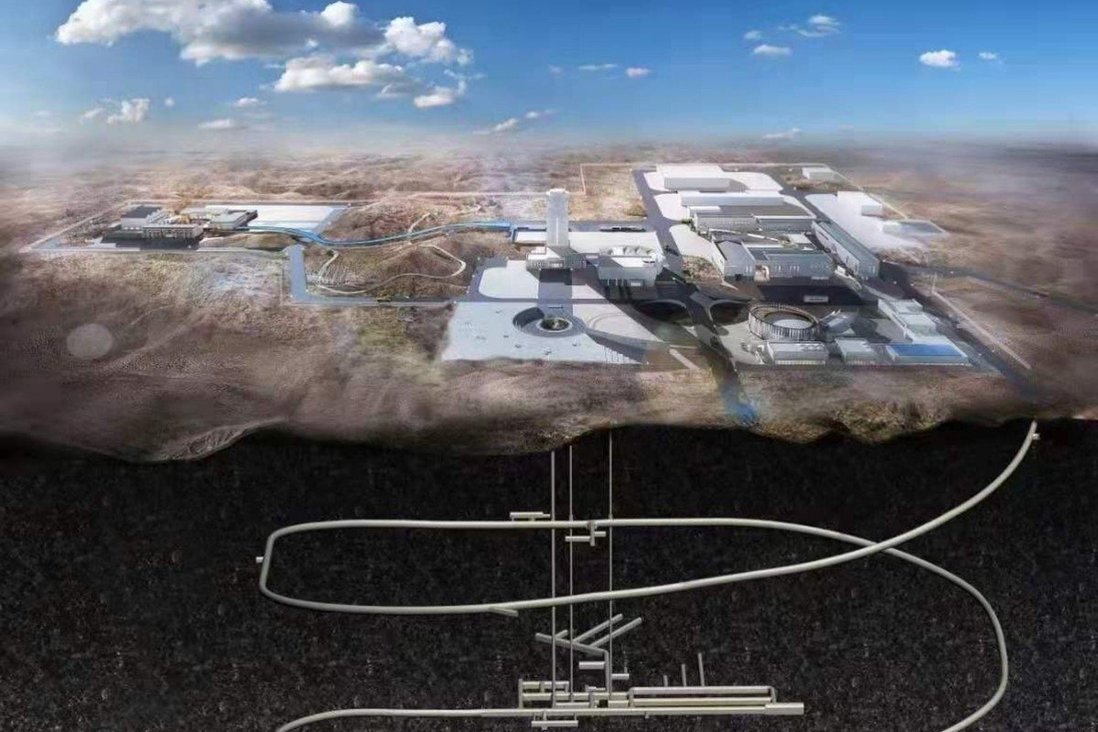
China builds bunker to test whether nuclear waste can be dumped underground, SCMP
Lab more than 500 metres underground in the Gobi Desert will be the world’s largest of its kind
If research there is successful, a long-term underground dump for high-level radioactive waste could be built, helping to address a global problem
China has started building a laboratory deep underground in the Gobi Desert to assess whether it would be a suitable location for a nuclear waste dump, amid moves to expand its nuclear power capacity.
The Beishan Underground Research Laboratory in the northwestern province of Gansu will be used to research long-term storage of high-level radioactive waste. With its deepest level to be built 560 metres (1,837 feet) below ground, it will be the world’s largest lab of its kind, according to the ChinaNuclear Energy Association, which promotes nuclear power.
- The world has about a quarter of a million tonnes of highly radioactive waste, all kept in “temporary” storage. No country has found a solution for permanent deep geological storage, with public opposition often a factor.
- China’s attempt to find an answer comes at a time when it plans to build a fleet of new reactors. Disposal of high-level radioactive waste is becoming more critical as it uses more nuclear power and tries to become carbon neutral
……. It is estimated that the lab will cost over 2.7 billion yuan (US$400 million), take seven years to build and operate for 50 years. If research proves the site to be suitable, a long-term underground repository for high-level radioactive waste will be built nearby by 2050, Wang Ju, chief designer of the lab, told state media in April………. https://www.scmp.com/news/china/science/article/3138484/china-builds-bunker-test-whether-nuclear-waste-can-be-dumped
Alarm at Japan’s plan to restart Kansai’s ageing No.3 nuclear reactor
As Japan reboots ageing Mihama nuclear reactor, experts express concern, Reuters, Aaron Sheldrick 23 June 21
- Reactor restarted after sitting idle for 10 years
- First of four old reactors to get exceptions
- For an interactive graphic on the status of Japan’s nuclear reactors, click https://tmsnrt.rs/2OTpNfA
– The head of a major inquiry into Japan’s nuclear disaster and a former senior Cabinet adviser have sounded alarms over plans this week to restart a 44-year old reactor, saying the industry and government have not taken on board the lessons from Fukushima.
Kansai Electric Power (9503.T), which serves Osaka and its industrial environs – an area with roughly the same economic output as Mexico – said it restarted the No. 3 reactor at its Mihama station in western Japan earlier on Wednesday.
The reactor is the oldest to be restarted since the 2011 Fukushima disaster and needed special approval to have its lifetime extended beyond the standard 40-year limit. Most reactors in Japan remain shut after the accident highlighted failings in regulation and oversight.
Tatsujiro Suzuki, a former deputy chairman of the Cabinet Office’s Atomic Energy Commission, told Reuters he has misgivings over how approval for the restart was obtained.
- He said he was concerned about a lack of transparency and the use of subsidies to sweeten local opinion to get the necessary restart approval…….
- It looks like the industry and the government have not learned the lessons of Fukushima,” said Suzuki, who is on the advisory board of a parliamentary committee on nuclear safety.
Bureaucrats from the Ministry of Economy, Trade and Industry (METI), which supports nuclear energy to power Japan’s industrial economy, went to Fukui prefecture 110 times over a two-year period until early this year.
The visits to Fukui by officials including the head of the powerful natural resources agency were raised at a recent hearing of the parliamentary committee.
A subsidy of 2.5 billion yen ($23 million) was agreed for local communities before the Fukui governor signed off on the restart…….
- Five workers died at Mihama power station in 2004 after a pipe that had not been inspected for nearly a decade burst, releasing high pressure steam and hot water.
- In 2019, Kansai Electric executives admitted to receiving cash and gifts worth 360 million yen from an official from a town hosting one of its other nuclear plants.”They haven’t changed, that’s my impression, despite the scandal involving kickbacks,” Suzuki said……..
A silo mentality among executives and a collectivist mindset among bureaucrats, which puts organisational interests ahead of public duties on safety are still prevalent in Japan, Kurokawa said.
“It’s always important to ask what are the sanctions for bad corporate behaviour. If there are none, and in Japan there are none, then oversight is meaningless,” he said, adding he was concerned about the restart.
Mihama is one of 16 reactors that have received either preliminary or final approval to restart…………https://www.reuters.com/world/asia-pacific/japan-reboots-44-year-old-nuclear-reactor-experts-sound-alarm-2021-06-22/
Yet another incident of stolen nuclear materials in India
In yet another incident of the capture of nuclear-related materials from
unauthorized persons in India has made headlines in the Indian media but
largely ignored in the international media.
On 4th June 2021, as reported in the Indian media, the authorities arrested seven people possessing
approximately 6.4 kilograms of Uranium in the Eastern State of Jharkhand.
This is the second time in less than a month where Indian authorities have
captured such a gang in an attempt to sell uranium illegally.
An incident of the same nature was reported just a few days ago in May 2021 where
authorities apprehended unauthorized persons, who were trying to sell
nearly 7 kilograms of natural uranium on the black market. Notably, Indian
authorities themselves believe that these events might be linked to a
“national gang involved in illegal uranium trade”.
Modern Diplomacy 12th June 2021
Incidents of Uranium Theft in India: Depleting Nuclear Safety and International Silence
China’s Taishan nuclear reactor has 5 damaged fuel rods
There are likely five damaged fuel rods in the 1,750 MW Taishan-1 EPR in
China, which have led to an increase in radiation levels within the reactor
coolant, the Chinese Ministry of Ecology and Environment said in a
statement June 16, providing the first official explanation for the nuclear
reactor’s recent technical problems.
French power company EDF, a minority
owner of the Taishan plant, said in a statement June 14 that Taishan-1 had
seen an increase in the concentration of radioactive gases in its primary
circuit. The environment ministry added that “at present, the radiation
activity of [Taishan-1’s] reactor circuit coolant … is still within the
scope of allowing stable operation as stipulated in the technical
specifications for the operation of the nuclear power plant.”
The meeting
of technical specifications, which define the licensed operating parameters
or a reactor, and operational safety of the Taishan plant are guaranteed,
the ministry added. It also said the increase in radioactivity in
Taishan-1’s primary circuit is related to fuel-rod damage.
S&P 16th June 2021
The Taishan death blow

China’s EPR reactor accident should end French reactor projects
The Taishan death blow — Beyond Nuclear International Radioactive leak at Chinese reactor could finish French nuclear exports https://wordpress.com/read/feeds/72759838/posts/3403922693
By Stéphane Lhomme, Nuclear Observatory
If the opacity maintained by the Chinese regime prevents us, for the time being, from knowing the exact consequences of the radioactive leak involving the EPR no.1 reactor at Taishan, revealed on June 14 by CNN, it is, on the other hand, already possible to see how this unfolded and to recommend some next steps.
The fault in the fuel duct seals inside the Taishan EPR dates back to October 2020, that is to say, it had already been going on for more than eight months: the operators of the reactor — the Chinese and the French company Framatome — were perfectly well aware of the gravity of the situation and had jointly decided to hide the existence of the problem from not only the surrounding population but also from the International Atomic Energy Agency.
Luckily, the information ended up seeping out via the American subsidiary of Framatome (Areva NP Inc.). This latter, likely after discussions with the CIA and the White House, happily informed CNN.
Indeed, now that the situation at the EPR at Taishan is known around the world, it will be difficult for the Chinese to continue to operate the reactor under conditions that are most likely beyond its “scope of authorized operational safety” — contrary to what Framatome claims in order not to offend the Chinese.
It is widely known publicly that China and the USA, the two biggest global powers, are huge geopolitical and economic rivals. It is clear that if the Taishan 1 EPR, and perhaps its twin, Taishan 2, must be shut down for an extended period, this will be an inconvenience for China, which occasionally lacks electricity in this region. Hence the guilty pleasure felt by the Americans in revealing the problem.
But this will still remain only a limited problem for China where, contrary to what one sometimes reads or hears, nuclear power is a marginal energy source, consisting of less than 1% of the country’s energy consumption.
On the other hand, it is quite possible that the French nuclear industry will be the big loser in this affair, one that could represent a fatal blow for EDF’s EPR construction projects in France and overseas. Indeed, given that the EPR construction sites managed by the French — Areva in Finland, EDF in France and Great Britain — are veritable industrial and financial disasters, the promoters of the EPR reactor have been desperately clinging to the “good Chinese example”.
That is because the two EPRs at Taishan were built and brought on line (in December 2018 and September 2019 respectively) with “only” a few years delay and the cost overruns were officially limited to a few billion (according to China which, one must remember, is a dictatorship where “information” is totally controlled).
The situation currently unfolding in China demonstrates that, despite the alleged prowess of the Chinese nucleocrats, the Taishan EPRs are not going any better than those the French are trying desperately to build. This event will certainly sow enormous doubt among the few foreign leaders who are still considering ordering EPR reactors, despite all their setbacks. It is surely the straw that broke the camel’s back, or rather the radioactive leak that caused the (defective) EPR containment to overflow.
Likewise, this incident should motivate French political leaders (but also Finnish and British ones) to finally take responsibility and definitively halt EPR construction at Olkiluoto (Finland), Flamanville (France) and Hinkley Point (Great Britain), and to stop announcing future EPR projects in India and elsewhere.
Safety concerns on Taishan reactor, but China wants to be world’s nuclear leader by 2050
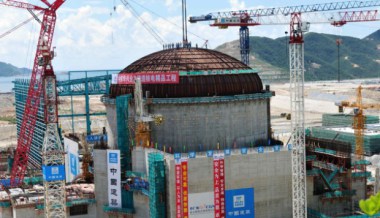
China’s nuclear safety queried over Taishan reactor, but it wants to lead world by 2050 SCMP, Stephen Chen in Beijing, 21 June 21
- Road map drawn up by the country’s nuclear experts sets series of goals to help it catch up with the West on safety
- Increase in radioactivity in Taishan did not spread outside reactor, data showed, but Chinese nuclear industry trails in software and hardware
China aims to become a dominant player in the world nuclear market in less than 30 years and have the highest safety standards and lowest costs, a government advisory body has said.
For decades, China tried to catch up with safety standards in Western countries, led by the United States and France. But now China plans to challenge them, the Chinese Academy of Engineering (CAE) said in a report published last Tuesday…….
by 2050, the road map describes China leading the setting of new industry standards for global nuclear power and taking “a bigger share in the international market”.
The increase in radioactivity in Taishan was caused by leaking fuel rods known as “leakers”
They are still used by many nuclear power plants globally, but the US had by 2013 eradicated them from more than 90 per cent of its reactors, …….
The Taishan radioactivity was viewed in some quarters as an environmental threat that the Chinese government had tried to cover up.
China’s National Nuclear Safety Administration had posted the event on its website on April 7, but the scientists who produced the road map admitted that the country’s nuclear safety was not yet up to the standards in the West, even if its nuclear reactors had no safety incidents in the past three decades.
Safety improvements require cutting-edge technology such as computer programs simulating the operation of a reactor, and materials to make critical components. The Chinese nuclear industry is behind in both software and hardware, according to the report.
Chinese nuclear power companies have produced numerous software products for nuclear plant design, operation and safety evaluation, but did so in isolation, and their reliability and modelling of serious accidents had room for improvement, said senior nuclear safety scientist Huang Hongwen in the report commissioned by the CAE.
China has also been dependent on Western suppliers of some hardware components critical to safe operation of nuclear plants, according to the report.
“Some of our high-precision nuclear safety equipment is still in the hands of others,” Huang wrote.
The US government imposed a sanction – which remains in place – on the Chinese nuclear power industry in 2019, banning the sale of any nuclear-related technology or goods to China except in the event of an immediate environmental threat such as radioactive leakage. The US government said it was investigating the Taishan event………….
Wang Junhao, president of Zhejiang University of Finance and Economics, wrote in the journal Economic Theory and Business Management in April that the penalties for safety lapses were too light to act as a deterrent.
“When a hidden safety hazard was discovered by regulatory inspections, the financial loss was too small,” Wang said. “There must be greater punishments.” https://www.scmp.com/news/china/science/article/3138214/chinas-nuclear-safety-queried-over-taishan-reactor-it-wants-lead
1 This Month



26 September – International Day for the Total Elimination of Nuclear Weapons


PLEASE OPPOSE HR 8255 AND S.3639 – bills would accelerate satellite deployment, with no environmental review or safeguards – https://ncstd5li.quorum.us/campaign/169331/
To see nuclear-related stories in greater depth and intensity – go to https://nuclearinformation.wordpress.com
-
Archives
- September 2026 (245)
- August 2026 (330)
- July 2026 (355)
- June 2026 (287)
- May 2026 (306)
- April 2026 (356)
- March 2026 (251)
- February 2026 (267)
- January 2026 (308)
- December 2025 (358)
- November 2025 (359)
- October 2025 (375)
-
Categories
- 1
- 1 NUCLEAR ISSUES
- business and costs
- climate change
- culture and arts
- ENERGY
- environment
- health
- history
- indigenous issues
- Legal
- marketing of nuclear
- media
- opposition to nuclear
- PERSONAL STORIES
- politics
- politics international
- Religion and ethics
- safety
- secrets,lies and civil liberties
- spinbuster
- technology
- Uranium
- wastes
- weapons and war
- Women
- 2 WORLD
- ACTION
- AFRICA
- Atrocities
- AUSTRALIA
- Christina's notes
- Christina's themes
- culture and arts
- Events
- Fuk 2022
- Fuk 2023
- Fukushima 2017
- Fukushima 2018
- fukushima 2019
- Fukushima 2020
- Fukushima 2021
- general
- global warming
- Humour (God we need it)
- Nuclear
- RARE EARTHS
- Reference
- resources – print
- Resources -audiovicual
- Weekly Newsletter
- World
- World Nuclear
- YouTube
-
RSS
Entries RSS
Comments RSS
 nuclear-news