China demands answers on US nuclear submarine accident in South China Sea
China demands answers on US nuclear submarine accident in South China Sea, SCMP, Minnie Chan, 8 Oct 21,
Chinese foreign ministry blames freedom of navigation operations as it seeks details on the where and how of collision and the likely nuclear risks. Complex underwater terrain and ongoing nuclear submarine arms race increase risk of accidents in the region, analyst warns
China has demanded further explanation from the United States over a collision involving a US Navy nuclear submarine in the South China Sea last week, slamming the lack of information as “irresponsible” and expressing serious concerns about any “nuclear leak”.
“The United States should clarify more details of the occurrence, including the specific location, the intention of its navigation, what kind of object the sub had struck, whether it caused a nuclear leak that would contaminate marine environment,” Chinese foreign ministry spokesman Zhao Lijian said on Friday.
“It’s irresponsible and displays a lack of transparency on the part of the US to deliberately delay and conceal the details of the accident.”
- ……… The incident with the Connecticut comes just weeks after Australia, the UK and the US announced a new security arrangement. The so-called AUKUS pact also created a rift with France, which saw a US$66 billion deal to provide Australia conventional submarines voided in favour of a deal for American-made nuclear-powered ships.
- ……………. A witness on Thursday told an inquest in London into the mysterious sinking of a French trawler that rescuers saw a submarine in the area of the type used by the Dutch navy……………….
Japanese Prime Minister Fumio Kishida praises Treaty on the Prohibition of Nuclear Weapons
ICAN 9 Oct 21, After receiving a letter from Hiroshima survivor and long-time ICAN activist Setsuko Thurlow and ICAN, the new Japanese Prime Minister Fumio Kishida said “I believe that the Treaty on the Prohibition of Nuclear Weapons is a very important treaty for a world without nuclear weapons.” This is definitely a good sign from a nuclear allied country that previously has dismissed our treaty.
Setsuko had already met with Mr Kishida in 2018, together with ICAN partner Peace Boat, to discuss Japan’s nuclear disarmament policy and we will use the opportunity of this new Prime Minister to strengthen our work to get Japan join the treaty.
Taiwan not to get nuclear submarines, calls on Australia for help against China

Taiwanese Foreign Minister warns his country is preparing for war with China, asks Australia for help, ABC, by defence correspondent Andrew Greene and Stan Grant 4 Oct 21, Taiwan’s Foreign Minister warns his nation is preparing for war with China and urges Australia to increase intelligence sharing and security cooperation as Beijing intensifies a campaign of military intimidation.
Key points:
- Taiwan’s Foreign Minister Joseph Wu warns of looming war with China and urges closer cooperation with Australia
- Dozens of Chinese military aircraft have flown into Taiwanese airspace in recent days
- Mr Wu has also thanked Australia for supporting Taiwan’s bid to join a new trade pact
Dozens of aircraft from the People’s Liberation Army (PLA) have flown sorties into Taiwan’s Air Defence Identification Zone (ADIZ) since Friday, prompting the self-ruled island to scramble its own military jets.
Speaking to the ABC’s China Tonight program, Taiwan’s Foreign Minister Joseph Wu declared that if the PLA were to launch an actual strike, his democratic state would be ready to repel it……………
Australia does not formally recognise Taiwan diplomatically, but the federal government regularly calls for a “peaceful resolution” of differences between China and the small independent nation through dialogue and without the threat or use of force or coercion.
A communique issued after last month’s AUSMIN meetings between Australia and the United States declared that “both sides stated their intent to strengthen ties with Taiwan, which is a leading democracy and a critical partner for both countries”.
Taiwan endorses new AUKUS pact, won’t seek its own nuclear submarines
Taiwan has also welcomed the recent establishment of the AUKUS strategic partnership between Australia, the United Kingdom, and the United States, as well as the growing activity between the Quad allies, the US, India, Australia and Japan.
……………….The Taiwanese Foreign Minister said that unlike Australia, his nation would not be trying to acquire nuclear-powered submarines, because it has a “different war strategy”.
Defence analyst Professor Clinton Fernandes from the University of New South Wales warns it would be difficult for the US and allies to prevent any invasion attempt by China……….. https://www.abc.net.au/news/2021-10-04/taiwan-preparing-for-war-with-china/100511294
Why China sent a record number of fighter jets and nuclear-capable bombers into Taiwan’s defence zone
Why China sent a record number of fighter jets and nuclear-capable bombers into Taiwan’s defence zone, ABC, By Max Walden and Joyce Cheng 4 Oct 21, Beijing has sent a record number of fighter jets into Taiwan’s defence zone over its National Day weekend, amid a surge in nationalism on the mainland.
The numbers rose again on Monday with 56 Chinese aircraft entering Taiwan’s air defence identification zone before Taiwan scrambled fighter jets and deployed missile systems to monitor the Chinese planes.
The latest sortie included 34 J-16 fighters and 12 nuclear-capable H-6 bombers, which all flew in an area in the vicinity of the Pratas Islands, according to a map provided by Taiwan’s Defence Ministry.
Later, four more Chinese J-16s flew toward the southwestern part of Taiwan’s air defence zone — a buffer outside a country’s airspace.
The show of force over four consecutive days is part of a longer-term trend described by many as a campaign of intimidation targeting the self-governing island………………
Wen-Ti Sung, an expert on China’s foreign policy from the Australian National University, said Beijing’s show of force was for international and domestic audiences.
He said it could be a response to the new AUKUS pact between Australia, Britain and the United States. “It (the pact) is a big deal that signals Australia’s greater willingness to be engaged with security [issues] in Taiwan Strait and the South China Sea,” Mr Sung said.
It will be increasing deterrence against China, and China does not look upon [that] very favourably.”
Mr Sung added that Taipei’s talks with the US to change the name of Taiwan’s representative office — its de facto embassy in the US — from Taipei Economic and Cultural Representative Office to Taiwan Representative Office was likely to have also irked China.
Taiwan’s diplomatic offices can only be addressed with “Taipei” rather than “Taiwan” as most countries do not recognise the island as a sovereign country.
“It’s natural that China will want to show some muscle at this point to signal to the other actors internationally, for example the US and Australia, that if they make further moves in this direction, then China may risk serious escalated military tension, potentially conflict,” Mr Sung said……………..
What do China and Taiwan want?
The Chinese Communist Party (CCP) has seen the transformation of China into an economic and geopolitical superpower, while also wielding tight control over every aspect of social, cultural and political life on the mainland.
It views Taiwan as part of its territory and wants to reclaim it as part of the People’s Republic of China.
President Xi Jinping pledged reunification of China and Taiwan during a speech to commemorate the 100th anniversary of the CCP in July………………
Taiwan’s government responded by noting China’s economic success under the CCP, but decrying it as a dictatorship that suppressed human rights. The CCP should abandon its aggressive political claims on Taiwan as well as the diplomatic suppression and military threats towards Taiwan,” a statement said at the time…..
While previously a military dictatorship, Taiwan has evolved into one of the Asia Pacific’s few liberal democracies.
For example, it’s the only place in Asia where same-sex marriage is legal…….
The annual Taiwan National Security Survey showed in late 2020 that only 1 per cent of the population supported reunification with the mainland, while 60 per cent opposed adopting Beijing’s “one country, two systems” framework for Hong Kong……….
China’s coercion of Taiwan has become increasingly economic as well as military………
China has begun to impose trade sanctions against Taiwan………. https://www.abc.net.au/news/2021-10-04/china-taiwan-national-day-warplanes-explainer/100511702
Time to find more realistic options than complete, verifiable, and irreversible dismantling of the North Korean nuclear program
Lessons From North Korea: Once You Go Nuclear, You Don’t Go Back, algemeiner, by Alon Levkowitz ,4 Oct 21, The Biden administration has accepted the fact that CVID — the complete, verifiable, and irreversible dismantling of the North Korean nuclear program — will not occur under the Kim Jong-un administration. The time has come to find other realistic options.
In a 2021 survey by the Korea Institute for National Unification on South Korean attitudes toward North Korea, a majority of South Koreans expressed the belief that North Korea will never give up its nuclear weapons. Does this mean the concept of CVID is no longer relevant? Are the South Korean people more realistic than leaders who assert that the North Korean regime will give up its nuclear weapons if it gets sufficient security assurances and economic benefits?
The Singapore Summit of June 12, 2018, between Donald Trump and Kim Jong-un created euphoria on the US side that Kim had made the strategic decision to give up his nuclear weapons in exchange for a lifting of sanctions and subsequent improvement in the North Korean economy.
This euphoria was based on a misunderstanding between Washington and Pyongyang that was revealed a few months later at the Hanoi Summit on February 27-28, 2019. Did President Trump fail to convince Kim to give up North Korea’s nuclear program? Was it realistic to expect him to give up his leverage for economic benefits? One can argue that Kim was never willing to fully dismantle the North Korean nuclear weapon program, but only to give up those parts of the tactical nuclear program that would be required to lift the sanctions without giving up strategic nuclear capabilities……..
The ongoing sanctions on North Korea have not led to any change in Kim’s nuclear and missile policy. Washington needs to understand that as long as Kim Jong-un is in power, the CVID is a declarative policy without any essence, because Kim will not give up the nuclear and missile card. He might be willing to give up some tactical elements to ease the sanctions, but he will never agree to CVID.
Dr. Alon Levkowitz, a research associate at the Begin-Sadat Center for Strategic Studies, is an expert on East Asian security, the Korean Peninsula, and Asian international organizations. https://www.algemeiner.com/2021/10/04/lessons-from-north-korea-once-you-go-nuclear-you-dont-go-back/
China supports North Korea’s call to revise sanctions, return to nuclear talks
China backs North Korean call to revise sanctions to revive nuclear talks SCMP, 2 Oct 21,
Instead of empty slogans, US should restart UN resolutions and ‘revise sanctions related to humanitarian aspects’, Beijing says
Denuclearisation talks stalled in 2019 and Pyongyang has resumed its missile tests
China has backed North Korea’s calls for the US to revise its sanctions to break the stalemate in denuclearisation talks.
Pyongyang resumed its missile tests last month after a six-month lull, the latest being a new hypersonic missile fired on Tuesday. It first fired a
nuclear-capable cruise missile on September 12, then followed up with two railway-borne ballistic missiles days later – in breach of UN Security Council resolutions.
Although the Chinese foreign ministry has continued to urge restraint from all parties in response to Pyongyang, spokeswoman Hua Chunying also called for North Korea’s “justified and reasonable concerns” to be taken seriously and addressed.
“The US should not fall back on empty slogans calling for dialogue, but should demonstrate sincerity and come up with a realistic dialogue proposal, restart the reversible UN resolutions at the Security Council, and revise sanctions that are related to humanitarian aspects,” Hua said on Thursday……………… https://www.scmp.com/news/china/diplomacy/article/3150921/china-backs-north-korean-call-revise-sanctions-revive-nuclear
Japan’s independent English language newsletter, analysing nuclear issues, is struggling to survive
Japan NPO on nuke power issues struggling to retain English newsletter
September 27, 2021 (Mainichi Japan TOKYO (Kyodo) — A citizens’ organization in Japan that publishes independent analysis in English on nuclear power issues is struggling financially, threatening its ability to remain the major source of specialized public information on Japan’s nuclear industry for an international audience.
The Citizens’ Nuclear Information Center based in Tokyo has published the free bimonthly English newsletter Nuke Info Tokyo since 1987 but is having to crowdfund to keep publishing amid financial difficulties caused by the coronavirus pandemic.
The nonprofit organization, which also produces a monthly newsletter in Japanese for a domestic audience, had previously financed the cost of the English publication by holding paid seminars at which it also solicited donations and sold books, as well as collecting membership fees.
But it has been unable to hold the events since early 2020 when coronavirus infections began to impact Japan, Hajime Matsukubo, CNIC secretary general, told Kyodo News.
Membership — already in decline — has also dropped further amid the pandemic and its effect on the economy, he said.
“Membership decreased by about 100 last year alone under the coronavirus outbreaks and (membership) is around 2,100 now,” Matsukubo said, admitting the decline in membership also owed to a waning of public interest in nuclear issues in recent years.
…………. Philip White, a former editor of Nuke Info Tokyo, wrote that he fielded calls around the clock from the foreign media by referring to the archived English-language articles at the time of the disaster.
“The international media was hungry for critical information to counter the sanitized version offered by the government and the nuclear industry. Our English website offered clearly referenced Nuke Info Tokyo articles,” he wrote……………
Matsukubo argues that the government and electric power companies operating nuclear plants tend to withhold information, not just when accidents occur but also in normal times.
Although the government has said the Fukushima plant is under control, it is uncertain how many more years it will take to deal with over a million tons of treated radioactive water from the plant and decommission damaged reactors.
The government continues to deem nuclear power a major energy source, although, since 2014, it has said it aims to decrease its reliance on such power.
Running the English newsletter, staffed by Stronell, four freelance translators, and an editor who is also co-director of the group, costs around 1.5 million yen ($13,700) per year. While the translators used to work voluntarily, CNIC started to pay them in 2009 — though they receive half or less than the market rate.
At this time, the newsletter, which had been printed and mailed to readers with a postage fee charged only to readers in Japan, was made available for free online. Several hundred readers regularly refer to the newsletter, among them journalists, NGO staff, and academics.
Another co-director of CNIC, Hideyuki Ban, said that researchers worldwide have quoted Nuke Info Tokyo in their work.
“Nuke Info Tokyo is the only newsletter in English that specializes in the situation of nuclear power in Japan and has covered a wide range of issues from citizens’ standpoints for decades,” Ban said.
CNIC was founded in 1975 by scientists, including the late Jinzaburo Takagi, a nuclear chemist who began his career in the nuclear industry but later voiced concerns about atomic power……..
To coincide with the policy discussion, CNIC held a virtual seminar on Friday to draw attention to the issues and help people make up their minds on the right policy for Japan.
Stronell said she hopes to run an article on the seminar given by experts in the newsletter.
“I think the most important thing is having independent experts’ information on nuclear power accidents like Fukushima and other problems to let people make decisions about their own health and future,” Stronell said. “And so for us to continue to do this, and that’s what the crowdfunding project is about, any support is very much appreciated.” https://mainichi.jp/english/articles/20210927/p2g/00m/0na/078000c
AUKUS and confronting China throws fuel on the fire of Indo-Pacific tensions. An accelerating arms race will follow.

Australia commits fully to China containment
Canberra is now a fully paid-up member of a China containment front, whether it wants to admit it, or not. In the process, it has yielded sovereignty to the US by committing itself to an interlocking web of military procurement decisions that includes the acquisition of a nuclear-propelled submarine fleet.
New drives to counter China come with a major risk: throwing fuel on the Indo-Pacific arms race SMH, Tony Walker Tony Walker is a Friend of The Conversation.Vice-chancellor’s fellow, La Trobe University September 27, 2021 An accelerating arms race in the Indo-Pacific is all but guaranteed now that China finds itself a target of new security arrangements — AUKUS and the Quad — aimed at containing its power and influence.
This has the makings of a new great game in the region in which rival powers are no longer in the business of pretending things can continue as they are.
The AUKUS agreement, involving Australia, the US and UK to counter China’s rise means a military power balance in the Indo-Pacific will come more sharply into focus.
The region has been re-arming at rates faster than other parts of the world due largely to China’s push to modernise its defence capabilities.
In their latest surveys, the London-based International Institute of Strategic Studies (IISS) and the Stockholm International Peace Research Institute (SIPRI) report no let-up in military spending in the Indo-Pacific. This is despite the pandemic.
SIPRI notes a 47% increase in defence spending in the Indo-Pacific in the past decade, led by China and India.
China can be expected to respond to threats posed by the new security arrangements by further expediting its military program.
It will see the formation of AUKUS as yet another attempt to contain its ambitions — and therefore a challenge to its military capabilities.
The Quad makes clear its ambitions
Unambiguously, AUKUS implies a containment policy.
Likewise, the further elevation of the Quad security grouping into a China containment front will play into an atmosphere of heightened security anxiety in the Indo-Pacific.
The four Quad participants – the US, Japan, India and Australia – have their own reasons and agendas for wanting to push back against China.
After their summit last week in Washington, the Quad leaders used words in their joint statement that might be regarded as unexceptional in isolation.
Together with other developments such as AUKUS, however, the language was pointed, to say the least:
Together, we re-commit to promoting the free, open, rules-based order, rooted in international law and undaunted by coercion, to bolster security in the Indo-Pacific and beyond.
The “beyond” part of the statement was not expanded on, but might be read as a commitment to extend the Quad collaboration globally.
All this has come together at the dawn of a new US administration whose members include several conspicuous China hawks, and at a moment when China has shown itself to be ever-willing to throw its weight around.
Beijing’s crude campaign against Australian exports in an effort to bend Australia’s policy to its will is a prime example. It is doubtful an AUKUS or an invigorated Quad would have emerged without this development.
The Obama administration talked about pivoting to the Asia-Pacific without putting much meat on the bones.
Under President Joe Biden, this shift will be driven by a hardening in American thinking that now recognises time is running out, and may already have expired, in the US ability to constrain China’s rise.
These are profound geopolitical moments whose trajectory is impossible to predict.
Australia commits fully to China containment
Canberra is now a fully paid-up member of a China containment front, whether it wants to admit it, or not. In the process, it has yielded sovereignty to the US by committing itself to an interlocking web of military procurement decisions that includes the acquisition of a nuclear-propelled submarine fleet.
Whether these submarines are supplied by the US or Britain is a bit immaterial since the technology involved originates in America.
The submarines will not be available for the better part of two decades under the most optimistic forecasts. However, in the meantime, Australia could base US or British submarines in its ports or lease American submarines.
Meanwhile, Australia is committing itself to a range of US-supplied hardware aimed at enhancing the inter-operability of its military with the US.
This is the reality of fateful decisions taken by the Morrison government in recent months. Such a commitment involves a certain level of confidence in America remaining a predictable and steadfast superpower, and not one riven by internal disputes.
Australian defence spending likely to rise. What is absolutely certain in all of this is that an Indo-Pacific security environment will now become more, not less, contentious. …………………………………
What other Indo-Pacific nations are doing
Many other Indo-Pacific states can now be expected to review their military acquisition programs with the likelihood of a more combative security environment.
Taiwan, for example, is proposing to spend $US8.69 billion (A$11.9 billion) over the next five years on long-range missiles, and increase its inventory of cruise missiles. It is also adding to its arsenal of heavy artillery.
South Korea is actively adding to its missile capabilities. This includes the testing of a submarine-launched ballistic missile.
Seoul has also hinted it might be considering building its own nuclear-propelled submarines (this was among President Moon Jae-in’s election pledges in 2017). Signs that North Korea may have developed a submarine capable of firing ballistic missiles will be concentrating minds in Seoul.
All this indicates how quickly the strategic environment in the Indo-Pacific is shifting.
Australia — perhaps more so than others — is the prime example of a regional player that has put aside a conventional view of a region in flux. It now sees an environment so threatening that a policy of strategic ambiguity between its custodial partner (the US) and most important trade relationship (China) has been abandoned.
The price tag for this in terms of equipment and likely continuing economic fallout for Australian exporters will not come cheap. https://theconversation.com/new-drives-to-counter-china-come-with-a-major-risk-throwing-fuel-on-the-indo-pacific-arms-race-168734
Why America is ecstatic about Morrison’s AUKUS pact
Why Washington was so ecstatic about Morrison’s AUKUS pact, SMH, 28 Sept 21,
Political and international editor ”………….. For many years, a critical element of American war planning has been to defeat China’s navy by bottling it up in the shallow waters of the South China Sea.
It would do this by blocking choke-points that allow passage in and out. And submarines are the most effective tool for achieving this.
If much of China’s navy is contained in those coastal waters, it’s relatively easy for the US to find and destroy. China’s submarines are at their most vulnerable in the shallow littorals nearest their homeland. It’s easier to shoot fish in a barrel than in a pond.
“US forces and their allies will stand a far greater chance of finding Chinese submarines, hemmed into the South China Sea, than China will of finding America’s in the vast Pacific,” as Rory Medcalf of the ANU’s National Security College puts it.
This helps explain why Beijing has put such effort into asserting control of the South China Sea and, just to its north, the East China Sea. In the event of a crisis, China’s priority is to scramble its submarines well beyond the first island chain into the deep waters of the Pacific where they can operate freely, concealed and lethal.
……………In the event of all-out war, the US wants Tokyo’s 22 subs and Canberra’s six to complement the US fleet of 68. Japan’s have been pencilled in to operate in the north and Australia’s in the south.
This is where AUKUS come in. It includes in-principle agreement from Washington and London to supply Australia with nuclear propulsion technology for a new fleet of eight submarines instead of the planned 12 diesel-electric subs, now ditched.
Why was this greeted rapturously in Washington? “The long-term prospect of eight nuclear-powered RAN subs prowling the Pacific resets the naval balance of power,” says Mike Green of the Centre for Strategic and International Studies in Washington.
…….. Australian officials say it will take almost 20 years to actually get the first Australian-built, nuclear propelled sub into the water. ……. The Australian Strategic Policy Institute’s subs expert, Marcus Hellyer says that the only plausible way that Australia could put a nuclear-powered sub in the water in time to be relevant to the looming US-China contest would be if America handed over some of its ageing Los Angeles class subs. The Pentagon is currently pensioning them off. They’d need to be refurbished. But that’d still be a lot faster, taking years rather than the decades of waiting for the first Australian-made one…..
And AUKUS is about much more than subs. “It’s about areas like cyber and emerging technologies…….https://www.smh.com.au/national/why-washington-was-so-ecstatic-about-morrison-s-aukus-pact-20210927-p58v3c.html
AUKUS deal leaves France out of South East Asian security arrangement.

Australian Prime Minister Scott Morrison on Wednesday said the three nations had agreed to “a new enhanced trilateral security partnership”.
The subtext of France and Australia’s submarine deal, Aljazeera, 27 Sep 21,
What do a new security pact and a cancelled military contract say about France’s place in the world? It was supposed to be an announcement of a pact, not the start of a foreign relations crisis between allies. But as Australia announced a new security partnership with the United Kingdom and the United States, dubbed AUKUS, it also cancelled a multibillion-dollar contract to buy submarines from France. So how did an abandoned deal for a dozen submarines turn in to the diplomatic version of a lover’s quarrel?Australia’s decision to cancel a multibillion-dollar order for French submarines in favour of American and British technology has sparked a diplomatic row of unprecedented proportions between longtime Western allies.
The French foreign ministry recalled its ambassadors to the United States and Australia citing “duplicity, disdain and lies”.
China’s Xi warns of ‘interference’ as Australia brushes off angerHundreds arrested in Australian anti-lockdown protestsFrance accuses Australia, US of ‘lying’ over submarine deal
Alongside the economic damage for tens of billions of euros, France said it resents the way Australia and its partners have handled the matter. French Foreign Minister Jean-Yves Le Drian, said, “There has been contempt so it’s not going well between us, not at all.”
President Emmanuel Macron will have a call with his US counterpart, Joe Biden, in the next few days, the French government said on Sunday.
Australia’s strategic alignment
Australia announced on Wednesday it would ditch a contract worth more than 50 billion euros ($59bn) to acquire 12 French-made diesel-electric submarines.
Instead, it will commission at least eight US nuclear-powered submarines in the framework of a new alliance – known by its acronym AUKUS – which will see Australia, the US, and the United Kingdom share advanced technologies with one another.
Australian Prime Minister Scott Morrison on Wednesday said the three nations had agreed to “a new enhanced trilateral security partnership”.
Nuclear submarine for Japan? Kono says yes, Kishida says no
Poll leader believes capability is ‘extremely important’ for country

September 26, 2021
TOKYO — Following a recent deal by the U.S. and the U.K. to offer Australia classified technology to build nuclear-powered submarines, should fellow Quad member Japan also seek such a capability? The four candidates running for the Liberal Democratic Party presidential race to succeed Prime Minister Yoshihide Suga were asked the question Sunday on Fuji TV.
Poll leader Taro Kono, minister for administrative reform and also in charge of vaccine distribution, gave a thumbs-up. “As a capability, it is very important for Japan to have nuclear submarines,” he said.
“Whether there are regions [in Japan] willing to host them as a home port, or whether the operating capabilities or costs are pragmatic, these are issues we need to consider going forward,” he added.
Sanae Takaichi, the former internal affairs minister, also looked favorably upon the idea. “If we think of the worst-case risks in the international environment ahead, I do believe we could have [submarines] that can travel a little longer,” she said, referring to the advantage of nuclear propulsion in that they can stay submerged longer without refueling.
Japan’s Atomic Energy Basic Law stipulates that the use of nuclear power will be limited to peaceful purposes. Takaichi said there was “a need to sort things out” but added she did not believe nuclear-powered submarines to be unconstitutional.
Former LDP policy chief Fumio Kishida, meanwhile, was less receptive to the idea. “When I think about Japan’s national security arrangements, to what extent do we need it?” he asked.
Nuclear-powered submarines are faster and can travel longer compared to the diesel-electric submarines that Japan currently has. But Kishida was alluding to the fact that the Self-Defense Forces’ operations are primarily in areas close to Japan.
“To maintain stealth, it will require long hours of work,” he said. “We have to prioritize improving working conditions [of sailors] and secure the personnel.”
Japan’s Maritime Self-Defense Force has struggled to hire sailors in a country whose population is declining. Submarines are especially unpopular among young recruits, partly because they are unable to use their smartphones for extended periods.
Seiko Noda, the LDP’s executive acting secretary-general, said: “I have no intention to hold such a capability. I want to make clear that we are a nation with three non-nuclear principles,” she said, pointing to Japan’s long-held position of neither possessing nor manufacturing nuclear weapons, nor permitting their introduction into Japanese territory.
“This is not a situation where we can immediately buy and start to use the submarines,” she said. “We must properly establish a national consensus.”
On Sept. 16, the U.S., the U.K. and Australia announced an enhanced trilateral security partnership called AUKUS, that will see Washington and London share sensitive nuclear-propulsion technology with Canberra to develop a fleet of nuclear-powered submarines. It is a move to bolster deterrence against China’s growing maritime power.
https://asia.nikkei.com/Politics/Nuclear-submarine-for-Japan-Kono-says-yes-Kishida-says-no
Japan’s election campaign – Liberal Democratic Party candidates’ differing views on nuclear recycling.
Three of the four candidates vying to lead the Liberal Democratic Party
called Sunday for Japan to maintain its nuclear fuel recycling program as
they geared up for the last few days of campaigning prior to Wednesday’s
vote. During a Fuji TV program, vaccination minister Taro Kono, the only
contender who has pushed for phasing out nuclear power generation, went
against his leadership rivals and said Japan should pivot away from fuel
recycling “as soon as possible.”
Japan Times 26th Sept 2021
https://www.japantimes.co.jp/news/2021/09/26/national/ldp-hopefuls-nuclear-fuel/
Will Fukushima’s Water Dump Set a Risky Precedent?
Will Fukushima’s Water Dump Set a Risky Precedent? IEEE Spectrum
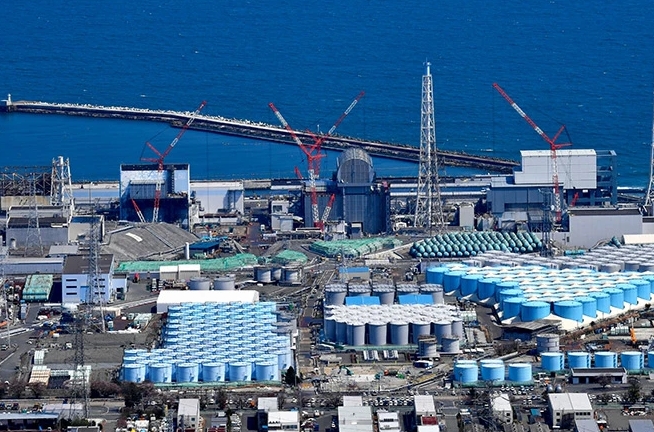
Questions raised over new norms the disaster’s radioactive wastewater cleanup efforts may foster, RAHUL RAO 24 SEP 2021 Since the Japanese earthquake and tsunami in March 2011, groundwater has been trickling through the damaged facilities at the Fukushima Daiichi nuclear power plant, filtering through the melted cores and fuel rods and becoming irradiated with a whole medley of radioisotopes. Japanese authorities have been pumping that water into a vast array of tanks on-site: currently over a thousand tanks, and adding around one new tank per week.
Now, Japanese authorities are preparing to release that water into the Pacific Ocean. Even though they’re treating and diluting the water first, the plan is meeting with vocal protests. From that opposition and from scientists’ critiques of the process, the ongoing events at Fukushima leave an unprecedented example that other nuclear power facilities can watch and learn from.
The release is slated to start in 2023, and potentially last for decades. This month, observers from the International Atomic Energy Agency have arrived in the country to inspect the process. And efforts are also underway to build an undersea tunnel that will discharge the water a kilometer away from the shore.
Before they do that, they’ll treat the water to cleanse it of radioactive contaminants. According to the authorities’ account of the situation, there’s one major contaminant that their system cannot cleanse: tritium.
It’s actually normal for nuclear power plants to release tritium into the air and water in their normal operations. In fact, pre-disaster, Fukushima Daiichi held boiling-water reactors, the lowest-tritium type of nuclear reactors. The Japanese government’s solution is to dilute the tritium-contaminated water down to comparable levels. That’s part of the reason the discharge will likely last several decades.
“While one can argue whether such release limits are appropriate in general for normally operating facilities, the planned release, if carried out correctly, does not appear to be outside of the norm,” says Edwin Lyman, director of nuclear power safety at the Union of Concerned Scientists.
Even so, the plan has—perhaps expectedly—encountered some rather vocal opposition. Some of the loudest cries have come from within Japan, particularly from the fishing industry. Radiation levels in seafood from that coast are well within safety limits, but fishing cooperatives are concerned the plan is (once again) putting their reputations at stake………….
can the events at Fukushima offer other energy facilities around the world any lessons at all?
For one, they’re a good show of the need for emergency planning. “Every nuclear plant should be required to analyze the potential for such long-term consequences,” says Lyman. “New nuclear plants, if built, should incorporate such evaluations into their siting decisions.”
But there’s other things experts say that facilities could learn. For example, something that hasn’t always been present in the Fukushima matter—working against it—has been transparency.
Authorities at the plant haven’t fully addressed the matter of non-tritium contaminants, according to Ken Buesseler, a marine radiochemist at Woods Hole Oceanographic Institution who has studied radioactivity in the ocean off Fukushima. Some contaminants—like caesium-137 and strontium-90—were present in the initial disaster in 2011. Others—like cobalt-60 and cerium-144—entered the water later.
It isn’t something the authorities have completely ignored. “Japan plans to run the water again through the decontamination process before release, and the dilution will further reduce the concentrations of the remaining isotopes,” says Lyman.
But Buesseler isn’t convinced that it will be enough. “Theoretically, it’s possible to improve the situation a lot,” he says. “In practice, they haven’t done that.” Japanese authorities insist they can do so, but their ability, he says, hasn’t been independently verified and peer-reviewed……….
“I’d hate to see every country that has radioactive waste start dumping waste into the ocean,” he says. “It’s a transboundary issue, in a way. It’s something bigger than Japan, and something different from regular operation. I think they need to be at least open about that, getting international approval.”
Here, Lyman agrees. “This situation is unique and the decision to release the water into the sea should not set a precedent for any other project.”
But even taking all of that into account, some believe that, if anything, this is an example of a time when there simply is no choice but to take drastic action.
“I believe that this action is necessary to avoid potentially worse consequences,” says Lyman. https://spectrum.ieee.org/fukushima-wastewater-cleanup-questions
Nuclear submarine for Japan? Kono says yes, Kishida says no
Nuclear submarine for Japan? Kono says yes, Kishida says no Nikkei Asia Poll leader believes capability is ‘extremely important’ for country. YUSUKE TAKEUCHI, Nikkei staff writer, September 26, 2021
TOKYO — Following a recent deal by the U.S. and the U.K. to offer Australia classified technology to build nuclear-powered submarines, should fellow Quad member Japan also seek such a capability? The four candidates running for the Liberal Democratic Party presidential race to succeed Prime Minister Yoshihide Suga were asked the question Sunday on Fuji TV.
Poll leader Taro Kono, minister for administrative reform and also in charge of vaccine distribution, gave a thumbs-up. “As a capability, it is very important for Japan to have nuclear submarines,” he said……..
Sanae Takaichi, the former internal affairs minister, also looked favorably upon the idea. “If we think of the worst-case risks in the international environment ahead, I do believe we could have [submarines] that can travel a little longer,” she said, referring to the advantage of nuclear propulsion in that they can stay submerged longer without refueling.
Japan’s Atomic Energy Basic Law stipulates that the use of nuclear power will be limited to peaceful purposes. Takaichi said there was “a need to sort things out” but added she did not believe nuclear-powered submarines to be unconstitutional.
Former LDP policy chief Fumio Kishida, meanwhile, was less receptive to the idea. “When I think about Japan’s national security arrangements, to what extent do we need it?” he asked.
Nuclear-powered submarines are faster and can travel longer compared to the diesel-electric submarines that Japan currently has. But Kishida was alluding to the fact that the Self-Defense Forces’ operations are primarily in areas close to Japan.
To maintain stealth, it will require long hours of work,” he said. “We have to prioritize improving working conditions [of sailors] and secure the personnel.”…….
Seiko Noda, the LDP’s executive acting secretary-general, said: “I have no intention to hold such a capability. I want to make clear that we are a nation with three non-nuclear principles,” she said, pointing to Japan’s long-held position of neither possessing nor manufacturing nuclear weapons, nor permitting their introduction into Japanese territory.
“This is not a situation where we can immediately buy and start to use the submarines,” she said. “We must properly establish a national consensus.” ……. https://asia.nikkei.com/Politics/Nuclear-submarine-for-Japan-Kono-says-yes-Kishida-says-no
LDP candidates debate on nuke power must be based on realities
September 24, 2021
Japan’s nuclear power policy has emerged as one of the main issues for the ruling Liberal Democratic Party’s leadership race.
The four candidates for the party presidential election on Sept. 29 should face up to the lessons from the disaster that unfolded at Tokyo Electric Power Co.’s Fukushima No. 1 nuclear power plant a decade ago and offer specific policy proposals for ensuring in-depth debate on key questions.
Taro Kono, the minister of administrative reform who also served as foreign and defense minister in the past, is the only one among the contenders who has clearly argued for phasing out nuclear power generation.
Kono has stated that Japan should pull the plug on its nuclear fuel recycling program “as soon as possible” while promising to allow offline reactors to be restarted when they are officially endorsed as safe, for the time being.
The other three politicians seeking to succeed outgoing Prime Minister Yoshihide Suga have committed themselves to maintaining the current policy of keeping nuclear reactors running. During a recent debate, they voiced skepticism about Kono’s vow to end the fuel recycling program.
Fumio Kishida, a former foreign minister and LDP policy chief, questioned the consistency between Kono’s position on fuel recycling and his policy of allowing reactors to be brought on stream.
Seiko Noda, executive acting secretary-general of the LDP, ruled out any energy policy change that could cause a disruption in the stable supply of power. Sanae Takaichi, a former communications minister, stressed she would promote the development of small reactors and nuclear fusion reactor technology.
The nuclear fuel recycling process involves recovering plutonium from spent nuclear fuel for recycling back into new fuel.
But Japan’s original plan to reprocess spent nuclear fuel to obtain start-up plutonium for a new generation of plutonium “fast breeder” reactors fell through when its Monju prototype fast breeder reactor, which was supposed to be the core technology for the program, was shut down after a sodium leak and fire.
The government then shifted to a strategy of converting spent plutonium, formed in nuclear reactors as a by-product of burning uranium fuel, and uranium into a “mixed oxide” (MOX) that can be reused in existing reactors to produce more electricity.
But this approach has also hit a snag as the number of operating reactors has declined sharply since the Fukushima meltdowns.
Asahi Shimbun editorials have argued that the government should concede that the fuel recycling program is no longer viable and declare an end to it. To be sure, withdrawing from the program would mean spent nuclear fuel must be disposed of as waste. But Japan would only make the world uneasy if it keeps a massive stockpile of weapons-usable plutonium without any plan to use it.
Arguments concerning nuclear policy issues in general, not just fuel recycling, tend to overlook reality. The most important fact about the catastrophic accident at the Fukushima plant is that it caused tremendous damage to society.
Not much is known about the current conditions of the reactors whose cores melted down during the accident. There is no predicting when and how the process of decommissioning the plant will come to an end.
The LDP presidential candidates are divided over whether to build new nuclear plants or expand current ones. But it is obvious that winning the support of the public in general and the local communities involved for such plans would be next to impossible.
It is also unclear when the small reactor and the nuclear fusion reactor that are under development will enter commercial use.
A new estimate by the industry ministry on the future costs of power generation published in August predicts that solar power will eclipse nuclear energy in terms of costs as of 2030. It is hardly surprising that the government’s draft new Basic Energy Plan, unveiled in July, says promoting renewable energy sources should be the top energy policy priority.
Since the Fukushima disaster, the government has been seeking to restart offline reactors one by one while leaving the decisions up to the Nuclear Regulation Authority. But the government should not shy away from a sweeping review of its broken nuclear energy policy.
There are many sticky questions the LDP presidential hopefuls need to address. How would they try to change the country’s current energy mix in what ways and in what kind of time frames while maintaining a steady power supply? What would they do with the growing amount of spent nuclear fuel?
The LDP election requires them to clarify their approaches to tackling these tough challenges.
1 This Month
Chernobyl: The Lost Tapes – A good documentary on Chernobyl on SBS available On Demand for the next 3 weeks– https://www.sbs.com.au/ondemand/tv-program/chernobyl-the-lost-tapes/2352741955560

of the week–London Campaign for Nuclear Disarmament

Tell the Ukrainian Government to Drop Prosecution of Peace Activist Yurii Sheliazhenko
To see nuclear-related stories in greater depth and intensity – go to https://nuclearinformation.wordpress.com
-
Archives
- April 2026 (126)
- March 2026 (251)
- February 2026 (268)
- January 2026 (308)
- December 2025 (358)
- November 2025 (359)
- October 2025 (376)
- September 2025 (257)
- August 2025 (319)
- July 2025 (230)
- June 2025 (348)
- May 2025 (261)
-
Categories
- 1
- 1 NUCLEAR ISSUES
- business and costs
- climate change
- culture and arts
- ENERGY
- environment
- health
- history
- indigenous issues
- Legal
- marketing of nuclear
- media
- opposition to nuclear
- PERSONAL STORIES
- politics
- politics international
- Religion and ethics
- safety
- secrets,lies and civil liberties
- spinbuster
- technology
- Uranium
- wastes
- weapons and war
- Women
- 2 WORLD
- ACTION
- AFRICA
- Atrocities
- AUSTRALIA
- Christina's notes
- Christina's themes
- culture and arts
- Events
- Fuk 2022
- Fuk 2023
- Fukushima 2017
- Fukushima 2018
- fukushima 2019
- Fukushima 2020
- Fukushima 2021
- general
- global warming
- Humour (God we need it)
- Nuclear
- RARE EARTHS
- Reference
- resources – print
- Resources -audiovicual
- Weekly Newsletter
- World
- World Nuclear
- YouTube
-
RSS
Entries RSS
Comments RSS
 nuclear-news